Why Do They Call Evil That Which Is Good?

Chris Mooney says in his article ‘Science Deniers Are Freaking Out About “Cosmos”’

Indeed, the science denial crowd hasn’t been happy with Cosmos in general. Here are some principal lines of attack:

  • Denying the Big Bang
  • Denying evolution
  • Denying climate change

Chris Mooney is a science and political journalist, podcaster, and the host of MJ’s Climate Desk Live. He is the author of four books, including the New York Times bestselling The Republican War on Science. You can read the rest at Bill Moyer’s site and Mother Jones, if you like this sort of thing.

Michael Brendan Dougherty, a more subtle critic, says in his article: ‘In Defense of Creationists – Sure, they’re misreading Genesis. But for all the right reasons.’

My own view is that a literal one-week creation should be ruled out because, combined with the best knowledge we have of science, it would make God into a devil, a trickster. “Haha, mortals, I only buried these dinosaur bones and set the galaxies in explosive motion so the unbelievers would damn themselves to Hell,” doesn’t sound like a great or loving God. It seems to me that the very idea of good, eternal, law-giving God endowing man with rational abilities was the historical prerequisite for scientific exploration.

Michael Brendan Dougherty is senior correspondent at TheWeek.com. He is the founder and editor of The Slurve, a newsletter about baseball. His work has appeared in The New York Times Magazine, ESPN Magazine, Slate and The American Conservative. You can read the rest of this article at The Week.

In the act of creation, God demonstrated overwhelming creative power throughout time and space (and whatever else there might be that we have yet to discover). We reviewed this concept in-depth in our post ‘Every Good Story – Thysdor Ya’Rosel’ and more succinctly in ‘All the world’s a stage…

So far as misreading Genesis, we covered that issue in the recent post ‘Nip ‘Em in the Bud.’

We live in a universe governed by laws which the Law Giver can suspend as it suits His good pleasure. We’ve covered this concept in another recent post ‘Instrumentality.’

For those of us old enough to remember, both the Twilight Zone and Outer Limits television series’ had episodes where that which existed had no reality behind it. How creepy would it be to dig into the ground and find nothing (i.e. no precious metals and gems, petrochemicals, fossils, etc.)?

To this point, the scriptures describe treasures in the sand and deep beneath the ground. As described in Scripture, the world is meant to communicate two major lessons concerning God:

For his invisible attributes, namely, his eternal power and divine nature, have been clearly perceived, ever since the creation of the world, in the things that have been made. Romans 1:20 English Standard Version (ESV)

On the fossils front, death certainly entered creation when the Lord God made garments of skins to clothe Adam and Eve after their fall from grace.  We also read that the creation was subjected to futility by God because of Adam’s sin. So, we can say with confidence that sin had far-reaching consequences for creation!

It’s helpful to see the Scriptures as an accommodation to us by an infinite and unknowable God. In fact, the Lord Jesus Christ is described as the image of the invisible God and declares Himself of one essence with the Father. He appeared to us in human form to identify with us more fully than we sometimes appreciate.

The Lord Jesus Christ taught often through parables:

A parable is a succinct, didactic story, in prose or verse, which illustrates one or more instructive lessons or principles. It differs from a fable in that fables employ animals, plants, inanimate objects, or forces of nature as characters, whereas parables have human characters. A parable is a type of analogy.

When asked, the Lord Jesus Christ explained to His followers why He spoke in parables:

This is why I speak to them in parables, because seeing they do not see, and hearing they do not hear, nor do they understand. Matthew 13:13 (ESV)

He spoke this to remind His followers of Isaiah’s prophecy:

And He said, “Go, and say to this people: “‘Keep on hearing, but do not understand; keep on seeing, but do not perceive.’ Make the heart of this people dull, and their ears heavy, and blind their eyes; lest they see with their eyes, and hear with their ears, and understand with their hearts, and turn and be healed.” Isaiah 6:9-10 (ESV)

Again, reiterating today’s opening statements, isn’t He evil for not revealing all? In the parable about Lazarus and the rich man, concerning warnings about the place of eternal torment:

He said to him, ‘If they do not hear Moses and the Prophets, neither will they be convinced if someone should rise from the dead.’” Luke 16:31 (ESV)

Ultimately, it comes down to believing, or not, the documentary evidence that we have in Scripture. We’ve addressed the authority and basic meaning of Scripture in our posts: ‘Authority of Scripture?’ and ‘Scripture – What Is It Good For?,’ respectively.

So, we stand condemned unless He saves us and, otherwise, we remain dead in our sins and trespasses. God, through the apostle, speaks of His sovereignty in these matters:

But who are you, O man, to answer back to God? Will what is molded say to its molder, “Why have you made me like this?” Romans 9:20 (ESV)

We may take offence to this statement. But, we’ve conveniently forgotten what preceded this passage:

…For all have sinned and fall short of the glory of God, Romans 3:23 (ESV)

The onus for sin lies with us. We’ve examined our responsibility in the post titled: ‘There, But for God’s Grace and Mercy Through His Providence, Go I.’

Why one side insists on winning a war started before the First World War, I understand. Loosely paraphrasing Huxley, they believe what they want because they have an agenda that doesn’t include the One that made them. We’ve covered Aldous Huxley’s admission in our posts ‘Wonder Why?’ and ‘Mean Ends – Luxe Hso-Dualy.’

But I grow tired of their fight as this life winds down. These recurrent attacks endanger the liberty we all claim to cherish. You can keep your slapshots to yourselves. We’ve already addressed this latest controversy in our post: ‘Climate Changiness.’

Now, we’ve discussed how it’s our duty to live peaceful and quiet lives. The Scriptures say we will be persecuted as He was. However, dear folks of the opposition, your war is with Him. And you will inevitably appear before Him, so, please live peacefully while He gives you opportunity to repent.

Politicization of science by the right or the left is futile. Finally, it comes down to what the Lord Jesus Christ said to His critics:

Jesus said to them, “Is this not the reason you are wrong, because you know neither the Scriptures nor the power of God? Mark 12:24 (ESV)

I urge you, turn and be healed.

The Garden of Eden, Thomas Cole

The Garden of Eden, 1828, Thomas Cole (1801–1848), public domain – US

Is He Fair?

I hope God’s not fair, and so should you. The scriptures say: by the works of the law, no one is justified.

For all have sinned and fall short of God’s glory.

But, He has not dealt with us as our sins deserve.

He saves us, not because of righteous works we have done, but according to His mercy.

But, as a result of His work in us, we must show our faith by our works.

God, through His apostles and prophets, is blunt:

Let no one deceive himself. If anyone among you thinks that he is wise in this age, let him become a fool that he may become wise. For the wisdom of this world is folly with God. For it is written, “He catches the wise in their craftiness,” and again, “The Lord knows the thoughts of the wise, that they are futile.” 1 Corinthians 3:18-20 English Standard Version (ESV)

Therefore, repent and trust Him for life.

Last Judgment, Michelangelo Buonarroti

Last Judgment, 1537–41, Michelangelo Buonarroti (1475–1564), public domain in US

Dr. Cosby’s Reading Secrets

Ever since we were able to buy comedy albums, we’ve laughed with Dr. Bill Cosby.

Bill Cosby Far from Finished 2013  about 2 hours 34.5 minutes long (~90 minute show, 50 minute interview, and 10 minute behind the scenes).

Dr. Cosby earned a Doctorate in Education in 1976 from University of Massachusetts Amherst. He wrote the article ‘How to Read Faster’ that taught three methods to speed read with improved comprehension: preview, skim, and cluster, which appeared in the November 1979 issue of Ebony magazine on page 86 and in the March 1980 issue of Ebony magazine on page 72.

Here’s how to preview lengthy material:

  1. Read the first two paragraphs of your reading material.
  2. Next read only the first sentence of each of the following paragraphs.
  3. Then read the last two paragraphs entirely.

You get the gist of the text so you can evaluate it. Then you know whether it’s worth the time to read the material in-depth.

I urge you to use Dr. Cosby’s preview technique when reading anything time-consuming (for instance, the posts on this blog).

Thank you, sir, for speaking out. I think you’ve been speaking out for decades but people weren’t listening very well.

Happy 77th birthday.

Scripture – What Is It Good For?

It’s the only written record that purports to be from life not of this world, or realm for that matter. It’s the only communication we have from someone untainted by wrath, avarice, sloth, pride, lust, envy, and gluttony.

This written record is special, in so far as it is self–referential. What does it say for itself?

Scripture reveals the power of God at work in throughout the ages.

Jesus said to them, “Is this not the reason you are wrong, because you know neither the Scriptures nor the power of God? Mark 12:24 English Standard Version (ESV)

Scripture bears witness of the work of the Lord Jesus Christ, the Author of eternal life.

You search the Scriptures because you think that in them you have eternal life; and it is they that bear witness about me, John 5:39 (ESV)

Scripture testifies to the death, burial, and resurrection of the Lord Jesus Christ witnessed by many then alive.

For I delivered to you as of first importance what I also received: that Christ died for our sins in accordance with the Scriptures, that he was buried, that he was raised on the third day in accordance with the Scriptures, and that he appeared to Cephas, then to the twelve. Then he appeared to more than five hundred brothers at one time, most of whom are still alive, though some have fallen asleep. Then he appeared to James, then to all the apostles. Last of all, as to one untimely born, he appeared also to me. 1 Corinthians 15:3-8 (ESV)

Scripture is the authoritative source and check for all preaching.

Now these Jews were more noble than those in Thessalonica; they received the word with all eagerness, examining the Scriptures daily to see if these things were so. Acts 17:11 (ESV)

Scripture was written for our instruction and encouragement leading to hope.

For whatever was written in former days was written for our instruction, that through endurance and through the encouragement of the Scriptures we might have hope. Romans 15:4 (ESV)

Scripture reveals truths once hidden from men and into which angels long to look.

Concerning this salvation, the prophets who prophesied about the grace that was to be yours searched and inquired carefully, inquiring what person or time the Spirit of Christ in them was indicating when he predicted the sufferings of Christ and the subsequent glories. It was revealed to them that they were serving not themselves but you, in the things that have now been announced to you through those who preached the good news to you by the Holy Spirit sent from heaven, things into which angels long to look. 1 Peter 1:10-12 (ESV)

Scripture, though written by men, finds its source and ultimate Author in God and has the full weight of His authority for equipping those following Him.

All Scripture is breathed out by God and profitable for teaching, for reproof, for correction, and for training in righteousness, that the man of God may be complete, equipped for every good work. 2 Timothy 3:16-17 (ESV)

Scripture, the prophetic testimony, comes from God. The Holy Spirit provides the prophets, as His representatives, not only visions but also words used to describe and interpret them.

…Knowing this first of all, that no prophecy of Scripture comes from someone’s own interpretation. For no prophecy was ever produced by the will of man, but men spoke from God as they were carried along by the Holy Spirit. 2 Peter 1:20-21 (ESV)

Scripture is God’s wisdom given through his apostles and prophets for our sakes, some of which is hard to understand. But we are not to be carried away with error. We are to obey that which we understand and grow in grace and knowledge of our Lord Jesus Christ.

…As he does in all his letters when he speaks in them of these matters. There are some things in them that are hard to understand, which the ignorant and unstable twist to their own destruction, as they do the other Scriptures. 2 Peter 3:16 (ESV)

And men recognized the preeminent value of this Word. The Westminster Confession gives a concise statement on its integrity and utility.

Calvin comments on authority of the word in chapter 7 of his Institutes of the Christian Religion.

And, so does the man, Christ Jesus

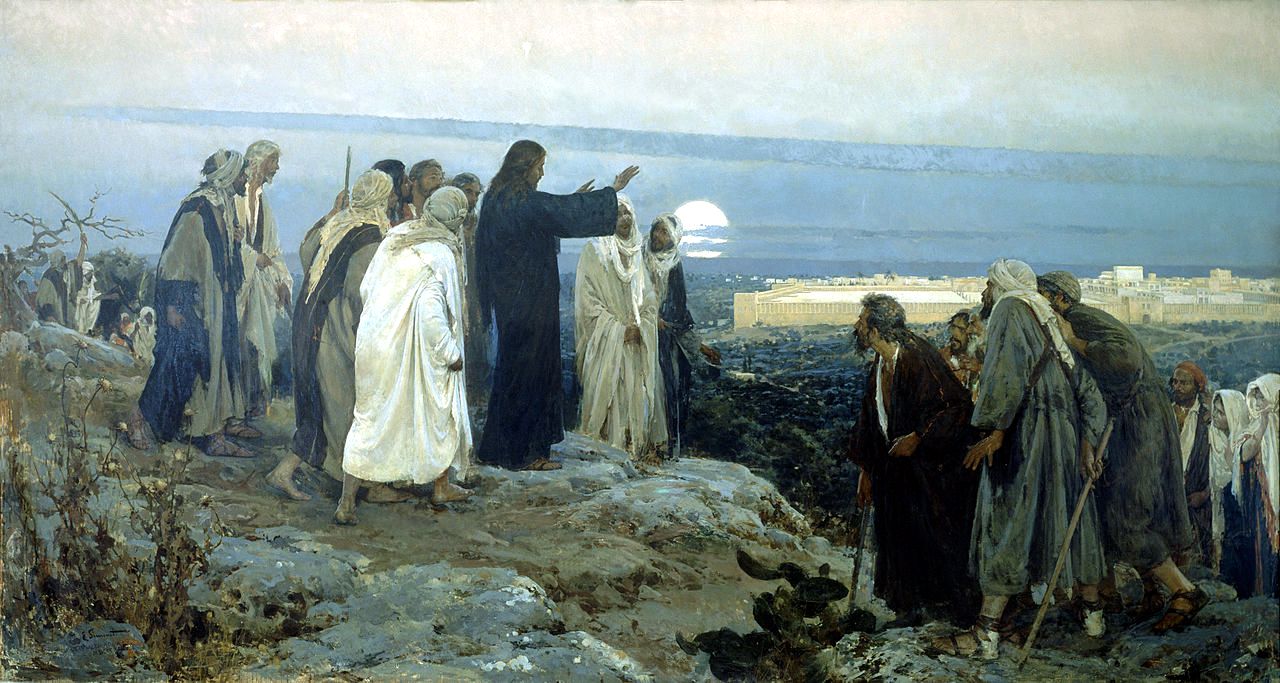
Flevit super illam; He wept over it, 1892, E. Simonet

Flevit super illam (Latin language); He wept over it, 1892, E. Simonet, public domain US

Instrumentality

Instrumentality is not a well appreciated concept.  But it is key to understanding both the nature of the universe and the nature of man. Google’s definition of the word is:

in·stru·men·tal·i·ty

noun

The fact or quality of serving as an instrument or means to an end; agency.

“A corporate body can act only through the instrumentality of human beings”

A thing that serves as an instrument or means to an end.

The principle of instrumentality is essential to understanding our universe. The scriptures record the creation of all things this way:

And God said, “Let there be light,” and there was light. And God saw that the light was good. And God separated the light from the darkness. God called the light Day, and the darkness he called Night. And there was evening and there was morning, the first day. Genesis 1:3-5 English Standard Version (ESV)

And later in the book:

And God said, “Let there be lights in the expanse of the heavens to separate the day from the night. And let them be for signs and for seasons, and for days and years, and let them be lights in the expanse of the heavens to give light upon the earth.” And it was so… And there was evening and there was morning, the fourth day. Genesis 1:14-19 (ESV)

Oops, God must have gotten it wrong. Shouldn’t the sun have been created before the light? Why didn’t He check in with some noted authority first, like Hawking or Tyson. We’ve presented what Tyson believes in our post ‘Neil deGrasse Tyson Mistakes God for Who He Is Not’

Our ready reference, John Calvin, says on the precedence of light over the sun:

Gen. 1:3 …Let there be light…  It was proper that the light, by means of which the world was to be adorned with such excellent beauty, should be first created; and this also was the commencement of the distinction, (among the creatures).  It did not, however, happen from inconsideration or by accident, that the light preceded the sun and the moon.

To nothing are we more prone than to tie down the power of God to those instruments the agency of which he employs. The sun and moon supply us with light: And, according to our notions we so include this power to give light in them, that if they were taken away from the world, it would seem impossible for any light to remain.

Therefore the Lord, by the very order of the creation, bears witness that he holds in his hand the light, which he is able to impart to us without the sun and moon.

We aren’t sure what you think of the scriptures as an authority for wisdom. Many modern-day teachers would have you believe they are unreliable and, in many cases, downright fallacious. We’ve addressed this in ‘Nip ‘Em in the Bud.’

However, the remark that the Lord Jesus Christ made to teachers of His people who were trying to trip Him up on another matter is appropriate for our teachers today:

Jesus said to them, “Is this not the reason you are wrong, because you know neither the Scriptures nor the power of God? Mark 12:24 (ESV)

Martian sunset: Spirit at Gusev crater

Martian sunset: Spirit at Gusev crater, 19 May 2005, NASA’s Mars Exploration Rover, Public Domain

The principle of instrumentality is also essential to understanding humanity. Paul describes himself, and us by generalization, as jars of clay:

For God, who said, “Let light shine out of darkness,” has shone in our hearts to give the light of the knowledge of the glory of God in the face of Jesus Christ.

But we have this treasure in jars of clay, to show that the surpassing power belongs to God and not to us. 2 Corinthians 4:6-7 (ESV)

Calvin says:

2 Corinthians 4:7. But we have this treasure. Those that heard Paul glorying in such a magnificent strain as to the excellence of his ministry, and beheld, on the other hand, his person, contemptible and abject in the eyes of the world, might be apt to think that he was a silly and ridiculous person, and might look upon his boasting as childish, while forming their estimate of him from the meanness of his person…

First of all, he employs the similitude of a treasure, which is not usually laid up in a splendid and elegantly adorned chest, but rather in some vessel that is mean and worthless; and then farther, he subjoins, that the power of God is, by that means, the more illustrated, and is the better seen…

“…Farther, they do not consider, that it is ordered by the special Providence of God, that there should be in ministers no appearance of excellence, lest anything of distinction should throw the power of God into the shade. As, therefore, the abasement of ministers, and the outward contempt of their persons give occasion for glory accruing to God, that man acts a wicked part, who measures the dignity of the gospel by the person of the minister.”

Paul, however, does not speak merely of the universal condition of mankind, but of his own condition in particular. It is true, indeed, that all mortal men are earthen vessels. Hence, let the most eminent of them all be selected, and let him be one that is adorned to admiration with all ornaments of birth, intellect, and fortune, still, if he be a minister of the gospel, he will be a mean and merely earthen depository of an inestimable treasure. Paul, however, has in view himself, and others like himself, his associates, who were held in contempt, because they had nothing of show.

So why is this instrumentality important for understanding the nature of man? For at least two reasons, first, it seems we’ll be augmenting, modifying, and curing ourselves using brain implants routinely someday. Defense Advanced Research Projects Agency (DARPA) requested proposals for SUBNETS, Systems-Based Neurotechnology for Emerging Therapies, in 2013. Their website describes the project and the expected results:

The Systems-Based Neurotechnology for Emerging Therapies (SUBNETS) program was created in response to a pressing need. Despite the continued best efforts of the Departments of Defense and Veterans Affairs to protect the health of U.S. service members and veterans, the effects of neuropsychological illness brought on by war, traumatic injuries, and other experiences remain challenging to treat. Current approaches—surgery, medications, and psychotherapy—can often help to alleviate the worst effects of illnesses such as major depression and post-traumatic stress, but they are imprecise and not universally effective. Through SUBNETS, DARPA hopes to generate the knowledge and technology required to deliver relief to patients with otherwise intractable neuropsychological illness.

The SUBNETS vision is distinct from current therapeutic approaches in that it seeks to create an implanted, closed-loop diagnostic and therapeutic system for treating, and possibly even curing, neuropsychological illness. That vision is premised on the understanding that brain function—and dysfunction, in the case of neuropsychological illness—plays out across distributed neural systems, as opposed to being strictly relegated to distinct anatomical regions of the brain. The program also aims to take advantage of neural plasticity, a feature of the brain by which the organ’s anatomy and physiology alter over time to support normal brain function. Because of plasticity, researchers are optimistic that by using SUBNETS-developed technology the brain can be trained or treated to restore normal functionality following injury or the onset of neuropsychological illness.

The 2013 DARPA SUBNETS press release elaborates:

…The program will pursue a new investigative approach that establishes the characteristics of distributed neural systems and attempts to develop and apply therapies that incorporate near real-time recording, analysis and stimulation in next-generation devices inspired by current Deep Brain Stimulation (DBS).

DBS already exists as a therapy option for certain neurologic and neuropsychological illnesses in patients who are not responsive to other therapies. Approximately 100,000 people around the globe live with a DBS implant, a device that delivers electrical stimulation to reduce the motor impairment caused by Parkinson’s disease and dystonia. These devices are also being studied as therapy for depression, obsessive compulsive disorder, Tourette’s and epilepsy…

DARPA is specifically interested in evaluating the underlying systems which contribute to the following conditions as described by the Diagnostic and Statistical Manual of Mental Disorders: Post-Traumatic Stress Disorder, Major Depression, Borderline Personality Disorder and General Anxiety Disorder. DARPA also seeks to evaluate the representation in the central nervous system of: Traumatic Brain Injury, Substance Abuse/Addiction and Fibromyalgia/Chronic Pain.

Because programs like SUBNETS push the leading edge of science, they are sometimes society’s first encounter with the dilemmas associated with new technologies. DARPA pursues these technologies because of their promise, but the Agency understands that it is important to consider ethical, legal, societal and policy questions. For that reason, DARPA has convened an Ethical, Legal and Social Implications (ELSI) panel to inform and advise SUBNETS and other emerging neuroscience efforts.

The full SUBNETS solicitation is available here.

The latest 2014 DARPA Press Release, as of this post, is here.

The second reason is the nature of our personhood in the face of the ravages of degenerative diseases. If all we are arises from materiality, then when the material fails, that which is us also falters.

However, not all secular scientists would claim a direct material basis for personhood; nevertheless, they claim emergence from the material substrate in the sense of M. Polanyi. In this regard, we’ve covered David Chalmers’s views on consciousness briefly in a previous post.

But, there are serious issues to contemplate with what Alzheimer’s disease and other dementia mean for us as persons. HuffPo and WSJ have run touching stories.

We have briefly touched on what Francis Schaeffer referred to the ‘soulishness of man’ in this blog. Calvin offers analysis of the outward and inner man referred to in 2 Corinthians 4:16-18.

2 Corinthians 4:16. Though our outward man. The outward man, some improperly and ignorantly confound with the old man, for widely different from this is the old man, of which we have spoken in Romans 4:6. Chrysostom, too, and others restrict it entirely to the body; but it is a mistake, for the Apostle intended to comprehend, under this term, everything that relates to the present life. As he here sets before us two men, so you must place before your view two kinds of life — the earthly and the heavenly.

The outward man is the maintenance of the earthly life, which consists not merely in the flower of one’s age, (1 Corinthians 7:36) and in good health, but also in riches, honors, friendships, and other resources. Hence, according as we suffer a diminution or loss of these blessings, which are requisite for keeping up the condition of the present life, is our outward man in that proportion corrupted…

Thus, therefore, it is necessary, that the condition of the present life should decay, in order that the inward man may be in a flourishing state; because, in proportion as the earthly life declines, does the heavenly life advance, at least in believers. For in the reprobate, too, the outward man decays, but without anything to compensate for it…

2 Corinthians 4:17. Momentary lightness. As our flesh always shrinks back from its own destruction, whatever reward may be presented to our view, and as we are influenced much more by present feeling than by the hope of heavenly blessings, Paul on that account admonishes us, that the afflictions and vexations of the pious have little or nothing of bitterness, if compared with the boundless blessings of everlasting glory…

As, however, the decay is visible, and the renovation is invisible, Paul, with the view of shaking us off from a carnal attachment to the present life, draws a comparison between present miseries and future felicity…

So then, those who have been purchased with His blood, walking in newness of life, and obedient to God can hold on to this promise:

So we do not lose heart. Though our outer self is wasting away, our inner self is being renewed day by day. For this light momentary affliction is preparing for us an eternal weight of glory beyond all comparison, as we look not to the things that are seen but to the things that are unseen. For the things that are seen are transient, but the things that are unseen are eternal. 2 Corinthians 4:16-18 (ESV)

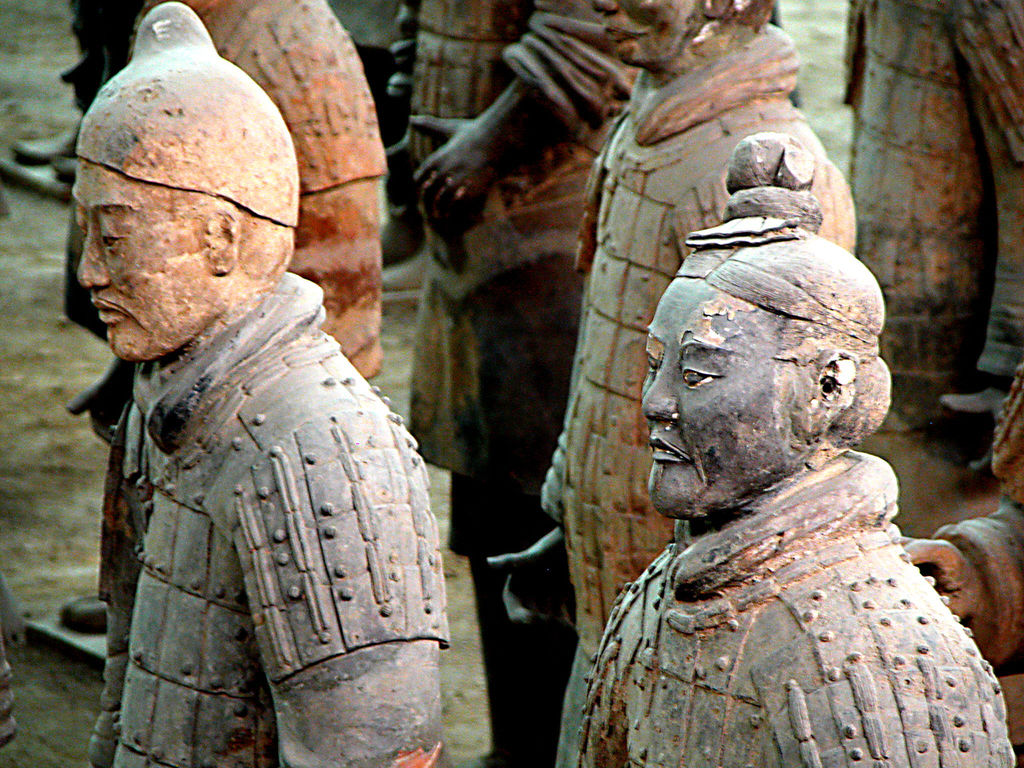
Terracotta Army detail, Xi'an, China

Terracotta Army detail, Xi’an, China, 9 April 2005, Photo by Peter Morgan from Nomadic, CCA 2.0 Generic

I Desire Mercy, and Not Sacrifice

The Lord Jesus Christ referred to this scripture twice as recorded in the gospels.

On the first occasion, His message seems to be: associate with the sin sick to bring them healing and exhort those, who consider themselves well and in no need of a doctor, that they need healing, too.

And as Jesus reclined at table in the house, behold, many tax collectors and sinners came and were reclining with Jesus and his disciples. And when the Pharisees saw this, they said to his disciples, “Why does your teacher eat with tax collectors and sinners?”  But when he heard it, he said, “Those who are well have no need of a physician, but those who are sick. Go and learn what this means, ‘I desire mercy, and not sacrifice.’ For I came not to call the righteous, but sinners.” Matthew 9:10-13 English Standard Version (ESV)

On the second occasion, He urged those who considered themselves righteous to obey the substance and not just the form of God’s commandments.

Or have you not read in the Law how on the Sabbath the priests in the temple profane the Sabbath and are guiltless? I tell you, something greater than the temple is here. And if you had known what this means, ‘I desire mercy, and not sacrifice,’ you would not have condemned the guiltless. For the Son of Man is lord of the Sabbath.” Matthew 12:5-8 (ESV)

Clearly, these folks thought themselves better than those around them.

But to what scripture (because the New Testament was not yet written) was the Lord referring? He quoted Hosea 6:6, but verses six and seven complete a thought.

For I desire steadfast love and not sacrifice, the knowledge of God rather than burnt offerings.

But like Adam they transgressed the covenant; there they dealt faithlessly with me.

Hosea 6:6-7 (ESV)

Textual notes indicate the term steadfast love is rendered mercy in the Septuagint (Greek translation of the Old Testament).

John Calvin comments on verse six:

It is a remarkable passage; the Son of God has twice quoted it. The Pharisees reproached him for his intercourse with men of bad and abandoned life, and he said to them in Matthew 9, ‘Mercy I desire, and not sacrifice.’ He shows, by this defense, that God is not worshipped by external ceremonies, but when men forgive and bear with one another, and are not above measure rigid. [emphasis added]

Again, in the Matthew 12, when the Pharisees blamed the disciples for gathering ears of corn, he said ‘But rather go and learn what this is, Mercy I desire, and not sacrifice.’ Inasmuch as they were so severe against his disciples, Christ shows that those who make holiness to consist in ceremonies are foolish worshipers of God; and that they also blamed their brethren without a cause, and made a crime of what was not in itself sinful, and what could be easily defended by any wise and calm expounder.

Calvin adds concerning verse seven:

God then subjoins a complaint, — But they like men have transgressed the covenant; there have they dealt treacherously against me. Here God shows that the Israelites boasted in vain of their sacrifices and of all the pomps of their external worship, for God did not regard these external things, but only wished to exercise the faithful in spiritual worship.

Then the import of the whole is this, “My design was, when I appointed the sacrifices and the whole legal worship, to lead you so to myself, that there might be nothing carnal or earthly in your sacrificing; but ye have corrupted the whole law; you have been perverse interpreters; for sacrifices have been nothing else among you but mockery as if it were a satisfaction to me to have an ox or a ram killed. You have then transgressed my covenant; and it is nothing that the people say to me, that they have diligently performed the outward ceremonies, for such a worship is not in the least valued by me.”

We can (and must) replace Calvin’s reference to ‘Israelites who boast in vain’ with the ‘unbelieving church of that age,’ for such they were. And we have these same with us today. It’s not as if they are unaware of the substance of proper worship, it’s just less costly (in the here and now) to practice merely the form of it.

At least two of these folks asked the Lord, “Which commandment is the most important of all?” He answered:

“You shall love the Lord your God with all your heart and with all your soul and with all your strength and with all your mind, and your neighbor as yourself.”

On another occasion He asked one of these folks how they understood the scriptures in a nutshell and they gave the same answer. To this one, the Lord said, “You have answered correctly; do this, and you will live.”

But, as we are prone to do, let us not go beyond what the scriptures say. The best example that comes to mind of mercy correctly applied is that demonstrated by the Lord.

The Woman taken in Adultery.  1644, Rembrandt (1606 – 1669), Public Domain

The Woman taken in Adultery. 1644, Rembrandt (1606 – 1669), Public Domain

Here’s the entire story from the source:

Early in the morning he came again to the temple. All the people came to him, and he sat down and taught them.  The scribes and the Pharisees brought a woman who had been caught in adultery, and placing her in the midst they said to him, “Teacher, this woman has been caught in the act of adultery. Now in the Law Moses commanded us to stone such women. So what do you say?” This they said to test him, that they might have some charge to bring against him.

Jesus bent down and wrote with his finger on the ground.  And as they continued to ask him, he stood up and said to them, “Let him who is without sin among you be the first to throw a stone at her.”  And once more he bent down and wrote on the ground.  

But when they heard it, they went away one by one, beginning with the older ones, and Jesus was left alone with the woman standing before him.  Jesus stood up and said to her, “Woman, where are they? Has no one condemned you?”  She said, “No one, Lord.” And Jesus said, “Neither do I condemn you; go, and from now on sin no more.”

So there we have it. When someone is repentant from the heart (and surely she was), the Lord says:

“Neither do I condemn you; go, and from now on sin no more.”

Go and do likewise.

I’m Better Than You?

I’m Better Than You? I know I shouldn’t, but I feel hostile toward someone who indicates, through words or deeds, that they think they’re better than me. Perhaps they’ve denigrated my beliefs, or my world view, or maybe, my God. How dare they do that, I think. They’ll be sorry. God will get them. And I’m not going to warn or pray for them, either.

In his essay, ‘Can We be Good Without God,’ Glenn Tinder describes the setting in which we find ourselves:

The life of every society is a harsh process of mutual appraisal. People are ceaselessly judged and ranked, and they in turn ceaselessly judge and rank others. This is partly a necessity of social and political order… It is partly also a struggle for self-esteem; we judge ourselves for the most part as others judge us. Hence outer and inner pressures alike impel us to enter the struggle.

The process is harsh because all of us are vulnerable… The process is harsh also because it is unjust… Few are rated exactly, or even approximately, as they deserve.

In his book, Revolt Against the Masses, Fred Siegel warns that Nietzsche called for a new aristocracy; an elite to run the world, as H. G. Wells put it. Siegel shows convincingly that this spirit has been at work in the US political system since before World War One.  The C-SPAN talk, in its entirety, is found here.

In the midst of this and other movements, I worry we’ll give our democracy away to totalitarianism.

But Tinder reminds us that something different, sacrificial love, or agape, undergirds our Western moral system:

Agape is the core of Christian morality. Moreover, as we shall see, it is a source of political standards that are widely accepted and even widely, if imperfectly, realized…

Agape means refusing to take part in this process [of mutual appraisal]. It lifts the one who is loved above the level of reality on which a human being can be equated with a set of observable characteristics. The agape of God, according to Christian faith, does this with redemptive power; God ‘crucifies’ the observable, and always deficient, individual, and “raises up” that individual to new life. The agape of human beings bestows new life in turn by accepting the work of God.

So we have agape set against ruthless, condemning judgment. Note that condemning judgment is generally censured whereas discerning judgment is imperative if often lacking. The individual who is exalted by God is simultaneously fallen and at war with God. He or she must discern their entrenched faults to repent of them.

Returning to the initial theme of this essay, when I feel this way, I remember these truths:

“Bless those who persecute you; bless and do not curse them… Beloved, never avenge yourselves, but leave it to the wrath of God, for it is written, ‘Vengeance is mine, I will repay, says the Lord.’” Romans 12:14-21

“You have heard that it was said, ‘You shall love your neighbor and hate your enemy.’ But I say to you, Love your enemies and pray for those who persecute you, so that you may be sons of your Father who is in heaven. For he makes his sun rise on the evil and on the good, and sends rain on the just and on the unjust.”  Matthew 5:43-45

“Blessed are you when people hate you and when they exclude you and revile you and spurn your name as evil, on account of the Son of Man! Rejoice in that day, and leap for joy, for behold, your reward is great in heaven; for so their fathers did to the prophets.” Luke 6:22-23

“If you love those who love you, what benefit is that to you? …But love your enemies, and do good, and lend, expecting nothing in return, and your reward will be great, and you will be sons of the Most High, for he is kind to the ungrateful and the evil. Be merciful, even as your Father is merciful.” Luke 6:32-36

“Beloved, do not be surprised at the fiery trial when it comes upon you to test you, as though something strange were happening to you. But rejoice insofar as you share Christ’s sufferings, that you may also rejoice and be glad when his glory is revealed” 1 Peter 4:12-13

“You know that the rulers of the Gentiles lord it over them, and their great ones exercise authority over them. It shall not be so among you. But whoever would be great among you must be your servant, and whoever would be first among you must be your slave, even as the Son of Man came not to be served but to serve, and to give his life as a ransom for many.” Matt. 20:25-28; Mark 10:42-45; Luke 22:24-27

“[Peter to the elders] Shepherd the flock of God that is among you, exercising oversight, not under compulsion, but willingly, as God would have you; not for shameful gain, but eagerly;  not domineering over those in your charge, but being examples to the flock.” 1 Peter 5:2-3

“[Paul to the Corinthians] To the present hour we hunger and thirst, we are poorly dressed and buffeted and homeless, and we labor, working with our own hands. When reviled, we bless; when persecuted, we endure; when slandered, we entreat. We have become, and are still, like the scum of the world, the refuse of all things.” 1 Cor. 4:11-13

“[Paul to the Philippians] Brothers, join in imitating me, and keep your eyes on those who walk according to the example you have in us.” Phil. 3:17

“…[Make] supplications, prayers, intercessions, and thanksgivings [to God]…for all people, for kings and all who are in high positions, that we may lead a peaceful and quiet life, godly and dignified in every way…” 1 Tim. 2:1-4

“Let us not grow weary of doing good…” Gal. 6:9-10

“The God of peace will soon crush Satan under your feet. Rom. 16:20 …by the blood of the Lamb and the word of our testimony, for they loved not their lives even unto death.” Rev. 12:11

This last one takes me aback, but it is as true as the others.

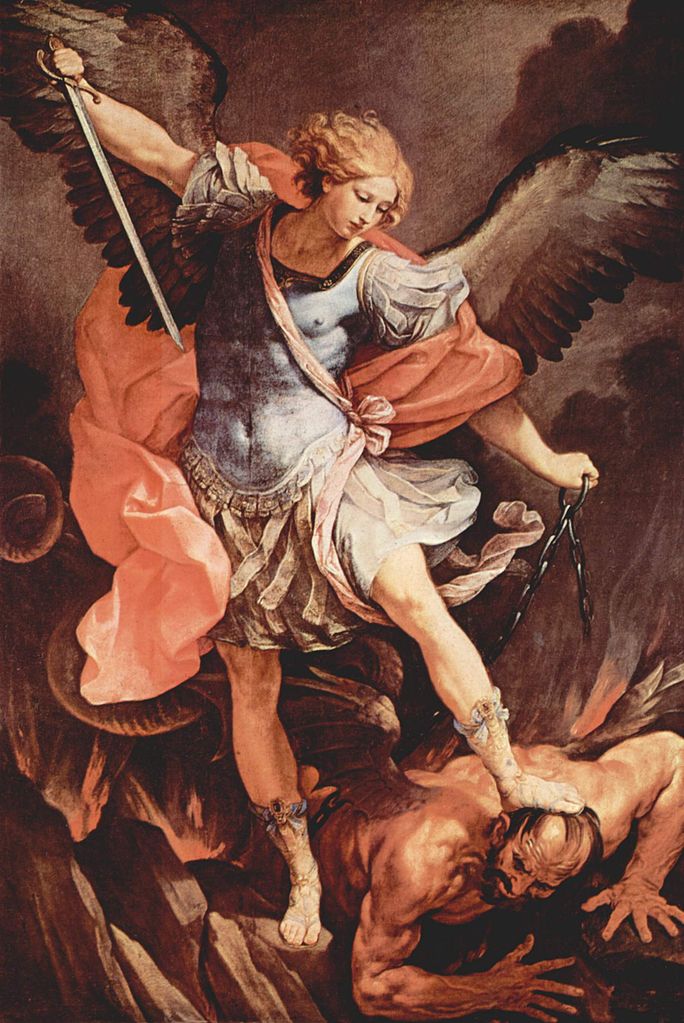
Archangel Michael, Guido Reni (1575–1642)

Archangel Michael, Guido Reni (1575–1642), painted circa 1636, public domain-US

After this life is over, the only thing I want to hear from my Lord is: “well done good and faithful servant…” knowing that, after doing all, I’ve done only what I was supposed to do. And I want that for you too. But that’s ultimately a transaction between you and Him.

This is my hope for you.

Climate Changiness

Please forgive this Hollywood conceit: “The arrogance of man is thinking nature is under our control, and not the other way around.” Actually, the Lord Jesus Christ is in control but we don’t even believe the Hollywood metaphor, so…

Godzilla – Asia Trailer [HD]

It’s not as if there was some gathering storm on the horizon.

5/18/14 Wright to Newcastle, WY Supercell Time-Lapse

Of course, that’s not what some would have you believe.

Chris Mooney’s MJ article ‘This Ice Sheet Will Unleash a Global Superstorm Sandy That Never Ends’ explains that glaciologist Richard Alley claims losing West Antarctica would produce 10 feet of sea level rise in coming centuries. That’s comparable to the flooding from Sandy—but permanent.

The NY Times article titled ‘Scientists Warn of Rising Oceans From Polar Melt’ starts:

A large section of the mighty West Antarctica ice sheet has begun falling apart and its continued melting now appears to be unstoppable, two groups of scientists reported on Monday. If the findings hold up, they suggest that the melting could destabilize neighboring parts of the ice sheet and a rise in sea level of 10 feet or more may be unavoidable…

Wait for it

…in coming centuries.

However, the Economist explains more carefully:

Glaciologists use the word “collapse” to describe a shift towards an irretrievable loss of an ice sheet. There is, reckons Dr Joughin, probably nothing that can now be done to save the Thwaites glacier. Much of the coverage of the new studies, though, suggests there will be a collapse in the everyday, imminent sense of the word.

Dr Joughin’s models predict that once the loss of ice from the Thwaites glacier really gets going, it may be enough to raise sea levels by a further 1mm a year by itself. But they also predict that this will not start to happen for at least another 200 years—and perhaps much longer than that. Bad news, then, but not quite a collapse—or at least, not on human timescales.

But what’s the worst that can happen?

Quoted in a WSJ opinion article, Secretary Kerry said, while addressing graduates of Boston College,

If we make the necessary efforts to address this challenge—and supposing I’m wrong or scientists are wrong, 97% of them all wrong—supposing they are, what’s the worst that can happen? …We put millions of people to work transitioning our energy, creating new and renewable and alternative; we make life healthier because we have less particulates in the air and cleaner air and more health; we give ourselves greater security through greater energy independence—that’s the downside.

The WSJ opinion author says:

The “worst that can happen” is that we spend trillions of dollars trying to solve a problem that we can’t do anything to stop; that we misallocate scarce resources in a way that slows economic growth; that slower growth leads to less economic opportunity for Boston College grads and especially the world’s poor, and that America and the world become much less wealthy and technologically advanced than we would otherwise. All of which would make the world less able to cope with the costs of climate change if Mr. Kerry is right.

And 97% of scientists are agreed so, from a postmodern perspective, it must be settled. I bet 99 and 44/100 percent believed in the Aether before Einstein’s special relativity was verified (Aether is on the march again, though; a relativistic Aether this time).

However, let’s not forget: Truth does not depend on man’s theories, only his theories do.

The climate change controversy seems to be a case of agnotology, the study of how ignorance arises via circulation of misinformation calculated to mislead. Quoting from the abstract for ‘Climate Consensus and ‘Misinformation’: A Rejoinder to Agnotology, Scientific Consensus, and the Teaching and Learning of Climate Change’

Agnotology, then, is a two-edged sword since either side in a debate may claim that general ignorance arises from misinformation allegedly circulated by the other. Significant questions about anthropogenic influences on climate remain. Therefore, Legates et al. appropriately asserted that partisan presentations of controversies stifle debate and have no place in education.

In the effort to stem climate change, the current administration has issued new federal limits on greenhouse-gas emissions.

Under the rule, states will be given a wide menu of policy options to achieve the pollution cuts. Rather than immediately shutting down coal plants, states would be allowed to reduce emissions by making changes across their electricity systems — by installing new wind and solar generation or energy-efficiency technology, and by starting or joining state and regional “cap and trade” programs, in which states agree to cap carbon pollution and buy and sell permits to pollute.

The Washington Post adds:

Under the draft rule, the EPA would let states and utilities meet the new standard with different approaches mixing four options including energy efficiency, shifting from coal to natural gas, investing in renewable energy and making power plant upgrades. Other compliance methods could include offering discounts to encourage consumers to shift electricity use to off-peak hours.

WSJ comments on the political fallout:

Republicans are using the proposed rule to assert that Democrats will raise energy costs and kill jobs, and that carbon restrictions are futile in the absence of similar action by China and other large polluting nations…

While Democrats are more vocal than Republicans in saying that man-made climate change is a problem, some in energy-producing states are wary of backing a government response…

Additional WSJ commentary claims large adverse economic impact for small climate improvement:

The EPA claims to be targeting “polluters,” but the government is essentially creating an artificial scarcity in carbon energy. Scarcities mean higher prices, which will hit the poor far harder than they will the anticarbon crusaders who live in Pacific Heights. The lowest 10% of earners pay three times as much as a share of their income for electricity compared to the middle class. If you want more inequality, this is an ideal way to ensure it.

and

The irony is that all the damage will do nothing for climate change. Based on the EPA’s own carbon accounting, shutting down every coal-fired power plant tomorrow and replacing them with zero-carbon sources would reduce the Earth’s temperature by about one-twentieth of a degree Fahrenheit in a hundred years.

And, of course, China is following suit with their own climate change measures. At least, that is, until their people rebel at the resulting deprivations.

What will we do if our people rebel? Well, we’ve got restrictions against what happened in China twenty-five years ago.

Except, of course, until we don’t.

Then there’s the whole issue of blatant racism. Caleb S. Rossiter explains in his opinion article ‘Sacrificing Africa for Climate Change.’

…Each American accounts for 20 times the emissions of each African. We [America] are not rationing our electricity. Why should Africa, which needs electricity for the sort of income-producing enterprises and infrastructure that help improve life expectancy? The average in Africa is 59 years—in America it’s 79. Increased access to electricity was crucial in China’s growth, which raised life expectancy to 75 today from 59 in 1968.

From a WSJ review of Robert Bryce’s new book Smaller Faster Lighter Denser Cheaper:

“For the vast majority of the world’s population,” Mr. Bryce argues, “the cheapest and most reliable forms of energy are, and will continue to be, hydrocarbons.” Anyone who thinks that he is doing the world a favor by compelling the switch from fossil fuels to wind and solar is consigning billions of people to a life of poverty and darkness.

Or there’s geoengineering on your own terms. What could go wrong with that?

We are meant to live peaceful and quiet lives, practicing true equity, and not using the poor (and soon to be poor) as pawns. But, as Calvin (no, the one from the Calvin and Hobbes comic) proves, we are all wet when we think we are in control.

Tiananmen – Gate of Heavenly Peace

On June 5, 2015, one lone man stood down a column of Type 59 PLA main battle tanks as they left Tiananmen Square following the suppression of protests by force the night before. He is known as Tank Man.

Here’s a CNN video clip showing raw footage of Tank Man’s own protest. Note the long tank column at the 10 second mark.

Tank Man

The Tiananmen Square protests were a long time coming. The protest developed in mid–April 1989 as an immediate result of the death of Hu Yaobang, denounced former as the General Secretary of the Chinese Communist Party, a known liberal within the Party.

At that time, thousands of students from China University of Political Science and Law, Peking University, and Tsinghua University marched on Tiananmen Square (other protests gathered in Xian and Shanghai).

The students drafted a list of pleas and suggestions (Seven Demands) for the government:

  1. Affirm as correct Hu Yaobang’s views on democracy and freedom;
  2. Admit that the campaigns against spiritual pollution and bourgeois liberalization had been wrong;
  3. Publish information on the income of state leaders and their family members;
  4. End the ban on privately run newspapers and stop press censorship;
  5. Increase funding for education and raise intellectuals’ pay;
  6. End restrictions on demonstrations in Beijing
  7. Provide objective coverage of students in official media.

Through demonstrations, boycotts, hunger strikes, military crackdowns, and martial law, the confrontation between the students and government built. At 4:30pm on June 3, the order for martial law was finalized:

  1. The operation to quell the counterrevolutionary riot was to begin at 9:00 pm
  2. Military units should converge on the Square by 1:00 am on June 4 and the Square must be cleared by 6:00 am.
  3. No delays would be tolerated.
  4. No person may impede the advance of the troops enforcing martial law. The troops may act in self-defense and use any means to clear impediments.
  5. State media will broadcast warnings to citizens.

The morning of June 4th, at 4:00 am, lights on the Square were suddenly turned off. The government announced: “Clearance of the Square begins now. We agree with students’ request to clear the Square.” The students sang The Internationale and braced for a last stand. An officer with a loudspeaker called out “you better leave or this won’t end well.”

It didn’t, an untold number died in various confrontations.

On June 5, a lone man stood in front of a column of tanks driving out of Tiananmen Square on 5 June on Chang’an Avenue. This is Frontline’s Tank Man documentary in its entirety.

Tank Man Documentary

The government regained control in the week following.  Officials responsible for organizing or condoning the protests were removed, and protest leaders were jailed.

However, the China democracy movement, although suppressed, continued. Liu Xiaobo helped write Charter 8, released 10 December 2008. The charter called for more freedom of expression, human rights, more democratic elections, for privatizing state enterprises and land and for economic liberalism. He was imprisoned on charges stemming from soliciting signatures for the Charter. Liu Xiaobo explained in a statement prepared for trial that was eventually delivered to the Nobel Prize committee:

China’s political reform […] should be gradual, peaceful, orderly and controllable and should be interactive, from above to below and from below to above. This way causes the least cost and leads to the most effective result. I know the basic principles of political change, that orderly and controllable social change is better than one which is chaotic and out of control. The order of a bad government is better than the chaos of anarchy. So I oppose systems of government that are dictatorships or monopolies. This is not ‘inciting subversion of state power’. Opposition is not equivalent to subversion. ”—Liu Xiaobo, 9 February 2010

In an open letter to Hu Jintao, now former General Secretary of the Communist Party of China, Brunhild Staiger, President of the European Association for Chinese Studies questions the basis for Liu’s imprisonment.

Others have advocated similar gradual reformations. While the reforms are similar to those of Charter 8, they specifically reject Jacksonian democracy. Yu takes a Marxist approach.

Along these lines, President Xi Jinping announced the “China Dream” (中国梦) at the 18th National People’s Congress, that began on November 8, 2012. According to Xi, the China Dream is to realize the hopes of the Chinese people and achieve the rejuvenation of the Chinese nation.

President Xi has set out goals for China:

…To achieve a “moderately prosperous society” (小康社会) by 2021 (the hundredth anniversary of the Chinese Communist Party founding) and a strong, democratic, culturally advanced, harmonious, and modernized socialist country by 2049.

These tenets share the “path of rejuvenation’s” focus on the Century of Humiliation, the period of roughly 100 years between the First Opium War and the founding of the People’s Republic of China in 1949 when foreign powers took advantage of a weak China. Core to the idea of the China Dream is that China is finally reclaiming a position of prosperity and power enjoyed before the period of national humiliation. To achieve the dream, China requires an effective government, a prosperous economy, a harmonious society, and a strong military.

And then there’s the 2010 book, The China Dream, by retired Colonel Liu Mingfu of the People’s Liberation Army. The book preceded President Xi’s party congress speech. The Wall Street Journal said of the book:

…The former professor [Colonel Liu Mingfu] at its National Defense University wrote a book of the same name [The China Dream], arguing that China should aim to surpass the U.S. as the world’s top military power and predicting a marathon contest for global dominion. The book flew off the shelves but was pulled over concerns it could damage relations with the U.S., according to people familiar with its publication.

Reuter’s excerpts Liu’s book:

“To save itself, to save the world, China must prepare to become the (world’s) helmsman.”

All but forgotten in that great nation, Tiananmen Square and all that took place must be remembered. Along with Zhao Ziyang, we must say 我們已經老了,無所謂了, “We are already old, it doesn’t matter to us anymore.” But it will matter to you.

The situation is Not OK! 不行!! Bù xíng!

We stand with you all.

Nip ‘Em in the Bud

What a silly sounding phrase. What does it mean?

Wikidictionary gives:

  1. To remove a bud from a plant to prevent flower and fruit from forming.
  2. (idiomatic) To stop something at an early stage.

Phrases.org.uk says the idiom originated in 1607 and gives a definition:

Put a stop to something while it is still in its early development.

I think Wikidictionary definition one has been happening to my lilac bush for the past few years. But, let’s nip this silliness in the bud. What real importance does this idiomatic phrase hold for us?

It’s the usual approach used to discredit and cast doubt on the bible’s veracity. Why bother reading the Gospel of John when you can’t trust the very first book, Genesis, or so goes the argument. Really, the argument centers on the first two chapters of that first book. The bud, so to speak.

Wikipedia expounds on the controversy over the first two chapters of Genesis in their entry: Genesis creation narrative. The issues raised are: use of names of God, the uniqueness and mutability of man’s soul, and an issue with naming the animals and their creation. These discrepancies are attributed to different authorship and traditions. Also, the Wikipedia entry authors introduce the concept of borrowed mythology altered to represent monotheism.

Our go to reference, John Calvin’s Commentary on Genesis, discusses most of these points.

As to names of God, Calvin says:

Genesis, Chap. 2, Vs. 4. These are the generations… Some of the Hebrews think that the essential name of God is here at length expressed by Moses, because his majesty shines forth more clearly in the completed world.

To this, the Commentary translator, John King, adds:

A new section of the history of Moses commences at this point; and, from the repetition which occurs of some facts — such as the creation of man — which had been recorded in the preceding chapter, as well as from certain peculiarities of phraseology, many learned men have inferred, that the early portion of the Mosaic history is older than the time of Moses, and that he, under the infallible direction of the Spirit of God, collected and arranged the several fragments of primeval annals in one consistent narrative.

One chief argument on which such a conclusion rests is, that from the commencement of the first chapter to the end of the third verse of the second chapter, God is spoken of only under the name of Elohim [Spirit of God]; from the fourth verse of the second to the end of the third chapter, he is uniformly styled Jehovah Elohim [Self existent one, Spirit of God]; and in the fourth and fifth chapters, the name of Elohim or of Jehovah stands alone.

This, it is argued, could scarcely have occurred without some cause; and the inference has been drawn, that different records had different forms of expression, which Moses did not alter, unless truth required him to do so.

Against this view, however, [another commentator] argues with considerable force, in his Dissertation “on the Names of God in the Pentateuch;”… that these names are intended to present the Divine character under different aspects to our view.

As to uniqueness of man, Calvin says:

Chap. 1, Vs. 26, Let us make man…In our image… Therefore by this word the perfection of our whole nature is designated, as it appeared when Adam was endued with a right judgment, had affections in harmony with reason, had all his senses sound and well-regulated, and truly excelled in everything good.

Thus the chief seat of the Divine image was in his mind and heart, where it was eminent: yet was there no part of him in which some scintillations of it did not shine forth. …In the mind perfect intelligence flourished and reigned, uprightness attended as its companion, and all the senses were prepared and molded for due obedience to reason; and in the body there was a suitable correspondence with this internal order.

As to uniqueness of man’s soul as opposed to those of the animals, Calvin says:

Chap. 2, Vs. 7, And the Lord God formed man… Nevertheless, he, at the same time, designed to distinguish man by some mark of excellence from brute animals: for these arose out of the earth in a moment; but the peculiar dignity of man is shown in this, that he was gradually formed. For why did not God command him immediately to spring alive out of the earth, unless that, by a special privilege, he might outshine all the creatures which the earth produced?

And breathed into his nostrils… Three gradations, indeed, are to be noted in the creation of man; that his dead body was formed out of the dust of the earth; that it was endued with a soul, whence it should receive vital motion; and that on this soul God engraved his own image, to which immortality is annexed.

Man became a living soul I take nepesh for the very essence of the soul: but the epithet living suits only the present place, and does not embrace generally the powers of the soul. For Moses intended nothing more than to explain the animating of the clayey figure, whereby it came to pass that man began to live…

As to changeability of man’s condition, Calvin says:

Chap. 1, Vs. 26, Let us make man…In our image… But now, although some obscure lineaments of that image are found remaining in us; yet are they so vitiated and maimed, that they may truly be said to be destroyed. For besides the deformity which everywhere appears unsightly, this evil also is added, that no part is free from the infection of sin.

Chap. 3, Vs. 6, And gave also unto her husband with her… Pride was the beginning of all evils, and that by pride the human race was ruined. Yet a fuller definition of the sin may be drawn from the kind of temptation which Moses describes. For first the woman is led away from the word of God by the wiles of Satan, through unbelief.  Wherefore, the commencement of the ruin by which the human race was overthrown was a defection from the command of God.

…At length, having despised the command of God, they not only indulge their own lust, but enslave themselves to the devil. If anyone prefers a shorter explanation, we may say unbelief has opened the door to ambition, but ambition has proved the parent of rebellion, to the end that men, having cast aside the fear of God, might shake off his yoke.

Chap. 3, Vs. 7, And the eyes of them both were opened… God created man flexible; and not only permitted, but willed that he should be tempted. …Therefore, whatever sin and fault there is in the fall of our first parents remains with themselves; but there is sufficient reason why the eternal counsel of God preceded it, though that reason is concealed from us.

As to the creation act, Calvin says:

Chap. 1, Vs. 3, And God said… Moses now, for the first time, introduces God in the act of speaking, as if he had created the mass of heaven and earth without the Word. Yet John testifies that ‘without him nothing was made of the things which were made,’ (John 1:3). And it is certain that the world had been begun by the same efficacy of the Word by which it was completed. God, however, did not put forth his Word until he proceeded to originate light; because in the act of distinguishing, his wisdom begins to be conspicuous.

Chap. 1, Vs. 5, The first day… Here the error of those is manifestly refuted, who maintain that the world was made in a moment. For it is too violent a cavil to contend that Moses distributes the work which God perfected at once into six days, for the mere purpose of conveying instruction.

Let us rather conclude that God himself took the space of six days, for the purpose of accommodating his works to the capacity of men. We slightingly pass over the infinite glory of God, which here shines forth; whence arises this but from our excessive dullness in considering his greatness? In the meantime, the vanity of our minds carries us away elsewhere.

For the correction of this fault, God applied the most suitable remedy when he distributed the creation of the world into successive portions that he might fix our attention, and compel us, as if he had laid his hand upon us, to pause and to reflect.

As to the first and second accounts of creation, he says:

Chap. 2, Vs. 4, These are the generations… The design of Moses was deeply to impress upon our minds the origin of the heaven and the earth, which he designates by the word generation… Wherefore, it is not a superfluous repetition which inculcates the necessary fact that the world existed only from the time when it was created since such knowledge directs us to its Architect and Author.

Chap. 2, Vs. 7, And the Lord God formed man… He now explains what he had before omitted in the creation of man that his body was taken out of the earth. He had said that he was formed after the image of God…

As to other creation accounts, he says:

Chap. 1, Vs. 1, In the beginning…  [Moses] moreover teaches by the word “created,” that what before did not exist was now made; for he has not used the term yatsar, which signifies to frame or forms but bara which signifies to create. Therefore his meaning is that the world was made out of nothing.

Hence the folly of those is refuted who imagine that unformed matter existed from eternity; and who gather nothing else from the narration of Moses than that the world was furnished with new ornaments, and received a form of which it was before destitute.

This indeed was formerly a common fable among heathens, who had received only an obscure report of the creation, and who, according to custom, adulterated the truth of God with strange figments; but for Christian men to labor …in maintaining this gross error is absurd and intolerable. Let this, then be maintained in the first place, that the world is not eternal but was created by God.

On an interesting point to note about God’s all–encompassing sovereignty, Calvin expounds:

Chap. 1, Vs. 3, Let there be light… It was proper that the light, by means of which the world was to be adorned with such excellent beauty, should be first created; …It did not, however, happen from inconsideration or by accident, that the light preceded the [creation of] sun and the moon.

To nothing are we more prone than to tie down the power of God to those instruments the agency of which he employs. The sun and moon supply us with light: And, according to our notions we so include this power to give light in them, that if they were taken away from the world, it would seem impossible for any light to remain.

Therefore the Lord, by the very order of the creation, bears witness that he holds in his hand the light, which he is able to impart to us without the sun and moon.

Roughly three hundred forty years later, B. B. Warfield, Princeton Theological Seminary’s last Calvinist Presbyterian Principal (equivalent to President), wrote the following in his 1915 article Calvin’s Doctrine of Creation.

“It should scarcely be passed without remark that Calvin’s doctrine of creation is, if we have understood it aright, for all except the souls of men, an evolutionary one. The ‘indigested mass,’ including the ‘promise and potency’ of all that was yet to be, was called into being by the simple fiat of God. But all that has come into being since — except the souls of men alone — has arisen as a modification of this original world-stuff by means of the interaction of its intrinsic forces. Not these forces apart from God, of course…”

Warfield’s incorrect attempt to reconcile Calvin’s Commentary with Darwin’s evolution theory through old earth creationism sounds very much like this dawn of man scene from 2001 space odyssey.

Dawn of Man Scene from 2001 Space Odyssey

You can’t have it both ways. As was said above, God is free to create in ways, timing, and manner as He sees fit ex-nihilo. He has graciously accommodated us in how He structured creation. Dorothy L. Sayers put forward an idea for us to understand the creation of man in the context of the fossil record as a unique act of creation with a perfect backstory (see Every Good Story – Thysdor Ya’Rosel).

If you attack the trustworthiness of the very first chapters, then have you not undermined the foundations and left entry for utter destruction of the rest? This can be seen in the split from Princeton Theological Seminary (PTS) after Warfield’s tenure by Westminster Theological Seminary (WTS) under Machen in 1929. PTS abandoned the veracity of God’s word. WTS was formed to uphold it. The attack was successful then and it will be so again if we don’t hold on to the truth of the word of God.

Evolutionist propagandists are not concerned with the proper order of sediments, transitionary evidence, or aeons. Their concern is not for truth. Their concern is like those of their ancient compatriots, to throw off the yoke of the Lord who made them. For what purpose but that they may go their own way. And so they shall. Will you, however, follow them?

Expulsion from the Garden of Eden, by Thomas Cole (

Expulsion from the Garden of Eden, 1828, by Thomas Cole (1801–1848), public domain – US