The Sower

The first 23 verses of the Book of Matthew, chapter 13, record the Lord Jesus’s parable of the sower, His reasoning behind speaking in parables, and His explanation of the sower parable. This is His explanation:

“Hear then the parable of the sower:

When anyone hears the word of the kingdom and does not understand it, the evil one comes and snatches away what has been sown in his heart. This is what was sown along the path.

As for what was sown on rocky ground, this is the one who hears the word and immediately receives it with joy, yet he has no root in himself, but endures for a while, and when tribulation or persecution arises on account of the word, immediately he falls away.

As for what was sown among thorns, this is the one who hears the word, but the cares of the world and the deceitfulness of riches choke the word, and it proves unfruitful.

As for what was sown on good soil, this is the one who hears the word and understands it. He indeed bears fruit and yields, in one case a hundredfold, in another sixty, and in another thirty.”

Matthew 13:18-23 English Standard Version (ESV)

John Calvin comments on the parable as a whole:

…He only intended to warn us, that, in many persons, the seed of life is lost on account of various defects, in consequence of which it is either destroyed immediately, or it withers, or it gradually degenerates.

That we may derive the greater advantage from this warning, we ought to bear in mind, that he makes no mention of despisers who openly reject the word of God, but describes those only in whom there is some appearance of docility.

But if the greater part of such men perishes, what shall become of the rest of the world, by whom the doctrine of salvation is openly rejected?

And relative to the good soil:

But he that received the seed into a good soil… None are compared by Christ to a good and fertile soil, but those in whom the word of God not only strikes its roots deep and solid, but overcomes every obstacle that would prevent it from yielding fruit.

Is it objected that it is impossible to find anyone who is pure and free from thorns? It is easy to reply, that Christ does not now speak of the perfection of faith, but only points out those in whom the word of God yields fruit. Though the produce may not be great, yet everyone who does not fall off from the sincere worship of God is reckoned a good and fertile soil

Hence too we learn that we have no right to despise those who occupy a lower degree of excellence; for the master of the house himself, though he gives to one the preference above another on account of more abundant produce, yet bestows the general designation, good, even on inferior soils…

Therefore, please:

…Put away all filthiness and rampant wickedness and receive with meekness the implanted word, which is able to save your souls. James 1:21 (ESV)

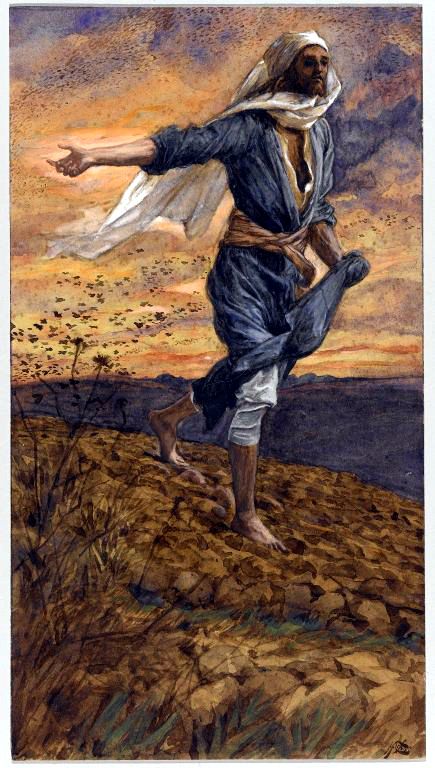
The Sower - Tissot

The Sower, 1886 – 1894, James Tissot, Brooklyn Museum, PD-Art-US

The Samaritan Leper

The story where Jesus cleanses ten lepers is a familiar one. It’s unusual that it comes right before one of Jesus’s declarations of the Kingdom. Or is it?

On the way to Jerusalem he was passing along between Samaria and Galilee. And as he entered a village, he was met by ten lepers, who stood at a distance and lifted up their voices, saying, “Jesus, Master, have mercy on us.” When he saw them he said to them, “Go and show yourselves to the priests.” And as they went they were cleansed.

Then one of them, when he saw that he was healed, turned back, praising God with a loud voice; and he fell on his face at Jesus’ feet, giving him thanks. Now he was a Samaritan. Then Jesus answered, “Were not ten cleansed? Where are the nine? Was no one found to return and give praise to God except this foreigner?” And he said to him, “Rise and go your way; your faith has made you well.”

Being asked by the Pharisees when the kingdom of God would come, he answered them, “The kingdom of God is not coming in ways that can be observed, nor will they say, ‘Look, here it is!’ or ‘There!’ for behold, the kingdom of God is in the midst of you.” Luke 17:11-21 English Standard Version (ESV)

John Calvin has some interesting comments about the passage:

Thy faith hath saved thee. The word save is restricted by some commentators to the cleanness of the flesh. But if this be the case, since Christ commends the lively faith of this Samaritan, it may be asked, how were the other nine saved? for all of them without exception obtained the same cure.

We must therefore arrive at the conclusion, that Christ has here pronounced a different estimate of the gift of God from that which is usually pronounced by ungodly men; namely, that it was a token or pledge of God’s fatherly love.

The nine lepers were cured; but as they wickedly efface the remembrance of the grace of God, the cure itself is debased and contaminated by their ingratitude, so that they do not derive from it the advantage which they ought. It is faith alone that sanctifies the gifts of God to us, so that they become pure, and, united to the lawful use of them, contribute to our salvation.

Lastly, by this word Christ has informed us in what manner we lawfully enjoy divine favors. Hence we infer that he included the eternal salvation of the soul along with the temporal gift. The Samaritan was saved by his faith How? Certainly not because he was cured of leprosy, (for this was likewise obtained by the rest,) but because he was admitted into the number of the children of God, and received from His hand a pledge of fatherly kindness.

We see the extent of God’s common grace through healings. But, without faith, those temporal miracles do not result in salvation.

Further, Calvin notes:

The kingdom of God will not come with observation. …The word observation is here employed by Christ to denote extraordinary splendor; and he declares, that the kingdom of God will not make its appearance at a distance, or attended by pompous display. He means, that they are greatly mistaken who seek with the eyes of the flesh the kingdom of God, which is in no respect carnal or earthly, for it is nothing else than the inward and spiritual renewal of the soul.

From the nature of the kingdom itself he shows that they are altogether in the wrong, who look around here or there, in order to observe visible marks. That restoration of the Church,” he tells us,which God has promised, must be looked for within; for, by quickening his elect into a heavenly newness of life, he establishes his kingdom within them.”

And thus he indirectly reproves the stupidity of the Pharisees, because they aimed at nothing but what was earthly and fading. It must be observed, however, that Christ speaks only of the beginnings of the kingdom of God; for we now begin to be formed anew by the Spirit after the image of God, in order that our entire renovation, and that of the whole world, may afterwards follow in due time.

I urge you, turn back, submit yourself to Him, and give Him thanks.

The Healing of the Ten Lepers, Tissot

The Healing of Ten Lepers, 1886 – 1894, James Tissot, Brooklyn Museum, PD-Art-US

Holy as I Am Holy?

The Apostle Peter wrote in his first letter:

As obedient children, do not be conformed to the passions of your former ignorance, but as he who called you is holy, you also be holy in all your conduct, since it is written, “You shall be holy, for I am holy.” 1 Peter 1:14-16 English Standard Version (ESV)

John Calvin comments on these verses:

He who hath called you is holy – He reasons from the end for which we are called. God sets us apart as a peculiar people for himself; then we ought to be free from all pollutions

Calvin, stating the obvious, that we are not capable of being like God in holiness, nevertheless, points out:

…We ought daily to strive more and more. And we ought to remember that we are not only told what our duty is, but that God also adds, “I am he who sanctify you.”

The Calvin presses the point further:

It is added: in all manner of conversation, or, in your whole conduct. There is then no part of our life which is not to be redolent with this good odour of holiness…

You may currently stink at holy conduct. However, if you are in Christ and He is in you, then you must make great efforts to achieve or obtain it:

Strive for peace with everyone, and for the holiness without which no one will see the Lord. Hebrews 12:14 (ESV)

To this verse, Calvin comments with regard to those who profess Christ as Lord:

Follow peace, etc. – Men are so born that they all seem to shun peace; for all study their own interest, seek their own ways, and care not to accommodate themselves to the ways of others. Unless then we strenuously labor to follow peace, we shall never retain it; for many things will happen daily affording occasion for discords…

And, with regard to those outside of Christ, Calvin says:

As however peace cannot be maintained with the ungodly except on the condition of approving of their vices and wickedness, the Apostle immediately adds, that holiness is to be followed together with peace; as though he commended peace to us with this exception, that the friendship of the wicked is not to be allowed to defile or pollute us; for holiness has an especial regard to God…

Finally, Calvin adds:

He declares, that without holiness no man shall see the Lord; for with no other eyes shall we see God than those which have been renewed after his image.

As scripture teaches, we know everyone born from above practices right behavior.

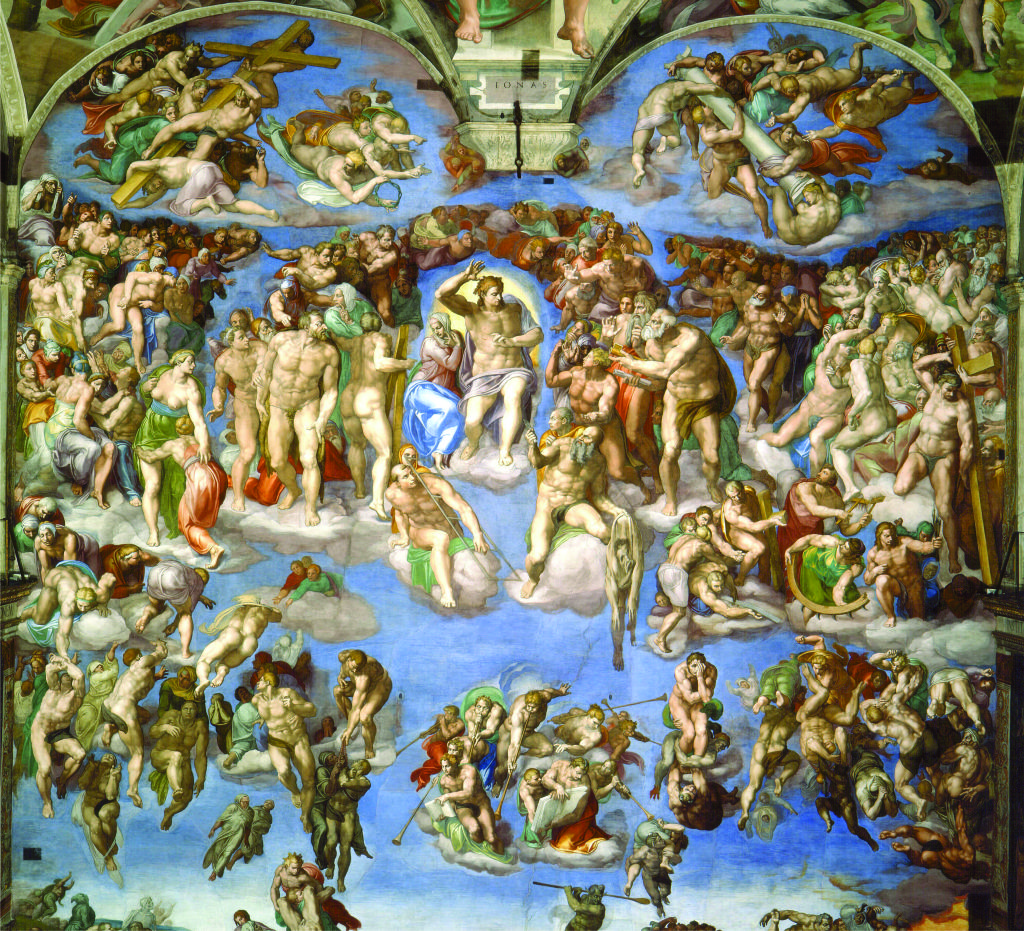
Last Judgment

Last Judgment, 1537 – 1541, Michelangelo and assistants, the Sistine Chapel in the Vatican, PD-Art-US

It’s Not Your Founding Fathers’ Republic Any More – Review and Commentary — Bernhardt Writer

This week, I’d like to recommend Myron Magnet’s book review: ‘It’s Not Your Founding Fathers’ Republic Any More.’ According to Magnet we abandoned the original intent of the U.S. Constitution long ago. The books he reviews suggest many remedies including automatic sunsetting of laws and regulations in the U.S. Code (USC) and Code of Federal Regulations (CFR), respectively.

Magnet says President Wilson established in the WWI era the doctrine of the “Living Constitution” administered by the Supreme Court thereby codifying judicial activism that undid civil liberty victories in the aftermath of the Civil War. Secondly, President Roosevelt established prior to and during the WWII era unelected extra-governmental commissions (aka agencies) that have independent legislative, administrative, and judicial powers within themselves. Agencies are created as a matter of course now by legislative action. FDR also strengthened the power of the judiciary to act as a permanent constitutional convention amending the document through their decisions.

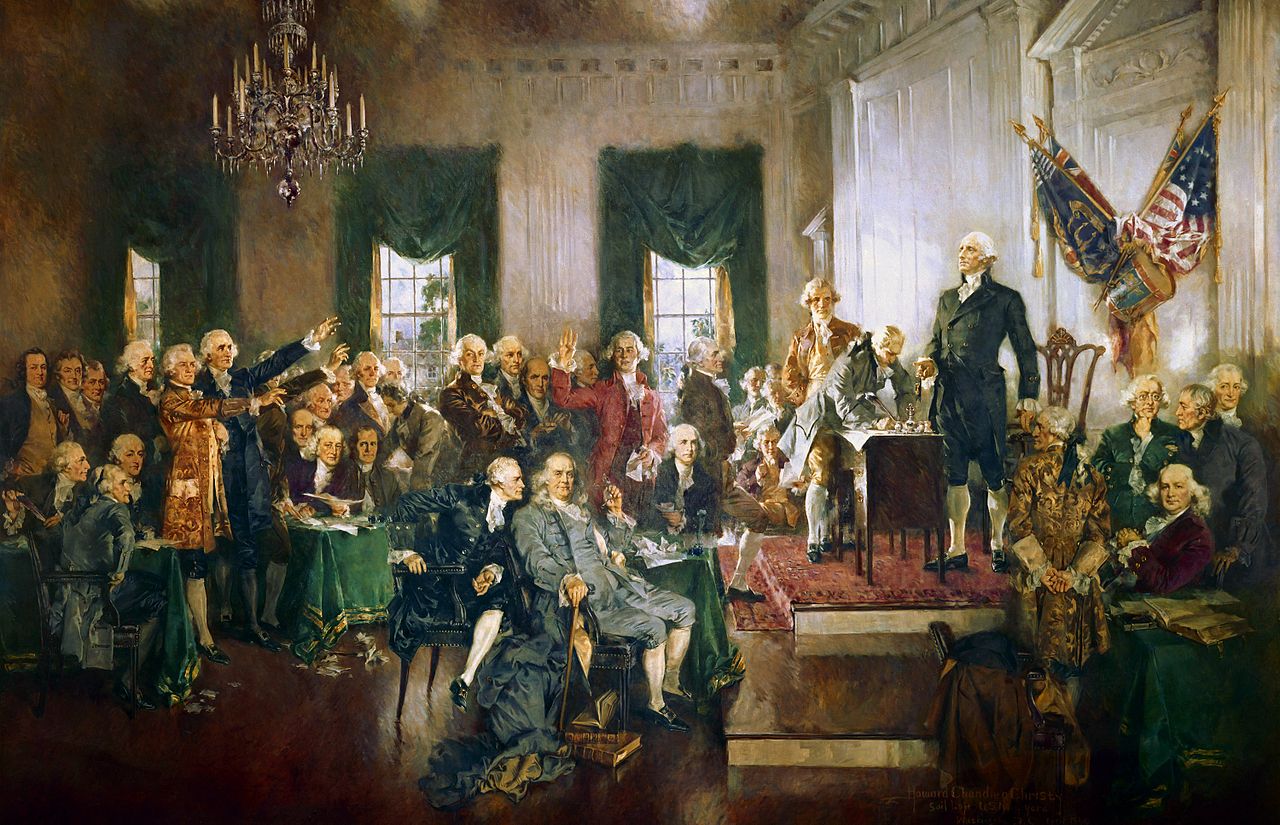
Signing the U.S. Constitution

Scene at the Signing of the Constitution of the United States, Howard Chandler Christy (January 10, 1873 – March 3, 1952), Public Domain in the US

Magnet states that the Founders original intent was to limit governmental authority through the division and limited enumeration of powers. Only nineteen federal government powers were enumerated. Principle among these were: raising taxes, coining money, keeping the country safe, building post offices and post roads, regulating the armed forces, and making laws for carrying out limited governmental responsibilities. All other powers devolved to the states or the people.

Flawed through compromise (in the bad sense), the Constitution was amended from 1865 and 1870 via the Thirteenth Amendment which freed the slaves, the Fourteenth assuring black Americans citizenship and civil rights, and the Fifteenth that prohibited states from denying black citizens the right to vote.

However, a series of Supreme Court decisions undid the power of those amendments won through Civil War bloodshed. In 1873, the Supreme Court subverted the Fourteenth Amendment through the Slaughter-House Cases, stating that the amendment did not include the rights: to own property; to court access; to equal taxation; to vote; to live, work, and travel where you want; and to have the protection of the Bill of Rights against state and federal violation. The Court held the amendment only granted the right to travel on interstate waterways and to petition the federal government for redress of grievances

In 1876, the Supreme Court, in their United States v. Cruikshank decision, threw out a federal indictment of Louisiana murderers for conspiracy to deprive more than 100 freedmen of their constitutional rights, on the grounds that the killers had violated no federal rights that extended to the states, citing the Slaughter-House Cases. This decision led Southern Democrats to enact Jim Crow laws. Cruikshank smoothed the way for Plessy v. Ferguson, in 1896, which enabled Southern states to segregate transportation and schools and outlaw interracial marriage.

In 1908, Wilson wrote:

No doubt a great deal of nonsense has been talked about the inalienable rights of the individual, and a great deal that was mere vague sentiment and pleasing speculation has been put forward as fundamental principle…Living political constitutions must be Darwinian in structure and practice…The chief instrumentality by which the law of the Constitution has been extended to cover the facts of national development has of course been judicial interpretations—the decisions of courts. The process of formal amendment of the Constitution was made so difficult by the…Constitution itself that it has seldom been feasible to use it; and the difficulty of formal amendment has undoubtedly made the courts more liberal, not to say more lax, in their interpretation than they would otherwise have been.

Wilson went on to advocate that the judicial system adapt the Constitution to the times through their decisions. In other words, the courts were to “make the law for their own day.”

Although the Supreme Court deflected attempts to control the national economy, executive pressure during the New Deal swayed the Court’s 1942 Wickard v. Filburn decision. Filburn, a dairy farmer, was fined for not limiting his wheat crop in accordance with the Agricultural Adjustment Act. The act was meant to curb a perceived deflationary overproduction crisis (held, at the time, to be a cause of the Depression). Congress established the act based on the Interstate Commerce Clause. The act established a crop quota system by state. These quotas were then allocated to individual farms by the states. Filburn used his wheat locally to feed his cows. But the Court decided that his wheat competed with wheat in commerce (he could have purchased it instead of growing it) so, therefore, it was subject to the Commerce clause and the act’s quotas.

In the same period, FDR noted, “The practice of creating independent regulatory commissions, who perform administrative work in addition to judicial work, threatens to develop a ‘fourth branch’ of Government for which there is no sanction in the Constitution.” He was responsible for numerous legislative Acts and their associated bureaucratic agencies.

So much for the intent of Lincoln’s Gettysburg Address:

FOUR SCORE AND SEVEN YEARS AGO OUR FATHERS BROUGHT FORTH ON THIS CONTINENT A NEW NATION CONCEIVED IN LIBERTY AND DEDICATED TO THE PROPOSITION THAT ALL MEN ARE CREATED EQUAL…

IT IS RATHER FOR US TO BE HERE DEDICATED TO THE GREAT TASK REMAINING BEFORE US

THAT FROM THESE HONORED DEAD WE TAKE INCREASED DEVOTION TO THAT CAUSE FOR WHICH THEY GAVE THE LAST FULL MEASURE OF DEVOTION

THAT WE HERE HIGHLY RESOLVE THAT THESE DEAD SHALL NOT HAVE DIED IN VAIN

THAT THIS NATION UNDER GOD SHALL HAVE A NEW BIRTH OF FREEDOM~AND

THAT GOVERNMENT OF THE PEOPLE BY THE PEOPLE FOR THE PEOPLE SHALL NOT PERISH FROM THE EARTH

I must admit, with everything going on lately, I became overwhelmed. I’m sure it’s happened to you too. Please forgive the hiatus. We’ll cover two special topics from Professor Siegel’s book Revolt Against the Masses in the future.

Can I be Certain of You?

In his comments on Philippians, chapter 1, verse 6:

And I am sure of this, that he who began a good work in you will bring it to completion at the day of Jesus Christ. Philippians 1:6 English Standard Version (ESV)

John Calvin says:

It is asked, however, whether anyone can be certain as to the salvation of others, for Paul here is not speaking of himself but of the Philippians. I answer, that the assurance which an individual has respecting his own salvation, is very different from what he has as to that of another. For the Spirit of God is a witness to me of my calling, as he is to each of the elect. As to others, we have no testimony, except from the outward efficacy of the Spirit; that is, in so far as the grace of God shews itself in them, so that we come to know it.

There is, therefore, a great difference, because the assurance of faith remains inwardly shut up, and does not extend itself to others. But wherever we see any such tokens of Divine election as can be perceived by us, we ought immediately to be stirred up to entertain good hope, both in order that we may not be envious towards our neighbors, and withhold from them an equitable and kind judgment of charity; and also, that we may be grateful to God. This, however, is a general rule both as to ourselves and as to others — that, distrusting our own strength, we depend entirely upon God alone [emphasis mine].

And what can we look for as tokens of Divine election? Scripture says we are to be clothed in His righteousness, in word and deed:

Put on then, as God’s chosen ones, holy and beloved, compassionate hearts, kindness, humility, meekness, and patience, bearing with one another and, if one has a complaint against another, forgiving each other; as the Lord has forgiven you, so you also must forgive. Colossians 3:12-13 (ESV)

Look for these things in yourselves first and then in others.

Tamme-Lauri oak. The oldest tree in Estonia

Tamme-Lauri oak. The oldest tree in Estonia, 3 September 2013, Abrget47j, Creative Commons Attribution-Share Alike 3.0 Unported

Able to Stand

I’ve been reminded repeatedly of this truth recently:

Who are you to pass judgment on the servant of another? It is before his own master that he stands or falls. And he will be upheld, for the Lord is able to make him stand. Romans 14:4 English Standard Version (ESV)

The immediate context is the weaker brother among those in the church at Rome, which was composed of former Jews trained to obey the Law and regulations and others who were never exposed to those regulations. Each looked down on the other for their freedoms and bondages.

Nowadays we look down on a brother (or sister) if they don’t dress the way we do, or perform ceremonies the way we do, work for an employer the way we do, or look at the world the way we do, or behave as responsibly as we do. I could go on. I’m sure you could supply more examples.

About this scripture passage, John Calvin comments:

To his own Lord he stands or falls, etc. As though he said, — “It belongs rightly to the Lord, either to disapprove, or to accept what his servant doeth: hence he robs the Lord, who attempts to take to himself this authority.” And he adds, he shall indeed stand: and by so saying, he not only bids us to abstain from condemning, but also exhorts us to mercy and kindness, so as ever to hope well of him, in whom we perceive anything of God; inasmuch as the Lord has given us a hope, that he will fully confirm, and lead to perfection, those in whom he has begun the work of grace [emphasis mine].

Lately, I’ve tried to practice what Calvin says constitutes true worship:

“God is not worshipped by external ceremonies, but when men forgive and bear with one another, and are not above measure rigid.”

and

“God values faith and kindness much more than sacrifices and all ceremonies.”

We would do well to follow his advice.

Humans Need Not Apply – YouTube Video — A Commentary

I spotted this YouTube video: Humans Need Not Apply by CGP Grey (15 minutes duration) that seems particularly relevant to our times. It’s coming if we don’t pull the plug. Will we be prepared to face the consequences humanely as individuals, a society, or a global community?

We, at Mandated Memoranda are preparing for our second round of collaborative editing of A Digital Carol. Our preface and blurb reads:

We no longer believe in ghosts, do we? I thought not. But we invest our time and attention in the promise of virtual reality for entertainment and, as some might wish it, our evolutionary destiny. Of course, this is only the latest manifestation of our desire to create our own heaven, on our own terms, here on earth.

A Digital Carol is Dickens’s A Christmas Carol retold with new forms and modern perspectives. No longer do we read a tale of a mean miser who, through sorrowful experiences, becomes kindly. We now face a monstrous egotist who teeters between damnation and redemption.

This story’s goal is not to inspire a more joyous holiday or a more generous spirit, but to question the very premise of our existence. We are too late into the dark night of the soul for anything but drastic measures.

Thank you for your forbearance with us at this time.

PreCrime in America

For all the tragedy and folderol in politics, one thing for which I consistently credit the left is advocating civil rights. Here’s just the latest example from someone who went to Bernhardt’s high school. I may not agree with the entire speech but here’s an excerpt anyone interested in individualized and equal justice can appreciate:

Here in Pennsylvania and elsewhere, legislators have introduced the concept of “risk assessments” that seek to assign a probability to an individual’s likelihood of committing future crimes and, based on those risk assessments, make sentencing determinations. Although these measures were crafted with the best of intentions, I am concerned that they may inadvertently undermine our efforts to ensure individualized and equal justice…

Criminal sentences must be based on the facts, the law, the actual crimes committed, the circumstances surrounding each individual case, and the defendant’s history of criminal conduct. They should not be based on unchangeable factors that a person cannot control, or on the possibility of a future crime that has not taken place. Equal justice can only mean individualized justice, with charges, convictions, and sentences befitting the conduct of each defendant and the particular crime he or she commits…

Of course, we all know about PreCrime from the movie: Minority Report, which was loosely adapted from Philip K. Dick’s short story: The Minority Report.

Bernhardt will continue his review and commentary of Professor Fred Siegel’s book: The Revolt Against the Masses in the weeks to come.

The Revolt Against the Masses – A Review (Part 2) — by Bernhardt Writer

This week we tackle chapters 2 through 5. The chapters are titled:

2. Betrayal and the Birth of Modern Liberalism

3. Randolph Bourne Writing Novels

4. Three Trials

5. Giants in Decline

What I took away from these chapters is that a harrowing and confusing period in American history, World War I and its aftermath, divided those who sought social reform from those who, it pains me to say it, sought social cleansing and the rise of a new ruling class. Many of the individuals described in chapter one played a part during this time. The forces of lasting reform seem to have gone dormant in America and those for the other goal are, as yet, thwarted. Succeeding chapters will show how these latter forces strove to accomplish their agenda throughout the twentieth century.

This is my inadequate review and commentary of chapters two through five. Many quotes are drawn from Professor Siegel’s book and are supplemented by original sources when necessary.

A young progressive reformer, John Chamberlain, characterized the period prior to America’s entry into WWI as: “the years of Great Expectation when the Millennium, Woodrovian fostered, seemed just around the corner.” The Millennium alluded to was the thousand years of peace prophesied in the Revelation of John. It was not to be.

On July 30, 1916, at 2:08 AM, saboteurs caused a one kiloton explosion on Black Tom Island off the New Jersey coast, near Liberty Island, in NYC harbor. Two million pounds of munitions on their way to the allies were detonated through a series of fires.

This sabotage is viewed as the proximate cause for President Wilson to denounce Germany’s supporters in America as “creatures” of “disloyalty and anarchy [who] must be crushed.” He pushed for and got the Sedition Act of 1918 passed. The Sedition Act extended the Espionage Act of 1917.

The Act’s section 3 text called for in part:

Whoever,…when the United States is at war, shall wilfully utter, print, write, or publish any disloyal, profane, scurrilous, or abusive language about the form of government of the United States, or the Constitution of the United States, or the military or naval forces…or any language intended to bring the form of government… or the Constitution… or the military or naval forces… or the flag… of the United States into contempt, scorn, contumely, or disrepute…shall be punished by a fine of not more than $10,000 or imprisonment for not more than twenty years, or both….

The incongruity between Wilson’s fighting the war to end all wars to make the world safe for democracy and his curtailment of liberties at home drove a wedge between progressives and those who would soon call themselves liberals.

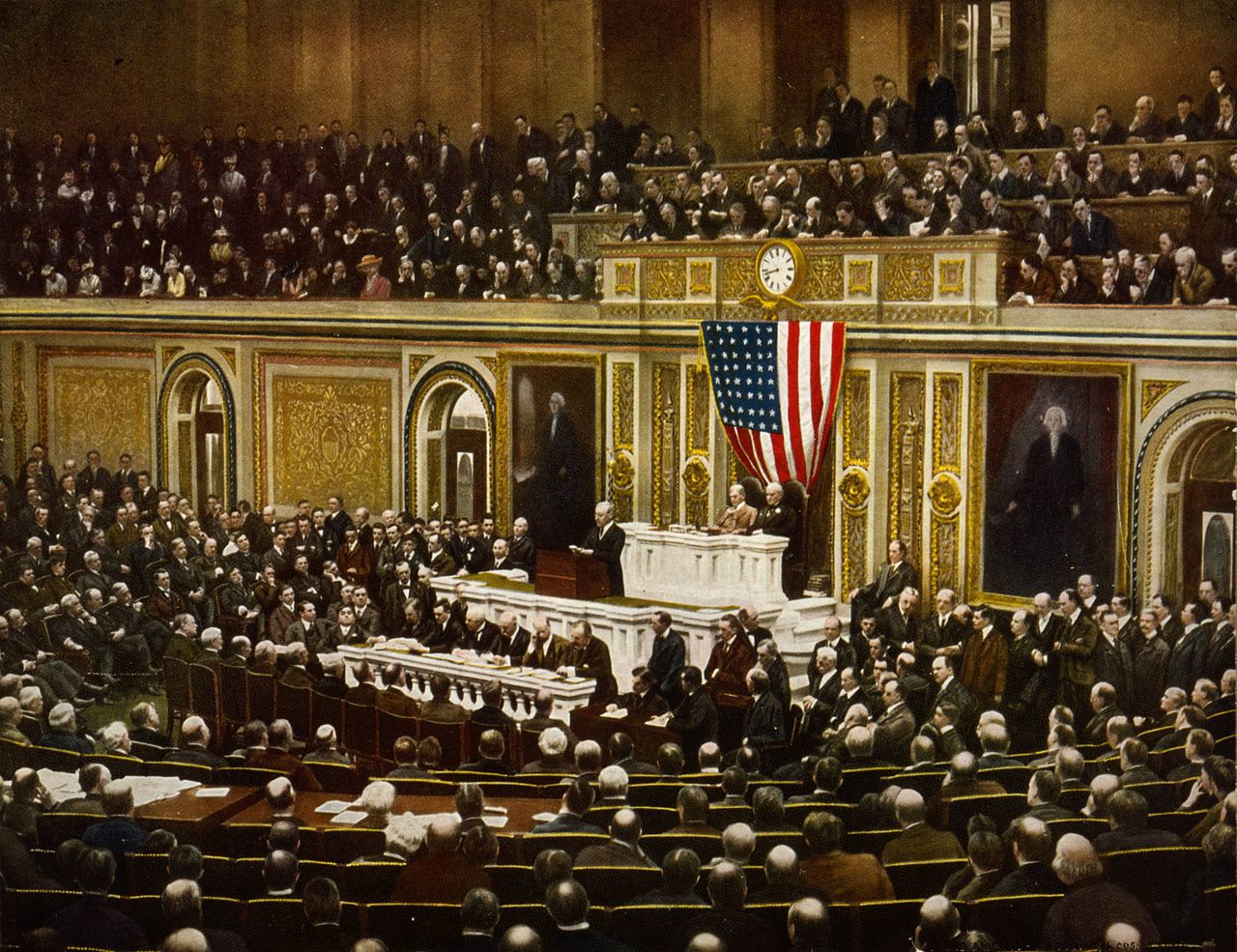
President Woodrow Wilson asking Congress to declare war on Germany on 2 April 1917

“For the freedom of the world”. President Woodrow Wilson asking Congress to declare war on Germany on 2 April 1917. Color halftone photomechanical print, 1917.04.02 (photograph), 1918.12.21 (publication), Public Domain in the United States

In 1919, Walter Lippmann wrote, “The word liberalism, was introduced into the jargon of American politics by that group who were Progressives in 1912 and Wilson Democrats from 1916 to 1918.”

Whereas, pre-war Progressives hoped to reform a nation of immigrants grounded in the Protestant ethic, Liberals objected to wartime conscription, civil liberties repression, Prohibition, and the first Red Scare. They saw middle class values as a continuation of WWI repressions.

“Like most sensible people,” liberal Harold Edmund Stearns said, “I regard Prohibition as an outrage and a direct invitation to revolution.”

Randolph Bourne, noted in 1918: “The modern radical opposes the present social system not because it does not give him ‘rights’ but because it warps and stunts the potentialities of society and of human nature.”

But, in a triumph for American free speech rights, Justice Oliver Wendell Holmes declared, in Schenck v. United States (1919):

The most stringent protection of free speech would not protect a man in falsely shouting fire in a theatre and causing a panic… The question in every case is whether the words used are used in such circumstances and are of such a nature as to create a clear and present danger that they will bring about the substantive evils that Congress has a right to prevent.

Yet, Harold Stearns wrote in his 1919 book, Liberalism in America: Its Origin, Its Temporary Collapse, Its Future:

In Soviet countries there is in fact no freedom of the press and no pretense that there is. In America today there is in fact no freedom of the press and we only make the matter worse by pretending that there is.

In the same book, Stearns wrote:

The root of liberalism, in a word, is hatred of compulsion, for liberalism has the respect for the individual and his conscience and reason which the employment of coercion necessarily destroys. The liberal has faith in the individual – faith that he can be persuaded by rational means to beliefs compatible with social good.

Sinclair Lewis, through his book, Main Street, gave cultural content to the label “liberal.”

About Main Street, Siegel says:

Main Street caught the post-war literary mood of disillusion perfectly. It distilled and amplified the sentiments of Americans who thought of themselves as members of a creative class stifled by the conventions of provincial life.

Lewis followed up Main Street with his satire Babbitt in 1922. At the end of the novel, the main character, George Follansbee Babbitt, says, “I’ve never done a single thing I want to in my whole life! I don’t know’s I’ve accomplished anything except to just get along.”

H. L. Mencken wrote:

It is not what he [George Babbitt] feels and aspires that moves him primarily; it is what the folks about him will think of him. His politics is communal politics, mob politics, herd politics; his religion is a public rite wholly without subjective significance.

He thought George Babbitt embodied what was wrong in society. Thus Mencken agreed with Lewis, who characterized Babbitt as: “This is the story of the ruler of America.”

In his 1927 New Republic essay “The Drug on the Market,” Waldo Frank said:

In a democracy, where castes are vague, where money-power has few manifest badges of dress or standard of living; where indeed millionaire and clerk go to the same movie, read the same books, travel the same roads, and where intellectual distinctions must be carefully concealed,” it is the “herd” that rules.

Three defining court cases took place in the 1920s. They were the 1924 Leopold and Loeb, 1925 Scopes, and 1926-27 Sacco and Vanzetti trials. Clarence Darrow defended the first two and future Supreme Court Justice Felix Frankfurter argued for a second appeal to the Massachusetts State Supreme Judicial Court of the third one. Each trial helped shape case-law and how justice is carried out in America.

Leopold wrote to Loeb: “A superman…is, on account of certain superior qualities inherent in him, exempted from the ordinary laws which govern men. He is not liable for anything he may do.” Pleasure was their moral guide, as Nietzsche’s writings suggested.

During his plea to Cook County Circuit Court Judge John R. Caverly, Darrow asked:

Why did they kill Bobby Franks? Not for money, not for spite, not for hate. They killed him as they might kill a spider or a fly, for the experience. They killed him because they were made that way. Because somewhere in the infinite processes that go to the making up of a boy or the man something slipped, and these unfortunate lads sit here, hated, despised, outcasts, with the community shouting.

All the Leopold and Loeb trial documentation is available online. Darrow put Biblical morality on trial and survival of the fittest won.

As part of the defense, Darrow called Scopes’ student, Harry Shelton, to the witness stand to demonstrate that Scopes’ evolution lessons had not adversely him:

Darrow: “Are you a church member?”

Shelton: “Yes, sir.”

D: “Do you still belong?”

S: “Yes, sir.”

D: “You didn’t leave church when he [Scopes] told you all forms of life began with a single cell?”

S: “No,sir.”

Through several witnesses’ testimony, Darrow attempted to show no moral corruption resulted due to learning about evolution.

In rebuttal, Bryan turned Darrow’s logic against him. Bryan quoted the defense Darrow used in the Leopold and Loeb case to show that Darrow believed in education’s culpability in moral outcomes.

If this boy is to blame for this, where did he get it? Is there any blame attached because somebody took Nietzsche’s philosophy seriously and fashioned his life upon it? And there is no question in this case but what is true. Then who is to blame? ‘The university would be more to blame than he is. The scholars of the world would be more to blame than he is. The publishers of the world—and Nietzsche’s books are published by one of the biggest publishers in the world—are more to blame than he is. Your Honor, it is hardly fair to hang a 19-year-old boy for the philosophy that was taught him at the university.

The Scopes trial documentation is online. Darrow and the ACLU put Biblical creation on trial and Darwinian evolution won.

The Sacco and Vanzetti case concerned whether the two were guilty of a factory robbery and killing in support of the Galleanists, an Italian anarchist group that advocated revolutionary violence, including ongoing bombing and assassination in America.

Critical opinion assessed that they were railroaded because of anti-Italian prejudice and their anarchist political beliefs. The trials and various appeals were riddled with judicial and prosecutorial misconduct. Later investigations and admissions asserted Sacco was directly involved in the murder but both were involved with the group.

In October 1927, H.G. Wells wrote “Wells Speaks Some Plain Words To Us,” a New York Times essay that described Sacco and Vanzetti as “a case like the Dreyfus case, by which the soul of a people is tested and displayed.” He said:

The guilt or innocence of these two Italians is not the issue that has excited the opinion of the world. Possibly they were actual murderers, and still more possibly they knew more than they would admit about the crime…. Europe is not “retrying” Sacco and Vanzetti or anything of the sort. It is saying what it thinks of Judge Thayer. Executing political opponents as political opponents after the fashion of Mussolini and Moscow we can understand, or bandits as bandits; but this business of trying and executing murderers as Reds, or Reds as murderers, seems to be a new and very frightening line for the courts of a State in the most powerful and civilized Union on earth to pursue.

Prompted by the Sacco and Vanzetti case, the Massachusetts legislature passed a law in 1939 requiring a review of all evidence in first-degree murder cases. The review can result in a reduced conviction or a new trial based on the law and on the evidence or “for any other reason that justice may require.” (Mass laws, 1939 c 341).

Those supporting Communism and the Soviets used the Sacco and Vanzetti trial as a wedge to draw prominent liberals to their cause. Drawing on declassified Comintern documents, Stephen Koch, in his Double Lives: Spies and Writers in the Secret Soviet War of Ideas Against the West, explains that Willi Münzenberg, the Comintern’s master propagandist, intended:

to create for the right-thinking non-Communist West… the belief that…to criticize or challenge Soviet policy was the unfailing mark of a bad, bigoted, and probably stupid person, while support was equally infallible proof of a forward-looking mind committed to all that was best for humanity and mankind by an uplifting refinement of sensibility.

Münzenberg thought the “the idea of America” had to be countered. Koch noted that Soviet sympathizers used events such as the trial:

to instill a reflexive loathing of the United States and its people, to undermine the myth of the Land of Opportunity, the United States would be shown as an almost insanely xenophobic place, murderously hostile to foreigners.

After Herbert Croly’s death in 1930, George Soule, The New Republic’s polemicist for economic planning, said Croly intended liberalism to be “a mental attitude, the faith in the pursuit of a new truth as the chief agency of human deliverance.”

Earlier, in Wells’ 1920 Outline of History, he writes, “There can be no peace now…but a common peace in all the world; no prosperity but a general prosperity, but there can be no peace and prosperity without common historical ideas.”

In 1924, Wells wrote the essay “The Spirit of Fascism: Is There Any Good in It?” In it, Wells wrote:

Moscow and Rome are alike in this, that they embody the rule of a minority conceited enough to believe that they have a clue to the tangled incoherencies of human life, and need only sufficiently terrorize criticism and opposition to achieve a general happiness…Neither recognizes the enormously tentative quality of human institutions, and the tangled and scarcely explored difficulties in the path of social reconstruction.

In 1928, Wells described his alternative in his book The Open Conspiracy: Blue Prints for a World Revolution (revised and republished as What Are We to Do with Our Lives?) where he states: “the freemasonry of the highly competent” ruling class would subject the masses to “the great processes of social reconstruction.” and, through their rule, “escape from the distressful pettiness and mortality of the individual life.” He also wrote:

We no longer want that breeding swarm of hefty sweaty bodies, without which the former civilizations could not have endured, we want watchful and understanding guardians and drivers of complex delicate machines, which can be mishandled and brutalized and spoilt all too easily.

If only words had no power to move mankind’s heart to actions which, in retrospect, are monstrous and despicable. But such is the choice we have as humans. The same choice, in kind, as that which we had in the Garden:

And the woman said to the serpent, “We may eat of the fruit of the trees in the garden, but God said, ‘You shall not eat of the fruit of the tree that is in the midst of the garden, neither shall you touch it, lest you die.’” But the serpent said to the woman, “You will not surely die.” Genesis 3:2-4 English Standard Version (ESV)

And so it goes.

The Revolt Against the Masses – A Review (Part 1) — by Bernhardt Writer

As we promised in Quo Vadis III, this post is the first in a series of reviews of the book The Revolt Against the Masses, by Fred Siegel, senior fellow at the Manhattan Institute.

This is one of the books and many articles we’re reading as we prepare Who Shall Be God. WSBG concerns American political and social change filtered through two families’ conflicts. Our goal is to digest the nonfiction materials in support of our fiction writing.

At the outset, we must say that Professor Siegel has helped us understand the experiences we had growing up in NYC during the Sixties. Rising out of the lower part of Inwood, through East Harlem, and to the Upper West Side, via a Mephistophelian deal by which my mother sacrificed herself for my betterment, I attended an upper middle class public school. Yes, from the world’s point of view, who you know is as important as merit. Lucky breaks are, often as not, quid pro quo.

In the feeder Intermediate School (IS) I attended, I learned educational tracking served to segregate and alienate economic groups. Naively, I asked one acquaintance, who got into trouble a lot, why he didn’t study harder since, it seemed to me, he was smart. He (again, we’re talking eleven year olds) said his family and social group wouldn’t permit it. I saw him many years later from a distance and got the impression he was trying to make a life for himself.

At least one child was pushed down an IS staircase the week when Martin Luther King, Jr. was assassinated. The retributive aggression at the IS broke along economic rather than racial lines. I was subject to abuse at this time because my mother always made sure I wore a white shirt and tie to school. Ironically, my mother raised me to regard a person by their character, not the color of their skin or their economic status.

From there, I qualified for two specialized high schools but selected one over the other from the desire to satisfy the head over the heart. The only preparatory coaching I received during an ongoing teachers strike were group art lessons held by a dedicated teacher in her home. These few classes helped the many children she invited fill out our portfolios.

During my tenure at Stuyvesant, I witnessed the radical movement first hand. Some of those kids (you’d recognize them) are now on the national stage. Inadvertently, I also witnessed one of the last protest marches down Broadway from Colombia University. Of course, while in high school, I experienced the ostracism and mockery of those who thought they were better than me. I ask you, is adult life really any different?

Having gained entrance to Cooper Union though grueling exams, I learned how loosely those trusted with stewardship could act when they changed the rules in their favor. This revelation prompted my one and only act of protest against the irresponsibility of those who were extraordinarily privileged toward those who were not. I did not have Professor Siegel as my teacher while at CU.

Growing up in pre-Giuliani NYC, I experienced age appropriate crime. By that, I mean I was always mugged by those my own age. However, my defining memory of the city was the night someone dragged heavy garbage cans repeatedly along the concrete sidewalk in the common courtyard at the center of the block, or so we all thought.

Turns out that was automatic machine gun fire aimed at police officers guarding a city official who lived in the neighborhood. The siren of patrol car after patrol car signaled the fate that was meted out. I read of the perpetrators’ demise years later (but can no longer find the story online).

We thank Professor Siegel for his book and plan to touch on individual and groups of chapters in coming weeks. The following is an inadequate commentary on and condensation of chapter one.

CHAPTER 1 Progenitors

Men, like E. L. Godkin, Charles Francis Adams Jr., Henry Adams, H. G. Wells, Herbert Croly, Randolph Bourne, H. L. Mencken, and G. B. Shaw shaped opinion prior to, during, and after WWI.  They advocated instituting an American intellectual aristocracy, overthrowing middle class values, and destroying American democracy.

Quoting E. L. Godkin, “Plenty of people know how to get money; but…to be rich properly is indeed a fine art. It requires culture, imagination, and character.”

Charles Francis Adams Jr., [grand]son of John Quincy Adams, thought businessmen didn’t have the right temperament to govern. Aristocrats like him should hold office.

His brother, Henry Adams claimed superior men’s intellectual alienation from American life arose because they were underappreciated by the common-man.

H.G. Wells and Herbert Croly, The New Republic’ editor and co-founder, shared Adams’s anti-capitalism. However, they believed the experts Adams hated could be used to destroy the unrestrained capitalism disapproved by the elites.

Wells, heralded as a secular prophet, explained, “The book [Well’s Anticipations of the Reaction of Mechanical and Scientific Progress upon Human Life and Thought] was designed to undermine and destroy… monogamy, faith in God and respectability, all under the guise of a speculation about motor cars and electrical heating.”

Herbert Croly and Randolph Bourne were the two intellectuals most responsible for liberalism’s ideology.

Croly rejected Hamilton’s commercial republic, Jefferson’s self-reliant landowners, and America’s adherence to the Constitution, political parties, and law courts. Croly said, “The average American individual is morally and intellectually inadequate to serious and consistent conceptions of his responsibilities as a democrat,” and, “Democracy must stand or fall on a platform of possible human perfectibility…”

Progressivism [at that time] embraced conventional morality. As a movement, it pursued control over society’s unruly passions. Progressives sought restoration of America’s traditional promises by taming large corporations and major city political machines. Their expression of a social gospel led them to reduce class divisions by outlawing child labor and instituting an income tax. This progressive movement split between those who supported American involvement in WWI and the pro-German opponents of the war.

Bourne, the prophet of multiculturalism, called for southern and eastern European immigrants, not yet corrupted by capitalism, to create a “Trans-National America” to free the country from a puritanical Protestant culture.

Bourne wholeheartedly approved of French preparations for war with Germany. He also liked that Germany’s “war on squalor and ugliness was being waged on every hand,” because “taste is, after all, the only morality.” Bourne wrote, “The world, will never be safe until it has learned a high and brave materiality that will demand cleanliness, order, comfort, beauty, and welfare as the indispensable soil in which the virtues of mutual respect, intelligence, and good will may flourish.”

H. L. Mencken, critic of “Mr. Wilson’s War,” derided Prohibition, preachers, anti-evolutionists, and American democracy. He defined the American people as a “rabble of ignorant peasants.” Mencken was guided throughout his career by a sentiment from G. B. Shaw’s play Man and Superman, “we must eliminate the Yahoo, or his vote will wreck the Commonwealth…”

Both Mencken and Shaw exploited Western culture’s self-defeating vulnerability: its capacity for self-criticism. …Mencken advised Theodore Dreiser, “There can never be any compromise in future men of German blood and the common run of ‘good,’ ‘right thinking’ Americans. We must stand against them forever, and do what damage we can do to them, and to their tin-pot democracy.”

Mencken wrote three revealing articles for The Atlantic magazine. “The Mailed Fist and Its Prophet,” proclaiming Nietzsche’s “contemptuous of weakness” attitude as Germany’s inspiration. Mencken quoted Nietzsche, “the weak and the botched must perish… I tell you that a good war hallows every cause.” The second article exalted [German] General Erich Ludendorff as a hero. The third, never published essay—“After Germany’s Conquest of the United States”—advocated America’s rule by hard men of a superior Kultur…’

In this light, American liberalism of the early twentieth century, as distinct from classical liberalism of the nineteenth century, was driven by hatred of the common man, his morals, and his liberty. Those motives sound familiar, don’t they?

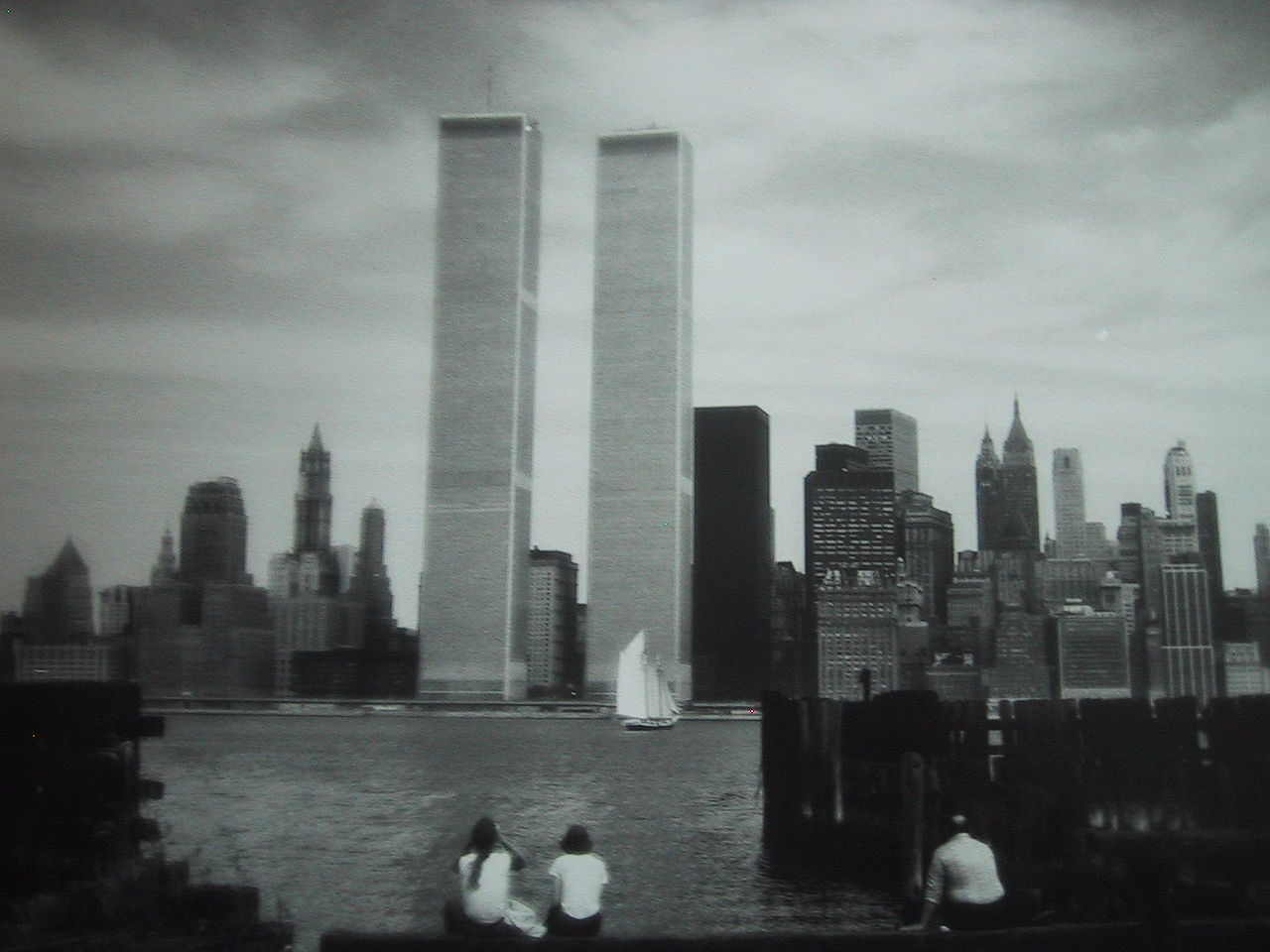
World Trade Buildings Across the Water, circa 1990, © Edgar de Evia. David McJonathan owns all rights, licensed under Creative Commons Attribution-Share Alike 2.5 Generic

World Trade Buildings Across the Water, circa 1990, © Edgar de Evia. David McJonathan owns all rights, licensed under Creative Commons Attribution-Share Alike 2.5 Generic

Bernhardt Writer is Adolphus’s older, more mature, and handsomer brother. He will contribute reviews, commentary, and essays from time to time. He has contributed anonymously and pseudonymously before on this blog. Please forbear him, he carries on sometimes.