Whose Side is He On?

We use the phrase: “With God on Our Side,” to justify our deadly decisions as morally right, especially when they’re not. Bob Dylan sings a song recounting how this phrase is used ignominiously in history.

Dylan Sings “With God On Our Side”

Before we go any further, let’s be clear, God gives the sword to rulers so that they act as His servant avenging wrong and carrying out His wrath. He will judge whether they have done this rightly. It is apparent that no government has yet lasted long.

In this context, CNN recently quoted a Ukrainian Priest: “We know how to fight a partisan (guerrilla) war. We know these forests and swamps like the back of our hand and it will be very hard to fight us. Truth will win. Truth is where God is and God is on our side.”

Nearer to home but longer ago, Lincoln said: “Sir, my concern is not whether God is on our side; my greatest concern is to be on God’s side, for God is always right.” In his second inaugural, Lincoln said in part:

…Both [i.e., North and South] read the same Bible, and pray to the same God; and each invokes His aid against the other. It may seem strange that any men should dare to ask a just God’s assistance in wringing their bread from the sweat of other men’s faces; but let us judge not that we be not judged. The prayers of both could not be answered; that of neither has been answered fully. The Almighty has His own purposes. “Woe unto the world because of offences! for it must needs be that offences come; but woe to that man by whom the offence cometh!”

If we shall suppose that American Slavery is one of those offences which, in the providence of God, must needs come, but which, having continued through His appointed time, He now wills to remove, and that He gives to both North and South, this terrible war, as the woe due to those by whom the offence came, shall we discern therein any departure from those divine attributes which the believers in a Living God always ascribe to Him? Fondly do we hope — fervently do we pray — that this mighty scourge of war may speedily pass away.

Yet, if God wills that it continue, until all the wealth piled by the bond–man’s two hundred and fifty years of unrequited toil shall be sunk, and until every drop of blood drawn with the lash, shall be paid by another drawn with the sword, as was said three thousand years ago, so still it must be said “the judgments of the Lord, are true and righteous altogether”

Lincoln on east portico of U.S. Capitol

The second inaugural address of Abraham Lincoln, given on 4 March 1865 on the east portico of the U.S. Capitol, photographed by Alexander Gardner (1821 – 1882), Image created between 1910 and 1920, from photograph taken in 1865, in the public domain in the US.

But where does this sentiment we write about come from and in what context was it said? For the answer, we look to the book of psalms:

The Lord is on my side; I will not fear.
What can man do to me?

The Lord is on my side as my helper;
I shall look in triumph on those who hate me.

It is better to take refuge in the Lord
than to trust in man.

It is better to take refuge in the Lord
than to trust in princes.

Clearly, this is not a justification for princes to use. But, rather, it is an admission of their futility as protection and an admonition for fealty to the Lord of all.

But, is He really on one nation’s side versus that of another? In the following passage, He declares to us No (or Neither) in no uncertain terms. And this took place just prior to a key battle He Himself would use in conquering territory for Israel.

When Joshua was by Jericho, he lifted up his eyes and looked, and behold, a man was standing before him with his drawn sword in his hand. And Joshua went to him and said to him, “Are you for us, or for our adversaries?” And he said, “No; but I am the commander of the army of the LORD. Now I have come.” And Joshua fell on his face to the earth and worshiped and said to him, “What does my lord say to his servant?” And the commander of the LORD’s army said to Joshua, “Take off your sandals from your feet, for the place where you are standing is holy.” And Joshua did so.

So, whether or not the Lord is on our side, nationally, is not a significant question with which to be occupied. The answer is: “Neither.” The most important question we must ask ourselves is: whose side am I on? We choose to serve the Lord.
I Wonder What Else Is Not So?

A new book just came out debunking the link between heart disease and saturated fats. Here’s a quote from the author’s Wall Street Journal Saturday essay:

The fact is, there has never been solid evidence for the idea that these fats cause disease. We only believe this to be the case because nutrition policy has been derailed over the past half-century by a mixture of personal ambition, bad science, politics and bias.

Isn’t that the problem, we jockey for money, power, and fame and look what happens: kale. Quoting from the essay again:

This shift [from animal fat to vegetable oils] seemed like a good idea at the time, but it brought many potential health problems in its wake. In those early clinical trials, people on diets high in vegetable oil were found to suffer higher rates not only of cancer but also of gallstones. And, strikingly, they were more likely to die from violent accidents and suicides.

Who knew that Butter, Meat and Cheese Belong in a Healthy Diet.

What about brute Neandertals? Certainly we got that right. Here’s a recent admission from Scientific American:

Ironically, the original La Chapelle-aux-Saints discovery in the early 20th century gave rise to the Neandertals’ unfortunate reputation as dumb brutes. Shortly after the find, French paleontologist Marcellin Boule reconstructed the skeleton to show a stooped, slouching individual with bent knees, a short neck and a low, sloping skull. Thus, the image of the oafish caveman was born. Scientists later determined that the skeleton was in fact that of an aged male who suffered from severe arthritis.

Quoting from the abstract of a PLOS ONE article titled: Neandertal Demise: An Archaeological Analysis of the Modern Human Superiority Complex:

Modern humans are usually seen as superior in a wide range of domains, including weaponry and subsistence strategies, which would have led to the demise of Neandertals. This systematic review of the archaeological records of Neandertals and their modern human contemporaries finds no support for such interpretations, as the Neandertal archaeological record is not different enough to explain the demise in terms of inferiority in archaeologically visible domains.

The paper goes on to suggest interbreeding and assimilation may be responsible for the disappearance of specific Neandertal morphology from the fossil record.

Certainly there can’t be fountains of the deep as described in Genesis and made popular by the recent film Noah? Well, yeah.

All these discrepancies in our science point toward a specific worldview. This worldview encompasses what to think (i.e., modern man is the pinnacle of evolution) and how to think (i.e., power and money rule the prevailing culture, deviate from it at your peril). Holding this worldview ultimately results in downright fraudulence in the quest to dominate all that is thought and believed.

One such fraud recently perpetrated concerned delegitimizing a religion that originated in the Middle East. No one but the skeptical would take the attack seriously. Now–a–days, everyone expects scoffers to scoff, but how many others were hindered or shaken from a true understanding?

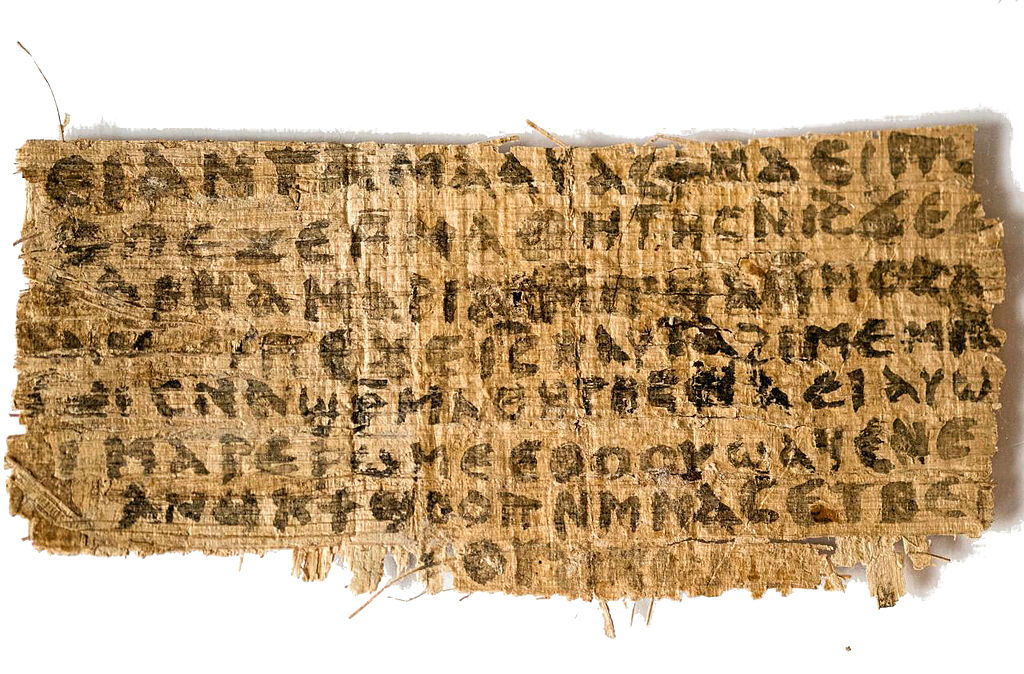
A recent WSJ article, How the ‘Jesus’ Wife’ Hoax Fell Apart, comments on the fraud and its resolution.

“Two factors immediately indicated that this was a forgery,” Mr. Askeland tells me. “First, the fragment shared the same line breaks as the 1924 publication. Second, the fragment contained a peculiar dialect of Coptic called Lycopolitan, which fell out of use during or before the sixth century.” Ms. King [the original researcher involved in the September 2012 announcement] had done two radiometric tests, he noted, and “concluded that the papyrus plants used for this fragment had been harvested in the seventh to ninth centuries.” In other words, the fragment that came from the same material as the “Jesus’ wife” fragment was written in a dialect that didn’t exist when the papyrus it appears on was made.

The article author continues:

It is perhaps understandable that Ms. King would have been taken in when an anonymous owner presented her with some papyrus fragments for research. What is harder to understand was the rush by the media and others to embrace the idea that Jesus had a wife and that Christian beliefs have been mistaken for centuries.

Papyrus fragment

Gospel of Jesus’ Wife by Unknown (Public Domain-US)

I have to ask. Why go to so much trouble? Heart disease, kindred Neandertals, deep fountains, and forged papyri, oh my. If the interpretation of facts and worldviews supported by them are unimportant, then leave it alone and walk away. But they are important. It’s life or death and everyone knows it.

Consider the following. What would happen if we would de-politicize and de-conflict science? Maybe funding wouldn’t be so hard to come by. Maybe folks wouldn’t be so pressured to tow the party line (at any cost). Maybe we’d see some viewpoints, other than our own, are not as crazy as they sound and are just as scientific. Maybe they’d be even more scientific. Just maybe.

You Thought I Was Like You

This IS a new blog post. We rehearse again the same opening statement from an Aeon article on the possibility and ethics of a human imposed artificial hell as we did in a previous post:

Even in my most religious moments, I have never been able to take the idea of hell seriously. Prevailing Christian theology asks us to believe that an all-powerful, all-knowing being would do what no human parent could ever do: create tens of billions of flawed and fragile creatures, pluck out a few favourites to shower in transcendent love, and send the rest to an eternity of unrelenting torment.

However, this time we explore a different facet of the Aeon article argument. Is God like us doing what no human parent would? Although we could spend time expounding on human parenting, both good and bad, I think all of us know those stories either through the media or through our experience. In our age, it’s God’s declarations we’ve forgotten.
The obvious place to start is Psalm 50:21:

These things you have done, and I have been silent; you thought that I was one like yourself. But now I rebuke you and lay the charge before you.

The psalmist describes God calling His people to hear Him speak. He rebukes His faithful, not for being delinquent in ritual sacrifice of bulls and goats which are His anyway, but for not offering sacrifices of thanksgiving, performing their vows to the Most High, and calling upon Him in the day of trouble. And He promises in response:

“I will deliver you, and you shall glorify me.”

To the wicked He says that they have no right to recite His statutes or covenant because they hate discipline and reject His words. He goes on to say that they are pleased with thieves, keep company with adulterers, speak evil and deceit, and condemn and slander even their own kin.

These are the charges over which He kept silent. But not for the reason they might have thought, that He didn’t notice or care, but for them to have time to repent.

Finally, He calls those thus condemned to repentance, even warning them of the penalty if they do not:

“Mark this, then, you who forget God, lest I tear you apart, and there be none to deliver! The one who offers thanksgiving as his sacrifice glorifies Me; to one who orders his way rightly I will show the salvation of God!”

Reiterating this theme, He says through His prophet, Isaiah:

Let the wicked forsake his way, and the unrighteous man his thoughts; let him return to the LORD, that He may have compassion on him, and to our God, for He will abundantly pardon.

For My thoughts are not your thoughts, neither are your ways My ways, declares the LORD. For as the heavens are higher than the earth, so are My ways higher than your ways and My thoughts than your thoughts.

He calls yet again, through His prophet Ezekiel:

“I have no pleasure in the death of the wicked, but that the wicked turn from his way and live.”

And through His prophet Paul, He states that He: desires all people to be saved and to come to the knowledge of the truth.

This God gave His own Son as a sacrifice for us, His enemies, that whoever believes in Him should not die but live, eternally. What human parent ever did that?

Ecce homo! (Behold the man!), by Antonio Ciseri, 1871

Pontius Pilate presenting a scourged Christ to the people Ecce homo! (Behold the man!), by Antonio Ciseri, 1871, in the public domain.

Earn Your Place In Heaven?

Recently, two prominent personalities implied one could earn one’s way to heaven. I’ll let them say it in their own words. Former New York City Mayor Michael Bloomberg is quoted as saying:

“I am telling you if there is a God, when I get to Heaven I’m not stopping to be interviewed,” he told the New York Times, citing his work on gun control, obesity, and anti-smoking laws. “I am heading straight in. I have earned my place in Heaven. It’s not even close.”

On April 15, 2014, in a Back of Book Segment: Life After Death with guest Pastor Robert Jeffers, Bill O’Reilly opined:

“I’ve always felt there is a battle between good and evil and if there is a heaven you have to earn your way in through your actions on Earth.”

Pastor Jeffers corrected the statement by quoting from the book of James.

And, of course, for those who are old enough to remember or are well–schooled in the classics, there’s Led Zeppelin’s Stairway to Heaven:

There’s a lady who’s sure all that glitters is gold And she’s buying a stairway to heaven.

These things they say make me wonder…

But then I remember that He saved us, not because of good works we have done, but according to His own mercy.

I recall that entrance to heaven depends not on human will or exertion, but on God, who has mercy.

Finally, I know that we were ransomed from our futile ways, not with perishable silver or gold, but with Christ’s precious blood.

And, lest we think these assurances are merely cherry picked scriptures, He states, through His prophet, in a single passage excerpted here:

And you were dead in the trespasses and sins…

But God, being rich in mercy, because of the great love with which he loved us, even when we were dead in our trespasses, made us alive together with Christ—by grace you have been saved—

For by grace you have been saved through faith. And this is not your own doing; it is the gift of God, not a result of works, so that no one may boast.

The dead are incapable of earning anything. Only by His mercy does He raise us to life that we might repent of our pride and circumspectly follow Him. And only His way leads to life eternal.

Heaven’s Peak by Greg Willis

Heaven’s Peak by Greg Willis (Creative Commons Attribution-Share Alike 2.0 Generic)

God – Mean Ogre or Transcendent Benefactor?

An Aeon article on the possibility and ethics of a human imposed artificial hell opens with the following statement:

Even in my most religious moments, I have never been able to take the idea of hell seriously. Prevailing Christian theology asks us to believe that an all-powerful, all-knowing being would do what no human parent could ever do: create tens of billions of flawed and fragile creatures, pluck out a few favourites to shower in transcendent love, and send the rest to an eternity of unrelenting torment.

I wouldn’t want to worship that god either.

Chat Botté and the Ogre by Gustave Doré

Illustration of Chat Botté and the Ogre by Gustave Doré (Creative Commons Attribution-Share Alike 3.0 Unported)

But God isn’t that. He created man sin free but with an ability to become otherwise through an act of disobedience.

We are responsible for evil in the world.

The fact that God saw fit to create man and communicate with him at all, even as a friend, is amazing. That He did all this knowing we’d disobey is a wonder. That He would sacrifice His Son on our behalf is a miracle beyond compare. That he would save any (rather than none) is a superlative I can’t express.

It’s characterizations like that in the Aeon article which lead others to make heartrending statements like this:

As I have explained previously, the problem of evil prevents me from believing in God, or at least an all-powerful God who gives a damn about us. But the problem of beauty keeps me from being an adamant atheist.

Beauty is an attribute of God and His habitations. He set beauty in our midst for our enjoyment and so that we’d look to him for salvation.

The Three Languages of Politics – A Review

Arnold Kling is a Cato Institute Adjunct Scholar, a Mercatus Center affiliate, and regularly posts to his askblog site. His book: The Three Languages of Politics is a short essay and analysis of political speech in the United States.

Kling identifies three ideological groups and their dominant dichotomies. Progressives divide issues along an oppressor–oppressed axis. Conservatives use a civilized–barbarous axis. And libertarians, Kling’s camp, use a freedom–coercive axis.

He goes on to say that individuals in each camp use political language divided along these axes to show loyalty, elevate status, and create hostility towards others in opposing camps.

Political debate using these preferred axes is frustrating and endless as each camp talks past the other without communicating.

A debater might either aim to: open minds of those in opposition, open minds of those in their camp, or close the minds of those in their camp. The majority opt for the third option.

Uncharitable discussion focuses on finding an opponent’s weakest argument and denouncing it.

Few participants attempt to be charitable and end up narrowing and reducing their audience’s understanding of the issues at hand.

In the course of argumentation, Kling observes, we suggest we are reasonable and our opponent is not. The only people we are qualified to call unreasonable [or other derogatory terms] are ourselves. Our opponents may be wrong, however, and it is our burden to prove it [which is often hard or impossible].

Kling suggests we treat these ideologies as languages to be understood and not heresies to be stamped out.

Learning the language of other camps enables us to understand how others think about political issues without demonizing their positions or them.

Constructive reasoning weighs the merits of facts and theories to take a stand on an issue. Motivated reasoning filters the facts and theories to legitimate preconceived opinions.

Engaging in motivated reasoning is like arguing a case at law. We present evidence to justify or reinforce already accepted ideas. Openness only extends to those facts and theories that support our views.

Kling concludes that constructive reasoning applies an equal standard to evidence that supports or contradicts our preconceptions. We become open to changing our minds.

Remarkably, we find scripture touches all these axes: oppressoroppressed, civilizedbarbarous, and freedomcoercion. Then again, perhaps it’s not surprising that He plays no favorites.

Newsstands in DC

Newsstands (propaganda) by InSapphoWeTrust (Creative Commons Attribution-Share Alike 2.0 Generic license)

Authority of Scripture?

Since we appeal to the authority of the scriptures on this blog, we should discuss what we mean by it.

We agree with John Calvin in his defense of scripture’s necessity, authority, and character:

Institutes, Chapter 6: …For if we reflect how prone the human mind is to lapse into forgetfulness of God, how readily inclined to every kind of error, how bent every now and then on devising new and fictitious religions, it will be easy to understand how necessary it was to make such a depository of doctrine as would secure it from either perishing by the neglect, vanishing away amid the errors, or being corrupted by the presumptuous audacity of men.

It being thus manifest that God, foreseeing the inefficiency of his image imprinted on the fair form of the universe, has given the assistance of his Word to all whom he has ever been pleased to instruct effectually, we, too, must pursue this straight path, if we aspire in earnest to a genuine contemplation of God;—we must go, I say, to the Word, where the character of God, drawn from his works is described accurately and to the life; these works being estimated, not by our depraved Judgment, but by the standard of eternal truth.

Institutes, Chapter 7: …The next thing to be considered is, how it appears not probable merely, but certain, that the name of God is neither rashly nor cunningly pretended. If, then, we would consult most effectually for our consciences, and save them from being driven about in a whirl of uncertainty, from wavering, and even stumbling at the smallest obstacle, our conviction of the truth of Scripture must be derived from a higher source than human conjectures, Judgments, or reasons; namely, the secret testimony of the Spirit

Still, however, it is preposterous to attempt, by discussion, to rear up a full faith in Scripture…. Profane men think that religion rests only on opinion, and, therefore, that they may not believe foolishly, or on slight grounds, desire and insist to have it proved by reason that Moses and the prophets were divinely inspired. But I answer, that the testimony of the Spirit is superior to reason. For as God alone can properly bear witness to his own words, so these words will not obtain full credit in the hearts of men, until they are sealed by the inward testimony of the Spirit…

Institutes, Chapter 8: …For it is wonderful how much we are confirmed in our belief, when we more attentively consider how admirably the system of divine wisdom contained in it is arranged—how perfectly free the doctrine is from everything that savors of earth—how beautifully it harmonizes in all its parts—and how rich it is in all the other qualities which give an air of majesty to composition.

Our hearts are still more firmly assured when we reflect that our admiration is elicited more by the dignity of the matter than by the graces of style. For it was not without an admirable arrangement of Providence, that the sublime mysteries of the kingdom of heaven have for the greater part been delivered with a contemptible meanness of words.

Had they been adorned with a more splendid eloquence, the wicked might have caviled, and alleged that this constituted all their force. But now, when an unpolished simplicity, almost bordering on rudeness, makes a deeper impression than the loftiest flights of oratory, what does it indicate if not that the Holy Scriptures are too mighty in the power of truth to need the rhetorician’s art?

In light of our previous post, we do not so much agree with the tone with which Calvin defends his positions (and these are mild). He’d definitely have given the current crop of vehement deniers a run for their money were he alive in this day and age.

Lake Geneva

Lake Geneva after storm. Picture taken from Montreux, on the left side in the rays of light – Saint-Gingolph by Rulexip. (Creative Commons Attribution-Share Alike 3.0 Unported)

We say that the scriptures, in the original languages, carry God’s authority as His proclamation of redemption for all who will believe. We say this, rather than maintain, as some do, that they are an accretion of fables or that they consist of truths [that] are illusions which we’ve forgotten are illusions. We believe that God deigns to use vernacular translations in the communication of His truth to the world. We see the scriptures as the window He offers us through which we may know the True and Living God.

Neil deGrasse Tyson Mistakes God for Who He Is Not

Of course all humans fail and err. However, does Tyson mean to impugn God?

According to Mother Jones’ biblical and cosmological authority, Chris Mooney:

To be a Young Earth creationist is to hold a truly unique place in the history of wrongness. These religious ideologues don’t just deny human evolution; their belief in a universe that is only a few thousand years old commits them to an enormity of other errors, including many beliefs that fly in the face of modern physics.

But maybe he’s just host of MJ’s Climate Desk.

According to Mooney, Tyson explains:

To believe in a universe as young as 6 or 7,000 years old is to extinguish the light from most of the galaxy. Not to mention the light from all the hundred billion other galaxies in the observable universe.

But, by this statement, Tyson fallaciously misrepresents his opponent.

Crab Nebula (NASA)

Crab Nebula by Hubble Space Telescope (Public Domain)

Someone of no import nowadays, John Calvin, had this to say of God’s prerogatives with respect to His universe:

With regard to inanimate objects again we must hold that though each is possessed of its peculiar properties, yet all of them exert their force only in so far as directed by the immediate hand of God. Hence they are merely instruments, into which God constantly infuses what energy he sees meet, and turns and converts to any purpose at his pleasure. No created object makes a more wonderful or glorious display than the sun. …No pious man, therefore, will make the sun either the necessary or principal cause of those things which existed before the creation of the sun, but only the instrument which God employs, because he so pleases; though he can lay it aside, and act equally well by himself: Again, when we read, that at the prayer of Joshua the sun was stayed in its course; that as a favor to Hezekiah, its shadow receded ten degrees; by these miracles God declared that the sun does not daily rise and set by a blind instinct of nature, but is governed by Him in its course, that he may renew the remembrance of his paternal favor toward us…

We addressed this previously with our blog post Superstition. Another expert, Aldous Huxley, said:

Most ignorance is vincible ignorance. We don’t know because we don’t want to know. It is our will that decides how and upon what subjects we shall use our intelligence… No philosophy is completely disinterested. The pure love of truth is always mingled to some extent with the need, consciously or unconsciously felt by even the noblest and the most intelligent philosophers.

However, I think we’d all do well to heed John Horgan when he says:

Of course we feel validated when others see the world as we do. But we should resist the need to insist or even imply that our views—or anti-views—are better than all others. In fact, we should all be more modest in how we talk about our faith or lack thereof.

By way of disclosure, we do not hold to typical creation hypotheses, we believe Genesis chapters 1 and 2 are in harmony, and John Horgan does not endorse the content or views expressed on this blog.

Quo Vadis III

We here at Mandated Memoranda Publishing have just released book four to our advanced copy readers. Yes, this is actually book three, but we missed our Christmas deadline, ergo, book four. The title is A Digital Carol. From the protean blurb with which we’ve been toying:

This is a tale from our childhoods retold in modern language and forms. The story’s goal is not to inspire a more joyous holiday or a more generous giving spirit, but to question the very premise of our existence. We are too late into the dark night of the soul for anything but drastic measures.

We purchased the imagery for the cover and hope to post the blurb and quarter scale cover image on the MM books tab soon. We plan to use the same editing service that we used for Tragic Wonders to better effect this time. If we get a good review (who knows), then we’ll splurge on professional promotion.

Apropos of nothing more than sympathy for the Ukrainian people, here’s Wikimedia Commons Picture of the Year 2013 – Second place finisher:

National park Holy Mountains, Donetsk Oblast, Ukraine

National park “Sviati Hory” (Holy Mountains), Donetsk Oblast, Ukraine – Attribution: Balkhovitin (License: CC BY-SA 3.0)

Meanwhile, as folks eagerly purchase in app gaming benefits, we scour the interwebs everyday researching for our next two books. Book three is titled Who Shall Be God and book five is China Dream.

Some of the books we plan to read for WSBG are:

The Righteous Mind: Why Good People Are Divided by Politics and Religion—Jonathan Haidt

The Servile Mind: How Democracy Erodes the Moral Life—Kenneth Minogue

The Revolt Against the Masses: How Liberalism Has Undermined the Middle Class—Fred Siegel

Liberty: Rethinking an Imperiled Ideal—Glenn Tinder

The Three Languages of Politics—Arnold Kling

Some articles that have impressed us are:

Progressives Against Progress—Fred Siegel (City Journal, 2010)

Can We Be Good Without God—Glenn Tinder (Atlantic, 1989)

The False Equation of Atheism and Intellectual Sophistication—Emma Green (Atlantic, 2014)

Bigger Than Phil—Adam Gopnik (The New Yorker, 2014)

Keeping the Faith in My Doubt—John Horgan (NY Times, 2004)

I don’t think I’m giving too much away when I quote Tinder from his Atlantic article:

Tocqueville suggested approvingly that Christianity tends to make a people “circumspect and undecided.” with “its impulses…checked and its works unfinished.” This expresses well the spirit of reform inherent in Christian faith. Christianity is radical, but it is also hesitant. This is partly, of course, because Christianity restrains our self-assurance. Efforts at social transformation must always encounter unforeseen complexities, difficulties, limits, and tragedies. Caution is in order. But Christian hesitancy has deeper grounds than prudence and more compelling motives than wariness of practical blunders. Hesitation expresses a consciousness of the mystery of being and the dignity of every person. It provides a moment for consulting destiny. Recent decades have seen heroic political commitments in behalf of social reform, but hesitation has been evident mainly in the service of self-interest. Christian faith, however, suggests that hesitation should have a part in our most conscientious deeds. It is a formality that is fitting when we cross the frontier between meditation and action. And like all significant formalities, it is a mark of respect—for God and for the creatures with whom we share the earth.

Is our program this year a tad ambitious? You betcha. Worse still, we hope to write about these and other sources in the coming weeks and months.