All Israel Shall Be Saved

Much has been said recently about the reestablishment of Israel in the Middle East. Even Kim Riddlebarger’s A Case for Amillennialism, which we mentioned a few weeks ago, touches on the issue of national Israel. Some of what’s been said is divisive and some is not.

So let’s step back from the contemporary rhetoric and see what the Bible says. The Apostle Paul discussed Israel in his letter to the church in Rome. He described that nation’s relationship to God now that the gospel had been revealed. Paul made the following statement:

And in this way all Israel will be saved, as it is written,

“The Deliverer will come from Zion,

He will banish ungodliness from Jacob”;

Romans 11:26 English Standard Version (ESV)

What did he mean by ‘in this way?’ It seems that a lot of controversy surrounds this clause.

The exegete John Calvin said of the verse:

Many understand this of the Jewish people, as though Paul had said, that religion would again be restored among them as before [e.g., the sacrificial system].

But I extend the word Israel to all the people of God, according to this meaning:

“When the Gentiles shall come in, the Jews also shall return from their defection to the obedience of faith; and thus shall be completed the salvation of the whole Israel of God, which must be gathered from both; and yet in such a way that the Jews shall obtain the first place, being as it were the first-born in God’s family.”

Calvin didn’t make this assertion and others because of personal preference or animus, but based on the context of Paul’s statements in the chapter. Paul went on to say:

As regards the gospel, they [i.e., Israel] are enemies for your [i.e., the hearers of his letter] sake. But as regards election, they are beloved for the sake of their forefathers. For the gifts and the calling of God are irrevocable.

For just as you were at one time disobedient to God but now have received mercy because of their disobedience, so they too have now been disobedient in order that by the mercy shown to you they also may now receive mercy. For God has consigned all to disobedience, that he may have mercy on all. Romans 11:28-32 (ESV)

To this, Calvin commented:

[Paul] shows that the worst thing in the Jews ought not to subject them to the contempt of the Gentiles. Their chief crime was unbelief: but Paul teaches us, that they were thus blinded for a time by God’s providence, that a way to the gospel might be made for the Gentiles;

Paul then intends here to teach two things — that there is nothing in any man why he should be preferred to others, apart from the mere favor of God; and that God in the dispensation of his grace, is under no restraint that he should not grant it to whom he pleases.

There is an emphasis in the word mercy; for it intimates that God is bound to none, and that he therefore saves all freely, for they are all equally lost.

…Paul simply means that both Jews and Gentiles do not otherwise obtain salvation than through the mercy of God, and thus he leaves to none any reason for complaint. It is indeed true that this mercy is without any difference offered to all, but everyone must seek it by faith.

And thus ‘in this way’: All Israel Shall Be Saved.

Valley of Jezreel

The view from Megiddo, northeast across the Jezreel Valley in Israel to Mount Tabor, 9 November 2005, by Joe Freeman, Creative Commons Attribution-Share Alike 2.5 Generic

Prayer – Why Should We Pray If He Is All-knowing?

John Calvin addressed the issue posed by the title in his Institutes of the Christian Religion. He says it’s absurd to dissuade people from praying because God always knows our needs without us informing Him. To the contrary, Calvin cites Psalm 145:18:

The Lord is near to all who call on him,

    to all who call on him in truth. (ESV)

as the very reason that we should ask for His aid.

Calvin also shoots down the claim that it is unnecessary to ask for things He is ready and willing to provide. He cites Ps. 34:15:

The eyes of the Lord are toward the righteous

    and his ears toward their cry. (ESV)

to assert that God bestows His gifts liberally in answer to the prayers of His children so as to prove His love toward them.

However, Calvin doesn’t discount our laziness and outright presumption at times:

…Although it is true that while we are listless or insensible to our wretchedness, he wakes and watches for use and sometimes even assists us unasked; it is very much for our interest to be constantly supplicating him:

First, that our heart may always be inflamed with a serious and ardent desire of seeking, loving and serving him, while we accustom ourselves to have recourse to him as a sacred anchor in every necessity;

Secondly, that no desires, no longing whatever, of which we are ashamed to make him the witness, may enter our minds, while we learn to place all our wishes in his sight, and thus pour out our heart before him; and,

Lastly, that we may be prepared to receive all his benefits with true gratitude and thanksgiving, while our prayers remind us that they proceed from his hand.

Calvin observes that we more earnestly desire continued answers once we’ve recognized He has answered our previous prayers. We identify His continual, active providence as His tangible demonstration of His promises to us through our experiences of answered prayer.

And so Calvin concludes that both of the following are true: Ps. 121:4

Behold, he who keeps Israel

    will neither slumber nor sleep. (ESV)

And yet whenever He sees us insensible, or, may it not be, unbelieving, he withdraws as if he had forgotten us.

Stoning of Steven

The Lapidation of Saint Stephen, 1625, Rembrandt (1606–1669), in the public domain in the US

Prayer – Why do it?

In his Institutes of the Christian Religion, John Calvin addresses why anyone should pray to God:

For there is a kind of [communication] between God and men, by which, having entered the upper sanctuary, they appear before Him and appeal to his promises, that when necessity requires they may learn by experiences that what they believed merely on the authority of his word was not in vain.

Now, he takes as a given that we hold to this:

Without faith it is impossible to please him, for whoever would draw near to God must believe that he exists and that he rewards those who seek him. Hebrews 11:6 English Standard Version (ESV)

And have done this:

If you confess with your mouth that Jesus is Lord and believe in your heart that God raised him from the dead, you will be saved. Romans 10:9 (ESV)

Calvin goes on to say that it is both necessary and useful to pray to the Lord for every good thing that He promises us. God reveals His promises to us in His word. Therefore, we should know the bible well.

Calvin points out that our only safety is in calling upon our heavenly Father:

Since by it we invoke the presence of His:

Providence to watch over our interests,

Power to sustain us when weak and almost fainting, and

Goodness to receive us into favor, though miserably loaded with sin.

Through prayer, we call upon Him to make evident to us all his excellent attributes.

As a result of calling upon Him, Calvin states:

Admirable peace and tranquility are given to our consciences; for the straits by which we were pressed being laid before the Lord, we rest fully satisfied with the assurance that none of our evils are unknown to him, and that he is both able and willing to make the best provision for us.

Next week, we’ll consider the question: “Why Should We Pray If He Is All-knowing?”

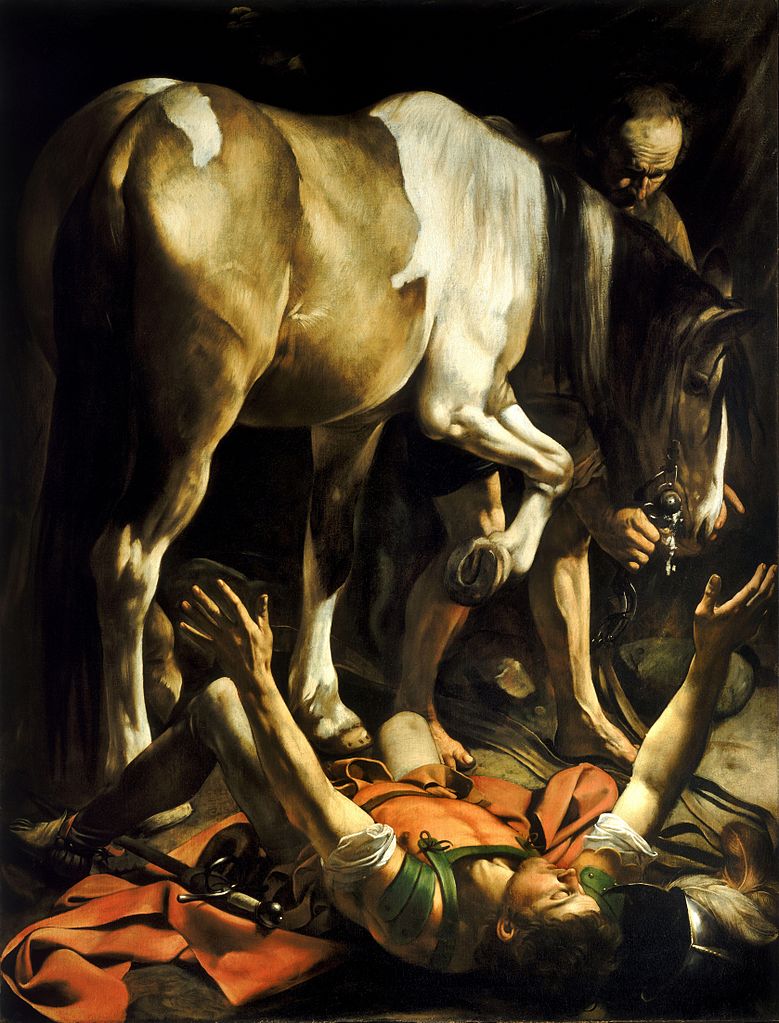
The Conversion of Paul - Caravaggio

Conversion on the Way to Damascus, circa 1600-1601, Caravaggio (1571–1610), public domain in the US

The Real Meaning of Thanksgiving Day

Perhaps you’ve read these proclamations by Abraham Lincoln? I had not. Perhaps they mean nothing to you; perhaps they meant nothing to Abraham Lincoln or his Secretary of State, William Seward. But, even if they were just speechifying, these stand as powerful and stark words, even today.

Proclamation 97 — Appointing a Day of National Humiliation, Fasting, and Prayer – March 30, 1863

By the President of the United States of America

A Proclamation

Whereas the Senate of the United States, devoutly recognizing the supreme authority and just government of Almighty God in all the affairs of men and of nations, has by a resolution requested the President to designate and set apart a day for national prayer and humiliation; and

Whereas it is the duty of nations as well as of men to own their dependence upon the overruling power of God, to confess their sins and transgressions in humble sorrow, yet with assured hope that genuine repentance will lead to mercy and pardon, and to recognize the sublime truth, announced in the Holy Scriptures and proven by all history, that those nations only are blessed whose God is the Lord;

And, insomuch as we know that by His divine law nations, like individuals, are subjected to punishments and chastisements in this world, may we not justly fear that the awful calamity of civil war which now desolates the land may be but a punishment inflicted upon us for our presumptuous sins, to the needful end of our national reformation as a whole people? We have been the recipients of the choicest bounties of Heaven; we have been preserved these many years in peace and prosperity; we have grown in numbers, wealth, and power as no other nation has ever grown. But we have forgotten God. We have forgotten the gracious hand which preserved us in peace and multiplied and enriched and strengthened us, and we have vainly imagined, in the deceitfulness of our hearts, that all these blessings were produced by some superior wisdom and virtue of our own. Intoxicated with unbroken success, we have become too self-sufficient to feel the necessity of redeeming and preserving grace, too proud to pray to the God that made us.

It behooves us, then, to humble ourselves before the offended Power, to confess our national sins, and to pray for clemency and forgiveness.

Now, therefore, in compliance with the request, and fully concurring in the views of the Senate, I do by this my proclamation designate and set apart Thursday, the 30th day of April, 1863, as a day of national humiliation, fasting, and prayer. And I do hereby request all the people to abstain on that day from their ordinary secular pursuits, and to unite at their several places of public worship and their respective homes in keeping the day holy to the Lord and devoted to the humble discharge of the religious duties proper to that solemn occasion.

All this being done in sincerity and truth, let us then rest humbly in the hope authorized by the divine teachings that the united cry of the nation will be heard on high and answered with blessings no less than the pardon of our national sins and the restoration of our now divided and suffering country to its former happy condition of unity and peace. In witness whereof I have hereunto set my hand and caused the seal of the United States to be affixed.

Done at the city of Washington, this 30th day of March, A. D. 1863, and of the Independence of the United States the eighty-seventh.

ABRAHAM LINCOLN.

By the President:

WILLIAM H. SEWARD, Secretary of State.

Citation: Abraham Lincoln: “Proclamation 97 – Appointing a Day of National Humiliation, Fasting, and Prayer,” March 30, 1863. Online by Gerhard Peters and John T. Woolley, The American Presidency Project.

The second proclamation sets forth a specific day for thanksgiving.

Proclamation 106 — Thanksgiving Day, 1863 – October 3, 1863

By the President of the United States of America

A Proclamation

The year that is drawing toward its close has been filled with the blessings of fruitful fields and healthful skies. To these bounties, which are so constantly enjoyed that we are prone to forget the source from which they come, others have been added which are of so extraordinary a nature that they can not fail to penetrate and soften even the heart which is habitually insensible to the ever-watchful providence of Almighty God.

In the midst of a civil war of unequaled magnitude and severity, which has sometimes seemed to foreign states to invite and to provoke their aggression, peace has been preserved with all nations, order has been maintained, the laws have been respected and obeyed, and harmony has prevailed everywhere, except in the theater of military conflict, while that theater has been greatly contracted by the advancing armies and navies of the Union.

Needful diversions of wealth and of strength from the fields of peaceful industry to the national defense have not arrested the plow, the shuttle, or the ship; the ax has enlarged the borders of our settlements, and the mines, as well of iron and coal as of the precious metals, have yielded even more abundantly than heretofore. Population has steadily increased notwithstanding the waste that has been made in the camp, the siege, and the battlefield, and the country, rejoicing in the consciousness of augmented strength and vigor, is permitted to expect continuance of years with large increase of freedom.

No human counsel hath devised nor hath any mortal hand worked out these great things. They are the gracious gifts of the Most High God, who, while dealing with us in anger for our sins, hath nevertheless remembered mercy.

It has seemed to me fit and proper that they should be solemnly, reverently, and gratefully acknowledged, as with one heart and one voice, by the whole American people. I do therefore invite my fellow-citizens in every part of the United States, and also those who are at sea and those who are sojourning in foreign lands, to set apart and observe the last Thursday of November next as a day of thanksgiving and praise to our beneficent Father who dwelleth in the heavens. And I recommend to them that while offering up the ascriptions justly due to Him for such singular deliverances and blessings they do also, with humble penitence for our national perverseness and disobedience, commend to His tender care all those who have become widows, orphans. mourners, or sufferers in the lamentable civil strife in which we are unavoidably engaged, and fervently implore the interposition of the Almighty hand to heal the wounds of the nation and to restore it, as soon as may be consistent with the divine purposes, to the full enjoyment of peace, harmony, tranquillity, and union.

In testimony whereof I have hereunto set my hand and caused the seal of the United States to be affixed.

Done at the city of Washington, this 3d day of October, A. D. 1863, and of the Independence of the United States the eighty-eighth.

ABRAHAM LINCOLN.

By the President:

WILLIAM H. SEWARD, Secretary of State.

Citation: Abraham Lincoln: “Proclamation 106 – Thanksgiving Day, 1863,” October 3, 1863. Online by Gerhard Peters and John T. Woolley, The American Presidency Project.

The third proclamation establishes the last Thursday in November as Thanksgiving Day.

Proclamation 118 — Thanksgiving Day, 1864 – October 20, 1864

By the President of the United States of America

A Proclamation

It has pleased Almighty God to prolong our national life another year, defending us with His guardian care against unfriendly designs from abroad and vouchsafing to us in His mercy many and signal victories over the enemy, who is of our own household. It has also pleased our Heavenly Father to favor as well our citizens in their homes as our soldiers in their camps and our sailors on the rivers and seas with unusual health. He has largely augmented our free population by emancipation and by immigration, while He has opened to us new sources of wealth and has crowned the labor of our workingmen in every department of industry with abundant rewards. Moreover, He has been pleased to animate and inspire our minds and hearts with fortitude, courage, and resolution sufficient for the great trial of civil war into which we have been brought by our adherence as a nation to the cause of freedom and humanity, and to afford to us reasonable hopes of an ultimate and happy deliverance from all our dangers and afflictions:

Now, therefore, I, Abraham Lincoln, President of the United States, do hereby appoint and set apart the last Thursday in November next as a day which I desire to be observed by all my fellow-citizens, wherever they may then be, as a day of thanksgiving and praise to Almighty God, the beneficent Creator and Ruler of the Universe. And I do further recommend to my fellow-citizens aforesaid that on that occasion they do reverently humble themselves in the dust and from thence offer up penitent and fervent prayers and supplications to the Great Disposer of Events for a return of the inestimable blessings of peace, union, and harmony throughout the land which it has pleased Him to assign as a dwelling place for ourselves and for our posterity throughout all generations.

In testimony whereof I have hereunto set my hand and caused the seal of the United States to be affixed.

Done at the city of Washington, this 20th day of October, A.D. 1864, and of the Independence of the United States the eighty-ninth.

ABRAHAM LINCOLN.

By the President:

WILLIAM H. SEWARD, Secretary of State .

Citation: Abraham Lincoln: “Proclamation 118 – Thanksgiving Day, 1864,” October 20, 1864. Online by Gerhard Peters and John T. Woolley, The American Presidency Project.

These proclamations, in their totality, are what the day should mean for the citizens of the United States of America.

Freedom From Want - Rockwell

FREEDOM FROM WANT — Office for Emergency Management. Office of War Information. Domestic Operations Branch. Bureau of Special Services. (03/09/1943 – 09/15/1945), in the Public Domain


Why Do They Call Evil That Which Is Good?

Chris Mooney says in his article ‘Science Deniers Are Freaking Out About “Cosmos”’

Indeed, the science denial crowd hasn’t been happy with Cosmos in general. Here are some principal lines of attack:

  • Denying the Big Bang
  • Denying evolution
  • Denying climate change

Chris Mooney is a science and political journalist, podcaster, and the host of MJ’s Climate Desk Live. He is the author of four books, including the New York Times bestselling The Republican War on Science. You can read the rest at Bill Moyer’s site and Mother Jones, if you like this sort of thing.

Michael Brendan Dougherty, a more subtle critic, says in his article: ‘In Defense of Creationists – Sure, they’re misreading Genesis. But for all the right reasons.’

My own view is that a literal one-week creation should be ruled out because, combined with the best knowledge we have of science, it would make God into a devil, a trickster. “Haha, mortals, I only buried these dinosaur bones and set the galaxies in explosive motion so the unbelievers would damn themselves to Hell,” doesn’t sound like a great or loving God. It seems to me that the very idea of good, eternal, law-giving God endowing man with rational abilities was the historical prerequisite for scientific exploration.

Michael Brendan Dougherty is senior correspondent at TheWeek.com. He is the founder and editor of The Slurve, a newsletter about baseball. His work has appeared in The New York Times Magazine, ESPN Magazine, Slate and The American Conservative. You can read the rest of this article at The Week.

In the act of creation, God demonstrated overwhelming creative power throughout time and space (and whatever else there might be that we have yet to discover). We reviewed this concept in-depth in our post ‘Every Good Story – Thysdor Ya’Rosel’ and more succinctly in ‘All the world’s a stage…

So far as misreading Genesis, we covered that issue in the recent post ‘Nip ‘Em in the Bud.’

We live in a universe governed by laws which the Law Giver can suspend as it suits His good pleasure. We’ve covered this concept in another recent post ‘Instrumentality.’

For those of us old enough to remember, both the Twilight Zone and Outer Limits television series’ had episodes where that which existed had no reality behind it. How creepy would it be to dig into the ground and find nothing (i.e. no precious metals and gems, petrochemicals, fossils, etc.)?

To this point, the scriptures describe treasures in the sand and deep beneath the ground. As described in Scripture, the world is meant to communicate two major lessons concerning God:

For his invisible attributes, namely, his eternal power and divine nature, have been clearly perceived, ever since the creation of the world, in the things that have been made. Romans 1:20 English Standard Version (ESV)

On the fossils front, death certainly entered creation when the Lord God made garments of skins to clothe Adam and Eve after their fall from grace.  We also read that the creation was subjected to futility by God because of Adam’s sin. So, we can say with confidence that sin had far-reaching consequences for creation!

It’s helpful to see the Scriptures as an accommodation to us by an infinite and unknowable God. In fact, the Lord Jesus Christ is described as the image of the invisible God and declares Himself of one essence with the Father. He appeared to us in human form to identify with us more fully than we sometimes appreciate.

The Lord Jesus Christ taught often through parables:

A parable is a succinct, didactic story, in prose or verse, which illustrates one or more instructive lessons or principles. It differs from a fable in that fables employ animals, plants, inanimate objects, or forces of nature as characters, whereas parables have human characters. A parable is a type of analogy.

When asked, the Lord Jesus Christ explained to His followers why He spoke in parables:

This is why I speak to them in parables, because seeing they do not see, and hearing they do not hear, nor do they understand. Matthew 13:13 (ESV)

He spoke this to remind His followers of Isaiah’s prophecy:

And He said, “Go, and say to this people: “‘Keep on hearing, but do not understand; keep on seeing, but do not perceive.’ Make the heart of this people dull, and their ears heavy, and blind their eyes; lest they see with their eyes, and hear with their ears, and understand with their hearts, and turn and be healed.” Isaiah 6:9-10 (ESV)

Again, reiterating today’s opening statements, isn’t He evil for not revealing all? In the parable about Lazarus and the rich man, concerning warnings about the place of eternal torment:

He said to him, ‘If they do not hear Moses and the Prophets, neither will they be convinced if someone should rise from the dead.’” Luke 16:31 (ESV)

Ultimately, it comes down to believing, or not, the documentary evidence that we have in Scripture. We’ve addressed the authority and basic meaning of Scripture in our posts: ‘Authority of Scripture?’ and ‘Scripture – What Is It Good For?,’ respectively.

So, we stand condemned unless He saves us and, otherwise, we remain dead in our sins and trespasses. God, through the apostle, speaks of His sovereignty in these matters:

But who are you, O man, to answer back to God? Will what is molded say to its molder, “Why have you made me like this?” Romans 9:20 (ESV)

We may take offence to this statement. But, we’ve conveniently forgotten what preceded this passage:

…For all have sinned and fall short of the glory of God, Romans 3:23 (ESV)

The onus for sin lies with us. We’ve examined our responsibility in the post titled: ‘There, But for God’s Grace and Mercy Through His Providence, Go I.’

Why one side insists on winning a war started before the First World War, I understand. Loosely paraphrasing Huxley, they believe what they want because they have an agenda that doesn’t include the One that made them. We’ve covered Aldous Huxley’s admission in our posts ‘Wonder Why?’ and ‘Mean Ends – Luxe Hso-Dualy.’

But I grow tired of their fight as this life winds down. These recurrent attacks endanger the liberty we all claim to cherish. You can keep your slapshots to yourselves. We’ve already addressed this latest controversy in our post: ‘Climate Changiness.’

Now, we’ve discussed how it’s our duty to live peaceful and quiet lives. The Scriptures say we will be persecuted as He was. However, dear folks of the opposition, your war is with Him. And you will inevitably appear before Him, so, please live peacefully while He gives you opportunity to repent.

Politicization of science by the right or the left is futile. Finally, it comes down to what the Lord Jesus Christ said to His critics:

Jesus said to them, “Is this not the reason you are wrong, because you know neither the Scriptures nor the power of God? Mark 12:24 (ESV)

I urge you, turn and be healed.

The Garden of Eden, Thomas Cole

The Garden of Eden, 1828, Thomas Cole (1801–1848), public domain – US

Whose Side is He On?

We use the phrase: “With God on Our Side,” to justify our deadly decisions as morally right, especially when they’re not. Bob Dylan sings a song recounting how this phrase is used ignominiously in history.

Dylan Sings “With God On Our Side”

Before we go any further, let’s be clear, God gives the sword to rulers so that they act as His servant avenging wrong and carrying out His wrath. He will judge whether they have done this rightly. It is apparent that no government has yet lasted long.

In this context, CNN recently quoted a Ukrainian Priest: “We know how to fight a partisan (guerrilla) war. We know these forests and swamps like the back of our hand and it will be very hard to fight us. Truth will win. Truth is where God is and God is on our side.”

Nearer to home but longer ago, Lincoln said: “Sir, my concern is not whether God is on our side; my greatest concern is to be on God’s side, for God is always right.” In his second inaugural, Lincoln said in part:

…Both [i.e., North and South] read the same Bible, and pray to the same God; and each invokes His aid against the other. It may seem strange that any men should dare to ask a just God’s assistance in wringing their bread from the sweat of other men’s faces; but let us judge not that we be not judged. The prayers of both could not be answered; that of neither has been answered fully. The Almighty has His own purposes. “Woe unto the world because of offences! for it must needs be that offences come; but woe to that man by whom the offence cometh!”

If we shall suppose that American Slavery is one of those offences which, in the providence of God, must needs come, but which, having continued through His appointed time, He now wills to remove, and that He gives to both North and South, this terrible war, as the woe due to those by whom the offence came, shall we discern therein any departure from those divine attributes which the believers in a Living God always ascribe to Him? Fondly do we hope — fervently do we pray — that this mighty scourge of war may speedily pass away.

Yet, if God wills that it continue, until all the wealth piled by the bond–man’s two hundred and fifty years of unrequited toil shall be sunk, and until every drop of blood drawn with the lash, shall be paid by another drawn with the sword, as was said three thousand years ago, so still it must be said “the judgments of the Lord, are true and righteous altogether”

Lincoln on east portico of U.S. Capitol

The second inaugural address of Abraham Lincoln, given on 4 March 1865 on the east portico of the U.S. Capitol, photographed by Alexander Gardner (1821 – 1882), Image created between 1910 and 1920, from photograph taken in 1865, in the public domain in the US.

But where does this sentiment we write about come from and in what context was it said? For the answer, we look to the book of psalms:

The Lord is on my side; I will not fear.
What can man do to me?

The Lord is on my side as my helper;
I shall look in triumph on those who hate me.

It is better to take refuge in the Lord
than to trust in man.

It is better to take refuge in the Lord
than to trust in princes.

Clearly, this is not a justification for princes to use. But, rather, it is an admission of their futility as protection and an admonition for fealty to the Lord of all.

But, is He really on one nation’s side versus that of another? In the following passage, He declares to us No (or Neither) in no uncertain terms. And this took place just prior to a key battle He Himself would use in conquering territory for Israel.

When Joshua was by Jericho, he lifted up his eyes and looked, and behold, a man was standing before him with his drawn sword in his hand. And Joshua went to him and said to him, “Are you for us, or for our adversaries?” And he said, “No; but I am the commander of the army of the LORD. Now I have come.” And Joshua fell on his face to the earth and worshiped and said to him, “What does my lord say to his servant?” And the commander of the LORD’s army said to Joshua, “Take off your sandals from your feet, for the place where you are standing is holy.” And Joshua did so.

So, whether or not the Lord is on our side, nationally, is not a significant question with which to be occupied. The answer is: “Neither.” The most important question we must ask ourselves is: whose side am I on? We choose to serve the Lord.

There, But for God’s Grace and Mercy Through His Providence, Go I

John Calvin

John Calvin (Photo credit: Wikipedia)

Why are we shocked when things like this, this, or this happen?

These sensational stories are tragic, no doubt. Scary, even. But we seem to think we’d never do or even be capable of such heinous acts. Then we bolt our door against our neighbor (rightly or wrongly, I can’t say; that’s up to you). Some believe we’re naturally moral. Still others say: red in tooth and claw.

The scriptures conclude we all fall short of God’s glory. But isn’t this an overstatement of our condition? Aren’t we really good, but just misguided, unmotivated, or low informational?

Paul, in the letter to the Romans, elaborates on what he concludes in case we were unsure:

11 no one understands;
no one seeks for God.
12  All have turned aside; together they have become worthless;
no one does good,
not even one.”
13 “Their throat is an open grave;
they use their tongues to deceive.”
“The venom of asps is under their lips.”
14 “Their mouth is full of curses and bitterness.”
15 “Their feet are swift to shed blood;
16   in their paths are ruin and misery,
17    and the way of peace they have not known.”
18   “There is no fear of God before their eyes.”

So, we have no excuse to be shocked at these sensational stories. This is the condition of man. However, if this is so, why then do we not claw and bite until we are no more?

John Calvin, a theologian not often cited now–a–days, suggests in the Institutes of the Christian Religion, book 1, chapter 17, and paragraph 11:

…How comes it, I ask, that their confidence never fails, but just that while the world apparently revolves at random, they know that God is everywhere at work, and feel assured that his work will be their safety? When assailed by the devil and wicked men, were they not confirmed by remembering and meditating on Providence, they should, of necessity, forthwith despond. But when they call to mind that the devil, and the whole train of the ungodly, are, in all directions, held in by the hand of God as with a bridle, so that they can neither conceive any mischief, nor plan what they have conceived, nor how much so ever they may have planned, move a single finger to perpetrate, unless in so far as he permits, nay, unless in so far as he commands; that they are not only bound by his fetters, but are even forced to do him service,—when the godly think of all these things they have ample sources of consolation. For, as it belongs to the lord to arm the fury of such foes and turn and destine it at pleasure, so it is his also to determine the measure and the end, so as to prevent them from breaking loose and wantoning as they list…

So God not only constrains the evildoer but commands him to do His bidding, yet without complicity or taint thrown back upon Him. But why, if we’re this way, are we guilty at all?

Calvin says in the Institutes of the Christian Religion, book 1, chapter 17, and paragraph 5:

… As all contingencies whatsoever depend on it, therefore, neither thefts nor adulteries, nor murders, are perpetrated without an interposition of the divine will. Why, then, they ask, should the thief be punished for robbing him whom the Lord chose to chastise with poverty? Why should the murderer be punished for slaying him whose life the Lord had terminated? If all such persons serve the will of God, why should they be punished?

I deny that they serve the will of God. For we cannot say that he who is carried away by a wicked mind performs service on the order of God, when he is only following his own malignant desires. He obeys God, who, being instructed in his will, hastens in the direction in which God calls him.

But how are we so instructed unless by his word? The will declared by his word is, therefore, that which we must keep in view in acting, God requires of us nothing but what he enjoins. If we design anything contrary to his precept, it is not obedience, but contumacy and transgression. But if he did not will it, we could not do it. I admit this.

But do we act wickedly for the purpose of yielding obedience to him? This, assuredly, he does not command. Nay, rather we rush on, not thinking of what he wishes, but so inflamed by our own passionate lust, that, with destined purpose, we strive against him. And in this way, while acting wickedly, we serve his righteous ordination, since in his boundless wisdom he well knows how to use bad instruments for good purposes.

And see how absurd this mode of arguing is. They will have it that crimes ought not to be punished in their authors, because they are not committed without the dispensation of God. I concede more—that thieves and murderers, and other evil-doers, are instruments of Divine Providence, being employed by the Lord himself to execute the Judgments which he has resolved to inflict.

But I deny that this forms any excuse for their misdeeds. For how? Will they implicate God in the same iniquity with themselves, or will they cloak their depravity by his righteousness? They cannot exculpate themselves, for their own conscience condemns them: they cannot charge God, since they perceive the whole wickedness in themselves, and nothing in Him save the legitimate use of their wickedness

So, it is apparent that Romans 3 is true and we are not only held back from what we could do but others are employed to execute God’s judgments and, yet, are solely guilty of their transgression.

I see the tendency to do wrong in myself all the time. Do you? The only remedy is falling at the feet of the Lord Jesus Christ in surrender because he says: Come to me, all who labor and are heavy laden, and I will give you rest.