Uncertain Footing

We go about our business without a care for the ground beneath us. However, can we be sure our foot will not slip? Losing what we think is firm footing can occur suddenly and without warning. Some causes are of this earth and some are not. All are common to the human condition.

One way we lose our footing is due to sinkholes. These occur because water erodes underground supports via either natural or manmade processes.

A Sinkhole in a Northeastern Chinese City Swallowed Five People [Required Hospitalization], CCTV, published on Aug 27, 2015

The United States Geological Survey (USGS) cites a shocking statistic. Between 35 to 40 percent of the US is susceptible to sinkholes. These occur in two rock types: evaporites (salt, gypsum, and anhydrite) and carbonates (limestone and dolomite). Many formations, but not all, occur at deep depths.

http://water.usgs.gov/edu/sinkholes.html

USGS Sinkhole Susceptibility Map

Commonly, water erosion in these areas results in underground caverns which can lead to ground subsidence. However, sometimes the cavern erodes so extensively that the ceiling collapses and a sinkhole results. Such things are common in Florida and Louisiana.

8/21/13 Slough in, Assumption Parish, Louisiana

As frightening as these may be, we find ourselves in a much worse situation: at any moment we can plunge into Hell.

Only God’s patient endurance gives any of us more time on this earth. He is in the right concerning this because He gives us existence. And He calls us wicked because we continually disobey Him.

A famous (some say infamous) American preacher, Jonathan Edwards, delivered one of many sermons to his congregation called “Sinners in the Hands of an Angry God.” Maybe you studied it in high school or college.

The sermon’s premise is summed up by Edwards’s statement:

“There is nothing that keeps wicked men at any one moment out of hell, but the mere pleasure of God.”

Of Edwards’s ten considerations, these three bring home our predicament:

2.  The Wicked deserve to be cast into hell. Divine justice does not prevent God from destroying the Wicked at any moment.

6.  If it were not for God’s restraints, there are, in the souls of wicked men, hellish principles reigning which, presently, would kindle and flame out into hellfire.

10.  God has never promised to save us from Hell, except for those contained in Christ through the covenant of Grace.

Just as his congregants cried out, we must say:

“What shall I do to be saved?”

And as Paul and Silas answered the Jailer:

Believe in the Lord Jesus, and you will be saved, you and your household

Only then will we have sure footing.

Sinners In The Hands Of An Angry God,” sermon reenacted by Ralph Green, October 30, 2012, Cloverhill4’s channel


The Lord Is Always Before Me

Can you make the claim in the title like the psalmist David did? I find I can’t; at least not consistently. But I want to. I want to very much.

I have set the Lord always before me;

    because he is at my right hand, I shall not be shaken.

Therefore my heart is glad, and my whole being rejoices;

    my flesh also dwells secure.

Psalm 16:8-9 English Standard Version (ESV)

Calvin says with regard to verse 8:

…The meaning, therefore, is, that David kept his mind so intently fixed upon the providence of God, as to be fully persuaded, that whenever any difficulty or distress should befall him, God would be always at hand to assist him.

He adds, also, [always], to show us how he constantly depended upon the assistance of God, so that, amidst the various conflicts with which he was agitated, no fear of danger could make him turn his eyes to any other quarter than to God in search of succor.

…David then reckons himself secure against all dangers, and promises himself certain safety, because, with the eyes of faith, he beholds God as present with him.

And with regard to verse 9:

In short, calmly to rejoice is the lot of no man but of him who has learned to place his confidence in God alone, and to commit his life and safety to his protection.

When, therefore, encompassed with innumerable troubles on all sides, let us be persuaded, that the only remedy is to direct our eyes towards God; and if we do this, faith will not only tranquillize our minds, but also replenish them with fullness of joy.

…Farther, although the body is not free from inconveniences and troubles, yet as God defends and maintains not only our souls, but also our bodies, David does not speak groundlessly when he represents the blessing of dwelling in safety as extending to his flesh in common with his soul.

David’s statements in verses 8 and 9 pertain to us if we’ve trusted in Christ. However, verse 10 does not.

For you will not abandon my soul to Sheol,

    or let your holy one see corruption.

Psalm 16:10 (ESV)

This verse didn’t even apply to David as the Apostle Peter rightly points out in his sermon at Pentecost. Peter uses this psalm (esp. verse 10) as a testimony of Christ’s resurrection. The passage is found in Acts of the Apostles, chapter 2, verses 25-28 (ESV).

We serve a risen Lord always ready to provide mercy and grace in our time of need. Call to Him.

View from the Cross

What Our Lord Saw from the Cross, 1886–1894, by James Tissot (1836–1902), in the public domain in the US

Do You Swear?

During the Lord Jesus’s Sermon on the Mount, He defined God’s standards for a righteous life. He cited common understandings for principled living and then raised the bar. Among these principles, He declared swearing (i.e., oath taking) off-limits.

“Again you have heard that it was said to those of old, ‘You shall not swear falsely, but shall perform to the Lord what you have sworn.’

But I say to you, do not take an oath at all, either by heaven, for it is the throne of God, or by the earth, for it is his footstool, or by Jerusalem, for it is the city of the great King. And do not take an oath by your head, for you cannot make one hair white or black.

Let what you say be simply ‘Yes’ or ‘No’; anything more than this comes from evil. Matthew 5:33-37 English Standard Version (ESV)

Specifically, Christ prohibits using God’s name (or euphemisms for it) to bolster our sincerity in what we promise or declare to others and to God.

John Calvin comments:

You shall not swear falsely… The man who perjures himself is not the only person who takes the name of God in vain, (Exodus 20:7). He does so, who idly and contemptuously pronounces the name of God on trivial occasions, or in ordinary conversation.

Calvin points out that some have used the Lord’s command to reject all vows. He says they’re mistaken:

Do not take an oath at all… His statement amounts to this, that there are other ways of “taking the name of God in vain,” besides perjury; and, therefore, that we ought to refrain from allowing ourselves the liberty of unnecessary swearing: for, when there are just reasons to demand it, the law not only permits, but expressly commands us to swear.

Stating the obvious, Calvin concludes:

Let what you say be simply ‘Yes’ or ‘No’ Christ now prescribes… that men act towards each other sincerely and honestly… Fairness and honesty in our words are, therefore, demanded by Christ, that there may be no longer any occasion for an oath.

And James, in his letter to the churches, echoed his Lord’s admonition:

But above all, my brothers, do not swear, either by heaven or by earth or by any other oath, but let your “yes” be yes and your “no” be no, so that you may not fall under condemnation. James 5:12 (ESV)

Therefore, let us speak truth, one to another.

Us – Michael Been, The Best of The Call

All Israel Shall Be Saved

Much has been said recently about the reestablishment of Israel in the Middle East. Even Kim Riddlebarger’s A Case for Amillennialism, which we mentioned a few weeks ago, touches on the issue of national Israel. Some of what’s been said is divisive and some is not.

So let’s step back from the contemporary rhetoric and see what the Bible says. The Apostle Paul discussed Israel in his letter to the church in Rome. He described that nation’s relationship to God now that the gospel had been revealed. Paul made the following statement:

And in this way all Israel will be saved, as it is written,

“The Deliverer will come from Zion,

He will banish ungodliness from Jacob”;

Romans 11:26 English Standard Version (ESV)

What did he mean by ‘in this way?’ It seems that a lot of controversy surrounds this clause.

The exegete John Calvin said of the verse:

Many understand this of the Jewish people, as though Paul had said, that religion would again be restored among them as before [e.g., the sacrificial system].

But I extend the word Israel to all the people of God, according to this meaning:

“When the Gentiles shall come in, the Jews also shall return from their defection to the obedience of faith; and thus shall be completed the salvation of the whole Israel of God, which must be gathered from both; and yet in such a way that the Jews shall obtain the first place, being as it were the first-born in God’s family.”

Calvin didn’t make this assertion and others because of personal preference or animus, but based on the context of Paul’s statements in the chapter. Paul went on to say:

As regards the gospel, they [i.e., Israel] are enemies for your [i.e., the hearers of his letter] sake. But as regards election, they are beloved for the sake of their forefathers. For the gifts and the calling of God are irrevocable.

For just as you were at one time disobedient to God but now have received mercy because of their disobedience, so they too have now been disobedient in order that by the mercy shown to you they also may now receive mercy. For God has consigned all to disobedience, that he may have mercy on all. Romans 11:28-32 (ESV)

To this, Calvin commented:

[Paul] shows that the worst thing in the Jews ought not to subject them to the contempt of the Gentiles. Their chief crime was unbelief: but Paul teaches us, that they were thus blinded for a time by God’s providence, that a way to the gospel might be made for the Gentiles;

Paul then intends here to teach two things — that there is nothing in any man why he should be preferred to others, apart from the mere favor of God; and that God in the dispensation of his grace, is under no restraint that he should not grant it to whom he pleases.

There is an emphasis in the word mercy; for it intimates that God is bound to none, and that he therefore saves all freely, for they are all equally lost.

…Paul simply means that both Jews and Gentiles do not otherwise obtain salvation than through the mercy of God, and thus he leaves to none any reason for complaint. It is indeed true that this mercy is without any difference offered to all, but everyone must seek it by faith.

And thus ‘in this way’: All Israel Shall Be Saved.

Valley of Jezreel

The view from Megiddo, northeast across the Jezreel Valley in Israel to Mount Tabor, 9 November 2005, by Joe Freeman, Creative Commons Attribution-Share Alike 2.5 Generic

Prayer – Why Should We Pray If He Is All-knowing?

John Calvin addressed the issue posed by the title in his Institutes of the Christian Religion. He says it’s absurd to dissuade people from praying because God always knows our needs without us informing Him. To the contrary, Calvin cites Psalm 145:18:

The Lord is near to all who call on him,

    to all who call on him in truth. (ESV)

as the very reason that we should ask for His aid.

Calvin also shoots down the claim that it is unnecessary to ask for things He is ready and willing to provide. He cites Ps. 34:15:

The eyes of the Lord are toward the righteous

    and his ears toward their cry. (ESV)

to assert that God bestows His gifts liberally in answer to the prayers of His children so as to prove His love toward them.

However, Calvin doesn’t discount our laziness and outright presumption at times:

…Although it is true that while we are listless or insensible to our wretchedness, he wakes and watches for use and sometimes even assists us unasked; it is very much for our interest to be constantly supplicating him:

First, that our heart may always be inflamed with a serious and ardent desire of seeking, loving and serving him, while we accustom ourselves to have recourse to him as a sacred anchor in every necessity;

Secondly, that no desires, no longing whatever, of which we are ashamed to make him the witness, may enter our minds, while we learn to place all our wishes in his sight, and thus pour out our heart before him; and,

Lastly, that we may be prepared to receive all his benefits with true gratitude and thanksgiving, while our prayers remind us that they proceed from his hand.

Calvin observes that we more earnestly desire continued answers once we’ve recognized He has answered our previous prayers. We identify His continual, active providence as His tangible demonstration of His promises to us through our experiences of answered prayer.

And so Calvin concludes that both of the following are true: Ps. 121:4

Behold, he who keeps Israel

    will neither slumber nor sleep. (ESV)

And yet whenever He sees us insensible, or, may it not be, unbelieving, he withdraws as if he had forgotten us.

Stoning of Steven

The Lapidation of Saint Stephen, 1625, Rembrandt (1606–1669), in the public domain in the US

Prayer – Why do it?

In his Institutes of the Christian Religion, John Calvin addresses why anyone should pray to God:

For there is a kind of [communication] between God and men, by which, having entered the upper sanctuary, they appear before Him and appeal to his promises, that when necessity requires they may learn by experiences that what they believed merely on the authority of his word was not in vain.

Now, he takes as a given that we hold to this:

Without faith it is impossible to please him, for whoever would draw near to God must believe that he exists and that he rewards those who seek him. Hebrews 11:6 English Standard Version (ESV)

And have done this:

If you confess with your mouth that Jesus is Lord and believe in your heart that God raised him from the dead, you will be saved. Romans 10:9 (ESV)

Calvin goes on to say that it is both necessary and useful to pray to the Lord for every good thing that He promises us. God reveals His promises to us in His word. Therefore, we should know the bible well.

Calvin points out that our only safety is in calling upon our heavenly Father:

Since by it we invoke the presence of His:

Providence to watch over our interests,

Power to sustain us when weak and almost fainting, and

Goodness to receive us into favor, though miserably loaded with sin.

Through prayer, we call upon Him to make evident to us all his excellent attributes.

As a result of calling upon Him, Calvin states:

Admirable peace and tranquility are given to our consciences; for the straits by which we were pressed being laid before the Lord, we rest fully satisfied with the assurance that none of our evils are unknown to him, and that he is both able and willing to make the best provision for us.

Next week, we’ll consider the question: “Why Should We Pray If He Is All-knowing?”

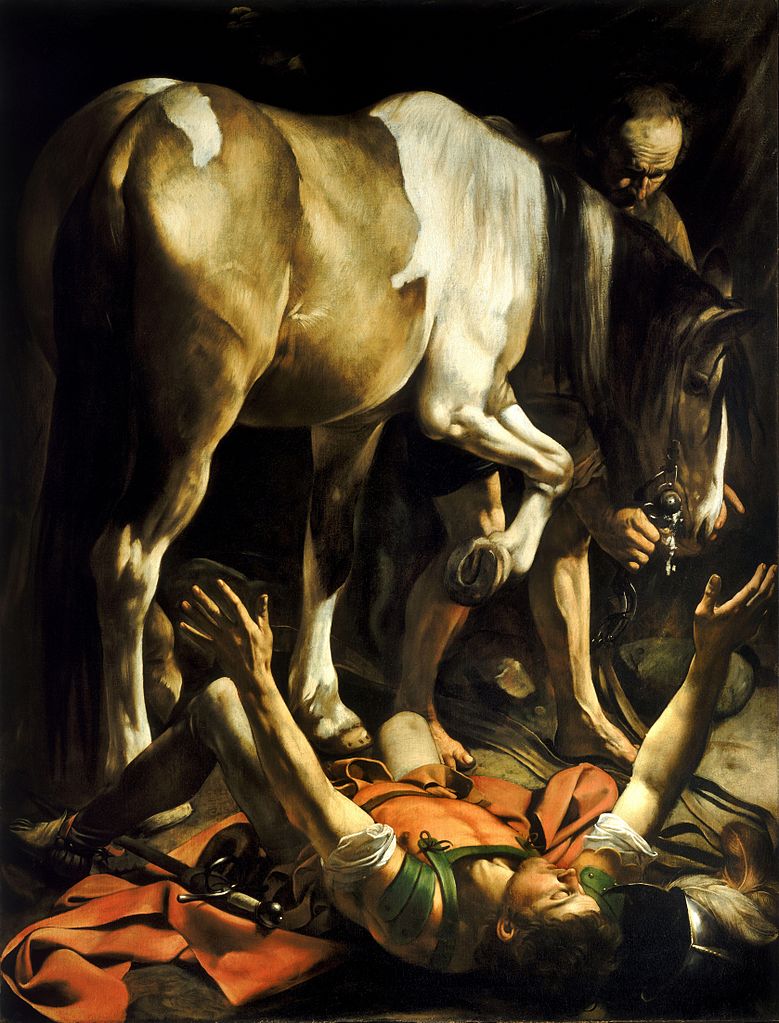
The Conversion of Paul - Caravaggio

Conversion on the Way to Damascus, circa 1600-1601, Caravaggio (1571–1610), public domain in the US

Now and Not Yet

I recently read Kim Riddlebarger’s A Case for Amillennialism. In it, he surveys ways Christians understand (or misunderstand) end times prophesy. I recommend the book for those interested in working through what they believe about the end.

He treats the subject fairly, in my opinion, although he does have a vested interest in Amillennialism. Throughout the text, he explores the concept of multiple fulfillments over time of individual Bible prophesies termed: ‘the now and not yet.’

While reading, it occurred to me that everyone you meet has their own ‘now and not yet.’ Perhaps the following statement seems alien to you:

Though you have not seen Him, you love him. Though you do not now see Him, you believe in Him and rejoice with joy that is inexpressible and filled with glory, obtaining the outcome of your faith, the salvation of your souls. 1 Peter 1:8-9 English Standard Version (ESV)

Certainly, it’s true that those alive today have not seen the Lord Jesus Christ. This is ‘a now and not yet’ for those who trust Him for salvation.

However, what struck me is that many do not love or even believe in Him. Consider this: perhaps it is not yet your time to believe and be saved from God’s wrath. But it could be, soon; perhaps even today.

Of course, you will be saved not because of anything you have done, but according to His mercy and purpose for you:

Though they were not yet born and had done nothing either good or bad—in order that God’s purpose of election might continue, not because of works but because of him who calls— Romans 9:11 (ESV)

What am I trying to get at? Let’s approach it this way. The Apostle Paul writes in his letter to the church at Rome:

And we know that for those who love God all things work together for good, for those who are called according to his purpose.

For those whom He foreknew He also predestined to be conformed to the image of his Son, in order that he might be the firstborn among many brothers.

And those whom He predestined, He also called, and those whom He called He also justified [i.e., made righteous], and those whom He justified he also glorified.

Romans 8:28-30 (ESV)

Paul speaks of a progressive reveal of those who become His children: from time in eternity past, through our lives, and to eternity future. One commentator points out (see note 270) how Paul describes this process in the past tense to show the certainty of its accomplishment because, by God’s decree, it is as good as already done. There is an element of ‘the now and a not yet’ for each of us as we journey through our lives.

To embark on the next step of your journey, you must believe that God exists and He rewards those that seek Him.

Then, consider:

…He appoints a certain day, “Today,” saying through David so long afterward, in the words already quoted,

“Today, if you hear his voice,

Do not harden your hearts.”

Hebrews 4:7 (ESV)

And He calls to us from heaven:

Behold, I stand at the door and knock. If anyone hears my voice and opens the door, I will come in to him and eat with him, and he with me. Revelation 3:20 (ESV)

Please receive Him today and make your ‘not yet’ into ‘now.’ Come out of the darkness and into the light, for it has not yet appeared what we shall become.

The Now and the Not Yet, Amy Grant, YouTube

Writing – A Review

I recommend two books on writing: Gotham Writers Workshop: Writing Fiction edited by Alexander Steele and Essentials of Screenwriting: The Art, Craft, and Business of Film and Television Writing by Richard Walter.

GWW covers the fiction writing craft–character, plot, point of view, etc.–suitable for all formats: short stories, essays, novels, etc. If I had to guess, this is one of the sources from which the myriads of writing books on the market draw their lessons. GWW purports to give the same materials you might get at an expensive writers workshop (except without the feedback, or the expense).

There’s a remarkably detailed overview of EoS on its Amazon page. I was interested in screenwriting which is covered in the first third of the book. I didn’t read the rest of the book which describes the sales and management involved in a screenwriting career.

My major take away from GWW is: rewrite, rewrite, and rewrite a third time. The idea of writing a draft, rewriting it from memory, and rewriting that one, again from memory, strikes me as an excellent way to deeply involve the subconscious in the story’s development.

I admit it goes against my personality to do this repetitive process. But I acknowledge its value and will endeavor to reduce it to practice in some form or other. My stories need more than just multiple revisions before sending them off for professional editing. These editors have never urged total rewrites because of policy (i.e., they like the return business).

EoS emphasizes developing an integrated story. Any element that advances the story and/or develops the characters is in; whatever doesn’t do these two things is out. If it moves the story or characters forward almost anything is in. However, if the story starts out as a sweet romantic comedy set in the South Bronx, don’t have the Martians invade and conquer the Earth in chapter 7.

Here’s an entire ‘Essentials of Screenwriting – Complete Film Courage Interview’ with UCLA Professor Richard Walter on YouTube. Please be aware that there are a few instances of coarse language during the interview. The following is an excerpt from this interview with a self-described crazy old hippie.

‘Most Important Thing I Teach My Screenwriting Students,’ UCLA Prof. Richard Walter, June 11, 2013

Gift Economy — Review and Commentary by Bernhardt Writer

Michael Horton’s Ordinary: Sustainable Faith in a Radical, Restless World is summarized by the two section headings that divide the book: ‘radical and restless’ and ‘ordinary and content.’ The first section concerns evangelicalism and its contractual foundation. The second, reformed tradition and its covenantal grounding.

Two points stood out to me. First, how God gives gifts to His people who, in turn, give them to those inside and outside the faith through good works. Horton submits that our common labors such as: employee, employer, wife, mother, father, husband, etc. are part of the means by which to share with others God’s gifts to us. Horton calls this God’s covenantal ‘gift economy.’

He says that giving gifts back to God in ‘our service to Him’ is giving them in a direction He did not intend. These gifts are to be given to our neighbors for His glory.

The second point is that elders of the local church should, in their spiritual oversight responsibility, meet with members often to listen to, instruct, and, if necessary, correct them. The word that caught my attention was often. How much more attentive, representative, and corrective they could be if they did this in all the churches.

I also noted that Horton didn’t outline any specific program of evangelism. He emphasized the image of a garden where one plants, another waters, but God gives the growth. If we are giving God’s gifts to us to our neighbors then opportunities to share the gospel, in sincere friendship, will open for us.

Christmas Gifts

Christmas Gifts, 25 December 2003, Kelvin Kay, Creative Commons Attribution-Share Alike 3.0 Unported license

Confess with Your Mouth, Believe In Your Heart

In case you don’t already know, an elevator speech is a short summary description of a product or service and the benefits that result from receiving them. The Apostle Paul offers us just such a statement:

“If you confess with your mouth that Jesus is Lord and believe in your heart that God raised him from the dead, you will be saved.”

I’ve always wondered; is that one sentence enough? Is its prescription adequate to attain eternal life?

First, where does this statement come from? The Apostle Paul writes in his letter to the church at Rome:

But what does it say? “The word is near you, in your mouth and in your heart” (that is, the word of faith that we proclaim); because, if you confess with your mouth that Jesus is Lord and believe in your heart that God raised him from the dead, you will be saved. For with the heart one believes and is justified, and with the mouth one confesses and is saved. Romans 10:8-10 English Standard Version (ESV)

Now, it’s important to realize that Paul is paraphrasing the prophet Moses and elaborating on what he said long ago:

“For this commandment that I command you today is not too hard for you, neither is it far off…But the word is very near you. It is in your mouth and in your heart, so that you can do it.” Deuteronomy 30:11, 14 (ESV)

Moses was giving the people of his day the same Gospel. However, it was veiled. It was only a type and shadow of good things to come. Paul lifts the veil of Moses’s statement.

Further, Paul explains the sentence we are discussing by way of his very next:

For with the heart one believes and is justified, and with the mouth one confesses and is saved.

The first clause: For with the heart one believes and is justified (i.e., made righteous) follows from another of Paul’s writings in the same letter, Romans 4:3, 23-25 (ESV):

For what does the Scripture say? “Abraham believed God, and it was counted to him as righteousness.” But the words “it was counted to him” were not written for his sake alone, but for ours also. It will be counted to us who believe in Him who raised from the dead Jesus our Lord, who was delivered up for our trespasses and raised for our justification.

But how is Jesus the Lord? The Apostle Peter proclaimed to those of his day:

Let all the house of Israel therefore know for certain that God has made him both Lord and Christ, this Jesus whom you crucified.” Acts 2:36 (ESV)

The second clause: with the mouth one confesses and is saved is related to the first clause, as the Lord Jesus explains:

The good person out of the good treasure of his heart produces good, and the evil person out of his evil treasure produces evil, for out of the abundance of the heart his mouth speaks. Luke 6:45 (ESV)

That accounts for the relation between our hearts and mouths. But what is the benefit of confessing Jesus as Lord? The Lord Jesus makes this starkly clear:

So everyone who acknowledges me before men, I also will acknowledge before my Father who is in heaven, but whoever denies me before men, I also will deny before my Father who is in heaven. Matthew 10:32-33 (ESV)

And what is one saved from? Paul explains:

Since, therefore, we have now been justified by his blood, much more shall we be saved by him from the wrath of God. For if while we were enemies we were reconciled to God by the death of his Son, much more, now that we are reconciled, shall we be saved by his life. Romans 5:9-10 (ESV)

As with any elevator speech, it’s meant to win an opportunity for a longer hearing.

“If you confess with your mouth that Jesus is Lord and believe in your heart that God raised him from the dead, you will be saved.”

But, if you only have one chance, it’s a pretty good seed to plant.

“Oklahoma”, The Call (Likely lyrics, the Band, this Video)