
 Tiānmìng – Mandate of Heaven was Mandated Memoranda Publishing’s first eBook, available in June of 2013. It follows the career of Michael Babbage, freelance reporter, during five years of world turmoil and upheaval from 2018 to 2023. Tiānmìng – Mandate of Heaven extrapolates today’s headlines into tomorrow’s nightmares. Click here or on the book image to read an excerpt in a new browser tab. Click learn more to view Amazon’s landing page for Tiānmìng – Mandate of Heaven. Thank you.
Meant Evil?
Perhaps you’ve read it? A story of treachery and redemption that unfolds at the end of the Book of Genesis (chapters 37, 39 – 50.) Jacob’s son Joseph is sold to traders by his brothers and winds up in Egypt as a slave. Through God’s providence, Joseph is promoted to ruler second only to Pharaoh. During a devastating Near East famine, Joseph is instrumental in feeding the civilizations in and around Egypt at the time. Providentially, one of those civilizations, in embryonic form, consisted of his brothers. Joseph, humbled by his God and Savior, offers mercy to them:
But Joseph said to them, “Do not fear, for am I in the place of God? As for you, you meant evil against me, but God meant it for good, to bring it about that many people should be kept alive, as they are today. So do not fear; I will provide for you and your little ones.” Thus he comforted them and spoke kindly to them. Genesis 50:19-21 English Standard Version (ESV)
The reformation preacher and teacher, John Calvin draws out three points from the passage. First, Calvin cautions us to follow Joseph’s example by restraining our passions in light of God’s providence in and through our circumstances:
Am I in the place of God? …Joseph considers the design of divine providence [and] restrains his feelings as with a bridle, lest they should carry him to excess…When, therefore, the desire of revenge urges us, let all our feelings be subjected to the same authority. […If we let] this thought take full possession of our minds, there is no ardor, however furious, which it will not suffice to mitigate.
It is to our advantage to deal with men of moderation, who set God before them as their leader, and who not only submit to His will, but also cheerfully obey Him. For if anyone is impotently carried away by the lust of the flesh, we must fear a thousand deaths from him, unless God should forcibly break his fury.
Calvin explains that, under God’s sovereignty, the brothers were fully guilty of their evil deeds and Joseph owed all honor to God for his good deeds.
You thought evil against me. …The selling of Joseph was a crime detestable for its cruelty and [faithlessness]; yet he was not sold except by the decree of heaven.
…Nothing is done without [God’s] will; because He both governs the counsels of men ([swaying] their wills and [turning] their efforts at his pleasure) and regulates all events: but if men undertake anything right and just, He so actuates and moves them inwardly by his Spirit, that whatever is good in them, may justly be said to be received from Him.
But if Satan and ungodly men rage, He acts by their hands in such an inexpressible manner, that the wickedness of the deed belongs to them, and the blame of it is imputed to them. For they are not induced to sin, as the faithful are to act aright, by the impulse of the Spirit, but they are the authors of their own evil, and follow Satan as their leader.
And finally, true repentance and reconciliation are evidenced by kind acts toward the one or ones forgiven:
I will nourish you. It was a [mark] of a solid and unfeigned reconciliation, not only to abstain from malice and injury, but also to “overcome evil with good,” as Paul teaches (Romans 12:21.)
He who fails in his duty, when he possesses the power of giving help, and when the occasion demands his assistance, shows, by this [failure], that he is not forgetful of injury.
Therefore, we shall prove our minds to be free from malevolence, when we [do] kindness [to] those enemies by whom we have been ill-treated.
In light of God’s providence, let us then practice forgiveness and reconciliation by doing good to those who have trespassed against us that we’ve forgiven.
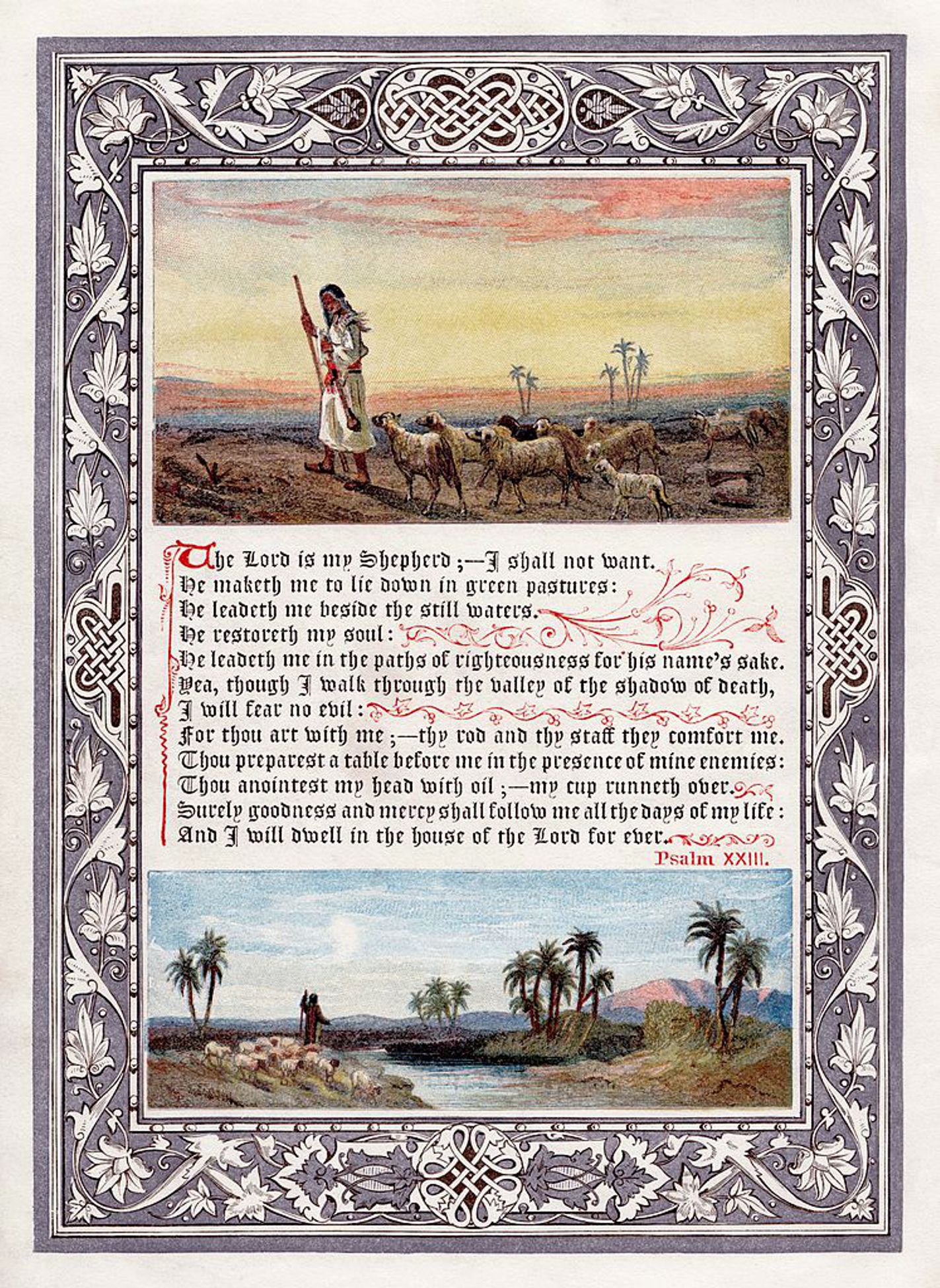
An image of Psalm 23 (KJV), frontispiece to the 1880 omnibus printing of The Sunday at Home: A Family Magazine for Sabbath Reading, [collected volume], London, Religious Tract Society, Public Domain in the United States
Speech and Mannerisms
Mandated Memoranda reviewed David Keirsey’s book Please Understand Me in a recent series of posts. This book is a useful reference for writers who want to fully flesh out their characters. I created detailed outlines for my personal use. You may profit from the same effort.
This week, we’ll look in more detail at speech characteristics and mannerisms of artisan, guardian, idealist, and rational personalities. Creating authentic dialog and describing specific mannerisms are good ways to flesh out a character.
People who possess an artisan personality type talk about what’s going on at the moment, what is immediately at hand, and that which is specific or individual. They do so without definitions, explanations, fantasies, principles, or hypotheses. In short, they are empirical. Artisans are sensitive to what sounds good. They use colorful phrases, current slang, sensory adjectives, and similes for comparisons.
Comfortable with their bodies, artisans’ most common gesture while speaking is a pawing motion, bent fingers with thumb loose at the side. More aggressive motions are an index finger to jab a point across, a closed fist to pound that point home, or an index finger opposed midjoint by thumb to peck at opponent.
Those who are guardians talk about what’s solid and sensible: commerce, household items, weather, recreation, news items, and personalities. Their speech moves from topic to topic associatively; whatever comes to mind. Never fancy, they use conventional vocabulary and phrasing and favor proverbs and adages.
Guardians avoid showy gestures: an index finger wags warnings, a fist with thumb atop curled index finger (as if holding reins) slows up discussion, and bringing a hand or hands down in a chopping motion emphasizes a statement or cuts off discussion.
Idealists talk about what is seen in the mind’s eye: love, hate, heaven and hell, comedy and tragedy, heart and soul, beliefs, fantasies, possibilities, symbols, temperament, character, and personality. They follow hunches, heed feelings, and intuit peoples’ motives and meanings. They find implications and insinuations in the slightest remark (word magic); this hypersensitivity leads to mistakes now and then.
Extending open hands to others, idealists offer or accept. They row hands like oars or wings to facilitate flow of ideas and words. Idealists bring hands together with fingers wrapped, palms together, fingers vertical, or fingers interlocked, as if trying to hold together two halves of a message in order to reconcile their differences.
Rationals choose the imaginative, conceptual, or inferential things to speak of over the observational, perceptual, or experiential. They avoid the irrelevant, trivial, and redundant in conversation. Their assumption that what’s obvious to them is to others, leading to an overly compact and terse speech style that sometimes loses their audience (to their bafflement.)
Preferring to appear unemotional when they communicate, rationals minimize body language, facial expressions, and non-verbal qualifiers. When they become animated their hand gestures express their need for precision and control. They bend their fingers to grasp the space before them turning and shaping their ideas in the air. They use fingers like a calculator, ticking off points one by one. They arrange small objects (salt and pepper shakers, pens, paperweights, etc.) to map out ideas. Most characteristic is the apposition of thumb to fingers as if bringing an idea or argument to the finest point possible.
***
We’ve said this before: all these traits describe some peoples’ predispositions. Their experiences can mold them, as far as they are willing and able, so that they acquire attributes of the other personality types. These attributes in sum could be said to be their overall dispositions. We covered an example of this kind of change in our posting “Why Are There Four Gospel Accounts?”
As an editor once urged me, “Details are what draw a reader into your story, add them.” If you are a writer, I heartily recommend reading Keirsey’s book for yourself.

The Four Temperaments of Mankind (l. to r.: Idealist, Artisan, Guardian, and Rational,) Preparatory drawing for the sculptors of the Grande Commande, Charles Ie Brun (1619 – 1690), Public Domain in the United States
Believe and Suffer
Some of us are bewildered when we face adversity, some expect it more often than it occurs, some chalk it up to mysterious forces, and some see it as highly probable at all times. What is certain in this life is that we will suffer at some time in our lives. For all of us, I wish it were as certain that we would all believe so as to be saved from the penalty that our sins deserve. The Apostle Paul wrote to the church in Philippi about believing and suffering:
Only let your manner of life be worthy of the gospel of Christ, so that whether I come and see you or am absent, I may hear of you that:
You are standing firm in one spirit
With one mind striving side by side for the faith of the gospel, and
Not frightened in anything by your opponents.
This is a clear sign to them of their destruction, but of your salvation, and that from God.
For it has been granted to you that for the sake of Christ you should not only believe in him but also suffer for his sake, engaged in the same conflict that you saw I had and now hear that I still have.
Philippians 1:27-30 English Standard Version (ESV)
Paul says God has granted them to believe in Him. But also, in an act of His Sovereign will, to suffer. Not any kind of suffering, but that according to His will, “for His sake.”
The reformer and preacher, John Calvin, makes at least three points about these verses. First, our common struggle against our sin, the world, and the devil unites us. Even if we’re divided by our sins against one another, the struggle is so great against us that we will reconcile and contend for the faith together.
Striving together for the faith…is the strongest bond of concord, …for this has often been the occasion of reconciling even the greatest enemies.
…The Apostle’s meaning is this: “Let the faith of the gospel unite you together, more especially as that is a common armory against one and the same enemy.”
The wicked, too, conspire together for evil, but their agreement is accursed: let us, therefore, contend with one mind under the banner of faith.
These struggles, and our patient suffering, are ordained and given by God as a sign of our salvation to us and to the enemies of the faith. These are both a benefit for our increased devotion and an honor to participate in His sufferings.
To you, says he, it is given, not only to believe in Christ, but also to suffer for him. Hence even the sufferings themselves are evidences of the grace of God; and, since it is so, you have from this source a token of salvation. Oh, if this persuasion were effectually [woven into] our minds — that persecutions are to be reckoned among God’s benefits, what progress would be made in the doctrine of piety!
…It is the highest honor…conferred upon us by Divine grace, that we suffer for his name either reproach, or imprisonment, or miseries, or tortures, or even death, for in that case he adorns us with his marks of distinction. But [many would] rather [that] God [refrain from giving] gifts of that nature, than embrace with [readiness] the cross when it is presented to them. Alas, then, for our stupidity!
Finally, Calvin stresses that our struggle and godly resistance is analogous, though far lesser, to Christ’s struggle and godly resistance on the cross. Yet, both faith and endurance remain His unmerited gifts to us, evident in our inability to resist in our own strength.
[Paul] wisely conjoins faith with the cross by an inseparable connection, [so] that the Philippians may know that they have been called to the faith of Christ on this condition — that they endure persecutions on His account, as though he had said that their adoption can no more be separated from the cross, than Christ can be torn asunder from himself.
Here Paul clearly testifies, that faith, as well as [faithfulness] in enduring persecutions, is an unmerited gift of God. And certainly the knowledge of God is a wisdom that is too high for our attaining it by our own acuteness, and our weakness shows itself in daily instances in our own experience, when God withdraws his hand for a little while…
May God grant you to believe and suffer for His sake.
Suffering and the Sovereignty of God: An Interview with R.C. Sproul Jr., Ligonier Ministries
The Rational Personality
Less than six percent of all men and women are rational personalities. They speak of what is seen by the mind’s eye. Pleasing others and obeying rules is secondary to determining whether intended means will work in achieving their ends. Their thought and speech go from general to specific. Rationals enjoy puns, paradoxes, and word play. They abhor repeated errors, especially their own. Concerned with events, they lose track of time. Ingenuity, autonomy, and resolve govern their self-image.
Rationals keep their emotions in check, are closet romantics, value reason and logic, are goal driven, pursue knowledge relentlessly, relish chances to explain their achievements, and aspire to predict and control events, understanding and explaining their contexts. They are mind-mates as spouses, individuators as parents, and visionaries as leaders.
Notable examples are: Napoleon, Grant, Sherman, Marshall, Eisenhower, MacArthur, Lincoln, Jefferson, Madison, Franklin, Einstein, Schrödinger, Tesla, Howard Hughes, Francis Bacon, Descartes, Kant, Dewey, Twain, Shakespeare, and William F. Buckley, Jr., and in fiction: Sherlock Holmes, Moriarty, and Spock.
Rarely will you meet anyone that fits this description. However, they are found as leaders in government or the military, scientists in laboratories and universities, engineers in industry and startups, philosophers, authors, and renown fictional characters.
This is one of the personalities that is especially important for writers to recognize and portray. David Keirsey’s book Please Understand Me is a useful reference for writers who want to fully flesh out their characters.
Keirsey says Hippocrates and Galen observed that there are four personality types. Later scientists refined their observations by identifying four distinctions within each type.
Keirsey defines the rational personality as abstract in their word use and utilitarian in their tool use. They speak about imaginative, conceptual, or inferential things. Their conversation appears unemotional and avoids the irrelevant, trivial, and redundant.
Rationals fall into four subcategories, each containing one to two percent of the population. Two are characterized as directive coordinators: the expressive field-marshal and the reserved mastermind. The field-marshal harnesses people and resources to lead them toward their goals with minimum wasted effort and maximum progress. The mastermind makes efficient schedules with contingencies, interested in moving an organization forward rather than dwelling on past mistakes. Their single-mindedness can lead to ignoring others wishes and points of view to their detriment.
The two other subtypes are informative engineers: expressive inventors and reserved architects. The outgoing inventor makes sure prototypes work under real world conditions. They display a charming capacity to ignore the standard, the traditional, and the authoritative. The highly attentive architect, often working alone, strives for design coherence and configuration elegance as masters of organization.
Rationals possess lifelong curiosity in logical investigation, critical experimentation, and mathematical description. They are preoccupied with the logic of building (i.e., technology) and are intrigued by complex systems, both machines and organisms.
They maximize efficiency of means and anticipate consequences of ends before they act. Rationals regard custom or tradition neither respectfully nor sentimentally, but as useful for deciphering the errors of history. All is uncertain and vulnerable to mistakes. Events aren’t of themselves good or bad, favorable or unfavorable. Only events possess time, all else is timeless.
They see themselves as inventive. Self-directed and self-determined, rationals live independently, free of coercion. They scrutinize other’s ideas for error before accepting them. They have an unwavering strength of will that they can overcome any obstacle, dominate any field, conquer any enemy — even themselves. But they never take will power for granted.
Rationals are unflappable in trying circumstances, reluctant to express emotions or desires. They listen carefully to ideas that make sense but reject illogical ideas or arguments. They have a gnawing hunger for achieving goals that is never fully satisfied. They live through their work; even play is work. Rarely do they measure up to their standards and are haunted by the feeling of teetering on the edge of failure. Relentless in their search, they want to know about the world and know how the world works.
They share abstract ideas with their mates. Marriage, itself, requires careful empirical study since there is no room for error. If they do err, they do their best to reduce underlying values conflict. Each child must become more self-directed and self-reliant, developing their individuality and autonomy. As strategic planners, they usually have a vision of how an organization will look and fare in the long run.
As we wrote in “Why Are There Four Gospel Accounts?,” an earlier blog posting, these traits describe some peoples’ predispositions. Their experiences can mold them, as far as they are willing and able, so that they acquire attributes of the other personality types. These attributes in sum could be said to be their overall dispositions.
If you are a writer, I heartily recommend reading Keirsey’s book for yourself. I created detailed outlines for my personal use. You may profit from the same effort. We’ll review artisan, guardian, idealist, and rational personality speech characteristics and mannerisms the next few weeks.
Why We Use Scripture Extensively in Our Posts
It’s not because we’re lazy (but, if you knew me better, you might disagree.) Nor is it because we can’t write well; though you may disagree with this as well. It’s because His word is what He says He will use to save us from the penalty of death which our sins against Him alone so richly deserve. He says:
“For as the rain and the snow come down from heaven
and do not return there but water the earth,
making it bring forth and sprout,
giving seed to the sower and bread to the eater,
so shall my word be that goes out from my mouth;
it shall not return to me empty,
but it shall accomplish that which I purpose,
and shall succeed in the thing for which I sent it.
Isaiah 55:10-11 English Standard Version (ESV)
His purpose, His eternal purpose is realized in Christ and the Church. The Lord alone is the objective source of knowledge and action who has entered into what we consider our world. Of course, it is His and is His forever.
When He was drawing me to Himself, He made my reading from the scriptures irresistible. I remember dwelling in long passages from a large bible at the front of a main line church sanctuary so many years ago. Months later, when He was ready for me to submit to Him in repentance, He sent an evangelist who read from the scriptures in answer to my doubting questions. And I trusted in the Lord Jesus Christ that evening after that sent one left.
You might think: “What does this have to do with me; I’m doing okay. It’s you, Adolphus, who needs a crutch to face the inevitability of death.” Well, I thought the same back then; so did everyone who professes belief in the Lord Jesus Christ. It is His sovereign will that chooses and saves you. No one, by strength of will, can save themselves. Everyone, whether saved or not, will stand before God’s judgment seat and give an account of ourselves. It is only by the merit of His Son, the Lord Jesus Christ, conferred to us through faith that we can face that judgment and live. All others will be sent away from His presence.
I offer you, not only the links above, but this verse for your consideration:
“For God so loved the world, that he gave his only Son, that whoever believes in him should not perish but have eternal life. John 3:16 (ESV)
Please, we beg of you, repent and believe.
Albert Mohler: The Authority of Scripture, Ligonier Ministries
Honoring Our Feet
Peculiar topic, no? Have you ever thought of someone’s opinions as second-rate and subtly (or so you thought) told them so? Have you been slighted or brushed off for some unfathomable reason, only later putting two and two together? Though we expect this treatment in the world, we shouldn’t expect it in the church. However, it’s there and He doesn’t like it. Through the Apostle Paul, He says:
The eye cannot say to the hand, “I have no need of you,” nor again the head to the feet, “I have no need of you.”
On the contrary, the parts of the body that seem to be weaker are indispensable, and on those parts of the body that we think less honorable we bestow the greater honor, and our unpresentable parts are treated with greater modesty, which our more presentable parts do not require.
But God has so composed the body, giving greater honor to the part that lacked it, that there may be no division in the body, but that the members may have the same care for one another. If one member suffers, all suffer together; if one member is honored, all rejoice together.
1 Corinthians 12:21-26 English Standard Version (ESV)
There is a lot in this admonition. First, let us consider the key word: honor. We know honor more sharply by what it is not:
dis·hon·or [disˈänər]
VERB
bring shame or disgrace on:
“the politician dishonors her good campaign by resorting to sniping.”
synonyms: disgrace, shame, discredit, bring into disrepute, humiliate, degrade, debase, lower, cheapen, drag down, drag through the mud, blacken the name of, give a bad name to, sully, stain, taint, besmirch, smear, mar, blot, stigmatize
antonym: honor, respect
The reformer, John Calvin, had some pointed things to say about these verses:
Hitherto [Paul exhorted] the less honorable members to…not envy the more distinguished members. Now, he [directs the] honorable members not to despise the inferior members, [with whom] they cannot dispense.
The dishonor of one member [results in] the common disgrace of the whole body, as appears from the care that we take to cover the parts that are less honorable…The body is not merely shattered, and the order of nature perverted, but the authority of God is openly [treated as of no importance] whenever anyone assumes more than belongs to him.
There is no room for envy or contempt. To be honored [means] to be in prosperity and happiness. Nothing, however, is better [suited] to promote harmony than…when everyone feels that he is proportionally enriched by the prosperity of others and impoverished by their penury.
Further, the Apostle Paul instructs us to listen to the Spirit’s guidance and refrain from looking down on our brothers and sisters:
If we live by the Spirit, let us also keep in step with the Spirit. Let us not become conceited, provoking one another, envying one another. Galatians 5:25-26 (ESV)
To this, Calvin says:
Among Christians, whoever [desires their own] glory departs from true glory, and therefore is justly charged with idle and foolish ambition. It is not lawful for us to glory but in God alone. Every other kind of glorying is pure vanity.
Mutual provocations and envying are the daughters of ambition. He who aspires to the highest rank must of necessity envy all others, and disrespectful, biting, stinging language is the unavoidable consequence.
So we see the origin of this form of strife: vaunted ambition. He who wants to be first, will be last.
But Paul’s admonitions about honor are not all negative. In the Letter to the Romans, he says:
Love one another with brotherly affection. Outdo one another in showing honor. Repay no one evil for evil, but give thought to do what is honorable in the sight of all. Romans 12:10, 17 (ESV)
In these verses, Calvin catches several subtleties we often miss:
Everyone is to give honor to his brethren and not to himself; for there is no poison more effectual in alienating the minds of men than the thought, that one is despised.
As there is nothing more opposed to brotherly concord than contempt, arising from haughtiness, when each one, neglecting others, advances himself; so the best fomenter of love is humility, when everyone honors others.
We render evil for evil sometimes…when we treat unkindly those who do us no good…When any one denies help to us when we need it, we…do not help him in time of need, any more than he assisted us.
We ought to diligently labor, that all may be edified by our honest dealings. For as purity of conscience is necessary for us before God, so uprightness of character before men is not to be neglected.
When we are [called] to prepare good things before men, …[it] is not that men may admire and praise us but that their minds being elevated to God, they may give praise to him, that by our example they may be stirred up to practice righteousness.
And so, we must “honor our feet,” that is, give sincere respect and due care to those who we consider less capable in word, thought, and deed, for the sake of the unity of His body, the church. Each of us contributes what we’ve been given, if we’re following the Spirit’s leading. To God, alone, be the glory.
U-MV021 – Sam Phillips – I Need Love, posted on YouTube by mypartofthething, lyrics
The Idealist Personality
Less than seven percent of all men and women are idealist personalities. They follow hunches, heed feelings, strive for consensus, follow laws for community’s sake, avoid or prevent fighting, generalize from particulars, view people and things metaphorically, and put themselves in others shoes.
They are concerned for morale, give of themselves selflessly, search for life’s meaning, seek and develop the potential in those around them, desire inner unity and absolute truth, and are prone to wishful thinking.
Idealists are enthusiastic, intuitive, and romantic. They feel misunderstood and aspire to wisdom. They are soulmates as spouses, harmonizers as parents, and catalysts as leaders. Gandhi, Joan of Arc, Susan B. Anthony, and Martin Luther possessed idealist personalities.
You may know a few who that fit this description. The teacher with a gift for drawing out good performances from seemingly incorrigible students, the pastor who seeks out and shepherds the destitute and hurting, the activist championing a noble (or ignoble) cause, or the wise mediator who reconciles differences between conflicting factions.
This is one of the personalities that is important for writers to recognize and portray. David Keirsey’s book Please Understand Me is a useful reference for writers who want to fully flesh out their characters.
Keirsey says Hippocrates and Galen observed that there are four personality types. Later scientists refined their observations by identifying four distinctions within each type.
Keirsey defines the idealist personality as abstract in their word use and cooperative in their tool use. Their thought and speech are rich in exaggeration, move from parts to wholes, and spontaneously transform one thing into another, erasing distinctions, and joining opposites.
Idealists fall into four subcategories, each containing only a few percent of the population. Two are characterized as directive: the expressive teacher and the reserved counselor. The teacher takes control of even difficult students with confidence and creativity, broadening or refining their attitudes and actions. The counselor advises, appeals, prescribes, or urges in order to help others toward greater well-being.
The two other subtypes are informative: expressive champions and reserved healers. The champion eagerly explores issues and events in order to passionately champion a cause or ideal that will motivate others to settle conflicts and/or act justly and wisely. The healer helps others to accept, accommodate, or reconcile to mend relationships or make whole a divided self.
Idealists seek professions involving the unfolding of mind and heart toward greater self-understanding and inner peace. They need and want to be in communication with people. They can learn to write and speak fluently with a poetic flair. They form personal relationships which communicate caring and willingness to become involved. However, these relationships can drain them, so either they disconnect professionally or risk becoming emotionally overwhelmed.
Their greatest happiness comes from selflessly giving of themselves to help others grow and develop. They believe things easily and without reserve, join causes, and are loyal to leaders more than principles. They can become fixated about beliefs, unmovable by appeals to reason or experience. Some bravely accept accidents as mystifying and inexplicable; others attribute causes of unhappy events to a higher [or lower] power. They focus on what might be, not what is and are drawn to discerning the true nature and significance of things.
Idealists base self-esteem on the empathy they feel with those closest to them. They maintain a benevolent attitude toward others and their powerful conscience suppresses feelings of animosity. Vague self-doubt nags most of them. They laboriously walk the line between authenticity and moral approval of others.
They exhibit delightful and contagious positive emotions when discussing ideas and insights. When frustrated in idealism, or treated unjustly, they become irritated quickly and respond furiously. They trust first impressions. Unconsciously, but sometimes erroneously, they adopt their perceptions of another’s desires and emotions. They want relationships to be deep, meaningful, and full of beauty and sensitivity. They try to get in touch with the person they were meant to be. Some stop struggling to become a perfected ideal and accept themselves as they are. Recognition as a special person by someone they care about is very gratifying. They want to see behind and through to the world as it really is.
They desire a spouse who knows their feelings without being told, who spontaneously expresses words of endearment that acknowledge their unique identity. They closely bond with their children, even into adulthood, if possible, to encourage their positive self-esteem, self-respect, and self-confidence. At work, idealists facilitate, motivate, or energize cooperative action and high morale in their subordinates.
As we wrote in “Why Are There Four Gospel Accounts?,” an earlier blog posting, these traits describe some peoples’ predispositions. Their experiences can mold them, as far as they are willing and able, so that they acquire attributes of the other personality types. These attributes in sum could be said to be their overall dispositions.
If you are a writer, I heartily recommend reading Keirsey’s book for yourself. I created detailed outlines for my personal use. You may profit from the same effort. We’ll review Keirsey’s take on the Rational personality type in two or three weeks.
It’s A Wonderful Life from PNN Media Group on Vimeo.
It’s Not About You
We live in a self-centered world. From identity politics to Twitter, FoMO to twenty-four-hour cable news, safe spaces to speech codes, we focus on what pleases us, amuses us, or fills us with self-importance. We think everything revolves around us and if it doesn’t, it should. We see it on campuses, on the campaign trail, and at international summits that ultimately do little to mitigate climate change in the end.
Our culture often frames this untenable condition in terms of unrequited love. The band, Scouting for Girls, sets this theme to a catchy tune. Please be aware that the lyrics contain mild innuendoes (yes, a trigger warning):
Scouting For Girls – It’s Not About You, Lyrics
To this situation we find ourselves in, we must say with the Apostle James:
From the same mouth come blessing and cursing. My brothers, these things ought not to be so.
James 3:10 English Standard Version (ESV)
Worse still, agreeing with the Apostle Paul, we see that we go along recklessly with them:
Though they know God’s righteous decree that those who practice such things deserve to die, they not only do them but give approval to those who practice them.
Therefore, you have no excuse, O man, every one of you who judges. For in passing judgment on another you condemn yourself, because you, the judge, practice the very same things.
Romans 1:32-2:1 (ESV)
But, the Lord Jesus, through the Apostle John, puts the matter in perspective:
Whoever loves his life loses it, and whoever hates his life in this world will keep it for eternal life.
John 12:25 (ESV)
Much has been written on the interpretation of this verse. Calvin says in part:
He who, under the influence of immoderate desire of the present life, cannot leave the world but by constraint, is said to love life; but he who, despising life, advances courageously to death, is said to hate life.
Not that we ought absolutely to hate life, which is justly reckoned to be one of the highest of God’s blessings;
but because believers ought to cheerfully lay it down, when it retards them from approaching to Christ;
just as a man, when he wishes to make haste in any matter, would shake off from his shoulders a heavy and disagreeable burden.
Further, we are to live for the good of others:
So we, though many, are one body in Christ, and individually members one of another. Love one another with brotherly affection. Outdo one another in showing honor. Live in harmony with one another. Do not be haughty, but associate with the lowly. Never be wise in your own sight.
Romans 12:5, 10, 16 (ESV)
Yet, if we’re honest with ourselves and others, we don’t give others honor or affection:
But if you bite and devour one another, watch out that you are not consumed by one another. Let us not become conceited, provoking one another, envying one another. Bear one another’s burdens, and so fulfill the law of Christ.
Galatians 5:15, 26; 6:2 (ESV)
But, if we trust the Father to do for us that which we do not do (i.e., change our behavior), then:
Therefore encourage one another and build one another up, just as you are doing. See that no one repays anyone evil for evil, but always seek to do good to one another and to everyone.
1 Thessalonians 5:11, 15 (ESV)
However, heed this admonition with a warning. Do not neglect it at your peril:
Beloved, let us love one another, for love is from God, and whoever loves has been born of God and knows God. If anyone says, “I love God,” and hates his brother, he is a liar; for he who does not love his brother whom he has seen cannot love God whom he has not seen. And this commandment we have from him: whoever loves God must also love his brother.
1 John 4:7, 20, 21 (ESV)
The Lord Jesus Christ offers us an escape from our self-centeredness, if only we’d trust in His saving work on the cross.
The Guardian Personality
Roughly forty percent of all men and women are guardian personalities. They are solid, sensible, follow the rules even when no one is looking, move associatively from topic to topic in conversation, always on the lookout for rule breaking, humbly shoulder responsibilities “no matter what,” and suffer when unappreciated.
Guardians are dutiful, prepare for the worst, suffer bravely and patiently, catch and reprimand trespassers, and keep traditions, customs, and continuity with the past. They are helpmates as spouses, socializers as parents, and stabilizers as leaders. Presidents Washington, Bush (41), Truman, and Nixon possessed guardian personalities.
No doubt you know many that fit this description. The concerned citizens that attend town council meetings and staff polling places, the project manager who facilitates timely production, packing, and distribution, the police officer on the street who shields others from imminent danger, the loan official who goes the extra mile to get you affordable loan terms, and the long-suffering wife and mother next door with the truck driver husband and hellion son who sometimes shakes up the neighborhood.
Two weeks ago, we described the artisan personality. The guardian is another of the four personality types that’s important for writers to recognize and portray. David Keirsey’s book Please Understand Me is a useful reference for writers who want to fully flesh out their characters.
Keirsey says Hippocrates and Galen observed that there are four personality types. Later scientists refined their observations by identifying four distinctions within each type.
Keirsey defines the guardian personality as concrete in their word use and cooperative in their tool use. They talk about what’s solid and sensible: commerce, household items, weather, recreation, news items and personalities. They believe that only by establishing and obeying rules and regulations can civil order be maintained.
Guardians fall into four subcategories, each containing approximately ten percent of the population. Two are characterized as monitoring: the expressive supervisor and the reserved inspector. The supervisor enforces standard operating procedures. In the home, it’s not enough that others do assigned duties, they must want to do them. The inspector works behind the scene on products and accounts, is watchful for irregularities from rules, and is simple and down-home.
The two other subtypes are conserving: expressive providers and reserved protectors. The provider furnishes others with life’s necessities, makes others part of their group, and is personable and talkative. The protector shields others from dirt and danger of this world, sees to others physical safety and security, and chats tirelessly with a close circle of friends.
Guardians regard companies and corporations as indispensable social institutions that enable them to earn their keep and provide for family. They feel responsible for the morality of their group, guarding right and wrong.
They give their all from a young age. Pain and suffering are unavoidable and must be faced bravely. They believe: “if anything can go wrong it will,” and prepare accordingly. They keep others in line. They are creatures of habit who faithfully follow routines. They value family and societal history.
They shoulder responsibilities “no matter what.” They feel: “if I don’t do it, who will,” and suffer when they’re unappreciated. They are obligated to do good deeds. But they may feel put upon if help isn’t offered (to be shooed away, of course). Receiving service is blow to their self-respect. Modest, unassuming, self-effacing, they crave respect and public recognition.
Concerned about homes, jobs, families, their neighborhood; duties and responsibilities; health, finances, how they dress, whether they’re on time. They worry too much about loved ones and society’s direction. They believe in hierarchical authority structures and are likely to believe in a supreme being. Since the world is going to hell in a handbasket, it’s the institutions that hold people accountable and teach values. They feel appreciated to the degree others are grateful for what they’ve done for them. It is galling when others take them for granted, but they believe responsibility far outweighs entitlement to gratitude. They desire the power to set things straight in light of right and wrong.
They’re ready to roll up their sleeves and work side-by-side with their spouse to build a comfortable, stable family life. Loyal and obligated to stand by their mate in times of trouble and help them straighten up and fly right. Guardians see to it that children are civilized, enculturated, in support of and in step with the community. They carefully administer what is done, how it is done, and who is to do it.
As we wrote in “Why Are There Four Gospel Accounts?” an earlier blog posting, these traits describe some peoples’ predispositions. Their experiences can mold them, as far as they are willing and able, so that they acquire attributes of the other personality types. These attributes in sum could be said to be their overall dispositions.
If you are a writer, I heartily recommend reading Keirsey’s book for yourself. I created detailed outlines for my personal use. You may profit from the same effort. We’ll review Keirsey’s take on the Idealist and Rational personality types in the next few weeks.

Former President Harry S. Truman (1884-1972) at a president’s desk reproduction with foreground “The buck Stops Here” sign, ca. July 1959, Public Domain, Credit: Harry S. Truman Library & Museum

