Prayer – Why do it?

In his Institutes of the Christian Religion, John Calvin addresses why anyone should pray to God:

For there is a kind of [communication] between God and men, by which, having entered the upper sanctuary, they appear before Him and appeal to his promises, that when necessity requires they may learn by experiences that what they believed merely on the authority of his word was not in vain.

Now, he takes as a given that we hold to this:

Without faith it is impossible to please him, for whoever would draw near to God must believe that he exists and that he rewards those who seek him. Hebrews 11:6 English Standard Version (ESV)

And have done this:

If you confess with your mouth that Jesus is Lord and believe in your heart that God raised him from the dead, you will be saved. Romans 10:9 (ESV)

Calvin goes on to say that it is both necessary and useful to pray to the Lord for every good thing that He promises us. God reveals His promises to us in His word. Therefore, we should know the bible well.

Calvin points out that our only safety is in calling upon our heavenly Father:

Since by it we invoke the presence of His:

Providence to watch over our interests,

Power to sustain us when weak and almost fainting, and

Goodness to receive us into favor, though miserably loaded with sin.

Through prayer, we call upon Him to make evident to us all his excellent attributes.

As a result of calling upon Him, Calvin states:

Admirable peace and tranquility are given to our consciences; for the straits by which we were pressed being laid before the Lord, we rest fully satisfied with the assurance that none of our evils are unknown to him, and that he is both able and willing to make the best provision for us.

Next week, we’ll consider the question: “Why Should We Pray If He Is All-knowing?”

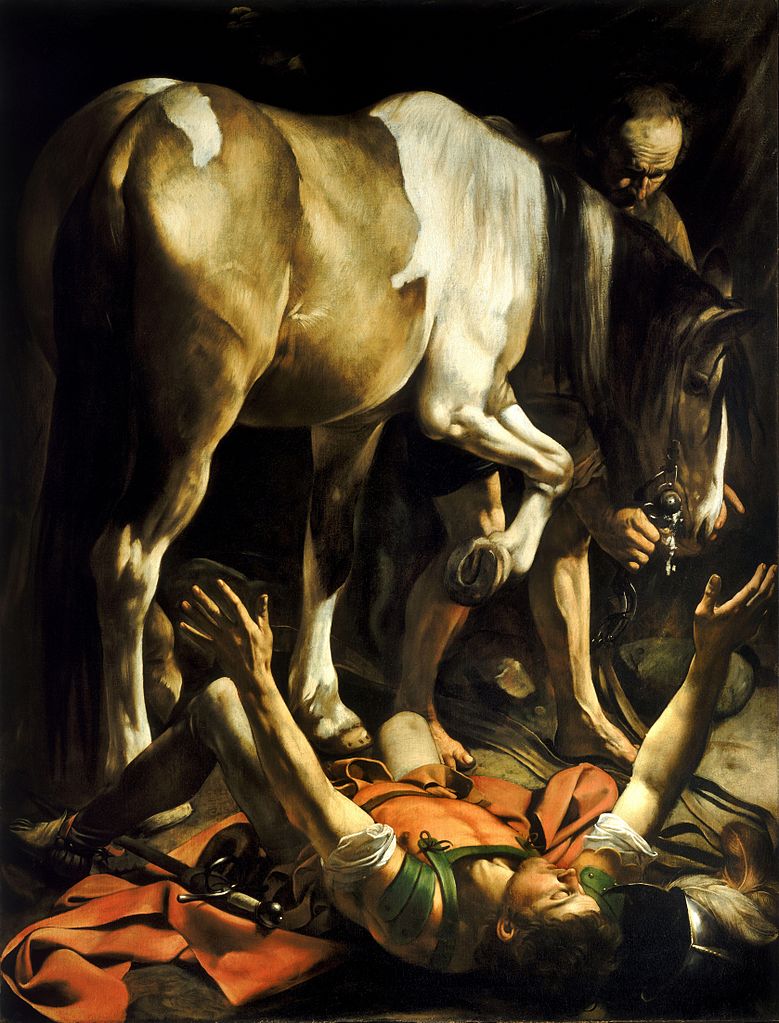
The Conversion of Paul - Caravaggio

Conversion on the Way to Damascus, circa 1600-1601, Caravaggio (1571–1610), public domain in the US

Everyone Divided

There’s no sidestepping it, scripture divides us. This principle applies to everyone we know and everyone we may never know. The Apostle John, in his first letter to the Church, describes what is true of everyone.

Writing about the Christ, John says:

If you know that he is righteous, you may be sure that everyone who practices righteousness has been born of him. 1 John 2:29 English Standard version (ESV)

To this, Calvin says:

If you know that he is righteous [John] again passes on to exhortations, so that he mingles these continually with doctrine throughout the Epistle; but he proves by many arguments that faith is necessarily connected with a holy and pure life. The first argument is, that we are spiritually begotten after the likeness of Christ; it hence follows, that no one is born of Christ but he who lives righteously…

Next, speaking of our response to Christ, John says:

And everyone who thus hopes in him purifies himself as he is pure. 1 John 3:3 ESV

And Calvin says:

And every man that has this hope …The meaning then is, that though we have not Christ now present before our eyes, yet if we hope in him, it cannot be but that this hope will excite and stimulate us to follow purity, for it leads us straight to Christ, whom we know to be a perfect pattern of purity.

Then, speaking of those apart from Christ, John says:

Everyone who makes a practice of sinning also practices lawlessness; sin is lawlessness. 1 John 3:4 ESV

Calvin explains the distinction:

Whosoever commits, or does, sin. …The import of the passage is, that the perverse life of those who indulge themselves in the liberty of sinning, is hateful to God, and cannot be borne with by him, because it is contrary to his Law.

It does not hence follow, nor can it be hence inferred, that the faithful are iniquitous; because they desire to obey God, and abhor their own vices, and that in every instance; and they also form their own life, as much as in them lies, according to the law.

But when there is a deliberate purpose to sin, or a continued course in sin, then the law is transgressed.

John presses this point further:

Everyone who hates his brother is a murderer, and you know that no murderer has eternal life abiding in him. 1 John 3:15 ESV

And Calvin responds:

Is a murderer. …The Apostle declares that all who hate their brethren are murderers. He could have said nothing more atrocious; nor is what is said hyperbolic, for we wish him to perish whom we hate. It does not matter if a man keeps his hands from mischief; for the very desire to do harm, as well as the attempt, is condemned before God: nay, when we do not ourselves seek to do an injury, yet if we wish an evil to happen to our brother from someone else, we are murderers.

Returning to those in Christ, John says:

Everyone who believes that Jesus is the Christ has been born of God, and everyone who loves the Father loves whoever has been born of him. 1 John 5:1 ESV

Calvin responds with:

Whosoever believes …The first truth is, that all born of God, believe that Jesus is the Christ [i.e., Messiah, Savior]; where, again, you see that Christ alone is set forth as the object of faith, as in him it finds righteousness, life, and every blessing that can be desired, and God in all that he is…

Loves him also that is begotten of him …The context plainly shows that his purpose was no other than to trace up brotherly love to faith as its fountain. It is, indeed, an argument drawn from the common course of nature; but what is seen among men is transferred to God.

John elaborates on the condition of those in Christ:

For everyone who has been born of God overcomes the world. And this is the victory that has overcome the world—our faith. 1 John 5:4 ESV

About the victory, Calvin says:

This is the victory. …This passage is remarkable, for though Satan continually repeats his dreadful and horrible onsets, yet the Spirit of God, declaring that we are beyond the reach of danger, removes fear, and animates us to fight with courage. …But as this promise secures to us perpetually the invincible power of God, so, on the other hand, it annihilates all the strength of men…he makes victory to depend on faith alone; and faith receives from another that by which it overcomes. They then take away from God what is his own, who sing triumph to their own power.

And, as if to draw a final distinction, John says:

We know that everyone who has been born of God does not keep on sinning, but he who was born of God protects him, and the evil one does not touch him. 1 John 5:18 ESV

To which, Calvin’s explanation is:

We know that whosoever is born of God If you suppose that God’s children are wholly pure and free from all sin, as the fanatics contend, then the Apostle is inconsistent with himself; for he would thus take away the duty of mutual prayer among brethren. …Hence spiritual life is never extinguished in them… Though the faithful indeed fall through the infirmity of the flesh, yet they groan under the burden of sin, loathe themselves, and cease not to fear God.

Keeps himself. What properly belongs to God he transfers to us; for were any one of us the keeper of his own salvation, it would be a miserable protection. Therefore Christ asks the Father to keep us, intimating that it is not done by our own strength. …And we know that we fight with no other weapons but those of God. Hence the faithful keep themselves from sin, as far as they are kept by God. (John 17:11).

There are many ‘everyones’ that we come across every day. All are divided in the ways we’ve just seen. Which are you? Which, then, is your neighbor? Our duty is to love our neighbor as we love ourselves.

I don’t know your situation; but I find I need to pray for and serve my neighbors to keep myself from mischief.

Everyone at Yankee Stadium

Yankees Stadium Crowd, uploaded to Wikimedia Commons 26 February 2013, Donald Riesbeck Jr., in the Public Domain

Sin No More

I’d always worried about the meaning of Christ’s phrase: “sin no more.” Only in the last few years have I come to a settled understanding closer to what the Lord meant by it:

Afterward Jesus found him in the temple and said to him, “See, you are well! Sin no more, that nothing worse may happen to you.” John 5:14 English Standard Version (ESV)

Calvin has many words to say about this verse. Here are a few of them:

After these things Jesus found him. …When he charges him, sin no more, he does not enjoin him to be free from all sin, but speaks comparatively as to his former life; for Christ exhorts him henceforth to repent, and not to do as he had done before.

Lest something worse befall thee. …When we are incessantly pressed down by new afflictions, we ought to trace this to our obstinacy…There is no reason to wonder, therefore, if God makes use of severer punishment to bruise us…when moderate punishment is of no avail; for it is proper that they who will not endure to be corrected should be bruised by strokes.

…Indeed, the roots of vices are too deep in us to be capable of being torn out in a single day, or in a few days; and the cure of the diseases of the soul is too difficult to be effected by remedies applied for a short time.

Calvin’s entire commentary on the verse implies, among other things, that the man was made well through God’s grace, and not only that, but raised from the dead to new life in Him.

Recently, while researching a blog post on Idols, concerning a passage in Matthew:

“No one can serve two masters, for either he will hate the one and love the other, or he will be devoted to the one and despise the other. You cannot serve God and money [or possessions].” Matthew 6:24 (ESV)

I ran across this statement by Calvin:

…It is, no doubt, true, that believers themselves are never so perfectly devoted to obedience to God, as not to be withdrawn from it [i.e., obedience] by the sinful desires of the flesh. But as they groan under this wretched bondage, and are dissatisfied with themselves, and give nothing more than an unwilling and reluctant service to the flesh, they are not said to serve two masters.

For their desires and exertions are approved by the Lord, as if they rendered to him a perfect obedience. But this passage reproves the hypocrisy of those who flatter themselves in their vices, as if they could reconcile light and darkness.

This is a deep and encouraging statement about the sanctification process that God performs in His own to bring about their maturity in following His Son. And He brooks no counterfeit.

Sanctification leads to a maturity outlined by the Apostle Paul in his letter to the Galatian church:

Now the works of the flesh are evident: sexual immorality, impurity, sensuality, idolatry, sorcery, enmity, strife, jealousy, fits of anger, rivalries, dissensions, divisions, envy, drunkenness, orgies, and things like these. I warn you, as I warned you before, that those who do such things will not inherit the kingdom of God.

But the fruit of the Spirit is love, joy, peace, patience, kindness, goodness, faithfulness, gentleness, self-control; against such things there is no law. Galatians 5:19-23 (ESV)

To this passage, Calvin says:

But the fruit of the Spirit. In the former part of the description he condemned the whole nature of man as producing nothing but evil and worthless fruits. He now informs us that all virtues, all proper and well-regulated affections, proceed from the Spirit, that is, from the grace of God, and the renewed nature which we derive from Christ. As if he had said, “Nothing but what is evil comes from man; nothing good comes but from the Holy Spirit.”

So let’s lay aside the deeds of the flesh and press on to do good works and exhibit fruit of the Spirit.

Carpathian National Park from Hoverla

View of Carpathian National Park from Hoverla, Ivano-Frankivsk Oblast, Ukraine, 22 September 2013, 12:22:41, by Balkhovitin, Creative Commons Attribution-Share Alike 3.0 Unported

Deluding Influence

Delusion is defined as:

De·lu·sion /dəˈlo͞oZHən/ noun: delusion; plural noun: delusions

An idiosyncratic belief or impression that is firmly maintained despite being contradicted by what is generally accepted as reality or rational argument, typically a symptom of mental disorder.

“The delusion of being watched.”

“Was her belief in his fidelity just a delusion?”

The action of deluding someone or the state of being deluded.

“What a capacity television has for delusion.”

And, perhaps more directly:

De·lude /dəˈlo͞od/ verb: delude; 3rd person present: deludes; past tense and past participle: deluded; gerund or present participle: deluding

Impose a misleading belief upon (someone); deceive; fool.

“Too many theorists have deluded the public.”

In the second letter to the Thessalonians, the Apostle Paul speaks of deluding influences and the man of lawlessness:

Now concerning the coming of our Lord Jesus Christ and our being gathered together to him, we ask you, brothers, not to be quickly shaken in mind or alarmed, either by a spirit or a spoken word, or a letter seeming to be from us, to the effect that the day of the Lord has come.

Let no one deceive you in any way. For that day will not come, unless the rebellion comes first, and the man of lawlessness is revealed, the son of destruction, who opposes and exalts himself against every so-called god or object of worship, so that he takes his seat in the temple of God, proclaiming himself to be God.

Do you not remember that when I was still with you I told you these things? And you know what is restraining him now so that he may be revealed in his time. For the mystery of lawlessness is already at work. Only he who now restrains it will do so until he is out of the way. And then the lawless one will be revealed, whom the Lord Jesus will kill with the breath of his mouth and bring to nothing by the appearance of his coming.

The coming of the lawless one is by the activity of Satan with all power and false signs and wonders, and with all wicked deception for those who are perishing, because they refused to love the truth and so be saved. Therefore God sends them a strong delusion, so that they may believe what is false, in order that all may be condemned who did not believe the truth but had pleasure in unrighteousness [emphasis added].

2 Thessalonians 2:1-12 English Standard Version (ESV)

Calvin has much to say about these verses: 1–2, 3–4, 5–8, and 9–12. We’ll concentrate on what he said about verses 11 and 12:

Verse 11 – The working of delusion. He means that errors will not merely have a place, but [that] the wicked will be blinded, so…they will rush forward to ruin without consideration.

For as God enlightens us inwardly by his Spirit, that his doctrine may be efficacious in us, and opens our eyes and hearts, that it may make its way thither, so by a righteous judgment he delivers over to a reprobate mind (Romans 1:28) those whom he has appointed to destruction, that with closed eyes and a senseless mind, they may, as if bewitched, deliver themselves over to Satan and his ministers to be deceived…

Verse 12 – That all may be condemned. That is, that they may receive the punishment due to their impiety. Thus, those that perish have no just ground to expostulate with God, inasmuch as they have obtained what they sought.

For we must keep in view what is stated in Deuteronomy 13:3, that the hearts of men are subjected to trial, when false doctrines come abroad, inasmuch as they [the false doctrines] have no power except among those who do not love God with a sincere heart. Let those, then, who take pleasure in unrighteousness, reap the fruit of it.

When he says all, he means that contempt of God finds no excuse in the great crowd and multitude of those who refuse to obey the gospel, for God is the Judge of the whole world, so that he will inflict punishment upon a hundred thousand, no less than upon one individual.

The participle εὐδοκήσαντες (taking pleasure) means (so to speak) a voluntary inclination to evil, for in this way every excuse is cut off from the ungrateful, when they take so much pleasure in unrighteousness, as to prefer it to the righteousness of God.

For by what violence will they say that they have been impelled to alienate themselves by a mad revolt from God, towards whom they were led by the guidance of nature? It is at least manifest that they willingly and knowingly lent an ear to falsehoods.

But none of this is new. Throughout history and in all lands, God has given over the disobedient.

Roughly seven hundred years before Christ and more than a century and a half before their decreed release by Cyrus the Great, the prophet Isaiah encouraged the future Babylonian exiles to flee from there and, by faith, return to the Promised Land. Speaking of their spiritual blindness, he says to them:

They know not, nor do they discern, for he has shut their eyes, so that they cannot see, and their hearts, so that they cannot understand. Isaiah 44:18 (ESV)

Speaking to His disciples about the crowds gathered by the Sea of Galilee to hear Him, the Lord Jesus Christ cites Isaiah (Is. 6:9–10):

And he said to them, “To you has been given the secret of the kingdom of God, but for those outside everything is in parables, so that

“they may indeed see but not perceive,

    and may indeed hear but not understand,

lest they should turn and be forgiven.”

Mark 4:11-12 (ESV)

Later, during Lord’s entry into Jerusalem prior to the Passover, John recounts what Isaiah said about God’s hardening of hearts as a commentary on those who did not believe in the Lord:

“He has blinded their eyes

    and hardened their heart,

lest they see with their eyes,

    and understand with their heart, and turn,

    and I would heal them.”

John 12:40 (ESV)

Later still, Paul, in his letter to the church in Rome says:

So then he has mercy on whomever he wills, and he hardens whomever he wills. Romans 9:18 (ESV)

This is a clear expression of God’s sovereign kindness and severity.

And yet, He sets Eternity in the heart:

He has made everything beautiful in its time. Also, he has put eternity into man’s heart, yet so that he cannot find out what God has done from the beginning to the end. Ecclesiastes 3:11 (ESV)

Truly, His ways are past finding out:

Oh, the depth of the riches and wisdom and knowledge of God! How unsearchable are his judgments and how inscrutable his ways! Romans 11:33 (ESV)

Even though we deserve ruthlessness, He Himself seeks to persuade us with rational arguments:

“Come now, let us reason together, says the Lord:

Though your sins are like scarlet, they shall be as white as snow;

Though they are red like crimson, they shall become like wool.

If you are willing and obedient, you shall eat the good of the land;

But if you refuse and rebel,you shall be eaten by the sword;

For the mouth of the Lord has spoken.”

Isaiah 1:18–20 (ESV)

Then, of course, He speaks to us of an unmerited gift:

Come to me, all who labor and are heavy laden, and I will give you rest. Take my yoke upon you, and learn from me, for I am gentle and lowly in heart, and you will find rest for your souls. Matthew 11:28-29 (ESV)

With Paul (and Isaiah), I say to you: sleeper, awake!

Fall of Rebel Angels - Brueghel

The Fall of the Rebel Angels (1562), Pieter Brueghel the Elder (1526/1530–1569), PD in US

Sanctification

Paul writes to the church in Rome:

I am speaking in human terms, because of your natural limitations. For just as you once presented your members as slaves to impurity and to lawlessness leading to more lawlessness, so now present your members as slaves to righteousness leading to sanctification.

For when you were slaves of sin, you were free in regard to righteousness. But what fruit were you getting at that time from the things of which you are now ashamed? For the end of those things is death.

But now that you have been set free from sin and have become slaves of God, the fruit you get leads to sanctification and its end, eternal life. For the wages of sin is death, but the free gift of God is eternal life in Christ Jesus our Lord.

Romans 6:19-23 English Standard Version (ESV)

The Westminster Confession Shorter Catechism Question and Answer number 35 states:

What is sanctification? Sanctification is the work of God’s free grace, whereby we are renewed in the whole man after the image of God, and are enabled more and more to die unto sin, and live unto righteousness.

What does John Calvin say about these verses in Romans here and here?

I speak what is human, etc. He says that he speaks after the manner of men, not as to the substance but as to the manner. So Christ says, in John 3:12, that he announced earthly things, while yet he spoke of heavenly mysteries, though not so magnificently as the dignity of the things required, because he accommodated himself to the capacities of a people ignorant and simple.

…As though [the Apostle] had said, “I might, by comparing sin and righteousness, show how much more ardently you ought to be led to render obedience to the latter [righteousness], than to serve the former [sin]; but from regard to your infirmity I omit this comparison: nevertheless, though I treat you with great indulgence, I may yet surely make this just demand — that you should not at least obey righteousness more coldly or negligently than you served sin…”

As you have presented, etc.; that is, “As you were formerly ready with all your faculties to serve sin, it is hence sufficiently evident how wretchedly enslaved and bound did your depravity hold you to itself: now then you ought to be equally prompt and ready to execute the commands of God; let not your activity in doing good be now less than it was formerly in doing evil.” He does not indeed observe the same order in the antithesis, by adapting different parts to each other, as he does in 1 Thessalonians 4:7, where he sets uncleanness in opposition to holiness; but the meaning is still evident…

For when you were, etc. He still repeats the difference, which he had before mentioned, between the yoke of righteousness and that of sin; for these two things, sin and righteousness, are so contrary, that he who devotes himself to the one, necessarily departs from the other. And he thus represents both, that by viewing them apart we may see more clearly what is to be expected from each; for to set things thus apart enables us to understand better their distinctive character. He then sets sin on one side, and righteousness on the other; and having stated this distinction, he afterwards shows what results from each of them…

What fruit, then, etc. He could not more strikingly express what he intended than by appealing to their conscience, and by confessing shame as it were in their person. Indeed the godly, as soon as they begin to be illuminated by the Spirit of Christ and the preaching of the gospel, do freely acknowledge their past life, which they have lived without Christ, to have been worthy of condemnation; and so far are they from endeavoring to excuse it, that, on the contrary, they feel ashamed of themselves. Yea, further, they call to mind the remembrance of their own disgrace, that being thus ashamed, they may more truly and more readily be humbled before God…

Ye have your fruit unto holiness, etc. As he had before mentioned a twofold end of sin, so he does now as to righteousness. Sin in this life brings the torments of an accusing conscience, and in the next eternal death. We now gather the fruit of righteousness, even holiness; we hope in future to gain eternal life. These things, unless we are beyond measure stupid, ought to generate in our minds a hatred and horror of sin, and also a love and desire for righteousness…

For the wages of sin, etc. …This verse is a conclusion to the former, and as it were an epilogue to it. He does not, however, in vain repeat the same thing again; but by doubling the terror, he intended to render sin an object of still greater hatred.

But the gift of God. They are mistaken who thus render the sentence, “Eternal life is the gift of God,” as though eternal life were the subject, and the gift of God the predicate; for this does not preserve the contrast. But as he has already taught us, that sin produces nothing but death; so now he subjoins, that this gift of God, even our justification and sanctification, brings to us the happiness of eternal life. Or, if you prefer, it may be thus stated, — “As the cause of death is sin, so righteousness, which we obtain through Christ, restores to us eternal life…”

I Could Laugh (feat. Chris Taylor) performed at BD’s House, 2014, by Michael Roe

The Real Meaning of Thanksgiving Day

Perhaps you’ve read these proclamations by Abraham Lincoln? I had not. Perhaps they mean nothing to you; perhaps they meant nothing to Abraham Lincoln or his Secretary of State, William Seward. But, even if they were just speechifying, these stand as powerful and stark words, even today.

Proclamation 97 — Appointing a Day of National Humiliation, Fasting, and Prayer – March 30, 1863

By the President of the United States of America

A Proclamation

Whereas the Senate of the United States, devoutly recognizing the supreme authority and just government of Almighty God in all the affairs of men and of nations, has by a resolution requested the President to designate and set apart a day for national prayer and humiliation; and

Whereas it is the duty of nations as well as of men to own their dependence upon the overruling power of God, to confess their sins and transgressions in humble sorrow, yet with assured hope that genuine repentance will lead to mercy and pardon, and to recognize the sublime truth, announced in the Holy Scriptures and proven by all history, that those nations only are blessed whose God is the Lord;

And, insomuch as we know that by His divine law nations, like individuals, are subjected to punishments and chastisements in this world, may we not justly fear that the awful calamity of civil war which now desolates the land may be but a punishment inflicted upon us for our presumptuous sins, to the needful end of our national reformation as a whole people? We have been the recipients of the choicest bounties of Heaven; we have been preserved these many years in peace and prosperity; we have grown in numbers, wealth, and power as no other nation has ever grown. But we have forgotten God. We have forgotten the gracious hand which preserved us in peace and multiplied and enriched and strengthened us, and we have vainly imagined, in the deceitfulness of our hearts, that all these blessings were produced by some superior wisdom and virtue of our own. Intoxicated with unbroken success, we have become too self-sufficient to feel the necessity of redeeming and preserving grace, too proud to pray to the God that made us.

It behooves us, then, to humble ourselves before the offended Power, to confess our national sins, and to pray for clemency and forgiveness.

Now, therefore, in compliance with the request, and fully concurring in the views of the Senate, I do by this my proclamation designate and set apart Thursday, the 30th day of April, 1863, as a day of national humiliation, fasting, and prayer. And I do hereby request all the people to abstain on that day from their ordinary secular pursuits, and to unite at their several places of public worship and their respective homes in keeping the day holy to the Lord and devoted to the humble discharge of the religious duties proper to that solemn occasion.

All this being done in sincerity and truth, let us then rest humbly in the hope authorized by the divine teachings that the united cry of the nation will be heard on high and answered with blessings no less than the pardon of our national sins and the restoration of our now divided and suffering country to its former happy condition of unity and peace. In witness whereof I have hereunto set my hand and caused the seal of the United States to be affixed.

Done at the city of Washington, this 30th day of March, A. D. 1863, and of the Independence of the United States the eighty-seventh.

ABRAHAM LINCOLN.

By the President:

WILLIAM H. SEWARD, Secretary of State.

Citation: Abraham Lincoln: “Proclamation 97 – Appointing a Day of National Humiliation, Fasting, and Prayer,” March 30, 1863. Online by Gerhard Peters and John T. Woolley, The American Presidency Project.

The second proclamation sets forth a specific day for thanksgiving.

Proclamation 106 — Thanksgiving Day, 1863 – October 3, 1863

By the President of the United States of America

A Proclamation

The year that is drawing toward its close has been filled with the blessings of fruitful fields and healthful skies. To these bounties, which are so constantly enjoyed that we are prone to forget the source from which they come, others have been added which are of so extraordinary a nature that they can not fail to penetrate and soften even the heart which is habitually insensible to the ever-watchful providence of Almighty God.

In the midst of a civil war of unequaled magnitude and severity, which has sometimes seemed to foreign states to invite and to provoke their aggression, peace has been preserved with all nations, order has been maintained, the laws have been respected and obeyed, and harmony has prevailed everywhere, except in the theater of military conflict, while that theater has been greatly contracted by the advancing armies and navies of the Union.

Needful diversions of wealth and of strength from the fields of peaceful industry to the national defense have not arrested the plow, the shuttle, or the ship; the ax has enlarged the borders of our settlements, and the mines, as well of iron and coal as of the precious metals, have yielded even more abundantly than heretofore. Population has steadily increased notwithstanding the waste that has been made in the camp, the siege, and the battlefield, and the country, rejoicing in the consciousness of augmented strength and vigor, is permitted to expect continuance of years with large increase of freedom.

No human counsel hath devised nor hath any mortal hand worked out these great things. They are the gracious gifts of the Most High God, who, while dealing with us in anger for our sins, hath nevertheless remembered mercy.

It has seemed to me fit and proper that they should be solemnly, reverently, and gratefully acknowledged, as with one heart and one voice, by the whole American people. I do therefore invite my fellow-citizens in every part of the United States, and also those who are at sea and those who are sojourning in foreign lands, to set apart and observe the last Thursday of November next as a day of thanksgiving and praise to our beneficent Father who dwelleth in the heavens. And I recommend to them that while offering up the ascriptions justly due to Him for such singular deliverances and blessings they do also, with humble penitence for our national perverseness and disobedience, commend to His tender care all those who have become widows, orphans. mourners, or sufferers in the lamentable civil strife in which we are unavoidably engaged, and fervently implore the interposition of the Almighty hand to heal the wounds of the nation and to restore it, as soon as may be consistent with the divine purposes, to the full enjoyment of peace, harmony, tranquillity, and union.

In testimony whereof I have hereunto set my hand and caused the seal of the United States to be affixed.

Done at the city of Washington, this 3d day of October, A. D. 1863, and of the Independence of the United States the eighty-eighth.

ABRAHAM LINCOLN.

By the President:

WILLIAM H. SEWARD, Secretary of State.

Citation: Abraham Lincoln: “Proclamation 106 – Thanksgiving Day, 1863,” October 3, 1863. Online by Gerhard Peters and John T. Woolley, The American Presidency Project.

The third proclamation establishes the last Thursday in November as Thanksgiving Day.

Proclamation 118 — Thanksgiving Day, 1864 – October 20, 1864

By the President of the United States of America

A Proclamation

It has pleased Almighty God to prolong our national life another year, defending us with His guardian care against unfriendly designs from abroad and vouchsafing to us in His mercy many and signal victories over the enemy, who is of our own household. It has also pleased our Heavenly Father to favor as well our citizens in their homes as our soldiers in their camps and our sailors on the rivers and seas with unusual health. He has largely augmented our free population by emancipation and by immigration, while He has opened to us new sources of wealth and has crowned the labor of our workingmen in every department of industry with abundant rewards. Moreover, He has been pleased to animate and inspire our minds and hearts with fortitude, courage, and resolution sufficient for the great trial of civil war into which we have been brought by our adherence as a nation to the cause of freedom and humanity, and to afford to us reasonable hopes of an ultimate and happy deliverance from all our dangers and afflictions:

Now, therefore, I, Abraham Lincoln, President of the United States, do hereby appoint and set apart the last Thursday in November next as a day which I desire to be observed by all my fellow-citizens, wherever they may then be, as a day of thanksgiving and praise to Almighty God, the beneficent Creator and Ruler of the Universe. And I do further recommend to my fellow-citizens aforesaid that on that occasion they do reverently humble themselves in the dust and from thence offer up penitent and fervent prayers and supplications to the Great Disposer of Events for a return of the inestimable blessings of peace, union, and harmony throughout the land which it has pleased Him to assign as a dwelling place for ourselves and for our posterity throughout all generations.

In testimony whereof I have hereunto set my hand and caused the seal of the United States to be affixed.

Done at the city of Washington, this 20th day of October, A.D. 1864, and of the Independence of the United States the eighty-ninth.

ABRAHAM LINCOLN.

By the President:

WILLIAM H. SEWARD, Secretary of State .

Citation: Abraham Lincoln: “Proclamation 118 – Thanksgiving Day, 1864,” October 20, 1864. Online by Gerhard Peters and John T. Woolley, The American Presidency Project.

These proclamations, in their totality, are what the day should mean for the citizens of the United States of America.

Freedom From Want - Rockwell

FREEDOM FROM WANT — Office for Emergency Management. Office of War Information. Domestic Operations Branch. Bureau of Special Services. (03/09/1943 – 09/15/1945), in the Public Domain

Resistance Isn’t Futile

The author of the book to the Hebrews, in chapter 12, verses 4-6 says:

In your struggle against sin you have not yet resisted to the point of shedding your blood. And have you forgotten the exhortation that addresses you as sons?

“My son, do not regard lightly the discipline of the Lord,

    nor be weary when reproved by him.

For the Lord disciplines the one he loves,

    and chastises every son whom he receives.”

Hebrews 12:4-6 English Standard Version (ESV)

Do you say, as I do sometimes: “Why should I struggle against doing my own will and instead do His will?” Or do we see ourselves as better than this One?

And he came out and went, as was his custom, to the Mount of Olives, and the disciples followed him. And when he came to the place, he said to them, “Pray that you may not enter into temptation.”

And he withdrew from them about a stone’s throw, and knelt down and prayed, saying, Father, if you are willing, remove this cup from me. Nevertheless, not my will, but yours, be done.”

And there appeared to him an angel from heaven, strengthening him. And being in an agony he prayed more earnestly; and his sweat became like great drops of blood falling down to the ground.

And when he rose from prayer, he came to the disciples and found them sleeping for sorrow, and he said to them, “Why are you sleeping? Rise and pray that you may not enter into temptation.”

Luke 22:39-46 (ESV)

Some manuscripts leave out the verses in the third paragraph.

So, with regard to the verse:

And being in an agony he prayed more earnestly; and his sweat became like great drops of blood falling down to the ground.

what does John Calvin comment?

Certainly those who imagine that the Son of God was exempt from human passions do not truly and sincerely acknowledge him to be a man…

…When Christ was distressed by grief and fear, he did not rise against God, but continued to be regulated by the true rule of moderation. We need not wonder that, since he was innocent and pure from every stain, the affections which flowed from him were pure and stainless… Christ, amidst fear and sadness, was weak without any taint of sin…

…He [Christ] had no horror at death…simply as a passage out of the world, but because he had before his eyes the dreadful tribunal of God, and the Judge himself armed with inconceivable vengeance; and because our sins, the load of which was laid upon him, pressed him down with their enormous weight. There is no reason to wonder, therefore, if the dreadful abyss of destruction tormented him grievously with fear and anguish.

…And, therefore, though he suffered death, yet since its pains were loosed—as Peter tells us, (Acts 2:24)—and he was victorious in the conflict, the Apostle justly says, that he was heard on account of his fear [Hebrews 5:7]. Here ignorant people rise up and exclaim, that it would have been unworthy of Christ to be afraid of being swallowed up by death.

But I should wish them to answer this question, What kind of fear do they suppose it to have been which drew from Christ drops of blood? (Luke 22:44). For that mortal sweat could only have proceeded from fearful and unusual horror. If any person, in the present day, were to sweat blood, and in such a quantity that the drops should fall to the ground, it would be reckoned an astonishing miracle…

If it be objected, that the fear which I am describing arises from unbelief, the answer is easy. When Christ was struck with horror at the divine curse, the feeling of the flesh affected him in such a manner, that faith still remained firm and unshaken. For such was the purity of his nature, that he felt, without being wounded by them, those temptations which pierce us with their stings.

And yet those persons, by representing him not to have felt temptations, foolishly imagine that he was victorious without fighting. And, indeed, we have no right to suppose that he used any hypocrisy, when he complained of a mortal sadness in his soul; nor do the Evangelists speak falsely, when they say that he was exceedingly sorrowful, and that he trembled.

In the face of deep fear and anguish, Christ prayed earnestly that His Father’s will be done and He opened the way of salvation to all who will be saved. No matter what anyone says, resistance is not futile.

Borg transmission from the movie Star Trek VIII First Contact – English version

Why Do They Call Evil That Which Is Good?

Chris Mooney says in his article ‘Science Deniers Are Freaking Out About “Cosmos”’

Indeed, the science denial crowd hasn’t been happy with Cosmos in general. Here are some principal lines of attack:

  • Denying the Big Bang
  • Denying evolution
  • Denying climate change

Chris Mooney is a science and political journalist, podcaster, and the host of MJ’s Climate Desk Live. He is the author of four books, including the New York Times bestselling The Republican War on Science. You can read the rest at Bill Moyer’s site and Mother Jones, if you like this sort of thing.

Michael Brendan Dougherty, a more subtle critic, says in his article: ‘In Defense of Creationists – Sure, they’re misreading Genesis. But for all the right reasons.’

My own view is that a literal one-week creation should be ruled out because, combined with the best knowledge we have of science, it would make God into a devil, a trickster. “Haha, mortals, I only buried these dinosaur bones and set the galaxies in explosive motion so the unbelievers would damn themselves to Hell,” doesn’t sound like a great or loving God. It seems to me that the very idea of good, eternal, law-giving God endowing man with rational abilities was the historical prerequisite for scientific exploration.

Michael Brendan Dougherty is senior correspondent at TheWeek.com. He is the founder and editor of The Slurve, a newsletter about baseball. His work has appeared in The New York Times Magazine, ESPN Magazine, Slate and The American Conservative. You can read the rest of this article at The Week.

In the act of creation, God demonstrated overwhelming creative power throughout time and space (and whatever else there might be that we have yet to discover). We reviewed this concept in-depth in our post ‘Every Good Story – Thysdor Ya’Rosel’ and more succinctly in ‘All the world’s a stage…

So far as misreading Genesis, we covered that issue in the recent post ‘Nip ‘Em in the Bud.’

We live in a universe governed by laws which the Law Giver can suspend as it suits His good pleasure. We’ve covered this concept in another recent post ‘Instrumentality.’

For those of us old enough to remember, both the Twilight Zone and Outer Limits television series’ had episodes where that which existed had no reality behind it. How creepy would it be to dig into the ground and find nothing (i.e. no precious metals and gems, petrochemicals, fossils, etc.)?

To this point, the scriptures describe treasures in the sand and deep beneath the ground. As described in Scripture, the world is meant to communicate two major lessons concerning God:

For his invisible attributes, namely, his eternal power and divine nature, have been clearly perceived, ever since the creation of the world, in the things that have been made. Romans 1:20 English Standard Version (ESV)

On the fossils front, death certainly entered creation when the Lord God made garments of skins to clothe Adam and Eve after their fall from grace.  We also read that the creation was subjected to futility by God because of Adam’s sin. So, we can say with confidence that sin had far-reaching consequences for creation!

It’s helpful to see the Scriptures as an accommodation to us by an infinite and unknowable God. In fact, the Lord Jesus Christ is described as the image of the invisible God and declares Himself of one essence with the Father. He appeared to us in human form to identify with us more fully than we sometimes appreciate.

The Lord Jesus Christ taught often through parables:

A parable is a succinct, didactic story, in prose or verse, which illustrates one or more instructive lessons or principles. It differs from a fable in that fables employ animals, plants, inanimate objects, or forces of nature as characters, whereas parables have human characters. A parable is a type of analogy.

When asked, the Lord Jesus Christ explained to His followers why He spoke in parables:

This is why I speak to them in parables, because seeing they do not see, and hearing they do not hear, nor do they understand. Matthew 13:13 (ESV)

He spoke this to remind His followers of Isaiah’s prophecy:

And He said, “Go, and say to this people: “‘Keep on hearing, but do not understand; keep on seeing, but do not perceive.’ Make the heart of this people dull, and their ears heavy, and blind their eyes; lest they see with their eyes, and hear with their ears, and understand with their hearts, and turn and be healed.” Isaiah 6:9-10 (ESV)

Again, reiterating today’s opening statements, isn’t He evil for not revealing all? In the parable about Lazarus and the rich man, concerning warnings about the place of eternal torment:

He said to him, ‘If they do not hear Moses and the Prophets, neither will they be convinced if someone should rise from the dead.’” Luke 16:31 (ESV)

Ultimately, it comes down to believing, or not, the documentary evidence that we have in Scripture. We’ve addressed the authority and basic meaning of Scripture in our posts: ‘Authority of Scripture?’ and ‘Scripture – What Is It Good For?,’ respectively.

So, we stand condemned unless He saves us and, otherwise, we remain dead in our sins and trespasses. God, through the apostle, speaks of His sovereignty in these matters:

But who are you, O man, to answer back to God? Will what is molded say to its molder, “Why have you made me like this?” Romans 9:20 (ESV)

We may take offence to this statement. But, we’ve conveniently forgotten what preceded this passage:

…For all have sinned and fall short of the glory of God, Romans 3:23 (ESV)

The onus for sin lies with us. We’ve examined our responsibility in the post titled: ‘There, But for God’s Grace and Mercy Through His Providence, Go I.’

Why one side insists on winning a war started before the First World War, I understand. Loosely paraphrasing Huxley, they believe what they want because they have an agenda that doesn’t include the One that made them. We’ve covered Aldous Huxley’s admission in our posts ‘Wonder Why?’ and ‘Mean Ends – Luxe Hso-Dualy.’

But I grow tired of their fight as this life winds down. These recurrent attacks endanger the liberty we all claim to cherish. You can keep your slapshots to yourselves. We’ve already addressed this latest controversy in our post: ‘Climate Changiness.’

Now, we’ve discussed how it’s our duty to live peaceful and quiet lives. The Scriptures say we will be persecuted as He was. However, dear folks of the opposition, your war is with Him. And you will inevitably appear before Him, so, please live peacefully while He gives you opportunity to repent.

Politicization of science by the right or the left is futile. Finally, it comes down to what the Lord Jesus Christ said to His critics:

Jesus said to them, “Is this not the reason you are wrong, because you know neither the Scriptures nor the power of God? Mark 12:24 (ESV)

I urge you, turn and be healed.

The Garden of Eden, Thomas Cole

The Garden of Eden, 1828, Thomas Cole (1801–1848), public domain – US

Is He Fair?

I hope God’s not fair, and so should you. The scriptures say: by the works of the law, no one is justified.

For all have sinned and fall short of God’s glory.

But, He has not dealt with us as our sins deserve.

He saves us, not because of righteous works we have done, but according to His mercy.

But, as a result of His work in us, we must show our faith by our works.

God, through His apostles and prophets, is blunt:

Let no one deceive himself. If anyone among you thinks that he is wise in this age, let him become a fool that he may become wise. For the wisdom of this world is folly with God. For it is written, “He catches the wise in their craftiness,” and again, “The Lord knows the thoughts of the wise, that they are futile.” 1 Corinthians 3:18-20 English Standard Version (ESV)

Therefore, repent and trust Him for life.

Last Judgment, Michelangelo Buonarroti

Last Judgment, 1537–41, Michelangelo Buonarroti (1475–1564), public domain in US

I Desire Mercy, and Not Sacrifice

The Lord Jesus Christ referred to this scripture twice as recorded in the gospels.

On the first occasion, His message seems to be: associate with the sin sick to bring them healing and exhort those, who consider themselves well and in no need of a doctor, that they need healing, too.

And as Jesus reclined at table in the house, behold, many tax collectors and sinners came and were reclining with Jesus and his disciples. And when the Pharisees saw this, they said to his disciples, “Why does your teacher eat with tax collectors and sinners?”  But when he heard it, he said, “Those who are well have no need of a physician, but those who are sick. Go and learn what this means, ‘I desire mercy, and not sacrifice.’ For I came not to call the righteous, but sinners.” Matthew 9:10-13 English Standard Version (ESV)

On the second occasion, He urged those who considered themselves righteous to obey the substance and not just the form of God’s commandments.

Or have you not read in the Law how on the Sabbath the priests in the temple profane the Sabbath and are guiltless? I tell you, something greater than the temple is here. And if you had known what this means, ‘I desire mercy, and not sacrifice,’ you would not have condemned the guiltless. For the Son of Man is lord of the Sabbath.” Matthew 12:5-8 (ESV)

Clearly, these folks thought themselves better than those around them.

But to what scripture (because the New Testament was not yet written) was the Lord referring? He quoted Hosea 6:6, but verses six and seven complete a thought.

For I desire steadfast love and not sacrifice, the knowledge of God rather than burnt offerings.

But like Adam they transgressed the covenant; there they dealt faithlessly with me.

Hosea 6:6-7 (ESV)

Textual notes indicate the term steadfast love is rendered mercy in the Septuagint (Greek translation of the Old Testament).

John Calvin comments on verse six:

It is a remarkable passage; the Son of God has twice quoted it. The Pharisees reproached him for his intercourse with men of bad and abandoned life, and he said to them in Matthew 9, ‘Mercy I desire, and not sacrifice.’ He shows, by this defense, that God is not worshipped by external ceremonies, but when men forgive and bear with one another, and are not above measure rigid. [emphasis added]

Again, in the Matthew 12, when the Pharisees blamed the disciples for gathering ears of corn, he said ‘But rather go and learn what this is, Mercy I desire, and not sacrifice.’ Inasmuch as they were so severe against his disciples, Christ shows that those who make holiness to consist in ceremonies are foolish worshipers of God; and that they also blamed their brethren without a cause, and made a crime of what was not in itself sinful, and what could be easily defended by any wise and calm expounder.

Calvin adds concerning verse seven:

God then subjoins a complaint, — But they like men have transgressed the covenant; there have they dealt treacherously against me. Here God shows that the Israelites boasted in vain of their sacrifices and of all the pomps of their external worship, for God did not regard these external things, but only wished to exercise the faithful in spiritual worship.

Then the import of the whole is this, “My design was, when I appointed the sacrifices and the whole legal worship, to lead you so to myself, that there might be nothing carnal or earthly in your sacrificing; but ye have corrupted the whole law; you have been perverse interpreters; for sacrifices have been nothing else among you but mockery as if it were a satisfaction to me to have an ox or a ram killed. You have then transgressed my covenant; and it is nothing that the people say to me, that they have diligently performed the outward ceremonies, for such a worship is not in the least valued by me.”

We can (and must) replace Calvin’s reference to ‘Israelites who boast in vain’ with the ‘unbelieving church of that age,’ for such they were. And we have these same with us today. It’s not as if they are unaware of the substance of proper worship, it’s just less costly (in the here and now) to practice merely the form of it.

At least two of these folks asked the Lord, “Which commandment is the most important of all?” He answered:

“You shall love the Lord your God with all your heart and with all your soul and with all your strength and with all your mind, and your neighbor as yourself.”

On another occasion He asked one of these folks how they understood the scriptures in a nutshell and they gave the same answer. To this one, the Lord said, “You have answered correctly; do this, and you will live.”

But, as we are prone to do, let us not go beyond what the scriptures say. The best example that comes to mind of mercy correctly applied is that demonstrated by the Lord.

The Woman taken in Adultery.  1644, Rembrandt (1606 – 1669), Public Domain

The Woman taken in Adultery. 1644, Rembrandt (1606 – 1669), Public Domain

Here’s the entire story from the source:

Early in the morning he came again to the temple. All the people came to him, and he sat down and taught them.  The scribes and the Pharisees brought a woman who had been caught in adultery, and placing her in the midst they said to him, “Teacher, this woman has been caught in the act of adultery. Now in the Law Moses commanded us to stone such women. So what do you say?” This they said to test him, that they might have some charge to bring against him.

Jesus bent down and wrote with his finger on the ground.  And as they continued to ask him, he stood up and said to them, “Let him who is without sin among you be the first to throw a stone at her.”  And once more he bent down and wrote on the ground.  

But when they heard it, they went away one by one, beginning with the older ones, and Jesus was left alone with the woman standing before him.  Jesus stood up and said to her, “Woman, where are they? Has no one condemned you?”  She said, “No one, Lord.” And Jesus said, “Neither do I condemn you; go, and from now on sin no more.”

So there we have it. When someone is repentant from the heart (and surely she was), the Lord says:

“Neither do I condemn you; go, and from now on sin no more.”

Go and do likewise.