A Christian Manifesto by Francis Schaeffer – A Review

L'Abri by Allan L. Winger

Chalet Les Melezes at Swiss L’Abri –
May, 1978 by Allan L. Winger

I was prompted by a Veritas Forum debate to reread A Christian Manifesto by Francis Schaeffer. Folks have raised various rumors and speculations about the quality of his home life and whether he accurately portrayed church history. However, his characterization and assessment of the conflict between the Christian and Humanist worldviews is insightful. Whatever you might think of Schaeffer’s politics (or, for that matter, his views on apologetics), his analysis is challenging. The following is a summary of the dichotomy through telescoped quotes from his book.

The Abolition of Truth and Morality (chapter one)

The basic problem of the Christians in this country in the last [one hundred ten] years or so, in regard to society and … government, is that … they have failed to see … a shift in world view—that is, … a fundamental change in the overall way people think and view the world and life as a whole.

These two world views [Christianity and Humanism] stand as total [ities] in complete antithesis to each other in content and also in their natural results—including sociological and governmental results, and specifically including law.

It is not just that they happen to bring forth different results, but it is absolutely inevitable that they will bring forth different results.

True [Christian] spirituality covers all of reality…the Lordship of Christ covers all of life and all of life equally [in such a way that He is neither complicit in nor tainted by sin]…It is true to total reality—the total of what is, beginning with the central reality, the objective existence of the personal–infinite God. Christianity is not just a series of truths but Truth…Living upon that truth…brings forth not only certain personal results, but also governmental and legal results.

The “humanist world view”…means Man beginning from himself, with no knowledge except what he himself can discover and no standards outside himself…Man is the measure of all things, as the Enlightenment expressed it.

They have reduced Man to even less than his natural finiteness by seeing him only as a complex arrangement of molecules, made complex by blind chance. Instead of seeing him as something great who is significant even in his sinning, they see Man in his essence only as an intrinsically competitive animal, that has no other basic operating principle than natural selection brought about by the strongest, the fittest, ending on top…both individually and collectively as society.

The problem … is: What is an adequate basis for law…so that the human aspiration for freedom can exist without anarchy, and yet provides a form that will not become arbitrary tyranny?

God in His sheer power could have crushed Satan in his revolt by the use of…sufficient power. But because of God’s character, justice came before the use of power alone. Therefore Christ died [so] that justice … would be the solution. Christ’s example…is our standard, our rule, our measure… The prince may have the power to control and to rule, but he does not have the right to do so without justice. This was the basis for English common law…the Magna Charta [and by implication and lineage, the Declaration of Independence and The Constitution].

Humanists push for “freedom” …that leads to chaos or to slavery under the state (or…an elite). Humanism, with its lack of any final base for values and law, always leads to chaos…then naturally to some form of authoritarianism to control the chaos. With its mistaken concept of final reality, it has no intrinsic reason to be interested in the individual… [but rather] the state and society.

Some excerpts from later chapters on this dichotomous theme:

Will Durant summed up the humanist problem with regard to personal ethics and social order: “Moreover, we shall find it no easy task to mold a natural ethic strong enough to maintain moral restraint and social order without the support of supernatural consolations, hopes, and fears.” (p. 45)

According to the Durants, Renan said in 1866: “If Rationalism wishes to govern the world without regard to the religious needs of the soul, the experience of the French Revolution is there to teach us the consequences of such a blunder.” (p. 45)

And the Durants themselves say in the same context: “There is no significant example in history, before our time, of a society successfully maintaining moral life without the aid of religion.” (p. 45)

The Humanist Manifestos not only say that humanism is a religion, but the Supreme Court has declared it to be a religion. (p. 54)

Most fundamentally, our culture, society, government, and law are in the condition they are in, not because of a conspiracy, but because the church has forsaken its duty to be the salt of the culture. (p.56)

If we are going to make judgments on any such subject [in this case, the Moral Majority] we must not get our final judgments uncritically from media that sees things from [the humanist] perspective and see it that way honestly. Most of the media do not have to be dishonest to slide things in their own direction because they see through the spectacles of a finally relativistic set of ethical personal and social standards. (p. 56)

…We must remember that although there are tremendous discrepancies between conservatives and liberals in the political arena, if they are both operating on a humanistic base [of personal peace and affluence] there will really be no final difference between them. As Christians we must stand absolutely and totally opposed to the whole humanist system… [and] must not become officially aligned with either group… (p. 78)

[If an elite authoritarian group takes over]…what form …might it take…? [Quoting Gerald Holton, Harvard professor of History of Science,] “If the layman cannot participate in decision-making, he will have to turn himself over, essentially blind, to a hermetic elite,”… the fundamental question becomes, “Are we still capable of self–government and therefore freedom? Margaret Mead wrote…about scientists elevated to the status of priests. Now there is a name for this elevation, when you are in the hands of—one hopes—a benevolent elite, when you have no control over your political decisions. From the point of view of John Locke, the name for this is slavery.” (p. 80 – 81)

We must never forget that the humanistic position is an exclusivist, closed system which shuts out all contending viewpoints—especially if these views teach anything other than relative values and standards. Anything which presents absolute truth, values, or standards is quite rightly seen by the humanist to be a total denial of the humanist position. (p. 112)

As a result the humanistic, material–energy, chance world view is completely intolerant when it presents itself through the political institutions and especially through the schools. (p. 112)

…Man is not basically good (bound only by social, economic, and political chains). Man is fallen. The Perfectibility of Man was the basis for much of the Enlightenment and of the French Revolution. [In] each place this concept…has been acted on it has led to tragedy, political chains, and to the loss of humanness. (p. 125)

One of their philosophers, in essence, proclaimed: We are gods and nothing will be impossible for us to do. As we see the rush of increasing progress mixed inexorably with confusion, is he not right? Yet, the rest of the thought, from scripture is: nevertheless, like men you shall die, and fall like any prince.

To end our review, Schaeffer was faulted (see links above) for an aggressive political stance and an allegiance (however tentative) with the then ascendant Moral Majority. Perhaps Glenn Tinder, publishing in Atlantic Magazine eight years later, offers a politic more agreeable to you and me. Plus, it’s in accordance with the practices of the third century AD.

The Snowman Cometh

Snow Shovelling

Snow Shoveling – Photo in the Public Domain by Jeff the quiet

I prepare this morning for battle with liner gloves. I think no frostbite for me. Valiantly, I shovel my way to the mailbox, around the cars, and into the lawn as a path for the meter woman. One of my outer gloves jumps off my hand; perhaps to frolic in the newly raised banks? I coax it back to service. The liners approve. And I heave another shovelful through the air.

Midway, I stand back to assess my progress and realize I’ve made the snow fort of my adolescent dreams. Towering battlements rise here and there. They guard the castle entryway. However, white powdery missiles fly my way no longer, once directed by a cohort on to better things now. But really, what could be better than a snow fort. Then I shovel a little more reality over the embankment.

Looking back at my masterpiece of excavation, I dread the snow still overhanging my head. The many feet of it huddled in a corner of the roof over the front porch. I can hear it crying out for quarter. Yet I intend it no quarter, it must fall, all convention’s judgment flung aside. In all this play, I harbor no maudlin or nefarious secrets from that Broadway stage. Oh, Neil, how sad you could not dream harder of better days to come.

Plot and Structure by James Scott Bell – A Review

James Scott Bell gives us the elements of compelling storytelling in his book Plot and Structure. His introduction motivates the reasons for good storytelling and encourages a lifelong process.

Chapter one covers what a plot is, the types of plots, the distinction between literary and commercial plots, and an argument for formulaic writing that produces excitement. He says, quoting the dictionary: “Plot – a plan as for designing a building or a novel.” The function of the plot is to connect with readers though the story. Story is what sells books to readers. Plot and structure help you tell the story. Quoting Hitchcock: “a good story is life, with the dull parts taken out.”

Bell advocates what he terms the LOCK system. The Lead is vibrant and compelling, someone to watch throughout the novel. The Objective is something which the Lead wants to get or get away from. Solid novels have one dominant Objective. Whether the Lead achieves the Objective is crucial to their wellbeing and is the “story question,” the driving force of the novel. Opposition characters and forces Confront the Lead to thwart them from the Objective. Confrontation provides the reader with emotional involvement in the story. Finally, the novel’s ending should be a Knockout. It should satisfy the reader and keep them coming back for more.

Chapter two covers the structure that holds a plot together. If plot is about the elements of a story, structure is about the timing of those elements. Story structure has beginnings, middles, and ends; three acts. The beginning is about the Lead, the entry point for the reader. It also presents the story world, establishes the tone (epic or farce? action or character progression? fast or slow?), compels the reader to move on to the middle, and introduces the opposition.

Middles are for confrontation where physical, professional, or psychological death hangs over the Lead. This is the place where subplots blossom. It creates a sense of inevitability by weaving plot strands in and out of each other and continuously surprising the reader. The middle also: deepens character relationships, keeps us caring about what happens, and sets up the final Knockout confrontation and resolution at the end. Ends tie up all significant, unresolved plot strands and provide the reader with a feeling of resonance. ‘Resonance’ is something beyond the confines of the book (i.e., its meaning in the larger sense).

Finally, chapter two broaches the concept of the disturbance and two doorways. The disturbance is anything that disturbs the lead’s ordinary life. It is the first threat or challenge to the status quo. However, the lead can still return to normal life. That’s where the first ‘doorway of no return’ comes in. This doorway sends the Lead irrevocably into the confrontations of the second act. The second doorway leads to the knockout ending that achieves resolution and resonance.

Chapter three covers methods for creating plot ideas. Chapters four through six dive into beginnings, middles, and ends.

Chapter seven describes the elements of scenes. Scenes typically take place in one location and time frame. They consist of action, reaction, setup, and deepening. These four chords can dominate the scene or compose portions of a scene called beats. Action and reaction naturally follow each other. Setup creates the circumstances and/or conditions for later scenes. Deepening enriches the reader’s understanding of a character or setting.

Scenes must have a Hook, Intensity, and Prompt (HIP). The Hook grabs the reader at the outset of the scene. Dialog, teaser, or action are good hooks into a scene. Description that is brief and sets a mood can also be a hook. Intensity is a building sense that more is at risk, could be lost, or found out. The writer creates this tension through conflict. The conflict can be stretched for all it’s worth by the interplay between action, dialogue, thoughts, and description. Scenes end with Prompts to read on. Prompts can consist of: impending disaster, portent, mysterious line of dialog, a suddenly revealed secret, a major decision or vow, announcement of a shattering event, a reversal or surprise, or a question left hanging.

Chapter eight discusses complex plots that interweave several subplots with the main plot. A subplot can be thematic, dealing with something the Lead needs to learn, which deepens the plot, lends meaning, and is a place to make a statement about life. Characters carry your themes. Each subplot follows the LOCK method. The subplots can be serial or parallel and each must work on their own.

The next seven chapters dive into the finer points presented in the first eight. This is not so say that you can skip the later chapters. Important principles and techniques are revealed in them. Two appendices summarize the book at a high level and describe how to create back cover material (or a blurb) for your book.

Bell uses movies and well known books to illustrate plot and structure techniques rather than esoteric (to me) literary references. His goal is to teach effectively and not to show how well read he is (and, by implication, how the reader isn’t).

Although portions read like a pep talk, the folksy presentation is not long winded and usually has a point or serves as introduction. The book seems converted to eBook format in a somewhat haphazard way (section and subsection titles in perplexing font sizes, rote use of indent everywhere including bulleted lists, only a logical table of contents). This is likely the publishers doing given the economics involved.

However, weaknesses aside, I strongly recommend the content of James Scott Bell’s Plot and Structure for new and struggling novelists who want  to sell books.

Self–Publishing – Love It or Leave It (Part 2)

A few days ago, I hit the ‘save and publish’ button on the Kindle Direct Publishing (KDP) website to launch Mandated Memoranda Publishing’s second book: Tragic Wonders – Stories, Poems, and Essays to Ponder. I found one glaring (to me) error in a chapter title very late in the quality control process. I left it.

This post is an update to a previous article on self–publishing. Several things are new with Kindle Previewer software and my process.

The Kindle Previewer (KP) version I used is 2.92. KDP no longer provides an emulated means to check your Kindle files targeted to iPhone/iPad. It generates a file with extension .azk. You’re supposed to sideload it to your Apple device to test it. I have no Apple device.

Additionally, KP 2.92 generates a fault when it produces the .azk file. Windows captures the fault this way:

Description  
Faulting Application Path: C:\..\Amazon\Kindle Previewer\lib\phantomjs_mobi82html.exe
Problem signature  
Problem Event Name: BEX
Application Name: phantomjs_mobi82html.exe
Application Version: 0.0.0.0
Application Timestamp: 4f7753dc
Fault Module Name: nvinit.dll_unloaded
Fault Module Version: 0.0.0.0
Fault Module Timestamp: 50ef1ca7
Exception Offset: 7520ce59
Exception Code: c0000005
Exception Data: 00000008
OS Version: 6.1.7601.2.1.0.256.48
Locale ID: 1033
Additional Information 1: 0a9e
Additional Information 2: 0a9e372d3b4ad19135b953a78882e789
Additional Information 3: 0a9e
Additional Information 4: 0a9e372d3b4ad19135b953a78882e789
Extra information about the problem  
Bucket ID: 4075841998

I sent a query to KDP about the fault and didn’t receive a reply once they figured I wasn’t asking for advice on my .azk file. This was a tad disturbing, to say the least. Then I went ahead and published Tragic Wonders. A friend with an iPhone purchased the book and said it worked fine. However, on 10 January 2014, I received a query from KDP about this issue. We’ll see if anything good results from the continued discussion.

Enough talk of Amazon’s problems. On to the new features of our process, some of which may be technical. We discovered and corrected some upsetting features imposed by Microsoft’s Notepad application. We used the text–align style attribute for chapter titles and table of contents (TOC) entries. We figured out some intricacies of nested .ncx file logical TOCs. We tried a different approach for page-breaks. Finally, we used Kindle Previewer to generate our last few .mobi files that we submitted to Amazon KDP.

We discovered through some disturbing errors in our .mobi files that Notepad was inserting non–printing characters. How could we tell if they were non–printing? It showed up in truncated logical TOC entries (generated by Kindlegen from .ncx entries) during the QA review. It also showed up in HTML TOC errors in the .mobi file text. Both errors occurred at the point where the lines in the files (.ncx and .htm) word wrapped.

It turns out this is well documented and has been an issue since Notepad first appeared. A workaround is: don’t narrow the Notepad application window so any TOC or logical TOC text word wraps. If you’ve done so and you have funny truncation error then you can retype those entries like I did (very tedious). A solution may be to use Notepad++ (but I haven’t, yet).

We used the text–align attribute to left justify chapter titles and TOC style entries. Amazon’s Kindle Publishing Guidelines only discourage specifying alignment for body text so it reflows freely.

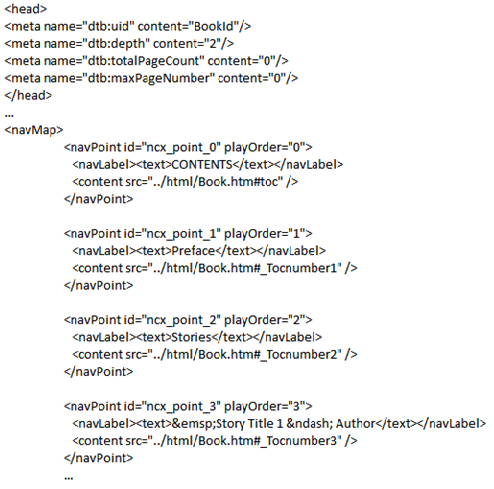
We figured out some intricacies of nested .ncx file logical TOCs (and didn’t figure out other things). This is  genericized excerpt from our .ncx file:

ncx

I call your attention to the em space setting off Story Title 1 as an indent. This conveniently differentiated story titles from section titles. Turns out there is another way, but not all eBook distributors use that method.

Having had difficulty with page breaks in our first book Tiānmìng – Mandate of Heaven, we tried a different approach to page-breaks this time. Using <br> without <p> or other formatting to end chapters seems to work. This is an example of what we did:

htm

We discovered that KDP was using a file structure to read and assemble their .mobi file (the one you can download from them) after you submit your files to KDP. I remember reading about that somewhere in the literature but now I had a concrete example in the zipped HTML files KDP produced for download. I recommend you use those HTML files for further development once most of your bugs are shaken out (i.e., after final edits are long done and most formatting issues have been retired).

You’ll need to package your files into separate folders labeled: image, xml, and html. The image folder contains your image files. The html folder contains your .htm file (if you use one .htm file like I have, up to now). And the xml folder contains your .ncx file. The .opf file should reside with these folders either on the desktop or in your working folder. The files that come from KDP expect this structure (you can see the changes from your original files in the downloaded ones when you compare them).

We used the HTML files KDP generated to finish our development after we went a few rounds with Amazon KDP’s Kindlegen to shake out bugs. This led us to use Kindle Previewer on our .opf file to produce a .mobi file. Kindle Previewer invokes Kindlegen and even produces the verbose error report we use to validate our .mobi files. We submitted the resulting .mobi file to KDP and did final quality assurance (QA) testing with the .mobi KDP produced from our submittal. I plan on structuring my files using this new approach in future books.

After I completed my book, I happened on these two eBooks on Kindle formatting and process. The first, The eBook Design and Development Guide [Kindle Edition], by Paul Salvette (Author), emphasizes formatting using cascading style sheets (CSS). It does a masterful job of explaining in simple terms how to use them. The process that is described bypasses the MS Word to filtered webpage step by copying and pasting the original manuscript into a text file and proceeding from there. I think this approach avoids some errors while enabling others.

The second book, EBook Formatting: KF8, Mobi & EPUB [Kindle Edition] by Matt Harrison (Author, Illustrator), says it is purely concerned with formatting. Heavily programming oriented, I expect it will provide clues for me to format my next book more professionally.

I’m not sure why Amazon’s KDP Systems Architect or chief designers can’t put out a series of books on Kindle book development akin to Microsoft’s series. I’d be first in line to buy the reference (if it’s $9.99 or less, of course).

Tragic Wonders in Times Square

Mandated Memoranda Publishing, LLC received, as part of our press release package, 105 seconds of exposure for this ad on the Thomson Reuters Sign at 43rd Street and 7th Avenue in Times Square.

Tragic Wonders - Stories, Poems, and Essays to Ponder for Amazon Kindle on the Thompson Reuters building in Times Square

Tragic Wonders – Stories, Poems, and Essays to Ponder for Amazon Kindle on the Thompson Reuters building in Times Square. (PRNewsFoto / Mandated Memoranda Publishing, LLC)

The ad was shown seven times at 15 seconds each. This one appeared at: 2013 12 31  – 09:18:38 [9:18 am on New Year’s Eve]. All the shots were either 9 am or 4 pm. One was 9 am on New Year’s Day. According to Google Streetview, the Thomson Reuters Sign is here:


We will do this for our next release; but we’ll add PR Newswire’s Twitter feed service.

Tragic Wonders – Stories, Poems, and Essays to Ponder Press Release

Mandated Memoranda Publishing Announces Second Book

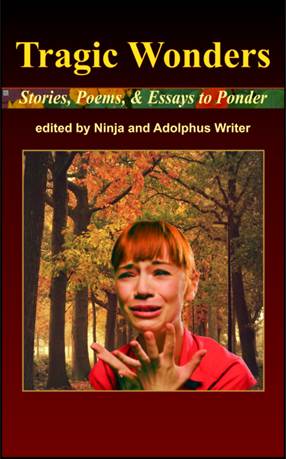
Tragic Wonders – Stories, Poems, and Essays to Ponder, Edited by Ninja and Adolphus Writer, Exclusively on Amazon as a Kindle Edition, a Mandated Memoranda Publishing, LLC release.

Tragic Wonders - Stories, Poems, and Essays to Ponder cover image

Tragic Wonders – Stories, Poems, and Essays to Ponder, Edited by Ninja and Adolphus Writer, Exclusively on Amazon as a Kindle Edition, a Mandated Memoranda Publishing, LLC release. (PRNewsFoto / Mandated Memoranda Publishing, LLC)

SYRACUSE, N.Y., Dec. 30, 2013 /PRNewswire-iReach/ — We all love to be entertained. But, what if that entertainment has other ideas? We asked our pseudonymous authors to write stories, poems, and essays of tragedy and wonder that delve into our souls’ deepest fears and needs.

(Photo: http://photos.prnewswire.com/prnh/20131230/MN38815)

In the short stories, you’ll meet a serial killer, alien snails, a petulant eleven–year–old, a beloved astronaut, a laid–off worker, and many others. Two poems provide a transition from fiction to opinion. The essays castigate, decry, praise, and skewer our personal, local, national, world, and cosmic conditions.

These writings are meant to engage readers in a reality that we all deny daily, whether we profess faith in Christ, are ambivalent, or are hostilely opposed to religion.

What if this world we live in is set up as a diabolical trap meant to prevent us from seeing that which is truly necessary? The anthology focuses on themes, situations, and emotions that are tragic, full of wonder, or, combined in some way, both.

We hope you’ll suspend your disbelief and consider the possibility that there is a way out of the trap in which we find ourselves. And that way doesn’t involve choosing between two different color pills.

Quote

“Maybe there’s a message in what great scholars once called futility or vanity? Perhaps there’s only one thing truly necessary.”—Karen Monteverde

Review

This isn’t an easy read, but it is a rewarding one, as the stories are crafted with great care. All in all, if you are the kind of reader who likes to have their own assumptions on how reality truly exists questioned by the written word, then this is sure to be an enjoyable book for you. –Red City Review, November 23, 2013

About the editors

Ninja (NEEN–yuh) S. Writer was born in Wolfsburg, West Germany. She majored in political science with a minor in mechanical engineering and volunteered for the Bundeswehr in 1994 when she learned a woman had attained the rank of general. She and Adolphus met while he was traveling in Germany. They married when she moved to the United States after completing her military service.

Adolphus Writer holds a doctorate in theoretical physics. After he graduated, he travelled to Europe, the Middle East, and Far East. Upon his return, he took a job at a large US defense firm applying his creative and analytical skills to pressing problems. He and Ninja corresponded extensively prior to their engagement.

In early 2012, Adolphus established Mandated Memoranda Publishing, LLC as a way to support the lifestyle to which he and his family had become accustomed. He says they like to eat on a daily basis and stay debt–free.

About the publisher

Mandated Memoranda Publishing, LLC published Tiānmìng – Mandate of Heaven as a Kindle edition in June 2013. It is an everyman’s spy adventure – a reluctant journalist’s tale of economic calamity, geologic catastrophe, geopolitical power shifts, and the beginnings of a hands–on surveillance state.

We plan to release a third Kindle edition, Who Shall Be God, a fictional account of the struggles between two families, the Stadists and the Libertas, who live in an east coast US city, north and south of the 38th parallel, respectively. Expect it on Amazon’s shelves in 2014 by the fall.

Book four, A Digital Carol, is a reimagining of the old Dickens’ favorite for a future generation. We are targeting it for Christmas, 2014. The working title for book five is China Dream. It’s still in process, as is the dream itself.

Book Details

Tragic Wonders – Stories, Poems, and Essays to Ponder

Edited by Ninja and Adolphus Writer

http://www.amazon.com/dp/B00HI79VE4

Anthology: realism, thriller, science fiction

1st edition, released December 15, 2013

By Mandated Memoranda Publishing, LLC

Exclusively as an Amazon Kindle Edition

ASIN: B00HI79VE4

ISBN: 978-0-9855327-1-0

Simultaneous Device Usage: Unlimited

150 pages (estimated)

More Details Online

On Goodreads

On Shelfari

Adolphus Writer (@AdolphusWriter)

Ninja S. Writer (@NinjaSWriter)

Mandated Memoranda Publishing, LLC

mandatedmemorandainquiry at outlook.com

News distributed by PR Newswire iReach: https://ireach.prnewswire.com

SOURCE Mandated Memoranda Publishing, LLC

RELATED LINKS
https://mandatedmemoranda.com/

Find this article at:
http://www.prnewswire.com/news-releases/mandated-memoranda-publishing-announces-second-book-237970761.html

Tolerance – Based on What Standard?

We all think we know what’s right and wrong. It’s in the air; self–evident. But we hold ourselves and others to lax standards. We say: do not kill. That’s all well and good. But when the living God visited us He said:

But I say to you that everyone who is angry with his brother will be liable to judgment; whoever insults his brother will be liable to the council; and whoever says, ‘You fool!’ will be liable to the hell of fire. Matt. 5:22 (ESV)

Check out the Greek if you doubt the translation.

He also spoke on lust, divorce, oaths, retaliation, and loving your enemies.

But, how does what He said line up with the Ten Commandments? Many today will grudgingly concede that these encompass much to which a progressive society should aspire.

We find He did not itemize how His statements lined up, but His intent was evident throughout the scriptures. Wiser folk than me searched these manuscripts. Highly analytic statesmen convened to discuss and codify the ramifications of the Ten Commandments and the Old and New Testaments. The Westminster Larger Catechism, Q.91-150, is a good place to start to investigate His standards.

Here’s a table that touches only a few of the seemingly minor offenses “worthy of hell fire.” The reference to the Catechism, above, is comprehensive. I must warn, however, I have a problem with summarization.

Commandment (abridged) Our Duties (abridged) Sins Forbidden (abridged)
Thou shall have no other gods before me. Honoring, adoring, loving, desiring, fearing, believing him Self-love, self-seeking, unbelief, heresy, misbelief, hardness of heart, pride, presumption
Thou shalt not make unto thee any graven image… Thou shalt not bow down   thyself to them, nor serve them… Reading, preaching, and hearing of the Word; church government and discipline; opposing all false worship Devising, counselling, commanding, using, and anywise approving, any religious worship not instituted by God himself
Thou shalt not take the name of the Lord thy God in vain: for the Lord   will not hold him guiltless that takes his name in vain. The name of God, his titles, attributes, ordinances, the Word, …and whatsoever else there is whereby he makes himself known, be holily and reverently used in thought, …word, and writing Not using of God’s name as is required; and the abuse of it in an ignorant, vain, irreverent, profane, superstitious …or any way perverting the Word, …or the maintaining of false doctrines
Remember the Sabbath day, to keep it holy. …Resting all the day, …and making it our delight to spend the whole time (except so much of it as is to be taken up in works of necessity and mercy) in the public and private exercises of God’s worship All omissions of the duties required… all profaning the day by idleness, and doing that which is in itself sinful; and by all needless works, words, and thoughts, about our worldly employments and recreations.
Honor thy father and thy mother: that thy days may be long upon the land   which the Lord thy God gives thee. Honor which inferiors owe to their superiors is, all due reverence…, prayer and   thanksgiving for them; imitation of their virtues and graces; willing   obedience to their lawful commands and counsels; …bearing with their   infirmities, and covering them in love… Sins of superiors are, besides the neglect of the duties required of them… commanding things unlawful, or not in the power of inferiors to perform; …correcting them unduly; careless exposing, or leaving them to wrong, temptation, and danger; provoking them to wrath…
Thou shalt not kill. …Preserve the life of ourselves and others…patient bearing of the hand of God, quietness of mind, cheerfulness of spirit; …mild and courteous   speeches and behavior; forbearance, readiness to be reconciled, patient bearing and forgiving of injuries, and requiting good for evil; comforting and succoring the distressed and protecting and defending the innocent. …Taking away the life of ourselves, or of others, except in case of public justice, lawful war, or necessary defense; the neglecting or withdrawing the lawful and necessary means of preservation of life; sinful anger, hatred, envy, desire of revenge; all excessive passions, distracting cares; provoking words, oppression, quarreling, striking, wounding, and whatsoever else tends to the destruction of the life of any.
Thou shalt not commit adultery. Chastity in body, mind, affections, words, and behavior; and the preservation of it in ourselves and others; watchfulness over the eyes and all the senses; temperance, keeping of chaste company, modesty in apparel; marriage by those that have not the gift of continency…; diligent labor in our callings; shunning all occasions of uncleanness, and resisting temptations thereunto. …Adultery, fornication, rape, incest, sodomy, and all unnatural lusts; all unclean imaginations, thoughts, purposes, and affections; all corrupt or filthy communications, or listening thereunto; wanton looks, impudent or light behavior, and immodest apparel; …and all other provocations to, or acts of uncleanness, either in ourselves or others.
Thou shalt not steal. …Truth, faithfulness, and justice in contracts and commerce between man and man; rendering to everyone his due; restitution of goods unlawfully detained from the right owners thereof; giving and lending freely, according to our abilities, and the necessities of others; …and an endeavor, by all just and lawful means, to procure, preserve, and further the wealth and outward estate of others, as well as our own. …Theft, robbery, man-stealing, and receiving any thing that is stolen; fraudulent dealing, …injustice and unfaithfulness in contracts…, or in matters of trust; oppression, extortion, usury, …and all other unjust or sinful ways of taking or withholding from our neighbor what belongs to him, or of enriching ourselves; covetousness; inordinate prizing and affecting worldly goods; …envying the prosperity of others…
Thou shalt not bear false witness against thy neighbor. Preserving and promoting of truth between man and man, and the good name of our neighbor, as well as our own; appearing and standing for the truth; and from the heart, sincerely, freely, clearly, and fully, speaking the truth, and only the truth, in matters of judgment and justice, and in all other things whatsoever; a charitable esteem of our neighbors; loving, desiring, and rejoicing in their good name; sorrowing for, and covering of their infirmities; freely acknowledging of their gifts and graces, defending their innocence;  a ready receiving of a good report, and unwillingness to admit of an evil report, concerning them; discouraging tale-bearers, flatterers, and slanderers; love and care of our own good name, and defending it when need requires; keeping of lawful promises; studying and practicing of whatsoever things are true, honest, lovely, and of good report. All prejudicing the truth, and the good name of our neighbors, as well as our own, especially in public judicature; giving false evidence, suborning false witnesses, wittingly appearing and pleading for an evil cause, outfacing and overbearing the truth; passing unjust sentence, calling evil good, and good evil; …forgery, concealing the truth, undue silence in a just cause, and holding our peace when iniquity calls for either a reproof from ourselves, or complaint to others; speaking the truth unseasonably, or maliciously to a wrong end, or perverting it to a wrong meaning, or in doubtful and equivocal expressions, to the prejudice of truth or justice; …misconstructing intentions, words, and actions; …hiding, excusing, or extenuating of sins, when called to a free confession;  unnecessary discovering of infirmities; raising false rumors, receiving and countenancing evil reports, and stopping our ears against just defense; evil suspicion; envying or grieving at the deserved credit of any, endeavoring or desiring to impair it, rejoicing in their disgrace and infamy…
Thou shalt not covet …anything that is thy neighbor’s. …Full contentment with our own condition, and such a charitable frame of the whole soul toward our neighbor, as that all our inward motions and affections touching him, tend unto, and further all that good which is his. …Discontentment with our own estate; envying and grieving at the good of our neighbor, together with all inordinate motions and affections to anything that is his.

Lest anyone think I, or those like me, are any better than anyone else, I like to recall this event:

The scribes and the Pharisees brought a woman who had been caught in adultery, and placing her in the midst they said to him, “Teacher, this woman has been caught in the act of adultery. Now in the Law Moses commanded us to stone such women. So what do you say?” This they said to test him, that they might have some charge to bring against him. Jesus bent down and wrote with his finger on the ground. And as they continued to ask him, he stood up and said to them, “Let him who is without sin among you be the first to throw a stone at her.” And once more he bent down and wrote on the ground. But when they heard it, they went away one by one, beginning with the older ones, and Jesus was left alone with the woman standing before him. Jesus stood up and said to her, “Woman, where are they? Has no one condemned you?” She said, “No one, Lord.” And Jesus said, “Neither do I condemn you; go, and from now on sin no more.”]] John 8:3-11 (ESV)

Some say He was writing out the names of the guilty in the crowd. Others say He was writing out the Ten Commandments. Perhaps it was both, cross referenced. And, where was the man if the woman was caught in the act? I would have been one of the last to have walked away, I think, not because I measured up, but because I didn’t.

Some hold this passage in doubt, but it rings true and many quote excerpts of it often. Never–the–less, our toleration must be based on the fact that everyone, Christian and non-Christian, is guilty of violating the Ten Commandments daily, if not minute by minute.

And we need to realize we’re hurting one another and our nation when we pull away into our huddles, holy or secular. Of harmful words and deeds, Thomas Jefferson wrote:

…The legitimate powers of government extend to such acts only as are injurious to others. But it does me no injury for my neighbor to say there are twenty gods, or no god. It neither picks my pocket nor breaks my leg.

And, as Mr. Taunton recently wrote:

Speaking on the issue of tolerance, mega-church pastor and bestselling author Rick Warren observed:

Our culture has accepted two huge lies.  The first is that if you disagree with someone’s lifestyle, you must fear them or hate them.  The second is that to love someone means you agree with everything they believe or do.  Both are nonsense. You don’t have to compromise convictions to be compassionate.

Tolerance is not the same thing as acceptance, and acceptance is not the same thing as an endorsement…We stand at a crossroads. The country must decide. Is the endgame here to be that orthodox Christians will henceforth have no voice within their own culture? If so, does this mean we have become a nation of bullies, forcing conformity while calling it tolerance? [early version (12-22-13, 10:55 pm) of Atlantic Magazine article]

If today’s target for intolerance is Christians, ask yourself, who’s next?

News Flash: Nothing. New. Under. Sun

We are bombarded every day in the news with scandals, calamities, wars, and impending doom and gloom. If this one thing were done (or not done) then everything would be all right (or disastrous) for the poor, the rich, the middle class, the environment, the economy, or this poor little kitten.

Kitten

Young Cat (Creative Commons Attribution-Share Alike 3.0 Unported – Maxo)

It even seems scheduled. The news apparatus can’t mention health insurance cancellations until there’s a groundswell (I noted it weeks earlier when I received my cancellation through the mail). And you get the impression that it’s all new, it’s never happened before, and no one knows what to do.

This guy by the name of Solomon seemed to have a clue. He said:

What has been is what will be,
and what has been done is what will be done,
and there is nothing new under the sun. [Ecclesiastes 1:9, ESV]

But, if it’s understood, then why do we cast about, wring our hands anxiously, and worry needlessly? And why do those, who purport to be leaders, do the same?

Recently, I ran across some interesting precursors to some things we take for granted. These might seem to be mundane things, but they are informative none-the-less. And they point out some important ideas to which we might pay attention.

Everyone knows that Copernicus published his De revolutionibus orbium coelestium in 1543, the year he died. In it, he maintained that the Earth orbited the sun and not vice versa. However, Michelle Thaller points out that Aristarchus of Samos knew the rough sizes of the Earth, Moon and Sun. He knew the Sun was much larger than the Earth over two thousand years ago. If you check on Aristarchus (310 BC – ca. 230 BC) you find he propounded heliocentricity. You also find Aristarchus’s estimate for the length of a month had a relative accuracy of 1 part in millions (off by a fraction of a second).

Aristarchus's 3rd century BC calculations on t...

Aristarchus’s 3rd century BC calculations on the relative sizes of the Earth, Sun and Moon, from a 10th century AD Greek copy (Photo credit: Wikipedia)

His estimate agreed with the Babylonian value to 1 part in tens of millions, decades before Babylon is known to have used it. This suggests that one party obtained it from the other or from a common source. His month estimate was contained in a calculation of the great year. The great year is associated with the precession of the equinoxes and takes about 25,800 years to complete.

This knowledge of precession was likely passed down to Hipparchus (c. 190 BC – c. 120 BC) and Ptolemy (c. AD 90 – c. AD 168). Hipparchus originated one of the models embodied by the Antikythera Mechanism. The knowledge likely originated from the ancient Egyptians who rebuilt a key temple in 3200 BC, 1600 BC and 100 BC to realign it with ‘fixed” stars. Aristarchus and Hipparchus were said to have visited Alexandria in Egypt, famed for its library of ancient texts (organized between the reign of Ptolemy I Soter (c.367 BC—c.283 BC) or his son Ptolemy II (283–246 BC)). Turns out Ptolemy lived there while some of the library collection remained unharmed.

As a second example, we think the “robber barons” of our day are bad. However, Fisk and Gould were the ones who “re-coined” the name in the eighteen hundreds. Turns out that Fisk and Gould used undue influence and an inside government man to game the gold market, corner it, and make obscene profits. President Grant and his treasury secretary, Boutwell, got wind of the scheme and dumped government gold on the market drastically lowering the artificially inflated price.

Only shady lawyers and a corrupt state judiciary let Fisk and Gould go. The damage to commodities, brokers, and the stock market took months to sort out. Some brokerages went bankrupt. Neither lived very well after their heydays. Fisk died as a result of a gunshot wound on January 7, 1872 in New York City’s Grand Central Hotel after refusing to pay extortion money to cover-up alleged illegal doings. Gould died of tuberculosis on December 2, 1892, roughly twenty years later.

Finally, product development at Apple is not what it seemed. Every technique was borrowed from somewhere else. So contends this videographer. Insanely great, wouldn’t you say?

So what do we make of it all? Everyone borrows, no one is original, and doing the right thing is better than doing evil. The man behind the curtain will be found out. If we search for tried and true solutions, we are certain to find them. Honesty and hard work are ultimately satisfying even if you look like a chump to those around you.

Wait until January 1, 2014 and folks are still without coverage. Worse still, when the corporate exemptions run out and those folk’s health insurance changes. What hollering we’ll hear then. Why doesn’t someone do the right thing and get it fixed now. The answers are out there.

Is God Mostly Dead?

In this month’s SciAm magazine, skeptic Michael Shermer writes a department feature article titled: Is God Dying? He cites the 2013 Bertelsmann Foundation survey of 14,000 people in 13 democratic nations for the foundation’s Religion Monitor. The study concludes that there is both widespread approval for the separation of church and state and a decline in religiosity over time and across generations.

Dr. Shermer claims the spread of democracy leads to the decline. He says that no one in religiously pluralistic countries can claim special status by faith membership. Also, since democracies have higher literacy rates and mass education, these lead to tolerance for others beliefs. Greater tolerance, in turn, lowers religious absolutism thereby undermining truth claims of any one religion over others.

Secondly, he claims open economic borders replace zero-sum religious tribalism with nonzero financial exchange. Citing the Bertelsmann report:

“Socio-economic well–being generally results in a decline in the social significance of religion in society and a decrease in the numbers of people who base their life praxis on religious norms and rules,”

Dr. Shermer explains that as a country’s impoverished declines, so, too, does religiosity since that is one of religion’s social functions.

He points out that the study authors do not go so far to say that “God is dead,” the Nietzschean conclusion. However, Dr. Shermer concludes the essay by citing a Pew Research Center survey that found the fastest–growing religious cohort in America is the “nones.” Out of 240 million Americans over 18 years of age, 14.4 million are atheist/agnostic and 33.6 million are religiously unaffiliated. He concludes this is a powerful voting block.

But what was he trying to say? Perhaps something like this: Democracy produces a decline of religiosity through mass education and social welfare. Education produces tolerance and tolerance undermines religious truth. Since the poor are relieved via secular means, there is no need for religious community services. Though he portrays the study he cites as not advocating “God is dead,” he then says the rise of the non-religious and unaffiliated form a powerful voting block. The purpose, left unsaid, for the voting block is the secularization of morality in democratic society.

Why didn’t he just come out and say that? I could have edited his essay for him so it would have been much clearer. Perhaps he’ll ask me to do so next time?

I’m sure Dr. Shermer knows the implications of his arguments with his head, if not his heart. True religion is controlling one’s actions and doing good, things to which no state can object. It is not mere tribalism as if one could select one’s god on the same basis one selects one’s political affiliation. Faith is God’s gift, no human attainment of faith is possible. Therefore, education can only strengthen one’s belief if one has it, whether for no god or the one true God.

I do concur with Dr. Shermer that democracy holds, at its core, the seeds of its destruction. As Kenneth Minogue (Sept. 11, 1930 – June 28, 2013), political theorist and Professor Emeritus of Political Science, writes:

My concern with democracy…begins in observing the remarkable fact that, while democracy means a government accountable to the electorate, our rulers now make us accountable to them…Nor should we be in any doubt that nationalizing the moral life is the first step towards totalitarianism…Yet decisions about how we live are what we mean by “freedom,” and freedom is incompatible with a moralizing state. That is why I am provoked to ask the question: can the moral life survive democracy? …It is this element of dehumanization that has produced what I am calling “the servile mind.” The charge of servility or slavishness is a serious one.

Finally, and perhaps Dr. Shermer forgets, God was once dead, not “mostly dead” as the title of the article purports. He is right, though, in believing that faith will likely diminish as the centuries pass. In fact, the Lord, commenting on the inevitability of His justice when he returns, says: “I tell you, he will give justice to them speedily. Nevertheless, when the Son of Man comes, will he find faith on earth?”

"Consumed," by Jennifer Hansen

“Consumed,” by Jennifer Hansen (19 April 2012) CCA-SA 3.0 Unported

Red City Review for Tragic Wonders

Tragic Wonders by Ninja and Adolphus Writer

RCR 4 Stars

Tragic Wonders 1 by 1_6 quarter scaleTragic Wonders, edited by Ninja and Adolphus Writer is a collection of short stories, essays and poems that ponders over the difficult notions that life so often delivers to us. The words written on the page deal with situations which put the characters in distressing circumstances, often forcing them to face their deepest fears in order to overcome the problems at hand. This book causes the reader to evaluate how they view themselves and the world around them through these collected narratives. The title is fitting for the elements that make up this book, as most of the stories combine both components of wonder and tragedy. Through twenty-one stories, two poems, and eighteen essays, the voices of all of the contributors collide in one massive heap, resulting in a delectable conversation about how things are, and if there is any real way to change how things are meant to be.

This is not your average book, as the stories and essays contained within vary a great deal in tone and theme. Nevertheless, the overall messages of trying to search for meaning, and going out into the unknown to find something more than what has already been discovered here on Earth, permeate the words that are constructed delicately on every page. The two poems that are sandwiched between the beginning section of fiction, and the ending portion of writers’ opinions are reflective points, which balance the collection nicely. This isn’t an easy read, but it is a rewarding one, as the stories are crafted with great care. All in all, if you are the kind of reader who likes to have their own assumptions on how reality truly exists questioned by the written word, then this is sure to be an enjoyable book for you.

This title has not yet been released, check for it soon!

(Reviewed November 23, 2013 by Red City Review, used by permission.)