From the Civil Rights Act to Ferguson — Bernhardt Writer

Recently, our nation has had several high-profile cases where black men have been killed by law enforcement officers or neighborhood watch members. Any death is tragic. We should remember all those who were cut down by violence whether or not their deaths were televised or otherwise recognized in the media. Each of them has left behind mothers, father, brothers, and sisters.

Recently, I was privileged to watch a lone voice speak out on the things I feel but have no right to voice. Fredrick Wilson II gives us straight talk on Ferguson, Travon Martin, you and me. His video channel is named: I’m Just Saying. Please be aware, he expresses some things coarsely.

In the video, Mr. Wilson speaks about events that took place fifty years ago. So what happened back then?

President Lyndon Baines Johnson (LBJ) sums up the situation in his 1965 voting rights speech before Congress:

But voting rights were only part of the story. Here’s a history of events leading up to the Civil Rights Act of 1964. This is the text of President Kennedy’s Civil Rights speech. Unfortunately, he was assassinated before his legislation was enacted. It was intentionally stalled in Congress. It took a Southern Democrat and former Senate Majority Leader (Johnson) to ram it through the Congress.

In my essay: The Revolt Against the Masses – A Review (Part 1), I told the story of my origins. I was born in a Harlem hospital, raised in Inwood, moved up to the East Harlem public housing projects, and then, after moving again and through hardships my mother took on, had access to good schools outside my immediate neighborhood (Manhattan Valley on the Upper West Side just below Morningside Heights).

Seen as privileged because of the white shirts and ties my mother dressed me in, I was discriminated against in the ways preteen children often do. Ours was a multicultural intermediate school (Nee junior high) before that term was fashionable. It was fed by several schools serving low, middle, and upper income families.

My mother made sure I had friends from all economic classes. Now, I wish I did again. We’re all stratified by where we live, work, and shop. Even our churches are mainly homogeneous by economics and race. This is sadly true even in the black community. I see the situation as a particular failure of the churches in America. It shouldn’t be this way. That’s why I was drawn to Mr. Wilson’s video. He spoke from his head and heart. I imagine he spoke from an upbringing like the one I had. Actually, it seemed better, because my father was often absent.

Greta Van Susteren also speaks on our common predicament. Please watch her video:

VIDEO: A Reminder to Charlatans Who Like to Demonize All Police …

— Greta Van Susteren (@greta) December 6, 2014

I want the nation to be racially and economically reconciled. But that isn’t some abstract thing that happens. It happens one by one on the ground where we live. All I can say is let it start with me.

ADC Punch List

No, it’s not something that one makes before sitting down around the Thanksgiving table. From Wikipedia, a punch list:

…Takes its name from the historical process of punching a hole in the margin of the document, next to one of the items on the list. This indicated that the work was completed for that particular construction task. Two copies of the list were punched at the same time to provide an identical record for the architect and contractor. [citation needed]

Although, I suppose, a punch list could be used for nefarious purposes, Mandated Memoranda Publishing formulated and used one to develop and market our newest book: A Digital Carol – A Tale for Our Generation. We refer to it as ADC.

We’ve become fairly practiced at generating Kindle books. We’ve reported on our eBook development for previous books: Tragic Wonders – Stories, Poems, and Essays to Ponder and Tiānmìng – Mandate of Heaven.

Earlier descriptions give more insight into the detailed development. As we’ve said before, your mileage may vary. Please consider this list as what it is: steps in a conditional and evolving process meant for adaptation and improvisation.

As an amusing aside, we helped surface a software bug in the Kindle Fire HD device’s Kindle Reader application (version 9.5_1190027510 (before Oct. 28, 2014) progressing to 9.5_1190027710 (as of Dec. 4, 2014)). According to some Amazon Customer Service representatives, it’s been widely reported from multiple users. I managed to send Amazon a device log to examine (using the Fire HD device’s help service). Additionally, one worker was able to duplicate the issue on her Fire HD device with her own book selection. It seems to occur generally with all Kindle eBooks.

We assured ourselves it was a device application issue by downloading our eBook (the AZW file) to our PC. Then we ran Kindle Previewer, version 2.923 in Fire HD emulation mode to check the book cover under midnight, sepia, and normal backgrounds. It rendered correctly and repeatedly in emulation mode. We also tested four randomly selected books we had purchased before the update (system update 4.5.1) was installed.

This testing followed running the original KDP generated MOBI file of our own book through a full Quality Assurance schedule using Kindle Previewer in E-Ink, Fire, and iPad (w/ side-loading) modes. We also tested the original KDP generated MOBI with the Kindle PC application and an AZK file side-loaded onto an iPad. Our book rendered correctly on all platforms but the Fire HD device. We almost halted publication because of the issue but went through with it anyway based on our intuition and experience.

What happens when the issue occurs is that any eBook’s cover (the JPG or GIF image at the book front) renders correctly when the selected background is midnight. It renders incorrectly when the background is changed to sepia or normal (white). The cover is surrounded by a background toned frame but the cover is either blacked (or whited) out or obscured by a dark semitransparent overlay.

The phenomenon is repeatable so long as the book is open. Once the book is closed and reopened, the issue changes. In this second instance, the cover renders correctly with sepia and normal background, but this time the midnight background obscures the cover.

One Amazon Customer Service rep said the issue was viewed as content related (i.e., the eBooks were at fault). She recognized the issue was a device application issue.

The best analogy I can give is this. Pretend you’ve taken a photo with your phone. You view the photo with the camera app and it looks good. You decide to improve how the photo looks so you open a photo-enhancement app on the phone. There, the photo is blacked out. Puzzled, you reopen the camera app. The photo is there and seems unchanged from when you took it. You close the camera app and reopen the enhancement app. This time the photo is whited out. Concerned, you email the photo to your PC where it looks just as colorful as it did in the camera app. Clearly, the enhancement app on the phone is at fault, not the photograph itself.

The photo represents all Kindle eBooks. The camera app and the PC app represent all Kindle Reader apps except the one on the Fire HD device. The enhancement app on the phone represents the Kindle Reader app on the Fire HD device. It is the Kindle Reader app on the Fire HD device that is at fault.

I hope Amazon Software personnel find and fix the bug (perhaps a test software artifact left active after product release?). Not resolving the issue could adversely affect all Amazon eBook sales this Christmas buying season. I wouldn’t want to be on the customer service staff if it is not fixed.

Obviously, these are our personal observations and opinions. EBook development seems never to be without excitement. Maybe it will be different next year? We resolved the previous bug we reported on our own (a rectifiable Windows ‘run with graphics processor’ selection for Kindle Previewer’s phantomjs_mobi82html executable file). Not so with this one, I’m afraid. As of yesterday, I think they still think it’s a data (or user!) issue. Such is the way of medium to large-sized software organizations.

POST UPDATE (12182014): Amazon has upgraded the Kindle Fire HD (3rd Gen) System software version to 4.5.2 and the HD device’s Kindle Reader to 9.6_1190216910. The reader was updated before the system software and appears to have resolved the cover rendering problem. This puts Amazon software in the ranks of Microsoft who actually fix their issues in a timely manner rather than letting them linger for weeks, months, and years.

Here’s the structured procedure we followed in the development and marketing of A Digital Carol – A Tale for Our Generation. We’ve also added some details on our HTML generation. This is our punch list:

Fact find from recent KDP newsletters

Kindlefy ADC version 1 – 3

  1. Add ISBN
  2. Spell check and search for errant spaces
  3. Create HTML
  4. Prepare Two Structure Files (Check To Press archive)
  5. Create File Folders (Check To Press archive)
  6. Update Kindle Previewer (KP)
  7. Generate MOBI and AZK files using KP
  8. Examine with KP (use spreadsheet for QA)
  9. Examine on Fire, PW, and iPad
  10. Revise original and go to 3 or Finish

Revise Blurb (do word count based page estimate ~130 pages; ASIN assignment)

Author interview, ADC Status, and MM posts: ADC status, Author interview (hit themes: Economic divide, Jobs automated, AI demons, War, and Population), Character Interview, Excerpts (?)

Dry run finalization of manuscript and generation of PDF

Recheck KF8 on HW

Start KDP entry for ADC [DO NOT SUBMIT]

Receive Copyedited Manuscript back from Kirkus (due November 17, received November 12)

Finalize manuscript, generate PDF

Submit PDF for review

Kirkus review ($575 for rush – suppressible if bad)

Books and Culture (?) – delayed

Publishers Weekly Indie aka Booklife (free if accepted)

Red City Review ($40) – delayed

Kindlefy ADC version 4

  1. Compare new manuscript with existing HTML (Use KDP generated version)
  2. Transcribe deltas into existing HTML
  3. Spell check updated HTML for transcription errors
  4. Buff em> versus i> and em> punctuation issues leave well enough alone (also French sp. not perfect; issue with images and font size, too)
  5. Repeat general HTML check over (used IE)
  6. Compare PDF source with HTML in Word
  7. Update Kindle Previewer (KP)
  8. Generate MOBI and AZK files using KP
  9. Do Kindle Fire only QA check on KP version
  10. Run KP MOBI (KF8) through KDP to get testable MOBI file, folders with HTML [check book data; DO NOT SUBMIT]
  11. Generate AZK from KDP file
  12. Examine KDP MOBI with KP (use spreadsheet for QA)
  13. Examine on Fire, PW, and iPad
  14. Revise and go to 3 or submit to KDP

Investigate Bowker listing?

Submit ADC for sale via KDP [Submitted to KDP Wednesday Nov 19, 2014, Published on Wednsday, Nov. 19, 2014] [ADC Pre-order unrealistic (Up to 90 days early; By Nov. 18 for 28 release?)]

Submit application for Copyright to LOC (need publication date)

Buy book and push to all devices, check out background color on cover issue

Follow up with KDP and Kindle development on this Fire HD device issue (kindle app version 9.5_1190027510).

Submit PDF for review:

Red City Review ($40)

Books and Culture (Free)

Update Author Central as necessary

Solicit reviews from Vine and other Amazon reviewers (see Dickens’s works)

Use Goodreads Authors program posts and adverts

Solicit Amazon Singles

Update Blurb/Press Release with ASIN and Amazon page estimate

Update MM Blog posts with ASIN and Amazon page estimate

Create PR Newswire Press Release from Blurb and Red City or Kirkus Reviews (Times Square and don’t forget Twitter Leisure, $400~)

Solicit other Reviews (if Kirkus Review good)

Economist

WSJ

Here’s the HTML process:

On Word file (97–2003 versions seem cleaner upon HTML conversion)

Remove cover

Reinforce styles (especially in author bio)

Substitute en dashs for hyphens (to account for Kindle rendering)

Replace book signing image with jpg

Save as ‘filtered web file’

Name: Adolphus Writer

Title: A Digital Carol – A Tale for Our Generation

On HTML

Simplify page breaks as per KDP guidelines

Move ‘<a> </a>’ out of ‘<h1> </h1>’ for chapter titles

Change ‘a name’ to ‘a id’ in all occurrences

Fix centered stars custom style

Remove excess formatting styles (i.e., those not used in manuscript body)

Clean Styles

Add ‘../image/’ to JPGs

Add text size: 200%, 150%, and 120% to centered title, centered subtitle, and h1 respectively

Add back font variant small caps to centered title

Make sure all styles have text indent as appropriate (0pt)

Remove color, text size (except as specified above), spacing

Adjust margin left to 0in instead of 0.3in as appropriate

Replace i> with em> except for foreign words

Assure punctuation italicized appropriately (see copyedited version)

Remove font color, text size, text spacing, lang[uage] references, and all span references in text

There you have it. I wish you well in your publishing adventures.

ADC Cover quarter scale, Copyrighted, All Rights Reserved

A Digital Carol – A Tale for Our Generation Cover – quarter scale (copyrighted, all rights reserved)

The Real Meaning of Thanksgiving Day

Perhaps you’ve read these proclamations by Abraham Lincoln? I had not. Perhaps they mean nothing to you; perhaps they meant nothing to Abraham Lincoln or his Secretary of State, William Seward. But, even if they were just speechifying, these stand as powerful and stark words, even today.

Proclamation 97 — Appointing a Day of National Humiliation, Fasting, and Prayer – March 30, 1863

By the President of the United States of America

A Proclamation

Whereas the Senate of the United States, devoutly recognizing the supreme authority and just government of Almighty God in all the affairs of men and of nations, has by a resolution requested the President to designate and set apart a day for national prayer and humiliation; and

Whereas it is the duty of nations as well as of men to own their dependence upon the overruling power of God, to confess their sins and transgressions in humble sorrow, yet with assured hope that genuine repentance will lead to mercy and pardon, and to recognize the sublime truth, announced in the Holy Scriptures and proven by all history, that those nations only are blessed whose God is the Lord;

And, insomuch as we know that by His divine law nations, like individuals, are subjected to punishments and chastisements in this world, may we not justly fear that the awful calamity of civil war which now desolates the land may be but a punishment inflicted upon us for our presumptuous sins, to the needful end of our national reformation as a whole people? We have been the recipients of the choicest bounties of Heaven; we have been preserved these many years in peace and prosperity; we have grown in numbers, wealth, and power as no other nation has ever grown. But we have forgotten God. We have forgotten the gracious hand which preserved us in peace and multiplied and enriched and strengthened us, and we have vainly imagined, in the deceitfulness of our hearts, that all these blessings were produced by some superior wisdom and virtue of our own. Intoxicated with unbroken success, we have become too self-sufficient to feel the necessity of redeeming and preserving grace, too proud to pray to the God that made us.

It behooves us, then, to humble ourselves before the offended Power, to confess our national sins, and to pray for clemency and forgiveness.

Now, therefore, in compliance with the request, and fully concurring in the views of the Senate, I do by this my proclamation designate and set apart Thursday, the 30th day of April, 1863, as a day of national humiliation, fasting, and prayer. And I do hereby request all the people to abstain on that day from their ordinary secular pursuits, and to unite at their several places of public worship and their respective homes in keeping the day holy to the Lord and devoted to the humble discharge of the religious duties proper to that solemn occasion.

All this being done in sincerity and truth, let us then rest humbly in the hope authorized by the divine teachings that the united cry of the nation will be heard on high and answered with blessings no less than the pardon of our national sins and the restoration of our now divided and suffering country to its former happy condition of unity and peace. In witness whereof I have hereunto set my hand and caused the seal of the United States to be affixed.

Done at the city of Washington, this 30th day of March, A. D. 1863, and of the Independence of the United States the eighty-seventh.

ABRAHAM LINCOLN.

By the President:

WILLIAM H. SEWARD, Secretary of State.

Citation: Abraham Lincoln: “Proclamation 97 – Appointing a Day of National Humiliation, Fasting, and Prayer,” March 30, 1863. Online by Gerhard Peters and John T. Woolley, The American Presidency Project.

The second proclamation sets forth a specific day for thanksgiving.

Proclamation 106 — Thanksgiving Day, 1863 – October 3, 1863

By the President of the United States of America

A Proclamation

The year that is drawing toward its close has been filled with the blessings of fruitful fields and healthful skies. To these bounties, which are so constantly enjoyed that we are prone to forget the source from which they come, others have been added which are of so extraordinary a nature that they can not fail to penetrate and soften even the heart which is habitually insensible to the ever-watchful providence of Almighty God.

In the midst of a civil war of unequaled magnitude and severity, which has sometimes seemed to foreign states to invite and to provoke their aggression, peace has been preserved with all nations, order has been maintained, the laws have been respected and obeyed, and harmony has prevailed everywhere, except in the theater of military conflict, while that theater has been greatly contracted by the advancing armies and navies of the Union.

Needful diversions of wealth and of strength from the fields of peaceful industry to the national defense have not arrested the plow, the shuttle, or the ship; the ax has enlarged the borders of our settlements, and the mines, as well of iron and coal as of the precious metals, have yielded even more abundantly than heretofore. Population has steadily increased notwithstanding the waste that has been made in the camp, the siege, and the battlefield, and the country, rejoicing in the consciousness of augmented strength and vigor, is permitted to expect continuance of years with large increase of freedom.

No human counsel hath devised nor hath any mortal hand worked out these great things. They are the gracious gifts of the Most High God, who, while dealing with us in anger for our sins, hath nevertheless remembered mercy.

It has seemed to me fit and proper that they should be solemnly, reverently, and gratefully acknowledged, as with one heart and one voice, by the whole American people. I do therefore invite my fellow-citizens in every part of the United States, and also those who are at sea and those who are sojourning in foreign lands, to set apart and observe the last Thursday of November next as a day of thanksgiving and praise to our beneficent Father who dwelleth in the heavens. And I recommend to them that while offering up the ascriptions justly due to Him for such singular deliverances and blessings they do also, with humble penitence for our national perverseness and disobedience, commend to His tender care all those who have become widows, orphans. mourners, or sufferers in the lamentable civil strife in which we are unavoidably engaged, and fervently implore the interposition of the Almighty hand to heal the wounds of the nation and to restore it, as soon as may be consistent with the divine purposes, to the full enjoyment of peace, harmony, tranquillity, and union.

In testimony whereof I have hereunto set my hand and caused the seal of the United States to be affixed.

Done at the city of Washington, this 3d day of October, A. D. 1863, and of the Independence of the United States the eighty-eighth.

ABRAHAM LINCOLN.

By the President:

WILLIAM H. SEWARD, Secretary of State.

Citation: Abraham Lincoln: “Proclamation 106 – Thanksgiving Day, 1863,” October 3, 1863. Online by Gerhard Peters and John T. Woolley, The American Presidency Project.

The third proclamation establishes the last Thursday in November as Thanksgiving Day.

Proclamation 118 — Thanksgiving Day, 1864 – October 20, 1864

By the President of the United States of America

A Proclamation

It has pleased Almighty God to prolong our national life another year, defending us with His guardian care against unfriendly designs from abroad and vouchsafing to us in His mercy many and signal victories over the enemy, who is of our own household. It has also pleased our Heavenly Father to favor as well our citizens in their homes as our soldiers in their camps and our sailors on the rivers and seas with unusual health. He has largely augmented our free population by emancipation and by immigration, while He has opened to us new sources of wealth and has crowned the labor of our workingmen in every department of industry with abundant rewards. Moreover, He has been pleased to animate and inspire our minds and hearts with fortitude, courage, and resolution sufficient for the great trial of civil war into which we have been brought by our adherence as a nation to the cause of freedom and humanity, and to afford to us reasonable hopes of an ultimate and happy deliverance from all our dangers and afflictions:

Now, therefore, I, Abraham Lincoln, President of the United States, do hereby appoint and set apart the last Thursday in November next as a day which I desire to be observed by all my fellow-citizens, wherever they may then be, as a day of thanksgiving and praise to Almighty God, the beneficent Creator and Ruler of the Universe. And I do further recommend to my fellow-citizens aforesaid that on that occasion they do reverently humble themselves in the dust and from thence offer up penitent and fervent prayers and supplications to the Great Disposer of Events for a return of the inestimable blessings of peace, union, and harmony throughout the land which it has pleased Him to assign as a dwelling place for ourselves and for our posterity throughout all generations.

In testimony whereof I have hereunto set my hand and caused the seal of the United States to be affixed.

Done at the city of Washington, this 20th day of October, A.D. 1864, and of the Independence of the United States the eighty-ninth.

ABRAHAM LINCOLN.

By the President:

WILLIAM H. SEWARD, Secretary of State .

Citation: Abraham Lincoln: “Proclamation 118 – Thanksgiving Day, 1864,” October 20, 1864. Online by Gerhard Peters and John T. Woolley, The American Presidency Project.

These proclamations, in their totality, are what the day should mean for the citizens of the United States of America.

Freedom From Want - Rockwell

FREEDOM FROM WANT — Office for Emergency Management. Office of War Information. Domestic Operations Branch. Bureau of Special Services. (03/09/1943 – 09/15/1945), in the Public Domain

Your Fiery Trial

No doubt you’ve suffered “the slings and arrows of outrageous fortune.” Perhaps you’ve been insulted, falsely accused, or unjustly condemned when you’ve tried to do good for others? All alive will at some time suffer one or more of these adversities. However, only those saved by God’s grace can grow as a result of them. The Apostle Peter says in his first letter:

Beloved, do not be surprised at the fiery trial when it comes upon you to test you, as though something strange were happening to you. But rejoice insofar as you share Christ’s sufferings, that you may also rejoice and be glad when his glory is revealed. 1 Peter 4:12-13 English Standard Version (ESV)

Although Peter elsewhere counsels that Paul’s writings are sometimes hard to understand, I find this passage of his difficult as well. Let’s see what John Calvin has to say:

Beloved, think it not strange, or, wonder not. There is a frequent mention made in this Epistle of afflictions; the cause of which we have elsewhere explained. But this difference is to be observed, that when he exhorts the faithful to patience, he sometimes speaks generally of troubles common to man’s life; but here he speaks of wrongs done to the faithful for the name of Christ.

And first, indeed, he reminded them that they ought not to have deemed it strange as for a thing sudden and unexpected; by which he intimates, that they ought by a long mediation to have been previously prepared to bear the cross. For whosoever has resolved to fight under Christ’s banner, will not be dismayed when persecution happens, but, as one accustomed to it, will patiently bear it. [In order] that we may then be in a prepared state of mind when the waves of persecutions roll over us, we ought in due time to habituate ourselves to such an event by meditating continually on the cross.

Moreover, he proves that the cross is useful to us by two arguments, — that God thus tries our faith, — and that we become thus partakers with Christ. Then, in the first place, let us remember that the trial of our faith is most necessary, and that we ought thus willingly to obey God who provides for our salvation. However, the chief consolation is to be derived from a fellowship with Christ.

Hence Peter not only forbids us to think it strange, when he sets this before us, but also bids us to rejoice. It is, indeed, a cause of joy, when God tries our faith by persecution; but the other joy far surpasses it, that is, when the Son of God allots to us the same course of life with himself, that he might lead us with himself to a blessed participation of heavenly glory.

For we must bear in mind this truth, that we have the dying of Christ in our flesh, that his life may be manifested in us. The wicked also do indeed bear many afflictions; but as they are separated from Christ, they apprehend nothing but God’s wrath and curse: thus it comes that sorrow and dread overwhelm them.

Hence, then, is the whole consolation of the godly, that they are associates with Christ, that hereafter they may be partakers of his glory; for we are always to bear in mind this transition from the cross to the resurrection. But as this world is like a labyrinth, in which no end of evils appears, Peter refers to the future revelation of Christ’s glory, as though he had said, that the day of its revelation is not to be overlooked, but ought to be expected.

But he mentions a twofold joy, one which we now enjoy in hope, and the other the full fruition of which the coming of Christ shall bring to us; for the first is mingled with grief and sorrow, the second is connected with exultation. For it is not suitable in the midst of afflictions to think of joy, which can free us from all trouble; but the consolations of God moderate evils, so that we can rejoice at the same time.

One might object that suffering for righteousness sake in the hope of future joy is nothing more than “pie in the sky when we die.” But it is so much more. This kind of suffering shows we are His possession, and if we are His, this world has no hold on us. This momentary light affliction is preparing us for an eternal weight of glory beyond all comparison.

Steel Mill Run-off

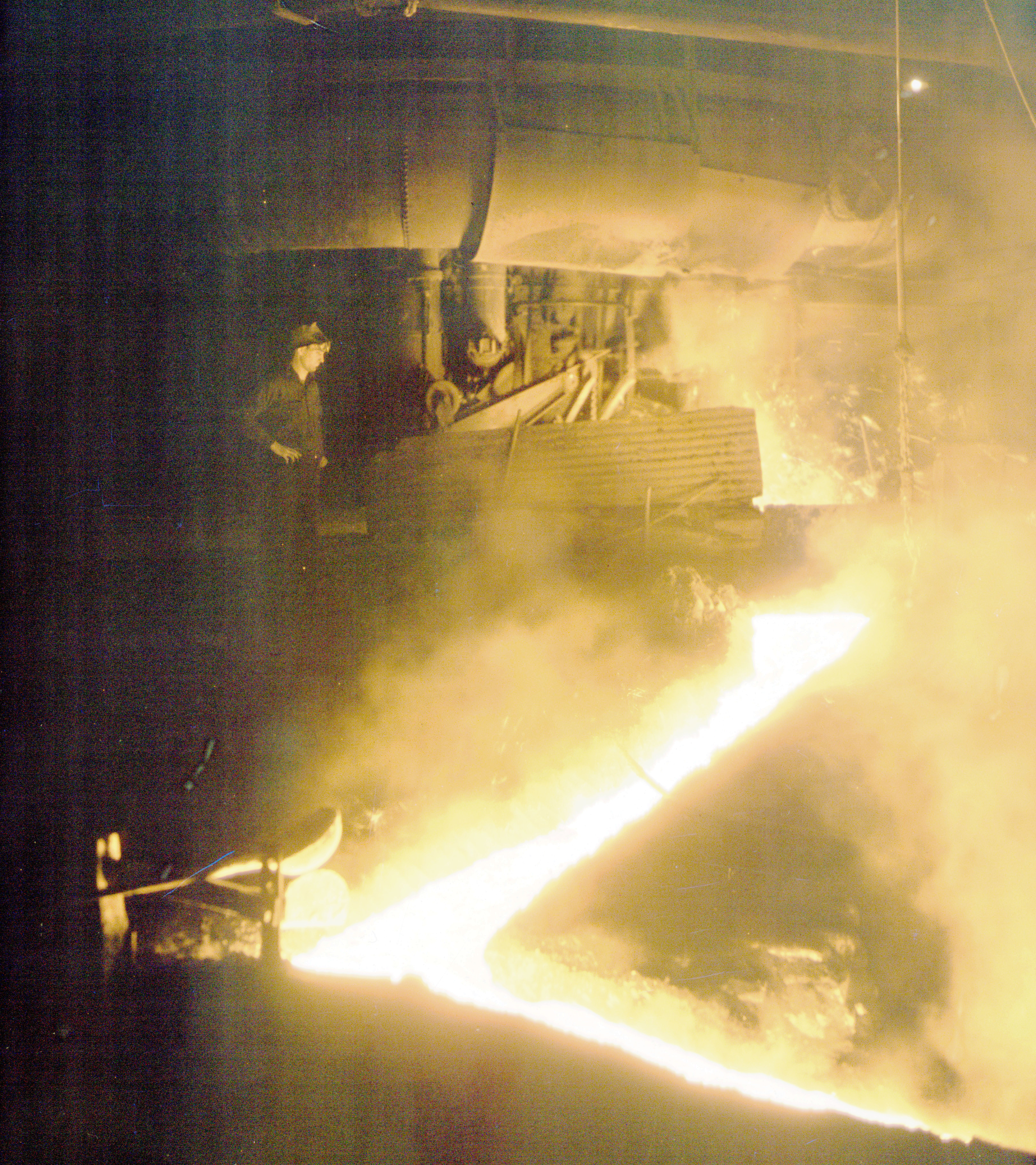
Run-off from a Steel Mill Open Hearth Furnace, Republic Steel Corp., Youngstown, Ohio, November 1941, A work of the U.S. federal government, in the public domain

ADC Author Interview

We here at Mandated Memoranda Publishing, LLC, are gearing up for a book unveiling. Here’s an author interview for the taking. All we ask is that you use the Q & A ‘as is,’ notify us of your intention to use the material, and send us a link ahead of your post via our email address. Thanks.

MM email address

Book Title: A Digital Carol – A Tale for Our Generation

Author: Adolphus Writer

Publisher: Mandated Memoranda Publishing, LLC

Genre: Science Fiction, Christian Futuristic

Publication date: November 19, 2014

Short author bio:

Adolphus Writer holds a doctorate in theoretical physics. After he graduated, he took a job at a large US defense firm applying his creative and analytical skills to pressing problems. He married Ninja (NEEN–yuh) S. Writer after she completed her service with the German Federal Defense forces.

During the economic downturn spanning the first and second decades of the twenty–first century, his job was eliminated and he was terminated. In early 2012, Adolphus established Mandated Memoranda Publishing, LLC as a way to support the lifestyle to which he and his family had become accustomed. He says they like to eat on a daily basis and stay debt–free.

Book Synopsis:

A Digital Carol – A Tale for Our Generation is the old Dickens’ favorite—A Christmas Carol—reimagined. We now face a monstrous egotist who questions the very premise of his existence and ours.

Images:

ADC Book Cover

ADC Cover quarter scale, Copyrighted, All Rights Reserved

Author

Adolphus Writer Picture

Contact information: mandatedmemorandainquiry at outlook dot com

Purchase link: Amazon Kindle eBook exclusively

Website / Blog: Mandated Memoranda Publishing, LLC

Twitter:

Adolphus Writer (@AdolphusWriter)

Other Social Media:

On Goodreads

On Google+

On Facebook

ABOUT YOUR BOOK AND WRITING PROCESS

Tell us a little about your book.

I think the ADC’s preface sums it up well without giving too much away:

We no longer believe in ghosts, do we? I thought not. But we invest our time and attention in the promise of virtual reality for entertainment and, as some might wish it, our evolutionary destiny. Of course, this is only the latest manifestation of our desire to create our own heaven, on our own terms, here on earth.

A Digital Carol is Dickens’ A Christmas Carol retold with new forms and modern perspectives. No longer do we read a tale of a mean miser who, through sorrowful experiences, becomes kindly. We now face a monstrous egotist who teeters between damnation and redemption.

This speculative fiction story’s goal is not to inspire a more joyous holiday or a more generous spirit, but to question the very premise of our existence. Are we too far into the dark night of the soul for anything but drastic measures?

The chapter titles have more flair than the original story, too:

Preface

Chapter 1 – You Disgust Me, Sir

Chapter 2 – Left Behind? No, Wait

Chapter 3 – Why Were You Holding Out?

Chapter 4 – What I Need From You

Chapter 5 – A Long, Long Way Down

Chapter 6 – Ben’s Recovery

Chapter 7 – A Very Good Year

About the Author

How did you come up with the title?

It’s probably obvious: A Christmas Carol becomes A Digital Carol. Dickens’ used the trope of spiritualism popular in his day. We chose Artificial Intelligence (AI) gone awry popular in ours. Neither Dickens nor we advocate for these movements. Although both stories are set during the Christmas season, we changed our title to A Digital Carol to emphasize the modern nature of the reimagined story.

Is there a message in your novel that you want readers to grasp?

If it’s stated anywhere in ADC, we’d have to say that the preface hints most directly at our message:

All of us want to create, in some shape or fashion, our own heaven, on our own terms, here on earth. Whether we believe it or not, we, even as the story’s main character: E. Ben Ezer, teeter between damnation and redemption. We hope this story prompts all readers to question the very premise of their existence.

How much of the book is realistic?

All of it. Of course, at least as of this writing, everything is greatly exaggerated in the story. We have a growing economic divide, jobs automated away, AI demons, Wars, and cries of over–population. We’ve recently experienced a worldwide financial crisis that may not be over. We have wars and rumors of wars raging in places most of us cannot find on a map. We have various elites that view the majority of us as low information and hardly worth the investment (e.g., look at real wages, job statistics, and offshored corporate income). We also have philosophical movements that put agrarian gentrification for the privileged above economic prosperity for all. I could go on as could you.

What is your writing process?

Get to the computer every morning and type until bed time. Yeah, right, as if that would happen. It’s the goal, but we only have that leisure on Mondays, Tuesdays, and Saturdays. The rest of the week is broken up by appointments.

Prior to starting a manuscript, we do a lot of daily reading on relevant topics to establish our mindset and a reservoir of facts from which we draw. As the writing progresses, we do less reading each day.

Did you hire an editor to review your manuscript before publishing?

We used to use advanced copy readers for early critiques. However, your friends and acquaintances shouldn’t be put on the spot when it comes to bald criticism. And, it’s this kind of criticism that you need. We’ve decided, from now on, to go to paid editing early in the development process.

Several shops offer quick turnarounds and direct communications. Pay the money and get the best you can afford. We chose to do three collaborative editing sessions before a final copyedit phase. I feel we have a better product for it.

Did you learn anything from writing your book and what was it?

Our collaborative editor for our second and third sessions recommended reading 120 pages from The Art of Dramatic Writing: Its Basis in the Creative Interpretation of Human Motives by Lajos Egri. Specifically, she recommended the chapter on ‘Conflict’. We read most of the book, actually. The author’s drama principles are useful; his science and philosophy are forgettable.

How long did it take to write your latest release?

Our first manuscript iteration is dated mid–November 2013. We sent the manuscript off for the first collaborative editing session June 2014. We received our manuscript from our third collaborative editing session October 2014. The manuscript is about 21,500 words.

Do you have a favorite line or scene from your latest release?

I think this exchange captures the initial mood of the story:

“No one anticipated the unfortunate events that have taken place, sir. They would rather die than subject their families to these horrors.”—Solicitor for community charity

“Perhaps it’s best that they do die. It reduces the surplus population. We have no need of them all anymore. Not one of them. Worldwide.”—Eli Benjamin Ezer

Eli Benjamin Ezer (also known as E. Ben. Ezer) is our main character. Honestly, I didn’t like the name Scrooge and each of his new names has an interesting meaning. The solicitor reappears later in the story (as his counterpart does in the original story).

ABOUT PUBLISHING AND MARKETING

What are the future plans for you and this book?

After we get the copyedited manuscript back, we’ll generate a PDF file and submit it for reviews at: Kirkus Review, Books and Culture, Publishers Weekly, and Red City Review.

In parallel, we’ll kindlefy the manuscript and post it to Kindle Direct Publishing (KDP) for sale by the end of November 2014. We’re already on Goodreads and plan to hold an event prior to Christmas.

If the reviews are fair to middlin’ or better, we’ll request ADC become a Kindle Single and solicit reviews from newspapers to which we subscribe.

What have you learned during your self-publishing journey?

How to quickly generate clean HTML from Microsoft Word and accurate Amazon KF8 files from the HTML. We have yet to figure out Kindle for iOS to our dismay.

GENERAL QUESTIONS

Do you recall how your interest in writing originated?

I can remember standing up in class, at age seven, and declaring I wanted to write a book about nuclear energy. I read widely in fiction and non-fiction throughout my schooling and afterwards. I had always planned on writing and publishing after retirement. The economic downturn merely accelerated the schedule.

Have you published anything else?

Mandated Memoranda Publishing, LLC has published Tiānmìng – Mandate of Heaven  as a Kindle edition in June 2013. It is an everyman’s spy adventure – a reluctant journalist’s tale of economic calamity, geologic catastrophe, geopolitical power shifts, and the beginnings of a hands–on surveillance state.

Our second Kindle Edition is Tragic Wonders – Stories, Poems, and Essays to Ponder which presents faith in Christ as a plausible alternative through brief narratives of realism, thriller, and science fiction. It was published on Amazon in December 2013.

What’s next for you?

We plan to release a fourth Kindle edition: Who Shall Be God, a fictional account of the struggles between two families, the Stadists and the Libertas, who live in an east coast US city, north and south of the 38th parallel, respectively. It will be published on Amazon in late 2015 or early 2016.

Our fifth planned Kindle edition is due in late 2016 or early 2017. The working title for this book is China Dream. It’s still in process, as is the dream itself. However, could it turn into a nightmare instead?

A Digital Carol – A Tale for Our Generation — A Status Report

We at Mandated Memoranda Publishing have been working on our third book: A Digital Carol – A Tale for Our Generation. This is the old Dickens‘ favorite—A Christmas Carol—reimagined. We now face a monstrous egotist who questions the very premise of his existence and ours. Its genre is sci-fi but I prefer the non–conformist genre speculative fiction.

We’ve updated our book blurb yet again. We plan on posting an Author Interview, a Character Interview, and a Candidate Press Release in the coming weeks. We’ve managed to streamline our Kindlefication and campaign processes further and may try to summarize them in outline form (our punch list).

We’ve labored through three rounds of collaborative editing, read Lajos Egri on how to create drama, and are now Kindlefying (are you listening, Oxford English Dictionary?) the manuscript while we wait for the final copyedited manuscript. We’ll fold those edits in and generate our Kindle book.

We also plan to solicit paid reviews and, if those are fair to middlin’, pursue Amazon Singles status and reviews by two newspapers to which we subscribe. We may ask Amazon for Singles consideration in any case because there is no accounting for taste when it comes to reviewers (both our experience and our collaborative editors bear this out).

Our aim is to publish the Kindle book by Black Friday (or Cyber Monday depending on the vagaries of Amazon KDP). We’ll add the book to Goodreads and do promotion there. We hope to have okay reviews by mid-December. We’ll add those to the Amazon product page. Then we’ll do a press release with the reviews (if one of the review companies doesn’t offer first).

For those of you who follow our devotional postings (under the Ponderings category), we plan to add four more after we get the book online. We’ll cover: Sanctification, Fiery Trials, Assurance, and Salvation. We plan on starting book four: Who Shall Be God during December. Postings at that time will reflect our research. As always, we appreciate your ongoing support for Mandated Memoranda Publishing.

ADC Cover quarter scale, Copyrighted, All Rights Reserved

A Digital Carol – A Tale for Our Generation Cover – quarter scale (copyrighted, all rights reserved)


Self-renunciation

When I first became a Christian many years ago, I heard words like the one in the title. And then I didn’t any longer. The plain meaning is:

Renunciation or formal rejection of one’s own will; self-sacrifice; unselfishness.

The scriptural basis for the concept is:

Then Jesus told his disciples, “If anyone would come after me, let him deny himself and take up his cross and follow me. Matthew 16:24 English Standard Version (ESV)

And calling the crowd to him with his disciples, he said to them, “If anyone would come after me, let him deny himself and take up his cross and follow me. Mark 8:34 (ESV)

And he said to all, “If anyone would come after me, let him deny himself and take up his cross daily and follow me. Luke 9:23 (ESV)

Of course, you might think of many other verses. What does Calvin comment on Matt 16:24:

If any man will come after me. …The words must be explained in this manner: “If any man would be my disciple, let him follow me by denying himself and taking up his cross, or, let him conform himself to my example.” The meaning is, that none can be reckoned to be the disciples of Christ unless they are true imitators of him, and are willing to pursue the same course.

He lays down a brief rule for our imitation, in order to make us acquainted with the chief points in which he wishes us to resemble him. It consists of two parts, self-denial and a voluntary bearing of the cross.

Let him deny himself. This self-denial is very extensive, and implies that we ought to give up our natural inclinations, and part with all the affections of the flesh, and thus give our consent to be reduced to nothing, provided that God lives and reigns in us.

We know with what blind love men naturally regard themselves, how much they are devoted to themselves, how highly they estimate themselves. But if we desire to enter into the school of Christ, we must begin with that folly to which Paul (1 Corinthians 3:18) exhorts us, becoming fools, that we may be wise; and next we must control and subdue all our affections.

And let him take up his cross. He lays down this injunction, because, though there are common miseries to which the life of men is indiscriminately subjected, yet as God trains his people in a peculiar manner, in order that they may be conformed to the image of his Son, we need not wonder that this rule is strictly addressed to them.

It may be added that, though God lays both on good and bad men the burden of the cross, yet unless they willingly bend their shoulders to it, they are not said to bear the cross; for a wild and refractory horse cannot be said to admit his rider, though he carries him.

The patience of the saints, therefore, consists in bearing willingly the cross which has been laid on them. Luke adds the word daily — let him take up his cross daily — which is very emphatic; for Christ’s meaning is, that there will be no end to our warfare till we leave the world. Let it be the uninterrupted exercise of the godly, that when many afflictions have run their course, they may be prepared to endure fresh afflictions.

John Calvin discusses the reality of self–renunciation in his devotional called An Introduction to the Christian Life, an appendix to his Institutes of the Christian Religion. It is a 44 page tract that begins with a realistic assessment of the difficulties in following Christ and concludes with the very real goals we must aim for if we hope to live the Christian life well. He discusses the middle ground of liberty between asceticism and license (both of which he considers inimical).

So let us:

“Enter by the narrow gate. For the gate is wide and the way is easy that leads to destruction, and those who enter by it are many. For the gate is narrow and the way is hard that leads to life, and those who find it are few. Matthew 7:13-14 (ESV)

Narrow path through pine trees

Meenikunno Landscape Reserve (the trees are Pinus sylvestris), Ruta Badina, Creative Commons Attribution-Share Alike 3.0 Unported

Legalistic?

I’ve heard it said that those who profess Christ shouldn’t try to put off the old self and put on the new self, to pursue sanctification, or intentionally obey the word of God.

Paul, in his letter to the Philippian church says:

Therefore, my beloved, as you have always obeyed, so now, not only as in my presence but much more in my absence, work out your own salvation with fear and trembling, for it is God who works in you, both to will and to work for his good pleasure. Philippians 2:12-13 English Standard Version (ESV)

Some would have you believe that Paul must have been mistaken. John Calvin comments on these verses:

It is God that worketh. This is the true engine for bringing down all haughtiness — this the sword for putting an end to all pride, when we are taught that we are utterly nothing, and can do nothing, except through the grace of God alone. I mean supernatural grace, which comes forth from the spirit of regeneration.

…There are, in any action, two principal departments — the inclination, and the power to carry it into effect. Both of these he ascribes wholly to God; what more remains to us as a ground of glorying?

Nor is there any reason to doubt that this division has the same force as if Paul had expressed the whole in a single word; for the inclination is the groundwork; the accomplishment of it is the summit of the building brought to a completion. …For he does not say that our hearts are simply turned or stirred up, or that the infirmity of a good will is helped, but that a good inclination is wholly the work of God.

…For we acknowledge that we have from nature an inclination, but as it is depraved through the corruption of sin, it begins to be good only when it has been renewed by God. Nor do we say that a man does anything good without willing it, but that it is only when his inclination is regulated by the Spirit of God.

Hence, in so far as concerns this department, we see that the entire praise is ascribed to God, and that what sophists teach us is frivolous — that grace is offered to us, and placed, as it were, in the midst of us, that we may embrace it if we choose; for if God did not work in us efficaciously, he could not be said to produce in us a good inclination.

As to the second department, we must entertain the same view. “God,” says he, “is ̔Ο ἐνεργῶν το ἐνεργεῖν he that worketh in us to do.” He brings, therefore, to perfection those pious dispositions which he has implanted in us, that they may not be unproductive, as he promises by Ezekiel, —

I will cause them to walk in my commandments.” (Ezekiel 11:20)

From this we infer that perseverance, also, is his free gift.

According to his good pleasure. …For Paul has it in view to ascribe everything to God, and to take everything from us. Accordingly, not satisfied with having assigned to God the production both of willing and of doing aright, he ascribes both to his unmerited mercy. By this means he shuts out the contrivance of the sophists as to subsequent grace, which they imagine to be the reward of merit. Hence he teaches, that the whole course of our life, if we live aright, is regulated by God, and that, too, from his unmerited goodness.

With fear and trembling. From this Paul deduces an exhortation — that they must with fear work out their own salvation. He conjoins, as he is accustomed, fear and trembling, for the sake of greater intensity, to denote — serious and anxious fear. He, accordingly, represses drowsiness as well as confidence…

The inference, also, is to be carefully observed: “You have,” says he, “all things from God; therefore be solicitous and humble.” For there is nothing that ought to train us more to modesty and fear, than our being taught, that it is by the grace of God alone that we stand, and will instantly fall down, if he even in the slightest degree withdraw his hand. Confidence in ourselves produces carelessness and arrogance.

…For distrust of ourselves leads us to lean more confidently upon the mercy of God. And this is what Paul’s words import, for he requires nothing from the Philippians, but that they submit themselves to God with true self-renunciation.

Work out your own salvation. …Salvation is taken to mean the entire course of our calling, and that this term includes all things, by which God accomplishes that perfection, to which he has predestinated us by his gracious choice. This no one will deny…

We are said to perfect it, when, under the regulation of the Spirit, we aspire after a life of blessedness. It is God that calls us, and offers to us salvation; it is our part to embrace by faith what he gives, and by obedience act suitably to his calling; but we have neither from ourselves. Hence we act only when he has prepared us for acting.

Addressing the whole issue, James wrote ironically:

But someone will say, “You have faith and I have works.” Show me your faith apart from your works, and I will show you my faith by my works. James 2:18 (ESV)

Know this then, that faith without works is dead.

Papyrus 54: James 2:16-18

Papyrus 54: James 2:16-18, 6th century, Public Domain in US

Resistance Isn’t Futile

The author of the book to the Hebrews, in chapter 12, verses 4-6 says:

In your struggle against sin you have not yet resisted to the point of shedding your blood. And have you forgotten the exhortation that addresses you as sons?

“My son, do not regard lightly the discipline of the Lord,

    nor be weary when reproved by him.

For the Lord disciplines the one he loves,

    and chastises every son whom he receives.”

Hebrews 12:4-6 English Standard Version (ESV)

Do you say, as I do sometimes: “Why should I struggle against doing my own will and instead do His will?” Or do we see ourselves as better than this One?

And he came out and went, as was his custom, to the Mount of Olives, and the disciples followed him. And when he came to the place, he said to them, “Pray that you may not enter into temptation.”

And he withdrew from them about a stone’s throw, and knelt down and prayed, saying, Father, if you are willing, remove this cup from me. Nevertheless, not my will, but yours, be done.”

And there appeared to him an angel from heaven, strengthening him. And being in an agony he prayed more earnestly; and his sweat became like great drops of blood falling down to the ground.

And when he rose from prayer, he came to the disciples and found them sleeping for sorrow, and he said to them, “Why are you sleeping? Rise and pray that you may not enter into temptation.”

Luke 22:39-46 (ESV)

Some manuscripts leave out the verses in the third paragraph.

So, with regard to the verse:

And being in an agony he prayed more earnestly; and his sweat became like great drops of blood falling down to the ground.

what does John Calvin comment?

Certainly those who imagine that the Son of God was exempt from human passions do not truly and sincerely acknowledge him to be a man…

…When Christ was distressed by grief and fear, he did not rise against God, but continued to be regulated by the true rule of moderation. We need not wonder that, since he was innocent and pure from every stain, the affections which flowed from him were pure and stainless… Christ, amidst fear and sadness, was weak without any taint of sin…

…He [Christ] had no horror at death…simply as a passage out of the world, but because he had before his eyes the dreadful tribunal of God, and the Judge himself armed with inconceivable vengeance; and because our sins, the load of which was laid upon him, pressed him down with their enormous weight. There is no reason to wonder, therefore, if the dreadful abyss of destruction tormented him grievously with fear and anguish.

…And, therefore, though he suffered death, yet since its pains were loosed—as Peter tells us, (Acts 2:24)—and he was victorious in the conflict, the Apostle justly says, that he was heard on account of his fear [Hebrews 5:7]. Here ignorant people rise up and exclaim, that it would have been unworthy of Christ to be afraid of being swallowed up by death.

But I should wish them to answer this question, What kind of fear do they suppose it to have been which drew from Christ drops of blood? (Luke 22:44). For that mortal sweat could only have proceeded from fearful and unusual horror. If any person, in the present day, were to sweat blood, and in such a quantity that the drops should fall to the ground, it would be reckoned an astonishing miracle…

If it be objected, that the fear which I am describing arises from unbelief, the answer is easy. When Christ was struck with horror at the divine curse, the feeling of the flesh affected him in such a manner, that faith still remained firm and unshaken. For such was the purity of his nature, that he felt, without being wounded by them, those temptations which pierce us with their stings.

And yet those persons, by representing him not to have felt temptations, foolishly imagine that he was victorious without fighting. And, indeed, we have no right to suppose that he used any hypocrisy, when he complained of a mortal sadness in his soul; nor do the Evangelists speak falsely, when they say that he was exceedingly sorrowful, and that he trembled.

In the face of deep fear and anguish, Christ prayed earnestly that His Father’s will be done and He opened the way of salvation to all who will be saved. No matter what anyone says, resistance is not futile.

Borg transmission from the movie Star Trek VIII First Contact – English version

Restore to Repentance?

Having been in the church a while, I’ve seen and heard things. This verse has always troubled me:

For it is impossible,

in the case of those:

who have once been enlightened,

who have tasted the heavenly gift,

and have shared in the Holy Spirit,

and have tasted the goodness of the word of God and the powers of the age to come,

and then have fallen away,

to restore them again to repentance,

since they are:

crucifying once again the Son of God to their own harm

and holding him up to contempt.

Hebrews 6:4-6 English Standard Version (ESV) emphasis mine

I had once presented the gospel to a fellow who said to me that he knew he was not redeemable because of these verses. Ignorant as I was at the time, I tried to convince him that there was always hope while he yet lived. He, a non-believer, quoted these verses to me, thanked me for my concern, and wandered away. I never saw him again.

John Calvin comments:

Let us then know, that the Gospel cannot be otherwise rightly known than by the illumination of the Spirit, and that being thus drawn away from the world, we are raised up to heaven, and that knowing the goodness of God we rely on his word.

But here arises a new question, how can it be that he who has once made such a progress should afterwards fall away? For God, it may be said, calls none effectually but the elect, and Paul testifies that they are really his sons who are led by his Spirit, (Romans 8:14) and he teaches us, that it is a sure pledge of adoption when Christ makes us partakers of his Spirit. The elect are also beyond the danger of finally falling away; for the Father who gave them to be preserved by Christ his Son is greater than all, and Christ promises to watch over them all so that none may perish.

To all this I answer, That God indeed favors none but the elect alone with the Spirit of regeneration, and that by this they are distinguished from the reprobate; for they are renewed after his image and receive the earnest of the Spirit in hope of the future inheritance, and by the same Spirit the Gospel is sealed in their hearts.

But I cannot admit that all this is any reason why he should not grant the reprobate also some taste of his grace, why he should not irradiate their minds with some sparks of his light, why he should not give them some perception of his goodness, and in some sort engrave his word on their hearts.

Otherwise, where would be the temporal faith mentioned by Mark 4:17? There is therefore some knowledge even in the reprobate, which afterwards vanishes away, either because it did not strike roots sufficiently deep, or because it withers, being choked up.

And by this bridle the Lord keeps us in fear and humility; and we certainly see how prone human nature is otherwise to security and foolish confidence. At the same time our solicitude ought to be such as not to disturb the peace of conscience. For the Lord strengthens faith in us, while he subdues our flesh: and hence he would have faith to remain and rest tranquilly as in a safe haven; but he exercises the flesh with various conflicts, that it may not grow wanton through idleness.

So the bitter admonition in these verses serves us well: to keep us striving for holiness, humility, and obedience to the Lord Jesus Christ in all we think, say, and do.

Fallen Angels in Hell

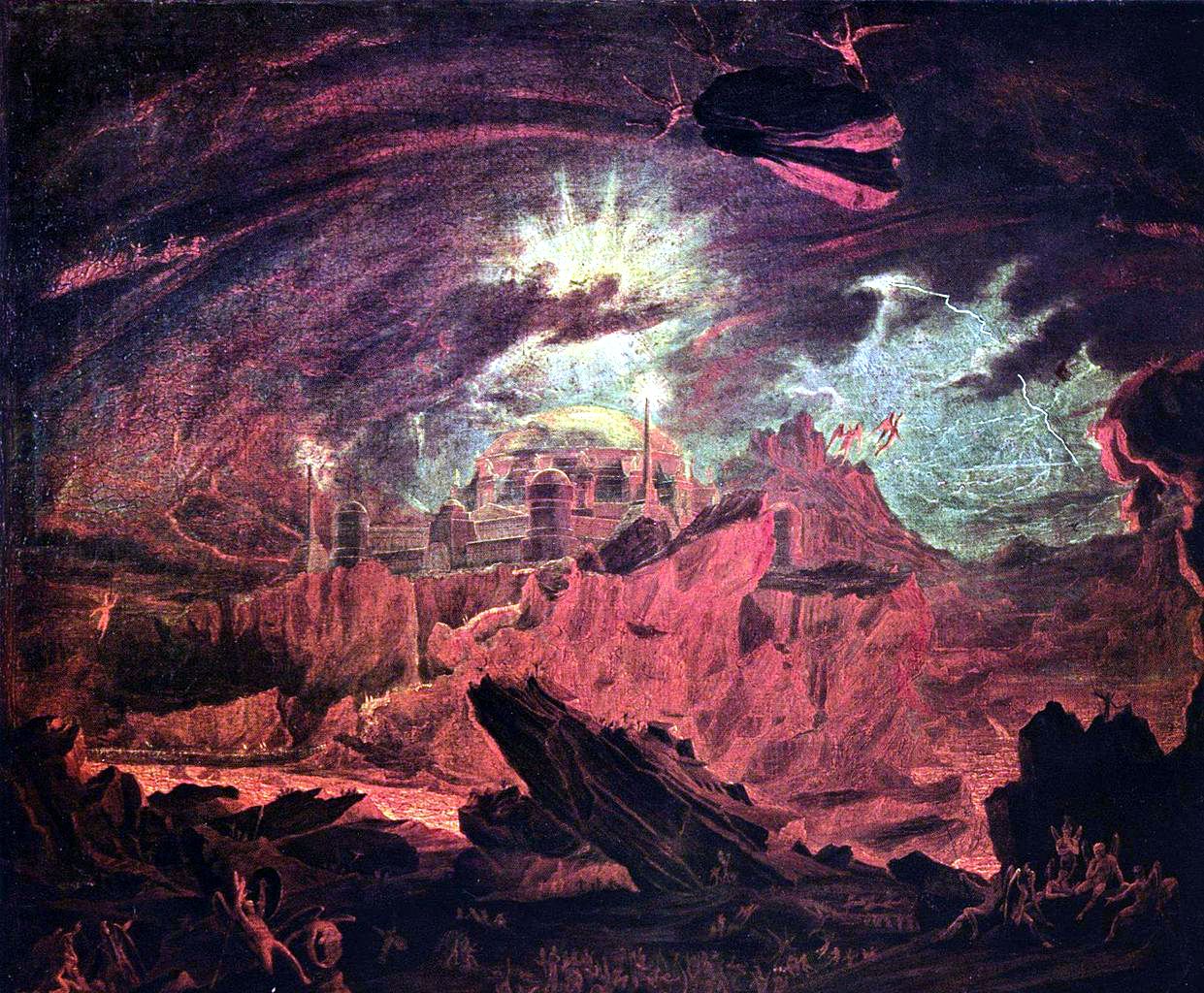
Fallen Angels in Hell, circa 1841, John Martin, 1789 – 1854, Public Domain in US