The Shocking Concrete Abstract Universal

Flannery O’Connor meant to shock us by her storylines and imagery:

The novelist with Christian concerns will find in modern life distortions which are repugnant to him, and his problem will be to make these appear as distortions to an audience which is used to seeing them as natural; and he may well be forced to take ever more violent means to get his vision across to this hostile audience.

When you can assume that your audience holds the same beliefs you do, you can relax a little and use more normal ways of talking to it; when you have to assume that it does not, then you have to make your vision apparent by shock – to the hard of hearing you shout, and for the almost blind you draw large and startling figures.

Anyone who has read The Violent Bear It Away or Everything That Rises Must Converge would have to agree that O’Connor had the ability to shout and startle.

On a more philosophical note, she reflected on the imbalance between abstract and concrete knowledge of her day in her essay: ‘The Catholic Novelist in the Protestant South,’ p 858–9, Collected Works:

It takes a story of mythic dimensions; one which belongs to everybody; one in which everybody is able to recognize the hand of God and imagine its descent upon himself.

In the Protestant South the Scriptures fill this role. The ancient Hebrew genius for making the absolute concrete has conditioned the Southerner’s way of looking at things…

Our response to life is different if we have been taught only the definition of faith than if we have trembled with Abraham as he held the knife over Isaac.

I’d say it was God’s genius for making the absolute concrete; but who’s quibbling. To paraphrase O’Connor, the point is that the abstract is transformed into the concrete thereby making the universal accessible. That’s what God has done throughout the Scriptures. To illustrate, I cite two examples.

The intricate description of the ephod and breastpiece of judgement belonging to the High Priest’s garments culminates in Exodus, chapter 28, verses 29 and 30:

So Aaron shall bear the names of the sons of Israel in the breastpiece of judgment on his heart, when he goes into the Holy Place, to bring them to regular remembrance before the Lord. And in the breastpiece of judgment you shall put the Urim and the Thummim, and they shall be on Aaron’s heart, when he goes in before the Lord. Thus Aaron shall bear the judgment of the people of Israel on his heart before the Lord regularly. English Standard Version

If we have ears to hear it, all the concrete details of these garments portray the concern Aaron was to have for the people of Israel as he regularly bore their judgement on his heart while he brought them in remembrance before the Lord. We later learn, in the Letter to the Hebrews, that Aaron and his line are a shadow of the reality residing in the Lord Jesus Christ’s intercession for His own before the Father.

Another example of the abstract being made concrete is the bread and wine of communion. First, the Lord Jesus shocks the religious rulers of His day (and us, if we’re honest):

“I am the living bread that came down from heaven. If anyone eats of this bread, he will live forever. And the bread that I will give for the life of the world is my flesh.”

The Jews then disputed among themselves, saying, “How can this man give us his flesh to eat?”

So Jesus said to them, “Truly, truly, I say to you, unless you eat the flesh of the Son of Man and drink his blood, you have no life in you. Whoever feeds on my flesh and drinks my blood has eternal life, and I will raise him up on the last day.” John 6:51-54 (ESV)

Then in the Upper Room, the Lord inaugurates the commemoration of His death and resurrection:

And as they were eating, he took bread, and after blessing it broke it and gave it to them, and said, “Take; this is my body.” And he took a cup, and when he had given thanks he gave it to them, and they all drank of it. And he said to them, “This is my blood of the [new] covenant, which is poured out for many. Truly, I say to you, I will not drink again of the fruit of the vine until that day when I drink it new in the kingdom of God.” Mark 14:22-25 (ESV)

Finally, Paul explains its significance

For I received from the Lord what I also delivered to you, that the Lord Jesus on the night when he was betrayed took bread, and when he had given thanks, he broke it, and said, “This is my body which is for you. Do this in remembrance of me.” In the same way also he took the cup, after supper, saying, “This cup is the new covenant in my blood. Do this, as often as you drink it, in remembrance of me.” For as often as you eat this bread and drink the cup, you proclaim the Lord’s death until he comes. 1 Corinthians 11:23-26 (ESV)

Which brings us full circle back to John, chapter 6:

Jesus said to them, “I am the bread of life; whoever comes to me shall not hunger, and whoever believes in me shall never thirst.” John 6:35 (ESV)

Even the Prophet Isaiah said as much:

“Come, everyone who thirsts,

    come to the waters;

and he who has no money,

    come, buy and eat!

Come, buy wine and milk

    without money and without price.

Why do you spend your money for that which is not bread,

    and your labor for that which does not satisfy?

Listen diligently to me, and eat what is good,

    and delight yourselves in rich food.

Incline your ear, and come to me;

    hear, that your soul may live;

and I will make with you an everlasting covenant,

    my steadfast, sure love for David.

Isaiah 55:1-3 (ESV)

Indeed, come and eat.

High Priest's Garments

The High Priest Aaron, Illustration from Brockhaus and Efron Jewish Encyclopedia (1906—1913), Public Domain in the United States

The Rebellion

Most of us would like to know beforehand when a disaster will occur. Many, to avoid the consequences, but some, to profit from them. If only those who boarded the planes knew that fateful September morning what was about to happen.

In the same way, we’d all like to know when the world will end. Many pretend that it will go on just as it has for millennia. Some think differently. A few believe the scriptures when they speak of the last day:

Let no one deceive you in any way. For that day will not come, unless the rebellion comes first, and the man of lawlessness is revealed, the son of destruction, who opposes and exalts himself against every so-called god or object of worship, so that he takes his seat in the temple of God, proclaiming himself to be God. 2 Thessalonians 2:3-4 English Standard Version (ESV)

So there are signs of the end. But, what would these things look like? John Calvin comments on this passage:

Paul, …foretells that, after [those in the visible church] have had foreign enemies for some time molesting them, they will have more evils to endure from enemies [within the church], inasmuch as many of those that have made a profession of attachment to Christ would be hurried away into base treachery, and inasmuch as the temple of God itself would be polluted by sacrilegious tyranny, so that Christ’s greatest enemy would exercise dominion there.

Relative to Antichrist’s pernicious arrogation of deity, Calvin says:

Scripture declares that God is the alone Lawgiver (James 4:12) who is able to save and to destroy; the alone King, whose office it is to govern souls by His word. [Scripture] represents Him as the author of all sacred rites; it teaches that righteousness and salvation are to be sought from Christ alone; and it assigns, at the same time, the manner and means.

And concerning the history of the visible church, Calvin says:

My readers now understand, that all the sects by which the Church has been lessened from the beginning, have been so many streams of revolt which began to draw away the water from the right course, but that the sect of Mahomet was like a violent bursting forth of water, that took away about the half of the Church by its violence. It remained, also, that Antichrist should infect the remaining part with his poison. Thus, we see with our own eyes, that this memorable prediction of Paul has been confirmed by the event.

So, are we able discern the fruition of these things in time to flee the consequences? The Lord Jesus Christ warned:

“But concerning that day and hour no one knows, not even the angels of heaven, nor the Son, but the Father only. For as were the days of Noah, so will be the coming of the Son of Man. For as in those days before the flood they were eating and drinking, marrying and giving in marriage, until the day when Noah entered the ark, and they were unaware until the flood came and swept them all away, so will be the coming of the Son of Man. Matthew 24:36-39 (ESV)

Calvin comments on this passage:

So now Christ declares that the last age of the world will be in a state of [senseless] indifference, so that men will think of nothing but the present life, and will extend their cares to a long period, pursuing their ordinary course of life, as if the world were always to remain in the same condition… [Emphasis mine]

Though the report of the last judgment is now widely circulated, and though there are a few persons who have been taught by God to perceive that Christ will come as a Judge in due time, yet it is proper that those persons should be aroused by this extraordinary kindness of God, and that their senses should be sharpened, lest they give themselves up to the indifference which so generally prevails.

Therefore, if you haven’t yet, we urge you to repent while there is still time.

***

Speaking of our collective indifference, The Federalist has summarized the recent Planned Parent video expose’. Item number 7 describes the Carly Fiorina video. No, I did NOT watch.

In the same vein, I don’t often agree with Mr. O’Reilly, but when I do, I offer you this video:

Is America Becoming Barbaric? Fox News, July 28, 2015

Everyone Divided

There’s no sidestepping it, scripture divides us. This principle applies to everyone we know and everyone we may never know. The Apostle John, in his first letter to the Church, describes what is true of everyone.

Writing about the Christ, John says:

If you know that he is righteous, you may be sure that everyone who practices righteousness has been born of him. 1 John 2:29 English Standard version (ESV)

To this, Calvin says:

If you know that he is righteous [John] again passes on to exhortations, so that he mingles these continually with doctrine throughout the Epistle; but he proves by many arguments that faith is necessarily connected with a holy and pure life. The first argument is, that we are spiritually begotten after the likeness of Christ; it hence follows, that no one is born of Christ but he who lives righteously…

Next, speaking of our response to Christ, John says:

And everyone who thus hopes in him purifies himself as he is pure. 1 John 3:3 ESV

And Calvin says:

And every man that has this hope …The meaning then is, that though we have not Christ now present before our eyes, yet if we hope in him, it cannot be but that this hope will excite and stimulate us to follow purity, for it leads us straight to Christ, whom we know to be a perfect pattern of purity.

Then, speaking of those apart from Christ, John says:

Everyone who makes a practice of sinning also practices lawlessness; sin is lawlessness. 1 John 3:4 ESV

Calvin explains the distinction:

Whosoever commits, or does, sin. …The import of the passage is, that the perverse life of those who indulge themselves in the liberty of sinning, is hateful to God, and cannot be borne with by him, because it is contrary to his Law.

It does not hence follow, nor can it be hence inferred, that the faithful are iniquitous; because they desire to obey God, and abhor their own vices, and that in every instance; and they also form their own life, as much as in them lies, according to the law.

But when there is a deliberate purpose to sin, or a continued course in sin, then the law is transgressed.

John presses this point further:

Everyone who hates his brother is a murderer, and you know that no murderer has eternal life abiding in him. 1 John 3:15 ESV

And Calvin responds:

Is a murderer. …The Apostle declares that all who hate their brethren are murderers. He could have said nothing more atrocious; nor is what is said hyperbolic, for we wish him to perish whom we hate. It does not matter if a man keeps his hands from mischief; for the very desire to do harm, as well as the attempt, is condemned before God: nay, when we do not ourselves seek to do an injury, yet if we wish an evil to happen to our brother from someone else, we are murderers.

Returning to those in Christ, John says:

Everyone who believes that Jesus is the Christ has been born of God, and everyone who loves the Father loves whoever has been born of him. 1 John 5:1 ESV

Calvin responds with:

Whosoever believes …The first truth is, that all born of God, believe that Jesus is the Christ [i.e., Messiah, Savior]; where, again, you see that Christ alone is set forth as the object of faith, as in him it finds righteousness, life, and every blessing that can be desired, and God in all that he is…

Loves him also that is begotten of him …The context plainly shows that his purpose was no other than to trace up brotherly love to faith as its fountain. It is, indeed, an argument drawn from the common course of nature; but what is seen among men is transferred to God.

John elaborates on the condition of those in Christ:

For everyone who has been born of God overcomes the world. And this is the victory that has overcome the world—our faith. 1 John 5:4 ESV

About the victory, Calvin says:

This is the victory. …This passage is remarkable, for though Satan continually repeats his dreadful and horrible onsets, yet the Spirit of God, declaring that we are beyond the reach of danger, removes fear, and animates us to fight with courage. …But as this promise secures to us perpetually the invincible power of God, so, on the other hand, it annihilates all the strength of men…he makes victory to depend on faith alone; and faith receives from another that by which it overcomes. They then take away from God what is his own, who sing triumph to their own power.

And, as if to draw a final distinction, John says:

We know that everyone who has been born of God does not keep on sinning, but he who was born of God protects him, and the evil one does not touch him. 1 John 5:18 ESV

To which, Calvin’s explanation is:

We know that whosoever is born of God If you suppose that God’s children are wholly pure and free from all sin, as the fanatics contend, then the Apostle is inconsistent with himself; for he would thus take away the duty of mutual prayer among brethren. …Hence spiritual life is never extinguished in them… Though the faithful indeed fall through the infirmity of the flesh, yet they groan under the burden of sin, loathe themselves, and cease not to fear God.

Keeps himself. What properly belongs to God he transfers to us; for were any one of us the keeper of his own salvation, it would be a miserable protection. Therefore Christ asks the Father to keep us, intimating that it is not done by our own strength. …And we know that we fight with no other weapons but those of God. Hence the faithful keep themselves from sin, as far as they are kept by God. (John 17:11).

There are many ‘everyones’ that we come across every day. All are divided in the ways we’ve just seen. Which are you? Which, then, is your neighbor? Our duty is to love our neighbor as we love ourselves.

I don’t know your situation; but I find I need to pray for and serve my neighbors to keep myself from mischief.

Everyone at Yankee Stadium

Yankees Stadium Crowd, uploaded to Wikimedia Commons 26 February 2013, Donald Riesbeck Jr., in the Public Domain

A New Prophet like Moses

“The end is near, the end is near!” We all associate this trope with crackpots and lunatics. Especially street corner prophets wearing sandwich boards. However, they are right in a sense. Around 150,000 people die every day, worldwide. Their ends are no longer near but already past.

We have to be wary of a prophet and his message. Thus Moses pointed us to the Prophet we should all listen to:

“The Lord your God will raise up for you a prophet like me from among you, from your brothers—it is to him you shall listen…and whoever will not listen to my words that he shall speak in my name, I myself will require it of him. Deuteronomy 18:15, 19 English Standard Version (ESV)

John Calvin has quite a bit to say about these verses:

The Lord thy God will raise up …But if He had referred them to Christ alone, the objection would naturally arise that it was hard for them to have neither Prophets nor revelations for two thousand years. Nor is there any strength in those two arguments on which some insist, that the Prophet, of whom Moses bears witness, must be more excellent than him who proclaimed him; and that the eulogium that he should be “like unto” Moses could not be applied to the ancient Prophets, since it is said elsewhere that “there arose not a Prophet since like unto” him. (Deuteronomy 34:10)…

…Yet Peter aptly and elegantly accommodates this testimony to Christ, (Acts 3:22) not to the exclusion of others of God’s servants, but in order to warn the Jews that in rejecting Christ they are at the same time refusing this inestimable benefit of God; for the gift of prophecy had so flourished among His ancient people, and teachers had so been constantly appointed to succeed each other, that nevertheless there should be some interruption before the coming of Christ.

Hence, in that sad dispersion which followed the return from the Babylonian captivity, the faithful complain in Psalm 74:9, “We see not our signs; there is no more any prophet.” On this account Malachi exhorts the people to remember the Law given in Horeb; and immediately after adds, “Behold I send you Elijah the prophet,” etc., (Malachi 4:4, 5) as much as to say, that the time was at hand in which a more perfect doctrine should be manifested, and a fuller light should shine. For the Apostle says truly, that:

“God, who at sundry times and in divers manners spoke unto the fathers by the prophets, hath in these last days spoken unto us by his Son,” (Hebrews 1:1, 2)

And, in fact, by the appearing of the doctrine of the Gospel, the course of the prophetic doctrine was completed; because God thus fully exhibited what was promised by the latter.

And this was so generally understood that even the Samaritan woman said that Messiah was coming, who would tell all things. (John 4:25) To this, then, what I have lately quoted as to the transition from the Law and the Prophets to the Gospel refers; and hence it is made out, that this passage was most appropriately expounded by Peter as relating to Christ; for unless the Jews chose to accuse God of falsehood, it was incumbent upon them to look to Christ, at whose hand was promised both the confirmation of doctrine and the restoration of all things.

They had been for a long time destitute of Prophets, of whom Moses had testified that they should never be wanting to them, and whom he had promised as the lawful ministers for retaining the people in allegiance, so that they should not turn aside to superstitions; they had, therefore, either no religion, or else that greatest of Teachers was to be expected, who in his own person would present the perfection of the prophetic office…

…But with regard to the comparison which Moses makes between himself and other prophets, its effect is to raise their teaching in men’s estimation. They had been long accustomed to this mode of instruction, viz., to hear God speaking to them by the mouth of a man; and the authority of Moses was so fully established, that they were firmly persuaded that they were under the divine government, and that all things necessary to salvation were revealed to them.

And, as recorded in John’s Gospel, chapter 5, verses: 39-40 and 46-47, the Lord Jesus Christ Himself says:

“You search the Scriptures because you think that in them you have eternal life; and it is they that bear witness about me, yet you refuse to come to me that you may have life…For if you believed Moses, you would believe me; for he wrote of me. But if you do not believe his writings, how will you believe my words?” John 5:39-40, 46-47 (ESV)

Please, believe Him.

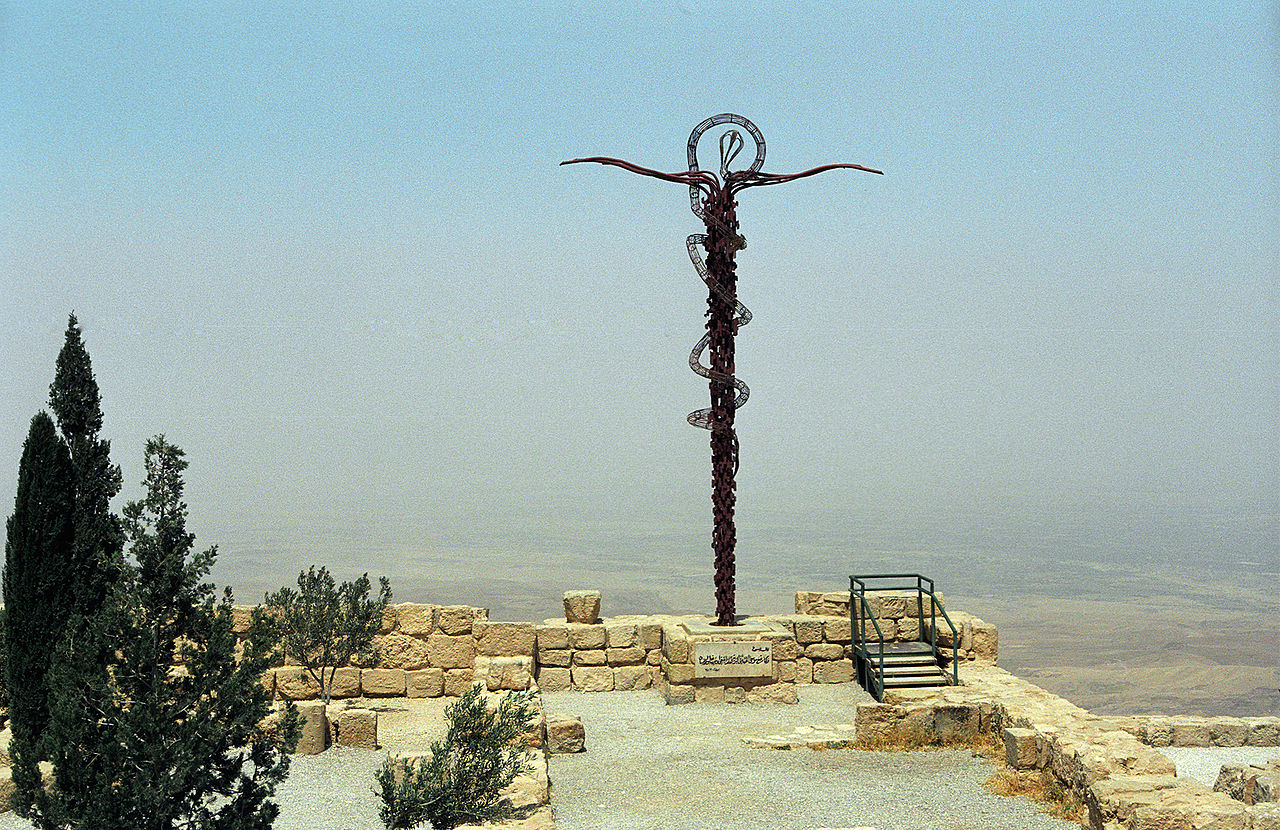
Brazen Serpent

[The Brazen Serpent], Mount Nebo, Jordan (2001), Jerzy Strzelecki, Creative Commons Attribution-Share Alike 3.0 Unported

Salvation

There is much confusion about this concept nowadays. There needn’t be. Scripture is clear:

“And there is salvation in no one else, for there is no other name under heaven given among men by which we must be saved.” Acts 4:12 English Standard Version (ESV)

Calvin says:

Neither is there salvation in any other. …And assuredly Christ had showed this one token of his grace, to the end [that] he might be known to be the only author of life. We must consider this in all the benefits of God, to wit, that he is the fountain of salvation. And he meant to prick and sting the priests with this sentence, when as he says that there is salvation in none other save only in Christ, whom they went about to put quite out of remembrance.

As if he should say, that they are twice damned who did not only refuse the salvation offered them by God, but endeavor to bring the same to naught, and did take from all the people the fruit and use thereof. Although he seems to speak unto deaf men, yet he preaches of the grace of Christ, if [perhaps] some can abide to hear; [and] if not, that they may at least be deprived of all excuse by this testimony.

Neither is there any other name…Salvation (says he) is in Christ alone, because God has decreed that it should be so. For by name he means the cause or means, as if he should have said, forasmuch as salvation is in God’s power only, he will not have the same to be common to us by any other means than if we ask it of Christ alone.

Whereas he says under heaven…I do rather think that this was added, because men cannot ascend into heaven, that they may come unto God. Therefore, seeing we are so far from the kingdom of God, it is needful that God does not only invite us unto himself, but that reaching out his hand he offer salvation unto us, that we may enjoy the same.

Peter teaches in this [passage], that he has done that in Christ, because he came down into the earth for this cause, that he might bring salvation with him. Neither is that contrary to this doctrine, that Christ is ascended above all heavens, (Ephesians 4:10). For he took upon him our flesh once for this cause, that he might be a continual pledge of our adoption. He has reconciled the Father to us forever by the sacrifice of his death: by his resurrection he has purchased for us eternal life.

And he is present with us now also, that he may make us partakers of the fruit of eternal redemption; but the revealing of salvation is handled in this [passage], and we know that the same was so revealed in Christ, that we need not any longer to say, “Who shall ascend into heaven?” (Romans 10:6).

And if this doctrine were deeply imprinted in the minds of all men, then should so many controversies concerning the causes of salvation be soon at an end, wherewith the Church is so much troubled…

The Visual Bible – Acts Chapter 4

Judgment and Condemnation

I was speaking with someone at church a few weeks back and we both wondered what 2 Corinthians 5:10 meant:

For we must all appear before the judgment seat of Christ, so that each one may receive what is due for what he has done in the body, whether good or evil. 2 Corinthians 5:10 English Standard Version (ESV)

Are believers judged? Rather than guess, I offered to look into it. Here’s what I found Calvin had to say:

We must be manifested. Though this is common to all, yet all without distinction do not raise their views in such a way as to consider every moment, that they must appear before the judgment-seat of Christ…For then the books, which are now shut, will be opened (Daniel 7:10).

That every one may give account. As the passage relates to the recompensing of deeds, we must notice briefly, that, as evil deeds are punished by God, so also good deeds are rewarded, but for a different reason; for evil deeds are requited with the punishment that they deserve, but God in rewarding good deeds does not look to merit or worthiness.

For no work is so full and complete in all its parts as to be deservedly well-pleasing to him, and farther, there is no one whose works are in themselves well-pleasing to God, unless he render satisfaction to the whole law. Now no one is found to be thus perfect. Hence the only resource is in his accepting us through unmerited goodness, and justifying us, by not imputing to us our sins.

After he has received us into favor, he receives our works also by a gracious acceptance. It is on this that the reward hinges. There is, therefore, no inconsistency in saying, that he rewards good works, provided we understand that mankind, nevertheless, obtain eternal life gratuitously…

So, here, I think we have half the explanation. All humankind is judged for the good and bad that they’ve done in this life. Any good we can do is only good insofar as God does not count our sins against us. This is only possible through faith in Christ’s saving work on the cross. And that, too, is freely given by Him alone to those who do not merit it.

But what of the condemnation due for the bad that we do? The scriptures say:

Truly, truly, I say to you, whoever hears my word and believes him who sent me has eternal life. He does not come into judgment, but has passed from death to life. John 5:24 (ESV)

Calvin says about this verse:

He that heareth my word. Here is described the way and manner of honoring God, that no one may think that it consists solely in any outward performance, or in frivolous ceremonies. …But here Christ demands from us no other honor than to obey his Gospel…

Hath eternal life. By these words he likewise commends the fruit of obedience, that we may be more willing to render it…

And shall not come into condemnation. There is here an implied contrast between the guilt to which we are all naturally liable, and the unconditional acquittal which we obtain through Christ; for if all were not liable to condemnation, what purpose would it serve to free from it those who believe in Christ?

The meaning therefore is, that we are beyond the danger of death, because we are acquitted through the grace of Christ; and, therefore, though Christ sanctifies and regenerates us, by his Spirit, to newness of life, yet here he specially mentions the unconditional forgiveness of sins, in which alone the happiness of men consists. For then does a man begin to live when he has God reconciled to him; and how would God love us, if he did not pardon our sins?

…Though life be only begun in us, Christ declares that believers are so certain of obtaining it, that they ought not to fear death; and we need not wonder at this, since they are united to him who is the inexhaustible fountain of life.

But what shall we do with such confidence? I suggest, with Calvin, that we cast off fear and live a life worthy of our gracious God’s gift.

The Last Judgment, Martin, 1853

The Last Judgment, 1853, John Martin (1789-1854), Tate Britain, Public Domain in US

Why Do They Call Evil That Which Is Good?

Chris Mooney says in his article ‘Science Deniers Are Freaking Out About “Cosmos”’

Indeed, the science denial crowd hasn’t been happy with Cosmos in general. Here are some principal lines of attack:

  • Denying the Big Bang
  • Denying evolution
  • Denying climate change

Chris Mooney is a science and political journalist, podcaster, and the host of MJ’s Climate Desk Live. He is the author of four books, including the New York Times bestselling The Republican War on Science. You can read the rest at Bill Moyer’s site and Mother Jones, if you like this sort of thing.

Michael Brendan Dougherty, a more subtle critic, says in his article: ‘In Defense of Creationists – Sure, they’re misreading Genesis. But for all the right reasons.’

My own view is that a literal one-week creation should be ruled out because, combined with the best knowledge we have of science, it would make God into a devil, a trickster. “Haha, mortals, I only buried these dinosaur bones and set the galaxies in explosive motion so the unbelievers would damn themselves to Hell,” doesn’t sound like a great or loving God. It seems to me that the very idea of good, eternal, law-giving God endowing man with rational abilities was the historical prerequisite for scientific exploration.

Michael Brendan Dougherty is senior correspondent at TheWeek.com. He is the founder and editor of The Slurve, a newsletter about baseball. His work has appeared in The New York Times Magazine, ESPN Magazine, Slate and The American Conservative. You can read the rest of this article at The Week.

In the act of creation, God demonstrated overwhelming creative power throughout time and space (and whatever else there might be that we have yet to discover). We reviewed this concept in-depth in our post ‘Every Good Story – Thysdor Ya’Rosel’ and more succinctly in ‘All the world’s a stage…

So far as misreading Genesis, we covered that issue in the recent post ‘Nip ‘Em in the Bud.’

We live in a universe governed by laws which the Law Giver can suspend as it suits His good pleasure. We’ve covered this concept in another recent post ‘Instrumentality.’

For those of us old enough to remember, both the Twilight Zone and Outer Limits television series’ had episodes where that which existed had no reality behind it. How creepy would it be to dig into the ground and find nothing (i.e. no precious metals and gems, petrochemicals, fossils, etc.)?

To this point, the scriptures describe treasures in the sand and deep beneath the ground. As described in Scripture, the world is meant to communicate two major lessons concerning God:

For his invisible attributes, namely, his eternal power and divine nature, have been clearly perceived, ever since the creation of the world, in the things that have been made. Romans 1:20 English Standard Version (ESV)

On the fossils front, death certainly entered creation when the Lord God made garments of skins to clothe Adam and Eve after their fall from grace.  We also read that the creation was subjected to futility by God because of Adam’s sin. So, we can say with confidence that sin had far-reaching consequences for creation!

It’s helpful to see the Scriptures as an accommodation to us by an infinite and unknowable God. In fact, the Lord Jesus Christ is described as the image of the invisible God and declares Himself of one essence with the Father. He appeared to us in human form to identify with us more fully than we sometimes appreciate.

The Lord Jesus Christ taught often through parables:

A parable is a succinct, didactic story, in prose or verse, which illustrates one or more instructive lessons or principles. It differs from a fable in that fables employ animals, plants, inanimate objects, or forces of nature as characters, whereas parables have human characters. A parable is a type of analogy.

When asked, the Lord Jesus Christ explained to His followers why He spoke in parables:

This is why I speak to them in parables, because seeing they do not see, and hearing they do not hear, nor do they understand. Matthew 13:13 (ESV)

He spoke this to remind His followers of Isaiah’s prophecy:

And He said, “Go, and say to this people: “‘Keep on hearing, but do not understand; keep on seeing, but do not perceive.’ Make the heart of this people dull, and their ears heavy, and blind their eyes; lest they see with their eyes, and hear with their ears, and understand with their hearts, and turn and be healed.” Isaiah 6:9-10 (ESV)

Again, reiterating today’s opening statements, isn’t He evil for not revealing all? In the parable about Lazarus and the rich man, concerning warnings about the place of eternal torment:

He said to him, ‘If they do not hear Moses and the Prophets, neither will they be convinced if someone should rise from the dead.’” Luke 16:31 (ESV)

Ultimately, it comes down to believing, or not, the documentary evidence that we have in Scripture. We’ve addressed the authority and basic meaning of Scripture in our posts: ‘Authority of Scripture?’ and ‘Scripture – What Is It Good For?,’ respectively.

So, we stand condemned unless He saves us and, otherwise, we remain dead in our sins and trespasses. God, through the apostle, speaks of His sovereignty in these matters:

But who are you, O man, to answer back to God? Will what is molded say to its molder, “Why have you made me like this?” Romans 9:20 (ESV)

We may take offence to this statement. But, we’ve conveniently forgotten what preceded this passage:

…For all have sinned and fall short of the glory of God, Romans 3:23 (ESV)

The onus for sin lies with us. We’ve examined our responsibility in the post titled: ‘There, But for God’s Grace and Mercy Through His Providence, Go I.’

Why one side insists on winning a war started before the First World War, I understand. Loosely paraphrasing Huxley, they believe what they want because they have an agenda that doesn’t include the One that made them. We’ve covered Aldous Huxley’s admission in our posts ‘Wonder Why?’ and ‘Mean Ends – Luxe Hso-Dualy.’

But I grow tired of their fight as this life winds down. These recurrent attacks endanger the liberty we all claim to cherish. You can keep your slapshots to yourselves. We’ve already addressed this latest controversy in our post: ‘Climate Changiness.’

Now, we’ve discussed how it’s our duty to live peaceful and quiet lives. The Scriptures say we will be persecuted as He was. However, dear folks of the opposition, your war is with Him. And you will inevitably appear before Him, so, please live peacefully while He gives you opportunity to repent.

Politicization of science by the right or the left is futile. Finally, it comes down to what the Lord Jesus Christ said to His critics:

Jesus said to them, “Is this not the reason you are wrong, because you know neither the Scriptures nor the power of God? Mark 12:24 (ESV)

I urge you, turn and be healed.

The Garden of Eden, Thomas Cole

The Garden of Eden, 1828, Thomas Cole (1801–1848), public domain – US

Scripture – What Is It Good For?

It’s the only written record that purports to be from life not of this world, or realm for that matter. It’s the only communication we have from someone untainted by wrath, avarice, sloth, pride, lust, envy, and gluttony.

This written record is special, in so far as it is self–referential. What does it say for itself?

Scripture reveals the power of God at work in throughout the ages.

Jesus said to them, “Is this not the reason you are wrong, because you know neither the Scriptures nor the power of God? Mark 12:24 English Standard Version (ESV)

Scripture bears witness of the work of the Lord Jesus Christ, the Author of eternal life.

You search the Scriptures because you think that in them you have eternal life; and it is they that bear witness about me, John 5:39 (ESV)

Scripture testifies to the death, burial, and resurrection of the Lord Jesus Christ witnessed by many then alive.

For I delivered to you as of first importance what I also received: that Christ died for our sins in accordance with the Scriptures, that he was buried, that he was raised on the third day in accordance with the Scriptures, and that he appeared to Cephas, then to the twelve. Then he appeared to more than five hundred brothers at one time, most of whom are still alive, though some have fallen asleep. Then he appeared to James, then to all the apostles. Last of all, as to one untimely born, he appeared also to me. 1 Corinthians 15:3-8 (ESV)

Scripture is the authoritative source and check for all preaching.

Now these Jews were more noble than those in Thessalonica; they received the word with all eagerness, examining the Scriptures daily to see if these things were so. Acts 17:11 (ESV)

Scripture was written for our instruction and encouragement leading to hope.

For whatever was written in former days was written for our instruction, that through endurance and through the encouragement of the Scriptures we might have hope. Romans 15:4 (ESV)

Scripture reveals truths once hidden from men and into which angels long to look.

Concerning this salvation, the prophets who prophesied about the grace that was to be yours searched and inquired carefully, inquiring what person or time the Spirit of Christ in them was indicating when he predicted the sufferings of Christ and the subsequent glories. It was revealed to them that they were serving not themselves but you, in the things that have now been announced to you through those who preached the good news to you by the Holy Spirit sent from heaven, things into which angels long to look. 1 Peter 1:10-12 (ESV)

Scripture, though written by men, finds its source and ultimate Author in God and has the full weight of His authority for equipping those following Him.

All Scripture is breathed out by God and profitable for teaching, for reproof, for correction, and for training in righteousness, that the man of God may be complete, equipped for every good work. 2 Timothy 3:16-17 (ESV)

Scripture, the prophetic testimony, comes from God. The Holy Spirit provides the prophets, as His representatives, not only visions but also words used to describe and interpret them.

…Knowing this first of all, that no prophecy of Scripture comes from someone’s own interpretation. For no prophecy was ever produced by the will of man, but men spoke from God as they were carried along by the Holy Spirit. 2 Peter 1:20-21 (ESV)

Scripture is God’s wisdom given through his apostles and prophets for our sakes, some of which is hard to understand. But we are not to be carried away with error. We are to obey that which we understand and grow in grace and knowledge of our Lord Jesus Christ.

…As he does in all his letters when he speaks in them of these matters. There are some things in them that are hard to understand, which the ignorant and unstable twist to their own destruction, as they do the other Scriptures. 2 Peter 3:16 (ESV)

And men recognized the preeminent value of this Word. The Westminster Confession gives a concise statement on its integrity and utility.

Calvin comments on authority of the word in chapter 7 of his Institutes of the Christian Religion.

And, so does the man, Christ Jesus

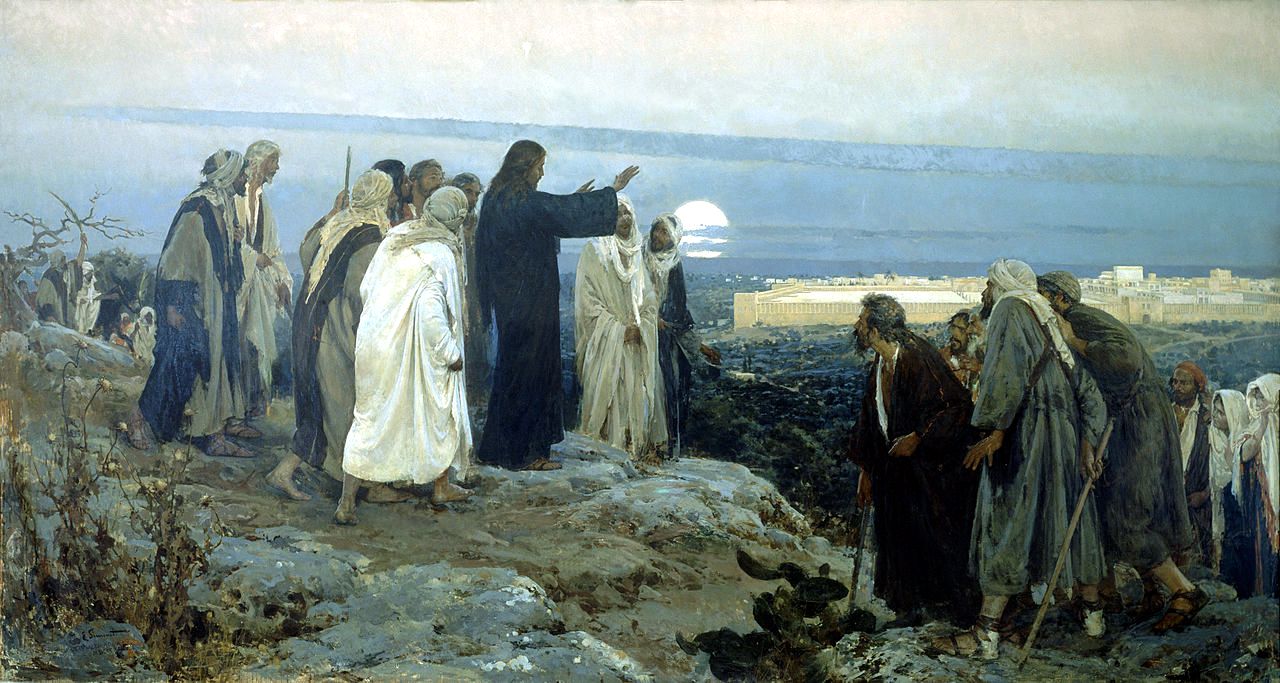
Flevit super illam; He wept over it, 1892, E. Simonet

Flevit super illam (Latin language); He wept over it, 1892, E. Simonet, public domain US

Instrumentality

Instrumentality is not a well appreciated concept.  But it is key to understanding both the nature of the universe and the nature of man. Google’s definition of the word is:

in·stru·men·tal·i·ty

noun

The fact or quality of serving as an instrument or means to an end; agency.

“A corporate body can act only through the instrumentality of human beings”

A thing that serves as an instrument or means to an end.

The principle of instrumentality is essential to understanding our universe. The scriptures record the creation of all things this way:

And God said, “Let there be light,” and there was light. And God saw that the light was good. And God separated the light from the darkness. God called the light Day, and the darkness he called Night. And there was evening and there was morning, the first day. Genesis 1:3-5 English Standard Version (ESV)

And later in the book:

And God said, “Let there be lights in the expanse of the heavens to separate the day from the night. And let them be for signs and for seasons, and for days and years, and let them be lights in the expanse of the heavens to give light upon the earth.” And it was so… And there was evening and there was morning, the fourth day. Genesis 1:14-19 (ESV)

Oops, God must have gotten it wrong. Shouldn’t the sun have been created before the light? Why didn’t He check in with some noted authority first, like Hawking or Tyson. We’ve presented what Tyson believes in our post ‘Neil deGrasse Tyson Mistakes God for Who He Is Not’

Our ready reference, John Calvin, says on the precedence of light over the sun:

Gen. 1:3 …Let there be light…  It was proper that the light, by means of which the world was to be adorned with such excellent beauty, should be first created; and this also was the commencement of the distinction, (among the creatures).  It did not, however, happen from inconsideration or by accident, that the light preceded the sun and the moon.

To nothing are we more prone than to tie down the power of God to those instruments the agency of which he employs. The sun and moon supply us with light: And, according to our notions we so include this power to give light in them, that if they were taken away from the world, it would seem impossible for any light to remain.

Therefore the Lord, by the very order of the creation, bears witness that he holds in his hand the light, which he is able to impart to us without the sun and moon.

We aren’t sure what you think of the scriptures as an authority for wisdom. Many modern-day teachers would have you believe they are unreliable and, in many cases, downright fallacious. We’ve addressed this in ‘Nip ‘Em in the Bud.’

However, the remark that the Lord Jesus Christ made to teachers of His people who were trying to trip Him up on another matter is appropriate for our teachers today:

Jesus said to them, “Is this not the reason you are wrong, because you know neither the Scriptures nor the power of God? Mark 12:24 (ESV)

Martian sunset: Spirit at Gusev crater

Martian sunset: Spirit at Gusev crater, 19 May 2005, NASA’s Mars Exploration Rover, Public Domain

The principle of instrumentality is also essential to understanding humanity. Paul describes himself, and us by generalization, as jars of clay:

For God, who said, “Let light shine out of darkness,” has shone in our hearts to give the light of the knowledge of the glory of God in the face of Jesus Christ.

But we have this treasure in jars of clay, to show that the surpassing power belongs to God and not to us. 2 Corinthians 4:6-7 (ESV)

Calvin says:

2 Corinthians 4:7. But we have this treasure. Those that heard Paul glorying in such a magnificent strain as to the excellence of his ministry, and beheld, on the other hand, his person, contemptible and abject in the eyes of the world, might be apt to think that he was a silly and ridiculous person, and might look upon his boasting as childish, while forming their estimate of him from the meanness of his person…

First of all, he employs the similitude of a treasure, which is not usually laid up in a splendid and elegantly adorned chest, but rather in some vessel that is mean and worthless; and then farther, he subjoins, that the power of God is, by that means, the more illustrated, and is the better seen…

“…Farther, they do not consider, that it is ordered by the special Providence of God, that there should be in ministers no appearance of excellence, lest anything of distinction should throw the power of God into the shade. As, therefore, the abasement of ministers, and the outward contempt of their persons give occasion for glory accruing to God, that man acts a wicked part, who measures the dignity of the gospel by the person of the minister.”

Paul, however, does not speak merely of the universal condition of mankind, but of his own condition in particular. It is true, indeed, that all mortal men are earthen vessels. Hence, let the most eminent of them all be selected, and let him be one that is adorned to admiration with all ornaments of birth, intellect, and fortune, still, if he be a minister of the gospel, he will be a mean and merely earthen depository of an inestimable treasure. Paul, however, has in view himself, and others like himself, his associates, who were held in contempt, because they had nothing of show.

So why is this instrumentality important for understanding the nature of man? For at least two reasons, first, it seems we’ll be augmenting, modifying, and curing ourselves using brain implants routinely someday. Defense Advanced Research Projects Agency (DARPA) requested proposals for SUBNETS, Systems-Based Neurotechnology for Emerging Therapies, in 2013. Their website describes the project and the expected results:

The Systems-Based Neurotechnology for Emerging Therapies (SUBNETS) program was created in response to a pressing need. Despite the continued best efforts of the Departments of Defense and Veterans Affairs to protect the health of U.S. service members and veterans, the effects of neuropsychological illness brought on by war, traumatic injuries, and other experiences remain challenging to treat. Current approaches—surgery, medications, and psychotherapy—can often help to alleviate the worst effects of illnesses such as major depression and post-traumatic stress, but they are imprecise and not universally effective. Through SUBNETS, DARPA hopes to generate the knowledge and technology required to deliver relief to patients with otherwise intractable neuropsychological illness.

The SUBNETS vision is distinct from current therapeutic approaches in that it seeks to create an implanted, closed-loop diagnostic and therapeutic system for treating, and possibly even curing, neuropsychological illness. That vision is premised on the understanding that brain function—and dysfunction, in the case of neuropsychological illness—plays out across distributed neural systems, as opposed to being strictly relegated to distinct anatomical regions of the brain. The program also aims to take advantage of neural plasticity, a feature of the brain by which the organ’s anatomy and physiology alter over time to support normal brain function. Because of plasticity, researchers are optimistic that by using SUBNETS-developed technology the brain can be trained or treated to restore normal functionality following injury or the onset of neuropsychological illness.

The 2013 DARPA SUBNETS press release elaborates:

…The program will pursue a new investigative approach that establishes the characteristics of distributed neural systems and attempts to develop and apply therapies that incorporate near real-time recording, analysis and stimulation in next-generation devices inspired by current Deep Brain Stimulation (DBS).

DBS already exists as a therapy option for certain neurologic and neuropsychological illnesses in patients who are not responsive to other therapies. Approximately 100,000 people around the globe live with a DBS implant, a device that delivers electrical stimulation to reduce the motor impairment caused by Parkinson’s disease and dystonia. These devices are also being studied as therapy for depression, obsessive compulsive disorder, Tourette’s and epilepsy…

DARPA is specifically interested in evaluating the underlying systems which contribute to the following conditions as described by the Diagnostic and Statistical Manual of Mental Disorders: Post-Traumatic Stress Disorder, Major Depression, Borderline Personality Disorder and General Anxiety Disorder. DARPA also seeks to evaluate the representation in the central nervous system of: Traumatic Brain Injury, Substance Abuse/Addiction and Fibromyalgia/Chronic Pain.

Because programs like SUBNETS push the leading edge of science, they are sometimes society’s first encounter with the dilemmas associated with new technologies. DARPA pursues these technologies because of their promise, but the Agency understands that it is important to consider ethical, legal, societal and policy questions. For that reason, DARPA has convened an Ethical, Legal and Social Implications (ELSI) panel to inform and advise SUBNETS and other emerging neuroscience efforts.

The full SUBNETS solicitation is available here.

The latest 2014 DARPA Press Release, as of this post, is here.

The second reason is the nature of our personhood in the face of the ravages of degenerative diseases. If all we are arises from materiality, then when the material fails, that which is us also falters.

However, not all secular scientists would claim a direct material basis for personhood; nevertheless, they claim emergence from the material substrate in the sense of M. Polanyi. In this regard, we’ve covered David Chalmers’s views on consciousness briefly in a previous post.

But, there are serious issues to contemplate with what Alzheimer’s disease and other dementia mean for us as persons. HuffPo and WSJ have run touching stories.

We have briefly touched on what Francis Schaeffer referred to the ‘soulishness of man’ in this blog. Calvin offers analysis of the outward and inner man referred to in 2 Corinthians 4:16-18.

2 Corinthians 4:16. Though our outward man. The outward man, some improperly and ignorantly confound with the old man, for widely different from this is the old man, of which we have spoken in Romans 4:6. Chrysostom, too, and others restrict it entirely to the body; but it is a mistake, for the Apostle intended to comprehend, under this term, everything that relates to the present life. As he here sets before us two men, so you must place before your view two kinds of life — the earthly and the heavenly.

The outward man is the maintenance of the earthly life, which consists not merely in the flower of one’s age, (1 Corinthians 7:36) and in good health, but also in riches, honors, friendships, and other resources. Hence, according as we suffer a diminution or loss of these blessings, which are requisite for keeping up the condition of the present life, is our outward man in that proportion corrupted…

Thus, therefore, it is necessary, that the condition of the present life should decay, in order that the inward man may be in a flourishing state; because, in proportion as the earthly life declines, does the heavenly life advance, at least in believers. For in the reprobate, too, the outward man decays, but without anything to compensate for it…

2 Corinthians 4:17. Momentary lightness. As our flesh always shrinks back from its own destruction, whatever reward may be presented to our view, and as we are influenced much more by present feeling than by the hope of heavenly blessings, Paul on that account admonishes us, that the afflictions and vexations of the pious have little or nothing of bitterness, if compared with the boundless blessings of everlasting glory…

As, however, the decay is visible, and the renovation is invisible, Paul, with the view of shaking us off from a carnal attachment to the present life, draws a comparison between present miseries and future felicity…

So then, those who have been purchased with His blood, walking in newness of life, and obedient to God can hold on to this promise:

So we do not lose heart. Though our outer self is wasting away, our inner self is being renewed day by day. For this light momentary affliction is preparing for us an eternal weight of glory beyond all comparison, as we look not to the things that are seen but to the things that are unseen. For the things that are seen are transient, but the things that are unseen are eternal. 2 Corinthians 4:16-18 (ESV)

Terracotta Army detail, Xi'an, China

Terracotta Army detail, Xi’an, China, 9 April 2005, Photo by Peter Morgan from Nomadic, CCA 2.0 Generic

Authority of Scripture?

Since we appeal to the authority of the scriptures on this blog, we should discuss what we mean by it.

We agree with John Calvin in his defense of scripture’s necessity, authority, and character:

Institutes, Chapter 6: …For if we reflect how prone the human mind is to lapse into forgetfulness of God, how readily inclined to every kind of error, how bent every now and then on devising new and fictitious religions, it will be easy to understand how necessary it was to make such a depository of doctrine as would secure it from either perishing by the neglect, vanishing away amid the errors, or being corrupted by the presumptuous audacity of men.

It being thus manifest that God, foreseeing the inefficiency of his image imprinted on the fair form of the universe, has given the assistance of his Word to all whom he has ever been pleased to instruct effectually, we, too, must pursue this straight path, if we aspire in earnest to a genuine contemplation of God;—we must go, I say, to the Word, where the character of God, drawn from his works is described accurately and to the life; these works being estimated, not by our depraved Judgment, but by the standard of eternal truth.

Institutes, Chapter 7: …The next thing to be considered is, how it appears not probable merely, but certain, that the name of God is neither rashly nor cunningly pretended. If, then, we would consult most effectually for our consciences, and save them from being driven about in a whirl of uncertainty, from wavering, and even stumbling at the smallest obstacle, our conviction of the truth of Scripture must be derived from a higher source than human conjectures, Judgments, or reasons; namely, the secret testimony of the Spirit

Still, however, it is preposterous to attempt, by discussion, to rear up a full faith in Scripture…. Profane men think that religion rests only on opinion, and, therefore, that they may not believe foolishly, or on slight grounds, desire and insist to have it proved by reason that Moses and the prophets were divinely inspired. But I answer, that the testimony of the Spirit is superior to reason. For as God alone can properly bear witness to his own words, so these words will not obtain full credit in the hearts of men, until they are sealed by the inward testimony of the Spirit…

Institutes, Chapter 8: …For it is wonderful how much we are confirmed in our belief, when we more attentively consider how admirably the system of divine wisdom contained in it is arranged—how perfectly free the doctrine is from everything that savors of earth—how beautifully it harmonizes in all its parts—and how rich it is in all the other qualities which give an air of majesty to composition.

Our hearts are still more firmly assured when we reflect that our admiration is elicited more by the dignity of the matter than by the graces of style. For it was not without an admirable arrangement of Providence, that the sublime mysteries of the kingdom of heaven have for the greater part been delivered with a contemptible meanness of words.

Had they been adorned with a more splendid eloquence, the wicked might have caviled, and alleged that this constituted all their force. But now, when an unpolished simplicity, almost bordering on rudeness, makes a deeper impression than the loftiest flights of oratory, what does it indicate if not that the Holy Scriptures are too mighty in the power of truth to need the rhetorician’s art?

In light of our previous post, we do not so much agree with the tone with which Calvin defends his positions (and these are mild). He’d definitely have given the current crop of vehement deniers a run for their money were he alive in this day and age.

Lake Geneva

Lake Geneva after storm. Picture taken from Montreux, on the left side in the rays of light – Saint-Gingolph by Rulexip. (Creative Commons Attribution-Share Alike 3.0 Unported)

We say that the scriptures, in the original languages, carry God’s authority as His proclamation of redemption for all who will believe. We say this, rather than maintain, as some do, that they are an accretion of fables or that they consist of truths [that] are illusions which we’ve forgotten are illusions. We believe that God deigns to use vernacular translations in the communication of His truth to the world. We see the scriptures as the window He offers us through which we may know the True and Living God.