How Did We Get Here? – by Bernhardt Writer

Matt Hennessy, writing for City Journal, characterized the state of the 2016 US election. He blames the Democrats for our situation. But, in my opinion, both parties are complicit:

…They’ve spent the last 100 years expanding the scope of executive authority, granting the federal administrative agencies the power of judge, jury, and executioner over their ever-widening dominion. If liberals and progressives didn’t want that awesome, intrusive power to fall into the wrong hands, perhaps they should have heeded the warnings of small-government conservatives, who railed for a century against the bloat, rot, and corruption they saw metastasizing within the District of Columbia. Perhaps they shouldn’t have declared the U.S. Constitution—with its bill of rights and enumerated powers—to be an antiquated relic.

John Micklethwait and Adrian Wooldridge chronicled the rise of progressivism and statism over the past 100 years in their book: The Fourth Revolution: The Global Race to Reinvent the State. We reviewed it here on this blog over a multi-week period in 2015. Here are some excerpts describing progressivism’s rise:

Beatrice Webb’s vision—the state as the epitome of reason and truth—enabled her to develop the ideology adopted by pro-statists worldwide. To her, the state stood for: planning versus confusion, merit versus privilege, and science versus prejudice…Why cause revolution when the same change could be brought about more lastingly through subversion of society using propaganda and recognized committees of experts.

Beatrice and her husband Sidney founded the Fabian Society as guardians of this socialist transformation. They established the London School of Economics to train a global cohort of social engineers…The Webbs also founded the New Statesman, a weekly review of politics and literature, as the clarion of their revolution.

In the period 1905-1915, the Webbs helped enact redistributive taxation to pay for [British] programs and lessened the stigma of “Poor Laws.” The poor became “victims,” not layabouts…They embraced eugenics as eagerly as they did town planning. The Webbs trusted the judgment of professional experts over the “average sensual man” when it came to bettering the life of commoners.

A prominent liberal ally of the Webbs, John Maynard Keynes, advocated for government intervention to aid Adam Smith’s hidden hand of the market. Although he spelled out caveats to his philosophy, these were conveniently forgotten over the years. His philosophy, Keynesianism, still powers big government.

The British Statist model was adopted by Hitler, Stalin, Mussolini, Franco, and Peron. They all blended Hegelian state worship into their dictatorships and used the state to control their economies. America, however, took a different turn under the Roosevelts.

Theodore Roosevelt (US president 1901-1909) acknowledged that the Webbs were right when they said that laissez-faire capitalism was over. He established regulatory bodies to constrain the power of corporations over the American people…By not embracing European style statism, with its comprehensive welfare state, he squared-the-circle through his progressive republicanism and saved the US from Europe’s excesses.

Franklin Delano Roosevelt, for his part, imposed tighter regulation instead of nationalizing broad sectors of the economy in the face of economic collapse and world war. World War II demonstrated big government’s ability to marshal all of industry to the service of war through detailed planning, financial incentives, and coercion.

The same occurred on both sides of the Atlantic and the Pacific…When Winston Churchill returned to power in October 1951, his government did nothing to roll back the welfare state. In the closing days of World War II, international supervisory organizations like the International Monetary Fund and the World Bank were created under Keynes influence as a result of the Bretton Woods international agreements.

In his article titled: “It’s Not Your Founding Fathers’ Republic Any More,” which we reviewed in 2014 on this blog, Myron Magnet, former Editor-in-Chief of City Journal, says:

President Wilson established in the WWI era the doctrine of the “Living Constitution” administered by the Supreme Court thereby codifying judicial activism that undid civil liberty victories in the aftermath of the Civil War. Secondly, President Roosevelt established prior to and during the WWII era unelected extra-governmental commissions (aka agencies) that have independent legislative, administrative, and judicial powers within themselves. Agencies are created as a matter of course now by legislative action. FDR also strengthened the power of the judiciary to act as a permanent constitutional convention amending the document through their decisions.

Fred Siegel characterized the increasing alienation of the liberal left from common US citizens in his book: The Revolt Against the Masses: How Liberalism Has Undermined the Middle Class. We reviewed his book here and here in 2014. This is a brief excerpt from our review:

On July 30, 1916, at 2:08 AM, saboteurs caused a one kiloton explosion on Black Tom Island off the New Jersey coast, near Liberty Island, in NYC harbor. Two million pounds of munitions on their way to the allies were detonated through a series of fires.

This sabotage is viewed as the proximate cause for President Wilson to denounce Germany’s supporters in America as “creatures” of “disloyalty and anarchy [who] must be crushed.” He pushed for and got the Sedition Act of 1918 passed. The Sedition Act extended the Espionage Act of 1917.

Whereas, pre-war Progressives {in the US] hoped to reform a nation of immigrants grounded in the Protestant ethic, Liberals objected to wartime conscription, civil liberties repression, Prohibition, and the first Red Scare. They saw middle class values as a continuation of WWI repressions.

“Like most sensible people,” liberal Harold Edmund Stearns said, “I regard Prohibition as an outrage and a direct invitation to revolution.”

Those supporting Communism and the Soviets used the Sacco and Vanzetti trial (1926-27) as a wedge to draw prominent liberals to their cause. Drawing on declassified Comintern documents, Stephen Koch, in his Double Lives: Spies and Writers in the Secret Soviet War of Ideas Against the West, explains that Willi Münzenberg, the Comintern’s master propagandist, intended:

to create for the right-thinking non-Communist West… the belief that…to criticize or challenge Soviet policy was the unfailing mark of a bad, bigoted, and probably stupid person, while support was equally infallible proof of a forward-looking mind committed to all that was best for humanity and mankind by an uplifting refinement of sensibility.

Münzenberg thought the “the idea of America” had to be countered. Koch noted that Soviet sympathizers used events such as the trial:

to instill a reflexive loathing of the United States and its people, to undermine the myth of the Land of Opportunity, the United States would be shown as an almost insanely xenophobic place, murderously hostile to foreigners.

In 1928, H. G. Wells described his alternative in his book The Open Conspiracy: Blue Prints for a World Revolution (revised and republished as What Are We to Do with Our Lives?) where he states: “the [instinctive fellowship] of the highly competent” ruling class would subject the masses to “the great processes of social reconstruction.” and, through their rule, “escape from the distressful pettiness and mortality of the individual life.” He also wrote:

We no longer want that breeding swarm of hefty sweaty bodies, without which the former civilizations could not have endured, we want watchful and understanding guardians and drivers of complex delicate machines, which can be mishandled and brutalized and spoilt all too easily.

…In this light, American liberalism of the early twentieth century, as distinct from classical liberalism of the nineteenth century, was driven by hatred of the common man, his morals, and his liberty.

Reflecting on the impact of such “liberal” ideology, Kenneth Minogue wrote: Alien Powers: The Pure Theory of Ideology. We reviewed it in this blog. Here is a synopsis of Minogue’s thought on the outcome of implementing such philosophy in our society:

In Western societies, individuals follow customs or conduct projects of which others may dislike or disapprove and the result may be conflict.

However, Western society is predominantly peaceful in spite of potential (or actual) conflict because individuals master internalized rules of law and morality. Poverty, inequality, and disappointment are inevitable consequences of open participation in a risk based society even when it is free from iniquitous societal distortions (e.g., American slavery).

Ideologists say these consequences result from hidden structural flaws that can only be remedied through the destruction of the prevailing system. One must attain the perfection of social harmony. If material possessions cause envy, then all possessions must be jointly owned. Rather than insisting on moral decency to curb envy, ideologists will abolish ownership altogether.

This same approach, rooted in externals, is applied to all inequality and disappointment. Transcendent principles (e.g., morality) are not applicable to unruly minds. Once harmony is achieved there will be no need for the transcendent; all humanity will become one in thinking and affections.

Finally, Myron Magnet writes on how Tocqueville foresaw the “End of Democracy in America” in the 1830s. Magnet, speaking of current society says:

Today’s sovereign…forces men to act as well as suppresses [their] action…As Tocqueville observed, “It is the state that has undertaken virtually alone to give bread to the hungry, aid and shelter to the sick, and work to the idle.”

…And whatever traditional American mores defined as good and bad, moral and immoral, base and praiseworthy, the sovereign has redefined and redefined until all such ideas have lost their meaning. Is it any wonder that today’s Americans feel that they have no say in how they are governed—or that they don’t understand how that came about?

Such oppression is “less degrading” in democracies because, since the citizens elect the sovereign, “each citizen, hobbled and reduced to impotence though he may be, can still imagine that in obeying he is only submitting to himself.”

Moreover, democratic citizens love equality more than liberty, and the love of equality grows as equality itself expands. Don’t let him have or be more than me. Tocqueville despairingly concluded, “The only necessary condition for centralizing public power in a democratic society is to love equality or to make a show of loving it. Thus the science of despotism, can be reduced…to a single principle.”

By this last statement, Tocqueville anticipated the controlling idea of Orwell’s classic allegory, Animal Farm: “All animals are equal but some animals are more equal than others.”

***

Progressivism used to stand for progress and truth. But, collectively, we’ve abandoned that paradigm for historical revision and nihilism. Perhaps we should “adjust,” as our leaders say, to a new normal: terrorism, crime, corruption, and complicity. Perhaps…

But, then I remember that the United States of America was founded not upon blood and soil as other nations were but on ideals summarized in our Declaration of Independence and Preamble of the Constitution.

In case you don’t recollect these ideals word for word, the Declaration of Independence says:

…We hold these truths to be self-evident, that all men are created equal, that they are endowed by their Creator with certain unalienable Rights, that among these are Life, Liberty and the pursuit of Happiness. That to secure these rights, Governments are instituted among Men, deriving their just powers from the consent of the governed…

And the Preamble of the Constitution of the United States of America says:

We the People of the United States, in Order to form a more perfect Union, establish Justice, insure domestic Tranquility, provide for the common defense, promote the general Welfare, and secure the Blessings of Liberty to ourselves and our Posterity, do ordain and establish this Constitution for the United States of America.

***

If you profess Christ as Lord and Savior, why should you care about the direction this country is taking? The Prophet Jeremiah spoke to that question in his letter to all those whom King Nebuchadnezzar had taken into exile from Jerusalem to Babylon:

…Seek the welfare of the city where I have sent you into exile, and pray to the Lord on its behalf, for in its welfare you will find your welfare. Jeremiah 29:7 English Standard Version (ESV)

While He dwelt among us, the Lord Jesus Christ pressed home this lesson:

“You have heard that it was said, ‘You shall love your neighbor and hate your enemy.’ But I say to you, Love your enemies and pray for those who persecute you. Matthew 5:43-44 (ESV)

And, while characterizing the whole of God’s law, He said:

The second is this: ‘You shall love your neighbor as yourself.’ There is no other commandment greater than these.” Mark 12:31 (ESV)

***

After all this, maybe you’re thinking: “What difference, at this point, does it make?”

I think that this election is about consolidating power of the unconstitutional administrative state and persecuting, either overtly or covertly, those opposed to its decisions versus a return to a constitutional republic of, by, and for the People of the United States of America, however tentative that return seems at the moment.
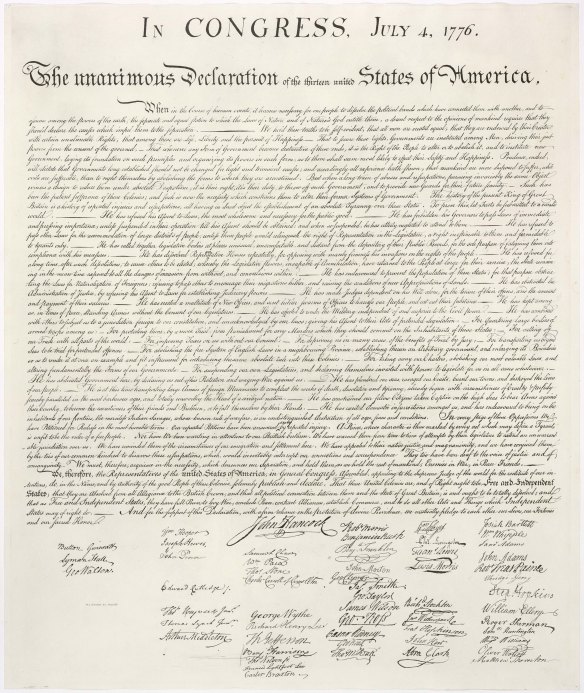
It’s your choice.

Declaration of Independence of the United States of America

Principles for Voting, R. C. Sproul, 27.5 minute MP3, 2012, Associated post, Declaration of Independence courtesy of the National Archives – Charters of Freedom

For your consideration:

Sabbath for Man

The Lord Jesus Christ opposed Israel’s religious rulers over legalistic practices that they thought commended them to God and kept them in power. These rulers had condemned His disciples for picking and eating grain on the Sabbath. Near the end of this confrontation, He said:

…If you had known what this means, ‘I desire mercy, and not sacrifice,’ you would not have condemned the guiltless. Matthew 12:7 English Standard Version (ESV)

And in a separate report of the event:

…He said to them, “The Sabbath was made for man, not man for the Sabbath. So the Son of Man is lord even of the Sabbath.” Mark 2:27-28 (ESV)

The Gospels go on to describe how the Lord healed a man on the Sabbath. Rather than repent and believe in God, Israel’s rulers viewed these presumed violations as a pretext to kill the Savior.

The Reformation leader, John Calvin, had insight into the texts:

But if you knew …Christ conveys an indirect reproof to the [religious rulers] for not considering why ceremonies were appointed, and to what object they are directed. …God declares…that he sets a higher value on mercy than on sacrifice, employing the word mercy…for [services] of kindness [and] sacrifices [as] the outward service of the Law…

…Though piety is justly reckoned to be as much superior to charity as God is higher than men, yet believers, by practicing justice towards each other, prove that their service [for] God is sincere. It is not without reason that this subject is brought [to] the notice of hypocrites, who imitate piety by outward signs, and yet pervert it by confining their laborious efforts to the carnal worship alone…

Those trying to trap and kill the Lord and thereby save themselves and their power missed His offer of mercy. They missed that:

The Sabbath was made for man. …Those persons judge amiss who turn [the Sabbath into] man’s destruction…which God appointed for his benefit. …Is not this a foolish attempt to overturn the purpose of God, when they demand to the injury of men that observation of the Sabbath which he intended to be advantageous?

But they are mistaken, I think, who suppose that in this passage the Sabbath is entirely abolished; for Christ simply informs us what is the proper use of it. Though he asserted, a little before, that he is Lord of the Sabbath, yet the full time for its abolition was not yet come, because the veil of the temple was not yet rent, (Matthew 27:51.)

Calvin then analyses the sanction with which Christ acted:

For the Son of man is Lord even of the Sabbath. …He declares that he has received authority to exempt his followers from the necessity of observing the Sabbath. The Son of man, (he says,) in the exercise of his authority, can relax the Sabbath in the same manner as other legal ceremonies. And certainly out of Christ the bondage of the Law is wretched, from which he alone delivers those on whom he bestows the free Spirit of adoption, (Romans 8:15.)

The rulers meant to sacrifice the Lord of Sabbath in order to keep their lives; Christ meant mercy in giving up His.

***

Lest we be carried away with the thought that Calvin advocated doing away with Sabbath observance, Calvin sums up his understanding of the Sabbath from the scriptures in his Institutes of the Christian Religion:

…First, that during our whole lives we may aim at a constant rest from our own works, in order that the Lord may work in us by his Spirit; secondly that every individual, as he has opportunity, may diligently exercise himself in private, in pious meditation on the works of God, and, at the same time, that all may observe the legitimate order appointed by the Church, for the hearing of the word, the administration of the sacraments, and public prayer: And, thirdly, that we may avoid oppressing those who are subject to us.

And contemporary theologian R. C. Sproul continues the debate on the topic of Sabbath keeping as do others here, here, here, and here. In any case, we would do well to strictly adhere to that severe admonition:

Whatever you do, in word or deed, do everything in the name of the Lord Jesus, giving thanks to God the Father through him. Colossians 3:17 (ESV)

Jesus As Lord of the Sabbath – A sermon from Dr. R.C. Sproul

And

Jesus Is Lord of the Sabbath – A sermon from Dr. R.C. Sproul

On the Surface – Part I

The Lord spoke to His bondservant Samuel, asking him how long he would grieve for Israel’s first king, now that He had rejected him? God commanded His prophet to anoint a new king from the house of Jesse. As he was considering each of Jesse’s sons in turn, God said to Samuel:

“Do not look on his appearance or on the height of his stature, because I have rejected him. For the Lord sees not as man sees: man looks on the outward appearance, but the Lord looks on the heart.” 1 Samuel 16:7 English Standard Version (ESV)

The Puritan Preacher and Theologian, Jonathan Edwards, famous for sermons such as: “Sinners in the Hands of an Angry God” and “The Thorns that Choke the Word,” wrote about this passage:

The true saints have not such a spirit of discerning that they can…determine [with certainty] who are godly, and who are not. For though they know experimentally what true religion is, in the internal exercises of it; yet these are what they can neither feel, nor see, in the heart of another. There is nothing in others, that comes within their view, but outward manifestations and appearances; but the Scripture plainly intimates, that this way of judging what is in men by outward appearances, is at best uncertain, and liable to deceit…

In his commentary, Edwards counsels us to treat all in the visible church charitably:

When there are many probable appearances of piety in others, it is the duty of the saints to receive them cordially into their charity, and to love them and rejoice in them, as their brethren in Christ Jesus. But yet the best of men may be, when the appearances seem to them exceeding fair and bright, as entirely to gain their charity, and conquer their hearts.

Yet, we will see some, who first profess and evidence godliness, fall away from the church:

It has been common thing in the church of God, for such bright professors, that are received as eminent saints, among the saints, to fall away and come to nothing…There may be all these things [i.e., evidences of piety], and yet there be nothing more than the common influences of the Spirit of God, joined with the delusions of Satan, and the wicked and deceitful heart…

He then reminds us of the warning Christ delivered using wheat and tares for His illustration:

In the parable of the wheat and tares, it is said, Matt. 13:26, “When the blade was sprung up, and brought forth fruit, then appeared the tares also.” As though the tares were not discerned, nor distinguishable from the wheat, until then, as Mr. Flavel observes, who mentions it as an observation of Jerome’s, that “wheat and tares are so much alike, until the blade of the wheat comes to bring forth the ear, that it is next to impossible to distinguish them.”

And then Mr. Flavel adds, “How difficult so ever it be to discern the difference between wheat and tares; yet doubtless the eye of sense can much easier discriminate them, than the quickest and piercing eye of man can discern the difference between special and common grace.

For all saving graces in the saints, have their counterfeits in hypocrites; there are similar works in those, which a spiritual and very judicious eye may easily mistake for the saving and genuine effects of a sanctifying spirit.”

Finally, Edwards drives home the message again:

This notion, of certainly discerning another’s state [by surface appearances] is not only not founded on reason or Scripture, but it is anti-scriptural, it is against the rules of Scripture; which say not a word of any such way of judging the state of others as this, but direct us to judge chiefly by the fruits that are seen in them.

***

Having been a member of several churches, some of which have disbanded, I can say from experience that it belongs to God alone to determine the state of other’s souls:

Therefore, do not pronounce judgment before the time, before the Lord comes, who will bring to light the things now hidden in darkness and will disclose the purposes of the heart. Then each one will receive his commendation from God. 1 Corinthians 4:5 (ESV)

And it is also certain: “you will recognize them by their fruit,” and those fruit of the spirit to look for are: love, joy, peace, patience, kindness, goodness, faithfulness, gentleness, self-control. As the Apostle Peter reminded us:

If these qualities are yours and are increasing, they keep you from being ineffective or unfruitful in the knowledge of our Lord Jesus Christ. 2 Peter 1:8 (ESV)

Wheat_and_tares_0708_(513649608)

Wheat and Tares, Nazareth Village, James Emery, 1 May 2007, used under the Creative Commons Attribution 2.0 Generic license

Let Us Reason Together

Last week, we discussed story writing in a review of the book: Writing for Story: Craft Secrets of Dramatic Nonfiction by Jon Franklin. There, we covered the topic of narrative transition. One transition technique is stream of consciousness that joins two disparate ideas that have no clear logical connection by using an emotional one instead. What came to mind was Isaiah’s pronouncement of the Lord’s grace and mercy:

“Come now, let us reason together, says the Lord:

though your sins are like scarlet,

    they shall be as white as snow;

though they are red like crimson,

    they shall become like wool.

Isaiah 1:18 English Standard Version (ESV)

How a declaration of Israel’s defection from obeying the Lord and His unmerited offer to wipe away those sins is connected by logical reasoning escapes me. Clearly, it is meant to reach the heart. Let’s see what Calvin offers on this verse:

…The charges which he makes against them [i.e., disobedient Israel] are not brought forward or maintained without strong necessity. For hypocrites are [inclined] to find fault with God, as if he were too severe, and could not be at all appeased.

They go still farther, and discover this excuse for their obstinacy, that it is in vain for them to attempt to return to a state of favor with God. If every other expedient fail, still they fly to this, that it is not proper to make such rigid demands on them, and that even the very best of men have something that needs to be forgiven…

Hence we obtain a declaration in the highest degree consolatory, that God does not contend with us as if he wished to pursue our offenses to the utmost. For if we sincerely turn to him, he will immediately return to favor with us, and will blot out all remembrance of our sins, and will not demand an account of them.

For he is not like men who, even for a slight and inconsiderable offense, often refuse to be reconciled. Nay, so far is he from giving us reason to complain of his excessive severity, that he is ready to cleanse us, and to make us as white as snow.

He is satisfied with cleanness of heart, and if, notwithstanding of this cleanness of heart, there be any offense, he forgives it, and acquits those who have provoked him.

Amazingly, we, in this Post-Christian nation, are offered the same choice:

But what does it say? “The word is near you, in your mouth and in your heart” (that is, the word of faith that we proclaim); because, if you confess with your mouth that Jesus is Lord and believe in your heart that God raised him from the dead, you will be saved. For with the heart one believes and is justified, and with the mouth one confesses and is saved. Romans 10:8-10 (ESV)

I urge you, listen to your heart and receive His gracious gift of mercy.

R.C. Sproul: Post-Christian Christianity, Ligonier Ministries

Two Natures – Distinct Yet United

Last week I reported on “Christ’s Human Nature.” There, the fourth point of John Flavel’s sermon: “Of Christ’s wonderful Person,” on John 1:14, in his book: Fountain of Life Opened Up, caught my attention:

Fourthly, [Christ’s] human nature is so united with the divine, as that each nature still retains its own essential properties distinct… The divine and human are not confounded; but a line of distinction runs betwixt them still in this wonderful person…

If you have the time and patience, I urge you to read his entire sermon. He offers sound doctrine on Christ’s human nature.

Flavel’s point got me wondering. Was the distinction and union obvious in scripture, would it prove Flavel’s points, and did John Calvin have insight that might help us to understand Christ better? What jumped to mind was the Lord’s struggle-in-prayer in the garden before He was betrayed as recounted in the synoptic gospels of Matthew, Mark, and Luke:

And going a little farther he fell on his face and prayed, saying, “My Father, if it be possible, let this cup pass from me; nevertheless, not as I will, but as you will.” Matthew 26:39 English Standard Version (ESV)

And

And he said, “Abba, Father, all things are possible for you. Remove this cup from me. Yet not what I will, but what you will.” Mark 14:36 (ESV)

And

Saying, “Father, if you are willing, remove this cup from me. Nevertheless, not my will, but yours, be done.” Luke 22:42 (ESV)

Even though the wording is different in the three accounts, in each, He defers to His Father’s will rather than His own. Was this the quintessential example of the distinct natures united?

Calvin addresses many possible questions we (and others) might have when reading Christ’s entreaty of His Father. However, to achieve some semblance of brevity, we’ve assembled those answers that are most relevant to our questions:

My Father, if it be possible. …We must remember…that Christ [did not have] confused emotions, like those to which we are accustomed, to withdraw his mind from pure moderation; but, so far as the pure and innocent nature of man could admit, he was struck with fear and seized with anguish, so that, amidst the violent shocks of temptation, he vacillated—as it were—from one wish to another. This is the reason why, after having prayed to be freed from death, he immediately restrains himself, and, submitting to the authority of the Father, corrects and recalls that wish which had suddenly escaped him…

But yet not as I will, but as thou wilt. …What led him to pray to be delivered from [His own physical] death was the dread of a greater evil. When he saw the wrath of God exhibited to him, as he stood at the tribunal of God charged with the sins of the whole world, he unavoidably shrunk with horror from the deep abyss of death…When Christ was struck with horror at the divine curse, the feeling of the flesh affected him in such a manner, that faith still remained firm and unshaken. For such was the purity of his nature, that he felt, without being wounded by them, those temptations which pierce us with their stings.

…in Christ there was a remarkable example of adaptation between the two wills, the will of God and the will of man, so that they differed from each other without any conflict or opposition…for Christ, as he was God, willed nothing different from the Father; and therefore it follows, that his human soul had affections distinct from the secret purpose of God…Christ was under the necessity of holding his will captive, in order to subject it to the government of God, though it was properly regulated.

The lesson Calvin draws for us based on the various questions we’ve included and omitted is:

…In the present corruption of our nature it is impossible to find ardor of affections accompanied by moderation, such as existed in Christ; but we ought to give such honor to the Son of God, as not to judge of him by what we find in ourselves.

In this light, his application is:

…How carefully ought we to repress the violence of our feelings, which are always inconsiderate, and rash, and full of rebellion? …We owe to God such obedience as to endure patiently that our wishes should not be granted; For the modesty of faith consists in permitting God to appoint differently from what we desire. Above all, when we have no certain and special promise, we ought to abide by this rule, not to ask anything but on the condition that God shall fulfill what he has decreed; which cannot be done, unless we give up our wishes to his disposal.

In his sermon, Flavel gives an excellent explanation of the differences between Christ and ourselves. Calvin drives home the point with how, given His example, we should endure our inevitable trials of faith. May the Lord Jesus Christ grant us obedience in these trials.

Garden of Gethsemane, Mount of Olives, Jerusalem

Garden of Gethsemane, Mount of Olives, Jerusalem, 16 November 2012, by Tango7174, used under Creative Commons Attribution-Share Alike 4.0 International, 3.0 Unported, 2.5 Generic, 2.0 Generic, and 1.0 Generic licenses

In Spirit and in Truth

How do we worship? Is it by actions or by attitudes? Do feeling count? Is there one right way, place, and time? As Jesus Christ confronted the Samaritan woman at the well with the truth of who He is, He said:

But the hour is coming, and is now here, when the true worshipers will worship the Father in spirit and truth, for the Father is seeking such people to worship him. God is spirit, and those who worship him must worship in spirit and truth.” John 4:23-24 English Standard Version (ESV)

Remarkably, in this statement lie answers for the questions with which we opened this post. Calvin comments on the passage:

But the hour cometh. …To show that God does not choose to be worshipped either in Jerusalem or in mount Gerizim, he takes a higher principle, that the true worship of Him consists in the spirit; …hence it follows that in all places He may be properly worshipped.

Why, and in what sense, is the worship of God called spiritual? The worship of God is said to consist in the spirit, because it is nothing else than that inward faith of the heart which produces prayer, and, next, purity of conscience and self-denial, that we may be dedicated to obedience to God as holy sacrifices.

But the Old Testament Church had elaborate ceremonies in their public worship. Did they worship in spirit and truth under the Law?

I reply, as God is always like himself, he did not from the beginning of the world approve of any other worship than that which is spiritual, and which agrees with his own nature. …Moses…declares in many passages that the Law has no other object than that the people may cleave to God with faith and a pure conscience.

…Thus we may justly say that the worship [described in] the Law was spiritual in its substance, but, in respect of its form, it was somewhat earthly and carnal; for the whole of that economy, the reality of which is now fully manifested, consisted of shadows.

…In all ages God wished to be worshipped by faith, prayer, thanksgiving, purity of heart, and innocence of life; and at no time did he delight in any other sacrifices.

But what about public worship in today’s visible Church?

…There are indeed among ourselves, in the present day, some outward exercises of godliness, which our weakness renders necessary, but such is the moderation and sobriety of them, that they do not obscure the plain truth of Christ. In short, what was exhibited to the fathers under figures and shadows is now openly displayed.

…Thus all who oppress the Church with an excessive multitude of ceremonies, do what is in their power to deprive the Church of the presence of Christ. I [dismiss] the vain excuses which they plead, that many persons in the present day have as much need of those aids as the Jews had in ancient times. It is always our duty to inquire by what order the Lord wished his Church to be governed, for He alone knows thoroughly what is expedient for us.

So why was there a difference between the Old and New Testament Churches?

The true worshippers. … Knowing that the world would never be entirely free from superstitions, [Christ] thus separates the devout and upright worshippers from those who were false and hypocritical.

…What it is to worship God in spirit and truth appears clearly from what has been already said. It is to lay aside the entanglements of ancient ceremonies, and to retain merely what is spiritual in the worship of God; for the truth of the worship of God consists in the spirit, and ceremonies are but a sort of appendage.

Finally, why is worship not elaborate ceremony but in spirit and truth?

God is a Spirit. …God is so far from being like us, that those things which please us most are the objects of his loathing and abhorrence…As we cannot ascend to the height of God, let us remember that we ought to seek from His word the rule by which we are governed. Christ simply declares here that his Father is of a spiritual nature, and, therefore, is not moved by frivolous matters, as men, through the lightness and unsteadiness of their character, are wont to be.

***

As Mark Dever preaches, our whole lives are acts of worship if they’re lived in obedience to God. Our public worship consists of: prayer, singing, hearing the Word read, hearing the Word preached, and participating in baptism and the Lord’s supper. Worship is hearing God’s word and responding to it in obedience.

Mark Dever: Worship in Spirit and Truth, Ligonier Ministries

Pray for Peace

Where do we find ourselves now? Is this the country you thought you’d be living in? Are you fed up and ready to “burn it all down?” Or do the alternatives we have scare you? Imagine what exiles from their homelands must feel.

We have an example of just such exiles in the book of Jeremiah. The people of Judah and Jerusalem were taken captive to Babylon by Nebuchadnezzar. The prophet Jeremiah exhorted the exiles to live in obedience to God for seventy years, the term God decreed for their banishment. While in Babylon, to show obedience, they were to build houses, plant gardens, and establish families. And, in their obedience, they were to do one more thing for their captors:

But seek the welfare of the city where I have sent you into exile, and pray to the Lord on its behalf, for in its welfare you will find your welfare. Jeremiah 29:7 English Standard Version (ESV)

We find ourselves in a very turbulent time. Those who want to “take a chance” don’t know what they’re in for. Neither do I, really. However, in the midst of this we are called to pray for those we would otherwise oppose. A very hard thing to do, I have to admit. However, lately I’ve been praying:

“Make bad men and women good.”

This is a prayer Calvin had recommended nearly 500 years ago. His commentary on the passage in Jeremiah is challenging:

…By saying that their peace would be in the peace of Babylon, he [suggests] that they could not be considered as a separate people until the time of seventy years was completed. He therefore commanded them to pray for the prosperity of Babylon.

At the first view this may seem hard; for we know how cruelly that miserable people had been treated by the Chaldeans. Then to pray for the most savage enemies, might have appeared unreasonable and by no means suitable. But the Prophet mitigates the hardness of the work by saying, that it would be profitable to them to pray for the happy condition of Babylon, inasmuch as they were the associates of their fortune.

…The Prophet teaches the Jews that they ought not to refuse what was required from them, when God [commanded] them to pray for Babylon, because the prosperity of that kingdom would be for their benefit…They were so connected with Babylon, that they could not expect to be exempt from all trouble and annoyance, if any adversity happened to Babylon, for they were of the same body. We now perceive the meaning of the Prophet.

…Hence [we] deduce a very useful doctrine, — that we ought not only to obey the kings under whose authority we live, but that we ought also to pray for their prosperity, so that God may be a witness of our voluntary subjection.

In our voluntary subjection to God’s appointed ruler’s (even ones we do not like), we must also act for their good:

He not only [entreats] them patiently to endure the punishment laid on them, but also to be faithful subjects of their conqueror; he not only forbids them to be seditious, but he would have them to obey from the heart, so that God might be a witness of their willing subjection and obedience.

He says, Seek the peace of the city; this may be understood of prayers; for דרש, daresh, often means to pray: but it may suitably be taken here, as I think, in reference to the conduct of the people, as though he had said, that the Jews were to do what they could, to exert themselves to the utmost, so that no harm might happen to the Chaldean monarchy…

Of course, this means opposing criminal acts (those would not be for their ultimate good before God,) possibly even to our harm. We are called to “seek their peace.”

So, we have a high bar to meet based on this example from antiquity. Not only must we pray for the prosperity of God’s appointed rulers (even those He uses as scourges,) but, we must act for their good to prove our willing submission to God who rules all.

***

For those of us who hope in the Lord Jesus Christ’s atonement for our sins, let us pray what Calvin prayed in his day:

Grant, Almighty God, that we may be more and more [accustomed] to render obedience to [you], and that whenever [you chastise] us with [your] scourges, we may examine our own consciences, and humbly and suppliantly [seek to avert your] wrath, and never doubt but [you will] be [benevolent] to us, after having chastised us with [your fatherly] hand; and may we thus [rest] on [your paternal] kindness, that we may ever look forward with quiet minds, until the end appears, which [you have] promised to us, and that when the warfare of this present life shall be finished, we may reach that blessed rest, which has been prepared for us in heaven, through Christ our Lord. — Amen.

We, who wait for a Savior from heaven, know this world is not our own. We are exiles. We should pray for Kings such that we, and our neighbors, might lead peaceful and quiet lives, and all would be, in His providence, saved.

Fiery Furnace

Confused Language

A recent Economist magazine review on Noam Chomsky’s work [paywall] comments:

Since he wrote “Syntactic Structures” in 1957, Mr. Chomsky has argued that human language is fundamentally different from any other kind of communication, that a “linguist from Mars” would agree that all human languages are variations on a single language, and that children’s incredibly quick and successful learning (despite often messy and inattentive parental input) points to an innate language faculty in the brain.

This view is remarkably accurate, especially considering the differences between Western and Eastern languages. The Economist review goes on to say that Chomsky and a computer scientist, Robert Berwick, claim to explain the evolution of human language in their new book titled: Why Only Us. Perhaps they’re wrong?

For a different perspective, it’s worthwhile reading the entire biblical account of this phenomenon.

Now the whole earth had one language and the same words. And as people migrated from the east, they found a plain in the land of Shinar and settled there. And they said to one another, “Come, let us make bricks, and burn them thoroughly.” And they had brick for stone, and bitumen for mortar. Then they said, “Come, let us build ourselves a city and a tower with its top in the heavens, and let us make a name for ourselves, lest we be dispersed over the face of the whole earth.”

And the Lord came down to see the city and the tower, which the children of man had built. And the Lord said, “Behold, they are one people, and they have all one language, and this is only the beginning of what they will do. And nothing that they propose to do will now be impossible for them. Come, let us go down and there confuse their language, so that they may not understand one another’s speech.”

So the Lord dispersed them from there over the face of all the earth, and they left off building the city. Therefore, its name was called Babel, because there the Lord confused the language of all the earth. And from there the Lord dispersed them over the face of all the earth.

Genesis 11:1-9 English Standard Version (ESV)

So the choice is stark. Either we have different languages because they “evolved” that way. Or we reaped what we sowed in trying to “make a name for ourselves.” And we did; just not a good name. Let’s see what Calvin has to say on this scripture passage.

And the Lord came down. …Moses…intimates that God, for a little while, seemed to take no notice of them… For [God] frequently bears with the wicked [such] that he not only suffers them to contrive many nefarious things, as if he were [unconcerned;] but even further[s] their impious and perverse designs with animating success, in order that he may at length cast them down to a lower depth.

Behold, the people is one. …God complains of a wickedness in men…to teach us [not that he is swayed by any passions, but] that he is not negligent of human affairs, and that, as he watches for the salvation of the faithful, so he is intent on observing the wickedness of the ungodly; as it is said in Psalm 34:16,

“The face of the Lord is against them that do evil, to cut off the remembrance of them from the earth.”

Go to, let us go down. …[God] declares that the work which they supposed could not be retarded, shall, without any difficulty, be destroyed…This example of Divine vengeance belongs to all ages: for men are always inflamed with the desire of daring to attempt what is unlawful. And this history shows that God will ever be averse to such counsels and designs; so that we here behold, depicted before our eyes what Solomon says:

‘There is no counsel, nor prudence, nor strength against the Lord,’ (Proverbs 21:30)

Unless the blessing of God be present, from which alone we may expect a prosperous issue, all that we attempt will necessarily perish.

So the Lord scattered them abroad. Men had already been spread abroad [by virtue of] the benediction and grace of God. But those whom the Lord had before distributed with honor in various abodes, he now ignominiously scatters[as] a violent rout, because the principal bond…between them was cut asunder.

Therefore, the name of it [is] called Babel. …What [did] they gain by their foolish ambition to acquire a name[?] They hoped that an everlasting memorial of their origin would be engraven on the tower… [However,] they [did] gain a name, but not each as they would have chosen: thus does God opprobriously cast down the pride of those who usurp to themselves honors to which they have no title.

However, Calvin points out God’s mercy and grace through all this:

Now, although the world bears this curse to the present day; yet, in the midst of punishment…the admirable goodness of God is rendered conspicuous, …because He has proclaimed one gospel, in all languages, through the whole world…

…They who before were miserably divided, have coalesced in the unity of the faith. In this sense Isaiah says, that the language of Canaan should be common to all under the reign of Christ, (Isaiah 19:18); because, although their language may differ in sound, they all speak the same thing, while they cry, “Abba, Father.”

***

What always stands out to me in this Genesis scripture account is the verse: “And nothing that they propose to do will now be impossible for them.” This was God’s assessment of us when we had one language. With increasing consolidation around a few key languages and advances in CRISPR, AI, and nuclear annihilation, we may still do on a global scale what should have remained impossible for men to do.

Because of these things, but not only these, I urge you to embrace that other human impossibility:

It is easier for a camel to go through the eye of a needle than for a rich person to enter the kingdom of God.” And they were exceedingly astonished, and said to him, “Then who can be saved?” Jesus looked at them and said, “With man it is impossible, but not with God. For all things are possible with God.” Mark 10:25-27 (ESV)

Please enter His kingdom, now.

Tower of Babel - Bruegel

The Tower of Babel, 1563, Pieter Brueghel the Elder (1526/1530–1569), public domain in the United States

God or Money?

Which will it be, God or money? The God spoken about in this context is the Father, the Son, and the Holy Spirit; one God in three persons. Money, or mammon, on the other hand, is any earthly means of exchange or gain (i.e., possessions).

While speaking with His disciples, the Lord Jesus Christ was overheard by the religious rulers of the day. They scoffed at what He said to His disciples:

“No servant can serve two masters, for either he will hate the one and love the other, or he will be devoted to the one and despise the other. You cannot serve God and money.” Luke 16:13 English Standard Version (ESV)

Christ then turned to these rulers and addressed how their heart attitudes kept them out of His Kingdom.

Christ spoke the same words to a different audience who listened intently to His Sermon on the Mount. He spoke about the heart attitude that His disciples and the crowds that followed Him should possess in the Kingdom of God. As part of that sermon, Christ said:

“No one can serve two masters, for either he will hate the one and love the other, or he will be devoted to the one and despise the other. You cannot serve God and money.” Matthew 6:24 (ESV)

Although the disciples were common to both groups, many in the first audience sneered at what He said and in the second, they hung on His every word.

John Calvin commented on this two-thousand-year-old chronicle over five hundred years ago:

No man can serve two masters. …[Christ] had formerly said, that the heart of man is bound and fixed upon its treasure; and he now gives warning, that the hearts of those who are devoted to riches are alienated from the Lord.

For the greater part of men are [inclined] to flatter themselves with a deceitful pretense, when they imagine, that it is possible for them to be divided between God and their own lusts. Christ affirms that it is impossible for any man to obey God, and, at the same time, to obey his own flesh…

We commonly call this a ‘divided heart.’ Calvin goes on:

True, it is not impossible that those who are rich shall serve God; but whoever gives himself up as a slave to riches must abandon the service of God: for covetousness makes us the slaves of the devil…

So it isn’t the riches themselves, so much as setting our hearts on those riches to the partial (or total) exclusion of Him. Calvin then extends this principle to all our vices.

…As God pronounces everywhere such commendations of sincerity, and hates a double heart, (1 Chronicles 12:33; Psalm 12:2); all are deceived, who imagine that he will be satisfied with the half of their heart…

The covetous, the voluptuaries, the gluttons, the unchaste, the cruel, all in their turn offer the same apology for themselves: as if it were possible for those to be partly employed in serving God, who are openly carrying on war against him.

But wait, we are beset with sins that, the scriptures say, so easily entangle us. Are we double minded and in danger of hell fire? To this, Calvin, the shepherd, says:

It is, no doubt, true, that believers themselves are never so perfectly devoted to obedience to God, as not to be withdrawn from it by the sinful desires of the flesh.

But as they groan under this wretched bondage, and are dissatisfied with themselves, and give nothing more than an unwilling and reluctant service to the flesh, they are not said to serve two masters: for their desires and exertions are approved by the Lord, as if they rendered to him a perfect obedience.

But this passage [Luke 16:13] reproves the hypocrisy of those who flatter themselves in their vices, as if they could reconcile light and darkness.

So there we have it. The question now becomes: “Do I serve the devil or do I serve the Lord.” For, we all have to serve somebody.

Serve Somebody, Johnny Q. Public, Lyrics by Bob Dylan

Fear and Trembling

The Christian life is often criticized. Sometimes for right reasons and sometimes not. When it’s maligned, the Christian life is mischaracterized as an exercise in self-effort leading to self-aggrandizement. Nothing could be further from the truth. In fact, we can’t live this life acceptably apart from total reliance on our Lord and Savior.

The Apostle Paul declared this doctrine in his letter to the Philippian church:

Therefore, my beloved, as you have always obeyed, so now, not only as in my presence but much more in my absence, work out your own salvation with fear and trembling, for it is God who works in you, both to will and to work for his good pleasure. Philippians 2:12-13 English Standard Version (ESV)

For months, we’ve consistently appealed to John Calvin’s scripture commentary. His unique idiom is sometimes difficult to render, and even harder to untangle, in the English language. We’ve tried to simplify his compressed and iterative text by rephrasing or reordering his words. We indicate these modifications with ellipses and square brackets. Let’s examine his exposition of this doctrine. First, Calvin contrasts those who apply this principle with those who do not:

…[One makes] progress in the knowledge of both the grace of God and [their] own weakness [when, awakened from negligence, they] diligently seek God’s help; while those that are puffed up with confidence in their own strength, must necessarily be at the same time in a state of intoxicated security.

He differentiates between two types of fear, only one of which leads to a good outcome:

…There are two kinds of fear; the one produces anxiety along with humility; the other hesitation. The former is opposed to fleshly confidence, negligence, [and] arrogance; the latter [is opposed] to assurance of faith.

…For distrust of ourselves leads us to lean more confidently upon the mercy [and grace] of God [alone]. And this is what Paul [implies], for he requires nothing from the Philippians, but that they submit themselves to God with true self-renunciation.

It’s somewhat startling to read this view from the namesake of Calvinism. Further, from the scriptures, Calvin shows us that starting and continuing in self-renunciation is supplied by God:

…For [Paul] does not say that our hearts are simply turned or stirred up, or that the infirmity of a good will is helped, but that a good inclination is wholly the work of God…as he promises by Ezekiel, —

“I will cause them to walk in my commandments.” (Ezekiel 36:26-27)

From this we infer that perseverance, also, is his free gift.

Summarizing the doctrine, Calvin writes:

Hence [Paul] teaches, that the whole course of our life, if we live aright, is regulated by God, and that, too, from his unmerited goodness.

Therefore, let us acknowledge that we are His workmanship by walking in the works He created for us to do.

R.C. Sproul – Fear and Trembling – Fear and Trembling Series, Uploaded to YouTube on Apr 1, 2011