Believe and Suffer

Some of us are bewildered when we face adversity, some expect it more often than it occurs, some chalk it up to mysterious forces, and some see it as highly probable at all times. What is certain in this life is that we will suffer at some time in our lives. For all of us, I wish it were as certain that we would all believe so as to be saved from the penalty that our sins deserve. The Apostle Paul wrote to the church in Philippi about believing and suffering:

Only let your manner of life be worthy of the gospel of Christ, so that whether I come and see you or am absent, I may hear of you that:

You are standing firm in one spirit

With one mind striving side by side for the faith of the gospel, and

Not frightened in anything by your opponents.

This is a clear sign to them of their destruction, but of your salvation, and that from God.

For it has been granted to you that for the sake of Christ you should not only believe in him but also suffer for his sake, engaged in the same conflict that you saw I had and now hear that I still have.

Philippians 1:27-30 English Standard Version (ESV)

Paul says God has granted them to believe in Him. But also, in an act of His Sovereign will, to suffer. Not any kind of suffering, but that according to His will, “for His sake.”

The reformer and preacher, John Calvin, makes at least three points about these verses. First, our common struggle against our sin, the world, and the devil unites us. Even if we’re divided by our sins against one another, the struggle is so great against us that we will reconcile and contend for the faith together.

Striving together for the faith…is the strongest bond of concord, …for this has often been the occasion of reconciling even the greatest enemies.

…The Apostle’s meaning is this: “Let the faith of the gospel unite you together, more especially as that is a common armory against one and the same enemy.”

The wicked, too, conspire together for evil, but their agreement is accursed: let us, therefore, contend with one mind under the banner of faith.

These struggles, and our patient suffering, are ordained and given by God as a sign of our salvation to us and to the enemies of the faith. These are both a benefit for our increased devotion and an honor to participate in His sufferings.

To you, says he, it is given, not only to believe in Christ, but also to suffer for him. Hence even the sufferings themselves are evidences of the grace of God; and, since it is so, you have from this source a token of salvation. Oh, if this persuasion were effectually [woven into] our minds — that persecutions are to be reckoned among God’s benefits, what progress would be made in the doctrine of piety!

…It is the highest honor…conferred upon us by Divine grace, that we suffer for his name either reproach, or imprisonment, or miseries, or tortures, or even death, for in that case he adorns us with his marks of distinction. But [many would] rather [that] God [refrain from giving] gifts of that nature, than embrace with [readiness] the cross when it is presented to them. Alas, then, for our stupidity!

Finally, Calvin stresses that our struggle and godly resistance is analogous, though far lesser, to Christ’s struggle and godly resistance on the cross. Yet, both faith and endurance remain His unmerited gifts to us, evident in our inability to resist in our own strength.

[Paul] wisely conjoins faith with the cross by an inseparable connection, [so] that the Philippians may know that they have been called to the faith of Christ on this condition — that they endure persecutions on His account, as though he had said that their adoption can no more be separated from the cross, than Christ can be torn asunder from himself.

Here Paul clearly testifies, that faith, as well as [faithfulness] in enduring persecutions, is an unmerited gift of God. And certainly the knowledge of God is a wisdom that is too high for our attaining it by our own acuteness, and our weakness shows itself in daily instances in our own experience, when God withdraws his hand for a little while…

May God grant you to believe and suffer for His sake.

Suffering and the Sovereignty of God: An Interview with R.C. Sproul Jr., Ligonier Ministries

Why Are There Four Gospel Accounts?

From an historical perspective, theologian Louis Berkhof explains that:

…Matthew wrote for the Jews and characterized Christ as the great King of the house of David. Mark composed his Gospel for the Romans and pictured the Savior as the mighty Worker, triumphing over sin and evil. Luke in writing his Gospel had in mind the needs of the Greeks and portrayed Christ as the perfect man, the universal Savior. And John, composing his Gospel for those who already had a saving knowledge of the Lord and stood in need of a more profound understanding of the essential character of Jesus, emphasized the divinity of Christ, the glory that was manifested in his works…

Recently, I ran across an interesting conjecture about this question while researching my next book. However, while it was compelling, I thought it best to test this conjecture against what Calvin penned about the four gospels in his Commentaries.

The first thing to notice is that Calvin values the Gospel of John differently from the synoptic gospels of Matthew, Mark, and Luke.

Concerning John’s Gospel in relation to the other three, Calvin says:

Yet there is also this difference between them, which the other three are more copious in their narrative of the life and death of Christ, but John dwells more largely on the doctrine by which the office of Christ, together with the power of his death and resurrection, is unfolded.

…And as all of them had the same object in view, to point out Christ, the three former exhibit his body, if we may be permitted to use the expression, but John exhibits his soul.

On this account, I am accustomed to say that this Gospel [i.e., John’s] is a key to open the door for understanding the rest; for whoever shall understand the power of Christ, as it is here strikingly portrayed, will afterwards read with advantage what the others relate about the Redeemer who was manifested.

About Mark’s gospel, Calvin says:

Mark is generally supposed to have been the private friend and disciple of Peter. It is even believed that he wrote the Gospel, as it was dictated to him by Peter, and thus merely performed the office of an amanuensis or clerk. But on this subject we need not give ourselves much trouble, for it is of little importance to us, provided only we believe that he is a properly qualified and divinely appointed witness, who committed nothing to writing, but as the Holy Spirit directed him and guided his pen.

Of Luke:

Luke asserts plainly enough that he is the person who attended Paul.

And of Matthew, Calvin says:

Matthew is sufficiently known [from the Gospel accounts].

Summing up for all three:

…For we will not say that the diversity which we perceive in the three Evangelists was the object of express arrangement, but as they intended to give an honest narrative of what they knew to be certain and undoubted, each followed that method which he reckoned best. Now as this did not happen by chance, but by the direction of Divine Providence, so under this diversity in the manner of writing the Holy Spirit suggested to them an astonishing harmony, which would almost be sufficient of itself to secure credit to them, if there were no other and stronger evidences to support their authority.

Note that John had intimate access with God and man and later in life, much knowledge and love.

Matthew (called Levi) was a Hebrew civil official collecting Roman taxes, despised by his countrymen, and was grateful to leave all behind.

Peter (and perhaps Mark) worked with his hands, was bold, impulsive, and spoke well  extemporaneously.

Luke was a physician who set out to document both the life of Jesus and the Acts of the Apostles meticulously.

The conclusion of the preceding exposition brings us to the source of the conjecture.

David Keirsey’s book Please Understand Me is a useful reference for writers who want to fully flesh out their characters.

He says Hippocrates and Galen observed that there are four personality types. Later scientists refined their observations by identifying four distinctions within each type. We’ll review Keirsey’s take on the four personality types via several posts over the next few weeks (possibly interspersed among other postings on different topics).

In the book’s notes section, Keirsey relates the four main personality types to the gospel writers:

Artisan (SP) — Bold, Works with Hands, Extemporaneous, Present Oriented — Peter (with amanuensis Mark)

Guardian (SJ) — Administrative, Works with Resources, Desires Respect, Past Oriented — Matthew

Rational (NT) — Reasoning, Works in Sciences, Seeks Knowledge, Period Oriented — Luke

Idealist (NF) — Empathetic, Works with People, Sagacious, Future Oriented — John

These are the Gospel author’s predispositions. Their experiences molded them, as far as they were willing and able, so that they acquired attributes of the other personality types. These attributes in total could be said to be their overall dispositions.

Although God may choose to relate to our predispositions through the Gospel writers, once He gets hold of us, He conforms us to His Son’s likeness as His sons and daughters.

None of the four writers seemed more transformed than Peter who, in his second letter to the churches, documents instruction for and prophesy of the future as his provision for the saints:

I think it right, as long as I am in this body, to stir you up by way of reminder, since I know that the putting off of my body will be soon, as our Lord Jesus Christ made clear to me. And I will make every effort so that after my departure you may be able at any time to recall these things. 2 Peter 1:13-15 English Standard Version (ESV)

Of course, the number “four” is a common theme throughout the bible.

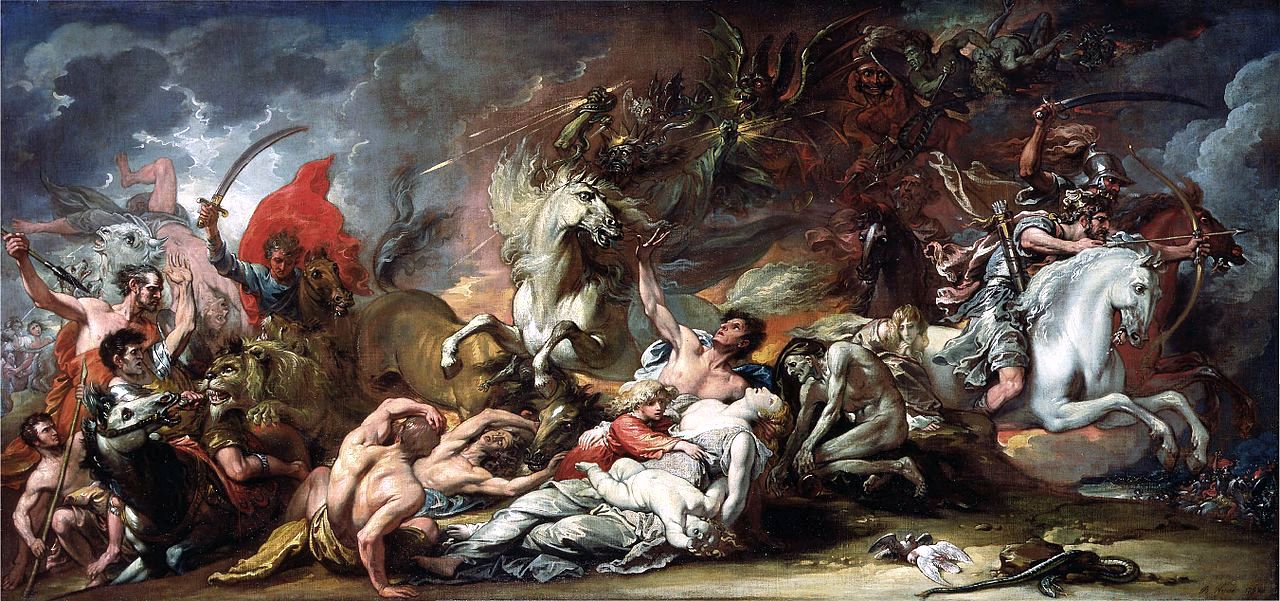
Four Horsemen of the Apocalype

Death on a Pale Horse is a version of the traditional subject, Four Horsemen of Revelation, 1796, Benjamin West (1738 – 1820), in the public domain in the US

Not Your Own

We often hear that faith must be personal. “My faith,” they say. People might tell us they’ve persevered through trials due to their faith. Were it to have failed, they would’ve been lost. But they had enough. At least that’s what they say. I don’t know about you, but I get the impression that they think this faith is their own, as if they produced it. As if it were due to strength of character or moral upbringing.

On the contrary, though we must hold faith individually:

And to the one who does not work but believes in him who justifies the ungodly, his faith is counted as righteousness. Romans 4:5 English Standard Version (ESV)

It is not our faith, it is a gift of God so that we might not boast about ourselves.

For by grace you have been saved through faith. And this is not your own doing; it is the gift of God, not a result of works, so that no one may boast. For we are his workmanship, created in Christ Jesus for good works, which God prepared beforehand, that we should walk in them. Ephesians 2:8-10 (ESV)

John Calvin comments on this verse:

For by grace are you saved. …God declares, that he owes us nothing; so that salvation is not a reward or recompense, but unmixed grace. The next question is, in what way do men receive that salvation which is offered to them by the hand of God? The answer is, by faith; and hence he concludes that nothing connected with it is our own…

Not of works. …Many persons restrict the word ‘gift’ to faith alone. But Paul is only repeating in other words the former sentiment. His meaning is, not that faith [only] is the gift of God, but that salvation [entirely] is given to us by God…

For we are his work. …The apostle affirms that we are God’s work, and that everything good in us is his creation; by which he means that the whole man is formed by his hand to be good. It is not the mere power of choosing aright, or some indescribable kind of preparation, or even assistance, but the right will itself, which is his workmanship; otherwise Paul’s argument would have no force.

Created to good works. …[Paul] says, that, before we were born, the good works were prepared by God; meaning, that in our own strength we are not able to lead a holy life, but only so far as we are formed and adapted by the hand of God. Now, if the grace of God came before our performances, all ground of boasting has been taken away…

To reiterate, faith is not a result of human will:

For he says to Moses, “I will have mercy on whom I have mercy, and I will have compassion on whom I have compassion.” So then it depends not on human will or exertion, but on God, who has mercy Romans 9:15-16 (ESV)

To this, Calvin comments:

It is not then of him who wills, etc. …That none of you may think that they who are elected are elected because they are deserving, or because they had in any way procured for themselves the favor of God, or, in short, because they had in them a particle of worthiness by which God might be moved, take simply this view of the matter, that it is neither by our will nor efforts…that we are counted among the elect, but that it wholly depends on the divine goodness, which of itself chooses those who neither will, nor strive, nor even think of such a thing… [Emphasis mine]

Therefore faith is not subjective. It is not of ourselves so that we may not boast. Just like the scriptures, faith is not a matter of one’s own opinion.

***

Now, if we accept that faith is not of ourselves, we who profess faith must also realize that we, ourselves, are not our own, either.

Or do you not know that your body is a temple of the Holy Spirit within you, whom you have from God? You are not your own, for you were bought with a price. So glorify God in your body. 1 Corinthians 6:19-20 (ESV)

77s – The 77’s – Bottom Line,   Uploaded to YouTube on Apr 6, 2008, posted by Neamberthal, Lyrics

The Sky Is Falling

No, really, it is. And the bottom is dropping out too. At least that’s what Margaret Atwood says.

In her article for Medium: “It’s Not Climate Change; It’s Everything Change,” Atwood describes three possible outcomes for mankind’s response to climate change. The following is an excerpt from picture 2, her most dismal:

…It will quickly become apparent that the present world population of six and a half billion people is not only dependent on oil, but was created by it: humanity has expanded to fill the space made possible to it by oil, and without that oil it would shrink with astounding rapidity. As for the costs to “the economy,” there won’t be any “economy.” Money will vanish: the only items of exchange will be food, water, and most likely — before everyone topples over — sex…

Contrary to Atwood’s views, we’ve urged responsible action to avert disaster:

…We should reconsider our approaches [toward climate change] for the sake of the next generation…

We’ve got to stop trying to oppress and coerce one another because we think we know what’s best for everyone else. Change over time is possible if we’re willing to cast off the hard sell, and adapt.

But climate change isn’t humanity’s most pressing problem. Nor is it our biggest problem, yours and mine, individually.

In John Calvin’s Institutes of the Christian Religion, chapter 17: “Use to be Made of the Doctrine of Providence,” he portrays the predicament of man living apart from God’s care under the dominion of chance:

Innumerable are the ills which beset human life, and present death in as many different forms. Not to go beyond ourselves, since the body is a receptacle, nay the nurse, of a thousand diseases, a man cannot move without carrying along with him many forms of destruction. His life is in a manner interwoven with death.

For what else can be said where heat and cold bring equal danger? Then, in what direction so ever you turn, all surrounding objects not only may do harm, but almost openly threaten and seem to present immediate death.

After giving many particulars through which we are exposed to harm, he says:

Amid these perils, must not man be very miserable, as one who, more dead than alive, with difficulty draws an anxious and feeble breath, just as if a drawn sword were constantly suspended over his neck?

It may be said that these things happen seldom, at least not always, or to all, certainly never all at once. I admit it; but since we are reminded by the example of others, that they may also happen to us, and that our life is not an exception any more than theirs, it is impossible not to fear and dread as if they were to befall us…

But, it is not so for the one who casts his lot with the Lord Jesus Christ, Calvin says:

…But when once the light of Divine Providence has illumined the believer’s soul, he is relieved and set free, not only from the extreme fear and anxiety which formerly oppressed him, but from all care. For as he justly shudders at the idea of chance, so he can confidently commit himself to God [Who actively protects him]…

The great American preacher, Jonathan Edwards, said that there is no security apart from Christ’s redeeming sacrifice. He said:

“There is nothing that keeps wicked men at any one moment out of hell, but the mere pleasure of God.”

Therefore, if you have not already, I urge you:

“Believe in the Lord Jesus, and you will be saved, you and your household.”

Sinners In The Hands Of An Angry God,” sermon reenacted by Ralph Green, October 30, 2012, Cloverhill4’s channel

Do You Swear?

During the Lord Jesus’s Sermon on the Mount, He defined God’s standards for a righteous life. He cited common understandings for principled living and then raised the bar. Among these principles, He declared swearing (i.e., oath taking) off-limits.

“Again you have heard that it was said to those of old, ‘You shall not swear falsely, but shall perform to the Lord what you have sworn.’

But I say to you, do not take an oath at all, either by heaven, for it is the throne of God, or by the earth, for it is his footstool, or by Jerusalem, for it is the city of the great King. And do not take an oath by your head, for you cannot make one hair white or black.

Let what you say be simply ‘Yes’ or ‘No’; anything more than this comes from evil. Matthew 5:33-37 English Standard Version (ESV)

Specifically, Christ prohibits using God’s name (or euphemisms for it) to bolster our sincerity in what we promise or declare to others and to God.

John Calvin comments:

You shall not swear falsely… The man who perjures himself is not the only person who takes the name of God in vain, (Exodus 20:7). He does so, who idly and contemptuously pronounces the name of God on trivial occasions, or in ordinary conversation.

Calvin points out that some have used the Lord’s command to reject all vows. He says they’re mistaken:

Do not take an oath at all… His statement amounts to this, that there are other ways of “taking the name of God in vain,” besides perjury; and, therefore, that we ought to refrain from allowing ourselves the liberty of unnecessary swearing: for, when there are just reasons to demand it, the law not only permits, but expressly commands us to swear.

Stating the obvious, Calvin concludes:

Let what you say be simply ‘Yes’ or ‘No’ Christ now prescribes… that men act towards each other sincerely and honestly… Fairness and honesty in our words are, therefore, demanded by Christ, that there may be no longer any occasion for an oath.

And James, in his letter to the churches, echoed his Lord’s admonition:

But above all, my brothers, do not swear, either by heaven or by earth or by any other oath, but let your “yes” be yes and your “no” be no, so that you may not fall under condemnation. James 5:12 (ESV)

Therefore, let us speak truth, one to another.

Us – Michael Been, The Best of The Call

All Israel Shall Be Saved

Much has been said recently about the reestablishment of Israel in the Middle East. Even Kim Riddlebarger’s A Case for Amillennialism, which we mentioned a few weeks ago, touches on the issue of national Israel. Some of what’s been said is divisive and some is not.

So let’s step back from the contemporary rhetoric and see what the Bible says. The Apostle Paul discussed Israel in his letter to the church in Rome. He described that nation’s relationship to God now that the gospel had been revealed. Paul made the following statement:

And in this way all Israel will be saved, as it is written,

“The Deliverer will come from Zion,

He will banish ungodliness from Jacob”;

Romans 11:26 English Standard Version (ESV)

What did he mean by ‘in this way?’ It seems that a lot of controversy surrounds this clause.

The exegete John Calvin said of the verse:

Many understand this of the Jewish people, as though Paul had said, that religion would again be restored among them as before [e.g., the sacrificial system].

But I extend the word Israel to all the people of God, according to this meaning:

“When the Gentiles shall come in, the Jews also shall return from their defection to the obedience of faith; and thus shall be completed the salvation of the whole Israel of God, which must be gathered from both; and yet in such a way that the Jews shall obtain the first place, being as it were the first-born in God’s family.”

Calvin didn’t make this assertion and others because of personal preference or animus, but based on the context of Paul’s statements in the chapter. Paul went on to say:

As regards the gospel, they [i.e., Israel] are enemies for your [i.e., the hearers of his letter] sake. But as regards election, they are beloved for the sake of their forefathers. For the gifts and the calling of God are irrevocable.

For just as you were at one time disobedient to God but now have received mercy because of their disobedience, so they too have now been disobedient in order that by the mercy shown to you they also may now receive mercy. For God has consigned all to disobedience, that he may have mercy on all. Romans 11:28-32 (ESV)

To this, Calvin commented:

[Paul] shows that the worst thing in the Jews ought not to subject them to the contempt of the Gentiles. Their chief crime was unbelief: but Paul teaches us, that they were thus blinded for a time by God’s providence, that a way to the gospel might be made for the Gentiles;

Paul then intends here to teach two things — that there is nothing in any man why he should be preferred to others, apart from the mere favor of God; and that God in the dispensation of his grace, is under no restraint that he should not grant it to whom he pleases.

There is an emphasis in the word mercy; for it intimates that God is bound to none, and that he therefore saves all freely, for they are all equally lost.

…Paul simply means that both Jews and Gentiles do not otherwise obtain salvation than through the mercy of God, and thus he leaves to none any reason for complaint. It is indeed true that this mercy is without any difference offered to all, but everyone must seek it by faith.

And thus ‘in this way’: All Israel Shall Be Saved.

Valley of Jezreel

The view from Megiddo, northeast across the Jezreel Valley in Israel to Mount Tabor, 9 November 2005, by Joe Freeman, Creative Commons Attribution-Share Alike 2.5 Generic

Prayer – Why Should We Pray If He Is All-knowing?

John Calvin addressed the issue posed by the title in his Institutes of the Christian Religion. He says it’s absurd to dissuade people from praying because God always knows our needs without us informing Him. To the contrary, Calvin cites Psalm 145:18:

The Lord is near to all who call on him,

    to all who call on him in truth. (ESV)

as the very reason that we should ask for His aid.

Calvin also shoots down the claim that it is unnecessary to ask for things He is ready and willing to provide. He cites Ps. 34:15:

The eyes of the Lord are toward the righteous

    and his ears toward their cry. (ESV)

to assert that God bestows His gifts liberally in answer to the prayers of His children so as to prove His love toward them.

However, Calvin doesn’t discount our laziness and outright presumption at times:

…Although it is true that while we are listless or insensible to our wretchedness, he wakes and watches for use and sometimes even assists us unasked; it is very much for our interest to be constantly supplicating him:

First, that our heart may always be inflamed with a serious and ardent desire of seeking, loving and serving him, while we accustom ourselves to have recourse to him as a sacred anchor in every necessity;

Secondly, that no desires, no longing whatever, of which we are ashamed to make him the witness, may enter our minds, while we learn to place all our wishes in his sight, and thus pour out our heart before him; and,

Lastly, that we may be prepared to receive all his benefits with true gratitude and thanksgiving, while our prayers remind us that they proceed from his hand.

Calvin observes that we more earnestly desire continued answers once we’ve recognized He has answered our previous prayers. We identify His continual, active providence as His tangible demonstration of His promises to us through our experiences of answered prayer.

And so Calvin concludes that both of the following are true: Ps. 121:4

Behold, he who keeps Israel

    will neither slumber nor sleep. (ESV)

And yet whenever He sees us insensible, or, may it not be, unbelieving, he withdraws as if he had forgotten us.

Stoning of Steven

The Lapidation of Saint Stephen, 1625, Rembrandt (1606–1669), in the public domain in the US

Prayer – Why do it?

In his Institutes of the Christian Religion, John Calvin addresses why anyone should pray to God:

For there is a kind of [communication] between God and men, by which, having entered the upper sanctuary, they appear before Him and appeal to his promises, that when necessity requires they may learn by experiences that what they believed merely on the authority of his word was not in vain.

Now, he takes as a given that we hold to this:

Without faith it is impossible to please him, for whoever would draw near to God must believe that he exists and that he rewards those who seek him. Hebrews 11:6 English Standard Version (ESV)

And have done this:

If you confess with your mouth that Jesus is Lord and believe in your heart that God raised him from the dead, you will be saved. Romans 10:9 (ESV)

Calvin goes on to say that it is both necessary and useful to pray to the Lord for every good thing that He promises us. God reveals His promises to us in His word. Therefore, we should know the bible well.

Calvin points out that our only safety is in calling upon our heavenly Father:

Since by it we invoke the presence of His:

Providence to watch over our interests,

Power to sustain us when weak and almost fainting, and

Goodness to receive us into favor, though miserably loaded with sin.

Through prayer, we call upon Him to make evident to us all his excellent attributes.

As a result of calling upon Him, Calvin states:

Admirable peace and tranquility are given to our consciences; for the straits by which we were pressed being laid before the Lord, we rest fully satisfied with the assurance that none of our evils are unknown to him, and that he is both able and willing to make the best provision for us.

Next week, we’ll consider the question: “Why Should We Pray If He Is All-knowing?”

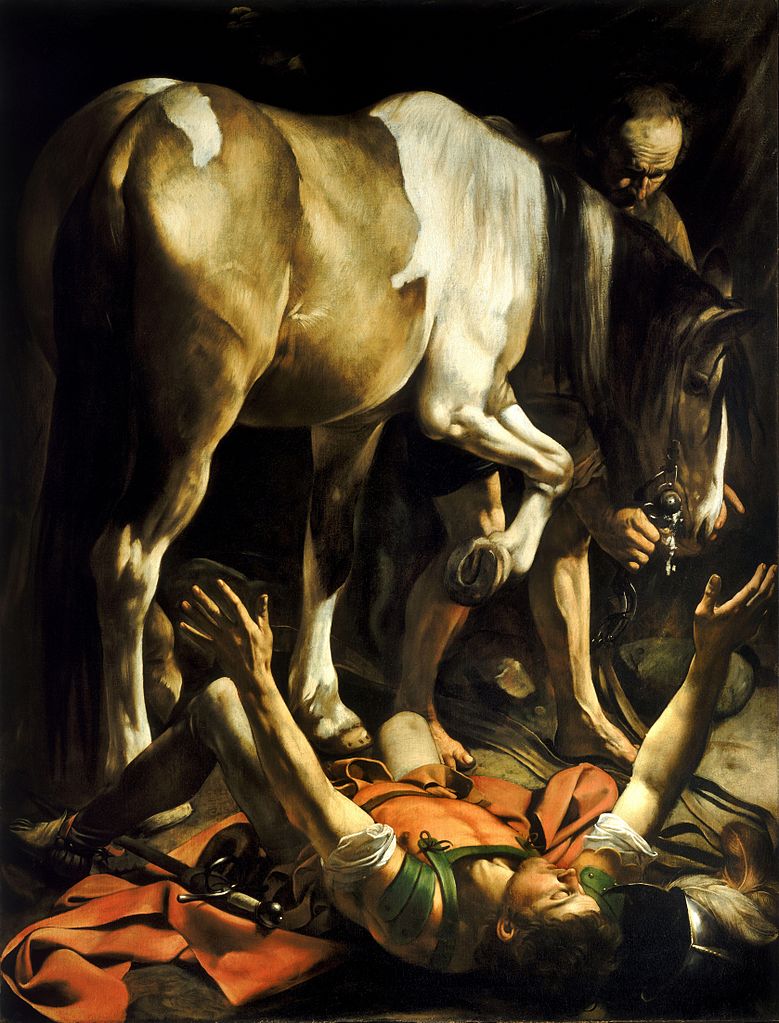
The Conversion of Paul - Caravaggio

Conversion on the Way to Damascus, circa 1600-1601, Caravaggio (1571–1610), public domain in the US

A New Prophet like Moses

“The end is near, the end is near!” We all associate this trope with crackpots and lunatics. Especially street corner prophets wearing sandwich boards. However, they are right in a sense. Around 150,000 people die every day, worldwide. Their ends are no longer near but already past.

We have to be wary of a prophet and his message. Thus Moses pointed us to the Prophet we should all listen to:

“The Lord your God will raise up for you a prophet like me from among you, from your brothers—it is to him you shall listen…and whoever will not listen to my words that he shall speak in my name, I myself will require it of him. Deuteronomy 18:15, 19 English Standard Version (ESV)

John Calvin has quite a bit to say about these verses:

The Lord thy God will raise up …But if He had referred them to Christ alone, the objection would naturally arise that it was hard for them to have neither Prophets nor revelations for two thousand years. Nor is there any strength in those two arguments on which some insist, that the Prophet, of whom Moses bears witness, must be more excellent than him who proclaimed him; and that the eulogium that he should be “like unto” Moses could not be applied to the ancient Prophets, since it is said elsewhere that “there arose not a Prophet since like unto” him. (Deuteronomy 34:10)…

…Yet Peter aptly and elegantly accommodates this testimony to Christ, (Acts 3:22) not to the exclusion of others of God’s servants, but in order to warn the Jews that in rejecting Christ they are at the same time refusing this inestimable benefit of God; for the gift of prophecy had so flourished among His ancient people, and teachers had so been constantly appointed to succeed each other, that nevertheless there should be some interruption before the coming of Christ.

Hence, in that sad dispersion which followed the return from the Babylonian captivity, the faithful complain in Psalm 74:9, “We see not our signs; there is no more any prophet.” On this account Malachi exhorts the people to remember the Law given in Horeb; and immediately after adds, “Behold I send you Elijah the prophet,” etc., (Malachi 4:4, 5) as much as to say, that the time was at hand in which a more perfect doctrine should be manifested, and a fuller light should shine. For the Apostle says truly, that:

“God, who at sundry times and in divers manners spoke unto the fathers by the prophets, hath in these last days spoken unto us by his Son,” (Hebrews 1:1, 2)

And, in fact, by the appearing of the doctrine of the Gospel, the course of the prophetic doctrine was completed; because God thus fully exhibited what was promised by the latter.

And this was so generally understood that even the Samaritan woman said that Messiah was coming, who would tell all things. (John 4:25) To this, then, what I have lately quoted as to the transition from the Law and the Prophets to the Gospel refers; and hence it is made out, that this passage was most appropriately expounded by Peter as relating to Christ; for unless the Jews chose to accuse God of falsehood, it was incumbent upon them to look to Christ, at whose hand was promised both the confirmation of doctrine and the restoration of all things.

They had been for a long time destitute of Prophets, of whom Moses had testified that they should never be wanting to them, and whom he had promised as the lawful ministers for retaining the people in allegiance, so that they should not turn aside to superstitions; they had, therefore, either no religion, or else that greatest of Teachers was to be expected, who in his own person would present the perfection of the prophetic office…

…But with regard to the comparison which Moses makes between himself and other prophets, its effect is to raise their teaching in men’s estimation. They had been long accustomed to this mode of instruction, viz., to hear God speaking to them by the mouth of a man; and the authority of Moses was so fully established, that they were firmly persuaded that they were under the divine government, and that all things necessary to salvation were revealed to them.

And, as recorded in John’s Gospel, chapter 5, verses: 39-40 and 46-47, the Lord Jesus Christ Himself says:

“You search the Scriptures because you think that in them you have eternal life; and it is they that bear witness about me, yet you refuse to come to me that you may have life…For if you believed Moses, you would believe me; for he wrote of me. But if you do not believe his writings, how will you believe my words?” John 5:39-40, 46-47 (ESV)

Please, believe Him.

Brazen Serpent

[The Brazen Serpent], Mount Nebo, Jordan (2001), Jerzy Strzelecki, Creative Commons Attribution-Share Alike 3.0 Unported

Idols

Scripture is clear: Idols are nothing. However, the scriptures point out that it is not the physical manifestation of the idol nor the demonic forces it represents but the disaffection of peoples’ hearts from their Lord and Creator that is deadly.

In one of the more amusing Old Testament passages, the Prophet Isaiah shows the futility of idols by describing a man using half of a wooden log to warm himself and cook a meal and then worshipping the other half:

He cuts down cedars, or he chooses a cypress tree or an oak and lets it grow strong among the trees of the forest. He plants a cedar and the rain nourishes it. Then it becomes fuel for a man. He takes a part of it and warms himself; he kindles a fire and bakes bread. Also he makes a god and worships it; he makes it an idol and falls down before it. Half of it he burns in the fire. Over the half he eats meat; he roasts it and is satisfied. Also he warms himself and says, “Aha, I am warm, I have seen the fire!” And the rest of it he makes into a god, his idol, and falls down to it and worships it. He prays to it and says, “Deliver me, for you are my god! Isaiah 44:14-17 English Standard Version (ESV)

The Prophet Jeremiah says physical idols are mere inanimate articles of superstition:

Their idols are like scarecrows in a cucumber field,

   and they cannot speak;

they have to be carried,

   for they cannot walk.

Do not be afraid of them,

   for they cannot do evil,

   neither is it in them to do good.”

Jeremiah 10:5 (ESV)

The Prophet Ezekiel emphasizes what was true all along; idol worship is a question of a person’s heart disaffection from the Lord:

For any one of the house of Israel, or of the strangers who sojourn in Israel, who separates himself from me, taking his idols into his heart and putting the stumbling block of his iniquity before his face, and yet comes to a prophet to consult me through him, I the Lord will answer him myself. Ezekiel 14:7 (ESV)

John Calvin comments on this passage:

He who caused his idols to ascend unto his heart, he who placed the stumbling block of his iniquity before his face, that is, was drowned in his own superstitions, so that his idols bore sway in his heart.

Lastly, he who is so forward in audacity that he did not conceal his wish to oppose the Almighty: if anyone, says he, came to a prophet to inquire of him in me, or my name, I will answer him. He [the Lord speaking through the prophet]…could no longer bear the hypocrites who deluded themselves so proudly. And certainly when they openly worshipped idols, and were [filled] with many superstitions, what audacity and pride it was to consult true prophets?

It is much the same as if a person should want only insult and rail at a physician, and not only load him with reproaches, but even spit in his face: and should afterwards go and ask his advice, saying, “What do you advise me to do? How must I be cured of this disease?” Such pride could not be borne between man and man…How then will God permit such reproaches to go unpunished?

The Apostle Paul addresses the question of idols directly:

Therefore, as to the eating of food offered to idols, we know that “an idol has no real existence,” and that “there is no God but one.” For although there may be so-called gods in heaven or on earth—as indeed there are many “gods” and many “lords”— yet for us there is one God, the Father, from whom are all things and for whom we exist, and one Lord, Jesus Christ, through whom are all things and through whom we exist. 1 Corinthians 8:4-6 (ESV)

Calvin disagrees with the translation no…existence:

…As to the words, Erasmus reads thus — “An idol has no existence.” I prefer the rendering of the old translation — an idol is nothing. For the argument is this — that an idol is nothing, inasmuch as there is but one God; for it follows admirably — “If there is no other God besides our God, then an idol is an empty dream, and mere vanity.” When he says — and there is none other God but one, I understand the conjunction [as giving this explanation].

For the reason why an idol is nothing is, that it must be estimated according to the thing that it represents. Now it is appointed for the purpose of representing God: nay more, for the purpose of representing false gods, inasmuch as there is but one God, who is invisible and incomprehensible.

The reason, too, must be carefully observed — An idol is nothing because there is no God but one; for he is the invisible God, and cannot be represented by a visible sign, so as to be worshipped through means of it. Whether, therefore, idols are erected to represent the true God, or false gods, it is in all cases a perverse contrivance.

Hence Habakkuk calls idols teachers of lies, (Habakkuk 2:18) because they deal falsely in pretending to give a figure or image of God, and deceive men under a false title. Hence οὐδεν (nothing) refers not to essence, but to quality — for an idol is made of some substance — either silver, or wood, or stone; but as God does not choose to be represented in this way, it is vanity and nothing as to meaning and use.

Paul takes it further and calls covetousness, which is a specific heart attitude, idolatry:

For you may be sure of this, that everyone who is sexually immoral or impure, or who is covetous (that is, an idolater), has no inheritance in the kingdom of Christ and God. Ephesians 5:5 (ESV)

Calvin points out this identification is representative of a greater issue:

Nor covetous man, who is an idolater. “Covetousness,” as he says in another place, “is idolatry,” (Colossians 3:5) — not the idolatry which is so frequently condemned in Scripture, but one of a different description. All covetous men must deny God, and put wealth in his place; such is their blind greediness of wretched gain.

But why does Paul attribute to covetousness alone what belongs equally to other carnal passions? In what respect is covetousness better entitled to this disgraceful name than ambition, or than a vain confidence in ourselves?

I answer, that this disease is widely spread, and not a few minds have caught the infection. Nay, it is not reckoned a disease, but receives, on the contrary, very general commendation. This accounts for the harshness of Paul’s language, which arose from a desire to tear from our hearts the false view.

Calvin says that all heart passions that disobey God deserve being labelled idolatry. But, he says, Paul is emphasizing covetousness because of its effect in man. As his Lord had said:

“No one can serve two masters, for either he will hate the one and love the other, or he will be devoted to the one and despise the other. You cannot serve God and money [or possessions].” Matthew 6:24 (ESV)

The same also recorded in Luke 16:13. Calvin draws an important distinction concerning this passage in Matthew:

…Christ affirms that it is impossible for any man to obey God, and, at the same time, to obey his own flesh…where riches hold the dominion of the heart, God has lost his authority. True, it is not impossible that those who are rich shall serve God; but whoever gives himself up as a slave to riches must abandon the service of God: for covetousness makes us the slaves of the devil.

…What is here said with a special reference to riches, may be properly extended to every other description of vice. As God pronounces everywhere such commendations of sincerity, and hates a double heart, (1 Chronicles 12:33; Psalm 12:2) all are deceived, who imagine that he will be satisfied with the half of their heart.

All, indeed, confess in words, that, where the affection is not entire, there is no true worship of God: but they deny it in fact, when they attempt to reconcile contradictions. “I shall not cease,” says an ambitious man, “to serve God, though I devote a great part of my mind to hunting after honors.”

It is, no doubt, true, that believers themselves are never so perfectly devoted to obedience to God, as not to be withdrawn from it by the sinful desires of the flesh. But as they groan under this wretched bondage, and are dissatisfied with themselves, and give nothing more than an unwilling and reluctant service to the flesh, they are not said to serve two masters.

For their desires and exertions are approved by the Lord, as if they rendered to him a perfect obedience. But this passage reproves the hypocrisy of those who flatter themselves in their vices, as if they could reconcile light and darkness.

Scarecrows out standing in a field

Scarecrow, Japan Paddy Field, By FG2, released into the Public Domain by its author