Stand Before the Judgment Seat

Last week we considered our propensity to judge others, assigning to some honors and infamy to others, when we have no way to see the quality of their hearts and souls. And, if we could see them, we’d be either too indulgent or too harsh. This week we look at God’s rightful place as Judge. In his letter to the church at Rome, in the fourteenth chapter, the Apostle Paul asks:

Why do you pass judgment on your brother? Or you, why do you despise your brother? For we will all stand before the judgment seat of God; Romans 14:10 English Standard Version (ESV)

The obvious answer to his questions is: our sinfulness. Calvin analyzes these verses further:

But you, why do you, etc. …It is an unreasonable boldness in anyone to assume the power to judge his brother, since by taking such a liberty he robs Christ the Lord of the power which he alone has received from the Father.

…As…it would be absurd among men for a criminal, who ought to occupy a humble place in the court, to ascend the tribunal of the judge; so it is absurd for a Christian to take to himself the liberty of judging the conscience of his brother…

That certainly puts us in our place. But, to examine the matter at a deeper level, consider Paul’s initial question and response in this chapter:

Who are you to pass judgment on the servant of another? It is before his own master that he stands or falls. And he will be upheld, for the Lord is able to make him stand. Romans 14:4 (ESV)

Calvin explains:

Who are you who judges, etc. …Now, though the power of judging as to the person, and also as to the deed, is taken from us, there is yet much difference between the two.

For we ought to leave the man, whatever he may be, to the judgment of God; but as to his deeds we may indeed form a decisive opinion, though not according to our own views, but according to the word of God; and the judgment, derived from his word, is neither human, nor another man’s judgment.

Paul then intended here to restrain us from presumption in judging; into which they fall, who dare to pronounce anything respecting the actions of men without the warrant of God’s word.

These are the same principles Paul proclaimed to the Corinthian church. However, lest we think our lot is hopeless, consider the second half of the verse to which Calvin says:

To his own Lord he stands or falls, etc. As though he said, — “It belongs rightly to the Lord, either to disapprove, or to accept what his servant does: hence he robs the Lord, who attempts to take to himself this authority.”

And he adds, he shall indeed stand: and by so saying, he not only bids us to abstain from condemning, but also exhorts us to mercy and kindness, so as ever to hope well of him, in whom we perceive anything of God; inasmuch as the Lord has given us a hope, that he will fully confirm, and lead to perfection, those in whom he has begun the work of grace…as he also teaches us in another place,

“He who began in you a good work, will perform it to the end.” (Philippians 1:6.)

So, the trade is equitable with regard to persons. We relinquish tribunal powers over others of whom we disapprove because they do not meet our personal standards. Rather, we are to judge others’ actions only according to His word. And God promises to complete the work He set out to do, in those others for whom we should hope well and, most importantly, in ourselves with whom we should be disappointed until His work is through.

77’s-Live Warehouse 1989: “Can’t Get Over It,” “Frames Without Photographs,” YouTube, 77’s

Not Acquitted

How often have we condemned others without cause based on their real or perceived deficiencies? Some in the world have lost their lives this way. However, in the church, we should be more prudent. The Apostle Paul addressed the Corinthian church, who had just such a problem, using himself as an example:

For I am not aware of anything against myself, but I am not thereby acquitted. It is the Lord who judges me. Therefore, do not pronounce judgment before the time, before the Lord comes, who will bring to light the things now hidden in darkness and will disclose the purposes of the heart. Then each one will receive his commendation from God. 1 Corinthians 4:4-5 English Standard Version (ESV)

Theologian John Calvin, expounded on Paul’s remarks:

I am not conscious to myself of anything faulty. …Paul [confesses elsewhere that he]…felt sin dwelling in him…but as to his apostleship, (which is the subject that is here treated of,) he had conducted himself with so much integrity and fidelity, that his conscience did not accuse him as to anything…Yet he says that he is not thereby justified, that is, pure, and altogether free from guilt in the sight of God.

Why? Assuredly, because God sees much more distinctly than we; and hence, what appears to us cleanest, is filthy in his eyes…We think of ourselves too indulgently, but God is a judge of the utmost strictness. Hence the truth of what Solomon says —

“Every man’s ways appear right his own eyes, but the Lord ponders the hearts.” (Proverbs 21:2.)

…Accordingly…we must have recourse to the free promise of mercy, which is offered to us in Christ, that we may be fully assured that we are accounted righteous by God.

Calvin then points out the limitations of Paul’s example:

Therefore, judge nothing before the time From this conclusion it is manifest, that Paul did not mean to reprove every kind of judgment without exception, but only what is hasty and rash, without examination of the case…

Let us know, then, how much is allowed us, what is now within the sphere of our knowledge, and what is deferred until the day of Christ, and let us not attempt to go beyond these limits. For there are some things that are now seen openly, while there are others that lie buried in obscurity until the day of Christ.

Yet, because of man’s utter depravity, Calvin declares:

Who will bring to light. If this is affirmed truly and properly respecting the day of Christ, it follows that matters are never so well regulated in this world but that many things are involved in darkness; and that there is never so much light, but that many things remain in obscurity. I speak of the life of men, and their actions.

He explains in the second clause, what is the cause of the obscurity and confusion, so that all things are not now manifest. It is because there are [astonishing] recesses and deepest lurking-places in the hearts of men. Hence, until the thoughts of the hearts are brought to light, there will always be darkness.

And, finally, summing up, Calvin warns:

And then shall everyone have praise It is as though he had said, “You now, O Corinthians, as if you had the adjudging of the prizes, crown some, and send away others with disgrace, but this right and office belong exclusively to Christ. You do that before the time — before it has become manifest who is worthy to be crowned, but the Lord has appointed a day on which he will make it manifest.”

Therefore, we should not judge another’s honor; it is before the Lord that they stand, and He is able to make them stand. And we will all stand before Him one day.

Michael Roe performs “I Could Laugh” at Grace Church, Show Low, AZ – 4-7-2014 – with. Chris Taylor, YouTube, Lyrics

Seasoned with Salt

You have friends. They don’t profess Christ as their savior. Do you take them aside, present the gospel in stark terms, and drop them if they don’t repent? That’s not what the Lord does, is it? The Apostle Paul gives us instruction:

Walk in wisdom toward outsiders, making the best use of the time. Let your speech always be gracious, seasoned with salt, so that you may know how you ought to answer each person. Colossians 4:5-6 English Standard Version (ESV)

How should we put this advice into practice? Here’s what Calvin says:

Walk wisely. [Paul] mentions those that are without, in contrast with those that are of the household of faith. (Galatians 6:10.) For the Church is like a city of which all believers are the inhabitants, connected with each other by a mutual relationship, while unbelievers are strangers.

But why would he have regard [given to unbelievers], rather than to believers? There are three reasons: first,

lest any stumbling block be put in the way of the blind, (Leviticus 19:14,)

for nothing is more [likely] to occur, than that unbelievers are driven from bad-to-worse through our imprudence, and their minds are wounded, so that they hold religion more and more in abhorrence.

Secondly, it is lest any occasion may be given for detracting from the honor of the gospel, and thus the name of Christ be exposed to derision, persons be rendered more hostile, and disturbances and persecutions be stirred up.

Lastly, it is, lest, while we are mingled together, in partaking of food, and on other occasions, we be defiled by their pollutions, and by little and little become profane.

To the same effect, also, is what follows, redeeming the time, that is, because [interaction] with them is dangerous. For in Ephesians 5:16, he assigns the reason, because the days are evil. “Amidst so great a corruption as prevails in the world we must seize opportunities of doing good, and we must struggle against impediments…”

Therefore, walking wisely, we should not put stumbling blocks in our friend’s path, not dishonor the gospel, and not become profane, ourselves. Instead, we should use those opportunities we’ve been given to honor the name of Christ. But Calvin goes further:

Your speech. He requires suavity of speech, such as may allure the hearers by its profitableness, for he does not merely condemn communications that are openly wicked or impious, but also such as are worthless and idle. Hence he would have them seasoned with salt.

Profane men have their seasonings of discourse, but he does not speak of them; nay more, as witticisms are insinuating, and for the most part procure favor, he indirectly prohibits believers from the practice and familiar use of them. For he reckons as tasteless everything that does not edify. The term grace is employed in the same sense, so as to be opposed to talkativeness, taunts, and all sorts of trifles which are either injurious or vain.

So, we should speak to others with courtesy, consideration, and tact.

That ye may know how. The man who has accustomed himself to caution in his communications will not fall into many absurdities, into which talkative and prating persons fall into from time to time, but, by constant practice, will acquire for himself expertness in making proper and suitable replies…

Nor does [Paul] merely say what, but also how, and not to all indiscriminately, but to everyone. For this is not the least important part of prudence — to have due regard to individuals.

Our conversations with friends should enlighten their (and our) morals and understanding. We should practice proper and suitable replies to each one who asks for a reason for the hope we have. We would do well to imitate Christ’s discussion with the woman at the well.

Two People Talking

Two People Talking, 23 August 2012, Centers for Disease Control and Prevention, a work of the U.S. Federal Government in the public domain.

The Brother You Can See

All sorts of people attend church. Some you like; some you don’t. A few rub us wrong. Fewer still seem to have it in for us. What are we to do? Avoidance comes to mind. But what’s God’s standard?

We love because he first loved us. If anyone says, “I love God,” and hates his brother, he is a liar; for he who does not love his brother whom he has seen cannot [or, how can he] love God whom he has not seen. And this commandment we have from him: whoever loves God must also love his brother. 1 John 4:19-21 English Standard Version (ESV)

Okay, so if we don’t love our brother then we don’t love God? The word used for love, here, is ἀγαπάω (agapaō), or sacrificial love. Though affection may arise from this kind of love, the essence of agape toward our brother or sister is: unconditional, generous effort for another’s welfare. For deeper insight concerning these verses, consider what Calvin says:

We love him …This love [of God] cannot exist, except it generates love [toward our brothers and sisters]. Hence [the Apostle John] says, that they are liars who boast that they love God, when they hate their brethren.

…The Apostle takes [for] granted what ought…to appear evident to us, that God offers himself to us in those men who bear his image, and that he requires the duties, which he does not want himself, to be performed to them, according to Psalm 16:[2-3], where we read,

“My goodness reaches not to thee, O Lord;

towards the saints who are on the earth is my love.”

…John…shows how fallacious is the boast of everyone who says that he loves God [who is invisible], and yet loves not God’s image which is before his eyes.

And this commandment …He not only gave a commandment respecting the love of God, but [commanded] us also to love our brethren. We must therefore so begin with God, as that there may be at the same time a transition made to men.

Echoing John, the Apostle Paul, in the twelfth chapter of the Letter to the Romans, says in part:

Live in harmony with one another. Do not be haughty, but associate with the lowly. Never be wise in your own sight. Repay no one evil for evil, but give thought to do what is honorable in the sight of all. If possible, so far as it depends on you, live peaceably with all. Romans 12:16-18 ESV

Further, we look to other ‘one anothers’ in scripture. Almost all of these are commands for us to act upon for our brethren’s welfare.

So, let us exert unconditional, generous effort for our brother’s or sister’s welfare by praying for their needs, forgiving and asking forgiveness, and supplying material kindnesses to them. Who knows, perhaps affection may arise afterward.

RC Sproul: Pre-Evangelism – Defending Your Faith Part 3

Sin, Righteousness, and Judgment

Current opinion holds that we are good people who do bad things. But opinion isn’t fact; and fact isn’t opinion. Someone, Who knew the facts, spoke about the Third Person of God this way:

And when he comes, he will convict the world concerning sin and righteousness and judgment: concerning sin, because they do not believe in me; concerning righteousness, because I go to the Father, and you will see me no longer; concerning judgment, because the ruler of this world is judged. John 16:8-11 English Standard Version (ESV)

There’s a lot of truth packed in these verses of scripture. Although Matthew Henry, Charles Spurgeon, and John Calvin all commented or preached on this text, we turn to a heartfelt sermon by George Whitfield, Anglican minister, preacher of Calvinist Methodism, and revivalist preacher in the USA circa 1740s. Speaking of sin, righteousness, and judgment, Whitefield said:

…First, …The Comforter, when he comes effectually to work upon a sinner, not only convinces him of the sin of his nature, the sin of his life, [and] of the sin of his duties…

But there is a fourth sin, of which the Comforter, when he comes, convinces the soul, and which alone (it is very remarkable) our Lord mentions, as though it was the only sin worth mentioning; for indeed it is the root of all other sins whatsoever: it is the reigning as well as the damning sin of the world. And what now do you imagine that sin may be? It is that cursed sin, that root of all other evils, I mean the sin of unbelief. Says our Lord, verse 9. “Of sin, because they believe not on me.”

…Perhaps you may think you believe, because you repeat the Creed, or subscribe to a Confession of Faith; because you go to church or meeting, receive the sacrament, and are taken into full communion. These are blessed privileges; but all this may be done, without our being true believers.

…Ask yourselves, therefore, whether or not the Holy [Spirit] ever powerfully convinced you of the sin of unbelief? …Were you ever made to cry out, “Lord, give me faith; Lord, give me to believe on thee; O that I had faith! O that I could believe!” If you never were thus distressed, at least, if you never saw and felt that you had no faith, it is a certain sign that the Holy [Spirit], the Comforter, never came into and worked savingly upon your souls.

…We have seen how the Holy [Spirit] convinces the sinner of the sin of his nature, life, duties, and of the sin of unbelief; and what then must the poor creature do? He must, he must inevitably despair, if there be no hope but in himself…

Whitefield continues:

Secondly, what is the righteousness, of which the Comforter convinces the world?

…O the righteousness of Christ! It so comforts my soul, that I must be excused if I mention it in almost all my discourses. I would not, if I could help it, have one sermon without it. Whatever infidels may object, or Arminians sophistically argue against an imputed righteousness; yet whoever know themselves and God, must acknowledge, that “Jesus Christ is the end of the law for righteousness, (and perfect justification in the sight of God) to everyone that believes,” and that we are to be made the righteousness of God in him.

This, and this only, a poor sinner can lay hold of, as a sure anchor of his hope. Whatever other scheme of salvation men may lay, I acknowledge I can see no other foundation whereon to build my hopes of salvation, but on the rock of Christ’s personal righteousness, imputed to my soul.

…When therefore the Spirit has hunted the sinner out of all his false rests and hiding-places, taken off the pitiful fig-leaves of his own works, and driven him out of the trees of the garden (his outward reformations) and places him naked before the bar of a sovereign, holy, just, and sin-avenging God; then, then it is, when the soul, having the sentence of death within itself because of unbelief, has a sweet display of Christ’s righteousness made to it by the Holy Spirit of God. Here it is, that he begins more immediately to act in the quality of a Comforter, and convinces the soul so powerfully of the reality and all-sufficiency of Christ’s righteousness, that the soul is immediately set a hungering and thirsting after it.

Now the sinner begins to see, that though he has destroyed himself, yet in Christ is his help; that, though he has no righteousness of his own to recommend him, there is a fullness of grace, a fullness of truth, a fullness of righteousness in the dear Lord Jesus, which, if once imputed to him, will make him happy for ever and ever.

…If you were never thus convinced of Christ’s righteousness in your own souls, though you may believe it doctrinally, it will avail you nothing; if the Comforter never came savingly into your souls, then you are comfortless indeed…

Whitefield then proceeds:

Thirdly, …the Comforter, when he comes, convinces the soul of judgment.

“Of judgment (says our Lord) because the Prince of this world is judged;” the soul, being enabled to lay hold on Christ’s perfect righteousness by a lively faith, has a conviction wrought in it by the Holy Spirit, that the Prince of this world is judged. The soul being now justified by faith, has peace with God through our Lord Jesus Christ, and can triumphantly say, “It is Christ that justifies me, who is he that condemns me?”

The strong man armed is now cast out; my soul is in a true peace; the Prince of this world will come and accuse, but he has now no share in me: the blessed Spirit which I have received, and whereby I am enabled to apply Christ’s righteousness to my poor soul, powerfully convinces me of this: why should I fear? Or of what shall I be afraid, since God’s Spirit witnesses with my spirit, that I am a child of God…

But, if we do not find ourselves thus convinced, Whitefield appeals to us once more to be reconciled to Christ:

Though of myself I can do nothing, and you can no more by your own power come to and believe on Christ, than Lazarus could come forth from the grave; yet who knows but God may beget some of you again to a lively hope by this foolishness of preaching, and that you may be some of that world, which the Comforter is to convince of sin, or righteousness, and of judgment?

Poor Christless souls! Do you know what a condition you are in? Why, you are lying in the wicked one, the devil; he rules in you, he walks and dwells in you, unless you dwell in Christ, and the Comforter is come into your hearts. And will you contentedly lie in that wicked one that devil? What wages will he give you? Eternal death.

O that you would come to Christ! The free gift of God through him is eternal life. He will accept of you even now, if you will believe in him. The Comforter may yet come into your hearts, even yours…

***

In conclusion, we briefly quote Augustine on these same verses:

Let men, therefore, believe in Christ, that they be not convicted of the sin of their own unbelief, whereby all sins are retained;

let them make their way into the number of believers, that they be not convicted of the righteousness of those, whom, as justified, they fail to imitate;

let them beware of that future judgment, that they be not judged with the prince of the world, whom, judged as he is, they continue to imitate.

For the unbending pride of mortals can have no thought of being spared itself, as it is thus called to think with terror of the punishment that overtook the pride of angels.

Sinners in the Hands of an Angry God – Classic Sermon by Jonathan Edwards – Christian Praise and Worship in Songs, Sermons, and Audio Books, Sermon Text

How Did We Get Here? – by Bernhardt Writer

Matt Hennessy, writing for City Journal, characterized the state of the 2016 US election. He blames the Democrats for our situation. But, in my opinion, both parties are complicit:

…They’ve spent the last 100 years expanding the scope of executive authority, granting the federal administrative agencies the power of judge, jury, and executioner over their ever-widening dominion. If liberals and progressives didn’t want that awesome, intrusive power to fall into the wrong hands, perhaps they should have heeded the warnings of small-government conservatives, who railed for a century against the bloat, rot, and corruption they saw metastasizing within the District of Columbia. Perhaps they shouldn’t have declared the U.S. Constitution—with its bill of rights and enumerated powers—to be an antiquated relic.

John Micklethwait and Adrian Wooldridge chronicled the rise of progressivism and statism over the past 100 years in their book: The Fourth Revolution: The Global Race to Reinvent the State. We reviewed it here on this blog over a multi-week period in 2015. Here are some excerpts describing progressivism’s rise:

Beatrice Webb’s vision—the state as the epitome of reason and truth—enabled her to develop the ideology adopted by pro-statists worldwide. To her, the state stood for: planning versus confusion, merit versus privilege, and science versus prejudice…Why cause revolution when the same change could be brought about more lastingly through subversion of society using propaganda and recognized committees of experts.

Beatrice and her husband Sidney founded the Fabian Society as guardians of this socialist transformation. They established the London School of Economics to train a global cohort of social engineers…The Webbs also founded the New Statesman, a weekly review of politics and literature, as the clarion of their revolution.

In the period 1905-1915, the Webbs helped enact redistributive taxation to pay for [British] programs and lessened the stigma of “Poor Laws.” The poor became “victims,” not layabouts…They embraced eugenics as eagerly as they did town planning. The Webbs trusted the judgment of professional experts over the “average sensual man” when it came to bettering the life of commoners.

A prominent liberal ally of the Webbs, John Maynard Keynes, advocated for government intervention to aid Adam Smith’s hidden hand of the market. Although he spelled out caveats to his philosophy, these were conveniently forgotten over the years. His philosophy, Keynesianism, still powers big government.

The British Statist model was adopted by Hitler, Stalin, Mussolini, Franco, and Peron. They all blended Hegelian state worship into their dictatorships and used the state to control their economies. America, however, took a different turn under the Roosevelts.

Theodore Roosevelt (US president 1901-1909) acknowledged that the Webbs were right when they said that laissez-faire capitalism was over. He established regulatory bodies to constrain the power of corporations over the American people…By not embracing European style statism, with its comprehensive welfare state, he squared-the-circle through his progressive republicanism and saved the US from Europe’s excesses.

Franklin Delano Roosevelt, for his part, imposed tighter regulation instead of nationalizing broad sectors of the economy in the face of economic collapse and world war. World War II demonstrated big government’s ability to marshal all of industry to the service of war through detailed planning, financial incentives, and coercion.

The same occurred on both sides of the Atlantic and the Pacific…When Winston Churchill returned to power in October 1951, his government did nothing to roll back the welfare state. In the closing days of World War II, international supervisory organizations like the International Monetary Fund and the World Bank were created under Keynes influence as a result of the Bretton Woods international agreements.

In his article titled: “It’s Not Your Founding Fathers’ Republic Any More,” which we reviewed in 2014 on this blog, Myron Magnet, former Editor-in-Chief of City Journal, says:

President Wilson established in the WWI era the doctrine of the “Living Constitution” administered by the Supreme Court thereby codifying judicial activism that undid civil liberty victories in the aftermath of the Civil War. Secondly, President Roosevelt established prior to and during the WWII era unelected extra-governmental commissions (aka agencies) that have independent legislative, administrative, and judicial powers within themselves. Agencies are created as a matter of course now by legislative action. FDR also strengthened the power of the judiciary to act as a permanent constitutional convention amending the document through their decisions.

Fred Siegel characterized the increasing alienation of the liberal left from common US citizens in his book: The Revolt Against the Masses: How Liberalism Has Undermined the Middle Class. We reviewed his book here and here in 2014. This is a brief excerpt from our review:

On July 30, 1916, at 2:08 AM, saboteurs caused a one kiloton explosion on Black Tom Island off the New Jersey coast, near Liberty Island, in NYC harbor. Two million pounds of munitions on their way to the allies were detonated through a series of fires.

This sabotage is viewed as the proximate cause for President Wilson to denounce Germany’s supporters in America as “creatures” of “disloyalty and anarchy [who] must be crushed.” He pushed for and got the Sedition Act of 1918 passed. The Sedition Act extended the Espionage Act of 1917.

Whereas, pre-war Progressives {in the US] hoped to reform a nation of immigrants grounded in the Protestant ethic, Liberals objected to wartime conscription, civil liberties repression, Prohibition, and the first Red Scare. They saw middle class values as a continuation of WWI repressions.

“Like most sensible people,” liberal Harold Edmund Stearns said, “I regard Prohibition as an outrage and a direct invitation to revolution.”

Those supporting Communism and the Soviets used the Sacco and Vanzetti trial (1926-27) as a wedge to draw prominent liberals to their cause. Drawing on declassified Comintern documents, Stephen Koch, in his Double Lives: Spies and Writers in the Secret Soviet War of Ideas Against the West, explains that Willi Münzenberg, the Comintern’s master propagandist, intended:

to create for the right-thinking non-Communist West… the belief that…to criticize or challenge Soviet policy was the unfailing mark of a bad, bigoted, and probably stupid person, while support was equally infallible proof of a forward-looking mind committed to all that was best for humanity and mankind by an uplifting refinement of sensibility.

Münzenberg thought the “the idea of America” had to be countered. Koch noted that Soviet sympathizers used events such as the trial:

to instill a reflexive loathing of the United States and its people, to undermine the myth of the Land of Opportunity, the United States would be shown as an almost insanely xenophobic place, murderously hostile to foreigners.

In 1928, H. G. Wells described his alternative in his book The Open Conspiracy: Blue Prints for a World Revolution (revised and republished as What Are We to Do with Our Lives?) where he states: “the [instinctive fellowship] of the highly competent” ruling class would subject the masses to “the great processes of social reconstruction.” and, through their rule, “escape from the distressful pettiness and mortality of the individual life.” He also wrote:

We no longer want that breeding swarm of hefty sweaty bodies, without which the former civilizations could not have endured, we want watchful and understanding guardians and drivers of complex delicate machines, which can be mishandled and brutalized and spoilt all too easily.

…In this light, American liberalism of the early twentieth century, as distinct from classical liberalism of the nineteenth century, was driven by hatred of the common man, his morals, and his liberty.

Reflecting on the impact of such “liberal” ideology, Kenneth Minogue wrote: Alien Powers: The Pure Theory of Ideology. We reviewed it in this blog. Here is a synopsis of Minogue’s thought on the outcome of implementing such philosophy in our society:

In Western societies, individuals follow customs or conduct projects of which others may dislike or disapprove and the result may be conflict.

However, Western society is predominantly peaceful in spite of potential (or actual) conflict because individuals master internalized rules of law and morality. Poverty, inequality, and disappointment are inevitable consequences of open participation in a risk based society even when it is free from iniquitous societal distortions (e.g., American slavery).

Ideologists say these consequences result from hidden structural flaws that can only be remedied through the destruction of the prevailing system. One must attain the perfection of social harmony. If material possessions cause envy, then all possessions must be jointly owned. Rather than insisting on moral decency to curb envy, ideologists will abolish ownership altogether.

This same approach, rooted in externals, is applied to all inequality and disappointment. Transcendent principles (e.g., morality) are not applicable to unruly minds. Once harmony is achieved there will be no need for the transcendent; all humanity will become one in thinking and affections.

Finally, Myron Magnet writes on how Tocqueville foresaw the “End of Democracy in America” in the 1830s. Magnet, speaking of current society says:

Today’s sovereign…forces men to act as well as suppresses [their] action…As Tocqueville observed, “It is the state that has undertaken virtually alone to give bread to the hungry, aid and shelter to the sick, and work to the idle.”

…And whatever traditional American mores defined as good and bad, moral and immoral, base and praiseworthy, the sovereign has redefined and redefined until all such ideas have lost their meaning. Is it any wonder that today’s Americans feel that they have no say in how they are governed—or that they don’t understand how that came about?

Such oppression is “less degrading” in democracies because, since the citizens elect the sovereign, “each citizen, hobbled and reduced to impotence though he may be, can still imagine that in obeying he is only submitting to himself.”

Moreover, democratic citizens love equality more than liberty, and the love of equality grows as equality itself expands. Don’t let him have or be more than me. Tocqueville despairingly concluded, “The only necessary condition for centralizing public power in a democratic society is to love equality or to make a show of loving it. Thus the science of despotism, can be reduced…to a single principle.”

By this last statement, Tocqueville anticipated the controlling idea of Orwell’s classic allegory, Animal Farm: “All animals are equal but some animals are more equal than others.”

***

Progressivism used to stand for progress and truth. But, collectively, we’ve abandoned that paradigm for historical revision and nihilism. Perhaps we should “adjust,” as our leaders say, to a new normal: terrorism, crime, corruption, and complicity. Perhaps…

But, then I remember that the United States of America was founded not upon blood and soil as other nations were but on ideals summarized in our Declaration of Independence and Preamble of the Constitution.

In case you don’t recollect these ideals word for word, the Declaration of Independence says:

…We hold these truths to be self-evident, that all men are created equal, that they are endowed by their Creator with certain unalienable Rights, that among these are Life, Liberty and the pursuit of Happiness. That to secure these rights, Governments are instituted among Men, deriving their just powers from the consent of the governed…

And the Preamble of the Constitution of the United States of America says:

We the People of the United States, in Order to form a more perfect Union, establish Justice, insure domestic Tranquility, provide for the common defense, promote the general Welfare, and secure the Blessings of Liberty to ourselves and our Posterity, do ordain and establish this Constitution for the United States of America.

***

If you profess Christ as Lord and Savior, why should you care about the direction this country is taking? The Prophet Jeremiah spoke to that question in his letter to all those whom King Nebuchadnezzar had taken into exile from Jerusalem to Babylon:

…Seek the welfare of the city where I have sent you into exile, and pray to the Lord on its behalf, for in its welfare you will find your welfare. Jeremiah 29:7 English Standard Version (ESV)

While He dwelt among us, the Lord Jesus Christ pressed home this lesson:

“You have heard that it was said, ‘You shall love your neighbor and hate your enemy.’ But I say to you, Love your enemies and pray for those who persecute you. Matthew 5:43-44 (ESV)

And, while characterizing the whole of God’s law, He said:

The second is this: ‘You shall love your neighbor as yourself.’ There is no other commandment greater than these.” Mark 12:31 (ESV)

***

After all this, maybe you’re thinking: “What difference, at this point, does it make?”

I think that this election is about consolidating power of the unconstitutional administrative state and persecuting, either overtly or covertly, those opposed to its decisions versus a return to a constitutional republic of, by, and for the People of the United States of America, however tentative that return seems at the moment.

It’s your choice.
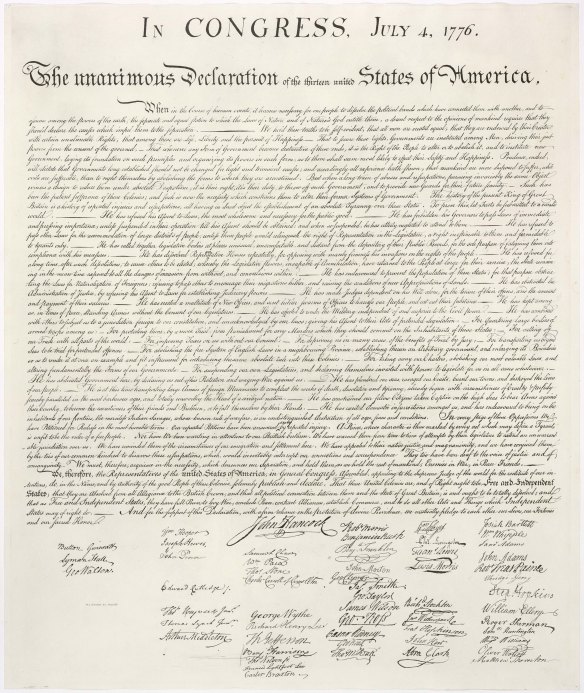
Declaration of Independence of the United States of America

Principles for Voting, R. C. Sproul, 27.5 minute MP3, 2012, Associated post, Declaration of Independence courtesy of the National Archives – Charters of Freedom

For your consideration:

Scripture, Christ, Grace, Faith, and Glory to God Alone

Church Reformers, such as Martin Luther, restored gospel preaching to the church in the sixteenth century. A motto for their cause is:

God declares sinners to be righteous because of Christ alone, by grace alone, through faith alone.

At the end of the twentieth century, members of the Alliance of Confessing Evangelicals, composed “The Cambridge Declaration” to reaffirm Reformation truths and refute contemporary errors that have infiltrated the church. The following condensation is adapted from: “The Cambridge Declaration”:

Thesis One: Sola Scriptura [Scripture Alone]

  • We reaffirm the inerrant Scripture to be the sole source of written divine revelation, which alone can bind the conscience. The Bible alone teaches all that is necessary for our salvation from sin and is the standard by which all Christian behavior must be measured.
  • We deny that any creed, council, or individual may bind a Christian’s conscience, that the Holy Spirit speaks independently of or contrary to what is set forth in the Bible, or that personal spiritual experience can ever be a vehicle of revelation.

Thesis Two: Solus Christus [Christ Alone]

  • We reaffirm that our salvation is accomplished by the mediatorial work of the historical Christ alone. His sinless life and substitutionary atonement alone are sufficient for our justification and reconciliation to the Father.
  • We deny that the gospel is preached if Christ’s substitutionary work is not declared and faith in Christ and his work is not solicited.

Thesis Three: Sola Gratia [Grace Alone]

  • We reaffirm that in salvation we are rescued from God’s wrath by his grace alone. It is the supernatural work of the Holy Spirit that brings us to Christ by releasing us from our bondage to sin and raising us from spiritual death to spiritual life.
  • We deny that salvation is in any sense a human work. Human methods, techniques or strategies by themselves cannot accomplish this transformation. Faith is not produced by our unregenerated human nature.

Thesis Four: Sola Fide [Faith Alone]

  • We reaffirm that justification is by grace alone through faith alone because of Christ alone. In justification Christ’s righteousness is imputed to us as the only possible satisfaction of God’s perfect justice.
  • We deny that justification rests on any merit to be found in us, or upon the grounds of an infusion of Christ’s righteousness in us, or that an institution claiming to be a church that denies or condemns sola fide can be recognized as a legitimate church.

Thesis Five: Soli Deo Gloria [Glory to God Alone]

  • We reaffirm that because salvation is of God and has been accomplished by God, it is for God’s glory and that we must glorify him always. We must live our entire lives before the face of God, under the authority of God and for his glory alone.
  • We deny that we can properly glorify God if our worship is confused with entertainment, if we neglect either Law or Gospel in our preaching, or if self-improvement, self-esteem, or self-fulfillment are allowed to become alternatives to the gospel.

The website, Reformation Theology, posted a summary explanation of the five solas from: Whatever Happened to the Gospel of Grace? by James Montgomery Boice, (Wheaton, Ill.: Crossway, 2001), We excerpt their summary here:

Scripture alone. When the Reformers used the words sola Scriptura they were expressing their concern for the Bible’s authority, and what they meant is that the Bible alone is our ultimate authority, not the pope, not the church, not the traditions of the church or church councils, still less personal intimations or subjective feelings, but Scripture only…If any…authorities depart from Bible teaching, they are to be judged by the Bible and rejected.

Christ alone. …The medieval church…added many human achievements to Christ’s work, so that it was no longer possible to say that salvation was entirely by Christ and his atonement…The Reformation motto solus Christus was formed to repudiate this error. It affirmed that salvation has been accomplished once for all by the mediatorial work of the historical Jesus Christ alone. His sinless life and substitutionary atonement alone are sufficient for our justification [i.e., being declared righteous]…

Grace alone. …God owes us nothing except just punishment for our many and very willful sins. Therefore, if he does save sinners, which he does in the case of some but not all, it is only because it pleases him to do it…By insisting on grace [i.e., unmerited favor] alone, the Reformers were denying that human methods, techniques, or strategies in themselves could ever bring anyone to faith. It is grace alone expressed through the supernatural work of the Holy Spirit that brings us to Christ, releasing us from our bondage to sin and raising us from death to spiritual life.

Faith alone. …Justification by faith alone [is] the article by which the church stands or falls, according to Martin Luther. The Reformers called justification by faith Christianity’s material principle, because it involves the very matter or substance of what a person must understand and believe to be saved…We may state the full doctrine as: Justification is the act of God by which he declares sinners to be righteous because of Christ alone, by grace alone, through faith alone.

Glory to God alone. Each of the great solas is summed up in the fifth Reformation motto: soli Deo gloria, meaning to God alone be the glory. It is what the apostle Paul expressed in Romans 11:36…It is because all things [truly] are from God, and to God, that we say, to God alone be the glory.

As Martin Luther yearned to understand the concept of the Righteousness of God, which is woven throughout the Book of Romans, God declared Luther, a sinner, to be righteous because of Christ alone, by grace alone, through faith alone.

Please consider Luther’s example and follow Christ.

The Five Solas of Reformation (Steven Lawson), YouTube, Feb 28, 2014, GoodTreeMinistries

What Shall I Do to be Saved?

Where were you when that dumpster exploded on Saturday, the 17th of September, 2016, at about 8:30 PM, between 6th and 7th Avenues on 23rd Street in Manhattan? Witnesses reported an event that shook buildings around the epicenter. Windows were blown out, and those on the street were injured. It didn’t look like terrorism initially (it was,) but the neighborhood was shaken up.

Something similar happened in first century Philippi, in Eastern Macedonia and Thrace, Greece. This time it was an earthquake that shook up the neighborhood. Doors to cells in the local prison were opened, and the jailer, no doubt shaken from sleep, supposed his life was forfeit because his charges had escaped. One of the prisoners, the Apostle Paul, called to the jailer not to harm himself; they were all still there. The jailer, trembling with fear, rushed to Paul and his companion, Silas, and:

…He brought them out and said, “Sirs, what must I do to be saved?” Acts 16:30 English Standard Version (ESV)

Paul and Silas “spoke the word” to the jailer and his household. As a result, he and his household all believed in God. John Calvin comments on this verse here.

This same Apostle Paul concisely addressed the nature of this belief:

…If you confess with your mouth that Jesus is Lord and believe in your heart that God raised him from the dead, you will be saved. For with the heart one believes and is justified, and with the mouth one confesses and is saved. Romans 10:9-10 (ESV)

But, how are we to believe this? Is it by strength of will or a leap into the dark? Stepping back a bit, Calvin says we must first have faith to believe. What, then, is the nature of this faith? To this, the author of the letter to the Hebrews says:

…Without faith it is impossible to please him, for whoever would draw near to God must believe that he exists and that he rewards those who seek him. Hebrews 11:6 (ESV)

Calvin explains the second clause of this verse this way:

…We ought to be fully persuaded that God is not sought in vain; and this persuasion includes the hope of salvation and eternal life.

And, it behooves us to recognize that God freely grants us this faith by His unmerited favor (i.e., grace) so that we might believe in Him:

For by grace you have been saved through faith. And this is not your own doing; it is the gift of God, not a result of works, so that no one may boast. Ephesians 2:8-9 (ESV)

Probing further, this belief was encapsulated in the Apostle’s Creed (as early as 180 AD):

  1. I believe in God the Father, Almighty, Maker of heaven and earth:
  2. And in Jesus Christ, his only begotten Son, our Lord:
  3. Who was conceived by the Holy Ghost, born of the Virgin Mary:
  4. Suffered under Pontius Pilate; was crucified, dead and buried: He descended into hell:
  5. The third day he rose again from the dead:
  6. He ascended into heaven, and sits at the right hand of God the Father Almighty:
  7. From thence he shall come to judge the quick and the dead:
  8. I believe in the Holy Ghost:
  9. I believe in the holy catholic church: the communion of saints:
  10. The forgiveness of sins:
  11. The resurrection of the body:
  12. And the life everlasting. Amen.

After controversies over God’s nature, a creedal statement, attributed to Athanasius of Alexandria and rooted in Augustine’s On the Trinity (415 AD), was formulated that encompassed right belief on the matter. The gist of the Athanasian creed is:

  • Whosoever will be saved, before all things it is necessary that he hold the catholic [i.e., all-embracing or universal] faith;
  • And the catholic faith is this: That we worship one God in Trinity, and Trinity in Unity;
  • Furthermore, it is necessary to everlasting salvation that he also believe rightly the incarnation of our Lord Jesus Christ.

The Nicene creed (381 AD) appears to combine significant elements of the prior two creeds:

I believe in one God, the Father Almighty, Maker of heaven and earth, and of all things visible and invisible.

And in one Lord Jesus Christ, the only-begotten Son of God, begotten of the Father before all worlds; God of God, Light of Light, very God of very God; begotten, not made, being of one substance with the Father, by whom all things were made.

Who, for us men for our salvation, came down from heaven, and was incarnate by the Holy Spirit of the virgin Mary, and was made man; and was crucified also for us under Pontius Pilate; He suffered and was buried; and the third day He rose again, according to the Scriptures; and ascended into heaven, and sits on the right hand of the Father; and He shall come again, with glory, to judge the quick and the dead; whose kingdom shall have no end.

And I believe in the Holy Ghost, the Lord and Giver of Life; who proceeds from the Father [and the Son]; who with the Father and the Son together is worshipped and glorified; who spoke by the prophets.

And I believe one holy catholic and apostolic Church. I acknowledge one baptism for the remission of sins; and I look for the resurrection of the dead, and the life of the world to come. Amen

These and other historical creeds have been systematized in the Westminster Confession of Faith. Many scripture truths are condensed in the Westminster Larger and Shorter Catechisms.

I heartily encourage that you study these Westminster documents as you diligently read the Scriptures which, as the Apostle James admonishes, are able to save your soul.

So, if you have believed in His name; be certain that it has been granted to you and:

…If anyone is in Christ, he is a new creation. The old has passed away; behold, the new has come. 2 Corinthians 5:17 (ESV)

Now, we embark together to follow our Savior.

Stephen Nichols: East of Eden: Our Need for a Savior, Reformation Bible College

Sabbath for Man

The Lord Jesus Christ opposed Israel’s religious rulers over legalistic practices that they thought commended them to God and kept them in power. These rulers had condemned His disciples for picking and eating grain on the Sabbath. Near the end of this confrontation, He said:

…If you had known what this means, ‘I desire mercy, and not sacrifice,’ you would not have condemned the guiltless. Matthew 12:7 English Standard Version (ESV)

And in a separate report of the event:

…He said to them, “The Sabbath was made for man, not man for the Sabbath. So the Son of Man is lord even of the Sabbath.” Mark 2:27-28 (ESV)

The Gospels go on to describe how the Lord healed a man on the Sabbath. Rather than repent and believe in God, Israel’s rulers viewed these presumed violations as a pretext to kill the Savior.

The Reformation leader, John Calvin, had insight into the texts:

But if you knew …Christ conveys an indirect reproof to the [religious rulers] for not considering why ceremonies were appointed, and to what object they are directed. …God declares…that he sets a higher value on mercy than on sacrifice, employing the word mercy…for [services] of kindness [and] sacrifices [as] the outward service of the Law…

…Though piety is justly reckoned to be as much superior to charity as God is higher than men, yet believers, by practicing justice towards each other, prove that their service [for] God is sincere. It is not without reason that this subject is brought [to] the notice of hypocrites, who imitate piety by outward signs, and yet pervert it by confining their laborious efforts to the carnal worship alone…

Those trying to trap and kill the Lord and thereby save themselves and their power missed His offer of mercy. They missed that:

The Sabbath was made for man. …Those persons judge amiss who turn [the Sabbath into] man’s destruction…which God appointed for his benefit. …Is not this a foolish attempt to overturn the purpose of God, when they demand to the injury of men that observation of the Sabbath which he intended to be advantageous?

But they are mistaken, I think, who suppose that in this passage the Sabbath is entirely abolished; for Christ simply informs us what is the proper use of it. Though he asserted, a little before, that he is Lord of the Sabbath, yet the full time for its abolition was not yet come, because the veil of the temple was not yet rent, (Matthew 27:51.)

Calvin then analyses the sanction with which Christ acted:

For the Son of man is Lord even of the Sabbath. …He declares that he has received authority to exempt his followers from the necessity of observing the Sabbath. The Son of man, (he says,) in the exercise of his authority, can relax the Sabbath in the same manner as other legal ceremonies. And certainly out of Christ the bondage of the Law is wretched, from which he alone delivers those on whom he bestows the free Spirit of adoption, (Romans 8:15.)

The rulers meant to sacrifice the Lord of Sabbath in order to keep their lives; Christ meant mercy in giving up His.

***

Lest we be carried away with the thought that Calvin advocated doing away with Sabbath observance, Calvin sums up his understanding of the Sabbath from the scriptures in his Institutes of the Christian Religion:

…First, that during our whole lives we may aim at a constant rest from our own works, in order that the Lord may work in us by his Spirit; secondly that every individual, as he has opportunity, may diligently exercise himself in private, in pious meditation on the works of God, and, at the same time, that all may observe the legitimate order appointed by the Church, for the hearing of the word, the administration of the sacraments, and public prayer: And, thirdly, that we may avoid oppressing those who are subject to us.

And contemporary theologian R. C. Sproul continues the debate on the topic of Sabbath keeping as do others here, here, here, and here. In any case, we would do well to strictly adhere to that severe admonition:

Whatever you do, in word or deed, do everything in the name of the Lord Jesus, giving thanks to God the Father through him. Colossians 3:17 (ESV)

Jesus As Lord of the Sabbath – A sermon from Dr. R.C. Sproul

And

Jesus Is Lord of the Sabbath – A sermon from Dr. R.C. Sproul

On the Surface – Part III

This is the third post on the topic of outward appearances versus heart attitudes. Our first post reviewed Jonathan Edward’s thoughts on wheat and tares in the church. A second post explored Abel’s obedience and Cain’s disobedience to God. This post examines our relationship to God the Father. The apostle Peter warns us:

If you call on him as Father who judges impartially according to each one’s deeds, conduct yourselves with fear throughout the time of your exile. 1 Peter 1:17 English Standard version (ESV)

Calvin comments:

And if you call on the Father …From the character of the Father himself, [the apostle Peter] shows what sort of obedience ought to be rendered. [God] judges, he says, without looking on the person, that is, no outward mask is of any account with him, as the case is with men, but he sees the heart, (1 Samuel 16:7) and his eyes look on faithfulness. (Jeremiah 5:3) This also is what Paul means when he says that God’s judgment is according to truth, (Romans 2:2) for he there inveighs against hypocrites, who think that they deceive God by a vain pretense.

The meaning is, that we by no means discharge our duty towards God, when we obey him only in appearance; for he is not a mortal man, whom the outward appearance pleases, but he reads what we are inwardly in our hearts. He not only prescribes laws for our feet and hands, but he also requires what is just and right as to the mind and spirit.

A person might hide their defection from all others, but not from Him. Calvin then shows how Peter presses home the lesson:

According to every man’s work He does not refer to merit or to reward; for Peter does not speak here of the merits of works, nor of the cause of salvation, but he only reminds us, that there will be no looking to the person before the tribunal of God, but that what will be regarded will be the real sincerity of the heart…

The fear that is mentioned, stands opposed to heedless security, such as is wont to creep in, when there is a hope of deceiving with impunity. For, as God’s eyes are such that they penetrate into the hidden recesses of the heart, we ought to walk with him carefully and not negligently.

He calls the present life a sojourning [i.e., time of your exile], not in the sense in which he called the Jews to whom he was writing sojourners, at the beginning of the Epistle, but because all the godly are in this world pilgrims. (Hebrews 11:13,38)

This world is not our home. We all travel to one destination or the other. Therefore, seek the Lord while he may be found.

R.C. Sproul – Fear and Trembling – Fear and Trembling, JvDaP