On the Surface – Part II

Earlier this year, when discussing the topic of envy, we considered the brothers, Cain and Abel. Let’s see what else we can learn from both their lives and Abel’s death:

And Abel also brought of the firstborn of his flock and of their fat portions. And the Lord had regard for Abel and his offering. Genesis 4:4 English Standard Version (ESV)

John Calvin analyzes this situation:

And the Lord had respect unto Abel, etc. …Notice the order Moses [observes]; for he does not simply state that the worship which Abel had paid was pleasing to God, but he begins with the person of the offeror; by which he signifies, that God will regard no works with favor except those the doer of which is already previously accepted and approved by him.

And no wonder; for man sees things which are apparent, but God looks into the heart, (1 Samuel 16:7) therefore, he estimates works no otherwise than as they proceed from the fountain of the heart.

Whence also it [follows], that he not only rejects but abhors the sacrifices of the wicked, however splendid they may appear in the eyes of men. For if he, who is polluted in his soul, by his mere touch contaminates, with his own impurities, things otherwise pure and clean, how can that but be impure which proceeds from himself?

…Now seeing that in another place, the Spirit testifies, by the mouth of Peter, that ‘hearts are purified by faith,’ (Acts 15:9) and seeing that the purity of the holy patriarchs was of the very same kind, the apostle does not in vain infer, that the offering of Abel was, by faith, more excellent than that of Cain.

Calvin then draws two conclusions with consequences. The first conclusion and consequence are:

Therefore, in the first place, we must hold, that all works done before faith, whatever splendor of righteousness may appear in them, were nothing but mere sins, being defiled from their roots, and were offensive to the Lord, whom nothing can please without inward purity of heart.

I wish they who imagine that men, by their own motion of freewill, are rendered [fit] to receive the grace of God, would reflect on this. Certainly, no controversy would then remain on the question, whether God justifies men gratuitously, and that by faith? For this must be received as a settled point, that, in the judgment of God, no respect is had to works until man is received into [his] favor.

And the second conclusion is harder still:

…Since the whole human race is hateful to God, there is no other way of reconciliation to divine favor than through faith. Moreover, since faith is a gratuitous gift of God, and a special illumination of the Spirit, then it is easy to infer, that we are [enabled to life] by his mere grace, just as if he had raised us from the dead.

In which sense also Peter says, that it is God who purifies the hearts by faith. For there would be no agreement of the fact with the statement, unless God had so formed faith in the hearts of men that it might be truly deemed his gift…

Calvin’s observations remind us of the apostle Paul’s words in his letter to the Ephesian church:

For by grace you have been saved through faith. And this is not your own doing; it is the gift of God, not a result of works, so that no one may boast. For we are his workmanship, created in Christ Jesus for good works, which God prepared beforehand, that we should walk in them. Ephesians 2:8-10 (ESV)

By faith Abel offered to God a more acceptable sacrifice and through his faith, though he died, he still speaks. Receive from the Lord Jesus Christ a new heart. May He renew a right spirit within you.

Andrew MurrayFaith – Abel – The Sacrifice Of Faith – The Holiest of All (99 of 130), Christian Praise and Worship in Songs, Sermons, and Audio Books

On the Surface – Part I

The Lord spoke to His bondservant Samuel, asking him how long he would grieve for Israel’s first king, now that He had rejected him? God commanded His prophet to anoint a new king from the house of Jesse. As he was considering each of Jesse’s sons in turn, God said to Samuel:

“Do not look on his appearance or on the height of his stature, because I have rejected him. For the Lord sees not as man sees: man looks on the outward appearance, but the Lord looks on the heart.” 1 Samuel 16:7 English Standard Version (ESV)

The Puritan Preacher and Theologian, Jonathan Edwards, famous for sermons such as: “Sinners in the Hands of an Angry God” and “The Thorns that Choke the Word,” wrote about this passage:

The true saints have not such a spirit of discerning that they can…determine [with certainty] who are godly, and who are not. For though they know experimentally what true religion is, in the internal exercises of it; yet these are what they can neither feel, nor see, in the heart of another. There is nothing in others, that comes within their view, but outward manifestations and appearances; but the Scripture plainly intimates, that this way of judging what is in men by outward appearances, is at best uncertain, and liable to deceit…

In his commentary, Edwards counsels us to treat all in the visible church charitably:

When there are many probable appearances of piety in others, it is the duty of the saints to receive them cordially into their charity, and to love them and rejoice in them, as their brethren in Christ Jesus. But yet the best of men may be, when the appearances seem to them exceeding fair and bright, as entirely to gain their charity, and conquer their hearts.

Yet, we will see some, who first profess and evidence godliness, fall away from the church:

It has been common thing in the church of God, for such bright professors, that are received as eminent saints, among the saints, to fall away and come to nothing…There may be all these things [i.e., evidences of piety], and yet there be nothing more than the common influences of the Spirit of God, joined with the delusions of Satan, and the wicked and deceitful heart…

He then reminds us of the warning Christ delivered using wheat and tares for His illustration:

In the parable of the wheat and tares, it is said, Matt. 13:26, “When the blade was sprung up, and brought forth fruit, then appeared the tares also.” As though the tares were not discerned, nor distinguishable from the wheat, until then, as Mr. Flavel observes, who mentions it as an observation of Jerome’s, that “wheat and tares are so much alike, until the blade of the wheat comes to bring forth the ear, that it is next to impossible to distinguish them.”

And then Mr. Flavel adds, “How difficult so ever it be to discern the difference between wheat and tares; yet doubtless the eye of sense can much easier discriminate them, than the quickest and piercing eye of man can discern the difference between special and common grace.

For all saving graces in the saints, have their counterfeits in hypocrites; there are similar works in those, which a spiritual and very judicious eye may easily mistake for the saving and genuine effects of a sanctifying spirit.”

Finally, Edwards drives home the message again:

This notion, of certainly discerning another’s state [by surface appearances] is not only not founded on reason or Scripture, but it is anti-scriptural, it is against the rules of Scripture; which say not a word of any such way of judging the state of others as this, but direct us to judge chiefly by the fruits that are seen in them.

***

Having been a member of several churches, some of which have disbanded, I can say from experience that it belongs to God alone to determine the state of other’s souls:

Therefore, do not pronounce judgment before the time, before the Lord comes, who will bring to light the things now hidden in darkness and will disclose the purposes of the heart. Then each one will receive his commendation from God. 1 Corinthians 4:5 (ESV)

And it is also certain: “you will recognize them by their fruit,” and those fruit of the spirit to look for are: love, joy, peace, patience, kindness, goodness, faithfulness, gentleness, self-control. As the Apostle Peter reminded us:

If these qualities are yours and are increasing, they keep you from being ineffective or unfruitful in the knowledge of our Lord Jesus Christ. 2 Peter 1:8 (ESV)

Wheat_and_tares_0708_(513649608)

Wheat and Tares, Nazareth Village, James Emery, 1 May 2007, used under the Creative Commons Attribution 2.0 Generic license

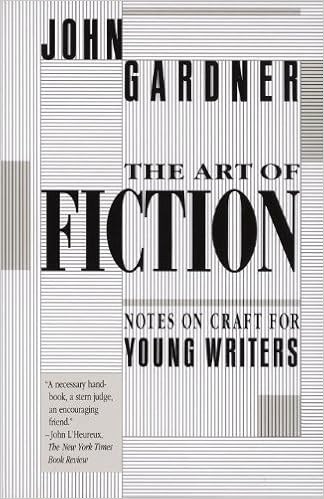
The Art of Fiction – A Review

The book: The Art of Fiction: Notes on Craft for Young Writers by John Gardner is not prescriptive in the same way as is Jon Franklin’s book: Writing for Story. Gardner surveys contemporary literature in general, pointing out its structure, methods, and morality. Morality in literature, for Gardner, is whether a story portrays what is real and eternally true about human life, as opposed to what is false or philosophically trendy.

His New York Times obituary quoted him writing:

“The value of great fiction is not just that it entertains or distracts us from our troubles, not just that it broadens our knowledge of people and places, but also that it helps us know what we believe, reinforces those qualities that are noblest in in us, leads us to feel uneasy about our failures and limitations.”

This quote is from The Art of Fiction. Though he won the 1976 National Book Critic’s Circle Award for October Light, he deeply offended the literary powers-that-be at the time, especially with his book: On Moral Fiction.

In The Art of Fiction, Gardner describes — the work of fiction:

In any piece of fiction, the writer’s first job is to convince the reader that the events he recounts really happened…This kind of documentation, moment by moment authenticating detail, is the mainstay not only of realistic fiction but of all fiction…It’s physical detail that pulls us into the story, makes us believe…The importance of physical detail is that it creates for us a kind of dream, a rich and vivid play in the mind.

Its value:

The value of great fiction, is not just that it entertains us or distracts us from our troubles, not just that it broadens our knowledge of people and places, but also that it helps us to know what we believe, reinforces those qualities that are noblest in us, leads us to feel uneasy about our faults and limitations.

In great fiction, we not only respond to imaginary things—sights, sounds, smells—as though they were real, we respond to fictional problems as though they were real: We sympathize, think, and judge…All fiction treats, directly or indirectly, the same thing: our love for people and the world, our aspirations and fears.

The overall method to create it:

The writer works out plot in one of three ways: by borrowing some traditional plot or an action from real life (the method of the Greek tragedians, Shakespeare, Dostoevsky, and many other writers, ancient and modern); by working his way back from his story’s climax; or by groping his way forward from an initial situation.

It’s by the whole process of first planning the fiction and then writing it—elaborating characters and details of setting, finding the style that seems appropriate to the feeling, discovering unanticipated requirements of the plot—that the writer finds out and communicates the story’s significance, intuited at the start.

Pitfalls in its creation:

The most obvious forms of clumsiness, really failures in the basic skills, include such mistakes as inappropriate or excessive use of the passive voice, inappropriate use of introductory phrases containing infinite verbs [e.g., Slapping him silly, she proceeded to…] , shifts in diction level or the regular use of distracting diction, lack of sentence variety, lack of sentence focus, faulty rhythm, accidental rhyme, needless explanation, and careless shifts in psychic distance [i.e., the reader’s nearness to the character].

And, finally, the real work that the fiction writer does:

The true writer has a great advantage over most other people: He knows the great tradition of literature, which has always been the cutting edge of morality, religion, and politics, to say nothing of social reform.

To write with taste, in the highest sense, is to write with the assumption that one out of a hundred people who read one’s work may be dying, or have some loved one dying; to write so that no one commits suicide, no one despairs; to write, as Shakespeare wrote, so that people understand, sympathize, see the universality of pain, and feel strengthened, if not directly encouraged to live on.

John Gardner describes, in far more detail, these things, the state of fiction writing up to the early nineteen eighties, and his thoughts on it all in his book. A worthy read, especially after studying a process for creating works of fiction. The Art of Fiction is highly motivational and recommended.

The Art of Fiction - Gardner

The Art of Fiction: Notes on Craft for Young Writers, John Gardner

Let Us Reason Together

Last week, we discussed story writing in a review of the book: Writing for Story: Craft Secrets of Dramatic Nonfiction by Jon Franklin. There, we covered the topic of narrative transition. One transition technique is stream of consciousness that joins two disparate ideas that have no clear logical connection by using an emotional one instead. What came to mind was Isaiah’s pronouncement of the Lord’s grace and mercy:

“Come now, let us reason together, says the Lord:

though your sins are like scarlet,

    they shall be as white as snow;

though they are red like crimson,

    they shall become like wool.

Isaiah 1:18 English Standard Version (ESV)

How a declaration of Israel’s defection from obeying the Lord and His unmerited offer to wipe away those sins is connected by logical reasoning escapes me. Clearly, it is meant to reach the heart. Let’s see what Calvin offers on this verse:

…The charges which he makes against them [i.e., disobedient Israel] are not brought forward or maintained without strong necessity. For hypocrites are [inclined] to find fault with God, as if he were too severe, and could not be at all appeased.

They go still farther, and discover this excuse for their obstinacy, that it is in vain for them to attempt to return to a state of favor with God. If every other expedient fail, still they fly to this, that it is not proper to make such rigid demands on them, and that even the very best of men have something that needs to be forgiven…

Hence we obtain a declaration in the highest degree consolatory, that God does not contend with us as if he wished to pursue our offenses to the utmost. For if we sincerely turn to him, he will immediately return to favor with us, and will blot out all remembrance of our sins, and will not demand an account of them.

For he is not like men who, even for a slight and inconsiderable offense, often refuse to be reconciled. Nay, so far is he from giving us reason to complain of his excessive severity, that he is ready to cleanse us, and to make us as white as snow.

He is satisfied with cleanness of heart, and if, notwithstanding of this cleanness of heart, there be any offense, he forgives it, and acquits those who have provoked him.

Amazingly, we, in this Post-Christian nation, are offered the same choice:

But what does it say? “The word is near you, in your mouth and in your heart” (that is, the word of faith that we proclaim); because, if you confess with your mouth that Jesus is Lord and believe in your heart that God raised him from the dead, you will be saved. For with the heart one believes and is justified, and with the mouth one confesses and is saved. Romans 10:8-10 (ESV)

I urge you, listen to your heart and receive His gracious gift of mercy.

R.C. Sproul: Post-Christian Christianity, Ligonier Ministries

Writing for Story – A Review

Jon Franklin, two-time Pulitzer prize winner, wrote: Writing for Story – Craft Secrets of Dramatic Nonfiction to teach authors his methods. Franklin illustrates his technique with annotated versions of his two essays: “Mrs. Kelly’s Monster” and “The Ballad of Old Man Peters,” the first of which won the 1979 Pulitzer prize. The goal of his technique is to impart knowledge and truth to readers. To paraphrase Franklin:

The secret to professional writing is a fusion of learned craftsmanship with artistic vision born of experience. The successful writer is the one who grasps the separate parts of their story and sees how those components work together to produce a compelling and dramatic tale.

Franklin’s writing process consists of three parts: outlining, roughing in the draft, and polishing. Outlining concerns the conceptual associations between the character and action which, for a short story, consists of a time sequence of five major focus narratives: the beginning complication focus, three development focuses which constitute the story body, and the ending resolution focus. Roughing in the draft (i.e., the structural level) involves the internal makeup of major focuses: sequence, emphasis, pacing, and orientation of action. Polishing entails good grammar, word usage, imagery, and principles of sentence and paragraph structure. More details of this process, abstracted from Franklin’s book, are described next. First, he describes the object of his process: the story.

Content of a Story

A story consists of a chronological action sequence that a captivating character undertakes and/or endures to solve a complication that they face. The flow from the complication’s introduction, through the action events, to the resolution constitutes a fiction story’s plot or a non-fiction story’s structure.

The resolution results, often, from a character’s flash of insight as to how to solve their problem rather than directly from the action. A story is said “to work” when a real character struggles diligently to solve a significant problem that confronts them, overcomes the problem, and becomes a changed character as a result.

Story Anatomy

Active images, built on action verbs, are the focuses of action. They are the smallest possible unit of story. Collections of these units form minor focuses. These join via simple transitions to form larger focuses glued together by increasingly complex transitions. Transitions guide the reader through changing times, places, moods, subjects, and characters. These larger focuses combine to form several major focuses that compose the principal subunits of stories.

There are typically five principal subunits in a short story and more in longer form copy. Each subunit has a specific role: the first is the complicating focus. The complicating focus consists of a series of subfocuses that grab the reader’s attention, introduce the characters, and reveal the complication that the story depicts. As examples, jokes may consist of a single image that doubles as a major focus whereas a psychological novel may consist of hierarchical image aggregations at multiple levels.

The next three development focuses (i.e., the story body) describe the actions that the character takes to resolve the complication. These are longer than the first or last focuses but easier to write. The first developmental focus enters deeper into the story and the third (last) developmental focus carries the story to the brink of the resolution.

The climax of the last developmental focus (at its end) is where the character has a “moment of insight” when they realize what they must do to solve the problem. Screenwriters call this flash of realization the second plot point. The complication is the first plot point.

The resolving focus which ends the story can be long or short but reads very quickly. This is possible because the necessary background has been laid and the character has made choices and taken actions to get them to this point. All that remains is the character’s psychological or physical action to clearly solve the problem.

Sagas

The saga is a variation on the five focus short story. Sagas consist of a major complication and resolution; but, instead of having three developmental focuses it has five, more or less, interlinked substories (or episodes) with their own complications and resolutions. These episodes interlink by presenting the complication (or cliffhanger) of the next substory either before or after the resolution of the current substory. This preserves and reinforces the tension of the story as a whole.

The Writing Process

The practicing writer is concerned with three hierarchical processes: outlining, roughing in the draft, and polishing.

Outlining

Outlining is based on complications and resolutions. There is one statement for each major focus (e.g., typically five for a short story) and every subfocus. Use a subject, active verb, and object (i.e., noun-verb-noun form) for outline statements to reduce the story to its essentials. In storytelling, the dramatic action that makes your point comes at the end of each section where the climax belongs. So each outline statement represents the focus ending.

The most dramatic aspect of any story is growth and change in the main character. The outline centers on this growth and change so that it will emerge as the story’s backbone. The outline presents the story’s drama via action that proceeds from complication to resolution.

The main advantage of constructing the outline first is in discovering structural flaws before any text is written. Structural problems can be simply resolved without wasted effort and emotional commitment. The outline is the psychological roadmap of your story and brings out eternal truths.

Rough Draft

Expanding the outline’s focus statements into rough copy marks the halfway point in story creation. Most of the creative work of the story is complete at the start of this stage. At the structural level, word choice is important only at dramatic high points.

This is where the writer constructs transitions, scene-settings, action sequences, and other products that enable the reader to slide through the story. Phrase order and sentence rhythms are not critical when roughing in the draft narrative.

Three Types of Narrative

There are three major types of narrative: transitional, preparatory, and climatic. Transitional narrative switches scenes and keeps the reader oriented. Preparatory narrative comes next and sets the reader up to understand the ensuing dramatic scene. Climactic narrative evokes the reader’s emotions via detailed action descriptions. After the climactic narrative ends, transitional narrative moves the reader to the next time and place so preparatory narrative can hasten them to the next climactic scene.

Transitional Narrative

Transitional narrative enables the reader to negotiate a story’s twists, turns, and changes without getting disoriented or lost. Good narrative makes the reader forget their reality and step into your character’s world. It establishes the time, place, character, subject, and mood at the story’s start and maintains “threads” of continuity through focus changes to the story’s end.

Three Transition Types

There are many types of transitions. Three major ones are: the break, the flashback/flash-forward, and the stream-of-consciousness appeal to emotion. The break transition breaks all five threads with typographic symbols, jars the reader, and is therefore weak. The cinematic equivalent is a fadeout or commercial break.

A flashback, if necessary, is best located immediately after the complication. It is used only once in short or medium length stories. The flashback’s danger is that it forces the reader to break with their experience of time flow, disrupting several threads and weakening others. It is a point of confusion for the reader.

The last transition method is psychological: a stream-of-consciousness emotional connection (e.g., rhyming, common movement, etc.) The human mind is easily directed by exploiting its emotional engine. Psychological transition is a very useful tool to associate images not usually brought together in order to display enduring truths.

Preparatory Narrative

Preparatory narrative follows a transitional narrative to prepare the reader intellectually and emotionally for a dramatic highpoint. An example of preparatory narrative is strong scene-building and character-strengthening text, preferably incorporating action, to help the reader understand and enter into the story.

Foreshadowing

Foreshadowing is a powerful technique used in preparatory narrative. It unobtrusively inserts details early in a story that enable later dramatic scenes to be told without explanation of background details which would distract the reader from the ongoing drama.

Climactic Narrative

Climactic narrative expresses a story’s dramatic action and accounts for almost all of a story’s emotional impact. Climactic narrative focusses tightly on events and supporting details. It never tells how a character feels or what he or she does; it shows what happens, what the character does in response, and what happens next. The proverb: “actions speak louder than words,” reflects this understanding.

In climactic narrative, you see generalizations described with detailed action that would be explicitly stated in preparatory and transitional narrative.

Creating the Rough Draft

Start at the ending of a story in order to know what to foreshadow. Write the end of last developmental focus where your character’s point of insight occurs; then write the transitional and preparatory narratives that set up the first scene of the resolution. Finally, write the rest of the resolution scenes to the end.

Next, write the story complication (i.e., the first plot point); introduce your characters, set up the situation, and bring them face to face with the problem. Capture it in as few pages as possible. Once you have the beginning, write successive developmental focuses until you’ve completed your (short) story.

Whenever your story seems to be going wrong, stop, go back to the outline, and read it carefully. Determine why you deviated and modify the story or outline accordingly. This process of refining the story per the outline and outline per the story is called calibration. Once the story and outline match (and you like the story) stop.

Pacing and Intensity

Pacing consists of transitions leading to smooth preparatory narrative cascading into dramatic scenes. Pace is determined by how rapidly the narrative moves from climactic point to climactic point within a major focus.

Intensity is built by closely focusing on the characters and surroundings. The interplay between pace and intensity is complex and can produce a variety of effects.

Cutting Dead Wood

A critical part of the rough draft process involves throwing away words. Remove unnecessary text, no matter how well written and, therefore, distracting, if it doesn’t fulfill Chekov’s law (i.e., a shotgun described as hanging over the mantel must be fired by story’s end.)

Unless you are willing to redefine the story to incorporate the distraction and remove aspects of the original story, the dead wood must be removed.

At this point, the rough draft is finished. Take a few days off to let your subconscious process what you’ve written before conducting a read through.

The Read Through

The read through should ask questions that a reader would ask: who is the character, what happens to them, what does he or she learn from the experience? What does the story make you feel?

Look for errors: is a transition too long, is a scene shortchanged, does a flashback come too quickly after the complication because the transition is too short, etc. After you make any necessary structural corrections then you can retire the outline.

Polishing

Polishing converts rough copy into clear, active, and integrated narrative that moves the story along without intruding into it.

The rules of polish are straightforward and not abstract. They are, however, one-part: logic, prejudice, authority, and tradition. The three rules of polish are: do it consciously, read and apply Elements of Style by Strunk and White, and read good writing voraciously.

Polish – Procedures

Polishing procedures, as opposed to rules, are similar to those for outlining and rough composition. Polish your story without regard to sequence, concentrating on the most critical scenes first and working from focus to focus in the order of their importance.

Once a story is completed, the lead or narrative hook is easier to rewrite. The lead helps the reader transition from their world to that of the character by establishing (or starting to establish) the story’s five threads.

Polish – Imagery and Sequencing

Polishing principles divide into image clarification and image sequencing. To achieve image clarity, make proper word choices and use strong verbs which cohere the words around it in only one way. Sequencing organizes the flow of paragraphs, images, and words to unfold the story image-by-image in a way that best accomplishes the story’s structural (i.e., dramatic) goals.

Complex sentences laden with prepositions and qualifiers alert the writer to inadequate or inessential images. If the copy seems confused, reorder the images as necessary, and rewrite them into new sentences. If the order of two images isn’t important (i.e., one doesn’t build on the other), one of them needs to be discarded.

Rhythm is important in sequencing. A series of long sentences, establishing a slow rhythm, may be broken by a short terse summation thereby adding impact to the conclusion. Rhythms such as blank verse can add psychological effect.

Recap

To sum up the results of Franklin’s process: active images build upon one another to reach an evocative statement at paragraph’s end. The drama drops off through a minor transition, if necessary, and starts rising again in preparatory text. Successive paragraphs rise and fall building towards the climax of a small focus consisting of that focus’s most dramatic images. This focus ends with a statement that summarizes the focus’s drama.

Small focuses transition one to another in sequence. Each one peaks with a dramatic summary statement. These small focuses build toward the major focus resolution where the focus statement is demonstrated. The narrative then passes through a major transition to start the next major focus. At the end of the story, the final few images of the narrative resolve the story’s complication and the story ends.

We heartily recommend Franklin’s method and urge you to read his book yourselves to discover his annotated essay examples and the numerous nuances that we, by necessity, left out.

Writing for Story - Franklin

Writing for Story: Craft Secrets of Dramatic Nonfiction, by Jon Franklin

Two Natures – Distinct Yet United

Last week I reported on “Christ’s Human Nature.” There, the fourth point of John Flavel’s sermon: “Of Christ’s wonderful Person,” on John 1:14, in his book: Fountain of Life Opened Up, caught my attention:

Fourthly, [Christ’s] human nature is so united with the divine, as that each nature still retains its own essential properties distinct… The divine and human are not confounded; but a line of distinction runs betwixt them still in this wonderful person…

If you have the time and patience, I urge you to read his entire sermon. He offers sound doctrine on Christ’s human nature.

Flavel’s point got me wondering. Was the distinction and union obvious in scripture, would it prove Flavel’s points, and did John Calvin have insight that might help us to understand Christ better? What jumped to mind was the Lord’s struggle-in-prayer in the garden before He was betrayed as recounted in the synoptic gospels of Matthew, Mark, and Luke:

And going a little farther he fell on his face and prayed, saying, “My Father, if it be possible, let this cup pass from me; nevertheless, not as I will, but as you will.” Matthew 26:39 English Standard Version (ESV)

And

And he said, “Abba, Father, all things are possible for you. Remove this cup from me. Yet not what I will, but what you will.” Mark 14:36 (ESV)

And

Saying, “Father, if you are willing, remove this cup from me. Nevertheless, not my will, but yours, be done.” Luke 22:42 (ESV)

Even though the wording is different in the three accounts, in each, He defers to His Father’s will rather than His own. Was this the quintessential example of the distinct natures united?

Calvin addresses many possible questions we (and others) might have when reading Christ’s entreaty of His Father. However, to achieve some semblance of brevity, we’ve assembled those answers that are most relevant to our questions:

My Father, if it be possible. …We must remember…that Christ [did not have] confused emotions, like those to which we are accustomed, to withdraw his mind from pure moderation; but, so far as the pure and innocent nature of man could admit, he was struck with fear and seized with anguish, so that, amidst the violent shocks of temptation, he vacillated—as it were—from one wish to another. This is the reason why, after having prayed to be freed from death, he immediately restrains himself, and, submitting to the authority of the Father, corrects and recalls that wish which had suddenly escaped him…

But yet not as I will, but as thou wilt. …What led him to pray to be delivered from [His own physical] death was the dread of a greater evil. When he saw the wrath of God exhibited to him, as he stood at the tribunal of God charged with the sins of the whole world, he unavoidably shrunk with horror from the deep abyss of death…When Christ was struck with horror at the divine curse, the feeling of the flesh affected him in such a manner, that faith still remained firm and unshaken. For such was the purity of his nature, that he felt, without being wounded by them, those temptations which pierce us with their stings.

…in Christ there was a remarkable example of adaptation between the two wills, the will of God and the will of man, so that they differed from each other without any conflict or opposition…for Christ, as he was God, willed nothing different from the Father; and therefore it follows, that his human soul had affections distinct from the secret purpose of God…Christ was under the necessity of holding his will captive, in order to subject it to the government of God, though it was properly regulated.

The lesson Calvin draws for us based on the various questions we’ve included and omitted is:

…In the present corruption of our nature it is impossible to find ardor of affections accompanied by moderation, such as existed in Christ; but we ought to give such honor to the Son of God, as not to judge of him by what we find in ourselves.

In this light, his application is:

…How carefully ought we to repress the violence of our feelings, which are always inconsiderate, and rash, and full of rebellion? …We owe to God such obedience as to endure patiently that our wishes should not be granted; For the modesty of faith consists in permitting God to appoint differently from what we desire. Above all, when we have no certain and special promise, we ought to abide by this rule, not to ask anything but on the condition that God shall fulfill what he has decreed; which cannot be done, unless we give up our wishes to his disposal.

In his sermon, Flavel gives an excellent explanation of the differences between Christ and ourselves. Calvin drives home the point with how, given His example, we should endure our inevitable trials of faith. May the Lord Jesus Christ grant us obedience in these trials.

Garden of Gethsemane, Mount of Olives, Jerusalem

Garden of Gethsemane, Mount of Olives, Jerusalem, 16 November 2012, by Tango7174, used under Creative Commons Attribution-Share Alike 4.0 International, 3.0 Unported, 2.5 Generic, 2.0 Generic, and 1.0 Generic licenses

Christ’s Human Nature

Sadly, if the scriptures can be twisted, they will be twisted. Folks, one thousand five hundred sixty-five years ago, met to work out a concise statement of the Lord Jesus Christ’s humanity based on the scriptures because several heresies were then circulating that led people astray. Phillip Schaff presents the text in its entirety:

Following the holy Fathers we teach with one voice that the Son [of God] and our Lord Jesus Christ is to be confessed as one and the same [Person], that he is perfect in Godhead and perfect in manhood, very God and very man, of a reasonable soul and [human] body consisting, consubstantial with the Father as touching his Godhead, and consubstantial with us as touching his manhood; made in all things like unto us, sin only excepted; begotten of his Father before the worlds according to his Godhead; but in these last days for us men and for our salvation born [into the world] of the Virgin Mary, the Mother of God according to his manhood.

This one and the same Jesus Christ, the only-begotten Son [of God] must be confessed to be in two natures, unconfusedly, immutably, indivisibly, inseparably [united], and that without the distinction of natures being taken away by such union, but rather the peculiar property of each nature being preserved and being united in one Person and subsistence, not separated or divided into two persons, but one and the same Son and only-begotten, God the Word, our Lord Jesus Christ, as the Prophets of old time have spoken concerning him, and as the Lord Jesus Christ hath taught us, and as the Creed of the Fathers hath delivered to us.

In passing, note that John MacArthur offers some insight to this creedal statement.

Four hundred eighty years ago, John Calvin reflected on such attacks on Christ’s humanity in his Institutes. His proof text was:

And the Word became flesh and dwelt among us, and we have seen his glory, glory as of the only Son from the Father, full of grace and truth.

John 1:14 English Standard Version (ESV)

And a brief excerpt from Calvin’s comments states:

And the [Word] was made flesh. …The plain meaning…is, that the [Word] begotten by God before all ages, and who always dwelt with the Father, was made man [at the incarnation]. On this [point] there are chiefly two things to be observed. [First], that two natures were so united in one Person in Christ, that one and the same Christ is true God and true man. [Second], that the unity of person does not hinder the two natures from remaining distinct, so that his Divinity retains all that is peculiar to itself, and his humanity holds separately whatever belongs to it.

And, therefore, as Satan has made a variety of foolish attempts to overturn sound doctrine by heretics, he has always brought forward one or another of these two errors; either that he was the Son of God and the Son of man in so confused a manner, that neither his Divinity remained entire, nor did he wear the true nature of man; or that he was clothed with flesh, so as to be as it were double, and to have two separate persons.

Sadly, too, Christ’s human nature is being attacked in our time. The Presbyterian clergyman, John Flavel, gave a sermon three hundred forty-five years ago that has bearing on the current attack:

To explicate this mystery more particularly, let it be considered;

First, the human nature was united to the second person [of the Godhead] miraculously and extraordinarily, being supernaturally framed in the womb of the Virgin, by the overshadowing power of the Highest… Luke 1: 34, 35

Secondly, Christ took a complete and perfect human soul and body, with all and every faculty and member pertaining to it. And this was necessary…that thereby he might heal the whole nature of that leprosy of sin, which has seized and infected every member and faculty…

Thirdly, He assumed our nature, as with all its integral parts, so with all its sinless infirmities… [Christ did] not assume our innocent nature, as it was in Adam before the fall…but after sin had…defaced, ruined, and spoiled it… Heb. 2:17, 4:15; Rom. 8:3

Fourthly, [Christ’s] human nature is so united with the divine, as that each nature still retains its own essential properties distinct… The divine and human are not confounded; but a line of distinction runs betwixt them still in this wonderful person…

Fifthly, the union of the two natures in Christ, as an inseparable union; so that from the first moment thereof, there never was, nor to eternity shall be, any separation of them…This hypostatical union remained even [through His death] as entire and firm as ever: for, though his soul and body were divided from each other, yet neither of them from the divine nature…

…And thus you are to form and regulate your conceptions of this great mystery.

Christ’s incarnation is a wonderful truth from the scriptures, repeatedly attacked over the centuries to the present day, that must be defended, upheld, and celebrated.

Stephen Nichols and R.C. Sproul: The Ligonier Statement on Christology, Mar 2, 2016, Ligonier Ministries

In His Presence

The priest Zechariah was burning incense in the temple as part of Israel’s worship of God when an angel appeared to him. The angel gave him good news that his prayers for a child would be answered. However, Zechariah expressed doubt when he said: “How shall I know this?” Another translation renders it: “How can I be sure?” He used his age and that of his wife for an excuse. To this, the angel said:

“I am Gabriel. I stand in the presence of God, and I was sent to speak to you and to bring you this good news. Luke 1:19 English Standard Version (ESV)

Because he disbelieved his words, Gabriel announced that Zechariah would be unable to speak until the child, John, was born.

What was the significance of the angel Gabriel’s remarks? For this, let us consult John Calvin:

I am Gabriel …By these words the angel intimates that it was not his veracity, but that of God who sent him, and whose message he brought, that had been questioned; and so he charges Zacharias with having offered an insult to God…

…’Gabriel’ means the strength, or power, or pre-eminence of God, and this name is given to the angel on our account, to instruct us that we must not ascribe to angels anything of their own, for whatever excellence they possess is from God.

The Greek participle, παρεστηκὼς, (standing,) is in the past tense, but everybody knows that the past tense of such verbs is often taken for the present, and particularly when a continued act is expressed. The word εὐαγγελίσασθαι (to convey glad tidings) aggravates the crime of Zacharias; for he was ungrateful to God, who kindly promised a joyful and desirable event.

So, when we pray to Him, we should not be rash, but believe:

Therefore, I tell you, whatever you ask in prayer, believe that you have received it, and it will be yours. Mark 11:24 (ESV)

“Christmas Story” Countdown – 12 Days till Christmas

Against You Only

The great King of Israel, David, committed adultery with another man’s wife. To hide his sin, he had her husband killed. Problem solved? Not in the least. After the prophet Nathan confronts him with the severity of his deed, David admits to his sin. His full confession is recorded in Psalm 51. The verse that concerns us in this post is:

Against you, you only, have I sinned

    and done what is evil in your sight,

so that you may be justified in your words

    and blameless in your judgment.

Psalm 51:4 English Standard Version (ESV)

Speaking of David’s confession, John Calvin says:

Against You only…I conceive his meaning to be, that though all the world should pardon him, he felt that God was the Judge with whom he had to do, that conscience hailed him to his bar, and that the voice of man could administer no relief to him, however much he might be disposed to forgive, or to excuse, or to flatter. His eyes and his whole soul were directed to God, regardless of what man might think or say concerning him.

…There is every reason to believe that David, in order to prevent his mind from being soothed into a false peace by the flatteries of his court, realized the judgment of God upon his offense, and felt that this was in itself an intolerable burden, even supposing that he should escape all trouble from the hands of his fellow-creatures.

On the import of the second couplet, Calvin says:

So that You may be justified…Any doubt upon the meaning of the words, however, is completely removed by the connection in which they are cited in Paul’s Epistle to the Romans,

“For what if some did not believe? Shall God be unjust? God forbid: yea, let God be true, but every man a liar; as it is written, ‘That thou may be justified in thy sayings, and might overcome when thou art judged.’” — Romans 3:3, 4

Here the words before us are quoted in proof of the doctrine that God’s righteousness is apparent even in the sins of men, and his truth in their falsehood.

To have a clear apprehension of their meaning, it is necessary that we reflect upon the covenant which God had made with David. The salvation of the whole world having been in a certain sense deposited with him by this covenant, the enemies of religion might take occasion to exclaim upon his fall, “Here is the pillar of the Church gone, and what is now to become of the miserable remnant whose hopes rested upon his holiness?”

…Aware that such attempts might be made to impugn the righteousness of God, David takes this opportunity of justifying [God’s righteousness], and charging himself with the whole guilt of the transaction. He declares that God was justified…should he have spoken the sentence of condemnation against him for his sin, as [God] might have done but for his gratuitous mercy.

Of course, the knowledge that our sin offends God most should not excuse us from seeking our brother’s or sister’s forgiveness. However, we should fear all the more, having been forgiven by others, that we did sin against Him who purchased us at great cost to Himself.

Ligonier Generic Background - David and Bathsheba

Life of David, Lecture 13 – David and Bathsheba, R. C. Sproul, Ligonier Ministries

In Spirit and in Truth

How do we worship? Is it by actions or by attitudes? Do feeling count? Is there one right way, place, and time? As Jesus Christ confronted the Samaritan woman at the well with the truth of who He is, He said:

But the hour is coming, and is now here, when the true worshipers will worship the Father in spirit and truth, for the Father is seeking such people to worship him. God is spirit, and those who worship him must worship in spirit and truth.” John 4:23-24 English Standard Version (ESV)

Remarkably, in this statement lie answers for the questions with which we opened this post. Calvin comments on the passage:

But the hour cometh. …To show that God does not choose to be worshipped either in Jerusalem or in mount Gerizim, he takes a higher principle, that the true worship of Him consists in the spirit; …hence it follows that in all places He may be properly worshipped.

Why, and in what sense, is the worship of God called spiritual? The worship of God is said to consist in the spirit, because it is nothing else than that inward faith of the heart which produces prayer, and, next, purity of conscience and self-denial, that we may be dedicated to obedience to God as holy sacrifices.

But the Old Testament Church had elaborate ceremonies in their public worship. Did they worship in spirit and truth under the Law?

I reply, as God is always like himself, he did not from the beginning of the world approve of any other worship than that which is spiritual, and which agrees with his own nature. …Moses…declares in many passages that the Law has no other object than that the people may cleave to God with faith and a pure conscience.

…Thus we may justly say that the worship [described in] the Law was spiritual in its substance, but, in respect of its form, it was somewhat earthly and carnal; for the whole of that economy, the reality of which is now fully manifested, consisted of shadows.

…In all ages God wished to be worshipped by faith, prayer, thanksgiving, purity of heart, and innocence of life; and at no time did he delight in any other sacrifices.

But what about public worship in today’s visible Church?

…There are indeed among ourselves, in the present day, some outward exercises of godliness, which our weakness renders necessary, but such is the moderation and sobriety of them, that they do not obscure the plain truth of Christ. In short, what was exhibited to the fathers under figures and shadows is now openly displayed.

…Thus all who oppress the Church with an excessive multitude of ceremonies, do what is in their power to deprive the Church of the presence of Christ. I [dismiss] the vain excuses which they plead, that many persons in the present day have as much need of those aids as the Jews had in ancient times. It is always our duty to inquire by what order the Lord wished his Church to be governed, for He alone knows thoroughly what is expedient for us.

So why was there a difference between the Old and New Testament Churches?

The true worshippers. … Knowing that the world would never be entirely free from superstitions, [Christ] thus separates the devout and upright worshippers from those who were false and hypocritical.

…What it is to worship God in spirit and truth appears clearly from what has been already said. It is to lay aside the entanglements of ancient ceremonies, and to retain merely what is spiritual in the worship of God; for the truth of the worship of God consists in the spirit, and ceremonies are but a sort of appendage.

Finally, why is worship not elaborate ceremony but in spirit and truth?

God is a Spirit. …God is so far from being like us, that those things which please us most are the objects of his loathing and abhorrence…As we cannot ascend to the height of God, let us remember that we ought to seek from His word the rule by which we are governed. Christ simply declares here that his Father is of a spiritual nature, and, therefore, is not moved by frivolous matters, as men, through the lightness and unsteadiness of their character, are wont to be.

***

As Mark Dever preaches, our whole lives are acts of worship if they’re lived in obedience to God. Our public worship consists of: prayer, singing, hearing the Word read, hearing the Word preached, and participating in baptism and the Lord’s supper. Worship is hearing God’s word and responding to it in obedience.

Mark Dever: Worship in Spirit and Truth, Ligonier Ministries