Resistance Isn’t Futile

The author of the book to the Hebrews, in chapter 12, verses 4-6 says:

In your struggle against sin you have not yet resisted to the point of shedding your blood. And have you forgotten the exhortation that addresses you as sons?

“My son, do not regard lightly the discipline of the Lord,

    nor be weary when reproved by him.

For the Lord disciplines the one he loves,

    and chastises every son whom he receives.”

Hebrews 12:4-6 English Standard Version (ESV)

Do you say, as I do sometimes: “Why should I struggle against doing my own will and instead do His will?” Or do we see ourselves as better than this One?

And he came out and went, as was his custom, to the Mount of Olives, and the disciples followed him. And when he came to the place, he said to them, “Pray that you may not enter into temptation.”

And he withdrew from them about a stone’s throw, and knelt down and prayed, saying, Father, if you are willing, remove this cup from me. Nevertheless, not my will, but yours, be done.”

And there appeared to him an angel from heaven, strengthening him. And being in an agony he prayed more earnestly; and his sweat became like great drops of blood falling down to the ground.

And when he rose from prayer, he came to the disciples and found them sleeping for sorrow, and he said to them, “Why are you sleeping? Rise and pray that you may not enter into temptation.”

Luke 22:39-46 (ESV)

Some manuscripts leave out the verses in the third paragraph.

So, with regard to the verse:

And being in an agony he prayed more earnestly; and his sweat became like great drops of blood falling down to the ground.

what does John Calvin comment?

Certainly those who imagine that the Son of God was exempt from human passions do not truly and sincerely acknowledge him to be a man…

…When Christ was distressed by grief and fear, he did not rise against God, but continued to be regulated by the true rule of moderation. We need not wonder that, since he was innocent and pure from every stain, the affections which flowed from him were pure and stainless… Christ, amidst fear and sadness, was weak without any taint of sin…

…He [Christ] had no horror at death…simply as a passage out of the world, but because he had before his eyes the dreadful tribunal of God, and the Judge himself armed with inconceivable vengeance; and because our sins, the load of which was laid upon him, pressed him down with their enormous weight. There is no reason to wonder, therefore, if the dreadful abyss of destruction tormented him grievously with fear and anguish.

…And, therefore, though he suffered death, yet since its pains were loosed—as Peter tells us, (Acts 2:24)—and he was victorious in the conflict, the Apostle justly says, that he was heard on account of his fear [Hebrews 5:7]. Here ignorant people rise up and exclaim, that it would have been unworthy of Christ to be afraid of being swallowed up by death.

But I should wish them to answer this question, What kind of fear do they suppose it to have been which drew from Christ drops of blood? (Luke 22:44). For that mortal sweat could only have proceeded from fearful and unusual horror. If any person, in the present day, were to sweat blood, and in such a quantity that the drops should fall to the ground, it would be reckoned an astonishing miracle…

If it be objected, that the fear which I am describing arises from unbelief, the answer is easy. When Christ was struck with horror at the divine curse, the feeling of the flesh affected him in such a manner, that faith still remained firm and unshaken. For such was the purity of his nature, that he felt, without being wounded by them, those temptations which pierce us with their stings.

And yet those persons, by representing him not to have felt temptations, foolishly imagine that he was victorious without fighting. And, indeed, we have no right to suppose that he used any hypocrisy, when he complained of a mortal sadness in his soul; nor do the Evangelists speak falsely, when they say that he was exceedingly sorrowful, and that he trembled.

In the face of deep fear and anguish, Christ prayed earnestly that His Father’s will be done and He opened the way of salvation to all who will be saved. No matter what anyone says, resistance is not futile.

Borg transmission from the movie Star Trek VIII First Contact – English version
Restore to Repentance?

Having been in the church a while, I’ve seen and heard things. This verse has always troubled me:

For it is impossible,

in the case of those:

who have once been enlightened,

who have tasted the heavenly gift,

and have shared in the Holy Spirit,

and have tasted the goodness of the word of God and the powers of the age to come,

and then have fallen away,

to restore them again to repentance,

since they are:

crucifying once again the Son of God to their own harm

and holding him up to contempt.

Hebrews 6:4-6 English Standard Version (ESV) emphasis mine

I had once presented the gospel to a fellow who said to me that he knew he was not redeemable because of these verses. Ignorant as I was at the time, I tried to convince him that there was always hope while he yet lived. He, a non-believer, quoted these verses to me, thanked me for my concern, and wandered away. I never saw him again.

John Calvin comments:

Let us then know, that the Gospel cannot be otherwise rightly known than by the illumination of the Spirit, and that being thus drawn away from the world, we are raised up to heaven, and that knowing the goodness of God we rely on his word.

But here arises a new question, how can it be that he who has once made such a progress should afterwards fall away? For God, it may be said, calls none effectually but the elect, and Paul testifies that they are really his sons who are led by his Spirit, (Romans 8:14) and he teaches us, that it is a sure pledge of adoption when Christ makes us partakers of his Spirit. The elect are also beyond the danger of finally falling away; for the Father who gave them to be preserved by Christ his Son is greater than all, and Christ promises to watch over them all so that none may perish.

To all this I answer, That God indeed favors none but the elect alone with the Spirit of regeneration, and that by this they are distinguished from the reprobate; for they are renewed after his image and receive the earnest of the Spirit in hope of the future inheritance, and by the same Spirit the Gospel is sealed in their hearts.

But I cannot admit that all this is any reason why he should not grant the reprobate also some taste of his grace, why he should not irradiate their minds with some sparks of his light, why he should not give them some perception of his goodness, and in some sort engrave his word on their hearts.

Otherwise, where would be the temporal faith mentioned by Mark 4:17? There is therefore some knowledge even in the reprobate, which afterwards vanishes away, either because it did not strike roots sufficiently deep, or because it withers, being choked up.

And by this bridle the Lord keeps us in fear and humility; and we certainly see how prone human nature is otherwise to security and foolish confidence. At the same time our solicitude ought to be such as not to disturb the peace of conscience. For the Lord strengthens faith in us, while he subdues our flesh: and hence he would have faith to remain and rest tranquilly as in a safe haven; but he exercises the flesh with various conflicts, that it may not grow wanton through idleness.

So the bitter admonition in these verses serves us well: to keep us striving for holiness, humility, and obedience to the Lord Jesus Christ in all we think, say, and do.

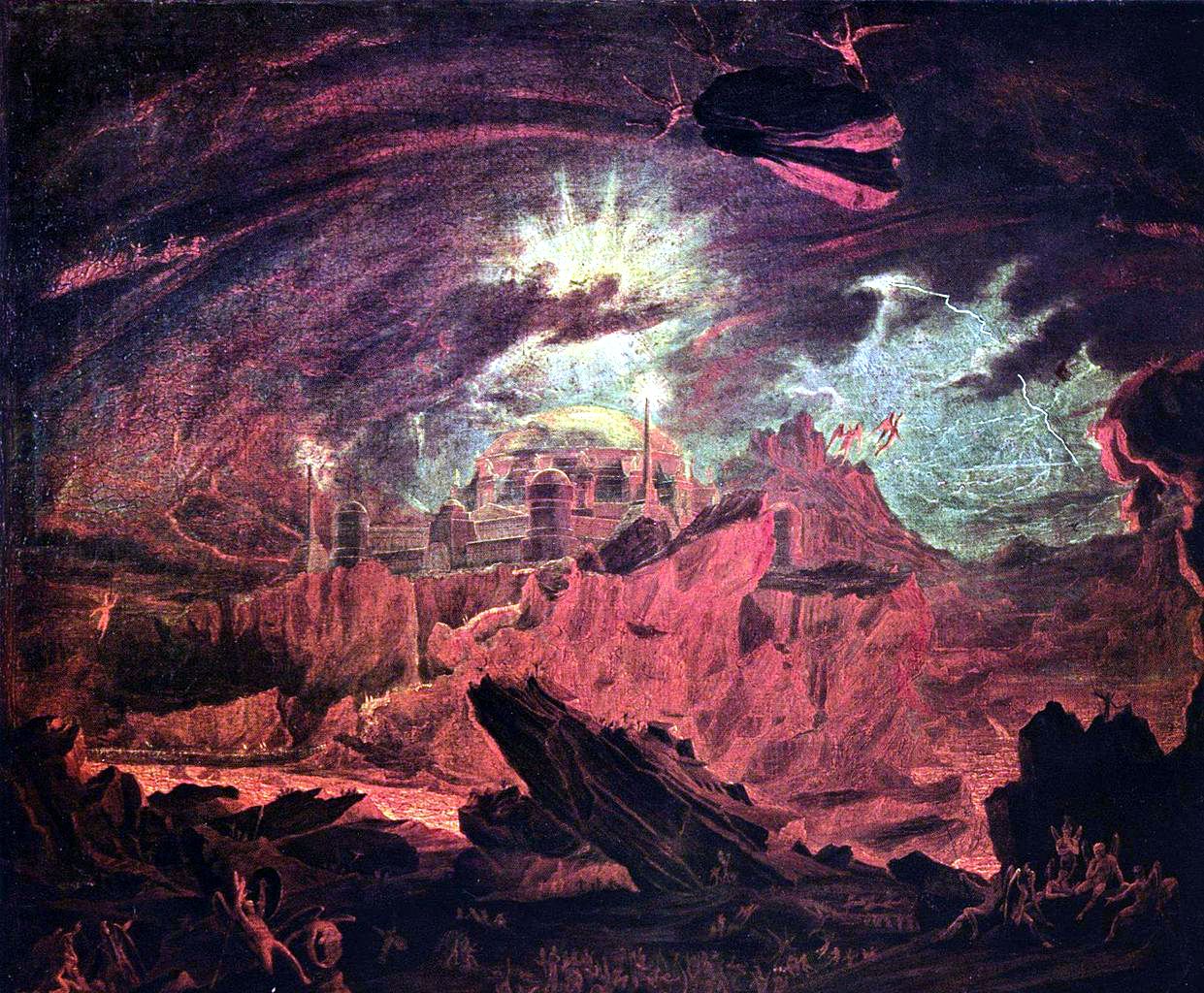
Fallen Angels in Hell

Fallen Angels in Hell, circa 1841, John Martin, 1789 – 1854, Public Domain in US

The Sower

The first 23 verses of the Book of Matthew, chapter 13, record the Lord Jesus’s parable of the sower, His reasoning behind speaking in parables, and His explanation of the sower parable. This is His explanation:

“Hear then the parable of the sower:

When anyone hears the word of the kingdom and does not understand it, the evil one comes and snatches away what has been sown in his heart. This is what was sown along the path.

As for what was sown on rocky ground, this is the one who hears the word and immediately receives it with joy, yet he has no root in himself, but endures for a while, and when tribulation or persecution arises on account of the word, immediately he falls away.

As for what was sown among thorns, this is the one who hears the word, but the cares of the world and the deceitfulness of riches choke the word, and it proves unfruitful.

As for what was sown on good soil, this is the one who hears the word and understands it. He indeed bears fruit and yields, in one case a hundredfold, in another sixty, and in another thirty.”

Matthew 13:18-23 English Standard Version (ESV)

John Calvin comments on the parable as a whole:

…He only intended to warn us, that, in many persons, the seed of life is lost on account of various defects, in consequence of which it is either destroyed immediately, or it withers, or it gradually degenerates.

That we may derive the greater advantage from this warning, we ought to bear in mind, that he makes no mention of despisers who openly reject the word of God, but describes those only in whom there is some appearance of docility.

But if the greater part of such men perishes, what shall become of the rest of the world, by whom the doctrine of salvation is openly rejected?

And relative to the good soil:

But he that received the seed into a good soil… None are compared by Christ to a good and fertile soil, but those in whom the word of God not only strikes its roots deep and solid, but overcomes every obstacle that would prevent it from yielding fruit.

Is it objected that it is impossible to find anyone who is pure and free from thorns? It is easy to reply, that Christ does not now speak of the perfection of faith, but only points out those in whom the word of God yields fruit. Though the produce may not be great, yet everyone who does not fall off from the sincere worship of God is reckoned a good and fertile soil

Hence too we learn that we have no right to despise those who occupy a lower degree of excellence; for the master of the house himself, though he gives to one the preference above another on account of more abundant produce, yet bestows the general designation, good, even on inferior soils…

Therefore, please:

…Put away all filthiness and rampant wickedness and receive with meekness the implanted word, which is able to save your souls. James 1:21 (ESV)

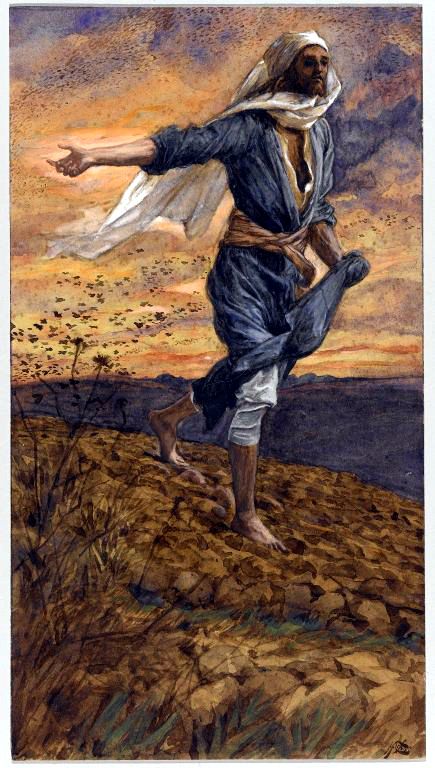
The Sower - Tissot

The Sower, 1886 – 1894, James Tissot, Brooklyn Museum, PD-Art-US

The Samaritan Leper

The story where Jesus cleanses ten lepers is a familiar one. It’s unusual that it comes right before one of Jesus’s declarations of the Kingdom. Or is it?

On the way to Jerusalem he was passing along between Samaria and Galilee. And as he entered a village, he was met by ten lepers, who stood at a distance and lifted up their voices, saying, “Jesus, Master, have mercy on us.” When he saw them he said to them, “Go and show yourselves to the priests.” And as they went they were cleansed.

Then one of them, when he saw that he was healed, turned back, praising God with a loud voice; and he fell on his face at Jesus’ feet, giving him thanks. Now he was a Samaritan. Then Jesus answered, “Were not ten cleansed? Where are the nine? Was no one found to return and give praise to God except this foreigner?” And he said to him, “Rise and go your way; your faith has made you well.”

Being asked by the Pharisees when the kingdom of God would come, he answered them, “The kingdom of God is not coming in ways that can be observed, nor will they say, ‘Look, here it is!’ or ‘There!’ for behold, the kingdom of God is in the midst of you.” Luke 17:11-21 English Standard Version (ESV)

John Calvin has some interesting comments about the passage:

Thy faith hath saved thee. The word save is restricted by some commentators to the cleanness of the flesh. But if this be the case, since Christ commends the lively faith of this Samaritan, it may be asked, how were the other nine saved? for all of them without exception obtained the same cure.

We must therefore arrive at the conclusion, that Christ has here pronounced a different estimate of the gift of God from that which is usually pronounced by ungodly men; namely, that it was a token or pledge of God’s fatherly love.

The nine lepers were cured; but as they wickedly efface the remembrance of the grace of God, the cure itself is debased and contaminated by their ingratitude, so that they do not derive from it the advantage which they ought. It is faith alone that sanctifies the gifts of God to us, so that they become pure, and, united to the lawful use of them, contribute to our salvation.

Lastly, by this word Christ has informed us in what manner we lawfully enjoy divine favors. Hence we infer that he included the eternal salvation of the soul along with the temporal gift. The Samaritan was saved by his faith How? Certainly not because he was cured of leprosy, (for this was likewise obtained by the rest,) but because he was admitted into the number of the children of God, and received from His hand a pledge of fatherly kindness.

We see the extent of God’s common grace through healings. But, without faith, those temporal miracles do not result in salvation.

Further, Calvin notes:

The kingdom of God will not come with observation. …The word observation is here employed by Christ to denote extraordinary splendor; and he declares, that the kingdom of God will not make its appearance at a distance, or attended by pompous display. He means, that they are greatly mistaken who seek with the eyes of the flesh the kingdom of God, which is in no respect carnal or earthly, for it is nothing else than the inward and spiritual renewal of the soul.

From the nature of the kingdom itself he shows that they are altogether in the wrong, who look around here or there, in order to observe visible marks. That restoration of the Church,” he tells us,which God has promised, must be looked for within; for, by quickening his elect into a heavenly newness of life, he establishes his kingdom within them.”

And thus he indirectly reproves the stupidity of the Pharisees, because they aimed at nothing but what was earthly and fading. It must be observed, however, that Christ speaks only of the beginnings of the kingdom of God; for we now begin to be formed anew by the Spirit after the image of God, in order that our entire renovation, and that of the whole world, may afterwards follow in due time.

I urge you, turn back, submit yourself to Him, and give Him thanks.

The Healing of the Ten Lepers, Tissot

The Healing of Ten Lepers, 1886 – 1894, James Tissot, Brooklyn Museum, PD-Art-US

Holy as I Am Holy?

The Apostle Peter wrote in his first letter:

As obedient children, do not be conformed to the passions of your former ignorance, but as he who called you is holy, you also be holy in all your conduct, since it is written, “You shall be holy, for I am holy.” 1 Peter 1:14-16 English Standard Version (ESV)

John Calvin comments on these verses:

He who hath called you is holy – He reasons from the end for which we are called. God sets us apart as a peculiar people for himself; then we ought to be free from all pollutions

Calvin, stating the obvious, that we are not capable of being like God in holiness, nevertheless, points out:

…We ought daily to strive more and more. And we ought to remember that we are not only told what our duty is, but that God also adds, “I am he who sanctify you.”

The Calvin presses the point further:

It is added: in all manner of conversation, or, in your whole conduct. There is then no part of our life which is not to be redolent with this good odour of holiness…

You may currently stink at holy conduct. However, if you are in Christ and He is in you, then you must make great efforts to achieve or obtain it:

Strive for peace with everyone, and for the holiness without which no one will see the Lord. Hebrews 12:14 (ESV)

To this verse, Calvin comments with regard to those who profess Christ as Lord:

Follow peace, etc. – Men are so born that they all seem to shun peace; for all study their own interest, seek their own ways, and care not to accommodate themselves to the ways of others. Unless then we strenuously labor to follow peace, we shall never retain it; for many things will happen daily affording occasion for discords…

And, with regard to those outside of Christ, Calvin says:

As however peace cannot be maintained with the ungodly except on the condition of approving of their vices and wickedness, the Apostle immediately adds, that holiness is to be followed together with peace; as though he commended peace to us with this exception, that the friendship of the wicked is not to be allowed to defile or pollute us; for holiness has an especial regard to God…

Finally, Calvin adds:

He declares, that without holiness no man shall see the Lord; for with no other eyes shall we see God than those which have been renewed after his image.

As scripture teaches, we know everyone born from above practices right behavior.

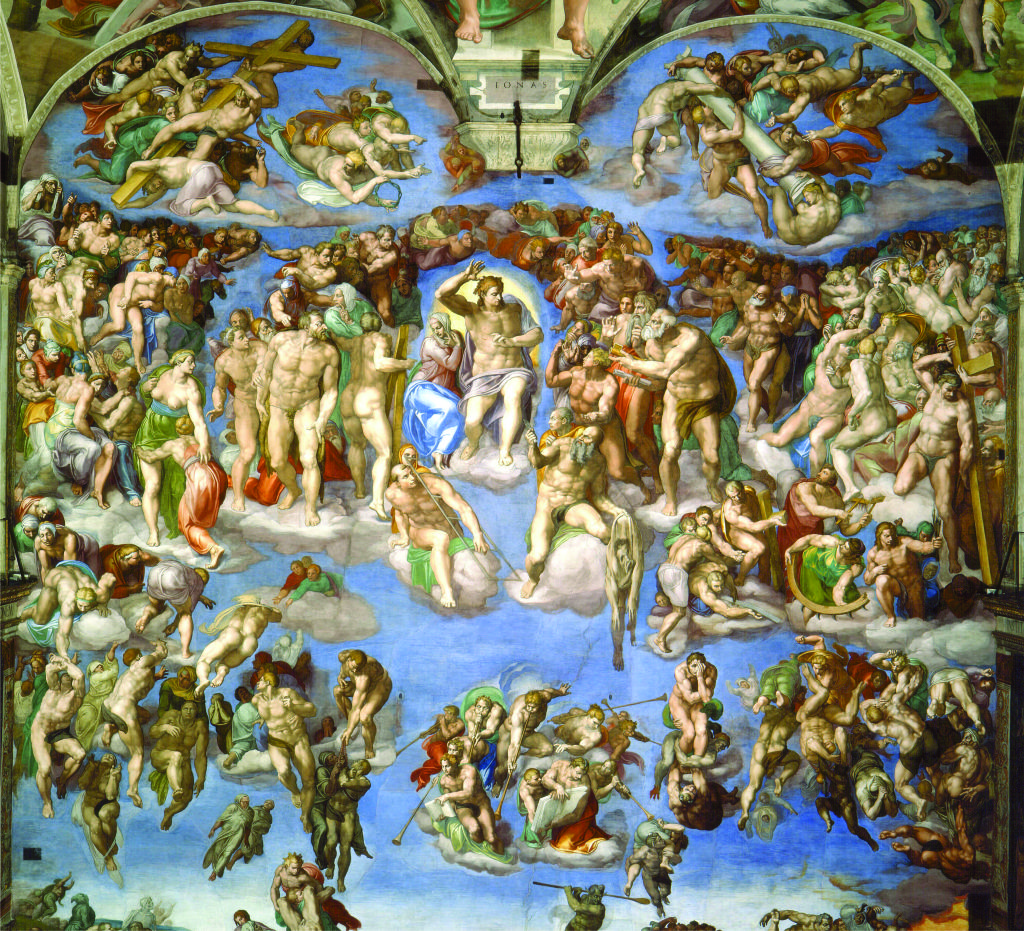
Last Judgment

Last Judgment, 1537 – 1541, Michelangelo and assistants, the Sistine Chapel in the Vatican, PD-Art-US

Can I be Certain of You?

In his comments on Philippians, chapter 1, verse 6:

And I am sure of this, that he who began a good work in you will bring it to completion at the day of Jesus Christ. Philippians 1:6 English Standard Version (ESV)

John Calvin says:

It is asked, however, whether anyone can be certain as to the salvation of others, for Paul here is not speaking of himself but of the Philippians. I answer, that the assurance which an individual has respecting his own salvation, is very different from what he has as to that of another. For the Spirit of God is a witness to me of my calling, as he is to each of the elect. As to others, we have no testimony, except from the outward efficacy of the Spirit; that is, in so far as the grace of God shews itself in them, so that we come to know it.

There is, therefore, a great difference, because the assurance of faith remains inwardly shut up, and does not extend itself to others. But wherever we see any such tokens of Divine election as can be perceived by us, we ought immediately to be stirred up to entertain good hope, both in order that we may not be envious towards our neighbors, and withhold from them an equitable and kind judgment of charity; and also, that we may be grateful to God. This, however, is a general rule both as to ourselves and as to others — that, distrusting our own strength, we depend entirely upon God alone [emphasis mine].

And what can we look for as tokens of Divine election? Scripture says we are to be clothed in His righteousness, in word and deed:

Put on then, as God’s chosen ones, holy and beloved, compassionate hearts, kindness, humility, meekness, and patience, bearing with one another and, if one has a complaint against another, forgiving each other; as the Lord has forgiven you, so you also must forgive. Colossians 3:12-13 (ESV)

Look for these things in yourselves first and then in others.

Tamme-Lauri oak. The oldest tree in Estonia

Tamme-Lauri oak. The oldest tree in Estonia, 3 September 2013, Abrget47j, Creative Commons Attribution-Share Alike 3.0 Unported

Able to Stand

I’ve been reminded repeatedly of this truth recently:

Who are you to pass judgment on the servant of another? It is before his own master that he stands or falls. And he will be upheld, for the Lord is able to make him stand. Romans 14:4 English Standard Version (ESV)

The immediate context is the weaker brother among those in the church at Rome, which was composed of former Jews trained to obey the Law and regulations and others who were never exposed to those regulations. Each looked down on the other for their freedoms and bondages.

Nowadays we look down on a brother (or sister) if they don’t dress the way we do, or perform ceremonies the way we do, work for an employer the way we do, or look at the world the way we do, or behave as responsibly as we do. I could go on. I’m sure you could supply more examples.

About this scripture passage, John Calvin comments:

To his own Lord he stands or falls, etc. As though he said, — “It belongs rightly to the Lord, either to disapprove, or to accept what his servant doeth: hence he robs the Lord, who attempts to take to himself this authority.” And he adds, he shall indeed stand: and by so saying, he not only bids us to abstain from condemning, but also exhorts us to mercy and kindness, so as ever to hope well of him, in whom we perceive anything of God; inasmuch as the Lord has given us a hope, that he will fully confirm, and lead to perfection, those in whom he has begun the work of grace [emphasis mine].

Lately, I’ve tried to practice what Calvin says constitutes true worship:

“God is not worshipped by external ceremonies, but when men forgive and bear with one another, and are not above measure rigid.”

and

“God values faith and kindness much more than sacrifices and all ceremonies.”

We would do well to follow his advice.

Scripture – What Is It Good For?

It’s the only written record that purports to be from life not of this world, or realm for that matter. It’s the only communication we have from someone untainted by wrath, avarice, sloth, pride, lust, envy, and gluttony.

This written record is special, in so far as it is self–referential. What does it say for itself?

Scripture reveals the power of God at work in throughout the ages.

Jesus said to them, “Is this not the reason you are wrong, because you know neither the Scriptures nor the power of God? Mark 12:24 English Standard Version (ESV)

Scripture bears witness of the work of the Lord Jesus Christ, the Author of eternal life.

You search the Scriptures because you think that in them you have eternal life; and it is they that bear witness about me, John 5:39 (ESV)

Scripture testifies to the death, burial, and resurrection of the Lord Jesus Christ witnessed by many then alive.

For I delivered to you as of first importance what I also received: that Christ died for our sins in accordance with the Scriptures, that he was buried, that he was raised on the third day in accordance with the Scriptures, and that he appeared to Cephas, then to the twelve. Then he appeared to more than five hundred brothers at one time, most of whom are still alive, though some have fallen asleep. Then he appeared to James, then to all the apostles. Last of all, as to one untimely born, he appeared also to me. 1 Corinthians 15:3-8 (ESV)

Scripture is the authoritative source and check for all preaching.

Now these Jews were more noble than those in Thessalonica; they received the word with all eagerness, examining the Scriptures daily to see if these things were so. Acts 17:11 (ESV)

Scripture was written for our instruction and encouragement leading to hope.

For whatever was written in former days was written for our instruction, that through endurance and through the encouragement of the Scriptures we might have hope. Romans 15:4 (ESV)

Scripture reveals truths once hidden from men and into which angels long to look.

Concerning this salvation, the prophets who prophesied about the grace that was to be yours searched and inquired carefully, inquiring what person or time the Spirit of Christ in them was indicating when he predicted the sufferings of Christ and the subsequent glories. It was revealed to them that they were serving not themselves but you, in the things that have now been announced to you through those who preached the good news to you by the Holy Spirit sent from heaven, things into which angels long to look. 1 Peter 1:10-12 (ESV)

Scripture, though written by men, finds its source and ultimate Author in God and has the full weight of His authority for equipping those following Him.

All Scripture is breathed out by God and profitable for teaching, for reproof, for correction, and for training in righteousness, that the man of God may be complete, equipped for every good work. 2 Timothy 3:16-17 (ESV)

Scripture, the prophetic testimony, comes from God. The Holy Spirit provides the prophets, as His representatives, not only visions but also words used to describe and interpret them.

…Knowing this first of all, that no prophecy of Scripture comes from someone’s own interpretation. For no prophecy was ever produced by the will of man, but men spoke from God as they were carried along by the Holy Spirit. 2 Peter 1:20-21 (ESV)

Scripture is God’s wisdom given through his apostles and prophets for our sakes, some of which is hard to understand. But we are not to be carried away with error. We are to obey that which we understand and grow in grace and knowledge of our Lord Jesus Christ.

…As he does in all his letters when he speaks in them of these matters. There are some things in them that are hard to understand, which the ignorant and unstable twist to their own destruction, as they do the other Scriptures. 2 Peter 3:16 (ESV)

And men recognized the preeminent value of this Word. The Westminster Confession gives a concise statement on its integrity and utility.

Calvin comments on authority of the word in chapter 7 of his Institutes of the Christian Religion.

And, so does the man, Christ Jesus

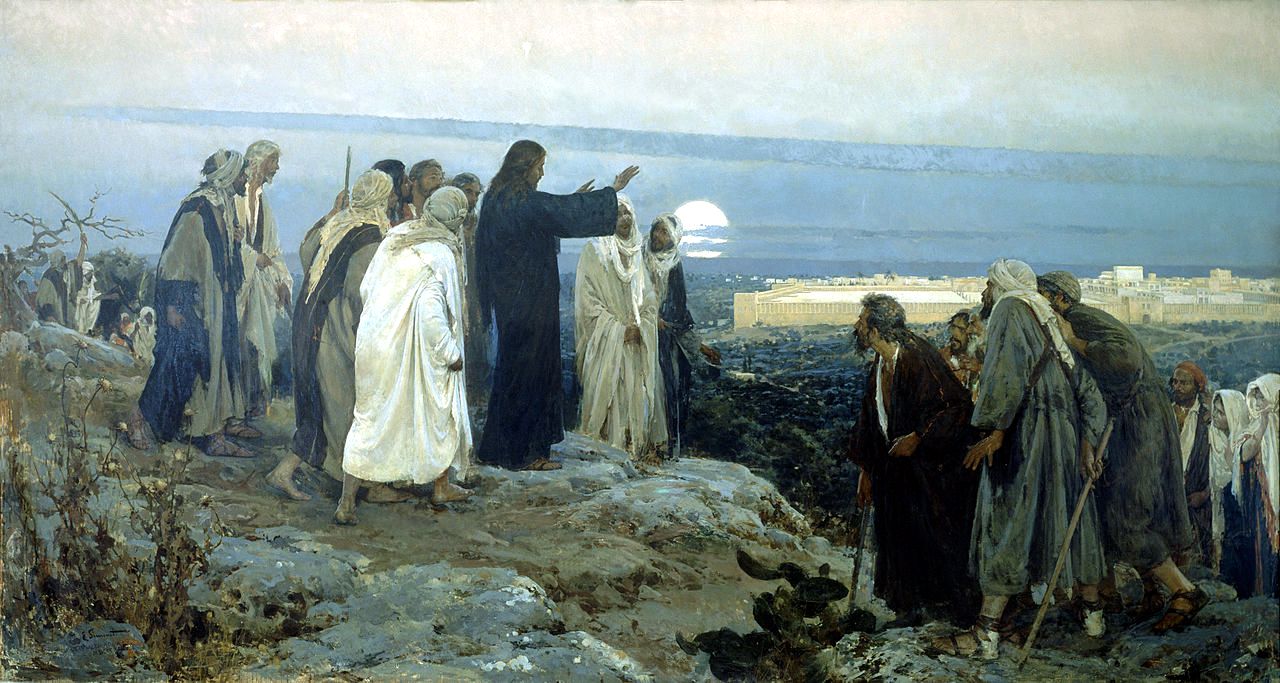
Flevit super illam; He wept over it, 1892, E. Simonet

Flevit super illam (Latin language); He wept over it, 1892, E. Simonet, public domain US

Reassurance

If you google (yes, to google is a verb) you’ll get:

re·as·sur·ance /ˌrēəˈSHo͝orəns/

noun

noun: reassurance

  1. the action of removing someone’s doubts or fears.

“children need reassurance and praise”

  • a statement or comment that removes someone’s doubts or fears.

plural noun: reassurances

“we have been given reassurances that the water is safe to drink”

This is interesting, because we all need some reassurance lately. Whether it’s because our health insurance has been cancelled, the insurance company hasn’t offered an alternative, and we’re forced to try the exchanges. Or, we’re a newly minted graduate with unproven skills that we’d use for mutual benefit like gangbusters, if only someone would give us a chance. Or, we’re a displaced older worker that still wants to contribute their skills to society and can’t seem to find anyone who will hire us for anything near (even half) what we’re worth to the employer.

Well, I don’t see it. If left to our own resources (just check the heavily commented websites) we almost squeal with glee at the displacement of humans by technology. Overpopulation, some say with the obvious solutions in mind. A mark of progress others say as they cite previous technology revolutions (market, first industrial, second industrial, digital, etc.).

All of these ‘revolutions’ recast how human labor was employed. Each caused worker dislocations. Some caused worker revolts. None were deterred (only derailed to the average worker’s detriment). They’ll tell you it will all work out. But we’re being inhuman of we go on like that. It won’t all work out. People are suffering needlessly. But we can’t return to the past.

The pundits on one side say if you get more of the pie I get less. So I should take your pie (oh, wait, they call it ‘re·dis·tri·bu·tion’). Some see nothing wrong with this. Others call it theft. The pundits on the other side say business should grow the pie. But business men just take more of the pie that’s left (I’m talking to you, Wall Street). We’ve been told to go shopping and buy from government exchanges, as if all will be better then. But that doesn’t grow the pie, either. It’s plain old manipulation. However, someone has to start growing the pie. It’s not going to grow itself, you know.

a work of the National Institutes of Health, part of the United States Department of Health and Human Services. As a work of the U.S. federal government, the image is in the public domain.

Pie slice, NCI at NIH, public domain

At lunch one day, I was discussing this problem with a friend whose politics differ from mine. We discussed the pie. However, neither of us had any since we’re both trying to lose weight after our job losses. I said we need savvy folks to start enterprises online and in bricks & mortar that use our displaced workforce and apprentice our new grads. Businesses are so refined now that training and loyalty has gone by the wayside. How will young workers grow into positions of responsibility? Why aren’t older workers tapped for their knowledge and expertise?

Now, you could say, these unemployed are the dregs of the workforce. They deserve what they got. And you’d be dead wrong in many cases. Good workers are being let go and not hired to boost stock performance. If you’re so concerned about quality employees, test them as a prequalification step. Give objective, targeted proficiency and psychological tests online as a gate of entry to the interviews. Grow and use trained interviewers with subject matter and social interaction expertise. You’ll be surprised what treasures you find.

Now what would you have them do? Well, figure out what we really need as a society and as a world and have them either make it for or serve it to us. We don’t need more pet rocks. But the world does need more energy, more clean and fresh water, safer roads and neighborhoods, better education independent of economic background, life mentoring, better preventative health care access, etc. You get the idea. Find a need and fill it.

Our technology can be leveraged to support these new enterprises in ways we don’t even bother using. Virtual offices will work if they’re managed well. The usual computer snooping software is unnecessary when folks are measured on productivity and results. When continued employment hinges on good cooperation and quality outputs, a factory, virtual service, or distributed design house (as examples) can flourish.

Meetings can be held online (many outplacement services work that way). Folks can gather centrally on a quarterly or less frequent basis once they’ve been vetted and oriented to the enterprise. Better minds than mine have worked all this out. Look for it and get cracking.

Funding can be raised via loans or investors. While loans may be hard to come by, more investment crowdsourcing is becoming acceptable and available. Check with your accountants and lawyers. I can’t figure it all out for you. You have to pitch in.

Think of it, how many billions of dollars are being left on the table in the interest of the bottom line because social responsibility and innovation are seen as what the other guy does? Granted it won’t be as profitable in the short run as the status quo of squeezing the life out of remaining workers. But in the long run it will pay dividends in work satisfaction, increased tax base, and societal growth and prosperity.

Responsible folks need to give this country (and this blogger) some reassurance and get ‘er done.

I Don’t Know Clouds At All

A while back, I was asked if I could write something light and fluffy; something buoyant and uplifted. So I got to thinking. I always wondered how clouds, those 500 ton shape shifting behemoths that patrol our skies, float in the air. Or do they hover? I guess I really don’t know clouds at all…

http://commons.wikimedia.org/wiki/File:Clouds.JPG

Clouds – taken from a plane flying over China by Axel Rouvin

That led me to remember the Joni Mitchell song off the album Clouds called “Both Sides, Now.” As recounted in Rolling Stone magazine, when Joni Mitchell read Saul Bellow‘s Henderson the Rain King, Henderson, like Mitchell, was looking at clouds from a plane. Her lyric: “I’ve looked at clouds from both sides now,” was a symbol of the ambiguities and mysteries of life.

In a 1967 radio interview, she related a quote from the book: “I dreamed down at the clouds, and thought that when I was a kid I had dreamed up at them, and having dreamed at the clouds from both sides as no other generation of men has done, one should be able to accept his death very easily.”

We disagree vehemently with Bellow’s sentiment. Death was never meant to be accepted so blithely. But I digress. There is more than enough on this blog to explain our position. That insight into her intended meaning proved to be a disappointment. I like the song otherwise. I guess you have to pay attention to the lyrics. Where were we? Light and fluffy…

Getting back to our premise for this entry, do clouds float or hover? By float, I mean like a rubber duck in a bath tub. By hover, I mean something like what a helicopter does (but possibly in reverse like an umbrella blowing away). Turns out it’s a little of both. Wikipedia has very detailed articles on water vapor and clouds that I hope to summarize below.

It turns out that water vapor is less dense than dry air. At the same temperature, water vapor floats in dry air like a rubber duck in water. The article on water vapor crunches the numbers. But it’s even better. Since both are gases, a volume of moisture laden air will rise or be buoyant if placed in a larger volume of dry air.

As the temperature rises, the proportion of water vapor in the air increases and its buoyancy will increase along with the added vapor. In air without particulates, water vapor density can reach 300% before condensation occurs under normal conditions (a principle used in cloud chambers).

The increase in buoyancy gives rise to strong, moisture rich, upward air currents when the air and sea temperatures reach 25 °C or above. This is the driving force behind tornadoes and hurricanes. In fact, under the right conditions, water vapor can lift a “steam balloon” with approximately 60% the lift of helium and twice that of hot air.

Clouds form when one or more sources of vertical lift causes air containing invisible water vapor to rise and cool to the temperature at which water vapor starts condensing. Atmospheric pressure decreases with altitude, so the rising air expands in a process that expends energy without heat loss to the surrounding air and causes the rising air to cool. If the air is cooled enough, the vapor condenses into a cloud.

Water vapor in saturated air is attracted to condensation nuclei such as salt particles, dust, or even bacteria that are small enough to be held aloft by air circulation alone. If condensation occurs below the freezing level, the average size of a newly formed droplet is around 0.02 mm (0.0008 in). Clouds that form just above the freezing level are composed of supercooled liquid droplets, while those that condense out at higher altitudes where the air is much colder generally form of ice crystals.

There are three main sources of vertical lift. The first is a combination of frontal and cyclonic lift. It occurs when stable or slightly unstable air, exposed to little or no surface heating, is forced aloft at weather fronts and around centers of low pressure. Cloud droplets form when the air is lifted beyond the condensation level where water vapor condenses on nuclei and droplets grow to a size of typically 0.025 mm (.001 in). In a cloud the droplets collide to form larger droplets. These larger droplets remain aloft as long as the atmospheric drag force of the air below them is larger than the gravitational force on them.

If the cloud droplets continue to grow past this size, they become too heavy to be held aloft and fall as rain. When this process takes place just above the freezing level, with additional lifting and growth in size, droplets can turn into freezing rain. At temperatures well below freezing, the vapor turns into ice crystals that average about 0.25 mm in length. With continuing lift, ice crystals combine with the vapor and each other until they are too heavy to be supported by the vertical air currents and fall out as snow.

The second source of vertical lifting, buoyant convection, is caused by daytime solar heating at surface level, or by relatively high absolute humidity. Air warmed in this way becomes increasingly unstable and it rises and cools until its temperature equals that of the surrounding air aloft. If air near the surface becomes extremely warm and unstable, it can result in rapidly rising clouds that cause severe weather. Strong convection updrafts enable droplets to grow to nearly .075 mm (.003 in) before precipitating as heavy rain from active thunderclouds. Occasionally, very warm unstable air is present around fronts and low-pressure centers. As with non-frontal convective lift, increasing instability promotes upward vertical cloud growth and raises the potential for severe weather.

A third source of lift is wind circulation forcing air over a physical barrier such as a mountain. This is called orographic lift. If the air is generally stable, nothing more than lenticular cap clouds will form. However, if the air becomes sufficiently moisture laden and unstable, orographic showers or thunderstorms may appear.

http://commons.wikimedia.org/wiki/File:Rolling-thunder-cloud.jpg

Storm – Rolling thunderstorm (Cumulonimbus Arcus) by John Kerstholt (Creative Commons license)

Additionally, there are three other mechanisms for lowering the air temperature to the point where water vapor condenses. All of these occur near surface level and do not require lifting of the air. Cooling by conduction, radiation, and evaporation can cause condensation at surface level resulting in the formation of fog.

Conduction cooling takes place when air from a relatively mild source area comes into contact with a colder surface, such as when mild marine air moves across a colder land area. Radiation cooling occurs due to the emission of infrared radiation, either by the air or by the surface underneath. This type of cooling commonly occurs at night when the sky is clear. Evaporative cooling happens when moisture is added to the air through evaporation, which forces the air temperature to cool to its wet-bulb temperature, or sometimes to the point of saturation.

So clouds float and hover. Who would have guessed? Aren’t they pretty?

http://commons.wikimedia.org/wiki/File:Moments_Before_Sunrise.jpg

Sunrise – The Twilight Sky just before Sunrise by Jessie Eastland (Creative Commons license)