Sanctification

Paul writes to the church in Rome:

I am speaking in human terms, because of your natural limitations. For just as you once presented your members as slaves to impurity and to lawlessness leading to more lawlessness, so now present your members as slaves to righteousness leading to sanctification.

For when you were slaves of sin, you were free in regard to righteousness. But what fruit were you getting at that time from the things of which you are now ashamed? For the end of those things is death.

But now that you have been set free from sin and have become slaves of God, the fruit you get leads to sanctification and its end, eternal life. For the wages of sin is death, but the free gift of God is eternal life in Christ Jesus our Lord.

Romans 6:19-23 English Standard Version (ESV)

The Westminster Confession Shorter Catechism Question and Answer number 35 states:

What is sanctification? Sanctification is the work of God’s free grace, whereby we are renewed in the whole man after the image of God, and are enabled more and more to die unto sin, and live unto righteousness.

What does John Calvin say about these verses in Romans here and here?

I speak what is human, etc. He says that he speaks after the manner of men, not as to the substance but as to the manner. So Christ says, in John 3:12, that he announced earthly things, while yet he spoke of heavenly mysteries, though not so magnificently as the dignity of the things required, because he accommodated himself to the capacities of a people ignorant and simple.

…As though [the Apostle] had said, “I might, by comparing sin and righteousness, show how much more ardently you ought to be led to render obedience to the latter [righteousness], than to serve the former [sin]; but from regard to your infirmity I omit this comparison: nevertheless, though I treat you with great indulgence, I may yet surely make this just demand — that you should not at least obey righteousness more coldly or negligently than you served sin…”

As you have presented, etc.; that is, “As you were formerly ready with all your faculties to serve sin, it is hence sufficiently evident how wretchedly enslaved and bound did your depravity hold you to itself: now then you ought to be equally prompt and ready to execute the commands of God; let not your activity in doing good be now less than it was formerly in doing evil.” He does not indeed observe the same order in the antithesis, by adapting different parts to each other, as he does in 1 Thessalonians 4:7, where he sets uncleanness in opposition to holiness; but the meaning is still evident…

For when you were, etc. He still repeats the difference, which he had before mentioned, between the yoke of righteousness and that of sin; for these two things, sin and righteousness, are so contrary, that he who devotes himself to the one, necessarily departs from the other. And he thus represents both, that by viewing them apart we may see more clearly what is to be expected from each; for to set things thus apart enables us to understand better their distinctive character. He then sets sin on one side, and righteousness on the other; and having stated this distinction, he afterwards shows what results from each of them…

What fruit, then, etc. He could not more strikingly express what he intended than by appealing to their conscience, and by confessing shame as it were in their person. Indeed the godly, as soon as they begin to be illuminated by the Spirit of Christ and the preaching of the gospel, do freely acknowledge their past life, which they have lived without Christ, to have been worthy of condemnation; and so far are they from endeavoring to excuse it, that, on the contrary, they feel ashamed of themselves. Yea, further, they call to mind the remembrance of their own disgrace, that being thus ashamed, they may more truly and more readily be humbled before God…

Ye have your fruit unto holiness, etc. As he had before mentioned a twofold end of sin, so he does now as to righteousness. Sin in this life brings the torments of an accusing conscience, and in the next eternal death. We now gather the fruit of righteousness, even holiness; we hope in future to gain eternal life. These things, unless we are beyond measure stupid, ought to generate in our minds a hatred and horror of sin, and also a love and desire for righteousness…

For the wages of sin, etc. …This verse is a conclusion to the former, and as it were an epilogue to it. He does not, however, in vain repeat the same thing again; but by doubling the terror, he intended to render sin an object of still greater hatred.

But the gift of God. They are mistaken who thus render the sentence, “Eternal life is the gift of God,” as though eternal life were the subject, and the gift of God the predicate; for this does not preserve the contrast. But as he has already taught us, that sin produces nothing but death; so now he subjoins, that this gift of God, even our justification and sanctification, brings to us the happiness of eternal life. Or, if you prefer, it may be thus stated, — “As the cause of death is sin, so righteousness, which we obtain through Christ, restores to us eternal life…”

I Could Laugh (feat. Chris Taylor) performed at BD’s House, 2014, by Michael Roe

The Upper Hand – Bernhardt Writer

Some people always have to have the upper hand. My father was one of those people. He would do whatever it took to gain an advantage over those he met. He would be proper, humble, a terror, or a fool if it would give him power and control over others. Fundamentally, he both disrespected and feared them at the same time. He was an expert at what he did and I was a rebellious teen who rejected his ways (by God’s grace).

Such recollections remind me of the scripture:

And in his teaching he said, “Beware of the scribes, who like to walk around in long robes and like greetings in the marketplaces and have the best seats in the synagogues and the places of honor at feasts, who devour widows’ houses and for a pretense make long prayers. They will receive the greater condemnation.” Mark 12:38-40 English Standard Version (ESV)

These prominent men displayed unwarranted pride and feigned humility as a cover for their real motive: greed. Further, we have:

But understand this: that in the last days there will come times of difficulty. For people will be lovers of self, lovers of money, proud, arrogant, abusive, disobedient to their parents, ungrateful, unholy, heartless, unappeasable, slanderous, without self-control, brutal, not loving good, treacherous, reckless, swollen with conceit, lovers of pleasure rather than lovers of God, having the appearance of godliness, but denying its power. Avoid such people. 2 Timothy 3:1-5 (ESV)

My father was such a one. He said he took communion because he was merely hungry:

But they will not get very far, for their folly will be plain to all… 2 Timothy 3:9 (ESV)

It saddens me, even today, that he did not repent while he had the chance. But such things should not characterize our behavior:

But let none of you suffer as a murderer or a thief or an evildoer or as a meddler. 1 Peter 4:15 (ESV)

In a note to this verse, the New American Standard translation renders meddler literally as: one who oversees others’ affairs. NAS adds troublesome to modify the noun in case we would misinterpret it. It’s the attitude, so prevalent today, of: “I know better than you,” put into action.

This should not be our way. Instead:

Do not love the world or the things in the world. If anyone loves the world, the love of the Father is not in him. For all that is in the world—the desires of the flesh and the desires of the eyes and pride of life—is not from the Father but is from the world. And the world is passing away along with its desires, but whoever does the will of God abides forever. 1 John 2:15-17 (ESV)

Even further:

When he had washed their feet and put on his outer garments and resumed his place, he said to them, “Do you understand what I have done to you? You call me Teacher and Lord, and you are right, for so I am. If I then, your Lord and Teacher, have washed your feet, you also ought to wash one another’s feet. For I have given you an example, that you also should do just as I have done to you. Truly, truly, I say to you, a servant is not greater than his master, nor is a messenger greater than the one who sent him. If you know these things, blessed are you if you do them. John 13:12-17 (ESV) [emphasis added]

I’ve always heard the Lord Jesus’s statement in John 13:8:

“If I do not wash you, you have no share with me,”

as a rebuke to Peter’s:

“You shall never wash my feet.”

But what if it were a plea?

Listening to good doctrine (as important as we think that is) is not enough to soften our hard hearts toward others. Or as one of our poets wrote: “I need love…to melt the frozen sea inside me.”

‘I Need Love’ by Sam Phillips – performed by Sixpence None the Richer (with lyrics)

But, exhibiting genuine humility in all circumstances that proceeds from a changed, crushed, and submissive heart may just be our duty.

Schadenfreude

Have you ever laughed when someone trips up, makes a mistake, or some other calamity befalls them? That’s an example of Schadenfreude.

Wikipedia defines it as:

Pleasure derived from the misfortunes of others. This word is taken from German and literally means ‘harm-joy.’ It is the feeling of joy or pleasure when one sees another fail or suffer misfortune. It is also borrowed by some other languages.

But it’s not something we should practice towards those we call brothers and sisters.

Rejoice with those who rejoice, weep with those who weep. Live in harmony with one another. Do not be haughty, but associate with the lowly. Never be wise in your own sight. Romans 12:15-16 English Standard Version (ESV)

We shouldn’t practice it toward those who do us wrong either.

Do not rejoice when your enemy falls,

and let not your heart be glad when he stumbles,

lest the Lord see it and be displeased,

and turn away his anger from him.

Proverbs 24:17-18 (ESV)

And not because we wish them harm, but because we’re commanded:

Beloved, never avenge yourselves, but leave it to the wrath of God, for it is written, “Vengeance is mine, I will repay, says the Lord.” Romans 12:19 (ESV)

and

Do not be overcome by evil, but overcome evil with good. Romans 12:21 (ESV)

But if we do persist, we’re on a slippery slope. Soon, we may find ourselves siding with the Pharisees and looking down on the Tax Collectors in our midst:

He also told this parable to some who trusted in themselves that they were righteous, and treated others with contempt:

“Two men went up into the temple to pray, one a Pharisee and the other a tax collector. The Pharisee, standing by himself, prayed thus: ‘God, I thank you that I am not like other men, extortioners, unjust, adulterers, or even like this tax collector. I fast twice a week; I give tithes of all that I get.’

“But the tax collector, standing far off, would not even lift up his eyes to heaven, but beat his breast, saying, ‘God, be merciful to me, a sinner!’

“I tell you, this man went down to his house justified, rather than the other. For everyone who exalts himself will be humbled, but the one who humbles himself will be exalted.” Luke 18:9-14 (ESV)

What does John Calvin think of the passage in Luke?

There are two faults at which Christ glances, and which he intended to condemn, — wicked confidence in ourselves, and the pride of despising brethren, the one of which springs out of the other. It is impossible that he who deceives himself with vain confidence should not lift himself up above his brethren. Nor is it wonderful that it should be so; for how should that man not despise his equals, who vaunts against God himself? Every man that is puffed up with self-confidence carries on open war with God, to whom we cannot be reconciled in any other way than by denial of ourselves; that is, by laying aside all confidence in our own virtue and righteousness, and relying on his mercy alone.

I urge you to read what else Calvin says about the passage.

It always seems to come down to: “Let him who is without sin among you be the first to throw a stone…” And it needs to start with me.

The Swallow's Nest Castle near Gaspra

The Swallow’s Nest Castle near Gaspra, Yalta municipality. Republic of Crimea, 4 April 2014, A. Savin, Creative Commons Attribution-Share Alike 3.0 Unported

Holy as I Am Holy?

The Apostle Peter wrote in his first letter:

As obedient children, do not be conformed to the passions of your former ignorance, but as he who called you is holy, you also be holy in all your conduct, since it is written, “You shall be holy, for I am holy.” 1 Peter 1:14-16 English Standard Version (ESV)

John Calvin comments on these verses:

He who hath called you is holy – He reasons from the end for which we are called. God sets us apart as a peculiar people for himself; then we ought to be free from all pollutions

Calvin, stating the obvious, that we are not capable of being like God in holiness, nevertheless, points out:

…We ought daily to strive more and more. And we ought to remember that we are not only told what our duty is, but that God also adds, “I am he who sanctify you.”

The Calvin presses the point further:

It is added: in all manner of conversation, or, in your whole conduct. There is then no part of our life which is not to be redolent with this good odour of holiness…

You may currently stink at holy conduct. However, if you are in Christ and He is in you, then you must make great efforts to achieve or obtain it:

Strive for peace with everyone, and for the holiness without which no one will see the Lord. Hebrews 12:14 (ESV)

To this verse, Calvin comments with regard to those who profess Christ as Lord:

Follow peace, etc. – Men are so born that they all seem to shun peace; for all study their own interest, seek their own ways, and care not to accommodate themselves to the ways of others. Unless then we strenuously labor to follow peace, we shall never retain it; for many things will happen daily affording occasion for discords…

And, with regard to those outside of Christ, Calvin says:

As however peace cannot be maintained with the ungodly except on the condition of approving of their vices and wickedness, the Apostle immediately adds, that holiness is to be followed together with peace; as though he commended peace to us with this exception, that the friendship of the wicked is not to be allowed to defile or pollute us; for holiness has an especial regard to God…

Finally, Calvin adds:

He declares, that without holiness no man shall see the Lord; for with no other eyes shall we see God than those which have been renewed after his image.

As scripture teaches, we know everyone born from above practices right behavior.

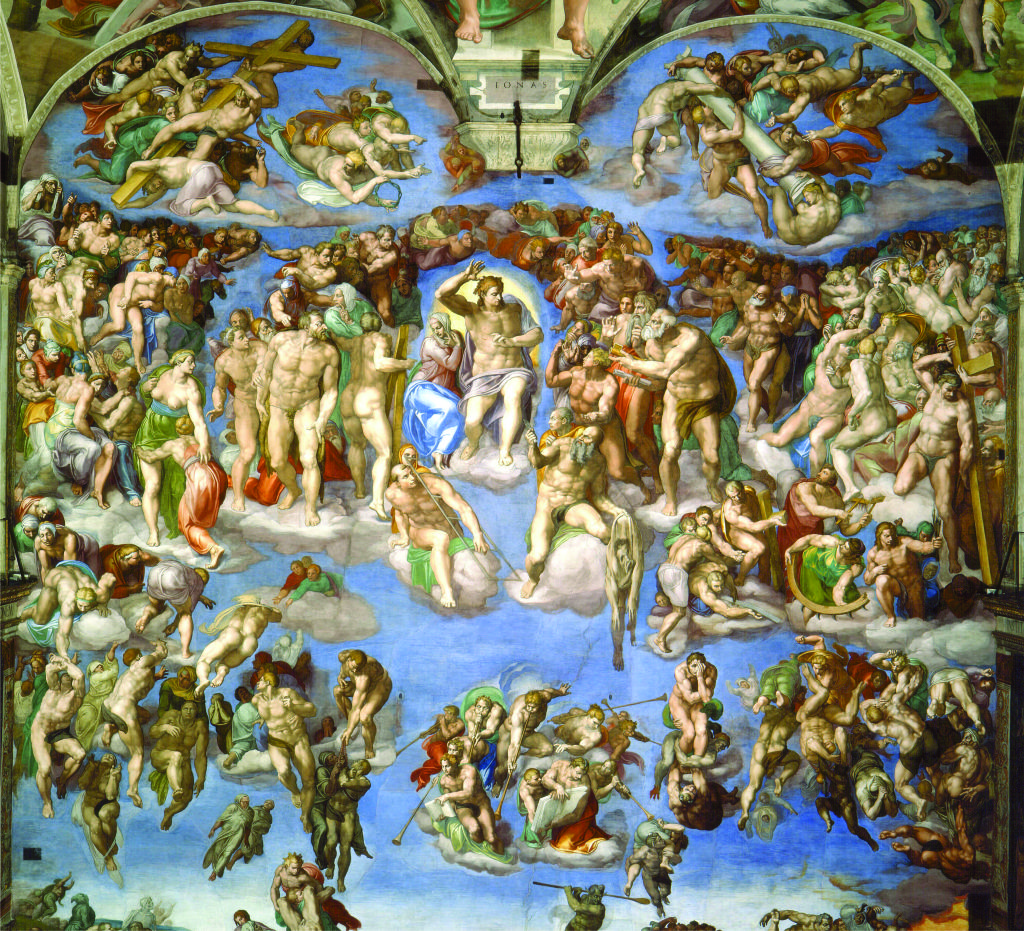
Last Judgment

Last Judgment, 1537 – 1541, Michelangelo and assistants, the Sistine Chapel in the Vatican, PD-Art-US

Is He Fair?

I hope God’s not fair, and so should you. The scriptures say: by the works of the law, no one is justified.

For all have sinned and fall short of God’s glory.

But, He has not dealt with us as our sins deserve.

He saves us, not because of righteous works we have done, but according to His mercy.

But, as a result of His work in us, we must show our faith by our works.

God, through His apostles and prophets, is blunt:

Let no one deceive himself. If anyone among you thinks that he is wise in this age, let him become a fool that he may become wise. For the wisdom of this world is folly with God. For it is written, “He catches the wise in their craftiness,” and again, “The Lord knows the thoughts of the wise, that they are futile.” 1 Corinthians 3:18-20 English Standard Version (ESV)

Therefore, repent and trust Him for life.

Last Judgment, Michelangelo Buonarroti

Last Judgment, 1537–41, Michelangelo Buonarroti (1475–1564), public domain in US

I Desire Mercy, and Not Sacrifice

The Lord Jesus Christ referred to this scripture twice as recorded in the gospels.

On the first occasion, His message seems to be: associate with the sin sick to bring them healing and exhort those, who consider themselves well and in no need of a doctor, that they need healing, too.

And as Jesus reclined at table in the house, behold, many tax collectors and sinners came and were reclining with Jesus and his disciples. And when the Pharisees saw this, they said to his disciples, “Why does your teacher eat with tax collectors and sinners?”  But when he heard it, he said, “Those who are well have no need of a physician, but those who are sick. Go and learn what this means, ‘I desire mercy, and not sacrifice.’ For I came not to call the righteous, but sinners.” Matthew 9:10-13 English Standard Version (ESV)

On the second occasion, He urged those who considered themselves righteous to obey the substance and not just the form of God’s commandments.

Or have you not read in the Law how on the Sabbath the priests in the temple profane the Sabbath and are guiltless? I tell you, something greater than the temple is here. And if you had known what this means, ‘I desire mercy, and not sacrifice,’ you would not have condemned the guiltless. For the Son of Man is lord of the Sabbath.” Matthew 12:5-8 (ESV)

Clearly, these folks thought themselves better than those around them.

But to what scripture (because the New Testament was not yet written) was the Lord referring? He quoted Hosea 6:6, but verses six and seven complete a thought.

For I desire steadfast love and not sacrifice, the knowledge of God rather than burnt offerings.

But like Adam they transgressed the covenant; there they dealt faithlessly with me.

Hosea 6:6-7 (ESV)

Textual notes indicate the term steadfast love is rendered mercy in the Septuagint (Greek translation of the Old Testament).

John Calvin comments on verse six:

It is a remarkable passage; the Son of God has twice quoted it. The Pharisees reproached him for his intercourse with men of bad and abandoned life, and he said to them in Matthew 9, ‘Mercy I desire, and not sacrifice.’ He shows, by this defense, that God is not worshipped by external ceremonies, but when men forgive and bear with one another, and are not above measure rigid. [emphasis added]

Again, in the Matthew 12, when the Pharisees blamed the disciples for gathering ears of corn, he said ‘But rather go and learn what this is, Mercy I desire, and not sacrifice.’ Inasmuch as they were so severe against his disciples, Christ shows that those who make holiness to consist in ceremonies are foolish worshipers of God; and that they also blamed their brethren without a cause, and made a crime of what was not in itself sinful, and what could be easily defended by any wise and calm expounder.

Calvin adds concerning verse seven:

God then subjoins a complaint, — But they like men have transgressed the covenant; there have they dealt treacherously against me. Here God shows that the Israelites boasted in vain of their sacrifices and of all the pomps of their external worship, for God did not regard these external things, but only wished to exercise the faithful in spiritual worship.

Then the import of the whole is this, “My design was, when I appointed the sacrifices and the whole legal worship, to lead you so to myself, that there might be nothing carnal or earthly in your sacrificing; but ye have corrupted the whole law; you have been perverse interpreters; for sacrifices have been nothing else among you but mockery as if it were a satisfaction to me to have an ox or a ram killed. You have then transgressed my covenant; and it is nothing that the people say to me, that they have diligently performed the outward ceremonies, for such a worship is not in the least valued by me.”

We can (and must) replace Calvin’s reference to ‘Israelites who boast in vain’ with the ‘unbelieving church of that age,’ for such they were. And we have these same with us today. It’s not as if they are unaware of the substance of proper worship, it’s just less costly (in the here and now) to practice merely the form of it.

At least two of these folks asked the Lord, “Which commandment is the most important of all?” He answered:

“You shall love the Lord your God with all your heart and with all your soul and with all your strength and with all your mind, and your neighbor as yourself.”

On another occasion He asked one of these folks how they understood the scriptures in a nutshell and they gave the same answer. To this one, the Lord said, “You have answered correctly; do this, and you will live.”

But, as we are prone to do, let us not go beyond what the scriptures say. The best example that comes to mind of mercy correctly applied is that demonstrated by the Lord.

The Woman taken in Adultery.  1644, Rembrandt (1606 – 1669), Public Domain

The Woman taken in Adultery. 1644, Rembrandt (1606 – 1669), Public Domain

Here’s the entire story from the source:

Early in the morning he came again to the temple. All the people came to him, and he sat down and taught them.  The scribes and the Pharisees brought a woman who had been caught in adultery, and placing her in the midst they said to him, “Teacher, this woman has been caught in the act of adultery. Now in the Law Moses commanded us to stone such women. So what do you say?” This they said to test him, that they might have some charge to bring against him.

Jesus bent down and wrote with his finger on the ground.  And as they continued to ask him, he stood up and said to them, “Let him who is without sin among you be the first to throw a stone at her.”  And once more he bent down and wrote on the ground.  

But when they heard it, they went away one by one, beginning with the older ones, and Jesus was left alone with the woman standing before him.  Jesus stood up and said to her, “Woman, where are they? Has no one condemned you?”  She said, “No one, Lord.” And Jesus said, “Neither do I condemn you; go, and from now on sin no more.”

So there we have it. When someone is repentant from the heart (and surely she was), the Lord says:

“Neither do I condemn you; go, and from now on sin no more.”

Go and do likewise.

Whose Side is He On?

We use the phrase: “With God on Our Side,” to justify our deadly decisions as morally right, especially when they’re not. Bob Dylan sings a song recounting how this phrase is used ignominiously in history.

Dylan Sings “With God On Our Side”

Before we go any further, let’s be clear, God gives the sword to rulers so that they act as His servant avenging wrong and carrying out His wrath. He will judge whether they have done this rightly. It is apparent that no government has yet lasted long.

In this context, CNN recently quoted a Ukrainian Priest: “We know how to fight a partisan (guerrilla) war. We know these forests and swamps like the back of our hand and it will be very hard to fight us. Truth will win. Truth is where God is and God is on our side.”

Nearer to home but longer ago, Lincoln said: “Sir, my concern is not whether God is on our side; my greatest concern is to be on God’s side, for God is always right.” In his second inaugural, Lincoln said in part:

…Both [i.e., North and South] read the same Bible, and pray to the same God; and each invokes His aid against the other. It may seem strange that any men should dare to ask a just God’s assistance in wringing their bread from the sweat of other men’s faces; but let us judge not that we be not judged. The prayers of both could not be answered; that of neither has been answered fully. The Almighty has His own purposes. “Woe unto the world because of offences! for it must needs be that offences come; but woe to that man by whom the offence cometh!”

If we shall suppose that American Slavery is one of those offences which, in the providence of God, must needs come, but which, having continued through His appointed time, He now wills to remove, and that He gives to both North and South, this terrible war, as the woe due to those by whom the offence came, shall we discern therein any departure from those divine attributes which the believers in a Living God always ascribe to Him? Fondly do we hope — fervently do we pray — that this mighty scourge of war may speedily pass away.

Yet, if God wills that it continue, until all the wealth piled by the bond–man’s two hundred and fifty years of unrequited toil shall be sunk, and until every drop of blood drawn with the lash, shall be paid by another drawn with the sword, as was said three thousand years ago, so still it must be said “the judgments of the Lord, are true and righteous altogether”

Lincoln on east portico of U.S. Capitol

The second inaugural address of Abraham Lincoln, given on 4 March 1865 on the east portico of the U.S. Capitol, photographed by Alexander Gardner (1821 – 1882), Image created between 1910 and 1920, from photograph taken in 1865, in the public domain in the US.

But where does this sentiment we write about come from and in what context was it said? For the answer, we look to the book of psalms:

The Lord is on my side; I will not fear.
What can man do to me?

The Lord is on my side as my helper;
I shall look in triumph on those who hate me.

It is better to take refuge in the Lord
than to trust in man.

It is better to take refuge in the Lord
than to trust in princes.

Clearly, this is not a justification for princes to use. But, rather, it is an admission of their futility as protection and an admonition for fealty to the Lord of all.

But, is He really on one nation’s side versus that of another? In the following passage, He declares to us No (or Neither) in no uncertain terms. And this took place just prior to a key battle He Himself would use in conquering territory for Israel.

When Joshua was by Jericho, he lifted up his eyes and looked, and behold, a man was standing before him with his drawn sword in his hand. And Joshua went to him and said to him, “Are you for us, or for our adversaries?” And he said, “No; but I am the commander of the army of the LORD. Now I have come.” And Joshua fell on his face to the earth and worshiped and said to him, “What does my lord say to his servant?” And the commander of the LORD’s army said to Joshua, “Take off your sandals from your feet, for the place where you are standing is holy.” And Joshua did so.

So, whether or not the Lord is on our side, nationally, is not a significant question with which to be occupied. The answer is: “Neither.” The most important question we must ask ourselves is: whose side am I on? We choose to serve the Lord.

There, But for God’s Grace and Mercy Through His Providence, Go I

John Calvin

John Calvin (Photo credit: Wikipedia)

Why are we shocked when things like this, this, or this happen?

These sensational stories are tragic, no doubt. Scary, even. But we seem to think we’d never do or even be capable of such heinous acts. Then we bolt our door against our neighbor (rightly or wrongly, I can’t say; that’s up to you). Some believe we’re naturally moral. Still others say: red in tooth and claw.

The scriptures conclude we all fall short of God’s glory. But isn’t this an overstatement of our condition? Aren’t we really good, but just misguided, unmotivated, or low informational?

Paul, in the letter to the Romans, elaborates on what he concludes in case we were unsure:

11 no one understands;
no one seeks for God.
12  All have turned aside; together they have become worthless;
no one does good,
not even one.”
13 “Their throat is an open grave;
they use their tongues to deceive.”
“The venom of asps is under their lips.”
14 “Their mouth is full of curses and bitterness.”
15 “Their feet are swift to shed blood;
16   in their paths are ruin and misery,
17    and the way of peace they have not known.”
18   “There is no fear of God before their eyes.”

So, we have no excuse to be shocked at these sensational stories. This is the condition of man. However, if this is so, why then do we not claw and bite until we are no more?

John Calvin, a theologian not often cited now–a–days, suggests in the Institutes of the Christian Religion, book 1, chapter 17, and paragraph 11:

…How comes it, I ask, that their confidence never fails, but just that while the world apparently revolves at random, they know that God is everywhere at work, and feel assured that his work will be their safety? When assailed by the devil and wicked men, were they not confirmed by remembering and meditating on Providence, they should, of necessity, forthwith despond. But when they call to mind that the devil, and the whole train of the ungodly, are, in all directions, held in by the hand of God as with a bridle, so that they can neither conceive any mischief, nor plan what they have conceived, nor how much so ever they may have planned, move a single finger to perpetrate, unless in so far as he permits, nay, unless in so far as he commands; that they are not only bound by his fetters, but are even forced to do him service,—when the godly think of all these things they have ample sources of consolation. For, as it belongs to the lord to arm the fury of such foes and turn and destine it at pleasure, so it is his also to determine the measure and the end, so as to prevent them from breaking loose and wantoning as they list…

So God not only constrains the evildoer but commands him to do His bidding, yet without complicity or taint thrown back upon Him. But why, if we’re this way, are we guilty at all?

Calvin says in the Institutes of the Christian Religion, book 1, chapter 17, and paragraph 5:

… As all contingencies whatsoever depend on it, therefore, neither thefts nor adulteries, nor murders, are perpetrated without an interposition of the divine will. Why, then, they ask, should the thief be punished for robbing him whom the Lord chose to chastise with poverty? Why should the murderer be punished for slaying him whose life the Lord had terminated? If all such persons serve the will of God, why should they be punished?

I deny that they serve the will of God. For we cannot say that he who is carried away by a wicked mind performs service on the order of God, when he is only following his own malignant desires. He obeys God, who, being instructed in his will, hastens in the direction in which God calls him.

But how are we so instructed unless by his word? The will declared by his word is, therefore, that which we must keep in view in acting, God requires of us nothing but what he enjoins. If we design anything contrary to his precept, it is not obedience, but contumacy and transgression. But if he did not will it, we could not do it. I admit this.

But do we act wickedly for the purpose of yielding obedience to him? This, assuredly, he does not command. Nay, rather we rush on, not thinking of what he wishes, but so inflamed by our own passionate lust, that, with destined purpose, we strive against him. And in this way, while acting wickedly, we serve his righteous ordination, since in his boundless wisdom he well knows how to use bad instruments for good purposes.

And see how absurd this mode of arguing is. They will have it that crimes ought not to be punished in their authors, because they are not committed without the dispensation of God. I concede more—that thieves and murderers, and other evil-doers, are instruments of Divine Providence, being employed by the Lord himself to execute the Judgments which he has resolved to inflict.

But I deny that this forms any excuse for their misdeeds. For how? Will they implicate God in the same iniquity with themselves, or will they cloak their depravity by his righteousness? They cannot exculpate themselves, for their own conscience condemns them: they cannot charge God, since they perceive the whole wickedness in themselves, and nothing in Him save the legitimate use of their wickedness

So, it is apparent that Romans 3 is true and we are not only held back from what we could do but others are employed to execute God’s judgments and, yet, are solely guilty of their transgression.

I see the tendency to do wrong in myself all the time. Do you? The only remedy is falling at the feet of the Lord Jesus Christ in surrender because he says: Come to me, all who labor and are heavy laden, and I will give you rest.