Your Fiery Trial

No doubt you’ve suffered “the slings and arrows of outrageous fortune.” Perhaps you’ve been insulted, falsely accused, or unjustly condemned when you’ve tried to do good for others? All alive will at some time suffer one or more of these adversities. However, only those saved by God’s grace can grow as a result of them. The Apostle Peter says in his first letter:

Beloved, do not be surprised at the fiery trial when it comes upon you to test you, as though something strange were happening to you. But rejoice insofar as you share Christ’s sufferings, that you may also rejoice and be glad when his glory is revealed. 1 Peter 4:12-13 English Standard Version (ESV)

Although Peter elsewhere counsels that Paul’s writings are sometimes hard to understand, I find this passage of his difficult as well. Let’s see what John Calvin has to say:

Beloved, think it not strange, or, wonder not. There is a frequent mention made in this Epistle of afflictions; the cause of which we have elsewhere explained. But this difference is to be observed, that when he exhorts the faithful to patience, he sometimes speaks generally of troubles common to man’s life; but here he speaks of wrongs done to the faithful for the name of Christ.

And first, indeed, he reminded them that they ought not to have deemed it strange as for a thing sudden and unexpected; by which he intimates, that they ought by a long mediation to have been previously prepared to bear the cross. For whosoever has resolved to fight under Christ’s banner, will not be dismayed when persecution happens, but, as one accustomed to it, will patiently bear it. [In order] that we may then be in a prepared state of mind when the waves of persecutions roll over us, we ought in due time to habituate ourselves to such an event by meditating continually on the cross.

Moreover, he proves that the cross is useful to us by two arguments, — that God thus tries our faith, — and that we become thus partakers with Christ. Then, in the first place, let us remember that the trial of our faith is most necessary, and that we ought thus willingly to obey God who provides for our salvation. However, the chief consolation is to be derived from a fellowship with Christ.

Hence Peter not only forbids us to think it strange, when he sets this before us, but also bids us to rejoice. It is, indeed, a cause of joy, when God tries our faith by persecution; but the other joy far surpasses it, that is, when the Son of God allots to us the same course of life with himself, that he might lead us with himself to a blessed participation of heavenly glory.

For we must bear in mind this truth, that we have the dying of Christ in our flesh, that his life may be manifested in us. The wicked also do indeed bear many afflictions; but as they are separated from Christ, they apprehend nothing but God’s wrath and curse: thus it comes that sorrow and dread overwhelm them.

Hence, then, is the whole consolation of the godly, that they are associates with Christ, that hereafter they may be partakers of his glory; for we are always to bear in mind this transition from the cross to the resurrection. But as this world is like a labyrinth, in which no end of evils appears, Peter refers to the future revelation of Christ’s glory, as though he had said, that the day of its revelation is not to be overlooked, but ought to be expected.

But he mentions a twofold joy, one which we now enjoy in hope, and the other the full fruition of which the coming of Christ shall bring to us; for the first is mingled with grief and sorrow, the second is connected with exultation. For it is not suitable in the midst of afflictions to think of joy, which can free us from all trouble; but the consolations of God moderate evils, so that we can rejoice at the same time.

One might object that suffering for righteousness sake in the hope of future joy is nothing more than “pie in the sky when we die.” But it is so much more. This kind of suffering shows we are His possession, and if we are His, this world has no hold on us. This momentary light affliction is preparing us for an eternal weight of glory beyond all comparison.

Steel Mill Run-off

Run-off from a Steel Mill Open Hearth Furnace, Republic Steel Corp., Youngstown, Ohio, November 1941, A work of the U.S. federal government, in the public domain

ADC Author Interview

We here at Mandated Memoranda Publishing, LLC, are gearing up for a book unveiling. Here’s an author interview for the taking. All we ask is that you use the Q & A ‘as is,’ notify us of your intention to use the material, and send us a link ahead of your post via our email address. Thanks.

MM email address

Book Title: A Digital Carol – A Tale for Our Generation

Author: Adolphus Writer

Publisher: Mandated Memoranda Publishing, LLC

Genre: Science Fiction, Christian Futuristic

Publication date: November 19, 2014

Short author bio:

Adolphus Writer holds a doctorate in theoretical physics. After he graduated, he took a job at a large US defense firm applying his creative and analytical skills to pressing problems. He married Ninja (NEEN–yuh) S. Writer after she completed her service with the German Federal Defense forces.

During the economic downturn spanning the first and second decades of the twenty–first century, his job was eliminated and he was terminated. In early 2012, Adolphus established Mandated Memoranda Publishing, LLC as a way to support the lifestyle to which he and his family had become accustomed. He says they like to eat on a daily basis and stay debt–free.

Book Synopsis:

A Digital Carol – A Tale for Our Generation is the old Dickens’ favorite—A Christmas Carol—reimagined. We now face a monstrous egotist who questions the very premise of his existence and ours.

Images:

ADC Book Cover

ADC Cover quarter scale, Copyrighted, All Rights Reserved

Author

Adolphus Writer Picture

Contact information: mandatedmemorandainquiry at outlook dot com

Purchase link: Amazon Kindle eBook exclusively

Website / Blog: Mandated Memoranda Publishing, LLC

Twitter:

Adolphus Writer (@AdolphusWriter)

Other Social Media:

On Goodreads

On Google+

On Facebook

ABOUT YOUR BOOK AND WRITING PROCESS

Tell us a little about your book.

I think the ADC’s preface sums it up well without giving too much away:

We no longer believe in ghosts, do we? I thought not. But we invest our time and attention in the promise of virtual reality for entertainment and, as some might wish it, our evolutionary destiny. Of course, this is only the latest manifestation of our desire to create our own heaven, on our own terms, here on earth.

A Digital Carol is Dickens’ A Christmas Carol retold with new forms and modern perspectives. No longer do we read a tale of a mean miser who, through sorrowful experiences, becomes kindly. We now face a monstrous egotist who teeters between damnation and redemption.

This speculative fiction story’s goal is not to inspire a more joyous holiday or a more generous spirit, but to question the very premise of our existence. Are we too far into the dark night of the soul for anything but drastic measures?

The chapter titles have more flair than the original story, too:

Preface

Chapter 1 – You Disgust Me, Sir

Chapter 2 – Left Behind? No, Wait

Chapter 3 – Why Were You Holding Out?

Chapter 4 – What I Need From You

Chapter 5 – A Long, Long Way Down

Chapter 6 – Ben’s Recovery

Chapter 7 – A Very Good Year

About the Author

How did you come up with the title?

It’s probably obvious: A Christmas Carol becomes A Digital Carol. Dickens’ used the trope of spiritualism popular in his day. We chose Artificial Intelligence (AI) gone awry popular in ours. Neither Dickens nor we advocate for these movements. Although both stories are set during the Christmas season, we changed our title to A Digital Carol to emphasize the modern nature of the reimagined story.

Is there a message in your novel that you want readers to grasp?

If it’s stated anywhere in ADC, we’d have to say that the preface hints most directly at our message:

All of us want to create, in some shape or fashion, our own heaven, on our own terms, here on earth. Whether we believe it or not, we, even as the story’s main character: E. Ben Ezer, teeter between damnation and redemption. We hope this story prompts all readers to question the very premise of their existence.

How much of the book is realistic?

All of it. Of course, at least as of this writing, everything is greatly exaggerated in the story. We have a growing economic divide, jobs automated away, AI demons, Wars, and cries of over–population. We’ve recently experienced a worldwide financial crisis that may not be over. We have wars and rumors of wars raging in places most of us cannot find on a map. We have various elites that view the majority of us as low information and hardly worth the investment (e.g., look at real wages, job statistics, and offshored corporate income). We also have philosophical movements that put agrarian gentrification for the privileged above economic prosperity for all. I could go on as could you.

What is your writing process?

Get to the computer every morning and type until bed time. Yeah, right, as if that would happen. It’s the goal, but we only have that leisure on Mondays, Tuesdays, and Saturdays. The rest of the week is broken up by appointments.

Prior to starting a manuscript, we do a lot of daily reading on relevant topics to establish our mindset and a reservoir of facts from which we draw. As the writing progresses, we do less reading each day.

Did you hire an editor to review your manuscript before publishing?

We used to use advanced copy readers for early critiques. However, your friends and acquaintances shouldn’t be put on the spot when it comes to bald criticism. And, it’s this kind of criticism that you need. We’ve decided, from now on, to go to paid editing early in the development process.

Several shops offer quick turnarounds and direct communications. Pay the money and get the best you can afford. We chose to do three collaborative editing sessions before a final copyedit phase. I feel we have a better product for it.

Did you learn anything from writing your book and what was it?

Our collaborative editor for our second and third sessions recommended reading 120 pages from The Art of Dramatic Writing: Its Basis in the Creative Interpretation of Human Motives by Lajos Egri. Specifically, she recommended the chapter on ‘Conflict’. We read most of the book, actually. The author’s drama principles are useful; his science and philosophy are forgettable.

How long did it take to write your latest release?

Our first manuscript iteration is dated mid–November 2013. We sent the manuscript off for the first collaborative editing session June 2014. We received our manuscript from our third collaborative editing session October 2014. The manuscript is about 21,500 words.

Do you have a favorite line or scene from your latest release?

I think this exchange captures the initial mood of the story:

“No one anticipated the unfortunate events that have taken place, sir. They would rather die than subject their families to these horrors.”—Solicitor for community charity

“Perhaps it’s best that they do die. It reduces the surplus population. We have no need of them all anymore. Not one of them. Worldwide.”—Eli Benjamin Ezer

Eli Benjamin Ezer (also known as E. Ben. Ezer) is our main character. Honestly, I didn’t like the name Scrooge and each of his new names has an interesting meaning. The solicitor reappears later in the story (as his counterpart does in the original story).

ABOUT PUBLISHING AND MARKETING

What are the future plans for you and this book?

After we get the copyedited manuscript back, we’ll generate a PDF file and submit it for reviews at: Kirkus Review, Books and Culture, Publishers Weekly, and Red City Review.

In parallel, we’ll kindlefy the manuscript and post it to Kindle Direct Publishing (KDP) for sale by the end of November 2014. We’re already on Goodreads and plan to hold an event prior to Christmas.

If the reviews are fair to middlin’ or better, we’ll request ADC become a Kindle Single and solicit reviews from newspapers to which we subscribe.

What have you learned during your self-publishing journey?

How to quickly generate clean HTML from Microsoft Word and accurate Amazon KF8 files from the HTML. We have yet to figure out Kindle for iOS to our dismay.

GENERAL QUESTIONS

Do you recall how your interest in writing originated?

I can remember standing up in class, at age seven, and declaring I wanted to write a book about nuclear energy. I read widely in fiction and non-fiction throughout my schooling and afterwards. I had always planned on writing and publishing after retirement. The economic downturn merely accelerated the schedule.

Have you published anything else?

Mandated Memoranda Publishing, LLC has published Tiānmìng – Mandate of Heaven  as a Kindle edition in June 2013. It is an everyman’s spy adventure – a reluctant journalist’s tale of economic calamity, geologic catastrophe, geopolitical power shifts, and the beginnings of a hands–on surveillance state.

Our second Kindle Edition is Tragic Wonders – Stories, Poems, and Essays to Ponder which presents faith in Christ as a plausible alternative through brief narratives of realism, thriller, and science fiction. It was published on Amazon in December 2013.

What’s next for you?

We plan to release a fourth Kindle edition: Who Shall Be God, a fictional account of the struggles between two families, the Stadists and the Libertas, who live in an east coast US city, north and south of the 38th parallel, respectively. It will be published on Amazon in late 2015 or early 2016.

Our fifth planned Kindle edition is due in late 2016 or early 2017. The working title for this book is China Dream. It’s still in process, as is the dream itself. However, could it turn into a nightmare instead?


Self-renunciation

When I first became a Christian many years ago, I heard words like the one in the title. And then I didn’t any longer. The plain meaning is:

Renunciation or formal rejection of one’s own will; self-sacrifice; unselfishness.

The scriptural basis for the concept is:

Then Jesus told his disciples, “If anyone would come after me, let him deny himself and take up his cross and follow me. Matthew 16:24 English Standard Version (ESV)

And calling the crowd to him with his disciples, he said to them, “If anyone would come after me, let him deny himself and take up his cross and follow me. Mark 8:34 (ESV)

And he said to all, “If anyone would come after me, let him deny himself and take up his cross daily and follow me. Luke 9:23 (ESV)

Of course, you might think of many other verses. What does Calvin comment on Matt 16:24:

If any man will come after me. …The words must be explained in this manner: “If any man would be my disciple, let him follow me by denying himself and taking up his cross, or, let him conform himself to my example.” The meaning is, that none can be reckoned to be the disciples of Christ unless they are true imitators of him, and are willing to pursue the same course.

He lays down a brief rule for our imitation, in order to make us acquainted with the chief points in which he wishes us to resemble him. It consists of two parts, self-denial and a voluntary bearing of the cross.

Let him deny himself. This self-denial is very extensive, and implies that we ought to give up our natural inclinations, and part with all the affections of the flesh, and thus give our consent to be reduced to nothing, provided that God lives and reigns in us.

We know with what blind love men naturally regard themselves, how much they are devoted to themselves, how highly they estimate themselves. But if we desire to enter into the school of Christ, we must begin with that folly to which Paul (1 Corinthians 3:18) exhorts us, becoming fools, that we may be wise; and next we must control and subdue all our affections.

And let him take up his cross. He lays down this injunction, because, though there are common miseries to which the life of men is indiscriminately subjected, yet as God trains his people in a peculiar manner, in order that they may be conformed to the image of his Son, we need not wonder that this rule is strictly addressed to them.

It may be added that, though God lays both on good and bad men the burden of the cross, yet unless they willingly bend their shoulders to it, they are not said to bear the cross; for a wild and refractory horse cannot be said to admit his rider, though he carries him.

The patience of the saints, therefore, consists in bearing willingly the cross which has been laid on them. Luke adds the word daily — let him take up his cross daily — which is very emphatic; for Christ’s meaning is, that there will be no end to our warfare till we leave the world. Let it be the uninterrupted exercise of the godly, that when many afflictions have run their course, they may be prepared to endure fresh afflictions.

John Calvin discusses the reality of self–renunciation in his devotional called An Introduction to the Christian Life, an appendix to his Institutes of the Christian Religion. It is a 44 page tract that begins with a realistic assessment of the difficulties in following Christ and concludes with the very real goals we must aim for if we hope to live the Christian life well. He discusses the middle ground of liberty between asceticism and license (both of which he considers inimical).

So let us:

“Enter by the narrow gate. For the gate is wide and the way is easy that leads to destruction, and those who enter by it are many. For the gate is narrow and the way is hard that leads to life, and those who find it are few. Matthew 7:13-14 (ESV)

Narrow path through pine trees

Meenikunno Landscape Reserve (the trees are Pinus sylvestris), Ruta Badina, Creative Commons Attribution-Share Alike 3.0 Unported

Holy as I Am Holy?

The Apostle Peter wrote in his first letter:

As obedient children, do not be conformed to the passions of your former ignorance, but as he who called you is holy, you also be holy in all your conduct, since it is written, “You shall be holy, for I am holy.” 1 Peter 1:14-16 English Standard Version (ESV)

John Calvin comments on these verses:

He who hath called you is holy – He reasons from the end for which we are called. God sets us apart as a peculiar people for himself; then we ought to be free from all pollutions

Calvin, stating the obvious, that we are not capable of being like God in holiness, nevertheless, points out:

…We ought daily to strive more and more. And we ought to remember that we are not only told what our duty is, but that God also adds, “I am he who sanctify you.”

The Calvin presses the point further:

It is added: in all manner of conversation, or, in your whole conduct. There is then no part of our life which is not to be redolent with this good odour of holiness…

You may currently stink at holy conduct. However, if you are in Christ and He is in you, then you must make great efforts to achieve or obtain it:

Strive for peace with everyone, and for the holiness without which no one will see the Lord. Hebrews 12:14 (ESV)

To this verse, Calvin comments with regard to those who profess Christ as Lord:

Follow peace, etc. – Men are so born that they all seem to shun peace; for all study their own interest, seek their own ways, and care not to accommodate themselves to the ways of others. Unless then we strenuously labor to follow peace, we shall never retain it; for many things will happen daily affording occasion for discords…

And, with regard to those outside of Christ, Calvin says:

As however peace cannot be maintained with the ungodly except on the condition of approving of their vices and wickedness, the Apostle immediately adds, that holiness is to be followed together with peace; as though he commended peace to us with this exception, that the friendship of the wicked is not to be allowed to defile or pollute us; for holiness has an especial regard to God…

Finally, Calvin adds:

He declares, that without holiness no man shall see the Lord; for with no other eyes shall we see God than those which have been renewed after his image.

As scripture teaches, we know everyone born from above practices right behavior.

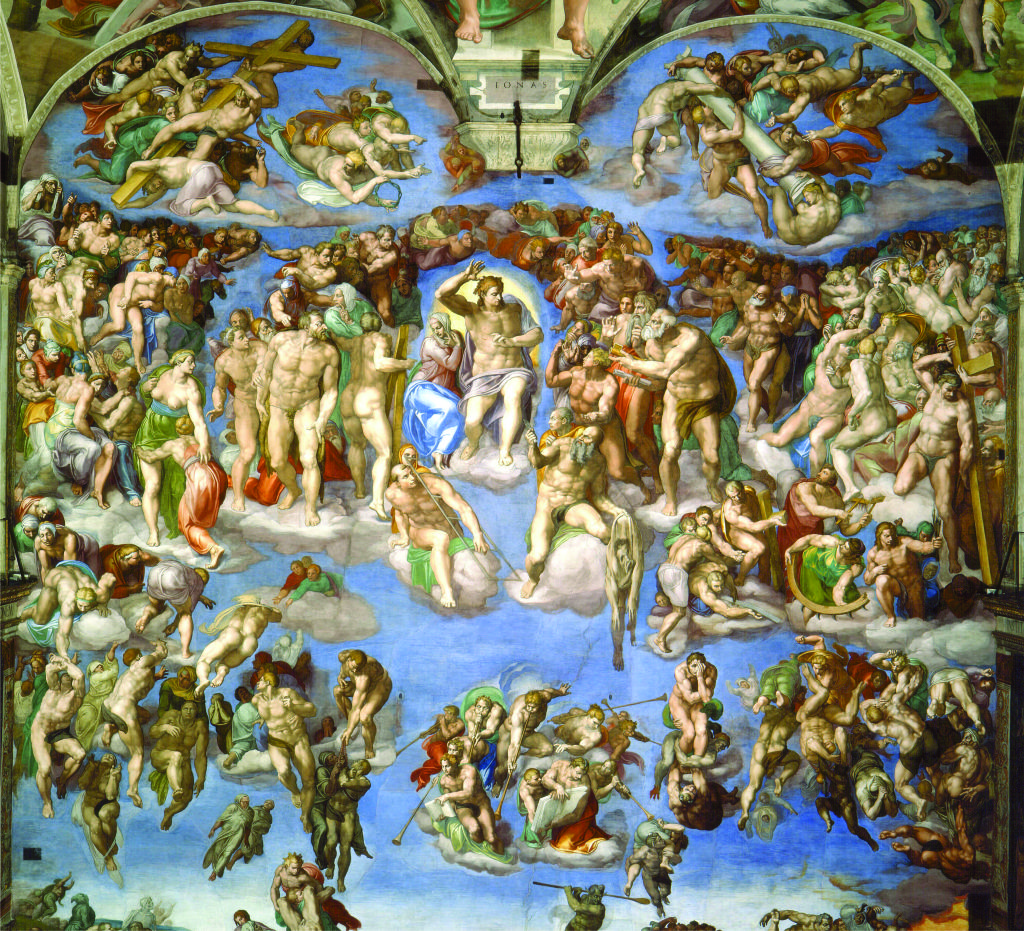
Last Judgment

Last Judgment, 1537 – 1541, Michelangelo and assistants, the Sistine Chapel in the Vatican, PD-Art-US

Is He Fair?

I hope God’s not fair, and so should you. The scriptures say: by the works of the law, no one is justified.

For all have sinned and fall short of God’s glory.

But, He has not dealt with us as our sins deserve.

He saves us, not because of righteous works we have done, but according to His mercy.

But, as a result of His work in us, we must show our faith by our works.

God, through His apostles and prophets, is blunt:

Let no one deceive himself. If anyone among you thinks that he is wise in this age, let him become a fool that he may become wise. For the wisdom of this world is folly with God. For it is written, “He catches the wise in their craftiness,” and again, “The Lord knows the thoughts of the wise, that they are futile.” 1 Corinthians 3:18-20 English Standard Version (ESV)

Therefore, repent and trust Him for life.

Last Judgment, Michelangelo Buonarroti

Last Judgment, 1537–41, Michelangelo Buonarroti (1475–1564), public domain in US

I Desire Mercy, and Not Sacrifice

The Lord Jesus Christ referred to this scripture twice as recorded in the gospels.

On the first occasion, His message seems to be: associate with the sin sick to bring them healing and exhort those, who consider themselves well and in no need of a doctor, that they need healing, too.

And as Jesus reclined at table in the house, behold, many tax collectors and sinners came and were reclining with Jesus and his disciples. And when the Pharisees saw this, they said to his disciples, “Why does your teacher eat with tax collectors and sinners?”  But when he heard it, he said, “Those who are well have no need of a physician, but those who are sick. Go and learn what this means, ‘I desire mercy, and not sacrifice.’ For I came not to call the righteous, but sinners.” Matthew 9:10-13 English Standard Version (ESV)

On the second occasion, He urged those who considered themselves righteous to obey the substance and not just the form of God’s commandments.

Or have you not read in the Law how on the Sabbath the priests in the temple profane the Sabbath and are guiltless? I tell you, something greater than the temple is here. And if you had known what this means, ‘I desire mercy, and not sacrifice,’ you would not have condemned the guiltless. For the Son of Man is lord of the Sabbath.” Matthew 12:5-8 (ESV)

Clearly, these folks thought themselves better than those around them.

But to what scripture (because the New Testament was not yet written) was the Lord referring? He quoted Hosea 6:6, but verses six and seven complete a thought.

For I desire steadfast love and not sacrifice, the knowledge of God rather than burnt offerings.

But like Adam they transgressed the covenant; there they dealt faithlessly with me.

Hosea 6:6-7 (ESV)

Textual notes indicate the term steadfast love is rendered mercy in the Septuagint (Greek translation of the Old Testament).

John Calvin comments on verse six:

It is a remarkable passage; the Son of God has twice quoted it. The Pharisees reproached him for his intercourse with men of bad and abandoned life, and he said to them in Matthew 9, ‘Mercy I desire, and not sacrifice.’ He shows, by this defense, that God is not worshipped by external ceremonies, but when men forgive and bear with one another, and are not above measure rigid. [emphasis added]

Again, in the Matthew 12, when the Pharisees blamed the disciples for gathering ears of corn, he said ‘But rather go and learn what this is, Mercy I desire, and not sacrifice.’ Inasmuch as they were so severe against his disciples, Christ shows that those who make holiness to consist in ceremonies are foolish worshipers of God; and that they also blamed their brethren without a cause, and made a crime of what was not in itself sinful, and what could be easily defended by any wise and calm expounder.

Calvin adds concerning verse seven:

God then subjoins a complaint, — But they like men have transgressed the covenant; there have they dealt treacherously against me. Here God shows that the Israelites boasted in vain of their sacrifices and of all the pomps of their external worship, for God did not regard these external things, but only wished to exercise the faithful in spiritual worship.

Then the import of the whole is this, “My design was, when I appointed the sacrifices and the whole legal worship, to lead you so to myself, that there might be nothing carnal or earthly in your sacrificing; but ye have corrupted the whole law; you have been perverse interpreters; for sacrifices have been nothing else among you but mockery as if it were a satisfaction to me to have an ox or a ram killed. You have then transgressed my covenant; and it is nothing that the people say to me, that they have diligently performed the outward ceremonies, for such a worship is not in the least valued by me.”

We can (and must) replace Calvin’s reference to ‘Israelites who boast in vain’ with the ‘unbelieving church of that age,’ for such they were. And we have these same with us today. It’s not as if they are unaware of the substance of proper worship, it’s just less costly (in the here and now) to practice merely the form of it.

At least two of these folks asked the Lord, “Which commandment is the most important of all?” He answered:

“You shall love the Lord your God with all your heart and with all your soul and with all your strength and with all your mind, and your neighbor as yourself.”

On another occasion He asked one of these folks how they understood the scriptures in a nutshell and they gave the same answer. To this one, the Lord said, “You have answered correctly; do this, and you will live.”

But, as we are prone to do, let us not go beyond what the scriptures say. The best example that comes to mind of mercy correctly applied is that demonstrated by the Lord.

The Woman taken in Adultery.  1644, Rembrandt (1606 – 1669), Public Domain

The Woman taken in Adultery. 1644, Rembrandt (1606 – 1669), Public Domain

Here’s the entire story from the source:

Early in the morning he came again to the temple. All the people came to him, and he sat down and taught them.  The scribes and the Pharisees brought a woman who had been caught in adultery, and placing her in the midst they said to him, “Teacher, this woman has been caught in the act of adultery. Now in the Law Moses commanded us to stone such women. So what do you say?” This they said to test him, that they might have some charge to bring against him.

Jesus bent down and wrote with his finger on the ground.  And as they continued to ask him, he stood up and said to them, “Let him who is without sin among you be the first to throw a stone at her.”  And once more he bent down and wrote on the ground.  

But when they heard it, they went away one by one, beginning with the older ones, and Jesus was left alone with the woman standing before him.  Jesus stood up and said to her, “Woman, where are they? Has no one condemned you?”  She said, “No one, Lord.” And Jesus said, “Neither do I condemn you; go, and from now on sin no more.”

So there we have it. When someone is repentant from the heart (and surely she was), the Lord says:

“Neither do I condemn you; go, and from now on sin no more.”

Go and do likewise.

Inflammation – Tomarick Fescidia

We Can Do It poster for Westinghouse, closely ...We used to be people who fulfilled our needs before our wants. We valued those things necessary for life. We saved for things we’d like to have if we were able. Sometimes we provided for needs to the exclusion of our wants so we’d have enough to share with others. Now we can’t wait to put on credit the newest electronics we saw unboxed online. We hold down multiple jobs to “sacrifice” for what we think we want. All the while, our families, relationships, and community fall by the wayside.

We used to live in places that had stories to tell. We valued the historical diversity of our nation. Now we all go down for our morning pick–me–up to the local franchise, offering the same experience in every city and town across the nation. We shop when we’re anxious, burn with passion for the latest trends, and forsake human companionship for electronic simulations of various forms and intensities.

When did we give up our culture? How did we become a consumer society? Why have we given ourselves over to our invisible overlords? To those who, however ineffectively, pull the strings which control our collective thoughts and actions. To them, it turns out, we, the American public, had a problem in need of a solution. What was our problem? Instability.

The solution was the active use of propaganda to direct the American collective unconscious towards social stability. You may remember, propaganda is the use of psychological manipulation or coercion to influence opinions and actions of individuals and groups toward stated or unstated goals. This was their chosen method to engineer the “consent of the governed.” Not the means that our founders intended when they penned those words, I’m afraid.

Propaganda in the twentieth century proved effective to promote democracy during World War I and the Final Solution during World War II. The same techniques were effective in regimenting and controlling the American public. Plans were instituted without many of us being aware of their influence. And there was money to be made for those who caught on. Lots of money.

Consent engineers, also known as public relations specialists, maintained that we Americans inherently distorted any information we took in. We made up our minds before we gathered and analyzed the relevant facts. We operated with partial facts corrupted by our preconceived prejudices and were unable to reach sound conclusions. Because of this situation, we were deemed incompetent to direct the public affairs of our democracy. An elite would rule the nation.

The specialists envisioned a utopia where individuals’ otherwise unconscious instinctual biological urges were controlled and directed by the elite to the service of some purposeful goal. Over the centuries, some societies built pyramids, some constructed hanging gardens, and many tried to rule the world. In our nation’s case, the goal was economic prosperity. The elites, which the specialists served, happened to own the means of mass production and directed the irrational desires of citizens to consume their wares. This had the simultaneous effect of satisfying the biological forces that might tear society apart.

By directing our own desires, the elites built a stable society. Citizens could work off their frustrations by spending on self-gratifying goods and services. These goods and services represented a common identity to which citizens were to adapt their self-images. Each citizen would acquire from what they consumed a sense of self, purpose, and history reflecting current attitudes and social patterns. The society and environment at large would also take on this immediacy and impermanence. No longer would we inherit our self–images or environs from previous generations.

Conscious and intelligent control was deemed important for democracy. Those who performed this duty were the real rulers who directed of the country. They used media tools to manipulate an unsuspecting public. The press release informed readers of the ‘news’ about events, products, or attitudes to adopt. Leaders were used, with or without their agreement, to sway those who followed them. Polling, focus groups, or other “democratic” means were employed to shape opinion rather than just measure it. Events, or better, spectacles, were created that purported to inform or celebrate when what was intended was to influence acceptance of new concepts and perceptions by the unconscious minds of many.

But weren’t they really tapping into humans’ ancient underlying motives. The scriptures say that the fear of death brings lifelong slavery. It was really this fear into which modern propaganda taps. Do I need to explain the concept of “duck and cover?”

They thought scientific manipulation of public opinion was necessary to overcome chaos and conflict in society. However, they knew that public relations propaganda could be used to subvert democracy as easily as it could be used to resolve conflict. It is in use to this day and we find ourselves at a crossroads.

None of this is new. It has been happening for millennia. All I did was gather the information in one place for you to read. I urge you to decouple from the hype, search your conscience and a Bible, if you’ve got one, and make changes starting with yourself first. Skip the hearty breakfast and don’t go shopping! Instead, find a church to participate in that reveres Christ, our only savior from our bodies of death. And let the love of Christ rule your reason and passions. Maybe we can still recover the life and community we’ve surely lost, before it’s too late.

Respect – Neal Knit Farrah

As you might anticipate from my name, I’m not necessarily a looker, one who stands out from the crowd or some suave international hipster. My middle name is a cruel joke my parents played on me, naming me after a hobby they both took up while waiting for me to be born. Since no one on either side of the family was named Neal I can only guess what they meant there. I’ve been dealing with the concept of respect, both theoretically and in practice, for a very long time.

Now our culture would have you believe that there is some special someone, your soul mate or that one who completes you. Actually, this is just a ruse to cut down on crime, war and unsanctioned anti-social behavior; a successful ruse, thankfully, but not the original intent.

We don’t hear these words anymore but I’ll quote them anyway: “Then the Lord God said, “It is not good that the man should be alone; I will make him a helper fit for him.”” A helper fit for him. Hmm, I wonder what that could mean. 

Perhaps it means what it says; it wasn’t good for him to be alone so He gave him one who was fit to help. Fit? That means suitable; more like ‘two peas in a pod’ than like ‘hand in a glove’ but you get the picture. Help? C’mon, you ever try to carry something heavy by yourself? Help!

When were either (they were both called Man, one male and the other female) going to be alone? All too soon. Driven from the ‘Tree of Life’ so they wouldn’t live forever in their fallen state, they were driven away from God’s presence, death’s real meaning.

So how does this all relate to respect? I bet you could tell me stories. But, this is my turn so here it goes. I found someone on a blind date. Unfortunately, I was a placeholder for the one she really wanted. Finding out and escaping with my soul wounded but intact, I was found by Christ.

One evening, among my peers, I was told this was my last chance to find a mate; I would have to make a decision one way or the other. I did not know the woman. We had never been more than acquaintances. I said no. What tragedy was needlessly perpetrated on her? Wouldn’t it have been kinder to say, “Do you really know him? Have you ever spoken heart to heart? What have you two decided together?” rather than try to broker some heroic “deal too far”?

No respect, no dignity.

Having been invited to dinner, I was plied with promised favors. Trying to be chaste, I declined. Her roommate brought up some rival. Fictional, I didn’t know? I wasn’t biting. Not long after, I was invited for coffee for one last chance at opportunity. I had to ask myself, “whose?”

No respect, no dignity.

One day I was introduced to a person with the explicit purpose of assessing whether I was mate material. This was her purpose, not mine. I only became aware of the ulterior motive after the fact. No doubt arranged by some well-meaning individual who wanted to fill a gap, meet a need or put me out of my ‘misery’. Or maybe they wanted me to be as happy as they were. And this happened in trusted circles. Just another way respect is in shortage.

 Perhaps you trade on your good looks (they fade), your status (it changes) or you just trade favors. Give these ways up. A long time ago, a taker, in a moment of candor, said “you have to figure out what you want out of life and get it”. I think you have to figure out what you want in life and give it. However, there are no guarantees for a return on your investment, at least not in this life. I want a help mate who fits. That will take respect and I plan to give it.