Pray for Peace

Where do we find ourselves now? Is this the country you thought you’d be living in? Are you fed up and ready to “burn it all down?” Or do the alternatives we have scare you? Imagine what exiles from their homelands must feel.

We have an example of just such exiles in the book of Jeremiah. The people of Judah and Jerusalem were taken captive to Babylon by Nebuchadnezzar. The prophet Jeremiah exhorted the exiles to live in obedience to God for seventy years, the term God decreed for their banishment. While in Babylon, to show obedience, they were to build houses, plant gardens, and establish families. And, in their obedience, they were to do one more thing for their captors:

But seek the welfare of the city where I have sent you into exile, and pray to the Lord on its behalf, for in its welfare you will find your welfare. Jeremiah 29:7 English Standard Version (ESV)

We find ourselves in a very turbulent time. Those who want to “take a chance” don’t know what they’re in for. Neither do I, really. However, in the midst of this we are called to pray for those we would otherwise oppose. A very hard thing to do, I have to admit. However, lately I’ve been praying:

“Make bad men and women good.”

This is a prayer Calvin had recommended nearly 500 years ago. His commentary on the passage in Jeremiah is challenging:

…By saying that their peace would be in the peace of Babylon, he [suggests] that they could not be considered as a separate people until the time of seventy years was completed. He therefore commanded them to pray for the prosperity of Babylon.

At the first view this may seem hard; for we know how cruelly that miserable people had been treated by the Chaldeans. Then to pray for the most savage enemies, might have appeared unreasonable and by no means suitable. But the Prophet mitigates the hardness of the work by saying, that it would be profitable to them to pray for the happy condition of Babylon, inasmuch as they were the associates of their fortune.

…The Prophet teaches the Jews that they ought not to refuse what was required from them, when God [commanded] them to pray for Babylon, because the prosperity of that kingdom would be for their benefit…They were so connected with Babylon, that they could not expect to be exempt from all trouble and annoyance, if any adversity happened to Babylon, for they were of the same body. We now perceive the meaning of the Prophet.

…Hence [we] deduce a very useful doctrine, — that we ought not only to obey the kings under whose authority we live, but that we ought also to pray for their prosperity, so that God may be a witness of our voluntary subjection.

In our voluntary subjection to God’s appointed ruler’s (even ones we do not like), we must also act for their good:

He not only [entreats] them patiently to endure the punishment laid on them, but also to be faithful subjects of their conqueror; he not only forbids them to be seditious, but he would have them to obey from the heart, so that God might be a witness of their willing subjection and obedience.

He says, Seek the peace of the city; this may be understood of prayers; for דרש, daresh, often means to pray: but it may suitably be taken here, as I think, in reference to the conduct of the people, as though he had said, that the Jews were to do what they could, to exert themselves to the utmost, so that no harm might happen to the Chaldean monarchy…

Of course, this means opposing criminal acts (those would not be for their ultimate good before God,) possibly even to our harm. We are called to “seek their peace.”

So, we have a high bar to meet based on this example from antiquity. Not only must we pray for the prosperity of God’s appointed rulers (even those He uses as scourges,) but, we must act for their good to prove our willing submission to God who rules all.

***

For those of us who hope in the Lord Jesus Christ’s atonement for our sins, let us pray what Calvin prayed in his day:

Grant, Almighty God, that we may be more and more [accustomed] to render obedience to [you], and that whenever [you chastise] us with [your] scourges, we may examine our own consciences, and humbly and suppliantly [seek to avert your] wrath, and never doubt but [you will] be [benevolent] to us, after having chastised us with [your fatherly] hand; and may we thus [rest] on [your paternal] kindness, that we may ever look forward with quiet minds, until the end appears, which [you have] promised to us, and that when the warfare of this present life shall be finished, we may reach that blessed rest, which has been prepared for us in heaven, through Christ our Lord. — Amen.

We, who wait for a Savior from heaven, know this world is not our own. We are exiles. We should pray for Kings such that we, and our neighbors, might lead peaceful and quiet lives, and all would be, in His providence, saved.

Fiery Furnace

God or Money?

Which will it be, God or money? The God spoken about in this context is the Father, the Son, and the Holy Spirit; one God in three persons. Money, or mammon, on the other hand, is any earthly means of exchange or gain (i.e., possessions).

While speaking with His disciples, the Lord Jesus Christ was overheard by the religious rulers of the day. They scoffed at what He said to His disciples:

“No servant can serve two masters, for either he will hate the one and love the other, or he will be devoted to the one and despise the other. You cannot serve God and money.” Luke 16:13 English Standard Version (ESV)

Christ then turned to these rulers and addressed how their heart attitudes kept them out of His Kingdom.

Christ spoke the same words to a different audience who listened intently to His Sermon on the Mount. He spoke about the heart attitude that His disciples and the crowds that followed Him should possess in the Kingdom of God. As part of that sermon, Christ said:

“No one can serve two masters, for either he will hate the one and love the other, or he will be devoted to the one and despise the other. You cannot serve God and money.” Matthew 6:24 (ESV)

Although the disciples were common to both groups, many in the first audience sneered at what He said and in the second, they hung on His every word.

John Calvin commented on this two-thousand-year-old chronicle over five hundred years ago:

No man can serve two masters. …[Christ] had formerly said, that the heart of man is bound and fixed upon its treasure; and he now gives warning, that the hearts of those who are devoted to riches are alienated from the Lord.

For the greater part of men are [inclined] to flatter themselves with a deceitful pretense, when they imagine, that it is possible for them to be divided between God and their own lusts. Christ affirms that it is impossible for any man to obey God, and, at the same time, to obey his own flesh…

We commonly call this a ‘divided heart.’ Calvin goes on:

True, it is not impossible that those who are rich shall serve God; but whoever gives himself up as a slave to riches must abandon the service of God: for covetousness makes us the slaves of the devil…

So it isn’t the riches themselves, so much as setting our hearts on those riches to the partial (or total) exclusion of Him. Calvin then extends this principle to all our vices.

…As God pronounces everywhere such commendations of sincerity, and hates a double heart, (1 Chronicles 12:33; Psalm 12:2); all are deceived, who imagine that he will be satisfied with the half of their heart…

The covetous, the voluptuaries, the gluttons, the unchaste, the cruel, all in their turn offer the same apology for themselves: as if it were possible for those to be partly employed in serving God, who are openly carrying on war against him.

But wait, we are beset with sins that, the scriptures say, so easily entangle us. Are we double minded and in danger of hell fire? To this, Calvin, the shepherd, says:

It is, no doubt, true, that believers themselves are never so perfectly devoted to obedience to God, as not to be withdrawn from it by the sinful desires of the flesh.

But as they groan under this wretched bondage, and are dissatisfied with themselves, and give nothing more than an unwilling and reluctant service to the flesh, they are not said to serve two masters: for their desires and exertions are approved by the Lord, as if they rendered to him a perfect obedience.

But this passage [Luke 16:13] reproves the hypocrisy of those who flatter themselves in their vices, as if they could reconcile light and darkness.

So there we have it. The question now becomes: “Do I serve the devil or do I serve the Lord.” For, we all have to serve somebody.

Serve Somebody, Johnny Q. Public, Lyrics by Bob Dylan

Faith Fail?

This was a critical time in the Lord Jesus Christ’s service to humankind. The ruling leadership was plotting his murder with one of His inner circle of disciples, Judas. Jesus had sent Peter and John ahead to prepare for a significant religious dinner celebration.

Then, at that dinner, while instructing His disciples of His impending death and resurrection, a controversy over who was the greatest disciple broke out. After Jesus taught them the meaning of humility and about their future roles as his disciples, He tells Peter how he will betray Him:

“Simon, Simon, behold, Satan demanded to have you, that he might sift you like wheat, but I have prayed for you that your faith may not fail. And when you have turned again, strengthen your brothers.” Peter said to him, “Lord, I am ready to go with you both to prison and to death.” Jesus said, “I tell you, Peter, the rooster will not crow this day, until you deny three times that you know me.” Luke 22:31–34 English Standard Version (ESV)

Calvin explains:

…When Christ formerly promised to his disciples the spirit of unshaken fortitude, he referred to a new state of things which followed the resurrection; and, therefore, as they were not yet [endowed] with heavenly power, Peter, forming confident expectations from himself, goes beyond the limits of faith.

…This claims our attention, that every man, remembering his own weakness, may earnestly resort to the assistance of the Holy Spirit [through prayer]; and next, that no man may venture to take more upon himself than what the Lord promises. [Thus,] Paul…enjoins us to:

…Work out our salvation with fear and trembling, because it is God that works in us to will and perform, (Philippians 2:12 – 13.)

…Therefore, whenever any temptation is presented to us, let us first remember our weakness, that, being entirely thrown down, we may learn to seek elsewhere [i.e., from God] what we need [i.e., His mercy and grace]; and, next, let us remember the grace which is promised, that it may free us from doubt.

So, we must rely on Christ and not on our own strength. However, this is not the end of the matter. Christ, through His servant Paul, challenges us:

Examine yourselves, to see whether you are in the faith. Test yourselves. Or do you not realize this about yourselves, that Jesus Christ is in you? — unless indeed you fail to meet the test! 2 Corinthians 13:5 (ESV)

And Calvin says:

…But what does Paul say here? He declares, that all are reprobates, who doubt whether they profess Christ and are a part of His body. Let us, therefore, reckon…right faith [is that] which leads us to [rest] in safety in the favor of God, with no wavering opinion, but with a firm and steadfast assurance.

They admonish us because God supplies saving faith; it is not our own doing:

For by grace you have been saved through faith. And this is not your own doing; it is the gift of God, not a result of works, so that no one may boast. For we are his workmanship, created in Christ Jesus for good works, which God prepared beforehand, that we should walk in them. Ephesians 2:8-10 (ESV)

Yet, facing ourselves more deeply, let us not forget the parable of the soils. As Christ explains:

Now the parable is this: The seed is the word of God. The ones along the path are those who have heard; then the devil comes and takes away the word from their hearts, so that they may not believe and be saved.

And the ones on the rock are those who, when they hear the word, receive it with joy. But these have no root; they believe for a while, and in time of testing fall away.

And as for what fell among the thorns, they are those who hear, but as they go on their way they are choked by the cares and riches and pleasures of life, and their fruit does not mature.

As for that in the good soil, they are those who, hearing the word, hold it fast in an honest and good heart, and bear fruit with patience.

Luke 8:11-15 (ESV)

Let us therefore exercise patience in our calling because He cannot fail; though we may:

My flesh and my heart may fail,

   but God is the strength of my heart and my portion forever.

Psalm 73:26 (ESV)

To this, Calvin reveals:

…There is here a contrast between the failing which David felt in himself and the strength with which he was divinely supplied; as if he had said, “Separated from God I am nothing, and all that I attempt to do ends in nothing; but when I come to him, I find an abundant supply of strength.”

It is highly necessary for us to consider what we are without God; for no man will cast himself wholly upon God, but he…who despairs of the sufficiency of his own powers. We will seek nothing from God but what we are conscious of [lacking] in ourselves.

Then, let us cast ourselves wholly upon Him that our faith may not fail.

The Denial of Saint Peter - Carravagio (1610)

The Denial of Saint Peter, circa 1610, by Michelangelo Merisi da Caravaggio (1571 – 1610), public domain in the United States

Where Are You?

On at least two recorded occasions, God has called out, “Where are you?” or words to that effect. The first call was in the garden of Eden at the beginning of creation:

And they heard the sound of the Lord God walking in the garden in the cool of the day, and the man and his wife hid themselves from the presence of the Lord God among the trees of the garden.

But the Lord God called to the man and said to him, “Where are you?” And he said, “I heard the sound of you in the garden, and I was afraid, because I was naked, and I hid myself.” He said, “Who told you that you were naked? Have you eaten of the tree of which I commanded you not to eat?”

Genesis 3:8-11 English Standard Version (ESV)

God created Man: Adam and Eve, gave them dominion over the earth, commanded them to obey one constraint, and placed them in the garden He created to tend it. Within a short time, by the will of God, their obedience to His one command was tested. They failed that test, and hid themselves because of their shame.

John Calvin comments on this crucial drama. First, he explains the nature of Adam’s and Eve’s fall:

Eve erred in not regulating the measure of her knowledge by the will of God…whereas the principal point of wisdom is a well-regulated sobriety in obedience to God.

…For the sake of complying with the wishes of his wife [and] being drawn by her into fatal ambition…[Adam] gave greater credit to the flatteries of the devil than to the sacred word of God.

God…manifest[s] himself to men…through the word, so…his majesty [is] maintained [and he is properly worshipped by us only] while we obey his word. Therefore, unbelief was the root of defection.

…They had been made in the likeness of God; but [they unlawfully aspired to] equality [with God by knowing good and evil].

As to the consequences of our ancestors’ fall, Calvin says:

…We are despoiled of the excellent gifts of the Holy Spirit, of the light of reason, of justice, and of rectitude, and are prone to every evil; that we are also lost and condemned, and subjected to death, is both our hereditary condition, and, at the same time, a just punishment which God, in the person of Adam, has indicted on the human race…From the time in which we were corrupted in Adam, we do not bear the punishment of another’s offense, but are guilty by our own fault.

Expounding on God’s confrontation of Adam and Eve in the garden, Genesis 3:8-11, Calvin says:

They had been already smitten by the voice of God, but they lay confounded under the trees…God now approaches nearer, and from the tangled thicket of trees draws him, however unwilling and resisting, forth into the midst…

Although this seems to be the confession of a dejected and humbled man, it will nevertheless soon appear that he was not yet properly subdued, nor led to repentance. He imputes his fear to the voice of God, and to his own nakedness…he fails to recognize the cause of shame in his sin; he, therefore, shows that he does not yet so feel his punishment, as to confess his fault.

…God [states] that Adam was admonished [prior to his disobedience]; and that he fell from no other cause than this, that he knowingly and voluntarily brought destruction upon himself.

Again, the atrocious nature of sin is marked in this transgression and rebellion; for, as nothing is more acceptable to God than obedience, so nothing is more intolerable than when men, having spurned his commandments, obey Satan and their own lust.

The second cry of “Where are you?” comes through other words from Christ on the Cross:

And about the ninth hour Jesus cried out with a loud voice, saying, “Eli, Eli, lema sabachthani?” that is, “My God, my God, why have you forsaken me?” Matthew 27:46 (ESV)

Calvin dissects this passage with help of old testament witnesses to Christ’s sufferings:

…Not only did he [i.e., Christ] offer his body as the price of our reconciliation with God, but in his soul also he endured the punishments due to us; and thus he became, as Isaiah speaks, a man of sorrows, (Is. 53:3.)

…When this temptation [i.e., being forsaken of God] was presented to Christ, as if, having God opposed to him, he were already devoted to destruction, he was seized with horror…but by the amazing power of the Spirit he achieved the victory.

In short, during this fearful torture his faith remained uninjured, so that, while he complained of being forsaken, he still relied on the aid of God as at hand.

Thus we see two diametrically opposite outcomes to similar events. God called to the first Adam, “Where are you?” The last Adam called to God “Why have you forsaken me?” The first Adam forsook his obedience to God’s word in exchange for his own self-exaltation. The last Adam overcame the temptation to reject God’s plan through faith in His Father’s promises. The Apostle Paul summarizes it nicely:

Therefore, as one trespass led to condemnation for all men, so one act of righteousness leads to justification and life for all men. For as by the one man’s disobedience the many were made sinners, so by the one man’s obedience the many will be made righteous. Romans 5:18-19 (ESV)

So, I must ask, where are you?

Ecce homo! (Behold the man!), by Antonio Ciseri, 1871

Pontius Pilate presenting a scourged Christ to the people, Ecce homo! (Behold the man!), (circa 1860–1880), by Antonio Ciseri (1821–1891), in the public domain in the United States

Tragic Wonders – Stories, Poems, and Essays to Ponder — An Excerpt

Tragic Wonders - Stories, Poems, and Essays to Ponder cover imageWhat if this world we live in is set up as a diabolical trap meant to prevent us from seeing that which is truly necessary? The anthology focuses on themes, situations, and emotions that are tragic, full of wonder, or, combined in some way, both.

In the stories, you’ll meet a serial killer, alien snails, a petulant eleven-year-old, a beloved astronaut, a laid-off worker, and many others. Two poems provide a transition from fiction to opinion. The short essays castigate, decry, praise, and skewer our personal, local, national, world, and cosmic conditions.

Mandated Memoranda’s second eBook, Tragic Wonders – Stories, Poems, and Essays to Ponder, edited by Ninja S. and Adolphus Writer, was first available December 2013. These writings are meant to engage readers in a reality that we all deny daily, whether we profess faith in Christ, are ambivalent, or are hostilely opposed to religion.

Click here to read an excerpt. Learn More on Amazon’s landing page.

Believe and Suffer

Some of us are bewildered when we face adversity, some expect it more often than it occurs, some chalk it up to mysterious forces, and some see it as highly probable at all times. What is certain in this life is that we will suffer at some time in our lives. For all of us, I wish it were as certain that we would all believe so as to be saved from the penalty that our sins deserve. The Apostle Paul wrote to the church in Philippi about believing and suffering:

Only let your manner of life be worthy of the gospel of Christ, so that whether I come and see you or am absent, I may hear of you that:

You are standing firm in one spirit

With one mind striving side by side for the faith of the gospel, and

Not frightened in anything by your opponents.

This is a clear sign to them of their destruction, but of your salvation, and that from God.

For it has been granted to you that for the sake of Christ you should not only believe in him but also suffer for his sake, engaged in the same conflict that you saw I had and now hear that I still have.

Philippians 1:27-30 English Standard Version (ESV)

Paul says God has granted them to believe in Him. But also, in an act of His Sovereign will, to suffer. Not any kind of suffering, but that according to His will, “for His sake.”

The reformer and preacher, John Calvin, makes at least three points about these verses. First, our common struggle against our sin, the world, and the devil unites us. Even if we’re divided by our sins against one another, the struggle is so great against us that we will reconcile and contend for the faith together.

Striving together for the faith…is the strongest bond of concord, …for this has often been the occasion of reconciling even the greatest enemies.

…The Apostle’s meaning is this: “Let the faith of the gospel unite you together, more especially as that is a common armory against one and the same enemy.”

The wicked, too, conspire together for evil, but their agreement is accursed: let us, therefore, contend with one mind under the banner of faith.

These struggles, and our patient suffering, are ordained and given by God as a sign of our salvation to us and to the enemies of the faith. These are both a benefit for our increased devotion and an honor to participate in His sufferings.

To you, says he, it is given, not only to believe in Christ, but also to suffer for him. Hence even the sufferings themselves are evidences of the grace of God; and, since it is so, you have from this source a token of salvation. Oh, if this persuasion were effectually [woven into] our minds — that persecutions are to be reckoned among God’s benefits, what progress would be made in the doctrine of piety!

…It is the highest honor…conferred upon us by Divine grace, that we suffer for his name either reproach, or imprisonment, or miseries, or tortures, or even death, for in that case he adorns us with his marks of distinction. But [many would] rather [that] God [refrain from giving] gifts of that nature, than embrace with [readiness] the cross when it is presented to them. Alas, then, for our stupidity!

Finally, Calvin stresses that our struggle and godly resistance is analogous, though far lesser, to Christ’s struggle and godly resistance on the cross. Yet, both faith and endurance remain His unmerited gifts to us, evident in our inability to resist in our own strength.

[Paul] wisely conjoins faith with the cross by an inseparable connection, [so] that the Philippians may know that they have been called to the faith of Christ on this condition — that they endure persecutions on His account, as though he had said that their adoption can no more be separated from the cross, than Christ can be torn asunder from himself.

Here Paul clearly testifies, that faith, as well as [faithfulness] in enduring persecutions, is an unmerited gift of God. And certainly the knowledge of God is a wisdom that is too high for our attaining it by our own acuteness, and our weakness shows itself in daily instances in our own experience, when God withdraws his hand for a little while…

May God grant you to believe and suffer for His sake.

Suffering and the Sovereignty of God: An Interview with R.C. Sproul Jr., Ligonier Ministries

Why We Use Scripture Extensively in Our Posts

It’s not because we’re lazy (but, if you knew me better, you might disagree.) Nor is it because we can’t write well; though you may disagree with this as well. It’s because His word is what He says He will use to save us from the penalty of death which our sins against Him alone so richly deserve. He says:

“For as the rain and the snow come down from heaven

   and do not return there but water the earth,

making it bring forth and sprout,

   giving seed to the sower and bread to the eater,

so shall my word be that goes out from my mouth;

   it shall not return to me empty,

but it shall accomplish that which I purpose,

   and shall succeed in the thing for which I sent it.

Isaiah 55:10-11 English Standard Version (ESV)

His purpose, His eternal purpose is realized in Christ and the Church. The Lord alone is the objective source of knowledge and action who has entered into what we consider our world. Of course, it is His and is His forever.

When He was drawing me to Himself, He made my reading from the scriptures irresistible. I remember dwelling in long passages from a large bible at the front of a main line church sanctuary so many years ago. Months later, when He was ready for me to submit to Him in repentance, He sent an evangelist who read from the scriptures in answer to my doubting questions. And I trusted in the Lord Jesus Christ that evening after that sent one left.

You might think: “What does this have to do with me; I’m doing okay. It’s you, Adolphus, who needs a crutch to face the inevitability of death.” Well, I thought the same back then; so did everyone who professes belief in the Lord Jesus Christ. It is His sovereign will that chooses and saves you. No one, by strength of will, can save themselves. Everyone, whether saved or not, will stand before God’s judgment seat and give an account of ourselves. It is only by the merit of His Son, the Lord Jesus Christ, conferred to us through faith that we can face that judgment and live. All others will be sent away from His presence.

I offer you, not only the links above, but this verse for your consideration:

“For God so loved the world, that he gave his only Son, that whoever believes in him should not perish but have eternal life. John 3:16 (ESV)

Please, we beg of you, repent and believe.

Albert Mohler: The Authority of Scripture, Ligonier Ministries

It’s Not About You

We live in a self-centered world. From identity politics to Twitter, FoMO to twenty-four-hour cable news, safe spaces to speech codes, we focus on what pleases us, amuses us, or fills us with self-importance. We think everything revolves around us and if it doesn’t, it should. We see it on campuses, on the campaign trail, and at international summits that ultimately do little to mitigate climate change in the end.

Our culture often frames this untenable condition in terms of unrequited love. The band, Scouting for Girls, sets this theme to a catchy tune. Please be aware that the lyrics contain mild innuendoes (yes, a trigger warning):

Scouting For Girls – It’s Not About You, Lyrics

To this situation we find ourselves in, we must say with the Apostle James:

From the same mouth come blessing and cursing. My brothers, these things ought not to be so.

James 3:10 English Standard Version (ESV)

Worse still, agreeing with the Apostle Paul, we see that we go along recklessly with them:

Though they know God’s righteous decree that those who practice such things deserve to die, they not only do them but give approval to those who practice them.

Therefore, you have no excuse, O man, every one of you who judges. For in passing judgment on another you condemn yourself, because you, the judge, practice the very same things.

Romans 1:32-2:1 (ESV)

But, the Lord Jesus, through the Apostle John, puts the matter in perspective:

Whoever loves his life loses it, and whoever hates his life in this world will keep it for eternal life.

John 12:25 (ESV)

Much has been written on the interpretation of this verse. Calvin says in part:

He who, under the influence of immoderate desire of the present life, cannot leave the world but by constraint, is said to love life; but he who, despising life, advances courageously to death, is said to hate life.

Not that we ought absolutely to hate life, which is justly reckoned to be one of the highest of God’s blessings;

but because believers ought to cheerfully lay it down, when it retards them from approaching to Christ;

just as a man, when he wishes to make haste in any matter, would shake off from his shoulders a heavy and disagreeable burden.

Further, we are to live for the good of others:

So we, though many, are one body in Christ, and individually members one of another. Love one another with brotherly affection. Outdo one another in showing honor. Live in harmony with one another. Do not be haughty, but associate with the lowly. Never be wise in your own sight.

Romans 12:5, 10, 16 (ESV)

Yet, if we’re honest with ourselves and others, we don’t give others honor or affection:

But if you bite and devour one another, watch out that you are not consumed by one another. Let us not become conceited, provoking one another, envying one another. Bear one another’s burdens, and so fulfill the law of Christ.

Galatians 5:15, 26; 6:2 (ESV)

But, if we trust the Father to do for us that which we do not do (i.e., change our behavior), then:

Therefore encourage one another and build one another up, just as you are doing. See that no one repays anyone evil for evil, but always seek to do good to one another and to everyone.

1 Thessalonians 5:11, 15 (ESV)

However, heed this admonition with a warning. Do not neglect it at your peril:

Beloved, let us love one another, for love is from God, and whoever loves has been born of God and knows God. If anyone says, “I love God,” and hates his brother, he is a liar; for he who does not love his brother whom he has seen cannot love God whom he has not seen. And this commandment we have from him: whoever loves God must also love his brother.

1 John 4:7, 20, 21 (ESV)

The Lord Jesus Christ offers us an escape from our self-centeredness, if only we’d trust in His saving work on the cross.

Why Are There Four Gospel Accounts?

From an historical perspective, theologian Louis Berkhof explains that:

…Matthew wrote for the Jews and characterized Christ as the great King of the house of David. Mark composed his Gospel for the Romans and pictured the Savior as the mighty Worker, triumphing over sin and evil. Luke in writing his Gospel had in mind the needs of the Greeks and portrayed Christ as the perfect man, the universal Savior. And John, composing his Gospel for those who already had a saving knowledge of the Lord and stood in need of a more profound understanding of the essential character of Jesus, emphasized the divinity of Christ, the glory that was manifested in his works…

Recently, I ran across an interesting conjecture about this question while researching my next book. However, while it was compelling, I thought it best to test this conjecture against what Calvin penned about the four gospels in his Commentaries.

The first thing to notice is that Calvin values the Gospel of John differently from the synoptic gospels of Matthew, Mark, and Luke.

Concerning John’s Gospel in relation to the other three, Calvin says:

Yet there is also this difference between them, which the other three are more copious in their narrative of the life and death of Christ, but John dwells more largely on the doctrine by which the office of Christ, together with the power of his death and resurrection, is unfolded.

…And as all of them had the same object in view, to point out Christ, the three former exhibit his body, if we may be permitted to use the expression, but John exhibits his soul.

On this account, I am accustomed to say that this Gospel [i.e., John’s] is a key to open the door for understanding the rest; for whoever shall understand the power of Christ, as it is here strikingly portrayed, will afterwards read with advantage what the others relate about the Redeemer who was manifested.

About Mark’s gospel, Calvin says:

Mark is generally supposed to have been the private friend and disciple of Peter. It is even believed that he wrote the Gospel, as it was dictated to him by Peter, and thus merely performed the office of an amanuensis or clerk. But on this subject we need not give ourselves much trouble, for it is of little importance to us, provided only we believe that he is a properly qualified and divinely appointed witness, who committed nothing to writing, but as the Holy Spirit directed him and guided his pen.

Of Luke:

Luke asserts plainly enough that he is the person who attended Paul.

And of Matthew, Calvin says:

Matthew is sufficiently known [from the Gospel accounts].

Summing up for all three:

…For we will not say that the diversity which we perceive in the three Evangelists was the object of express arrangement, but as they intended to give an honest narrative of what they knew to be certain and undoubted, each followed that method which he reckoned best. Now as this did not happen by chance, but by the direction of Divine Providence, so under this diversity in the manner of writing the Holy Spirit suggested to them an astonishing harmony, which would almost be sufficient of itself to secure credit to them, if there were no other and stronger evidences to support their authority.

Note that John had intimate access with God and man and later in life, much knowledge and love.

Matthew (called Levi) was a Hebrew civil official collecting Roman taxes, despised by his countrymen, and was grateful to leave all behind.

Peter (and perhaps Mark) worked with his hands, was bold, impulsive, and spoke well  extemporaneously.

Luke was a physician who set out to document both the life of Jesus and the Acts of the Apostles meticulously.

The conclusion of the preceding exposition brings us to the source of the conjecture.

David Keirsey’s book Please Understand Me is a useful reference for writers who want to fully flesh out their characters.

He says Hippocrates and Galen observed that there are four personality types. Later scientists refined their observations by identifying four distinctions within each type. We’ll review Keirsey’s take on the four personality types via several posts over the next few weeks (possibly interspersed among other postings on different topics).

In the book’s notes section, Keirsey relates the four main personality types to the gospel writers:

Artisan (SP) — Bold, Works with Hands, Extemporaneous, Present Oriented — Peter (with amanuensis Mark)

Guardian (SJ) — Administrative, Works with Resources, Desires Respect, Past Oriented — Matthew

Rational (NT) — Reasoning, Works in Sciences, Seeks Knowledge, Period Oriented — Luke

Idealist (NF) — Empathetic, Works with People, Sagacious, Future Oriented — John

These are the Gospel author’s predispositions. Their experiences molded them, as far as they were willing and able, so that they acquired attributes of the other personality types. These attributes in total could be said to be their overall dispositions.

Although God may choose to relate to our predispositions through the Gospel writers, once He gets hold of us, He conforms us to His Son’s likeness as His sons and daughters.

None of the four writers seemed more transformed than Peter who, in his second letter to the churches, documents instruction for and prophesy of the future as his provision for the saints:

I think it right, as long as I am in this body, to stir you up by way of reminder, since I know that the putting off of my body will be soon, as our Lord Jesus Christ made clear to me. And I will make every effort so that after my departure you may be able at any time to recall these things. 2 Peter 1:13-15 English Standard Version (ESV)

Of course, the number “four” is a common theme throughout the bible.

Four Horsemen of the Apocalype

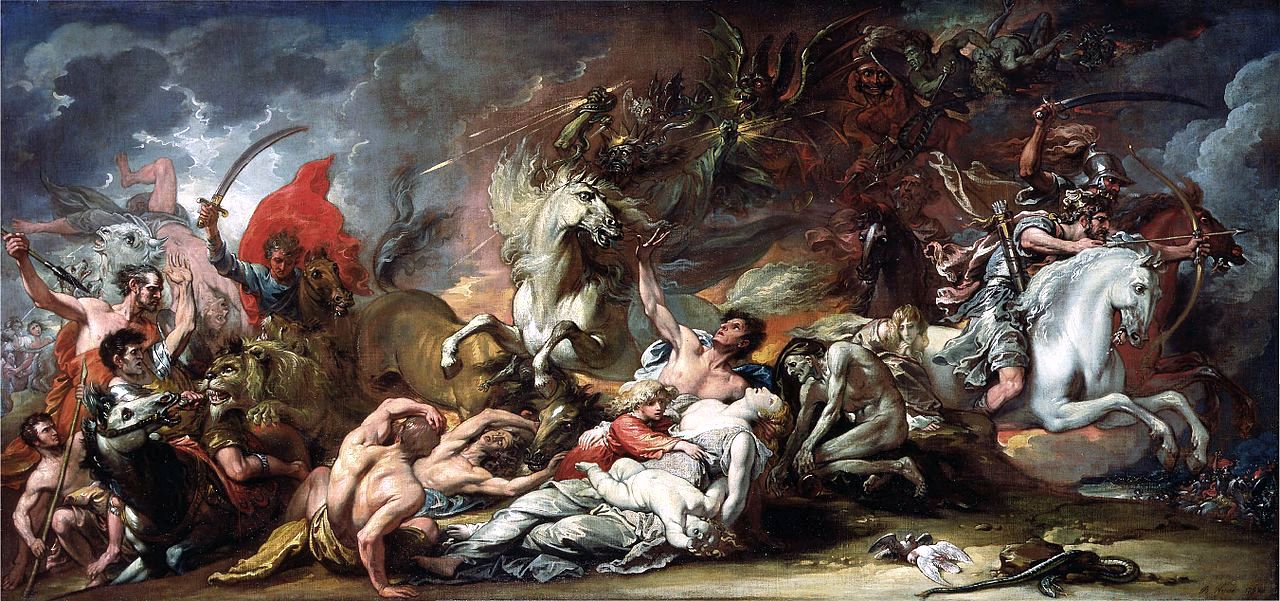
Death on a Pale Horse is a version of the traditional subject, Four Horsemen of Revelation, 1796, Benjamin West (1738 – 1820), in the public domain in the US

Live Move Be

The words in the title of this week’s post are found in Oprah’s favorite bible verse:

She says these are words to live by. The verse in its entirety is:

For

   “‘In him we live and move and have our being’;[a]

as even some of your own poets have said,

   “‘For we are indeed his offspring.’”[b]

Footnotes: a. Probably from Epimenides of Crete; b. From Aratus’s poem “Phainomena”

Acts 17:28 English Standard Version (ESV)

Calvin comments:

For in him. …We have our being in him, inasmuch as by His Spirit he keeps us in life, and upholds us. For the power of the Spirit is spread abroad throughout all parts of the world, that it may preserve them in their state; that He may minister unto the heaven and earth that force and vigor which we see, and motion to all living creatures.

Then Calvin corrects a possible misinterpretation:

Not as brain-sick men do trifle, that all things are full of gods, yea, that stones are gods; but because God does, by the wonderful power and inspiration of His Spirit, preserve those things which He hath created of nothing…

He explains why the Apostle Paul would use such non-biblical sources:

Certain of your poets. [Paul] cites half a verse out of Aratus, not so much for authority’s sake, as that he may make the men of Athens ashamed; for such sayings of the poets came from no other fountain save only from nature and common reason.

Neither is it any marvel if Paul, who spoke unto men who were infidels and ignorant of true godliness, [did] use the testimony of a poet, wherein was [present] a confession of that knowledge which is naturally engraved in men’s minds…

Focusing on the meaning of the poetry itself, Calvin says:

…It may be that Aratus did imagine that there was some parcel of the divinity in men’s minds, as the [Manicheans] did say, that the souls of men are of the nature of God…

But this invention ought not to have hindered Paul from retaining a true maxim, though it were corrupt with men’s fables, that men are the generation of God, because by the excellency of nature they resemble some divine thing.

Finally, Calvin relates the poetical expressions to that which God explains throughout scripture:

This is that which the Scripture teaches, that we are created after the image and similitude of God, (Genesis 1:27.)

The same Scripture teaches also, in many places, that we be made the sons of God by faith and free adoption when we are engrafted into the body of Christ, and being regenerate by the Spirit, we begin to be new creatures, (Galatians 3:26.)

And certainly, God’s scriptures are words to live by.