On the Surface – Part III

This is the third post on the topic of outward appearances versus heart attitudes. Our first post reviewed Jonathan Edward’s thoughts on wheat and tares in the church. A second post explored Abel’s obedience and Cain’s disobedience to God. This post examines our relationship to God the Father. The apostle Peter warns us:

If you call on him as Father who judges impartially according to each one’s deeds, conduct yourselves with fear throughout the time of your exile. 1 Peter 1:17 English Standard version (ESV)

Calvin comments:

And if you call on the Father …From the character of the Father himself, [the apostle Peter] shows what sort of obedience ought to be rendered. [God] judges, he says, without looking on the person, that is, no outward mask is of any account with him, as the case is with men, but he sees the heart, (1 Samuel 16:7) and his eyes look on faithfulness. (Jeremiah 5:3) This also is what Paul means when he says that God’s judgment is according to truth, (Romans 2:2) for he there inveighs against hypocrites, who think that they deceive God by a vain pretense.

The meaning is, that we by no means discharge our duty towards God, when we obey him only in appearance; for he is not a mortal man, whom the outward appearance pleases, but he reads what we are inwardly in our hearts. He not only prescribes laws for our feet and hands, but he also requires what is just and right as to the mind and spirit.

A person might hide their defection from all others, but not from Him. Calvin then shows how Peter presses home the lesson:

According to every man’s work He does not refer to merit or to reward; for Peter does not speak here of the merits of works, nor of the cause of salvation, but he only reminds us, that there will be no looking to the person before the tribunal of God, but that what will be regarded will be the real sincerity of the heart…

The fear that is mentioned, stands opposed to heedless security, such as is wont to creep in, when there is a hope of deceiving with impunity. For, as God’s eyes are such that they penetrate into the hidden recesses of the heart, we ought to walk with him carefully and not negligently.

He calls the present life a sojourning [i.e., time of your exile], not in the sense in which he called the Jews to whom he was writing sojourners, at the beginning of the Epistle, but because all the godly are in this world pilgrims. (Hebrews 11:13,38)

This world is not our home. We all travel to one destination or the other. Therefore, seek the Lord while he may be found.

R.C. Sproul – Fear and Trembling – Fear and Trembling, JvDaP

Two Natures – Distinct Yet United

Last week I reported on “Christ’s Human Nature.” There, the fourth point of John Flavel’s sermon: “Of Christ’s wonderful Person,” on John 1:14, in his book: Fountain of Life Opened Up, caught my attention:

Fourthly, [Christ’s] human nature is so united with the divine, as that each nature still retains its own essential properties distinct… The divine and human are not confounded; but a line of distinction runs betwixt them still in this wonderful person…

If you have the time and patience, I urge you to read his entire sermon. He offers sound doctrine on Christ’s human nature.

Flavel’s point got me wondering. Was the distinction and union obvious in scripture, would it prove Flavel’s points, and did John Calvin have insight that might help us to understand Christ better? What jumped to mind was the Lord’s struggle-in-prayer in the garden before He was betrayed as recounted in the synoptic gospels of Matthew, Mark, and Luke:

And going a little farther he fell on his face and prayed, saying, “My Father, if it be possible, let this cup pass from me; nevertheless, not as I will, but as you will.” Matthew 26:39 English Standard Version (ESV)

And

And he said, “Abba, Father, all things are possible for you. Remove this cup from me. Yet not what I will, but what you will.” Mark 14:36 (ESV)

And

Saying, “Father, if you are willing, remove this cup from me. Nevertheless, not my will, but yours, be done.” Luke 22:42 (ESV)

Even though the wording is different in the three accounts, in each, He defers to His Father’s will rather than His own. Was this the quintessential example of the distinct natures united?

Calvin addresses many possible questions we (and others) might have when reading Christ’s entreaty of His Father. However, to achieve some semblance of brevity, we’ve assembled those answers that are most relevant to our questions:

My Father, if it be possible. …We must remember…that Christ [did not have] confused emotions, like those to which we are accustomed, to withdraw his mind from pure moderation; but, so far as the pure and innocent nature of man could admit, he was struck with fear and seized with anguish, so that, amidst the violent shocks of temptation, he vacillated—as it were—from one wish to another. This is the reason why, after having prayed to be freed from death, he immediately restrains himself, and, submitting to the authority of the Father, corrects and recalls that wish which had suddenly escaped him…

But yet not as I will, but as thou wilt. …What led him to pray to be delivered from [His own physical] death was the dread of a greater evil. When he saw the wrath of God exhibited to him, as he stood at the tribunal of God charged with the sins of the whole world, he unavoidably shrunk with horror from the deep abyss of death…When Christ was struck with horror at the divine curse, the feeling of the flesh affected him in such a manner, that faith still remained firm and unshaken. For such was the purity of his nature, that he felt, without being wounded by them, those temptations which pierce us with their stings.

…in Christ there was a remarkable example of adaptation between the two wills, the will of God and the will of man, so that they differed from each other without any conflict or opposition…for Christ, as he was God, willed nothing different from the Father; and therefore it follows, that his human soul had affections distinct from the secret purpose of God…Christ was under the necessity of holding his will captive, in order to subject it to the government of God, though it was properly regulated.

The lesson Calvin draws for us based on the various questions we’ve included and omitted is:

…In the present corruption of our nature it is impossible to find ardor of affections accompanied by moderation, such as existed in Christ; but we ought to give such honor to the Son of God, as not to judge of him by what we find in ourselves.

In this light, his application is:

…How carefully ought we to repress the violence of our feelings, which are always inconsiderate, and rash, and full of rebellion? …We owe to God such obedience as to endure patiently that our wishes should not be granted; For the modesty of faith consists in permitting God to appoint differently from what we desire. Above all, when we have no certain and special promise, we ought to abide by this rule, not to ask anything but on the condition that God shall fulfill what he has decreed; which cannot be done, unless we give up our wishes to his disposal.

In his sermon, Flavel gives an excellent explanation of the differences between Christ and ourselves. Calvin drives home the point with how, given His example, we should endure our inevitable trials of faith. May the Lord Jesus Christ grant us obedience in these trials.

Garden of Gethsemane, Mount of Olives, Jerusalem

Garden of Gethsemane, Mount of Olives, Jerusalem, 16 November 2012, by Tango7174, used under Creative Commons Attribution-Share Alike 4.0 International, 3.0 Unported, 2.5 Generic, 2.0 Generic, and 1.0 Generic licenses

In Spirit and in Truth

How do we worship? Is it by actions or by attitudes? Do feeling count? Is there one right way, place, and time? As Jesus Christ confronted the Samaritan woman at the well with the truth of who He is, He said:

But the hour is coming, and is now here, when the true worshipers will worship the Father in spirit and truth, for the Father is seeking such people to worship him. God is spirit, and those who worship him must worship in spirit and truth.” John 4:23-24 English Standard Version (ESV)

Remarkably, in this statement lie answers for the questions with which we opened this post. Calvin comments on the passage:

But the hour cometh. …To show that God does not choose to be worshipped either in Jerusalem or in mount Gerizim, he takes a higher principle, that the true worship of Him consists in the spirit; …hence it follows that in all places He may be properly worshipped.

Why, and in what sense, is the worship of God called spiritual? The worship of God is said to consist in the spirit, because it is nothing else than that inward faith of the heart which produces prayer, and, next, purity of conscience and self-denial, that we may be dedicated to obedience to God as holy sacrifices.

But the Old Testament Church had elaborate ceremonies in their public worship. Did they worship in spirit and truth under the Law?

I reply, as God is always like himself, he did not from the beginning of the world approve of any other worship than that which is spiritual, and which agrees with his own nature. …Moses…declares in many passages that the Law has no other object than that the people may cleave to God with faith and a pure conscience.

…Thus we may justly say that the worship [described in] the Law was spiritual in its substance, but, in respect of its form, it was somewhat earthly and carnal; for the whole of that economy, the reality of which is now fully manifested, consisted of shadows.

…In all ages God wished to be worshipped by faith, prayer, thanksgiving, purity of heart, and innocence of life; and at no time did he delight in any other sacrifices.

But what about public worship in today’s visible Church?

…There are indeed among ourselves, in the present day, some outward exercises of godliness, which our weakness renders necessary, but such is the moderation and sobriety of them, that they do not obscure the plain truth of Christ. In short, what was exhibited to the fathers under figures and shadows is now openly displayed.

…Thus all who oppress the Church with an excessive multitude of ceremonies, do what is in their power to deprive the Church of the presence of Christ. I [dismiss] the vain excuses which they plead, that many persons in the present day have as much need of those aids as the Jews had in ancient times. It is always our duty to inquire by what order the Lord wished his Church to be governed, for He alone knows thoroughly what is expedient for us.

So why was there a difference between the Old and New Testament Churches?

The true worshippers. … Knowing that the world would never be entirely free from superstitions, [Christ] thus separates the devout and upright worshippers from those who were false and hypocritical.

…What it is to worship God in spirit and truth appears clearly from what has been already said. It is to lay aside the entanglements of ancient ceremonies, and to retain merely what is spiritual in the worship of God; for the truth of the worship of God consists in the spirit, and ceremonies are but a sort of appendage.

Finally, why is worship not elaborate ceremony but in spirit and truth?

God is a Spirit. …God is so far from being like us, that those things which please us most are the objects of his loathing and abhorrence…As we cannot ascend to the height of God, let us remember that we ought to seek from His word the rule by which we are governed. Christ simply declares here that his Father is of a spiritual nature, and, therefore, is not moved by frivolous matters, as men, through the lightness and unsteadiness of their character, are wont to be.

***

As Mark Dever preaches, our whole lives are acts of worship if they’re lived in obedience to God. Our public worship consists of: prayer, singing, hearing the Word read, hearing the Word preached, and participating in baptism and the Lord’s supper. Worship is hearing God’s word and responding to it in obedience.

Mark Dever: Worship in Spirit and Truth, Ligonier Ministries

Why Do You Look at Me That Way?

Don’t you hate it when your significant other gives you that look? You know what they mean. Maybe what you’re doing is something they warned you off months ago and there you are doing it again. They told you about how it hurt them when you did it. You even had words over it. May be you told them you’d never do it again.

The Apostle Peter had a similar experience but the stakes were much higher. Warned by Christ that the devil sought to have him and sift him like wheat, Peter said he’d follow Him to prison and death, if necessary. Then the Lord told Peter he’d deny Him three times.

He followed the Lord into the High priest’s courtyard after His arrest. There, Peter was confronted by three people about his association with Jesus the Galilean. He denied Him each time. The final encounter went like this:

And after an interval of about an hour still another insisted, saying, “Certainly this man also was with him, for he too is a Galilean.” But Peter said, “Man, I do not know what you are talking about.” And immediately, while he was still speaking, the rooster crowed.

And the Lord turned and looked at Peter. And Peter remembered the saying of the Lord, how he had said to him, “Before the rooster crows today, you will deny me three times.” And he went out and wept bitterly.

Luke 22:59-62 English Standard Version (ESV)

All four Gospel accounts report Peter’s denial.

The pastor and preacher, John Calvin, draws insight from Peter’s denial and repentance.

And Peter remembered the word of Jesus. …Which of us does not pass by with indifference and with deaf ears…[to] even the voice of God, which is heard clearly and distinctly in the doctrine of the Law and of the Gospel? Nor is it for a single day only that our minds are held by such brutal [senselessness], but it is perpetual until he who alone turns the hearts of men [condescends] to look upon us.

…Observe, however, that this was no ordinary look, for he had formerly looked at Judas who, after all, became no better by it. But in looking at Peter, he added to his eyes the secret efficacy of the Spirit, and thus by the rays of his grace, penetrated into his heart…Therefore know, that whenever anyone has fallen, his repentance will never begin, until the Lord has looked at him.

As Calvin says, this was no ordinary look that Christ gave Peter but one leading to repentance.

And he went out and wept bitterly. It is probable that Peter went out [to weep] through fear [and weakness] …We infer that he did not deserve pardon by satisfaction, but that he obtained it by the fatherly kindness of God…By this example, …we ought to [have] confident hope [that] God does not despise even weak repentance, provided that it be sincere.

…For we see many who shed tears purposely, so long as they are beheld by others, but who have no sooner retired than they have dry eyes. …Tears, which do not flow on account of the judgment of God, are often drawn forth by ambition and hypocrisy.

But, is weeping requisite in true repentance? …Believers often with dry eyes groan before the Lord without hypocrisy, and confess their fault to obtain pardon; but in more aggravated offenses they must be in no ordinary degree [thoughtless] and hardened, whose hearts are not pained by grief and sorrow, and who do not feel ashamed even so far as to shed tears…

Though tears should flow at our grieving the Lord with our sin, He is gracious to forgive us in light of even the weakest repentance if it proceeds from a sincere heart. My wish is for His look to drive me to repentance as often as I need. Is that yours?

Peter's Denial - Rembrandt

St. Peter’s Denial, Rembrandt (1606–1669), public domain in the United States

Pray for Peace

Where do we find ourselves now? Is this the country you thought you’d be living in? Are you fed up and ready to “burn it all down?” Or do the alternatives we have scare you? Imagine what exiles from their homelands must feel.

We have an example of just such exiles in the book of Jeremiah. The people of Judah and Jerusalem were taken captive to Babylon by Nebuchadnezzar. The prophet Jeremiah exhorted the exiles to live in obedience to God for seventy years, the term God decreed for their banishment. While in Babylon, to show obedience, they were to build houses, plant gardens, and establish families. And, in their obedience, they were to do one more thing for their captors:

But seek the welfare of the city where I have sent you into exile, and pray to the Lord on its behalf, for in its welfare you will find your welfare. Jeremiah 29:7 English Standard Version (ESV)

We find ourselves in a very turbulent time. Those who want to “take a chance” don’t know what they’re in for. Neither do I, really. However, in the midst of this we are called to pray for those we would otherwise oppose. A very hard thing to do, I have to admit. However, lately I’ve been praying:

“Make bad men and women good.”

This is a prayer Calvin had recommended nearly 500 years ago. His commentary on the passage in Jeremiah is challenging:

…By saying that their peace would be in the peace of Babylon, he [suggests] that they could not be considered as a separate people until the time of seventy years was completed. He therefore commanded them to pray for the prosperity of Babylon.

At the first view this may seem hard; for we know how cruelly that miserable people had been treated by the Chaldeans. Then to pray for the most savage enemies, might have appeared unreasonable and by no means suitable. But the Prophet mitigates the hardness of the work by saying, that it would be profitable to them to pray for the happy condition of Babylon, inasmuch as they were the associates of their fortune.

…The Prophet teaches the Jews that they ought not to refuse what was required from them, when God [commanded] them to pray for Babylon, because the prosperity of that kingdom would be for their benefit…They were so connected with Babylon, that they could not expect to be exempt from all trouble and annoyance, if any adversity happened to Babylon, for they were of the same body. We now perceive the meaning of the Prophet.

…Hence [we] deduce a very useful doctrine, — that we ought not only to obey the kings under whose authority we live, but that we ought also to pray for their prosperity, so that God may be a witness of our voluntary subjection.

In our voluntary subjection to God’s appointed ruler’s (even ones we do not like), we must also act for their good:

He not only [entreats] them patiently to endure the punishment laid on them, but also to be faithful subjects of their conqueror; he not only forbids them to be seditious, but he would have them to obey from the heart, so that God might be a witness of their willing subjection and obedience.

He says, Seek the peace of the city; this may be understood of prayers; for דרש, daresh, often means to pray: but it may suitably be taken here, as I think, in reference to the conduct of the people, as though he had said, that the Jews were to do what they could, to exert themselves to the utmost, so that no harm might happen to the Chaldean monarchy…

Of course, this means opposing criminal acts (those would not be for their ultimate good before God,) possibly even to our harm. We are called to “seek their peace.”

So, we have a high bar to meet based on this example from antiquity. Not only must we pray for the prosperity of God’s appointed rulers (even those He uses as scourges,) but, we must act for their good to prove our willing submission to God who rules all.

***

For those of us who hope in the Lord Jesus Christ’s atonement for our sins, let us pray what Calvin prayed in his day:

Grant, Almighty God, that we may be more and more [accustomed] to render obedience to [you], and that whenever [you chastise] us with [your] scourges, we may examine our own consciences, and humbly and suppliantly [seek to avert your] wrath, and never doubt but [you will] be [benevolent] to us, after having chastised us with [your fatherly] hand; and may we thus [rest] on [your paternal] kindness, that we may ever look forward with quiet minds, until the end appears, which [you have] promised to us, and that when the warfare of this present life shall be finished, we may reach that blessed rest, which has been prepared for us in heaven, through Christ our Lord. — Amen.

We, who wait for a Savior from heaven, know this world is not our own. We are exiles. We should pray for Kings such that we, and our neighbors, might lead peaceful and quiet lives, and all would be, in His providence, saved.

Fiery Furnace

Confused Language

A recent Economist magazine review on Noam Chomsky’s work [paywall] comments:

Since he wrote “Syntactic Structures” in 1957, Mr. Chomsky has argued that human language is fundamentally different from any other kind of communication, that a “linguist from Mars” would agree that all human languages are variations on a single language, and that children’s incredibly quick and successful learning (despite often messy and inattentive parental input) points to an innate language faculty in the brain.

This view is remarkably accurate, especially considering the differences between Western and Eastern languages. The Economist review goes on to say that Chomsky and a computer scientist, Robert Berwick, claim to explain the evolution of human language in their new book titled: Why Only Us. Perhaps they’re wrong?

For a different perspective, it’s worthwhile reading the entire biblical account of this phenomenon.

Now the whole earth had one language and the same words. And as people migrated from the east, they found a plain in the land of Shinar and settled there. And they said to one another, “Come, let us make bricks, and burn them thoroughly.” And they had brick for stone, and bitumen for mortar. Then they said, “Come, let us build ourselves a city and a tower with its top in the heavens, and let us make a name for ourselves, lest we be dispersed over the face of the whole earth.”

And the Lord came down to see the city and the tower, which the children of man had built. And the Lord said, “Behold, they are one people, and they have all one language, and this is only the beginning of what they will do. And nothing that they propose to do will now be impossible for them. Come, let us go down and there confuse their language, so that they may not understand one another’s speech.”

So the Lord dispersed them from there over the face of all the earth, and they left off building the city. Therefore, its name was called Babel, because there the Lord confused the language of all the earth. And from there the Lord dispersed them over the face of all the earth.

Genesis 11:1-9 English Standard Version (ESV)

So the choice is stark. Either we have different languages because they “evolved” that way. Or we reaped what we sowed in trying to “make a name for ourselves.” And we did; just not a good name. Let’s see what Calvin has to say on this scripture passage.

And the Lord came down. …Moses…intimates that God, for a little while, seemed to take no notice of them… For [God] frequently bears with the wicked [such] that he not only suffers them to contrive many nefarious things, as if he were [unconcerned;] but even further[s] their impious and perverse designs with animating success, in order that he may at length cast them down to a lower depth.

Behold, the people is one. …God complains of a wickedness in men…to teach us [not that he is swayed by any passions, but] that he is not negligent of human affairs, and that, as he watches for the salvation of the faithful, so he is intent on observing the wickedness of the ungodly; as it is said in Psalm 34:16,

“The face of the Lord is against them that do evil, to cut off the remembrance of them from the earth.”

Go to, let us go down. …[God] declares that the work which they supposed could not be retarded, shall, without any difficulty, be destroyed…This example of Divine vengeance belongs to all ages: for men are always inflamed with the desire of daring to attempt what is unlawful. And this history shows that God will ever be averse to such counsels and designs; so that we here behold, depicted before our eyes what Solomon says:

‘There is no counsel, nor prudence, nor strength against the Lord,’ (Proverbs 21:30)

Unless the blessing of God be present, from which alone we may expect a prosperous issue, all that we attempt will necessarily perish.

So the Lord scattered them abroad. Men had already been spread abroad [by virtue of] the benediction and grace of God. But those whom the Lord had before distributed with honor in various abodes, he now ignominiously scatters[as] a violent rout, because the principal bond…between them was cut asunder.

Therefore, the name of it [is] called Babel. …What [did] they gain by their foolish ambition to acquire a name[?] They hoped that an everlasting memorial of their origin would be engraven on the tower… [However,] they [did] gain a name, but not each as they would have chosen: thus does God opprobriously cast down the pride of those who usurp to themselves honors to which they have no title.

However, Calvin points out God’s mercy and grace through all this:

Now, although the world bears this curse to the present day; yet, in the midst of punishment…the admirable goodness of God is rendered conspicuous, …because He has proclaimed one gospel, in all languages, through the whole world…

…They who before were miserably divided, have coalesced in the unity of the faith. In this sense Isaiah says, that the language of Canaan should be common to all under the reign of Christ, (Isaiah 19:18); because, although their language may differ in sound, they all speak the same thing, while they cry, “Abba, Father.”

***

What always stands out to me in this Genesis scripture account is the verse: “And nothing that they propose to do will now be impossible for them.” This was God’s assessment of us when we had one language. With increasing consolidation around a few key languages and advances in CRISPR, AI, and nuclear annihilation, we may still do on a global scale what should have remained impossible for men to do.

Because of these things, but not only these, I urge you to embrace that other human impossibility:

It is easier for a camel to go through the eye of a needle than for a rich person to enter the kingdom of God.” And they were exceedingly astonished, and said to him, “Then who can be saved?” Jesus looked at them and said, “With man it is impossible, but not with God. For all things are possible with God.” Mark 10:25-27 (ESV)

Please enter His kingdom, now.

Tower of Babel - Bruegel

The Tower of Babel, 1563, Pieter Brueghel the Elder (1526/1530–1569), public domain in the United States

God or Money?

Which will it be, God or money? The God spoken about in this context is the Father, the Son, and the Holy Spirit; one God in three persons. Money, or mammon, on the other hand, is any earthly means of exchange or gain (i.e., possessions).

While speaking with His disciples, the Lord Jesus Christ was overheard by the religious rulers of the day. They scoffed at what He said to His disciples:

“No servant can serve two masters, for either he will hate the one and love the other, or he will be devoted to the one and despise the other. You cannot serve God and money.” Luke 16:13 English Standard Version (ESV)

Christ then turned to these rulers and addressed how their heart attitudes kept them out of His Kingdom.

Christ spoke the same words to a different audience who listened intently to His Sermon on the Mount. He spoke about the heart attitude that His disciples and the crowds that followed Him should possess in the Kingdom of God. As part of that sermon, Christ said:

“No one can serve two masters, for either he will hate the one and love the other, or he will be devoted to the one and despise the other. You cannot serve God and money.” Matthew 6:24 (ESV)

Although the disciples were common to both groups, many in the first audience sneered at what He said and in the second, they hung on His every word.

John Calvin commented on this two-thousand-year-old chronicle over five hundred years ago:

No man can serve two masters. …[Christ] had formerly said, that the heart of man is bound and fixed upon its treasure; and he now gives warning, that the hearts of those who are devoted to riches are alienated from the Lord.

For the greater part of men are [inclined] to flatter themselves with a deceitful pretense, when they imagine, that it is possible for them to be divided between God and their own lusts. Christ affirms that it is impossible for any man to obey God, and, at the same time, to obey his own flesh…

We commonly call this a ‘divided heart.’ Calvin goes on:

True, it is not impossible that those who are rich shall serve God; but whoever gives himself up as a slave to riches must abandon the service of God: for covetousness makes us the slaves of the devil…

So it isn’t the riches themselves, so much as setting our hearts on those riches to the partial (or total) exclusion of Him. Calvin then extends this principle to all our vices.

…As God pronounces everywhere such commendations of sincerity, and hates a double heart, (1 Chronicles 12:33; Psalm 12:2); all are deceived, who imagine that he will be satisfied with the half of their heart…

The covetous, the voluptuaries, the gluttons, the unchaste, the cruel, all in their turn offer the same apology for themselves: as if it were possible for those to be partly employed in serving God, who are openly carrying on war against him.

But wait, we are beset with sins that, the scriptures say, so easily entangle us. Are we double minded and in danger of hell fire? To this, Calvin, the shepherd, says:

It is, no doubt, true, that believers themselves are never so perfectly devoted to obedience to God, as not to be withdrawn from it by the sinful desires of the flesh.

But as they groan under this wretched bondage, and are dissatisfied with themselves, and give nothing more than an unwilling and reluctant service to the flesh, they are not said to serve two masters: for their desires and exertions are approved by the Lord, as if they rendered to him a perfect obedience.

But this passage [Luke 16:13] reproves the hypocrisy of those who flatter themselves in their vices, as if they could reconcile light and darkness.

So there we have it. The question now becomes: “Do I serve the devil or do I serve the Lord.” For, we all have to serve somebody.

Serve Somebody, Johnny Q. Public, Lyrics by Bob Dylan

Fear No Man

Many of us have feared someone. Bullies, from school, work, next door, or the national stage, come to mind. In an effort to blend in or hide, we change what we say, what we think, and what we do. Perhaps, if you are a Christian, you betray your witness of Him. Not everyone who inspires fear is a mere bully, though. Some are sociopaths. These can turn your world upside down or worse.

The collected proverbs of scripture are not just fortune cookie prescriptions for our amusement, but hard truths leading to life. Concerning bullies and sociopaths, it says:

The fear of man lays a snare,

    but whoever trusts in the Lord is safe.

Proverbs 29:25 English Standard Version (ESV)

That seems unlikely. How does belief in a Deity provide safety from what may become for us trials that lead to certain death? For that answer, let us look to the source of wisdom, the Lord Jesus Christ:

And do not fear those who kill the body but cannot kill the soul. Rather fear him who can destroy both soul and body in hell. Matthew 10:28 (ESV)

And again:

“I tell you, my friends, do not fear those who kill the body, and after that have nothing more that they can do. But I will warn you whom to fear: fear him who, after he has killed, has authority to cast into hell. Yes, I tell you, fear him! Luke 12:4-5 (ESV)

Calvin’s analysis of these passages and their contexts is enlightening:

…Our Lord’s discourse consists of two parts. First, in order to instruct us to bear with composure the loss of the bodily life, he bids us contemplate both eternal life and eternal death, and then arrives gradually at this [second] point, that the protection of our life is in the hand of God.

…Now the proud imaginations of wicked men, as if the life of the godly were placed at their disposal, is utterly unfounded: for God keeps them within limits, and restrains, whenever it pleases him, the cruelty and violence of their attacks. And yet they are said to have power to kill by his permission, for he often permits them to indulge their cruel rage.

…These words of Christ ought therefore to be explained in this manner: “Acknowledge that you have received immortal souls, which are subject to the disposal of God alone, and do not come into the power of men.” The consequence will be, that no terrors or alarms which men may employ will shake your faith. “For how comes it that the dread of men prevails in the struggle, but because the body is preferred to the soul, and immortality is less valued than a perishing life?”

The calculus we fear to face is that this life is not meant for pleasures but for testing. When all is said and done, death overtakes us all. Bullies and sociopaths can take no more from us than this earthly existence. If our lives are hidden with Christ, then we will appear with Him. Even now He walks with us. Fear Him.

The Seventy SevensYou Don’t Scare MeAll Fall Down (1984), Lyrics

Live Blues Version (1990)

It’s Not About You

We live in a self-centered world. From identity politics to Twitter, FoMO to twenty-four-hour cable news, safe spaces to speech codes, we focus on what pleases us, amuses us, or fills us with self-importance. We think everything revolves around us and if it doesn’t, it should. We see it on campuses, on the campaign trail, and at international summits that ultimately do little to mitigate climate change in the end.

Our culture often frames this untenable condition in terms of unrequited love. The band, Scouting for Girls, sets this theme to a catchy tune. Please be aware that the lyrics contain mild innuendoes (yes, a trigger warning):

Scouting For Girls – It’s Not About You, Lyrics

To this situation we find ourselves in, we must say with the Apostle James:

From the same mouth come blessing and cursing. My brothers, these things ought not to be so.

James 3:10 English Standard Version (ESV)

Worse still, agreeing with the Apostle Paul, we see that we go along recklessly with them:

Though they know God’s righteous decree that those who practice such things deserve to die, they not only do them but give approval to those who practice them.

Therefore, you have no excuse, O man, every one of you who judges. For in passing judgment on another you condemn yourself, because you, the judge, practice the very same things.

Romans 1:32-2:1 (ESV)

But, the Lord Jesus, through the Apostle John, puts the matter in perspective:

Whoever loves his life loses it, and whoever hates his life in this world will keep it for eternal life.

John 12:25 (ESV)

Much has been written on the interpretation of this verse. Calvin says in part:

He who, under the influence of immoderate desire of the present life, cannot leave the world but by constraint, is said to love life; but he who, despising life, advances courageously to death, is said to hate life.

Not that we ought absolutely to hate life, which is justly reckoned to be one of the highest of God’s blessings;

but because believers ought to cheerfully lay it down, when it retards them from approaching to Christ;

just as a man, when he wishes to make haste in any matter, would shake off from his shoulders a heavy and disagreeable burden.

Further, we are to live for the good of others:

So we, though many, are one body in Christ, and individually members one of another. Love one another with brotherly affection. Outdo one another in showing honor. Live in harmony with one another. Do not be haughty, but associate with the lowly. Never be wise in your own sight.

Romans 12:5, 10, 16 (ESV)

Yet, if we’re honest with ourselves and others, we don’t give others honor or affection:

But if you bite and devour one another, watch out that you are not consumed by one another. Let us not become conceited, provoking one another, envying one another. Bear one another’s burdens, and so fulfill the law of Christ.

Galatians 5:15, 26; 6:2 (ESV)

But, if we trust the Father to do for us that which we do not do (i.e., change our behavior), then:

Therefore encourage one another and build one another up, just as you are doing. See that no one repays anyone evil for evil, but always seek to do good to one another and to everyone.

1 Thessalonians 5:11, 15 (ESV)

However, heed this admonition with a warning. Do not neglect it at your peril:

Beloved, let us love one another, for love is from God, and whoever loves has been born of God and knows God. If anyone says, “I love God,” and hates his brother, he is a liar; for he who does not love his brother whom he has seen cannot love God whom he has not seen. And this commandment we have from him: whoever loves God must also love his brother.

1 John 4:7, 20, 21 (ESV)

The Lord Jesus Christ offers us an escape from our self-centeredness, if only we’d trust in His saving work on the cross.

Why Are There Four Gospel Accounts?

From an historical perspective, theologian Louis Berkhof explains that:

…Matthew wrote for the Jews and characterized Christ as the great King of the house of David. Mark composed his Gospel for the Romans and pictured the Savior as the mighty Worker, triumphing over sin and evil. Luke in writing his Gospel had in mind the needs of the Greeks and portrayed Christ as the perfect man, the universal Savior. And John, composing his Gospel for those who already had a saving knowledge of the Lord and stood in need of a more profound understanding of the essential character of Jesus, emphasized the divinity of Christ, the glory that was manifested in his works…

Recently, I ran across an interesting conjecture about this question while researching my next book. However, while it was compelling, I thought it best to test this conjecture against what Calvin penned about the four gospels in his Commentaries.

The first thing to notice is that Calvin values the Gospel of John differently from the synoptic gospels of Matthew, Mark, and Luke.

Concerning John’s Gospel in relation to the other three, Calvin says:

Yet there is also this difference between them, which the other three are more copious in their narrative of the life and death of Christ, but John dwells more largely on the doctrine by which the office of Christ, together with the power of his death and resurrection, is unfolded.

…And as all of them had the same object in view, to point out Christ, the three former exhibit his body, if we may be permitted to use the expression, but John exhibits his soul.

On this account, I am accustomed to say that this Gospel [i.e., John’s] is a key to open the door for understanding the rest; for whoever shall understand the power of Christ, as it is here strikingly portrayed, will afterwards read with advantage what the others relate about the Redeemer who was manifested.

About Mark’s gospel, Calvin says:

Mark is generally supposed to have been the private friend and disciple of Peter. It is even believed that he wrote the Gospel, as it was dictated to him by Peter, and thus merely performed the office of an amanuensis or clerk. But on this subject we need not give ourselves much trouble, for it is of little importance to us, provided only we believe that he is a properly qualified and divinely appointed witness, who committed nothing to writing, but as the Holy Spirit directed him and guided his pen.

Of Luke:

Luke asserts plainly enough that he is the person who attended Paul.

And of Matthew, Calvin says:

Matthew is sufficiently known [from the Gospel accounts].

Summing up for all three:

…For we will not say that the diversity which we perceive in the three Evangelists was the object of express arrangement, but as they intended to give an honest narrative of what they knew to be certain and undoubted, each followed that method which he reckoned best. Now as this did not happen by chance, but by the direction of Divine Providence, so under this diversity in the manner of writing the Holy Spirit suggested to them an astonishing harmony, which would almost be sufficient of itself to secure credit to them, if there were no other and stronger evidences to support their authority.

Note that John had intimate access with God and man and later in life, much knowledge and love.

Matthew (called Levi) was a Hebrew civil official collecting Roman taxes, despised by his countrymen, and was grateful to leave all behind.

Peter (and perhaps Mark) worked with his hands, was bold, impulsive, and spoke well  extemporaneously.

Luke was a physician who set out to document both the life of Jesus and the Acts of the Apostles meticulously.

The conclusion of the preceding exposition brings us to the source of the conjecture.

David Keirsey’s book Please Understand Me is a useful reference for writers who want to fully flesh out their characters.

He says Hippocrates and Galen observed that there are four personality types. Later scientists refined their observations by identifying four distinctions within each type. We’ll review Keirsey’s take on the four personality types via several posts over the next few weeks (possibly interspersed among other postings on different topics).

In the book’s notes section, Keirsey relates the four main personality types to the gospel writers:

Artisan (SP) — Bold, Works with Hands, Extemporaneous, Present Oriented — Peter (with amanuensis Mark)

Guardian (SJ) — Administrative, Works with Resources, Desires Respect, Past Oriented — Matthew

Rational (NT) — Reasoning, Works in Sciences, Seeks Knowledge, Period Oriented — Luke

Idealist (NF) — Empathetic, Works with People, Sagacious, Future Oriented — John

These are the Gospel author’s predispositions. Their experiences molded them, as far as they were willing and able, so that they acquired attributes of the other personality types. These attributes in total could be said to be their overall dispositions.

Although God may choose to relate to our predispositions through the Gospel writers, once He gets hold of us, He conforms us to His Son’s likeness as His sons and daughters.

None of the four writers seemed more transformed than Peter who, in his second letter to the churches, documents instruction for and prophesy of the future as his provision for the saints:

I think it right, as long as I am in this body, to stir you up by way of reminder, since I know that the putting off of my body will be soon, as our Lord Jesus Christ made clear to me. And I will make every effort so that after my departure you may be able at any time to recall these things. 2 Peter 1:13-15 English Standard Version (ESV)

Of course, the number “four” is a common theme throughout the bible.

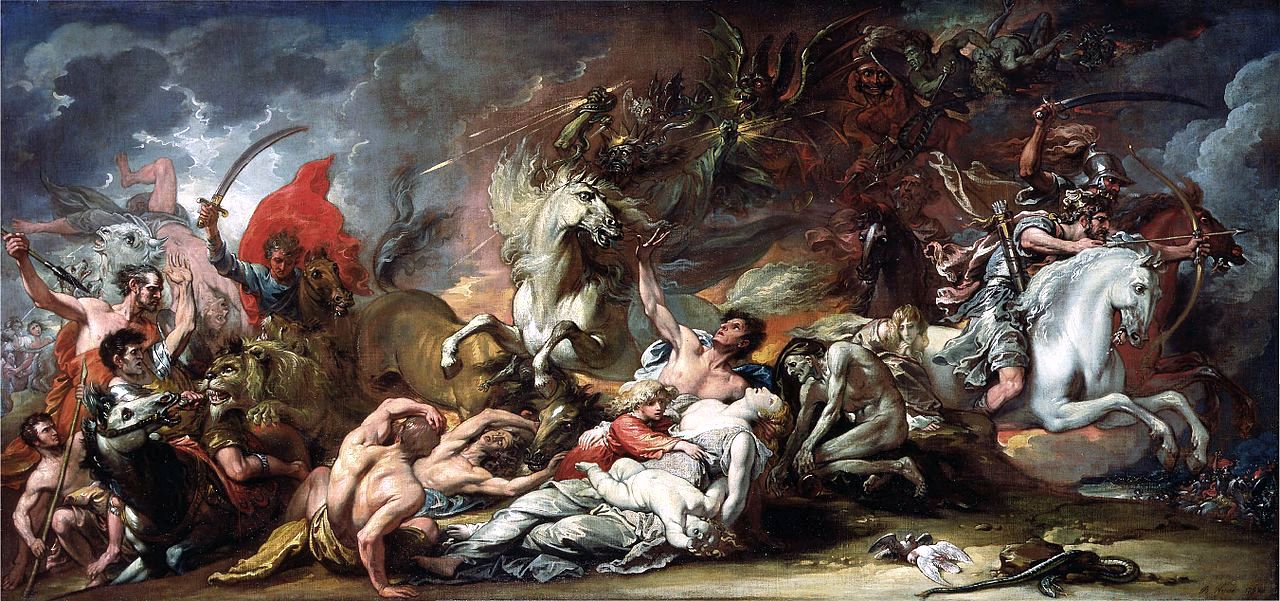
Four Horsemen of the Apocalype

Death on a Pale Horse is a version of the traditional subject, Four Horsemen of Revelation, 1796, Benjamin West (1738 – 1820), in the public domain in the US