Reassurance

If you google (yes, to google is a verb) you’ll get:

re·as·sur·ance /ˌrēəˈSHo͝orəns/

noun

noun: reassurance

  1. the action of removing someone’s doubts or fears.

“children need reassurance and praise”

  • a statement or comment that removes someone’s doubts or fears.

plural noun: reassurances

“we have been given reassurances that the water is safe to drink”

This is interesting, because we all need some reassurance lately. Whether it’s because our health insurance has been cancelled, the insurance company hasn’t offered an alternative, and we’re forced to try the exchanges. Or, we’re a newly minted graduate with unproven skills that we’d use for mutual benefit like gangbusters, if only someone would give us a chance. Or, we’re a displaced older worker that still wants to contribute their skills to society and can’t seem to find anyone who will hire us for anything near (even half) what we’re worth to the employer.

Well, I don’t see it. If left to our own resources (just check the heavily commented websites) we almost squeal with glee at the displacement of humans by technology. Overpopulation, some say with the obvious solutions in mind. A mark of progress others say as they cite previous technology revolutions (market, first industrial, second industrial, digital, etc.).

All of these ‘revolutions’ recast how human labor was employed. Each caused worker dislocations. Some caused worker revolts. None were deterred (only derailed to the average worker’s detriment). They’ll tell you it will all work out. But we’re being inhuman of we go on like that. It won’t all work out. People are suffering needlessly. But we can’t return to the past.

The pundits on one side say if you get more of the pie I get less. So I should take your pie (oh, wait, they call it ‘re·dis·tri·bu·tion’). Some see nothing wrong with this. Others call it theft. The pundits on the other side say business should grow the pie. But business men just take more of the pie that’s left (I’m talking to you, Wall Street). We’ve been told to go shopping and buy from government exchanges, as if all will be better then. But that doesn’t grow the pie, either. It’s plain old manipulation. However, someone has to start growing the pie. It’s not going to grow itself, you know.
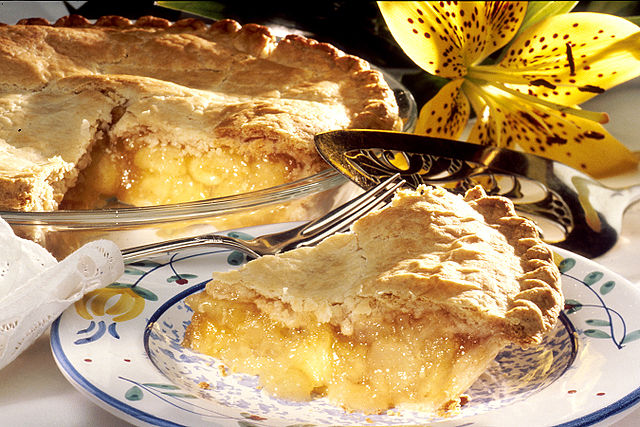
a work of the National Institutes of Health, part of the United States Department of Health and Human Services. As a work of the U.S. federal government, the image is in the public domain.

Pie slice, NCI at NIH, public domain

At lunch one day, I was discussing this problem with a friend whose politics differ from mine. We discussed the pie. However, neither of us had any since we’re both trying to lose weight after our job losses. I said we need savvy folks to start enterprises online and in bricks & mortar that use our displaced workforce and apprentice our new grads. Businesses are so refined now that training and loyalty has gone by the wayside. How will young workers grow into positions of responsibility? Why aren’t older workers tapped for their knowledge and expertise?

Now, you could say, these unemployed are the dregs of the workforce. They deserve what they got. And you’d be dead wrong in many cases. Good workers are being let go and not hired to boost stock performance. If you’re so concerned about quality employees, test them as a prequalification step. Give objective, targeted proficiency and psychological tests online as a gate of entry to the interviews. Grow and use trained interviewers with subject matter and social interaction expertise. You’ll be surprised what treasures you find.

Now what would you have them do? Well, figure out what we really need as a society and as a world and have them either make it for or serve it to us. We don’t need more pet rocks. But the world does need more energy, more clean and fresh water, safer roads and neighborhoods, better education independent of economic background, life mentoring, better preventative health care access, etc. You get the idea. Find a need and fill it.

Our technology can be leveraged to support these new enterprises in ways we don’t even bother using. Virtual offices will work if they’re managed well. The usual computer snooping software is unnecessary when folks are measured on productivity and results. When continued employment hinges on good cooperation and quality outputs, a factory, virtual service, or distributed design house (as examples) can flourish.

Meetings can be held online (many outplacement services work that way). Folks can gather centrally on a quarterly or less frequent basis once they’ve been vetted and oriented to the enterprise. Better minds than mine have worked all this out. Look for it and get cracking.

Funding can be raised via loans or investors. While loans may be hard to come by, more investment crowdsourcing is becoming acceptable and available. Check with your accountants and lawyers. I can’t figure it all out for you. You have to pitch in.

Think of it, how many billions of dollars are being left on the table in the interest of the bottom line because social responsibility and innovation are seen as what the other guy does? Granted it won’t be as profitable in the short run as the status quo of squeezing the life out of remaining workers. But in the long run it will pay dividends in work satisfaction, increased tax base, and societal growth and prosperity.

Responsible folks need to give this country (and this blogger) some reassurance and get ‘er done.

I Don’t Know Clouds At All

A while back, I was asked if I could write something light and fluffy; something buoyant and uplifted. So I got to thinking. I always wondered how clouds, those 500 ton shape shifting behemoths that patrol our skies, float in the air. Or do they hover? I guess I really don’t know clouds at all…

http://commons.wikimedia.org/wiki/File:Clouds.JPG

Clouds – taken from a plane flying over China by Axel Rouvin

That led me to remember the Joni Mitchell song off the album Clouds called “Both Sides, Now.” As recounted in Rolling Stone magazine, when Joni Mitchell read Saul Bellow‘s Henderson the Rain King, Henderson, like Mitchell, was looking at clouds from a plane. Her lyric: “I’ve looked at clouds from both sides now,” was a symbol of the ambiguities and mysteries of life.

In a 1967 radio interview, she related a quote from the book: “I dreamed down at the clouds, and thought that when I was a kid I had dreamed up at them, and having dreamed at the clouds from both sides as no other generation of men has done, one should be able to accept his death very easily.”

We disagree vehemently with Bellow’s sentiment. Death was never meant to be accepted so blithely. But I digress. There is more than enough on this blog to explain our position. That insight into her intended meaning proved to be a disappointment. I like the song otherwise. I guess you have to pay attention to the lyrics. Where were we? Light and fluffy…

Getting back to our premise for this entry, do clouds float or hover? By float, I mean like a rubber duck in a bath tub. By hover, I mean something like what a helicopter does (but possibly in reverse like an umbrella blowing away). Turns out it’s a little of both. Wikipedia has very detailed articles on water vapor and clouds that I hope to summarize below.

It turns out that water vapor is less dense than dry air. At the same temperature, water vapor floats in dry air like a rubber duck in water. The article on water vapor crunches the numbers. But it’s even better. Since both are gases, a volume of moisture laden air will rise or be buoyant if placed in a larger volume of dry air.

As the temperature rises, the proportion of water vapor in the air increases and its buoyancy will increase along with the added vapor. In air without particulates, water vapor density can reach 300% before condensation occurs under normal conditions (a principle used in cloud chambers).

The increase in buoyancy gives rise to strong, moisture rich, upward air currents when the air and sea temperatures reach 25 °C or above. This is the driving force behind tornadoes and hurricanes. In fact, under the right conditions, water vapor can lift a “steam balloon” with approximately 60% the lift of helium and twice that of hot air.

Clouds form when one or more sources of vertical lift causes air containing invisible water vapor to rise and cool to the temperature at which water vapor starts condensing. Atmospheric pressure decreases with altitude, so the rising air expands in a process that expends energy without heat loss to the surrounding air and causes the rising air to cool. If the air is cooled enough, the vapor condenses into a cloud.

Water vapor in saturated air is attracted to condensation nuclei such as salt particles, dust, or even bacteria that are small enough to be held aloft by air circulation alone. If condensation occurs below the freezing level, the average size of a newly formed droplet is around 0.02 mm (0.0008 in). Clouds that form just above the freezing level are composed of supercooled liquid droplets, while those that condense out at higher altitudes where the air is much colder generally form of ice crystals.

There are three main sources of vertical lift. The first is a combination of frontal and cyclonic lift. It occurs when stable or slightly unstable air, exposed to little or no surface heating, is forced aloft at weather fronts and around centers of low pressure. Cloud droplets form when the air is lifted beyond the condensation level where water vapor condenses on nuclei and droplets grow to a size of typically 0.025 mm (.001 in). In a cloud the droplets collide to form larger droplets. These larger droplets remain aloft as long as the atmospheric drag force of the air below them is larger than the gravitational force on them.

If the cloud droplets continue to grow past this size, they become too heavy to be held aloft and fall as rain. When this process takes place just above the freezing level, with additional lifting and growth in size, droplets can turn into freezing rain. At temperatures well below freezing, the vapor turns into ice crystals that average about 0.25 mm in length. With continuing lift, ice crystals combine with the vapor and each other until they are too heavy to be supported by the vertical air currents and fall out as snow.

The second source of vertical lifting, buoyant convection, is caused by daytime solar heating at surface level, or by relatively high absolute humidity. Air warmed in this way becomes increasingly unstable and it rises and cools until its temperature equals that of the surrounding air aloft. If air near the surface becomes extremely warm and unstable, it can result in rapidly rising clouds that cause severe weather. Strong convection updrafts enable droplets to grow to nearly .075 mm (.003 in) before precipitating as heavy rain from active thunderclouds. Occasionally, very warm unstable air is present around fronts and low-pressure centers. As with non-frontal convective lift, increasing instability promotes upward vertical cloud growth and raises the potential for severe weather.

A third source of lift is wind circulation forcing air over a physical barrier such as a mountain. This is called orographic lift. If the air is generally stable, nothing more than lenticular cap clouds will form. However, if the air becomes sufficiently moisture laden and unstable, orographic showers or thunderstorms may appear.

http://commons.wikimedia.org/wiki/File:Rolling-thunder-cloud.jpg

Storm – Rolling thunderstorm (Cumulonimbus Arcus) by John Kerstholt (Creative Commons license)

Additionally, there are three other mechanisms for lowering the air temperature to the point where water vapor condenses. All of these occur near surface level and do not require lifting of the air. Cooling by conduction, radiation, and evaporation can cause condensation at surface level resulting in the formation of fog.

Conduction cooling takes place when air from a relatively mild source area comes into contact with a colder surface, such as when mild marine air moves across a colder land area. Radiation cooling occurs due to the emission of infrared radiation, either by the air or by the surface underneath. This type of cooling commonly occurs at night when the sky is clear. Evaporative cooling happens when moisture is added to the air through evaporation, which forces the air temperature to cool to its wet-bulb temperature, or sometimes to the point of saturation.

So clouds float and hover. Who would have guessed? Aren’t they pretty?

http://commons.wikimedia.org/wiki/File:Moments_Before_Sunrise.jpg

Sunrise – The Twilight Sky just before Sunrise by Jessie Eastland (Creative Commons license)

There, But for God’s Grace and Mercy Through His Providence, Go I

John Calvin

John Calvin (Photo credit: Wikipedia)

Why are we shocked when things like this, this, or this happen?

These sensational stories are tragic, no doubt. Scary, even. But we seem to think we’d never do or even be capable of such heinous acts. Then we bolt our door against our neighbor (rightly or wrongly, I can’t say; that’s up to you). Some believe we’re naturally moral. Still others say: red in tooth and claw.

The scriptures conclude we all fall short of God’s glory. But isn’t this an overstatement of our condition? Aren’t we really good, but just misguided, unmotivated, or low informational?

Paul, in the letter to the Romans, elaborates on what he concludes in case we were unsure:

11 no one understands;
no one seeks for God.
12  All have turned aside; together they have become worthless;
no one does good,
not even one.”
13 “Their throat is an open grave;
they use their tongues to deceive.”
“The venom of asps is under their lips.”
14 “Their mouth is full of curses and bitterness.”
15 “Their feet are swift to shed blood;
16   in their paths are ruin and misery,
17    and the way of peace they have not known.”
18   “There is no fear of God before their eyes.”

So, we have no excuse to be shocked at these sensational stories. This is the condition of man. However, if this is so, why then do we not claw and bite until we are no more?

John Calvin, a theologian not often cited now–a–days, suggests in the Institutes of the Christian Religion, book 1, chapter 17, and paragraph 11:

…How comes it, I ask, that their confidence never fails, but just that while the world apparently revolves at random, they know that God is everywhere at work, and feel assured that his work will be their safety? When assailed by the devil and wicked men, were they not confirmed by remembering and meditating on Providence, they should, of necessity, forthwith despond. But when they call to mind that the devil, and the whole train of the ungodly, are, in all directions, held in by the hand of God as with a bridle, so that they can neither conceive any mischief, nor plan what they have conceived, nor how much so ever they may have planned, move a single finger to perpetrate, unless in so far as he permits, nay, unless in so far as he commands; that they are not only bound by his fetters, but are even forced to do him service,—when the godly think of all these things they have ample sources of consolation. For, as it belongs to the lord to arm the fury of such foes and turn and destine it at pleasure, so it is his also to determine the measure and the end, so as to prevent them from breaking loose and wantoning as they list…

So God not only constrains the evildoer but commands him to do His bidding, yet without complicity or taint thrown back upon Him. But why, if we’re this way, are we guilty at all?

Calvin says in the Institutes of the Christian Religion, book 1, chapter 17, and paragraph 5:

… As all contingencies whatsoever depend on it, therefore, neither thefts nor adulteries, nor murders, are perpetrated without an interposition of the divine will. Why, then, they ask, should the thief be punished for robbing him whom the Lord chose to chastise with poverty? Why should the murderer be punished for slaying him whose life the Lord had terminated? If all such persons serve the will of God, why should they be punished?

I deny that they serve the will of God. For we cannot say that he who is carried away by a wicked mind performs service on the order of God, when he is only following his own malignant desires. He obeys God, who, being instructed in his will, hastens in the direction in which God calls him.

But how are we so instructed unless by his word? The will declared by his word is, therefore, that which we must keep in view in acting, God requires of us nothing but what he enjoins. If we design anything contrary to his precept, it is not obedience, but contumacy and transgression. But if he did not will it, we could not do it. I admit this.

But do we act wickedly for the purpose of yielding obedience to him? This, assuredly, he does not command. Nay, rather we rush on, not thinking of what he wishes, but so inflamed by our own passionate lust, that, with destined purpose, we strive against him. And in this way, while acting wickedly, we serve his righteous ordination, since in his boundless wisdom he well knows how to use bad instruments for good purposes.

And see how absurd this mode of arguing is. They will have it that crimes ought not to be punished in their authors, because they are not committed without the dispensation of God. I concede more—that thieves and murderers, and other evil-doers, are instruments of Divine Providence, being employed by the Lord himself to execute the Judgments which he has resolved to inflict.

But I deny that this forms any excuse for their misdeeds. For how? Will they implicate God in the same iniquity with themselves, or will they cloak their depravity by his righteousness? They cannot exculpate themselves, for their own conscience condemns them: they cannot charge God, since they perceive the whole wickedness in themselves, and nothing in Him save the legitimate use of their wickedness

So, it is apparent that Romans 3 is true and we are not only held back from what we could do but others are employed to execute God’s judgments and, yet, are solely guilty of their transgression.

I see the tendency to do wrong in myself all the time. Do you? The only remedy is falling at the feet of the Lord Jesus Christ in surrender because he says: Come to me, all who labor and are heavy laden, and I will give you rest.

Quo Vadis II

Tragic Wonders 1 by 1_6 quarter scaleWe’re almost finished with a round of editing for Tragic Wonders. In prior posts, you’ve seen some of the stories and essays that we dropped from TW because of thematic duplication. We’ve also separated out two poems that now provide a transition from the stories to the essays. The next step is copy editing. Seems the company is geared towards Microsoft Office production but, for the money, they’ll accommodate Amazon Kindle requirements. Whew! Actually, they’ve been encouraging, cooperative, and fast. We’ll see how much we can say about them at a later date.

At this point, we plan to get TW out before Christmas (Thanksgiving is the real goal, but…). To do that, I want to have at least two professional reviews in place before issuing the press release and posting the Kindle book to Amazon and registering with the LOC and Red City Reviews usually posts to Goodreads but Goodreads requires an ASIN, Amazon’s ISBN equivalent… You get the idea, the timing will be tricky. Also, we were planning on switching from PRWeb to PR Newswire. You know, the PR firm recently hacked for customer data.

We’ve had several favorable reviews on TW’s all important cover. Yes, it turns out we do judge a book by its cover (among other things, like favorable excerpts from perhaps unfavorable professional reviews).

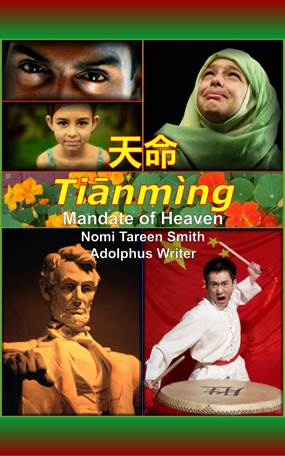
Right now, we have Tiānmìng – Mandate of Heaven priced at 99 cents. We’re going to raise the price back to $2.99 when TW comes out at 99 cents. In other news, we’ve decided to postpone publication of A Digital Carol until next Christmas. Actually, we’ll get it out before Thanksgiving 2014 to pick up on the buying season. We’ve already got the cover concept roughed in.

Yup, we’ll get this marketing thing down, yet. Hopefully, before we’re out of funds.

We plan to start Who Shall be God early in 2014 while ADC is in editing (yes, book three, that became book four, is book three again). The WSBG themes are coming together. It turns out that the 38th parallel not only runs through the Korean DMZ but through Virginia and Maryland. Hmm, I wonder if that’s significant given what DC has been doing lately?

Book five is about China. We’re still waiting for Xi and company to declare their intent after the Third Plenum meeting of the Communist Party’s Central Committee. Other news of interest is that China has twice the shale gas reserves as the US does. That should swing the balance all other things being equal. We’ll see.

And finally, we’ve updated our links page.

Redeemed Regret – Macon Georgia

Ecclesia and the Three Sons of Noah - medieval...

Ecclesia and the Three Sons of Noah – medieval stained glass detail, Canterbury Cathedral (Photo credit: chrisjohnbeckett)

It was a cold night, and I was running through a neighborhood I feared to walk in during the day. The sun was coming up as I reached the main drag. I was almost home. Just a few more miles to go.

When I reached my toasty–warm one–room apartment, I found it as I had left it so many weeks before. The boarder she asked me to house had left it in pretty good shape. Better than I deserved. She, though, did not leave me in very good shape. I collapsed on my bed.

I was bought and sold as you would a loaf of bread, maybe half a loaf, when all was said and done. We met by arrangement of our mutual friends at the time. They had thoughts of what each of us wanted and saw a match worth making. It took a few strikes of that match to ignite a spark.

I thought one thing and she thought another. I was headed toward the idea of marriage and she was headed toward her former lover. However, her way lay through me. I was trapped by an unrealizable idea that she had no intention of bringing to fruition. She got what she wanted. I should have known better. I was so infatuated with the romance of Hollywood that I ignored the warning signs of disaffection and entrapment.

The prophets say, “More bitter than death: the woman whose heart is snares and nets, and whose hands are fetters. He who pleases God escapes her…” Well, that escape wasn’t my doing. Not long afterward, I was captured by the Sovereign One, who, alone, was deserving of my utmost allegiance. He drew me as surely as a parent draws their child to what is good. I was now free indeed.

There, in new surroundings with much to learn and unlearn, I was barely coping with all the changes I needed to make. I was juggling responsibilities that I had so long neglected. Folks were having their doubts about whether I was having doubts. Things were taken away as well as given. I was experiencing the Ecclesia firsthand. Having searched for a new place to lay my head, I found myself in the company of a diverse and chastening crowd.

My time was up so soon. I had gained my employment from one and ceded my bedroom to another. I needed to find a new residence quickly. That’s when I fell into a trap again. Not of the same kind, thankfully, but entrapped nevertheless. I should have seen the warning signs. I should have fled my obligations (but I wouldn’t on principle). Only Mercy rescued me once more.

In the midst of the turmoil and strife, I did not notice a rare opportunity escape overseas. I was too bound by my unsophistication and numbed by the rapid–fire changes in my life. I was dislocated from a proper response. In a parking lot, on another cold night, I bid farewell to someone I should have known better.

I imagine her happily married and blessed with children, prosperous and satisfied with her life. A better path than I could have given. I must tread alone toward our mutual upward goal. For I have no doubts about her.

Platitudes Have Consequences – Wilma Terretts

“You’re going to do what?”

“Turn you in as an illegal alien, hon. With this 9/11 hysteria, you’ll be tied up…for a while.”

“But I’m a naturalized citizen according to my mother’s papers. Why are you doing this to me, Harry?”

“Because you wouldn’t do as I say. Let’s see how you get out of this one, Mildred.”

“Okay, I’ll do it, I’ll do it…Please don’t bring this down on me.”

“We’ll see.”

***

“But I have to get my papers in order.”

“We’re swamped, ma’am, with the government shutdown and all. You’ll have to go across the state to get any speedy action. You sure you can’t wait?”

“No, my husband threa—No.”

“We’ll arrange an appointment. You’ll have to get there by the date set.”

***

“I found my army papers; I was honorably discharged. He hid them on me, Wilma.”

“Those prove you’re a citizen, Mom.”

“It’s not enough. He’s still threatening deportation.”

“Well, come up here and we’ll go together. It’s a fairly short drive.”

***

“I hereby declare, on oath, that I absolutely and entirely renounce and abjure all allegiance and fidelity…and that I take this obligation freely without any mental reservation or purpose of evasion; so help me God.”

“You are now citizens of the United States of America.”

***

“How’d it go?”

“Fine, I’ve got it.”

“That must be a relief.”

“I’ve got to go back, Wilma.”

“Please spend a few days up here with me.”

“I have to go back before he does something else.”

“You can’t keep living in fear, Mom.”

“What do you expect me to do?”

“Sometimes God sends a boat to rescue us when we expect miracles, Mom.”

***

“I’ve been preparing him for a few months. I’ve made sure he has everything he’ll need.”

“What are you talking about, Mom?”

“Can I come up? I’d like to see you.”

“Sure, I’ll take vacation. I’ve been under a lot of pressure at work and I need time off.”

***

“I’ve come up here to make sure you have everything you need, and I find you’ve been taking care of me.”

“What do you mean? Of course I want you to be happy, Mom.”

“Don’t hug me when I go. I don’t think I can take that. Just leave when the train comes in.”

“I don’t understand.”

“Just do it for me.”

***

“She’s what?”

“In the hospital. I’m sorry, Wilma.”

“What have you done, Dad?”

“She had a stroke.”

“Did you call 911 in time?”

“No—”

“I’ll be down.”

“Stay here.”

“No, I’ll stay in a hotel.”

***

“So, how are you doing, Wilma?”

“It seems she was hiding her condition for months, maybe years, Maud.”

“Why didn’t her doctors see it?”

“They didn’t find the first cancer for five years. It showed up in the earlier radiographs only when they knew where to look.”

“So the prognosis isn’t good?”

“She died last night, Maud. We’re having the funeral as soon as possible.”

“I’m so sorry, Wilma.”

“Me too. I feel something I said caused all this to happen.”

“You can’t blame yourself. Your father’s relentless brutality took its toll. She simply took the opportunity that presented itself. Look, she might have died even if she did everything medical science knows to do. Our lives really are in His hands.”

“Yeah, it’s just that I said, sometimes God rescues us from our circumstances through common means. But, I didn’t mean this.”

Superstition

No, I’m not referring to the song by Stevie Wonder (as much as I like the instrumental version). But, instead, I refer to the prevalent bias against true religion. When we see religion as moral and ethical obedience to God–given law that is beneficial to us and to others, I’m not sure how we justify anything else. Except, of course, in order to avoid our responsibility and laugh in the face of our inevitable accountability.

English: The Flammarion engraving is a wood en...

Photo credit: Wikipedia

And we do the latter in everything we do in this scientific age. The art work in this post, Flammarion (Photo credit: Wikipedia), shows a medieval missionary delving into heaven through the firmament to see the workings of God. I think that our sciences expand the firmament to the extent that we shut out the possibility that the immaterial has place in our thoughts and contemplations. This “expansion” is seen not merely in our astrophysics but in our neuroscience and in all the other scientific disciplines. This is a mistake.

Calvin, in his Institutes of the Christian Religion, says:

With regard to inanimate objects again we must hold that though each is possessed of its peculiar properties, yet all of them exert their force only in so far as directed by the immediate hand of God. Hence they are merely instruments, into which God constantly infuses what energy he sees meet, and turns and converts to any purpose at his pleasure. No created object makes a more wonderful or glorious display than the sun. …No pious man, therefore, will make the sun either the necessary or principal cause of those things which existed before the creation of the sun, but only the instrument which God employs, because he so pleases; though he can lay it aside, and act equally well by himself: Again, when we read, that at the prayer of Joshua the sun was stayed in its course; that as a favor to Hezekiah, its shadow receded ten degrees; by these miracles God declared that the sun does not daily rise and set by a blind instinct of nature, but is governed by Him in its course, that he may renew the remembrance of his paternal favor toward us…

So, our Principle of Least Action, applied to quantum fields (if they turn out to be fields, except in approximation, as a result of the coming paradigm shift), is falsified by these “superstitious beliefs” put forth by scripture and exposited by John Calvin. Our entire mode of living, apart from reverential awe due to God, is falsified. Call scripture superstition if you must, but God is simply accommodating our finiteness as he calls us to into account before it’s too late for you or for me.

Research

The Last of the Spirits, from Charles Dickens:...

The Last of the Spirits, from Charles Dickens: A Christmas Carol. In Prose. Being a Ghost Story of Christmas. With Illustrations by John Leech. London: Chapman & Hall, 1843. First edition. (Photo credit: Wikipedia)

If you’ve read our first book: Tiānmìng – Mandate of Heaven, and who hasn’t ;-), you’ll know we at Mandated Memoranda Publishing do research and lots of it. Currently, we’re working on what we affectionately call Book Three. Its working title is: A Digital Carol.

We are reimagining the old Dickens’ favorite for a future generation. The gist of the old story revolves around the Victorian era’s fascination with ghosts and spirits. The new one, obviously, has to feature AI. But not just any AI, we feature Artificial General Intelligence, or AGI.

We’re all familiar with Big Dog, Cheetah, and Atlas. If not, we should be. These are specialized robotic machines that adapt to their environments in order to accomplish limited scope missions. However, these do not possess the ability to generalize their missions to encompass any goal, even self set goals. Others would like to make what may turn out to be a limited aspect of AGI available widely. We are nowhere near true AGI. Some think this is a very good thing.

There is a philosophic difference between what AI we currently have available and what may come about in the future. We deal with this theme in A Digital Carol. We also deal with the temptation to “kick away the ladder” when opportunity for our aggrandizement presents itself. Of course, we needn’t repeat the admonition that many attribute to mere superstition, do we?

Red City Review for Tianming – Mandate of Heaven

Tiānmìng – Mandate of Heaven by Adolphus Writer and Nomi Smith

Four Stars

Tianming CoverIn the not too distant future, the world is falling apart at the seams, which is depicted in the political thriller, ‘Tiānmìng – Mandate of Heaven’ by Adolphus Writer and Nomi T. Smith. This fast paced novel tells the story of Michael Babbage, a freelance reporter who is hired to document and analyze what is happening to the civilization of man. Between the political conflicts that have arisen and the natural disasters that are destroying the balance of society, there is not much to hope for besides an alternative to the failing situation at hand. The United States is a nation at unrest, but due to the strong will of President Moses Orestes, he refuses to let his people give up on the nation that he cares about so dearly. When Yellowstone erupts, half of the United States population has to move to Canada, while elsewhere in the world weak governments are taking advantage of the fact that other formerly powerful states are falling apart. Nuclear explosions are also reshaping the Asian continent, as Michael strives on to find answers on how to stop the ongoing calamity from continuing.

It is clear due to the complexities of this book that a lot of work was put into the creation of this story. Not only is it thought-provoking, but the characters and the situations that they are thrust into are a joy to read. The descriptions of the United States falling apart alone are very chilling, but to think of our entire world failing so helplessly during such an unmanageable point in time is rather frightening. The characters are all well-developed and by the end of the narrative things start to weave together in a pleasing and surprising manner. Although the natural disasters that occur seem a little bit farfetched, the reactions to them and the other manmade fiascos are plausible, given the other conditions that are occurring. Michael is a very likeable character, someone who the reader will be rooting for as he tries to figure out what is going on in this very unstable predicament that Earth has found itself in. (Reviewed September 19, 2013 by Red City Review, used by permission.)

To purchase a copy of Tiānmìng – Mandate of Heaven, click here to find it on Amazon.

Another Mass Shooting

Aerial view of the Washington Navy Yard. (Photo credit: Wikipedia)

What’s wrong with us? What’s it going to take? We’ve had another mass shooting. This time it was on a military base, the Washington Navy Yard. A base I once visited for business purposes. The security was lax then as it must have been now. To be fair, the level of security was equal to that necessary to protect national security information, not people.

I heard a doctor, who was treating some of the victims of this latest mass shooting, speak on television. She said that we have to get control of evil and eradicate it from our nation. I’m sure she meant well but I was perplexed as to how our society would go about implementing her desire.

I wondered how we would get control of evil and eradicate it. How would we go about doing that? Evil is perpetrated by men and women. It is found in the hearts and minds of those that do wrong. A building that collapses or a sinkhole that opens up suddenly may lead to a tragedy but these ‘perpetrate no evil.’

Did she mean we needed to seize control of the populace, declare martial law, or institute a totalitarian state? That’s what it would take to eradicate it from all our people. However, that would not, obviously, by the nature of the ‘solution,’ eradicate it from the nation. I would hope she didn’t mean that.

Barring a mass solution to this problem, we would have to identify individuals. But who would determine who was potentially evil. I say potentially because we can’t wait until someone proves they are evil by their actions, can we? It would be too late. But the laws of our nation preclude this pre-crime recourse. And, it’s no recourse, really, except in the movies; and we know how that turned out.

So, perhaps we should turn to the medical profession to identify those who might offend. What criteria would they use? Psychiatry’s handbook, the DSM-V, has objective descriptions of maladies that affect individuals. And those individuals may perpetrate offenses.

But who would apply the criteria? Doctors all over the nation would have to perform screenings. We’d have to indemnify and pay these doctors. They would be unavailable to treat those with other illnesses and we’d have to accept the losses that would result.

We’d need a large body of bureaucrats to administer this workforce of doctors. They’d be paid from our taxes. These administrators would assure fairness, justice, equity, and freedom from error of all those doctors’ decisions. They’d be responsible for adjudicating lapses in the system. Kind of like the IRS…

So, instead, maybe we could target minor offenses and incarcerate potential offenders at that point? Oh, wait, we’re doing that all ready. How’s that working out for us? Not real well, huh?

Maybe zero tolerance for gun ownership? But then only the criminals and terrorists would have guns. Law breakers, by definition, aren’t thwarted by zero tolerance laws. But, enough of this foolishness.

***

Maybe, we could show real compassion. We’d identify those who might act out (like we do all ready), but go one step further, and intervene. We’d stop hiding behind political correctness; put our reputations on the line; and save some of these folks and their potential victims from the crimes that might otherwise occur.

We’d educate the nation to reduce the stigma of dependency and mental illness. We’d do this so both the ill and their victims would seek help. We’d strengthen families, which are our first line of defense for the nation, so they could nurture those who might otherwise follow their bent into crime. Only when the family had done all it could do, would we intervene.

We’d target those who abuse alcohol, drugs, and little animals. We’d confront those who exhibit mental disorders and get them help. We’d provide them with counseling, medical treatment, and follow-up; not institutionalization. We’d hold the patients and caregivers to account for failures. And we’d recognize the toll caregiving takes on the caregivers themselves and provide support.

It will be hard and take self–sacrifice.

And, maybe, we could acknowledge that we all are bent and capable of snapping. That we ourselves are responsible for our actions and that these actions are not always good. And realize that we need to thoroughly change our life’s direction; an impossible task for us to do. And because of that, realize we need a Savior from the punishment we surely do deserve.