Against You Only

The great King of Israel, David, committed adultery with another man’s wife. To hide his sin, he had her husband killed. Problem solved? Not in the least. After the prophet Nathan confronts him with the severity of his deed, David admits to his sin. His full confession is recorded in Psalm 51. The verse that concerns us in this post is:

Against you, you only, have I sinned

    and done what is evil in your sight,

so that you may be justified in your words

    and blameless in your judgment.

Psalm 51:4 English Standard Version (ESV)

Speaking of David’s confession, John Calvin says:

Against You only…I conceive his meaning to be, that though all the world should pardon him, he felt that God was the Judge with whom he had to do, that conscience hailed him to his bar, and that the voice of man could administer no relief to him, however much he might be disposed to forgive, or to excuse, or to flatter. His eyes and his whole soul were directed to God, regardless of what man might think or say concerning him.

…There is every reason to believe that David, in order to prevent his mind from being soothed into a false peace by the flatteries of his court, realized the judgment of God upon his offense, and felt that this was in itself an intolerable burden, even supposing that he should escape all trouble from the hands of his fellow-creatures.

On the import of the second couplet, Calvin says:

So that You may be justified…Any doubt upon the meaning of the words, however, is completely removed by the connection in which they are cited in Paul’s Epistle to the Romans,

“For what if some did not believe? Shall God be unjust? God forbid: yea, let God be true, but every man a liar; as it is written, ‘That thou may be justified in thy sayings, and might overcome when thou art judged.’” — Romans 3:3, 4

Here the words before us are quoted in proof of the doctrine that God’s righteousness is apparent even in the sins of men, and his truth in their falsehood.

To have a clear apprehension of their meaning, it is necessary that we reflect upon the covenant which God had made with David. The salvation of the whole world having been in a certain sense deposited with him by this covenant, the enemies of religion might take occasion to exclaim upon his fall, “Here is the pillar of the Church gone, and what is now to become of the miserable remnant whose hopes rested upon his holiness?”

…Aware that such attempts might be made to impugn the righteousness of God, David takes this opportunity of justifying [God’s righteousness], and charging himself with the whole guilt of the transaction. He declares that God was justified…should he have spoken the sentence of condemnation against him for his sin, as [God] might have done but for his gratuitous mercy.

Of course, the knowledge that our sin offends God most should not excuse us from seeking our brother’s or sister’s forgiveness. However, we should fear all the more, having been forgiven by others, that we did sin against Him who purchased us at great cost to Himself.

Ligonier Generic Background - David and Bathsheba

Life of David, Lecture 13 – David and Bathsheba, R. C. Sproul, Ligonier Ministries

Angry Friends

We all want friends we can rely upon. We want friends we can confide in, freely discuss things of importance, and shoot the breeze with. That’s why it’s so disappointing to have angry friends:

Make no friendship with a man given to anger,

    nor go with a wrathful man,

lest you learn his ways

    and entangle yourself in a snare.

Proverbs 22:24-25 English Standard Version (ESV)

Our usual source for commentary, John Calvin, did not comment on the book of Proverbs. We therefore go to Matthew Henry. Wikipedia claims he is best known for this quote from his commentary on Genesis, Chapter 2:

The woman was made of a rib out of the side of Adam; not made out of his head to rule over him, nor out of his feet to be trampled upon by him, but out of his side to be equal with him, under his arm to be protected, and near his heart to be beloved.

To the verses in Proverbs, Henry says:

Make no friendship …It is the law of friendship that we accommodate ourselves to our friends and be ready to serve them, and therefore we ought to be wise and wary in the choice of a friend, that we come not under the sacred tie to any one whom it would be our folly to accommodate ourselves to. Though we must be civil to all, yet we must be careful whom we lay in our bosoms and contract a familiarity with.

Clearly, Henry holds friendship is high regard. This is no mere acquaintance nor a casual buddy he speaks about. This is someone we’d make a commitment to as a confidant with whom we could be at ease. Henry goes on to describe one, among many, he says, who we should avoid:

…A man who is easily provoked, touchy, and apt to resent affronts, who, when he is in a passion, cares not what he says or does, but grows outrageous, such a one is not fit to be made a friend or companion, for he will be [frequently] angry with us and that will be our trouble, and he will expect that we should, like him, be angry with others, and that will be our sin.

Then, Henry tells us why we should avoid such would-be compatriots:

Lest thou learn Good cause given for this caution: Lest thou learn his way. Those we go with we are apt to grow like.

Our corrupt hearts have so much tinder in them that it is dangerous conversing with those that throw about the sparks of their passion. We shall thereby get a snare to our souls, for a disposition to anger is a great snare to any man, and an occasion of much sin.

He does not say, “Lest thou have ill language given thee or get a broken head,” but, which is must worse, “Lest thou imitate him, to humor him, and so contract an ill habit.”

Don’t get ensnared or shorn by those with whom you are familiar. Take Proverbs 22:24-25 to heart and act upon it. Remember, there is a friend who sticks closer than a brother.

Delilah's Betrayal

Delilah’s Betrayal and Samson’s Imprisonment by the Philistines, Circa 1580, Joos van Winghe (1544 – 1603), in the public domain in the United States

Make Friends

The following saying has always held mystery for me. Parts of it make sense. It’s the idea of ‘casting your bread upon the waters.’ However, some of it almost sounds like buying your way to heaven.

And I tell you, make friends for yourselves by means of unrighteous wealth, so that when it fails they may receive you into the eternal dwellings. Luke 16:9 English Standard Version (ESV)

The theologian, John Calvin, dismisses the notion of a ‘pay to play’ entry into heaven. Instead, he says:

Make to yourselves friends. Christ…teaches us that by acts of charity we obtain favor with God, who has promised, that to the merciful he will show himself merciful, (Psalm 18:25.)…

The Lord looks not to the persons, but to the work itself, so that our liberality, though it may happen to be exercised towards ungrateful men, will be of [benefit] to us in the sight of God. […The depravity of men does not prevent the Lord from placing on his records all that we have expended on the poor.]

…Our kindness to the poor will be a seasonable relief to us; for whatever any man may have generously bestowed on his neighbors the Lord acknowledges as if it had been done to himself.

Calvin’s explanation makes me reconsider the make-up of my own giving.

To the parts I did understand, Calvin says:

When you fail. By this word he expresses [our] time of death, and reminds us that the time of our administration [of riches] will be short, lest the confident expectation of a longer…life should make us take a firmer grasp. …Many squander what they have on superfluities; while others…deprive both themselves and others of the benefit…

Of the mammon of unrighteousness. By giving this name to riches…Christ justly represents them as worthy of our suspicion; just as on another occasion he called them thorns, (Matthew 13:7, 22.)

[…Christ intends, by way of an unstated contrast,] that riches, which otherwise, in consequence of wicked abuse, polluted their possessors, and are almost in every [case] allurements of sin, ought to be directed to a contrary object, to be the means of procuring favor for us. [This is] a warning given to believers to keep themselves free from unrighteousness.

Key to the right use of riches, then, is to neither squander nor hoard; using it not as an occasion for sin but, instead, for righteousness.

Clarifying what our attitude should be when giving, the Apostle Paul cautions:

The point is this: whoever sows sparingly will also reap sparingly, and whoever sows bountifully will also reap bountifully. Each one must give as he has decided in his heart, not reluctantly or under compulsion, for God loves a cheerful giver. 2 Corinthians 9:6-7 (ESV)

And we do well to remember that time really is money when it comes to charity:

You shall not see your brother’s donkey or his ox fallen down by the way and ignore them. You shall help him to lift them up again. Deuteronomy 22:4 (ESV)

Deeds of Christian Charity

Deeds of Christian Charity, 1575, Pieter Aertsen (circa 1508–1575), in the public domain in the United States

God or Money?

Which will it be, God or money? The God spoken about in this context is the Father, the Son, and the Holy Spirit; one God in three persons. Money, or mammon, on the other hand, is any earthly means of exchange or gain (i.e., possessions).

While speaking with His disciples, the Lord Jesus Christ was overheard by the religious rulers of the day. They scoffed at what He said to His disciples:

“No servant can serve two masters, for either he will hate the one and love the other, or he will be devoted to the one and despise the other. You cannot serve God and money.” Luke 16:13 English Standard Version (ESV)

Christ then turned to these rulers and addressed how their heart attitudes kept them out of His Kingdom.

Christ spoke the same words to a different audience who listened intently to His Sermon on the Mount. He spoke about the heart attitude that His disciples and the crowds that followed Him should possess in the Kingdom of God. As part of that sermon, Christ said:

“No one can serve two masters, for either he will hate the one and love the other, or he will be devoted to the one and despise the other. You cannot serve God and money.” Matthew 6:24 (ESV)

Although the disciples were common to both groups, many in the first audience sneered at what He said and in the second, they hung on His every word.

John Calvin commented on this two-thousand-year-old chronicle over five hundred years ago:

No man can serve two masters. …[Christ] had formerly said, that the heart of man is bound and fixed upon its treasure; and he now gives warning, that the hearts of those who are devoted to riches are alienated from the Lord.

For the greater part of men are [inclined] to flatter themselves with a deceitful pretense, when they imagine, that it is possible for them to be divided between God and their own lusts. Christ affirms that it is impossible for any man to obey God, and, at the same time, to obey his own flesh…

We commonly call this a ‘divided heart.’ Calvin goes on:

True, it is not impossible that those who are rich shall serve God; but whoever gives himself up as a slave to riches must abandon the service of God: for covetousness makes us the slaves of the devil…

So it isn’t the riches themselves, so much as setting our hearts on those riches to the partial (or total) exclusion of Him. Calvin then extends this principle to all our vices.

…As God pronounces everywhere such commendations of sincerity, and hates a double heart, (1 Chronicles 12:33; Psalm 12:2); all are deceived, who imagine that he will be satisfied with the half of their heart…

The covetous, the voluptuaries, the gluttons, the unchaste, the cruel, all in their turn offer the same apology for themselves: as if it were possible for those to be partly employed in serving God, who are openly carrying on war against him.

But wait, we are beset with sins that, the scriptures say, so easily entangle us. Are we double minded and in danger of hell fire? To this, Calvin, the shepherd, says:

It is, no doubt, true, that believers themselves are never so perfectly devoted to obedience to God, as not to be withdrawn from it by the sinful desires of the flesh.

But as they groan under this wretched bondage, and are dissatisfied with themselves, and give nothing more than an unwilling and reluctant service to the flesh, they are not said to serve two masters: for their desires and exertions are approved by the Lord, as if they rendered to him a perfect obedience.

But this passage [Luke 16:13] reproves the hypocrisy of those who flatter themselves in their vices, as if they could reconcile light and darkness.

So there we have it. The question now becomes: “Do I serve the devil or do I serve the Lord.” For, we all have to serve somebody.

Serve Somebody, Johnny Q. Public, Lyrics by Bob Dylan

Where Are You?

On at least two recorded occasions, God has called out, “Where are you?” or words to that effect. The first call was in the garden of Eden at the beginning of creation:

And they heard the sound of the Lord God walking in the garden in the cool of the day, and the man and his wife hid themselves from the presence of the Lord God among the trees of the garden.

But the Lord God called to the man and said to him, “Where are you?” And he said, “I heard the sound of you in the garden, and I was afraid, because I was naked, and I hid myself.” He said, “Who told you that you were naked? Have you eaten of the tree of which I commanded you not to eat?”

Genesis 3:8-11 English Standard Version (ESV)

God created Man: Adam and Eve, gave them dominion over the earth, commanded them to obey one constraint, and placed them in the garden He created to tend it. Within a short time, by the will of God, their obedience to His one command was tested. They failed that test, and hid themselves because of their shame.

John Calvin comments on this crucial drama. First, he explains the nature of Adam’s and Eve’s fall:

Eve erred in not regulating the measure of her knowledge by the will of God…whereas the principal point of wisdom is a well-regulated sobriety in obedience to God.

…For the sake of complying with the wishes of his wife [and] being drawn by her into fatal ambition…[Adam] gave greater credit to the flatteries of the devil than to the sacred word of God.

God…manifest[s] himself to men…through the word, so…his majesty [is] maintained [and he is properly worshipped by us only] while we obey his word. Therefore, unbelief was the root of defection.

…They had been made in the likeness of God; but [they unlawfully aspired to] equality [with God by knowing good and evil].

As to the consequences of our ancestors’ fall, Calvin says:

…We are despoiled of the excellent gifts of the Holy Spirit, of the light of reason, of justice, and of rectitude, and are prone to every evil; that we are also lost and condemned, and subjected to death, is both our hereditary condition, and, at the same time, a just punishment which God, in the person of Adam, has indicted on the human race…From the time in which we were corrupted in Adam, we do not bear the punishment of another’s offense, but are guilty by our own fault.

Expounding on God’s confrontation of Adam and Eve in the garden, Genesis 3:8-11, Calvin says:

They had been already smitten by the voice of God, but they lay confounded under the trees…God now approaches nearer, and from the tangled thicket of trees draws him, however unwilling and resisting, forth into the midst…

Although this seems to be the confession of a dejected and humbled man, it will nevertheless soon appear that he was not yet properly subdued, nor led to repentance. He imputes his fear to the voice of God, and to his own nakedness…he fails to recognize the cause of shame in his sin; he, therefore, shows that he does not yet so feel his punishment, as to confess his fault.

…God [states] that Adam was admonished [prior to his disobedience]; and that he fell from no other cause than this, that he knowingly and voluntarily brought destruction upon himself.

Again, the atrocious nature of sin is marked in this transgression and rebellion; for, as nothing is more acceptable to God than obedience, so nothing is more intolerable than when men, having spurned his commandments, obey Satan and their own lust.

The second cry of “Where are you?” comes through other words from Christ on the Cross:

And about the ninth hour Jesus cried out with a loud voice, saying, “Eli, Eli, lema sabachthani?” that is, “My God, my God, why have you forsaken me?” Matthew 27:46 (ESV)

Calvin dissects this passage with help of old testament witnesses to Christ’s sufferings:

…Not only did he [i.e., Christ] offer his body as the price of our reconciliation with God, but in his soul also he endured the punishments due to us; and thus he became, as Isaiah speaks, a man of sorrows, (Is. 53:3.)

…When this temptation [i.e., being forsaken of God] was presented to Christ, as if, having God opposed to him, he were already devoted to destruction, he was seized with horror…but by the amazing power of the Spirit he achieved the victory.

In short, during this fearful torture his faith remained uninjured, so that, while he complained of being forsaken, he still relied on the aid of God as at hand.

Thus we see two diametrically opposite outcomes to similar events. God called to the first Adam, “Where are you?” The last Adam called to God “Why have you forsaken me?” The first Adam forsook his obedience to God’s word in exchange for his own self-exaltation. The last Adam overcame the temptation to reject God’s plan through faith in His Father’s promises. The Apostle Paul summarizes it nicely:

Therefore, as one trespass led to condemnation for all men, so one act of righteousness leads to justification and life for all men. For as by the one man’s disobedience the many were made sinners, so by the one man’s obedience the many will be made righteous. Romans 5:18-19 (ESV)

So, I must ask, where are you?

Ecce homo! (Behold the man!), by Antonio Ciseri, 1871

Pontius Pilate presenting a scourged Christ to the people, Ecce homo! (Behold the man!), (circa 1860–1880), by Antonio Ciseri (1821–1891), in the public domain in the United States

Pray for Magistrates

In this election season, we should ask that God work in our leaders such that our lives might be peaceful, quiet, godly, and dignified and that the gospel message would be unhindered. From the look of things, diligence in this effort will become more urgent in the years to come. Many are regularly requesting of Him for our leaders’ good but more of us need to become consistent in obeying the command:

First of all, then, I urge that supplications, prayers, intercessions, and thanksgivings be made for all people, for kings and all who are in high positions, that we may lead a peaceful and quiet life, godly and dignified in every way. This is good, and it is pleasing in the sight of God our Savior, who desires all people to be saved and to come to the knowledge of the truth. 1 Timothy 2:1-4 English Standard Version (ESV)

The reformer, John Calvin, examined the implications of these verses in detail. First, God appoints civil rulers to administer His justice:

The apostle…expressly enjoins Christians to pray for [their civil rulers]…seeing that God appointed magistrates and princes for the preservation of mankind.

However much they fall short of the divine appointment, still we must not on that account cease to love what belongs to God, and to desire that it may remain in force.

[For this] reason, believers, in whatever country they live, must not only obey the laws and the government of magistrates, but likewise in their prayers supplicate God for their salvation. Jeremiah said to the Israelites,

“Pray for the peace of Babylon, for in their peace you shall have peace.” (Jeremiah 29:7.)

The universal doctrine is this, that we should desire the continuance and peaceful condition of those governments which have been appointed by God.

Second, God restrains evil, protects His church, and upholds society through His appointed government:

…[The Apostle Paul]…enumerates the fruits which are yielded to us by a well-regulated government. The first is a peaceful life; for magistrates are armed with the sword, in order to keep us in peace. If they did not restrain the hardihood of wicked men, every place would be full of robberies and murders…

The second fruit is the preservation of godliness, that is, when magistrates give themselves to promote religion, to maintain the worship of God, and to take care that sacred ordinances be observed with due reverence.

The third fruit is the care of public decency; for it is also the business of magistrates to prevent men from abandoning themselves to brutal filthiness or [villainous] conduct, but, on the contrary, to promote decency and moderation.

And without His appointed government, we descend into barbarism:

If these three things are taken away, what will be the condition of human life? If, therefore, we are at all moved by solicitude about the peace of society, or godliness, or decency, let us remember that we ought also to be solicitous about those through whose agency we obtain such distinguished benefits.

Hence we conclude, that fanatics, who wish to have magistrates taken away, are destitute of all humanity, and breathe nothing but cruel barbarism…

Calvin then raises the obvious question that is so pertinent for our times:

“…Ought we to pray for kings, from whom we obtain none of these advantages?” I answer, the object of our prayer is, that, guided by the Spirit of God, they may begin to impart to us those benefits of which they formerly deprived us.

It is our duty, therefore, not only to pray for those who are already worthy, but we must pray to God that he may make bad men good.

To emphasize the point that we should pray that these bad persons be made good, Calvin draws a severe analogy:

We must always hold by this principle, that magistrates were appointed by God for the protection of religion, as well as of the peace and decency of society, in exactly the same manner that the earth is appointed to produce food.

Accordingly, in like manner as, when we pray to God for our daily bread, we ask him to make the earth fertile by his blessing; so in those benefits of which we have already spoken, we ought to consider the ordinary means which he has appointed by his providence for bestowing them.

[Then,] if we are deprived of those benefits [that] the…magistrates [should provide], that is through our own fault. It is the wrath of God that renders magistrates useless to us, in the same manner that it renders the earth barren; and, therefore, we ought to pray for the removal of those chastisements which have been brought upon us by our sins.

So, magistrates’ failure is God’s wrath on us who have sinned by not relying on Him alone for good governance; a severe chastisement, indeed. Are we in the situation Daniel found himself and his people in Babylon?

However, Calvin states, our sin does not absolve these magistrates of their responsibilities before God to carry out their appointed administration:

On the other hand, princes, and all who hold the office of magistracy, are here reminded of their duty. It is not enough, if, by giving to everyone what is due, they restrain all acts of violence, and maintain peace; but they must likewise endeavor to promote religion, and to regulate morals by wholesome discipline.

The exhortation of David (Psalm 2:12) to “kiss the Son,” and the prophecy of Isaiah, that they shall be nursing — fathers of the Church, (Isaiah 49:23,) are not without meaning; and, therefore, they have no right to flatter themselves, if they neglect to lend their assistance to maintain the worship of God.

The earth seems barren, and repentance is called for. If we ask Him for daily bread, should we not fervently ask for rulers made just? Whatever political view you may hold, we all, in obedience to God, must implore Him for our leaders good that “we may lead a peaceful and quiet life, godly and dignified in every way.”

The Weekly Republican Address: A Bold, Pro-Growth Agenda for 2016, Jan 16, 2016, Speaker Paul Ryan

Meant Evil?

Perhaps you’ve read it? A story of treachery and redemption that unfolds at the end of the Book of Genesis (chapters 37, 39 – 50.) Jacob’s son Joseph is sold to traders by his brothers and winds up in Egypt as a slave. Through God’s providence, Joseph is promoted to ruler second only to Pharaoh. During a devastating Near East famine, Joseph is instrumental in feeding the civilizations in and around Egypt at the time. Providentially, one of those civilizations, in embryonic form, consisted of his brothers. Joseph, humbled by his God and Savior, offers mercy to them:

But Joseph said to them, “Do not fear, for am I in the place of God? As for you, you meant evil against me, but God meant it for good, to bring it about that many people should be kept alive, as they are today. So do not fear; I will provide for you and your little ones.” Thus he comforted them and spoke kindly to them. Genesis 50:19-21 English Standard Version (ESV)

The reformation preacher and teacher, John Calvin draws out three points from the passage. First, Calvin cautions us to follow Joseph’s example by restraining our passions in light of God’s providence in and through our circumstances:

Am I in the place of God? …Joseph considers the design of divine providence [and] restrains his feelings as with a bridle, lest they should carry him to excess…When, therefore, the desire of revenge urges us, let all our feelings be subjected to the same authority. […If we let] this thought take full possession of our minds, there is no ardor, however furious, which it will not suffice to mitigate.

It is to our advantage to deal with men of moderation, who set God before them as their leader, and who not only submit to His will, but also cheerfully obey Him. For if anyone is impotently carried away by the lust of the flesh, we must fear a thousand deaths from him, unless God should forcibly break his fury.

Calvin explains that, under God’s sovereignty, the brothers were fully guilty of their evil deeds and Joseph owed all honor to God for his good deeds.

You thought evil against me. …The selling of Joseph was a crime detestable for its cruelty and [faithlessness]; yet he was not sold except by the decree of heaven.

…Nothing is done without [God’s] will; because He both governs the counsels of men ([swaying] their wills and [turning] their efforts at his pleasure) and regulates all events: but if men undertake anything right and just, He so actuates and moves them inwardly by his Spirit, that whatever is good in them, may justly be said to be received from Him.

But if Satan and ungodly men rage, He acts by their hands in such an inexpressible manner, that the wickedness of the deed belongs to them, and the blame of it is imputed to them. For they are not induced to sin, as the faithful are to act aright, by the impulse of the Spirit, but they are the authors of their own evil, and follow Satan as their leader.

And finally, true repentance and reconciliation are evidenced by kind acts toward the one or ones forgiven:

I will nourish you. It was a [mark] of a solid and unfeigned reconciliation, not only to abstain from malice and injury, but also to “overcome evil with good,” as Paul teaches (Romans 12:21.)

He who fails in his duty, when he possesses the power of giving help, and when the occasion demands his assistance, shows, by this [failure], that he is not forgetful of injury.

Therefore, we shall prove our minds to be free from malevolence, when we [do] kindness [to] those enemies by whom we have been ill-treated.

In light of God’s providence, let us then practice forgiveness and reconciliation by doing good to those who have trespassed against us that we’ve forgiven.

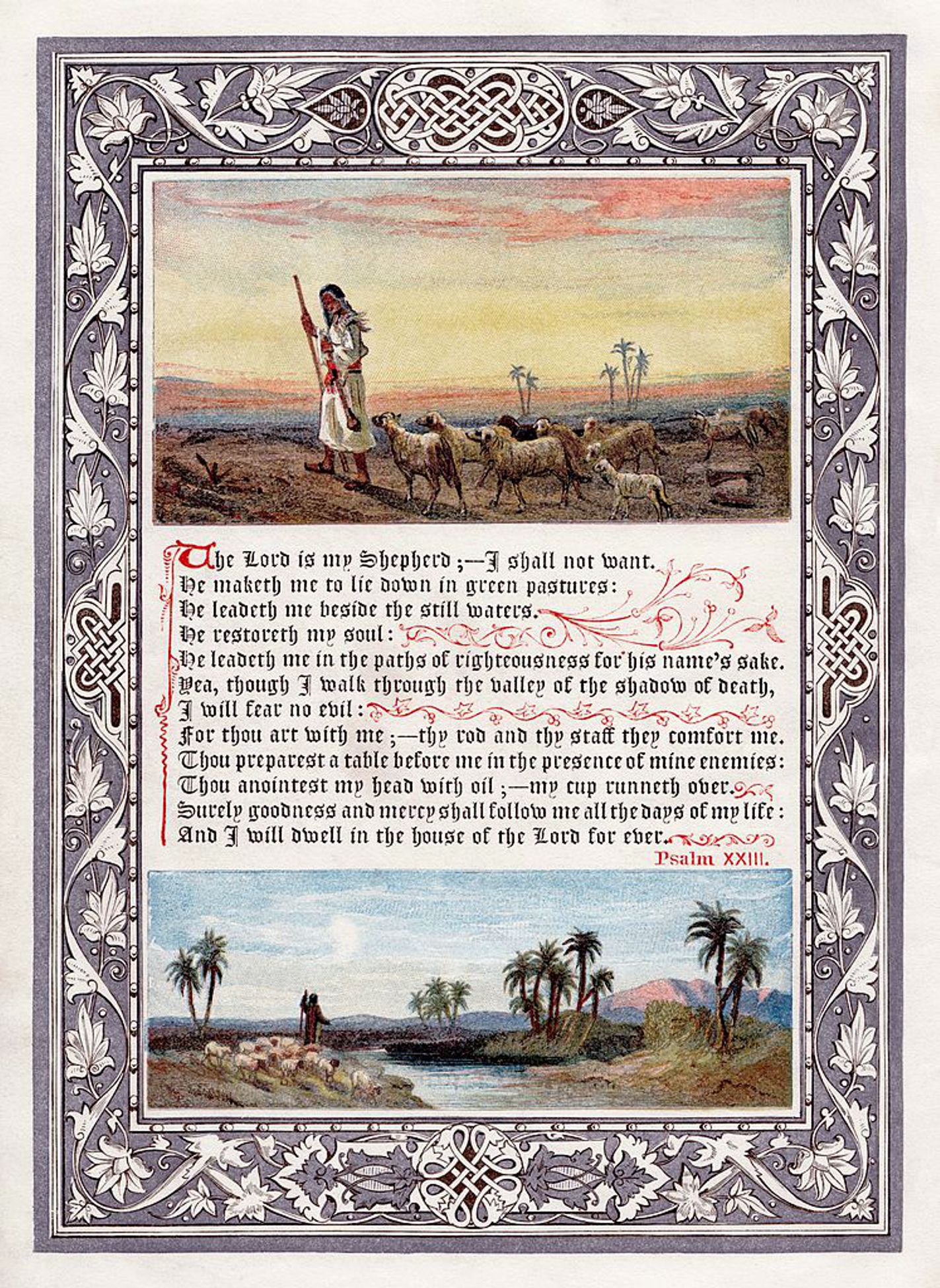
An image of Psalm 23 (KJV), frontispiece to the 1880 omnibus printing of The Sunday at Home

An image of Psalm 23 (KJV), frontispiece to the 1880 omnibus printing of The Sunday at Home: A Family Magazine for Sabbath Reading, [collected volume], London, Religious Tract Society, Public Domain in the United States

Believe and Suffer

Some of us are bewildered when we face adversity, some expect it more often than it occurs, some chalk it up to mysterious forces, and some see it as highly probable at all times. What is certain in this life is that we will suffer at some time in our lives. For all of us, I wish it were as certain that we would all believe so as to be saved from the penalty that our sins deserve. The Apostle Paul wrote to the church in Philippi about believing and suffering:

Only let your manner of life be worthy of the gospel of Christ, so that whether I come and see you or am absent, I may hear of you that:

You are standing firm in one spirit

With one mind striving side by side for the faith of the gospel, and

Not frightened in anything by your opponents.

This is a clear sign to them of their destruction, but of your salvation, and that from God.

For it has been granted to you that for the sake of Christ you should not only believe in him but also suffer for his sake, engaged in the same conflict that you saw I had and now hear that I still have.

Philippians 1:27-30 English Standard Version (ESV)

Paul says God has granted them to believe in Him. But also, in an act of His Sovereign will, to suffer. Not any kind of suffering, but that according to His will, “for His sake.”

The reformer and preacher, John Calvin, makes at least three points about these verses. First, our common struggle against our sin, the world, and the devil unites us. Even if we’re divided by our sins against one another, the struggle is so great against us that we will reconcile and contend for the faith together.

Striving together for the faith…is the strongest bond of concord, …for this has often been the occasion of reconciling even the greatest enemies.

…The Apostle’s meaning is this: “Let the faith of the gospel unite you together, more especially as that is a common armory against one and the same enemy.”

The wicked, too, conspire together for evil, but their agreement is accursed: let us, therefore, contend with one mind under the banner of faith.

These struggles, and our patient suffering, are ordained and given by God as a sign of our salvation to us and to the enemies of the faith. These are both a benefit for our increased devotion and an honor to participate in His sufferings.

To you, says he, it is given, not only to believe in Christ, but also to suffer for him. Hence even the sufferings themselves are evidences of the grace of God; and, since it is so, you have from this source a token of salvation. Oh, if this persuasion were effectually [woven into] our minds — that persecutions are to be reckoned among God’s benefits, what progress would be made in the doctrine of piety!

…It is the highest honor…conferred upon us by Divine grace, that we suffer for his name either reproach, or imprisonment, or miseries, or tortures, or even death, for in that case he adorns us with his marks of distinction. But [many would] rather [that] God [refrain from giving] gifts of that nature, than embrace with [readiness] the cross when it is presented to them. Alas, then, for our stupidity!

Finally, Calvin stresses that our struggle and godly resistance is analogous, though far lesser, to Christ’s struggle and godly resistance on the cross. Yet, both faith and endurance remain His unmerited gifts to us, evident in our inability to resist in our own strength.

[Paul] wisely conjoins faith with the cross by an inseparable connection, [so] that the Philippians may know that they have been called to the faith of Christ on this condition — that they endure persecutions on His account, as though he had said that their adoption can no more be separated from the cross, than Christ can be torn asunder from himself.

Here Paul clearly testifies, that faith, as well as [faithfulness] in enduring persecutions, is an unmerited gift of God. And certainly the knowledge of God is a wisdom that is too high for our attaining it by our own acuteness, and our weakness shows itself in daily instances in our own experience, when God withdraws his hand for a little while…

May God grant you to believe and suffer for His sake.

Suffering and the Sovereignty of God: An Interview with R.C. Sproul Jr., Ligonier Ministries

Why We Use Scripture Extensively in Our Posts

It’s not because we’re lazy (but, if you knew me better, you might disagree.) Nor is it because we can’t write well; though you may disagree with this as well. It’s because His word is what He says He will use to save us from the penalty of death which our sins against Him alone so richly deserve. He says:

“For as the rain and the snow come down from heaven

   and do not return there but water the earth,

making it bring forth and sprout,

   giving seed to the sower and bread to the eater,

so shall my word be that goes out from my mouth;

   it shall not return to me empty,

but it shall accomplish that which I purpose,

   and shall succeed in the thing for which I sent it.

Isaiah 55:10-11 English Standard Version (ESV)

His purpose, His eternal purpose is realized in Christ and the Church. The Lord alone is the objective source of knowledge and action who has entered into what we consider our world. Of course, it is His and is His forever.

When He was drawing me to Himself, He made my reading from the scriptures irresistible. I remember dwelling in long passages from a large bible at the front of a main line church sanctuary so many years ago. Months later, when He was ready for me to submit to Him in repentance, He sent an evangelist who read from the scriptures in answer to my doubting questions. And I trusted in the Lord Jesus Christ that evening after that sent one left.

You might think: “What does this have to do with me; I’m doing okay. It’s you, Adolphus, who needs a crutch to face the inevitability of death.” Well, I thought the same back then; so did everyone who professes belief in the Lord Jesus Christ. It is His sovereign will that chooses and saves you. No one, by strength of will, can save themselves. Everyone, whether saved or not, will stand before God’s judgment seat and give an account of ourselves. It is only by the merit of His Son, the Lord Jesus Christ, conferred to us through faith that we can face that judgment and live. All others will be sent away from His presence.

I offer you, not only the links above, but this verse for your consideration:

“For God so loved the world, that he gave his only Son, that whoever believes in him should not perish but have eternal life. John 3:16 (ESV)

Please, we beg of you, repent and believe.

Albert Mohler: The Authority of Scripture, Ligonier Ministries

Unless – a Conjunction

While doing research for a previous blog post, I noticed that John’s Gospel quotes the Lord Jesus several times using the word: unless.

Unless is interesting because it is a logic term.

Unless

/ənˈles/

conjunction

Except if (used to introduce a case in which a statement being made is not true or valid).

“Unless you have a photographic memory, repetition is vital”

Speaking English – How to Use “Unless,” July 10, 2013, Learn English with Rebecca [engVid RebeccaESL]

The Lord Jesus Christ used this conjunction to lead those who heard Him into God’s Kingdom.

Unless it is granted him by the Father, no one can come to me John 6:64-66 English Standard Version (ESV)

Unless the Father who sent me draws him, no one can come to me John 6:43-45 (ESV)

Unless one is born again he cannot see the kingdom of God John 3:2-3 (ESV)

Unless one is born of water and the Spirit, he cannot enter the kingdom of God John 3:4-6 (ESV)

Unless you believe that I am He you will die in your sins John 8:23-25 (ESV)

To sum up, unless God the Father grants it and draws us we cannot come to the Lord Jesus. Unless one is born again, of water and the Spirit, we can neither see nor enter God’s Kingdom. And unless we believe that the Lord Jesus Christ is the God who saves, we will die condemned to eternal punishment.