Meant Evil?

Perhaps you’ve read it? A story of treachery and redemption that unfolds at the end of the Book of Genesis (chapters 37, 39 – 50.) Jacob’s son Joseph is sold to traders by his brothers and winds up in Egypt as a slave. Through God’s providence, Joseph is promoted to ruler second only to Pharaoh. During a devastating Near East famine, Joseph is instrumental in feeding the civilizations in and around Egypt at the time. Providentially, one of those civilizations, in embryonic form, consisted of his brothers. Joseph, humbled by his God and Savior, offers mercy to them:

But Joseph said to them, “Do not fear, for am I in the place of God? As for you, you meant evil against me, but God meant it for good, to bring it about that many people should be kept alive, as they are today. So do not fear; I will provide for you and your little ones.” Thus he comforted them and spoke kindly to them. Genesis 50:19-21 English Standard Version (ESV)

The reformation preacher and teacher, John Calvin draws out three points from the passage. First, Calvin cautions us to follow Joseph’s example by restraining our passions in light of God’s providence in and through our circumstances:

Am I in the place of God? …Joseph considers the design of divine providence [and] restrains his feelings as with a bridle, lest they should carry him to excess…When, therefore, the desire of revenge urges us, let all our feelings be subjected to the same authority. […If we let] this thought take full possession of our minds, there is no ardor, however furious, which it will not suffice to mitigate.

It is to our advantage to deal with men of moderation, who set God before them as their leader, and who not only submit to His will, but also cheerfully obey Him. For if anyone is impotently carried away by the lust of the flesh, we must fear a thousand deaths from him, unless God should forcibly break his fury.

Calvin explains that, under God’s sovereignty, the brothers were fully guilty of their evil deeds and Joseph owed all honor to God for his good deeds.

You thought evil against me. …The selling of Joseph was a crime detestable for its cruelty and [faithlessness]; yet he was not sold except by the decree of heaven.

…Nothing is done without [God’s] will; because He both governs the counsels of men ([swaying] their wills and [turning] their efforts at his pleasure) and regulates all events: but if men undertake anything right and just, He so actuates and moves them inwardly by his Spirit, that whatever is good in them, may justly be said to be received from Him.

But if Satan and ungodly men rage, He acts by their hands in such an inexpressible manner, that the wickedness of the deed belongs to them, and the blame of it is imputed to them. For they are not induced to sin, as the faithful are to act aright, by the impulse of the Spirit, but they are the authors of their own evil, and follow Satan as their leader.

And finally, true repentance and reconciliation are evidenced by kind acts toward the one or ones forgiven:

I will nourish you. It was a [mark] of a solid and unfeigned reconciliation, not only to abstain from malice and injury, but also to “overcome evil with good,” as Paul teaches (Romans 12:21.)

He who fails in his duty, when he possesses the power of giving help, and when the occasion demands his assistance, shows, by this [failure], that he is not forgetful of injury.

Therefore, we shall prove our minds to be free from malevolence, when we [do] kindness [to] those enemies by whom we have been ill-treated.

In light of God’s providence, let us then practice forgiveness and reconciliation by doing good to those who have trespassed against us that we’ve forgiven.

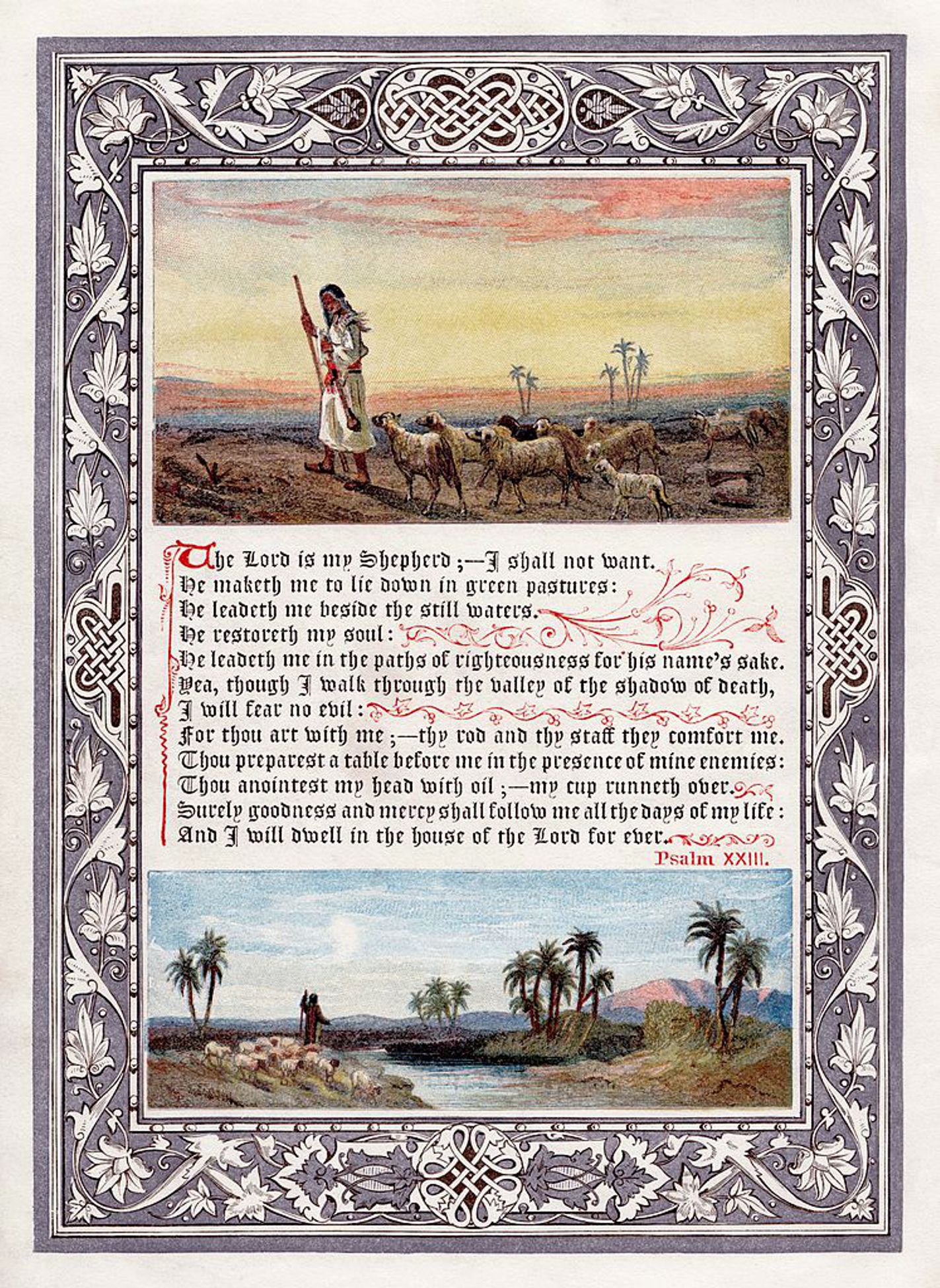
An image of Psalm 23 (KJV), frontispiece to the 1880 omnibus printing of The Sunday at Home

An image of Psalm 23 (KJV), frontispiece to the 1880 omnibus printing of The Sunday at Home: A Family Magazine for Sabbath Reading, [collected volume], London, Religious Tract Society, Public Domain in the United States

Not Your Own

We often hear that faith must be personal. “My faith,” they say. People might tell us they’ve persevered through trials due to their faith. Were it to have failed, they would’ve been lost. But they had enough. At least that’s what they say. I don’t know about you, but I get the impression that they think this faith is their own, as if they produced it. As if it were due to strength of character or moral upbringing.

On the contrary, though we must hold faith individually:

And to the one who does not work but believes in him who justifies the ungodly, his faith is counted as righteousness. Romans 4:5 English Standard Version (ESV)

It is not our faith, it is a gift of God so that we might not boast about ourselves.

For by grace you have been saved through faith. And this is not your own doing; it is the gift of God, not a result of works, so that no one may boast. For we are his workmanship, created in Christ Jesus for good works, which God prepared beforehand, that we should walk in them. Ephesians 2:8-10 (ESV)

John Calvin comments on this verse:

For by grace are you saved. …God declares, that he owes us nothing; so that salvation is not a reward or recompense, but unmixed grace. The next question is, in what way do men receive that salvation which is offered to them by the hand of God? The answer is, by faith; and hence he concludes that nothing connected with it is our own…

Not of works. …Many persons restrict the word ‘gift’ to faith alone. But Paul is only repeating in other words the former sentiment. His meaning is, not that faith [only] is the gift of God, but that salvation [entirely] is given to us by God…

For we are his work. …The apostle affirms that we are God’s work, and that everything good in us is his creation; by which he means that the whole man is formed by his hand to be good. It is not the mere power of choosing aright, or some indescribable kind of preparation, or even assistance, but the right will itself, which is his workmanship; otherwise Paul’s argument would have no force.

Created to good works. …[Paul] says, that, before we were born, the good works were prepared by God; meaning, that in our own strength we are not able to lead a holy life, but only so far as we are formed and adapted by the hand of God. Now, if the grace of God came before our performances, all ground of boasting has been taken away…

To reiterate, faith is not a result of human will:

For he says to Moses, “I will have mercy on whom I have mercy, and I will have compassion on whom I have compassion.” So then it depends not on human will or exertion, but on God, who has mercy Romans 9:15-16 (ESV)

To this, Calvin comments:

It is not then of him who wills, etc. …That none of you may think that they who are elected are elected because they are deserving, or because they had in any way procured for themselves the favor of God, or, in short, because they had in them a particle of worthiness by which God might be moved, take simply this view of the matter, that it is neither by our will nor efforts…that we are counted among the elect, but that it wholly depends on the divine goodness, which of itself chooses those who neither will, nor strive, nor even think of such a thing… [Emphasis mine]

Therefore faith is not subjective. It is not of ourselves so that we may not boast. Just like the scriptures, faith is not a matter of one’s own opinion.

***

Now, if we accept that faith is not of ourselves, we who profess faith must also realize that we, ourselves, are not our own, either.

Or do you not know that your body is a temple of the Holy Spirit within you, whom you have from God? You are not your own, for you were bought with a price. So glorify God in your body. 1 Corinthians 6:19-20 (ESV)

77s – The 77’s – Bottom Line,   Uploaded to YouTube on Apr 6, 2008, posted by Neamberthal, Lyrics

Gullible

Many think that those who follow Christ are hopelessly ignorant and gullible. They’ll believe anything.

I was reminded of how gullible I am by this video. It purports to show an F-35B Lightning II Marine Corps fighter takeoff, falter, and make a remarkable recovery to flight from a ship at sea.

F-35 Unintended loop right off the carrier deck during vertical take-off, December 15, 2009

Is it real? It sure looks real on the surface. But the answer is no; it’s a doctored frame sequence from a video game. Once you see how the F–35B actually takes off and lands, you’ll note many obvious discrepancies.

Are those who follow Christ gulled into believing? Are they rubes unworthy of being taken seriously? Are they insufferable? When you see what’s involved in true belief, you’ll note the impossibility of it.

We’ll take the Lord Jesus Christ’s testimony as evidence. Speaking in His own defense before the Council of Elders at Jerusalem, they ask if He is the Messiah and He responds to them:

“If you are the Christ, tell us.” But he said to them, “If I tell you, you will not believe” Luke 22:67 English Standard Version (ESV)

Their refusal to believe was ordained. John explains this clearly in his gospel account. After Christ’s triumphal entry into Jerusalem and His performance of many attesting signs, when the people still did not believe in Him, John tells us:

So that the word spoken by the prophet Isaiah might be fulfilled:

“Lord, who has believed what he heard from us,

   and to whom has the arm of the Lord been revealed?”

Therefore they could not believe. For again Isaiah said,

“He has blinded their eyes

   and hardened their heart,

lest they see with their eyes,

   and understand with their heart, and turn,

   and I would heal them.”

John 12:38-40 (ESV)

The Lord Jesus picked up on this theme when He told the parable of the Rich Man and Lazarus to His disciples, the Pharisees, scribes, tax collectors, and sinners [a derogatory term the religious elite used for commoners as if they were not the same].

And [the rich man] said, ‘No, father Abraham, but if someone goes to them from the dead, they will repent.’ He said to him, ‘If they do not hear Moses and the Prophets, neither will they be convinced if someone should rise from the dead.’” Luke 16:30-31 (ESV)

From elsewhere in scripture we know that Moses and the Prophets spoke of Him. I always imagine he delivered this punch line to the parable with dramatic irony.

While speaking with His disciples about the difficulty of entering the Kingdom of God, His disciples questioned Him:

And they were exceedingly astonished, and said to him, “Then who can be saved?” Jesus looked at them and said, “With man it is impossible, but not with God. For all things are possible with God.” Mark 10:26-27 (ESV)

So, by His own admission, entering into belief is impossible for humankind on their own. The Apostle Paul reiterates and expands on this truth:

For He says to Moses, “I will have mercy on whom I have mercy, and I will have compassion on whom I have compassion.” So then it depends not on human will or exertion, but on God, who has mercy. Romans 9:15-16 (ESV)

So belief is a gift of a merciful God to individuals, not something we can adopt like a political party affiliation or can attain like elected office.

But we may be assured that:

Whoever believes in the Son has eternal life; whoever does not obey the Son shall not see life, but the wrath of God remains on him. John 3:36 (ESV)

And we know that this gift is certain:

For the Scripture says, “Everyone who believes in him will not be put to shame.” Romans 10:11 (ESV)

Please, believe in Him.

Uncertain Footing

We go about our business without a care for the ground beneath us. However, can we be sure our foot will not slip? Losing what we think is firm footing can occur suddenly and without warning. Some causes are of this earth and some are not. All are common to the human condition.

One way we lose our footing is due to sinkholes. These occur because water erodes underground supports via either natural or manmade processes.

A Sinkhole in a Northeastern Chinese City Swallowed Five People [Required Hospitalization], CCTV, published on Aug 27, 2015

The United States Geological Survey (USGS) cites a shocking statistic. Between 35 to 40 percent of the US is susceptible to sinkholes. These occur in two rock types: evaporites (salt, gypsum, and anhydrite) and carbonates (limestone and dolomite). Many formations, but not all, occur at deep depths.

http://water.usgs.gov/edu/sinkholes.html

USGS Sinkhole Susceptibility Map

Commonly, water erosion in these areas results in underground caverns which can lead to ground subsidence. However, sometimes the cavern erodes so extensively that the ceiling collapses and a sinkhole results. Such things are common in Florida and Louisiana.

8/21/13 Slough in, Assumption Parish, Louisiana

As frightening as these may be, we find ourselves in a much worse situation: at any moment we can plunge into Hell.

Only God’s patient endurance gives any of us more time on this earth. He is in the right concerning this because He gives us existence. And He calls us wicked because we continually disobey Him.

A famous (some say infamous) American preacher, Jonathan Edwards, delivered one of many sermons to his congregation called “Sinners in the Hands of an Angry God.” Maybe you studied it in high school or college.

The sermon’s premise is summed up by Edwards’s statement:

“There is nothing that keeps wicked men at any one moment out of hell, but the mere pleasure of God.”

Of Edwards’s ten considerations, these three bring home our predicament:

2.  The Wicked deserve to be cast into hell. Divine justice does not prevent God from destroying the Wicked at any moment.

6.  If it were not for God’s restraints, there are, in the souls of wicked men, hellish principles reigning which, presently, would kindle and flame out into hellfire.

10.  God has never promised to save us from Hell, except for those contained in Christ through the covenant of Grace.

Just as his congregants cried out, we must say:

“What shall I do to be saved?”

And as Paul and Silas answered the Jailer:

Believe in the Lord Jesus, and you will be saved, you and your household

Only then will we have sure footing.

Sinners In The Hands Of An Angry God,” sermon reenacted by Ralph Green, October 30, 2012, Cloverhill4’s channel

The Lord Is Always Before Me

Can you make the claim in the title like the psalmist David did? I find I can’t; at least not consistently. But I want to. I want to very much.

I have set the Lord always before me;

    because he is at my right hand, I shall not be shaken.

Therefore my heart is glad, and my whole being rejoices;

    my flesh also dwells secure.

Psalm 16:8-9 English Standard Version (ESV)

Calvin says with regard to verse 8:

…The meaning, therefore, is, that David kept his mind so intently fixed upon the providence of God, as to be fully persuaded, that whenever any difficulty or distress should befall him, God would be always at hand to assist him.

He adds, also, [always], to show us how he constantly depended upon the assistance of God, so that, amidst the various conflicts with which he was agitated, no fear of danger could make him turn his eyes to any other quarter than to God in search of succor.

…David then reckons himself secure against all dangers, and promises himself certain safety, because, with the eyes of faith, he beholds God as present with him.

And with regard to verse 9:

In short, calmly to rejoice is the lot of no man but of him who has learned to place his confidence in God alone, and to commit his life and safety to his protection.

When, therefore, encompassed with innumerable troubles on all sides, let us be persuaded, that the only remedy is to direct our eyes towards God; and if we do this, faith will not only tranquillize our minds, but also replenish them with fullness of joy.

…Farther, although the body is not free from inconveniences and troubles, yet as God defends and maintains not only our souls, but also our bodies, David does not speak groundlessly when he represents the blessing of dwelling in safety as extending to his flesh in common with his soul.

David’s statements in verses 8 and 9 pertain to us if we’ve trusted in Christ. However, verse 10 does not.

For you will not abandon my soul to Sheol,

    or let your holy one see corruption.

Psalm 16:10 (ESV)

This verse didn’t even apply to David as the Apostle Peter rightly points out in his sermon at Pentecost. Peter uses this psalm (esp. verse 10) as a testimony of Christ’s resurrection. The passage is found in Acts of the Apostles, chapter 2, verses 25-28 (ESV).

We serve a risen Lord always ready to provide mercy and grace in our time of need. Call to Him.

View from the Cross

What Our Lord Saw from the Cross, 1886–1894, by James Tissot (1836–1902), in the public domain in the US

All Israel Shall Be Saved

Much has been said recently about the reestablishment of Israel in the Middle East. Even Kim Riddlebarger’s A Case for Amillennialism, which we mentioned a few weeks ago, touches on the issue of national Israel. Some of what’s been said is divisive and some is not.

So let’s step back from the contemporary rhetoric and see what the Bible says. The Apostle Paul discussed Israel in his letter to the church in Rome. He described that nation’s relationship to God now that the gospel had been revealed. Paul made the following statement:

And in this way all Israel will be saved, as it is written,

“The Deliverer will come from Zion,

He will banish ungodliness from Jacob”;

Romans 11:26 English Standard Version (ESV)

What did he mean by ‘in this way?’ It seems that a lot of controversy surrounds this clause.

The exegete John Calvin said of the verse:

Many understand this of the Jewish people, as though Paul had said, that religion would again be restored among them as before [e.g., the sacrificial system].

But I extend the word Israel to all the people of God, according to this meaning:

“When the Gentiles shall come in, the Jews also shall return from their defection to the obedience of faith; and thus shall be completed the salvation of the whole Israel of God, which must be gathered from both; and yet in such a way that the Jews shall obtain the first place, being as it were the first-born in God’s family.”

Calvin didn’t make this assertion and others because of personal preference or animus, but based on the context of Paul’s statements in the chapter. Paul went on to say:

As regards the gospel, they [i.e., Israel] are enemies for your [i.e., the hearers of his letter] sake. But as regards election, they are beloved for the sake of their forefathers. For the gifts and the calling of God are irrevocable.

For just as you were at one time disobedient to God but now have received mercy because of their disobedience, so they too have now been disobedient in order that by the mercy shown to you they also may now receive mercy. For God has consigned all to disobedience, that he may have mercy on all. Romans 11:28-32 (ESV)

To this, Calvin commented:

[Paul] shows that the worst thing in the Jews ought not to subject them to the contempt of the Gentiles. Their chief crime was unbelief: but Paul teaches us, that they were thus blinded for a time by God’s providence, that a way to the gospel might be made for the Gentiles;

Paul then intends here to teach two things — that there is nothing in any man why he should be preferred to others, apart from the mere favor of God; and that God in the dispensation of his grace, is under no restraint that he should not grant it to whom he pleases.

There is an emphasis in the word mercy; for it intimates that God is bound to none, and that he therefore saves all freely, for they are all equally lost.

…Paul simply means that both Jews and Gentiles do not otherwise obtain salvation than through the mercy of God, and thus he leaves to none any reason for complaint. It is indeed true that this mercy is without any difference offered to all, but everyone must seek it by faith.

And thus ‘in this way’: All Israel Shall Be Saved.

Valley of Jezreel

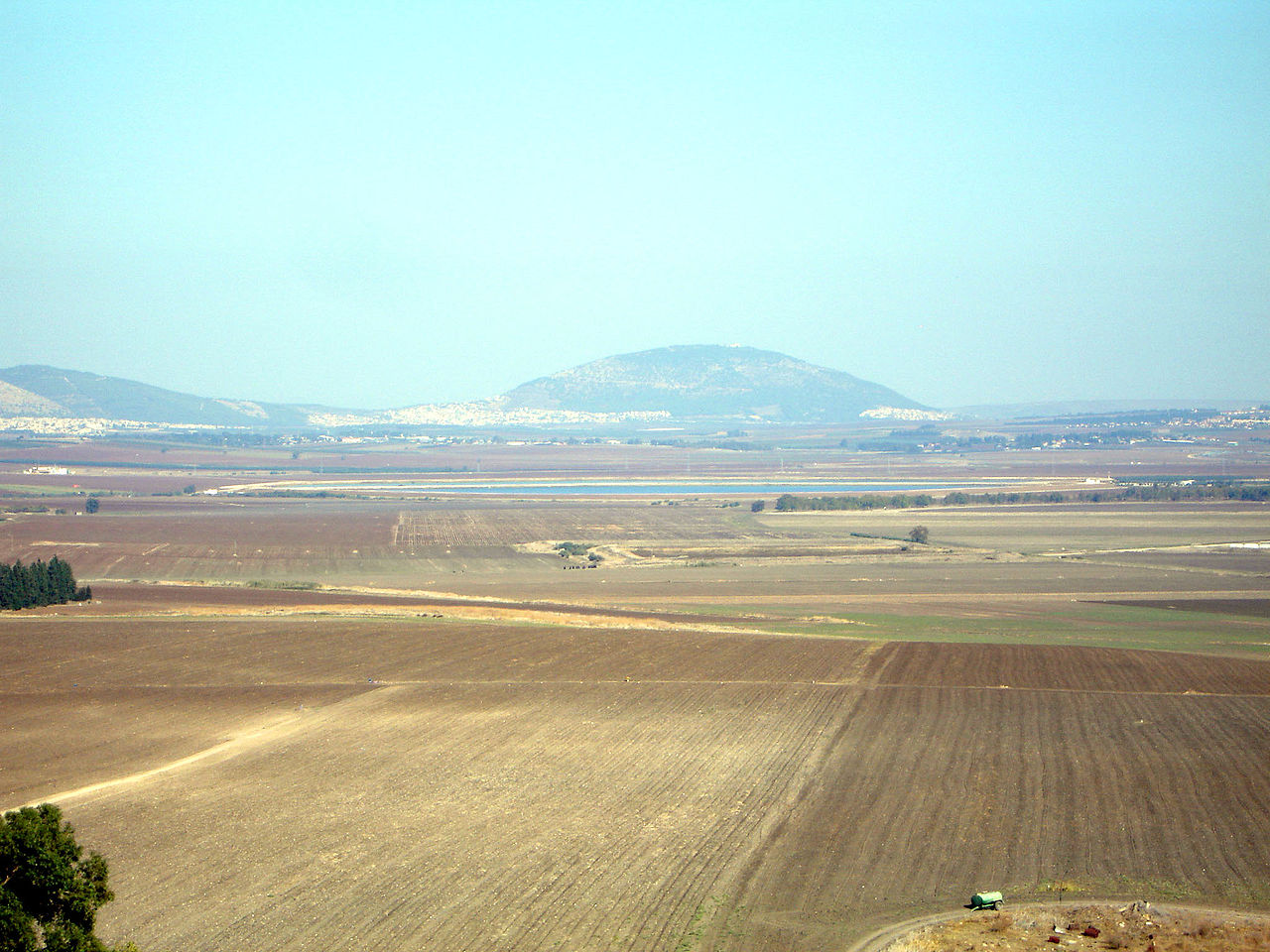
The view from Megiddo, northeast across the Jezreel Valley in Israel to Mount Tabor, 9 November 2005, by Joe Freeman, Creative Commons Attribution-Share Alike 2.5 Generic

No Rest

We are now planning Mandated Memoranda Publishing’s next novel: Who Shall Be God. We have characters, certain scenes, and even a cover image in mind already. We’re investigating background materials for the theme of the novel. Since it deals with political conflict reflected through two families, we’re reading The Fourth Revolution by John Micklethwait and Adrian Wooldridge and Alien Powers by Kenneth Minogue. However, we always have a biblical theme in mind too.

The scripture: Isaiah 57 jumped out at us based on our reading of The Art of Dramatic Writing by L. Egri. Here are the pertinent parts:

The righteous man perishes,

    and no one lays it to heart;

devout men are taken away,

    while no one understands.

For the righteous man is taken away from calamity;

    he enters into peace;

they rest in their beds

    who walk in their uprightness.

Isaiah 57:1-2 English Standard Version (ESV)

But the wicked are like the tossing sea;

    for it cannot be quiet,

    and its waters toss up mire and dirt.

There is no peace,” says my God, “for the wicked.”

Isaiah 57:20-21 (ESV)

We commonly know the last verse (repeated elsewhere in Isaiah 48:22, 57:20, 57:21) as the phrase:

“No rest for the wicked [or weary]”.

As we always do, let’s consult Calvin to get his take on Isaiah’s verses:

The righteous man hath perished…And no man layeth it to heart. …The Lord holds out as a mirror this event of his providence, more remarkable than all others, that he takes away good and worthy men out of this life, when he determines to chastise his people severely. But no man considers it, or reflects that it is a token of approaching destruction, that God gathers them, and places them in safety from being distressed by prevailing afflictions.

…The general meaning is, that wicked men grievously deceive themselves by supposing that there is no greater happiness than to have life continued to a great age, and by thus pluming themselves on their superiority to the servants of God, who die early. Being attached to the world, they likewise harden themselves by this pretense that, by nothing else than a manifestation of God’s favor towards them, while others die, they continue to be safe and sound…

Men of mercy are gathered. …But, since God, in many passages of Scripture, represents gentleness and kindness as a distinguishing mark of his children, this may be, as I have said, a definition of true righteousness.

Hence we see that the Lord, at that time, gathered many good men, whose death portended some dreadful calamity, and yet that the Jews [the Prophet’s proximate audience] paid no regard to such forewarnings, and even proceeded to more daring lengths of wickedness; for they thought that all went well with them, when they were the survivors of many excellent men.

Peace shall come. The Prophet describes what shall be the condition of believers in death; for the wicked, who think that there is no life but the present, imagine that good men have perished; because in death they see nothing but ruin. For this reason he says that “Peace shall come,” which is more desirable than a thousand lives full of trouble; as if he compared them to discharged soldiers, who are and allowed to enjoy case and quietness.

They shall rest in their beds. He adds the metaphor of sleep, in order to show that they shall be absolutely free from all the uneasiness of cares, just as if they were safely pleasantly asleep “on their beds.”

Whosoever walketh before him. …as if he had said, “Whosoever walketh before God shall enjoy peace.” Thus, when righteous men die, and their various labors are finished, and their course is ended, they are called to peace and repose. They “rest in their beds,” because they do not yet enjoy perfect blessedness and glory; but they wail; for the last day of the resurrection, when everything shall be perfectly restored; and that, I think, is what Isaiah meant.

By these comments, Calvin seems to echo Revelation 18:4.

Then I heard another voice from heaven saying,

“Come out of her, my people,

lest you take part in her sins,

lest you share in her plagues;”

Revelation 18:4 (ESV)

As for Isaiah’s second couplet, Calvin says:

But the wicked. …But because the reprobate make false pretensions to the name of God, and vainly glory in it, the Prophet shows that there is no reason why they should flatter themselves, or advance any claim, on the ground of this promise, since they can have no share in this peace. Nor will it avail them anything, that God, having compassion upon his people, receives them into favor, and commands peace to be proclaimed to them.

As the troubled sea. That metaphor of “the sea” is elegant and very well fitted to describe the uneasiness of the wicked; for of itself “the sea is troubled.” …Most appropriately, therefore, has the Prophet compared them to a stormy and troubled sea. Whoever then wishes to avoid these alarms and this frightful agony of heart, let him not reject that peace which the Lord offers to him. There can be no middle course between them; for, if you do not lay aside sinful desires and accept of this peace, you must unavoidably be miserably distressed and tormented.

There is no peace to the wicked. He confirms the preceding statement, namely, that in vain shall the reprobate endeavor to seek peace, for everywhere they will meet with war. It is God who threatens war, and therefore there can be no hope of “peace.” Wicked men would indeed wish to enjoy peace, and ardently long for it; for there is nothing which they more eagerly desire than to be at ease, and to lull their consciences, that they may freely take their pleasures and indulge in their vices.

They drive away all thoughts about the judgment of God, and endeavor to stupefy themselves and to repose in indolence, and think that these are the best ways and methods of obtaining peace. But they never shall enjoy it; for, until men have been reconciled to God, conscience will never cease to annoy and carry on war with them.

Saith my God. Thus he represents God as the only author of peace, that he may, by this dreadful threatening, tear from the Jews their dearest pleasures; and calls him “his God,” in opposition to the vain boasting of those who falsely boasted of his name; for they cannot acknowledge God, so long as they reject his Prophet and his doctrine. For this reason the Prophet boldly declares that he has received a command from God to declare perpetual war against them.

There is no rest for the wicked; no rest now or in eternity. Turn away from evil ways and do good.

Triumph of Death, 1562, Pieter Breughel the Elder

Triumph of Death, 1562, Pieter Breughel the Elder (1526/1530–1569), Museo del Prado, Madrid, Public Domain

Judgment and Condemnation

I was speaking with someone at church a few weeks back and we both wondered what 2 Corinthians 5:10 meant:

For we must all appear before the judgment seat of Christ, so that each one may receive what is due for what he has done in the body, whether good or evil. 2 Corinthians 5:10 English Standard Version (ESV)

Are believers judged? Rather than guess, I offered to look into it. Here’s what I found Calvin had to say:

We must be manifested. Though this is common to all, yet all without distinction do not raise their views in such a way as to consider every moment, that they must appear before the judgment-seat of Christ…For then the books, which are now shut, will be opened (Daniel 7:10).

That every one may give account. As the passage relates to the recompensing of deeds, we must notice briefly, that, as evil deeds are punished by God, so also good deeds are rewarded, but for a different reason; for evil deeds are requited with the punishment that they deserve, but God in rewarding good deeds does not look to merit or worthiness.

For no work is so full and complete in all its parts as to be deservedly well-pleasing to him, and farther, there is no one whose works are in themselves well-pleasing to God, unless he render satisfaction to the whole law. Now no one is found to be thus perfect. Hence the only resource is in his accepting us through unmerited goodness, and justifying us, by not imputing to us our sins.

After he has received us into favor, he receives our works also by a gracious acceptance. It is on this that the reward hinges. There is, therefore, no inconsistency in saying, that he rewards good works, provided we understand that mankind, nevertheless, obtain eternal life gratuitously…

So, here, I think we have half the explanation. All humankind is judged for the good and bad that they’ve done in this life. Any good we can do is only good insofar as God does not count our sins against us. This is only possible through faith in Christ’s saving work on the cross. And that, too, is freely given by Him alone to those who do not merit it.

But what of the condemnation due for the bad that we do? The scriptures say:

Truly, truly, I say to you, whoever hears my word and believes him who sent me has eternal life. He does not come into judgment, but has passed from death to life. John 5:24 (ESV)

Calvin says about this verse:

He that heareth my word. Here is described the way and manner of honoring God, that no one may think that it consists solely in any outward performance, or in frivolous ceremonies. …But here Christ demands from us no other honor than to obey his Gospel…

Hath eternal life. By these words he likewise commends the fruit of obedience, that we may be more willing to render it…

And shall not come into condemnation. There is here an implied contrast between the guilt to which we are all naturally liable, and the unconditional acquittal which we obtain through Christ; for if all were not liable to condemnation, what purpose would it serve to free from it those who believe in Christ?

The meaning therefore is, that we are beyond the danger of death, because we are acquitted through the grace of Christ; and, therefore, though Christ sanctifies and regenerates us, by his Spirit, to newness of life, yet here he specially mentions the unconditional forgiveness of sins, in which alone the happiness of men consists. For then does a man begin to live when he has God reconciled to him; and how would God love us, if he did not pardon our sins?

…Though life be only begun in us, Christ declares that believers are so certain of obtaining it, that they ought not to fear death; and we need not wonder at this, since they are united to him who is the inexhaustible fountain of life.

But what shall we do with such confidence? I suggest, with Calvin, that we cast off fear and live a life worthy of our gracious God’s gift.

The Last Judgment, Martin, 1853

The Last Judgment, 1853, John Martin (1789-1854), Tate Britain, Public Domain in US

Schadenfreude

Have you ever laughed when someone trips up, makes a mistake, or some other calamity befalls them? That’s an example of Schadenfreude.

Wikipedia defines it as:

Pleasure derived from the misfortunes of others. This word is taken from German and literally means ‘harm-joy.’ It is the feeling of joy or pleasure when one sees another fail or suffer misfortune. It is also borrowed by some other languages.

But it’s not something we should practice towards those we call brothers and sisters.

Rejoice with those who rejoice, weep with those who weep. Live in harmony with one another. Do not be haughty, but associate with the lowly. Never be wise in your own sight. Romans 12:15-16 English Standard Version (ESV)

We shouldn’t practice it toward those who do us wrong either.

Do not rejoice when your enemy falls,

and let not your heart be glad when he stumbles,

lest the Lord see it and be displeased,

and turn away his anger from him.

Proverbs 24:17-18 (ESV)

And not because we wish them harm, but because we’re commanded:

Beloved, never avenge yourselves, but leave it to the wrath of God, for it is written, “Vengeance is mine, I will repay, says the Lord.” Romans 12:19 (ESV)

and

Do not be overcome by evil, but overcome evil with good. Romans 12:21 (ESV)

But if we do persist, we’re on a slippery slope. Soon, we may find ourselves siding with the Pharisees and looking down on the Tax Collectors in our midst:

He also told this parable to some who trusted in themselves that they were righteous, and treated others with contempt:

“Two men went up into the temple to pray, one a Pharisee and the other a tax collector. The Pharisee, standing by himself, prayed thus: ‘God, I thank you that I am not like other men, extortioners, unjust, adulterers, or even like this tax collector. I fast twice a week; I give tithes of all that I get.’

“But the tax collector, standing far off, would not even lift up his eyes to heaven, but beat his breast, saying, ‘God, be merciful to me, a sinner!’

“I tell you, this man went down to his house justified, rather than the other. For everyone who exalts himself will be humbled, but the one who humbles himself will be exalted.” Luke 18:9-14 (ESV)

What does John Calvin think of the passage in Luke?

There are two faults at which Christ glances, and which he intended to condemn, — wicked confidence in ourselves, and the pride of despising brethren, the one of which springs out of the other. It is impossible that he who deceives himself with vain confidence should not lift himself up above his brethren. Nor is it wonderful that it should be so; for how should that man not despise his equals, who vaunts against God himself? Every man that is puffed up with self-confidence carries on open war with God, to whom we cannot be reconciled in any other way than by denial of ourselves; that is, by laying aside all confidence in our own virtue and righteousness, and relying on his mercy alone.

I urge you to read what else Calvin says about the passage.

It always seems to come down to: “Let him who is without sin among you be the first to throw a stone…” And it needs to start with me.

The Swallow's Nest Castle near Gaspra

The Swallow’s Nest Castle near Gaspra, Yalta municipality. Republic of Crimea, 4 April 2014, A. Savin, Creative Commons Attribution-Share Alike 3.0 Unported

The Real Meaning of Thanksgiving Day

Perhaps you’ve read these proclamations by Abraham Lincoln? I had not. Perhaps they mean nothing to you; perhaps they meant nothing to Abraham Lincoln or his Secretary of State, William Seward. But, even if they were just speechifying, these stand as powerful and stark words, even today.

Proclamation 97 — Appointing a Day of National Humiliation, Fasting, and Prayer – March 30, 1863

By the President of the United States of America

A Proclamation

Whereas the Senate of the United States, devoutly recognizing the supreme authority and just government of Almighty God in all the affairs of men and of nations, has by a resolution requested the President to designate and set apart a day for national prayer and humiliation; and

Whereas it is the duty of nations as well as of men to own their dependence upon the overruling power of God, to confess their sins and transgressions in humble sorrow, yet with assured hope that genuine repentance will lead to mercy and pardon, and to recognize the sublime truth, announced in the Holy Scriptures and proven by all history, that those nations only are blessed whose God is the Lord;

And, insomuch as we know that by His divine law nations, like individuals, are subjected to punishments and chastisements in this world, may we not justly fear that the awful calamity of civil war which now desolates the land may be but a punishment inflicted upon us for our presumptuous sins, to the needful end of our national reformation as a whole people? We have been the recipients of the choicest bounties of Heaven; we have been preserved these many years in peace and prosperity; we have grown in numbers, wealth, and power as no other nation has ever grown. But we have forgotten God. We have forgotten the gracious hand which preserved us in peace and multiplied and enriched and strengthened us, and we have vainly imagined, in the deceitfulness of our hearts, that all these blessings were produced by some superior wisdom and virtue of our own. Intoxicated with unbroken success, we have become too self-sufficient to feel the necessity of redeeming and preserving grace, too proud to pray to the God that made us.

It behooves us, then, to humble ourselves before the offended Power, to confess our national sins, and to pray for clemency and forgiveness.

Now, therefore, in compliance with the request, and fully concurring in the views of the Senate, I do by this my proclamation designate and set apart Thursday, the 30th day of April, 1863, as a day of national humiliation, fasting, and prayer. And I do hereby request all the people to abstain on that day from their ordinary secular pursuits, and to unite at their several places of public worship and their respective homes in keeping the day holy to the Lord and devoted to the humble discharge of the religious duties proper to that solemn occasion.

All this being done in sincerity and truth, let us then rest humbly in the hope authorized by the divine teachings that the united cry of the nation will be heard on high and answered with blessings no less than the pardon of our national sins and the restoration of our now divided and suffering country to its former happy condition of unity and peace. In witness whereof I have hereunto set my hand and caused the seal of the United States to be affixed.

Done at the city of Washington, this 30th day of March, A. D. 1863, and of the Independence of the United States the eighty-seventh.

ABRAHAM LINCOLN.

By the President:

WILLIAM H. SEWARD, Secretary of State.

Citation: Abraham Lincoln: “Proclamation 97 – Appointing a Day of National Humiliation, Fasting, and Prayer,” March 30, 1863. Online by Gerhard Peters and John T. Woolley, The American Presidency Project.

The second proclamation sets forth a specific day for thanksgiving.

Proclamation 106 — Thanksgiving Day, 1863 – October 3, 1863

By the President of the United States of America

A Proclamation

The year that is drawing toward its close has been filled with the blessings of fruitful fields and healthful skies. To these bounties, which are so constantly enjoyed that we are prone to forget the source from which they come, others have been added which are of so extraordinary a nature that they can not fail to penetrate and soften even the heart which is habitually insensible to the ever-watchful providence of Almighty God.

In the midst of a civil war of unequaled magnitude and severity, which has sometimes seemed to foreign states to invite and to provoke their aggression, peace has been preserved with all nations, order has been maintained, the laws have been respected and obeyed, and harmony has prevailed everywhere, except in the theater of military conflict, while that theater has been greatly contracted by the advancing armies and navies of the Union.

Needful diversions of wealth and of strength from the fields of peaceful industry to the national defense have not arrested the plow, the shuttle, or the ship; the ax has enlarged the borders of our settlements, and the mines, as well of iron and coal as of the precious metals, have yielded even more abundantly than heretofore. Population has steadily increased notwithstanding the waste that has been made in the camp, the siege, and the battlefield, and the country, rejoicing in the consciousness of augmented strength and vigor, is permitted to expect continuance of years with large increase of freedom.

No human counsel hath devised nor hath any mortal hand worked out these great things. They are the gracious gifts of the Most High God, who, while dealing with us in anger for our sins, hath nevertheless remembered mercy.

It has seemed to me fit and proper that they should be solemnly, reverently, and gratefully acknowledged, as with one heart and one voice, by the whole American people. I do therefore invite my fellow-citizens in every part of the United States, and also those who are at sea and those who are sojourning in foreign lands, to set apart and observe the last Thursday of November next as a day of thanksgiving and praise to our beneficent Father who dwelleth in the heavens. And I recommend to them that while offering up the ascriptions justly due to Him for such singular deliverances and blessings they do also, with humble penitence for our national perverseness and disobedience, commend to His tender care all those who have become widows, orphans. mourners, or sufferers in the lamentable civil strife in which we are unavoidably engaged, and fervently implore the interposition of the Almighty hand to heal the wounds of the nation and to restore it, as soon as may be consistent with the divine purposes, to the full enjoyment of peace, harmony, tranquillity, and union.

In testimony whereof I have hereunto set my hand and caused the seal of the United States to be affixed.

Done at the city of Washington, this 3d day of October, A. D. 1863, and of the Independence of the United States the eighty-eighth.

ABRAHAM LINCOLN.

By the President:

WILLIAM H. SEWARD, Secretary of State.

Citation: Abraham Lincoln: “Proclamation 106 – Thanksgiving Day, 1863,” October 3, 1863. Online by Gerhard Peters and John T. Woolley, The American Presidency Project.

The third proclamation establishes the last Thursday in November as Thanksgiving Day.

Proclamation 118 — Thanksgiving Day, 1864 – October 20, 1864

By the President of the United States of America

A Proclamation

It has pleased Almighty God to prolong our national life another year, defending us with His guardian care against unfriendly designs from abroad and vouchsafing to us in His mercy many and signal victories over the enemy, who is of our own household. It has also pleased our Heavenly Father to favor as well our citizens in their homes as our soldiers in their camps and our sailors on the rivers and seas with unusual health. He has largely augmented our free population by emancipation and by immigration, while He has opened to us new sources of wealth and has crowned the labor of our workingmen in every department of industry with abundant rewards. Moreover, He has been pleased to animate and inspire our minds and hearts with fortitude, courage, and resolution sufficient for the great trial of civil war into which we have been brought by our adherence as a nation to the cause of freedom and humanity, and to afford to us reasonable hopes of an ultimate and happy deliverance from all our dangers and afflictions:

Now, therefore, I, Abraham Lincoln, President of the United States, do hereby appoint and set apart the last Thursday in November next as a day which I desire to be observed by all my fellow-citizens, wherever they may then be, as a day of thanksgiving and praise to Almighty God, the beneficent Creator and Ruler of the Universe. And I do further recommend to my fellow-citizens aforesaid that on that occasion they do reverently humble themselves in the dust and from thence offer up penitent and fervent prayers and supplications to the Great Disposer of Events for a return of the inestimable blessings of peace, union, and harmony throughout the land which it has pleased Him to assign as a dwelling place for ourselves and for our posterity throughout all generations.

In testimony whereof I have hereunto set my hand and caused the seal of the United States to be affixed.

Done at the city of Washington, this 20th day of October, A.D. 1864, and of the Independence of the United States the eighty-ninth.

ABRAHAM LINCOLN.

By the President:

WILLIAM H. SEWARD, Secretary of State .

Citation: Abraham Lincoln: “Proclamation 118 – Thanksgiving Day, 1864,” October 20, 1864. Online by Gerhard Peters and John T. Woolley, The American Presidency Project.

These proclamations, in their totality, are what the day should mean for the citizens of the United States of America.

Freedom From Want - Rockwell

FREEDOM FROM WANT — Office for Emergency Management. Office of War Information. Domestic Operations Branch. Bureau of Special Services. (03/09/1943 – 09/15/1945), in the Public Domain