The author of the book to the Hebrews, in chapter 12, verses 4-6 says:
In your struggle against sin you have not yet resisted to the point of shedding your blood. And have you forgotten the exhortation that addresses you as sons?
“My son, do not regard lightly the discipline of the Lord,
Do you say, as I do sometimes: “Why should I struggle against doing my own will and instead do His will?” Or do we see ourselves as better than this One?
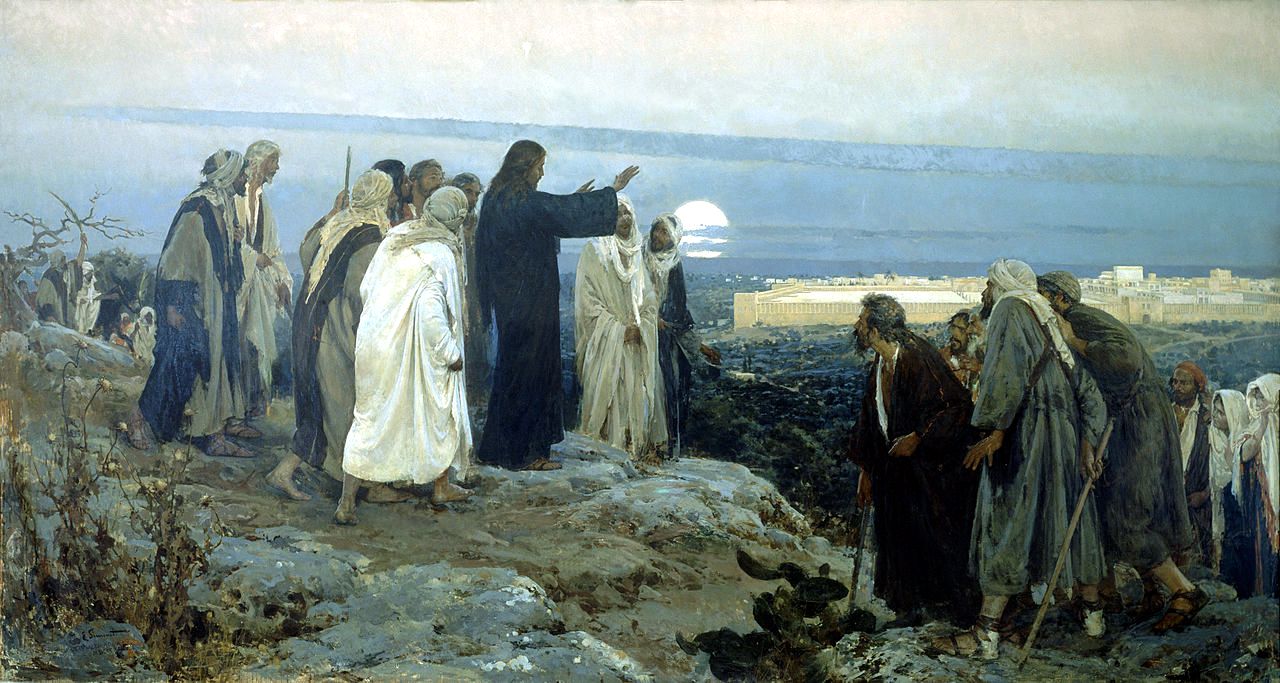
And he came out and went, as was his custom, to the Mount of Olives, and the disciples followed him. And when he came to the place, he said to them, “Pray that you may not enter into temptation.”
And he withdrew from them about a stone’s throw, and knelt down and prayed, saying, “Father, if you are willing, remove this cup from me. Nevertheless, not my will, but yours, be done.”
And there appeared to him an angel from heaven, strengthening him. And being in an agony he prayed more earnestly; and his sweat became like great drops of blood falling down to the ground.
And when he rose from prayer, he came to the disciples and found them sleeping for sorrow, and he said to them, “Why are you sleeping? Rise and pray that you may not enter into temptation.”
Certainly those who imagine that the Son of God was exempt from human passions do not truly and sincerely acknowledge him to be a man…
…When Christ was distressed by grief and fear, he did not rise against God, but continued to be regulated by the true rule of moderation. We need not wonder that, since he was innocent and pure from every stain, the affections which flowed from him were pure and stainless… Christ, amidst fear and sadness, was weak without any taint of sin…
…He [Christ] had no horror at death…simply as a passage out of the world, but because he had before his eyes the dreadful tribunal of God, and the Judge himself armed with inconceivable vengeance; and because our sins, the load of which was laid upon him, pressed him down with their enormous weight. There is no reason to wonder, therefore, if the dreadful abyss of destruction tormented him grievously with fear and anguish.
…And, therefore, though he suffered death, yet since its pains were loosed—as Peter tells us, (Acts 2:24)—and he was victorious in the conflict, the Apostle justly says, that he was heard on account of his fear [Hebrews 5:7]. Here ignorant people rise up and exclaim, that it would have been unworthy of Christ to be afraid of being swallowed up by death.
But I should wish them to answer this question, What kind of fear do they suppose it to have been which drew from Christ drops of blood? (Luke 22:44). For that mortal sweat could only have proceeded from fearful and unusual horror. If any person, in the present day, were to sweat blood, and in such a quantity that the drops should fall to the ground, it would be reckoned an astonishing miracle…
If it be objected, that the fear which I am describing arises from unbelief, the answer is easy. When Christ was struck with horror at the divine curse, the feeling of the flesh affected him in such a manner, that faith still remained firm and unshaken. For such was the purity of his nature, that he felt, without being wounded by them, those temptations which pierce us with their stings.
And yet those persons, by representing him not to have felt temptations, foolishly imagine that he was victorious without fighting. And, indeed, we have no right to suppose that he used any hypocrisy, when he complained of a mortal sadness in his soul; nor do the Evangelists speak falsely, when they say that he was exceedingly sorrowful, and that he trembled.
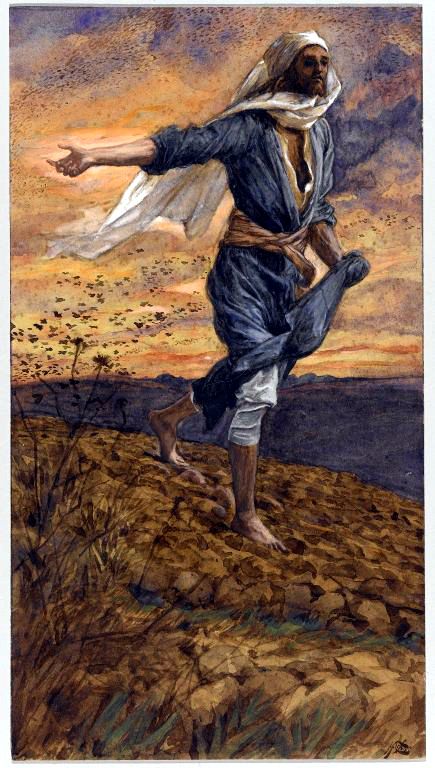
The first 23 verses of the Book of Matthew, chapter 13, record the Lord Jesus’s parable of the sower, His reasoning behind speaking in parables, and His explanation of the sower parable. This is His explanation:
“Hear then the parable of the sower:
When anyone hears the word of the kingdom and does not understand it, the evil one comes and snatches away what has been sown in his heart. This is what was sown along the path.
As for what was sown on rocky ground, this is the one who hears the word and immediately receives it with joy, yet he has no root in himself, but endures for a while, and when tribulation or persecution arises on account of the word, immediately he falls away.
As for what was sown among thorns, this is the one who hears the word, but the cares of the world and the deceitfulness of riches choke the word, and it proves unfruitful.
As for what was sown on good soil, this is the one who hears the word and understands it. He indeed bears fruit and yields, in one case a hundredfold, in another sixty, and in another thirty.”
…He only intended to warn us, that, in many persons, the seed of life is lost on account of various defects, in consequence of which it is either destroyed immediately, or it withers, or it gradually degenerates.
That we may derive the greater advantage from this warning, we ought to bear in mind, that he makes no mention of despisers who openly reject the word of God, but describes those only in whom there is some appearance of docility.
But if the greater part of such men perishes, what shall become of the rest of the world, by whom the doctrine of salvation is openly rejected?
And relative to the good soil:
But he that received the seed into a good soil… None are compared by Christ to a good and fertile soil, but those in whom the word of God not only strikes its roots deep and solid, but overcomes every obstacle that would prevent it from yielding fruit.
Is it objected that it is impossible to find anyone who is pure and free from thorns? It is easy to reply, that Christ does not now speak of the perfection of faith, but only points out those in whom the word of God yields fruit. Though the produce may not be great, yet everyone who does not fall off from the sincere worship of God is reckoned a good and fertile soil…
…Hence too we learn that we have no right to despise those who occupy a lower degree of excellence; for the master of the house himself, though he gives to one the preference above another on account of more abundant produce, yet bestows the general designation, good, even on inferior soils…
Therefore, please:
…Put away all filthiness and rampant wickedness and receive with meekness the implanted word, which is able to save your souls. James 1:21 (ESV)
The Sower, 1886 – 1894, James Tissot, Brooklyn Museum, PD-Art-US
As obedient children, do not be conformed to the passions of your former ignorance, but as he who called you is holy, you also be holy in all your conduct, since it is written, “You shall be holy, for I am holy.” 1 Peter 1:14-16 English Standard Version (ESV)
He who hath called you is holy – He reasons from the end for which we are called. God sets us apart as a peculiar people for himself; then we ought to be free from all pollutions…
Calvin, stating the obvious, that we are not capable of being like God in holiness, nevertheless, points out:
…We ought daily to strive more and more. And we ought to remember that we are not only told what our duty is, but that God also adds, “I am he who sanctify you.”
The Calvin presses the point further:
It is added: in all manner of conversation, or, in your whole conduct. There is then no part of our life which is not to be redolent with this good odour of holiness…
You may currently stink at holy conduct. However, if you are in Christ and He is in you, then you must make great efforts to achieve or obtain it:
Strive for peace with everyone, and for the holiness without which no one will see the Lord. Hebrews 12:14 (ESV)
To this verse, Calvin comments with regard to those who profess Christ as Lord:
Follow peace, etc. – Men are so born that they all seem to shun peace; for all study their own interest, seek their own ways, and care not to accommodate themselves to the ways of others. Unless then we strenuously labor to follow peace, we shall never retain it; for many things will happen daily affording occasion for discords…
And, with regard to those outside of Christ, Calvin says:
As however peace cannot be maintained with the ungodly except on the condition of approving of their vices and wickedness, the Apostle immediately adds, that holiness is to be followed together with peace; as though he commended peace to us with this exception, that the friendship of the wicked is not to be allowed to defile or pollute us; for holiness has an especial regard to God…
Finally, Calvin adds:
He declares, that without holiness no man shall see the Lord; for with no other eyes shall we see God than those which have been renewed after his image.
As scripture teaches, we know everyone born from above practices right behavior.
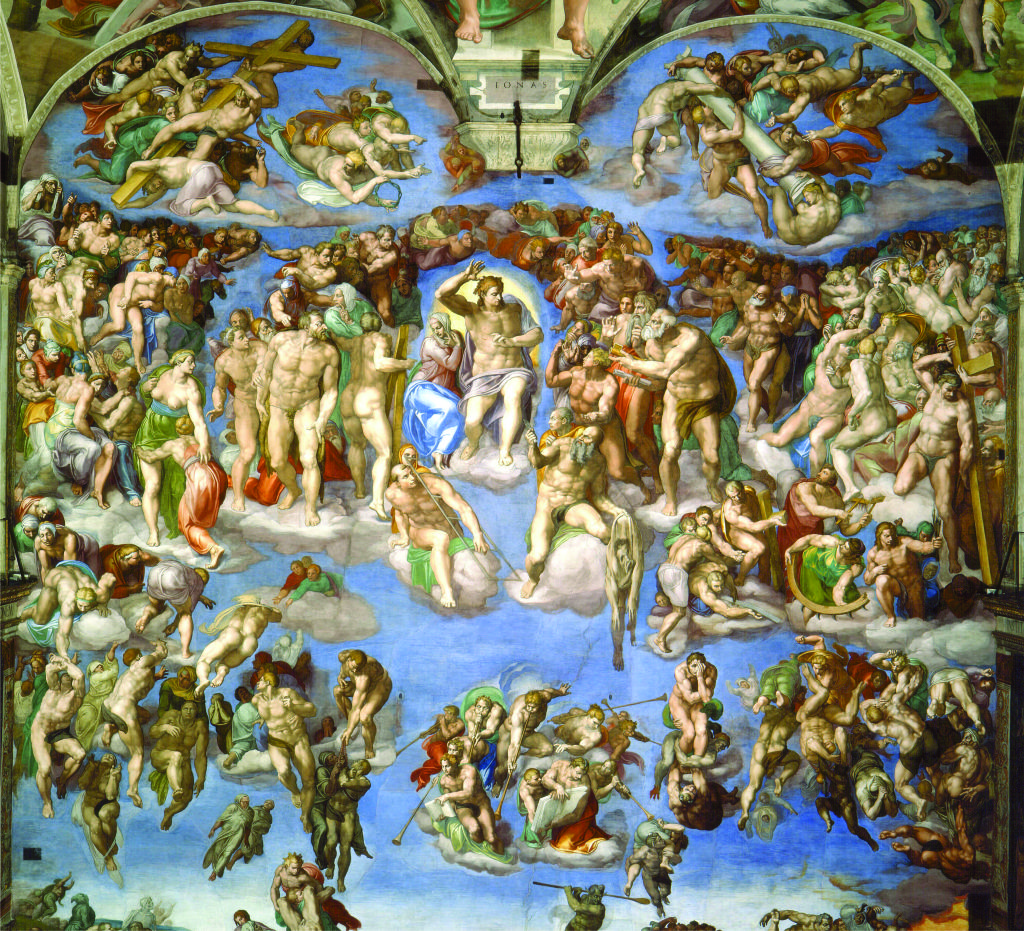
Last Judgment, 1537 – 1541, Michelangelo and assistants, the Sistine Chapel in the Vatican, PD-Art-US
In his comments on Philippians, chapter 1, verse 6:
And I am sure of this, that he who began a good work in you will bring it to completion at the day of Jesus Christ. Philippians 1:6 English Standard Version (ESV)
It is asked, however, whether anyone can be certain as to the salvation of others, for Paul here is not speaking of himself but of the Philippians. I answer, that the assurance which an individual has respecting his own salvation, is very different from what he has as to that of another. For the Spirit of God is a witness to me of my calling, as he is to each of the elect. As to others, we have no testimony, except from the outward efficacy of the Spirit; that is, in so far as the grace of God shews itself in them, so that we come to know it.
There is, therefore, a great difference, because the assurance of faith remains inwardly shut up, and does not extend itself to others. But wherever we see any such tokens of Divine election as can be perceived by us, we ought immediately to be stirred up to entertain good hope, both in order that we may not be envious towards our neighbors, and withhold from them an equitable and kind judgment of charity; and also, that we may be grateful to God. This, however, is a general rule both as to ourselves and as to others — that, distrusting our own strength, we depend entirely upon God alone [emphasis mine].
And what can we look for as tokens of Divine election? Scripture says we are to be clothed in His righteousness, in word and deed:
Put on then, as God’s chosen ones, holy and beloved, compassionate hearts, kindness, humility, meekness, and patience, bearing with one another and, if one has a complaint against another, forgiving each other; as the Lord has forgiven you, so you also must forgive. Colossians 3:12-13 (ESV)
Look for these things in yourselves first and then in others.
Tamme-Lauri oak. The oldest tree in Estonia, 3 September 2013, Abrget47j, Creative Commons Attribution-Share Alike 3.0 Unported
I’ve been reminded repeatedly of this truth recently:
Who are you to pass judgment on the servant of another? It is before his own master that he stands or falls. And he will be upheld, for the Lord is able to make him stand. Romans 14:4 English Standard Version (ESV)
The immediate context is the weaker brother among those in the church at Rome, which was composed of former Jews trained to obey the Law and regulations and others who were never exposed to those regulations. Each looked down on the other for their freedoms and bondages.
Nowadays we look down on a brother (or sister) if they don’t dress the way we do, or perform ceremonies the way we do, work for an employer the way we do, or look at the world the way we do, or behave as responsibly as we do. I could go on. I’m sure you could supply more examples.
About this scripture passage, John Calvin comments:
To his own Lord he stands or falls, etc. As though he said, — “It belongs rightly to the Lord, either to disapprove, or to accept what his servant doeth: hence he robs the Lord, who attempts to take to himself this authority.” And he adds, he shall indeed stand: and by so saying, he not only bids us to abstain from condemning, but also exhorts us to mercy and kindness, so as ever to hope well of him, in whom we perceive anything of God; inasmuch as the Lord has given us a hope, that he will fully confirm, and lead to perfection, those in whom he has begun the work of grace [emphasis mine].
Lately, I’ve tried to practice what Calvin says constitutes true worship:
“God is not worshipped by external ceremonies, but when men forgive and bear with one another, and are not above measure rigid.”
and
“God values faith and kindness much more than sacrifices and all ceremonies.”
It’s the only written record that purports to be from life not of this world, or realm for that matter. It’s the only communication we have from someone untainted by wrath, avarice, sloth, pride, lust, envy, and gluttony.
This written record is special, in so far as it is self–referential. What does it say for itself?
Scripture reveals the power of God at work in throughout the ages.
Scripture bears witness of the work of the Lord Jesus Christ, the Author of eternal life.
You search the Scriptures because you think that in them you have eternal life; and it is they that bear witness about me, John 5:39 (ESV)
Scripture testifies to the death, burial, and resurrection of the Lord Jesus Christ witnessed by many then alive.
For I delivered to you as of first importance what I also received: that Christ died for our sins in accordance with the Scriptures, that he was buried, that he was raised on the third day in accordance with the Scriptures, and that he appeared to Cephas, then to the twelve. Then he appeared to more than five hundred brothers at one time, most of whom are still alive, though some have fallen asleep. Then he appeared to James, then to all the apostles. Last of all, as to one untimely born, he appeared also to me. 1 Corinthians 15:3-8 (ESV)
Scripture is the authoritative source and check for all preaching.
Now these Jews were more noble than those in Thessalonica; they received the word with all eagerness, examining the Scriptures daily to see if these things were so. Acts 17:11 (ESV)
Scripture was written for our instruction and encouragement leading to hope.
For whatever was written in former days was written for our instruction, that through endurance and through the encouragement of the Scriptures we might have hope. Romans 15:4 (ESV)
Scripture reveals truths once hidden from men and into which angels long to look.
Concerning this salvation, the prophets who prophesied about the grace that was to be yours searched and inquired carefully, inquiring what person or time the Spirit of Christ in them was indicating when he predicted the sufferings of Christ and the subsequent glories. It was revealed to them that they were serving not themselves but you, in the things that have now been announced to you through those who preached the good news to you by the Holy Spirit sent from heaven, things into which angels long to look. 1 Peter 1:10-12 (ESV)
Scripture, though written by men, finds its source and ultimate Author in God and has the full weight of His authority for equipping those following Him.
All Scripture is breathed out by God and profitable for teaching, for reproof, for correction, and for training in righteousness, that the man of God may be complete, equipped for every good work. 2 Timothy 3:16-17 (ESV)
Scripture, the prophetic testimony, comes from God. The Holy Spirit provides the prophets, as His representatives, not only visions but also words used to describe and interpret them.
…Knowing this first of all, that no prophecy of Scripture comes from someone’s own interpretation. For no prophecy was ever produced by the will of man, but men spoke from God as they were carried along by the Holy Spirit. 2 Peter 1:20-21 (ESV)
Scripture is God’s wisdom given through his apostles and prophets for our sakes, some of which is hard to understand. But we are not to be carried away with error. We are to obey that which we understand and grow in grace and knowledge of our Lord Jesus Christ.
…As he does in all his letters when he speaks in them of these matters. There are some things in them that are hard to understand, which the ignorant and unstable twist to their own destruction, as they do the other Scriptures. 2 Peter 3:16 (ESV)
Instrumentality is not a well appreciated concept. But it is key to understanding both the nature of the universe and the nature of man. Google’s definition of the word is:
in·stru·men·tal·i·ty
noun
The fact or quality of serving as an instrument or means to an end; agency.
“A corporate body can act only through the instrumentality of human beings”
A thing that serves as an instrument or means to an end.
The principle of instrumentality is essential to understanding our universe. The scriptures record the creation of all things this way:
And God said, “Let there be light,” and there was light. And God saw that the light was good. And God separated the light from the darkness. God called the light Day, and the darkness he called Night. And there was evening and there was morning, the first day. Genesis 1:3-5 English Standard Version (ESV)
And later in the book:
And God said, “Let there be lights in the expanse of the heavens to separate the day from the night. And let them be for signs and for seasons, and for days and years, and let them be lights in the expanse of the heavens to give light upon the earth.” And it was so… And there was evening and there was morning, the fourth day. Genesis 1:14-19 (ESV)
Oops, God must have gotten it wrong. Shouldn’t the sun have been created before the light? Why didn’t He check in with some noted authority first, like Hawking or Tyson. We’ve presented what Tyson believes in our post ‘Neil deGrasse Tyson Mistakes God for Who He Is Not’
Our ready reference, John Calvin, says on the precedence of light over the sun:
Gen. 1:3 …Let there be light… It was proper that the light, by means of which the world was to be adorned with such excellent beauty, should be first created; and this also was the commencement of the distinction, (among the creatures). It did not, however, happen from inconsideration or by accident, that the light preceded the sun and the moon.
To nothing are we more prone than to tie down the power of God to those instruments the agency of which he employs. The sun and moon supply us with light: And, according to our notions we so include this power to give light in them, that if they were taken away from the world, it would seem impossible for any light to remain.
Therefore the Lord, by the very order of the creation, bears witness that he holds in his hand the light, which he is able to impart to us without the sun and moon.
We aren’t sure what you think of the scriptures as an authority for wisdom. Many modern-day teachers would have you believe they are unreliable and, in many cases, downright fallacious. We’ve addressed this in ‘Nip ‘Em in the Bud.’
However, the remark that the Lord Jesus Christ made to teachers of His people who were trying to trip Him up on another matter is appropriate for our teachers today:
Jesus said to them, “Is this not the reason you are wrong, because you know neither the Scriptures nor the power of God? Mark 12:24 (ESV)
Martian sunset: Spirit at Gusev crater, 19 May 2005, NASA’s Mars Exploration Rover, Public Domain
The principle of instrumentality is also essential to understanding humanity. Paul describes himself, and us by generalization, as jars of clay:
For God, who said, “Let light shine out of darkness,” has shone in our hearts to give the light of the knowledge of the glory of God in the face of Jesus Christ.
But we have this treasure in jars of clay, to show that the surpassing power belongs to God and not to us. 2 Corinthians 4:6-7 (ESV)
2 Corinthians 4:7. But we have this treasure. Those that heard Paul glorying in such a magnificent strain as to the excellence of his ministry, and beheld, on the other hand, his person, contemptible and abject in the eyes of the world, might be apt to think that he was a silly and ridiculous person, and might look upon his boasting as childish, while forming their estimate of him from the meanness of his person…
First of all, he employs the similitude of a treasure, which is not usually laid up in a splendid and elegantly adorned chest, but rather in some vessel that is mean and worthless; and then farther, he subjoins, that the power of God is, by that means, the more illustrated, and is the better seen…
“…Farther, they do not consider, that it is ordered by the special Providence of God, that there should be in ministers no appearance of excellence, lest anything of distinction should throw the power of God into the shade. As, therefore, the abasement of ministers, and the outward contempt of their persons give occasion for glory accruing to God, that man acts a wicked part, who measures the dignity of the gospel by the person of the minister.”
Paul, however, does not speak merely of the universal condition of mankind, but of his own condition in particular. It is true, indeed, that all mortal men are earthen vessels. Hence, let the most eminent of them all be selected, and let him be one that is adorned to admiration with all ornaments of birth, intellect, and fortune, still, if he be a minister of the gospel, he will be a mean and merely earthen depository of an inestimable treasure. Paul, however, has in view himself, and others like himself, his associates, who were held in contempt, because they had nothing of show.
So why is this instrumentality important for understanding the nature of man? For at least two reasons, first, it seems we’ll be augmenting, modifying, and curing ourselves using brain implants routinely someday. Defense Advanced Research Projects Agency (DARPA) requested proposals for SUBNETS, Systems-Based Neurotechnology for Emerging Therapies, in 2013. Their website describes the project and the expected results:
The Systems-Based Neurotechnology for Emerging Therapies (SUBNETS) program was created in response to a pressing need. Despite the continued best efforts of the Departments of Defense and Veterans Affairs to protect the health of U.S. service members and veterans, the effects of neuropsychological illness brought on by war, traumatic injuries, and other experiences remain challenging to treat. Current approaches—surgery, medications, and psychotherapy—can often help to alleviate the worst effects of illnesses such as major depression and post-traumatic stress, but they are imprecise and not universally effective. Through SUBNETS, DARPA hopes to generate the knowledge and technology required to deliver relief to patients with otherwise intractable neuropsychological illness.
The SUBNETS vision is distinct from current therapeutic approaches in that it seeks to create an implanted, closed-loop diagnostic and therapeutic system for treating, and possibly even curing, neuropsychological illness. That vision is premised on the understanding that brain function—and dysfunction, in the case of neuropsychological illness—plays out across distributed neural systems, as opposed to being strictly relegated to distinct anatomical regions of the brain. The program also aims to take advantage of neural plasticity, a feature of the brain by which the organ’s anatomy and physiology alter over time to support normal brain function. Because of plasticity, researchers are optimistic that by using SUBNETS-developed technology the brain can be trained or treated to restore normal functionality following injury or the onset of neuropsychological illness.
…The program will pursue a new investigative approach that establishes the characteristics of distributed neural systems and attempts to develop and apply therapies that incorporate near real-time recording, analysis and stimulation in next-generation devices inspired by current Deep Brain Stimulation (DBS).
DBS already exists as a therapy option for certain neurologic and neuropsychological illnesses in patients who are not responsive to other therapies. Approximately 100,000 people around the globe live with a DBS implant, a device that delivers electrical stimulation to reduce the motor impairment caused by Parkinson’s disease and dystonia. These devices are also being studied as therapy for depression, obsessive compulsive disorder, Tourette’s and epilepsy…
DARPA is specifically interested in evaluating the underlying systems which contribute to the following conditions as described by the Diagnostic and Statistical Manual of Mental Disorders: Post-Traumatic Stress Disorder, Major Depression, Borderline Personality Disorder and General Anxiety Disorder. DARPA also seeks to evaluate the representation in the central nervous system of: Traumatic Brain Injury, Substance Abuse/Addiction and Fibromyalgia/Chronic Pain.
Because programs like SUBNETS push the leading edge of science, they are sometimes society’s first encounter with the dilemmas associated with new technologies. DARPA pursues these technologies because of their promise, but the Agency understands that it is important to consider ethical, legal, societal and policy questions. For that reason, DARPA has convened an Ethical, Legal and Social Implications (ELSI) panel to inform and advise SUBNETS and other emerging neuroscience efforts.
The latest 2014 DARPA Press Release, as of this post, is here.
The second reason is the nature of our personhood in the face of the ravages of degenerative diseases. If all we are arises from materiality, then when the material fails, that which is us also falters.
However, not all secular scientists would claim a direct material basis for personhood; nevertheless, they claim emergence from the material substrate in the sense of M. Polanyi. In this regard, we’ve covered David Chalmers’s views on consciousness briefly in a previous post.
But, there are serious issues to contemplate with what Alzheimer’s disease and other dementia mean for us as persons. HuffPo and WSJ have run touching stories.
We have briefly touched on what Francis Schaeffer referred to the ‘soulishness of man’ in this blog. Calvin offers analysis of the outward and inner man referred to in 2 Corinthians 4:16-18.
2 Corinthians 4:16. Though our outward man. The outward man, some improperly and ignorantly confound with the old man, for widely different from this is the old man, of which we have spoken in Romans 4:6. Chrysostom, too, and others restrict it entirely to the body; but it is a mistake, for the Apostle intended to comprehend, under this term, everything that relates to the present life. As he here sets before us two men, so you must place before your view two kinds of life — the earthly and the heavenly.
The outward man is the maintenance of the earthly life, which consists not merely in the flower of one’s age, (1 Corinthians 7:36) and in good health, but also in riches, honors, friendships, and other resources. Hence, according as we suffer a diminution or loss of these blessings, which are requisite for keeping up the condition of the present life, is our outward man in that proportion corrupted…
Thus, therefore, it is necessary, that the condition of the present life should decay, in order that the inward man may be in a flourishing state; because, in proportion as the earthly life declines, does the heavenly life advance, at least in believers. For in the reprobate, too, the outward man decays, but without anything to compensate for it…
2 Corinthians 4:17. Momentary lightness. As our flesh always shrinks back from its own destruction, whatever reward may be presented to our view, and as we are influenced much more by present feeling than by the hope of heavenly blessings, Paul on that account admonishes us, that the afflictions and vexations of the pious have little or nothing of bitterness, if compared with the boundless blessings of everlasting glory…
As, however, the decay is visible, and the renovation is invisible, Paul, with the view of shaking us off from a carnal attachment to the present life, draws a comparison between present miseries and future felicity…
So we do not lose heart. Though our outer self is wasting away, our inner self is being renewed day by day. For this light momentary affliction is preparing for us an eternal weight of glory beyond all comparison, as we look not to the things that are seen but to the things that are unseen. For the things that are seen are transient, but the things that are unseen are eternal. 2 Corinthians 4:16-18 (ESV)
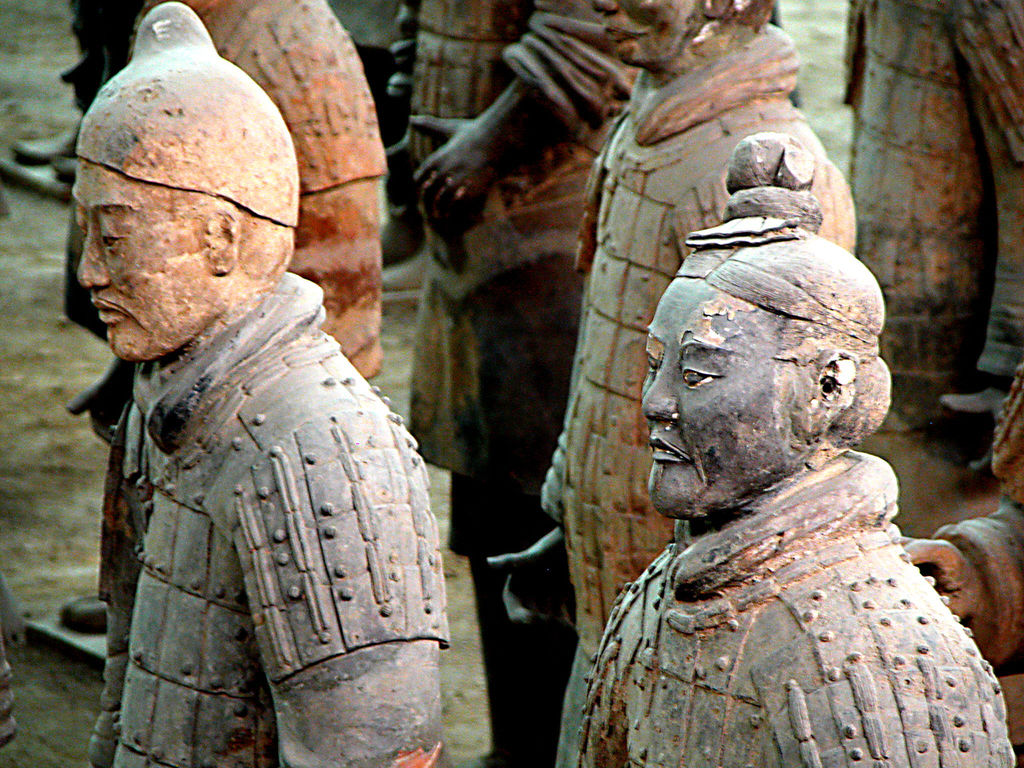
Terracotta Army detail, Xi’an, China, 9 April 2005, Photo by Peter Morgan from Nomadic, CCA 2.0 Generic
The Lord Jesus Christ referred to this scripture twice as recorded in the gospels.
On the first occasion, His message seems to be: associate with the sin sick to bring them healing and exhort those, who consider themselves well and in no need of a doctor, that they need healing, too.
And as Jesus reclined at table in the house, behold, many tax collectors and sinners came and were reclining with Jesus and his disciples. And when the Pharisees saw this, they said to his disciples, “Why does your teacher eat with tax collectors and sinners?” But when he heard it, he said, “Those who are well have no need of a physician, but those who are sick. Go and learn what this means, ‘I desire mercy, and not sacrifice.’ For I came not to call the righteous, but sinners.” Matthew 9:10-13 English Standard Version (ESV)
On the second occasion, He urged those who considered themselves righteous to obey the substance and not just the form of God’s commandments.
Or have you not read in the Law how on the Sabbath the priests in the temple profane the Sabbath and are guiltless? I tell you, something greater than the temple is here. And if you had known what this means, ‘I desire mercy, and not sacrifice,’ you would not have condemned the guiltless.For the Son of Man is lord of the Sabbath.” Matthew 12:5-8 (ESV)
But to what scripture (because the New Testament was not yet written) was the Lord referring? He quoted Hosea 6:6, but verses six and seven complete a thought.
For I desire steadfast love and not sacrifice, the knowledge of God rather than burnt offerings.
But like Adam they transgressed the covenant; there they dealt faithlessly with me.
It is a remarkable passage; the Son of God has twice quoted it. The Pharisees reproached him for his intercourse with men of bad and abandoned life, and he said to them in Matthew 9, ‘Mercy I desire, and not sacrifice.’ He shows, by this defense, that God is not worshipped by external ceremonies, but when men forgive and bear with one another, and are not above measure rigid. [emphasis added]
Again, in the Matthew 12, when the Pharisees blamed the disciples for gathering ears of corn, he said ‘But rather go and learn what this is, Mercy I desire, and not sacrifice.’ Inasmuch as they were so severe against his disciples, Christ shows that those who make holiness to consist in ceremonies are foolish worshipers of God; and that they also blamed their brethren without a cause, and made a crime of what was not in itself sinful, and what could be easily defended by any wise and calm expounder.
Calvin adds concerning verse seven:
God then subjoins a complaint, — But they like men have transgressed the covenant; there have they dealt treacherously against me. Here God shows that the Israelites boasted in vain of their sacrifices and of all the pomps of their external worship, for God did not regard these external things, but only wished to exercise the faithful in spiritual worship.
Then the import of the whole is this, “My design was, when I appointed the sacrifices and the whole legal worship, to lead you so to myself, that there might be nothing carnal or earthly in your sacrificing; but ye have corrupted the whole law; you have been perverse interpreters; for sacrifices have been nothing else among you but mockery as if it were a satisfaction to me to have an ox or a ram killed. You have then transgressed my covenant; and it is nothing that the people say to me, that they have diligently performed the outward ceremonies, for such a worship is not in the least valued by me.”
We can (and must) replace Calvin’s reference to ‘Israelites who boast in vain’ with the ‘unbelieving church of that age,’ for such they were. And we have these same with us today. It’s not as if they are unaware of the substance of proper worship, it’s just less costly (in the here and now) to practice merely the form of it.
At least two of these folks asked the Lord, “Which commandment is the most important of all?” He answered:
“You shall love the Lord your God with all your heart and with all your soul and with all your strength and with all your mind, and your neighbor as yourself.”
On another occasion He asked one of these folks how they understood the scriptures in a nutshell and they gave the same answer. To this one, the Lord said, “You have answered correctly; do this, and you will live.”
Early in the morning he came again to the temple. All the people came to him, and he sat down and taught them. The scribes and the Pharisees brought a woman who had been caught in adultery, and placing her in the midst they said to him, “Teacher, this woman has been caught in the act of adultery. Now in the Law Moses commanded us to stone such women. So what do you say?” This they said to test him, that they might have some charge to bring against him.
Jesus bent down and wrote with his finger on the ground. And as they continued to ask him, he stood up and said to them, “Let him who is without sin among you be the first to throw a stone at her.” And once more he bent down and wrote on the ground.
But when they heard it, they went away one by one, beginning with the older ones, and Jesus was left alone with the woman standing before him. Jesus stood up and said to her, “Woman, where are they? Has no one condemned you?” She said, “No one, Lord.” And Jesus said, “Neither do I condemn you; go, and from now on sin no more.”
So there we have it. When someone is repentant from the heart (and surely she was), the Lord says:
“Neither do I condemn you; go, and from now on sin no more.”
To remove a bud from a plant to prevent flower and fruit from forming.
(idiomatic) To stop something at an early stage.
Phrases.org.uk says the idiom originated in 1607 and gives a definition:
Put a stop to something while it is still in its early development.
I think Wikidictionary definition one has been happening to my lilac bush for the past few years. But, let’s nip this silliness in the bud. What real importance does this idiomatic phrase hold for us?
It’s the usual approach used to discredit and cast doubt on the bible’s veracity. Why bother reading the Gospel of John when you can’t trust the very first book, Genesis, or so goes the argument. Really, the argument centers on the first two chapters of that first book. The bud, so to speak.
Wikipedia expounds on the controversy over the first two chapters of Genesis in their entry: Genesis creation narrative. The issues raised are: use of names of God, the uniqueness and mutability of man’s soul, and an issue with naming the animals and their creation. These discrepancies are attributed to different authorship and traditions. Also, the Wikipedia entry authors introduce the concept of borrowed mythology altered to represent monotheism.
Genesis, Chap. 2, Vs. 4. These are the generations… Some of the Hebrews think that the essential name of God is here at length expressed by Moses, because his majesty shines forth more clearly in the completed world.
To this, the Commentary translator, John King, adds:
A new section of the history of Moses commences at this point; and, from the repetition which occurs of some facts — such as the creation of man — which had been recorded in the preceding chapter, as well as from certain peculiarities of phraseology, many learned men have inferred, that the early portion of the Mosaic history is older than the time of Moses, and that he, under the infallible direction of the Spirit of God, collected and arranged the several fragments of primeval annals in one consistent narrative.
One chief argument on which such a conclusion rests is, that from the commencement of the first chapter to the end of the third verse of the second chapter, God is spoken of only under the name of Elohim [Spirit of God]; from the fourth verse of the second to the end of the third chapter, he is uniformly styled Jehovah Elohim [Self existent one, Spirit of God]; and in the fourth and fifth chapters, the name of Elohim or of Jehovah stands alone.
This, it is argued, could scarcely have occurred without some cause; and the inference has been drawn, that different records had different forms of expression, which Moses did not alter, unless truth required him to do so.
Against this view, however, [another commentator] argues with considerable force, in his Dissertation “on the Names of God in the Pentateuch;”… that these names are intended to present the Divine character under different aspects to our view.
As to uniqueness of man, Calvin says:
Chap. 1, Vs. 26, Let us make man…In our image… Therefore by this word the perfection of our whole nature is designated, as it appeared when Adam was endued with a right judgment, had affections in harmony with reason, had all his senses sound and well-regulated, and truly excelled in everything good.
Thus the chief seat of the Divine image was in his mind and heart, where it was eminent: yet was there no part of him in which some scintillations of it did not shine forth. …In the mind perfect intelligence flourished and reigned, uprightness attended as its companion, and all the senses were prepared and molded for due obedience to reason; and in the body there was a suitable correspondence with this internal order.
As to uniqueness of man’s soul as opposed to those of the animals, Calvin says:
Chap. 2, Vs. 7, And the Lord God formed man… Nevertheless, he, at the same time, designed to distinguish man by some mark of excellence from brute animals: for these arose out of the earth in a moment; but the peculiar dignity of man is shown in this, that he was gradually formed. For why did not God command him immediately to spring alive out of the earth, unless that, by a special privilege, he might outshine all the creatures which the earth produced?
And breathed into his nostrils… Three gradations, indeed, are to be noted in the creation of man; that his dead body was formed out of the dust of the earth; that it was endued with a soul, whence it should receive vital motion; and that on this soul God engraved his own image, to which immortality is annexed.
Man became a living soul I take nepesh for the very essence of the soul: but the epithet living suits only the present place, and does not embrace generally the powers of the soul. For Moses intended nothing more than to explain the animating of the clayey figure, whereby it came to pass that man began to live…
As to changeability of man’s condition, Calvin says:
Chap. 1, Vs. 26, Let us make man…In our image… But now, although some obscure lineaments of that image are found remaining in us; yet are they so vitiated and maimed, that they may truly be said to be destroyed. For besides the deformity which everywhere appears unsightly, this evil also is added, that no part is free from the infection of sin.
Chap. 3, Vs. 6, And gave also unto her husband with her… Pride was the beginning of all evils, and that by pride the human race was ruined. Yet a fuller definition of the sin may be drawn from the kind of temptation which Moses describes. For first the woman is led away from the word of God by the wiles of Satan, through unbelief. Wherefore, the commencement of the ruin by which the human race was overthrown was a defection from the command of God.
…At length, having despised the command of God, they not only indulge their own lust, but enslave themselves to the devil. If anyone prefers a shorter explanation, we may say unbelief has opened the door to ambition, but ambition has proved the parent of rebellion, to the end that men, having cast aside the fear of God, might shake off his yoke.
Chap. 3, Vs. 7, And the eyes of them both were opened… God created man flexible; and not only permitted, but willed that he should be tempted. …Therefore, whatever sin and fault there is in the fall of our first parents remains with themselves; but there is sufficient reason why the eternal counsel of God preceded it, though that reason is concealed from us.
As to the creation act, Calvin says:
Chap. 1, Vs. 3, And God said… Moses now, for the first time, introduces God in the act of speaking, as if he had created the mass of heaven and earth without the Word. Yet John testifies that ‘without him nothing was made of the things which were made,’ (John 1:3). And it is certain that the world had been begun by the same efficacy of the Word by which it was completed. God, however, did not put forth his Word until he proceeded to originate light; because in the act of distinguishing, his wisdom begins to be conspicuous.
Chap. 1, Vs. 5, The first day… Here the error of those is manifestly refuted, who maintain that the world was made in a moment. For it is too violent a cavil to contend that Moses distributes the work which God perfected at once into six days, for the mere purpose of conveying instruction.
Let us rather conclude that God himself took the space of six days, for the purpose of accommodating his works to the capacity of men. We slightingly pass over the infinite glory of God, which here shines forth; whence arises this but from our excessive dullness in considering his greatness? In the meantime, the vanity of our minds carries us away elsewhere.
For the correction of this fault, God applied the most suitable remedy when he distributed the creation of the world into successive portions that he might fix our attention, and compel us, as if he had laid his hand upon us, to pause and to reflect.
As to the first and second accounts of creation, he says:
Chap. 2, Vs. 4, These are the generations… The design of Moses was deeply to impress upon our minds the origin of the heaven and the earth, which he designates by the word generation… Wherefore, it is not a superfluous repetition which inculcates the necessary fact that the world existed only from the time when it was created since such knowledge directs us to its Architect and Author.
Chap. 2, Vs. 7, And the Lord God formed man… He now explains what he had before omitted in the creation of man that his body was taken out of the earth. He had said that he was formed after the image of God…
As to other creation accounts, he says:
Chap. 1, Vs. 1, In the beginning… [Moses] moreover teaches by the word “created,” that what before did not exist was now made; for he has not used the term yatsar, which signifies to frame or forms but bara which signifies to create. Therefore his meaning is that the world was made out of nothing.
Hence the folly of those is refuted who imagine that unformed matter existed from eternity; and who gather nothing else from the narration of Moses than that the world was furnished with new ornaments, and received a form of which it was before destitute.
This indeed was formerly a common fable among heathens, who had received only an obscure report of the creation, and who, according to custom, adulterated the truth of God with strange figments; but for Christian men to labor …in maintaining this gross error is absurd and intolerable. Let this, then be maintained in the first place, that the world is not eternal but was created by God.
On an interesting point to note about God’s all–encompassing sovereignty, Calvin expounds:
Chap. 1, Vs. 3, Let there be light… It was proper that the light, by means of which the world was to be adorned with such excellent beauty, should be first created; …It did not, however, happen from inconsideration or by accident, that the light preceded the [creation of] sun and the moon.
To nothing are we more prone than to tie down the power of God to those instruments the agency of which he employs. The sun and moon supply us with light: And, according to our notions we so include this power to give light in them, that if they were taken away from the world, it would seem impossible for any light to remain.
Therefore the Lord, by the very order of the creation, bears witness that he holds in his hand the light, which he is able to impart to us without the sun and moon.
“It should scarcely be passed without remark that Calvin’s doctrine of creation is, if we have understood it aright, for all except the souls of men, an evolutionary one. The ‘indigested mass,’ including the ‘promise and potency’ of all that was yet to be, was called into being by the simple fiat of God. But all that has come into being since — except the souls of men alone — has arisen as a modification of this original world-stuff by means of the interaction of its intrinsic forces. Not these forces apart from God, of course…”
Warfield’s incorrect attempt to reconcile Calvin’s Commentary with Darwin’s evolution theory through old earth creationism sounds very much like this dawn of man scene from 2001 space odyssey.
Dawn of Man Scene from 2001 Space Odyssey
You can’t have it both ways. As was said above, God is free to create in ways, timing, and manner as He sees fit ex-nihilo. He has graciously accommodated us in how He structured creation. Dorothy L. Sayers put forward an idea for us to understand the creation of man in the context of the fossil record as a unique act of creation with a perfect backstory (see Every Good Story – Thysdor Ya’Rosel).
If you attack the trustworthiness of the very first chapters, then have you not undermined the foundations and left entry for utter destruction of the rest? This can be seen in the split from Princeton Theological Seminary (PTS) after Warfield’s tenure by Westminster Theological Seminary (WTS) under Machen in 1929. PTS abandoned the veracity of God’s word. WTS was formed to uphold it. The attack was successful then and it will be so again if we don’t hold on to the truth of the word of God.
Evolutionist propagandists are not concerned with the proper order of sediments, transitionary evidence, or aeons. Their concern is not for truth. Their concern is like those of their ancient compatriots, to throw off the yoke of the Lord who made them. For what purpose but that they may go their own way. And so they shall. Will you, however, follow them?
Expulsion from the Garden of Eden, 1828, by Thomas Cole (1801–1848), public domain – US
Institutes, Chapter 6: …For if we reflect how prone the human mind is to lapse into forgetfulness of God, how readily inclined to every kind of error, how bent every now and then on devising new and fictitious religions, it will be easy to understand how necessary it was to make such a depository of doctrine as would secure it from either perishing by the neglect, vanishing away amid the errors, or being corrupted by the presumptuous audacity of men.
It being thus manifest that God, foreseeing the inefficiency of his image imprinted on the fair form of the universe, has given the assistance of his Word to all whom he has ever been pleased to instruct effectually, we, too, must pursue this straight path, if we aspire in earnest to a genuine contemplation of God;—we must go, I say, to the Word, where the character of God, drawn from his works is described accurately and to the life; these works being estimated, not by our depraved Judgment, but by the standard of eternal truth.
Institutes, Chapter 7: …The next thing to be considered is, how it appears not probable merely, but certain, that the name of God is neither rashly nor cunningly pretended. If, then, we would consult most effectually for our consciences, and save them from being driven about in a whirl of uncertainty, from wavering, and even stumbling at the smallest obstacle, our conviction of the truth of Scripture must be derived from a higher source than human conjectures, Judgments, or reasons; namely, the secret testimony of the Spirit…
Still, however, it is preposterous to attempt, by discussion, to rear up a full faith in Scripture…. Profane men think that religion rests only on opinion, and, therefore, that they may not believe foolishly, or on slight grounds, desire and insist to have it proved by reason that Moses and the prophets were divinely inspired. But I answer, that the testimony of the Spirit is superior to reason. For as God alone can properly bear witness to his own words, so these words will not obtain full credit in the hearts of men, until they are sealed by the inward testimony of the Spirit…
Institutes, Chapter 8: …For it is wonderful how much we are confirmed in our belief, when we more attentively consider how admirably the system of divine wisdom contained in it is arranged—how perfectly free the doctrine is from everything that savors of earth—how beautifully it harmonizes in all its parts—and how rich it is in all the other qualities which give an air of majesty to composition.
Our hearts are still more firmly assured when we reflect that our admiration is elicited more by the dignity of the matter than by the graces of style. For it was not without an admirable arrangement of Providence, that the sublime mysteries of the kingdom of heaven have for the greater part been delivered with a contemptible meanness of words.
Had they been adorned with a more splendid eloquence, the wicked might have caviled, and alleged that this constituted all their force. But now, when an unpolished simplicity, almost bordering on rudeness, makes a deeper impression than the loftiest flights of oratory, what does it indicate if not that the Holy Scriptures are too mighty in the power of truth to need the rhetorician’s art?
In light of our previous post, we do not so much agree with the tone with which Calvin defends his positions (and these are mild). He’d definitely have given the current crop of vehement deniers a run for their money were he alive in this day and age.
Lake Geneva after storm. Picture taken from Montreux, on the left side in the rays of light – Saint-Gingolph by Rulexip. (Creative Commons Attribution-Share Alike 3.0 Unported)






 Mandated Memoranda