Believe and Suffer

Some of us are bewildered when we face adversity, some expect it more often than it occurs, some chalk it up to mysterious forces, and some see it as highly probable at all times. What is certain in this life is that we will suffer at some time in our lives. For all of us, I wish it were as certain that we would all believe so as to be saved from the penalty that our sins deserve. The Apostle Paul wrote to the church in Philippi about believing and suffering:

Only let your manner of life be worthy of the gospel of Christ, so that whether I come and see you or am absent, I may hear of you that:

You are standing firm in one spirit

With one mind striving side by side for the faith of the gospel, and

Not frightened in anything by your opponents.

This is a clear sign to them of their destruction, but of your salvation, and that from God.

For it has been granted to you that for the sake of Christ you should not only believe in him but also suffer for his sake, engaged in the same conflict that you saw I had and now hear that I still have.

Philippians 1:27-30 English Standard Version (ESV)

Paul says God has granted them to believe in Him. But also, in an act of His Sovereign will, to suffer. Not any kind of suffering, but that according to His will, “for His sake.”

The reformer and preacher, John Calvin, makes at least three points about these verses. First, our common struggle against our sin, the world, and the devil unites us. Even if we’re divided by our sins against one another, the struggle is so great against us that we will reconcile and contend for the faith together.

Striving together for the faith…is the strongest bond of concord, …for this has often been the occasion of reconciling even the greatest enemies.

…The Apostle’s meaning is this: “Let the faith of the gospel unite you together, more especially as that is a common armory against one and the same enemy.”

The wicked, too, conspire together for evil, but their agreement is accursed: let us, therefore, contend with one mind under the banner of faith.

These struggles, and our patient suffering, are ordained and given by God as a sign of our salvation to us and to the enemies of the faith. These are both a benefit for our increased devotion and an honor to participate in His sufferings.

To you, says he, it is given, not only to believe in Christ, but also to suffer for him. Hence even the sufferings themselves are evidences of the grace of God; and, since it is so, you have from this source a token of salvation. Oh, if this persuasion were effectually [woven into] our minds — that persecutions are to be reckoned among God’s benefits, what progress would be made in the doctrine of piety!

…It is the highest honor…conferred upon us by Divine grace, that we suffer for his name either reproach, or imprisonment, or miseries, or tortures, or even death, for in that case he adorns us with his marks of distinction. But [many would] rather [that] God [refrain from giving] gifts of that nature, than embrace with [readiness] the cross when it is presented to them. Alas, then, for our stupidity!

Finally, Calvin stresses that our struggle and godly resistance is analogous, though far lesser, to Christ’s struggle and godly resistance on the cross. Yet, both faith and endurance remain His unmerited gifts to us, evident in our inability to resist in our own strength.

[Paul] wisely conjoins faith with the cross by an inseparable connection, [so] that the Philippians may know that they have been called to the faith of Christ on this condition — that they endure persecutions on His account, as though he had said that their adoption can no more be separated from the cross, than Christ can be torn asunder from himself.

Here Paul clearly testifies, that faith, as well as [faithfulness] in enduring persecutions, is an unmerited gift of God. And certainly the knowledge of God is a wisdom that is too high for our attaining it by our own acuteness, and our weakness shows itself in daily instances in our own experience, when God withdraws his hand for a little while…

May God grant you to believe and suffer for His sake.

Suffering and the Sovereignty of God: An Interview with R.C. Sproul Jr., Ligonier Ministries

Not Your Own

We often hear that faith must be personal. “My faith,” they say. People might tell us they’ve persevered through trials due to their faith. Were it to have failed, they would’ve been lost. But they had enough. At least that’s what they say. I don’t know about you, but I get the impression that they think this faith is their own, as if they produced it. As if it were due to strength of character or moral upbringing.

On the contrary, though we must hold faith individually:

And to the one who does not work but believes in him who justifies the ungodly, his faith is counted as righteousness. Romans 4:5 English Standard Version (ESV)

It is not our faith, it is a gift of God so that we might not boast about ourselves.

For by grace you have been saved through faith. And this is not your own doing; it is the gift of God, not a result of works, so that no one may boast. For we are his workmanship, created in Christ Jesus for good works, which God prepared beforehand, that we should walk in them. Ephesians 2:8-10 (ESV)

John Calvin comments on this verse:

For by grace are you saved. …God declares, that he owes us nothing; so that salvation is not a reward or recompense, but unmixed grace. The next question is, in what way do men receive that salvation which is offered to them by the hand of God? The answer is, by faith; and hence he concludes that nothing connected with it is our own…

Not of works. …Many persons restrict the word ‘gift’ to faith alone. But Paul is only repeating in other words the former sentiment. His meaning is, not that faith [only] is the gift of God, but that salvation [entirely] is given to us by God…

For we are his work. …The apostle affirms that we are God’s work, and that everything good in us is his creation; by which he means that the whole man is formed by his hand to be good. It is not the mere power of choosing aright, or some indescribable kind of preparation, or even assistance, but the right will itself, which is his workmanship; otherwise Paul’s argument would have no force.

Created to good works. …[Paul] says, that, before we were born, the good works were prepared by God; meaning, that in our own strength we are not able to lead a holy life, but only so far as we are formed and adapted by the hand of God. Now, if the grace of God came before our performances, all ground of boasting has been taken away…

To reiterate, faith is not a result of human will:

For he says to Moses, “I will have mercy on whom I have mercy, and I will have compassion on whom I have compassion.” So then it depends not on human will or exertion, but on God, who has mercy Romans 9:15-16 (ESV)

To this, Calvin comments:

It is not then of him who wills, etc. …That none of you may think that they who are elected are elected because they are deserving, or because they had in any way procured for themselves the favor of God, or, in short, because they had in them a particle of worthiness by which God might be moved, take simply this view of the matter, that it is neither by our will nor efforts…that we are counted among the elect, but that it wholly depends on the divine goodness, which of itself chooses those who neither will, nor strive, nor even think of such a thing… [Emphasis mine]

Therefore faith is not subjective. It is not of ourselves so that we may not boast. Just like the scriptures, faith is not a matter of one’s own opinion.

***

Now, if we accept that faith is not of ourselves, we who profess faith must also realize that we, ourselves, are not our own, either.

Or do you not know that your body is a temple of the Holy Spirit within you, whom you have from God? You are not your own, for you were bought with a price. So glorify God in your body. 1 Corinthians 6:19-20 (ESV)

77s – The 77’s – Bottom Line,   Uploaded to YouTube on Apr 6, 2008, posted by Neamberthal, Lyrics

Uncertain Footing

We go about our business without a care for the ground beneath us. However, can we be sure our foot will not slip? Losing what we think is firm footing can occur suddenly and without warning. Some causes are of this earth and some are not. All are common to the human condition.

One way we lose our footing is due to sinkholes. These occur because water erodes underground supports via either natural or manmade processes.

A Sinkhole in a Northeastern Chinese City Swallowed Five People [Required Hospitalization], CCTV, published on Aug 27, 2015

The United States Geological Survey (USGS) cites a shocking statistic. Between 35 to 40 percent of the US is susceptible to sinkholes. These occur in two rock types: evaporites (salt, gypsum, and anhydrite) and carbonates (limestone and dolomite). Many formations, but not all, occur at deep depths.

http://water.usgs.gov/edu/sinkholes.html

USGS Sinkhole Susceptibility Map

Commonly, water erosion in these areas results in underground caverns which can lead to ground subsidence. However, sometimes the cavern erodes so extensively that the ceiling collapses and a sinkhole results. Such things are common in Florida and Louisiana.

8/21/13 Slough in, Assumption Parish, Louisiana

As frightening as these may be, we find ourselves in a much worse situation: at any moment we can plunge into Hell.

Only God’s patient endurance gives any of us more time on this earth. He is in the right concerning this because He gives us existence. And He calls us wicked because we continually disobey Him.

A famous (some say infamous) American preacher, Jonathan Edwards, delivered one of many sermons to his congregation called “Sinners in the Hands of an Angry God.” Maybe you studied it in high school or college.

The sermon’s premise is summed up by Edwards’s statement:

“There is nothing that keeps wicked men at any one moment out of hell, but the mere pleasure of God.”

Of Edwards’s ten considerations, these three bring home our predicament:

2.  The Wicked deserve to be cast into hell. Divine justice does not prevent God from destroying the Wicked at any moment.

6.  If it were not for God’s restraints, there are, in the souls of wicked men, hellish principles reigning which, presently, would kindle and flame out into hellfire.

10.  God has never promised to save us from Hell, except for those contained in Christ through the covenant of Grace.

Just as his congregants cried out, we must say:

“What shall I do to be saved?”

And as Paul and Silas answered the Jailer:

Believe in the Lord Jesus, and you will be saved, you and your household

Only then will we have sure footing.

Sinners In The Hands Of An Angry God,” sermon reenacted by Ralph Green, October 30, 2012, Cloverhill4’s channel

The Lord Is Always Before Me

Can you make the claim in the title like the psalmist David did? I find I can’t; at least not consistently. But I want to. I want to very much.

I have set the Lord always before me;

    because he is at my right hand, I shall not be shaken.

Therefore my heart is glad, and my whole being rejoices;

    my flesh also dwells secure.

Psalm 16:8-9 English Standard Version (ESV)

Calvin says with regard to verse 8:

…The meaning, therefore, is, that David kept his mind so intently fixed upon the providence of God, as to be fully persuaded, that whenever any difficulty or distress should befall him, God would be always at hand to assist him.

He adds, also, [always], to show us how he constantly depended upon the assistance of God, so that, amidst the various conflicts with which he was agitated, no fear of danger could make him turn his eyes to any other quarter than to God in search of succor.

…David then reckons himself secure against all dangers, and promises himself certain safety, because, with the eyes of faith, he beholds God as present with him.

And with regard to verse 9:

In short, calmly to rejoice is the lot of no man but of him who has learned to place his confidence in God alone, and to commit his life and safety to his protection.

When, therefore, encompassed with innumerable troubles on all sides, let us be persuaded, that the only remedy is to direct our eyes towards God; and if we do this, faith will not only tranquillize our minds, but also replenish them with fullness of joy.

…Farther, although the body is not free from inconveniences and troubles, yet as God defends and maintains not only our souls, but also our bodies, David does not speak groundlessly when he represents the blessing of dwelling in safety as extending to his flesh in common with his soul.

David’s statements in verses 8 and 9 pertain to us if we’ve trusted in Christ. However, verse 10 does not.

For you will not abandon my soul to Sheol,

    or let your holy one see corruption.

Psalm 16:10 (ESV)

This verse didn’t even apply to David as the Apostle Peter rightly points out in his sermon at Pentecost. Peter uses this psalm (esp. verse 10) as a testimony of Christ’s resurrection. The passage is found in Acts of the Apostles, chapter 2, verses 25-28 (ESV).

We serve a risen Lord always ready to provide mercy and grace in our time of need. Call to Him.

View from the Cross

What Our Lord Saw from the Cross, 1886–1894, by James Tissot (1836–1902), in the public domain in the US

All Israel Shall Be Saved

Much has been said recently about the reestablishment of Israel in the Middle East. Even Kim Riddlebarger’s A Case for Amillennialism, which we mentioned a few weeks ago, touches on the issue of national Israel. Some of what’s been said is divisive and some is not.

So let’s step back from the contemporary rhetoric and see what the Bible says. The Apostle Paul discussed Israel in his letter to the church in Rome. He described that nation’s relationship to God now that the gospel had been revealed. Paul made the following statement:

And in this way all Israel will be saved, as it is written,

“The Deliverer will come from Zion,

He will banish ungodliness from Jacob”;

Romans 11:26 English Standard Version (ESV)

What did he mean by ‘in this way?’ It seems that a lot of controversy surrounds this clause.

The exegete John Calvin said of the verse:

Many understand this of the Jewish people, as though Paul had said, that religion would again be restored among them as before [e.g., the sacrificial system].

But I extend the word Israel to all the people of God, according to this meaning:

“When the Gentiles shall come in, the Jews also shall return from their defection to the obedience of faith; and thus shall be completed the salvation of the whole Israel of God, which must be gathered from both; and yet in such a way that the Jews shall obtain the first place, being as it were the first-born in God’s family.”

Calvin didn’t make this assertion and others because of personal preference or animus, but based on the context of Paul’s statements in the chapter. Paul went on to say:

As regards the gospel, they [i.e., Israel] are enemies for your [i.e., the hearers of his letter] sake. But as regards election, they are beloved for the sake of their forefathers. For the gifts and the calling of God are irrevocable.

For just as you were at one time disobedient to God but now have received mercy because of their disobedience, so they too have now been disobedient in order that by the mercy shown to you they also may now receive mercy. For God has consigned all to disobedience, that he may have mercy on all. Romans 11:28-32 (ESV)

To this, Calvin commented:

[Paul] shows that the worst thing in the Jews ought not to subject them to the contempt of the Gentiles. Their chief crime was unbelief: but Paul teaches us, that they were thus blinded for a time by God’s providence, that a way to the gospel might be made for the Gentiles;

Paul then intends here to teach two things — that there is nothing in any man why he should be preferred to others, apart from the mere favor of God; and that God in the dispensation of his grace, is under no restraint that he should not grant it to whom he pleases.

There is an emphasis in the word mercy; for it intimates that God is bound to none, and that he therefore saves all freely, for they are all equally lost.

…Paul simply means that both Jews and Gentiles do not otherwise obtain salvation than through the mercy of God, and thus he leaves to none any reason for complaint. It is indeed true that this mercy is without any difference offered to all, but everyone must seek it by faith.

And thus ‘in this way’: All Israel Shall Be Saved.

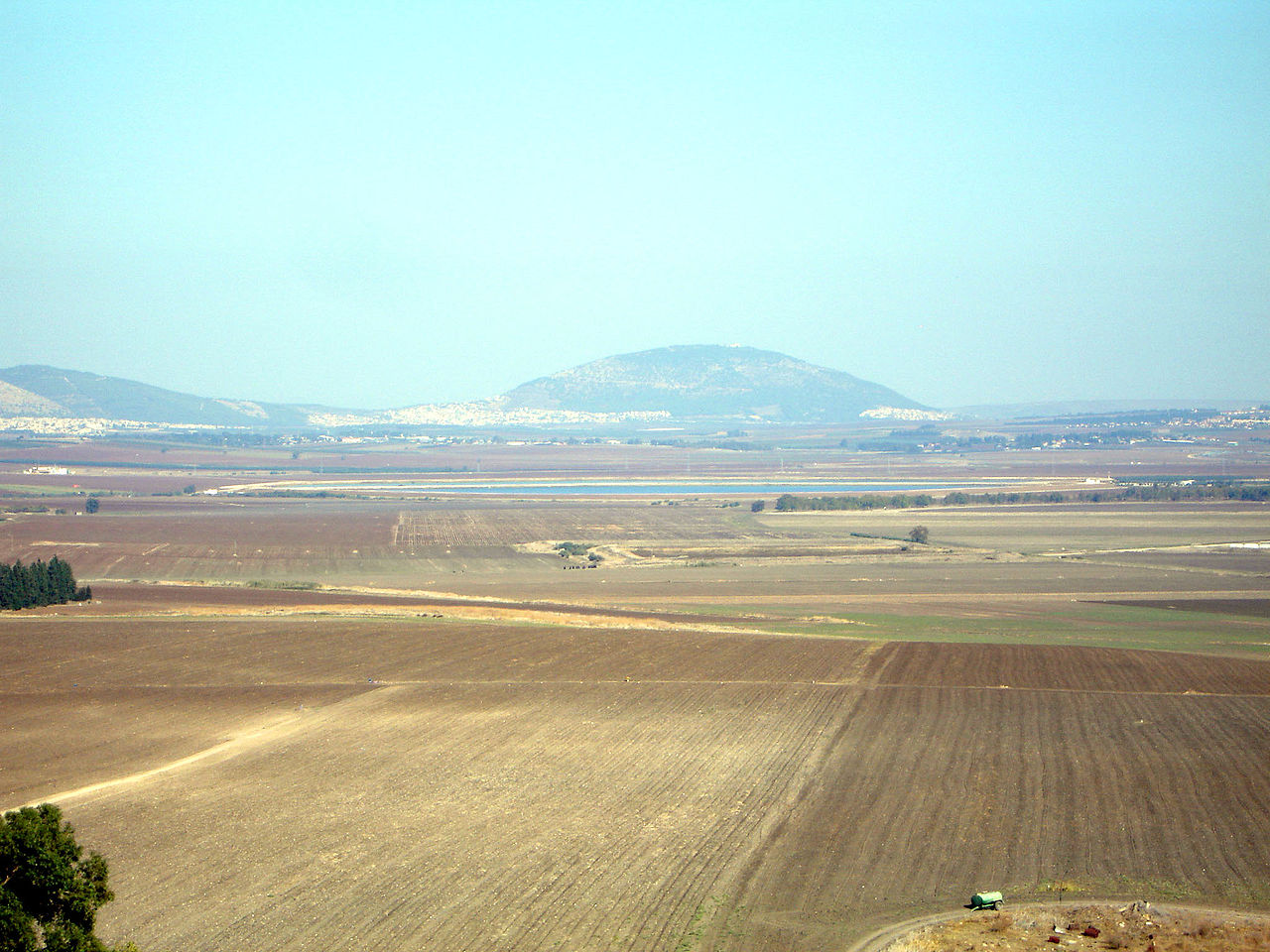
Valley of Jezreel

The view from Megiddo, northeast across the Jezreel Valley in Israel to Mount Tabor, 9 November 2005, by Joe Freeman, Creative Commons Attribution-Share Alike 2.5 Generic

Deluding Influence

Delusion is defined as:

De·lu·sion /dəˈlo͞oZHən/ noun: delusion; plural noun: delusions

An idiosyncratic belief or impression that is firmly maintained despite being contradicted by what is generally accepted as reality or rational argument, typically a symptom of mental disorder.

“The delusion of being watched.”

“Was her belief in his fidelity just a delusion?”

The action of deluding someone or the state of being deluded.

“What a capacity television has for delusion.”

And, perhaps more directly:

De·lude /dəˈlo͞od/ verb: delude; 3rd person present: deludes; past tense and past participle: deluded; gerund or present participle: deluding

Impose a misleading belief upon (someone); deceive; fool.

“Too many theorists have deluded the public.”

In the second letter to the Thessalonians, the Apostle Paul speaks of deluding influences and the man of lawlessness:

Now concerning the coming of our Lord Jesus Christ and our being gathered together to him, we ask you, brothers, not to be quickly shaken in mind or alarmed, either by a spirit or a spoken word, or a letter seeming to be from us, to the effect that the day of the Lord has come.

Let no one deceive you in any way. For that day will not come, unless the rebellion comes first, and the man of lawlessness is revealed, the son of destruction, who opposes and exalts himself against every so-called god or object of worship, so that he takes his seat in the temple of God, proclaiming himself to be God.

Do you not remember that when I was still with you I told you these things? And you know what is restraining him now so that he may be revealed in his time. For the mystery of lawlessness is already at work. Only he who now restrains it will do so until he is out of the way. And then the lawless one will be revealed, whom the Lord Jesus will kill with the breath of his mouth and bring to nothing by the appearance of his coming.

The coming of the lawless one is by the activity of Satan with all power and false signs and wonders, and with all wicked deception for those who are perishing, because they refused to love the truth and so be saved. Therefore God sends them a strong delusion, so that they may believe what is false, in order that all may be condemned who did not believe the truth but had pleasure in unrighteousness [emphasis added].

2 Thessalonians 2:1-12 English Standard Version (ESV)

Calvin has much to say about these verses: 1–2, 3–4, 5–8, and 9–12. We’ll concentrate on what he said about verses 11 and 12:

Verse 11 – The working of delusion. He means that errors will not merely have a place, but [that] the wicked will be blinded, so…they will rush forward to ruin without consideration.

For as God enlightens us inwardly by his Spirit, that his doctrine may be efficacious in us, and opens our eyes and hearts, that it may make its way thither, so by a righteous judgment he delivers over to a reprobate mind (Romans 1:28) those whom he has appointed to destruction, that with closed eyes and a senseless mind, they may, as if bewitched, deliver themselves over to Satan and his ministers to be deceived…

Verse 12 – That all may be condemned. That is, that they may receive the punishment due to their impiety. Thus, those that perish have no just ground to expostulate with God, inasmuch as they have obtained what they sought.

For we must keep in view what is stated in Deuteronomy 13:3, that the hearts of men are subjected to trial, when false doctrines come abroad, inasmuch as they [the false doctrines] have no power except among those who do not love God with a sincere heart. Let those, then, who take pleasure in unrighteousness, reap the fruit of it.

When he says all, he means that contempt of God finds no excuse in the great crowd and multitude of those who refuse to obey the gospel, for God is the Judge of the whole world, so that he will inflict punishment upon a hundred thousand, no less than upon one individual.

The participle εὐδοκήσαντες (taking pleasure) means (so to speak) a voluntary inclination to evil, for in this way every excuse is cut off from the ungrateful, when they take so much pleasure in unrighteousness, as to prefer it to the righteousness of God.

For by what violence will they say that they have been impelled to alienate themselves by a mad revolt from God, towards whom they were led by the guidance of nature? It is at least manifest that they willingly and knowingly lent an ear to falsehoods.

But none of this is new. Throughout history and in all lands, God has given over the disobedient.

Roughly seven hundred years before Christ and more than a century and a half before their decreed release by Cyrus the Great, the prophet Isaiah encouraged the future Babylonian exiles to flee from there and, by faith, return to the Promised Land. Speaking of their spiritual blindness, he says to them:

They know not, nor do they discern, for he has shut their eyes, so that they cannot see, and their hearts, so that they cannot understand. Isaiah 44:18 (ESV)

Speaking to His disciples about the crowds gathered by the Sea of Galilee to hear Him, the Lord Jesus Christ cites Isaiah (Is. 6:9–10):

And he said to them, “To you has been given the secret of the kingdom of God, but for those outside everything is in parables, so that

“they may indeed see but not perceive,

    and may indeed hear but not understand,

lest they should turn and be forgiven.”

Mark 4:11-12 (ESV)

Later, during Lord’s entry into Jerusalem prior to the Passover, John recounts what Isaiah said about God’s hardening of hearts as a commentary on those who did not believe in the Lord:

“He has blinded their eyes

    and hardened their heart,

lest they see with their eyes,

    and understand with their heart, and turn,

    and I would heal them.”

John 12:40 (ESV)

Later still, Paul, in his letter to the church in Rome says:

So then he has mercy on whomever he wills, and he hardens whomever he wills. Romans 9:18 (ESV)

This is a clear expression of God’s sovereign kindness and severity.

And yet, He sets Eternity in the heart:

He has made everything beautiful in its time. Also, he has put eternity into man’s heart, yet so that he cannot find out what God has done from the beginning to the end. Ecclesiastes 3:11 (ESV)

Truly, His ways are past finding out:

Oh, the depth of the riches and wisdom and knowledge of God! How unsearchable are his judgments and how inscrutable his ways! Romans 11:33 (ESV)

Even though we deserve ruthlessness, He Himself seeks to persuade us with rational arguments:

“Come now, let us reason together, says the Lord:

Though your sins are like scarlet, they shall be as white as snow;

Though they are red like crimson, they shall become like wool.

If you are willing and obedient, you shall eat the good of the land;

But if you refuse and rebel,you shall be eaten by the sword;

For the mouth of the Lord has spoken.”

Isaiah 1:18–20 (ESV)

Then, of course, He speaks to us of an unmerited gift:

Come to me, all who labor and are heavy laden, and I will give you rest. Take my yoke upon you, and learn from me, for I am gentle and lowly in heart, and you will find rest for your souls. Matthew 11:28-29 (ESV)

With Paul (and Isaiah), I say to you: sleeper, awake!

Fall of Rebel Angels - Brueghel

The Fall of the Rebel Angels (1562), Pieter Brueghel the Elder (1526/1530–1569), PD in US

Salvation

There is much confusion about this concept nowadays. There needn’t be. Scripture is clear:

“And there is salvation in no one else, for there is no other name under heaven given among men by which we must be saved.” Acts 4:12 English Standard Version (ESV)

Calvin says:

Neither is there salvation in any other. …And assuredly Christ had showed this one token of his grace, to the end [that] he might be known to be the only author of life. We must consider this in all the benefits of God, to wit, that he is the fountain of salvation. And he meant to prick and sting the priests with this sentence, when as he says that there is salvation in none other save only in Christ, whom they went about to put quite out of remembrance.

As if he should say, that they are twice damned who did not only refuse the salvation offered them by God, but endeavor to bring the same to naught, and did take from all the people the fruit and use thereof. Although he seems to speak unto deaf men, yet he preaches of the grace of Christ, if [perhaps] some can abide to hear; [and] if not, that they may at least be deprived of all excuse by this testimony.

Neither is there any other name…Salvation (says he) is in Christ alone, because God has decreed that it should be so. For by name he means the cause or means, as if he should have said, forasmuch as salvation is in God’s power only, he will not have the same to be common to us by any other means than if we ask it of Christ alone.

Whereas he says under heaven…I do rather think that this was added, because men cannot ascend into heaven, that they may come unto God. Therefore, seeing we are so far from the kingdom of God, it is needful that God does not only invite us unto himself, but that reaching out his hand he offer salvation unto us, that we may enjoy the same.

Peter teaches in this [passage], that he has done that in Christ, because he came down into the earth for this cause, that he might bring salvation with him. Neither is that contrary to this doctrine, that Christ is ascended above all heavens, (Ephesians 4:10). For he took upon him our flesh once for this cause, that he might be a continual pledge of our adoption. He has reconciled the Father to us forever by the sacrifice of his death: by his resurrection he has purchased for us eternal life.

And he is present with us now also, that he may make us partakers of the fruit of eternal redemption; but the revealing of salvation is handled in this [passage], and we know that the same was so revealed in Christ, that we need not any longer to say, “Who shall ascend into heaven?” (Romans 10:6).

And if this doctrine were deeply imprinted in the minds of all men, then should so many controversies concerning the causes of salvation be soon at an end, wherewith the Church is so much troubled…

The Visual Bible – Acts Chapter 4

Judgment and Condemnation

I was speaking with someone at church a few weeks back and we both wondered what 2 Corinthians 5:10 meant:

For we must all appear before the judgment seat of Christ, so that each one may receive what is due for what he has done in the body, whether good or evil. 2 Corinthians 5:10 English Standard Version (ESV)

Are believers judged? Rather than guess, I offered to look into it. Here’s what I found Calvin had to say:

We must be manifested. Though this is common to all, yet all without distinction do not raise their views in such a way as to consider every moment, that they must appear before the judgment-seat of Christ…For then the books, which are now shut, will be opened (Daniel 7:10).

That every one may give account. As the passage relates to the recompensing of deeds, we must notice briefly, that, as evil deeds are punished by God, so also good deeds are rewarded, but for a different reason; for evil deeds are requited with the punishment that they deserve, but God in rewarding good deeds does not look to merit or worthiness.

For no work is so full and complete in all its parts as to be deservedly well-pleasing to him, and farther, there is no one whose works are in themselves well-pleasing to God, unless he render satisfaction to the whole law. Now no one is found to be thus perfect. Hence the only resource is in his accepting us through unmerited goodness, and justifying us, by not imputing to us our sins.

After he has received us into favor, he receives our works also by a gracious acceptance. It is on this that the reward hinges. There is, therefore, no inconsistency in saying, that he rewards good works, provided we understand that mankind, nevertheless, obtain eternal life gratuitously…

So, here, I think we have half the explanation. All humankind is judged for the good and bad that they’ve done in this life. Any good we can do is only good insofar as God does not count our sins against us. This is only possible through faith in Christ’s saving work on the cross. And that, too, is freely given by Him alone to those who do not merit it.

But what of the condemnation due for the bad that we do? The scriptures say:

Truly, truly, I say to you, whoever hears my word and believes him who sent me has eternal life. He does not come into judgment, but has passed from death to life. John 5:24 (ESV)

Calvin says about this verse:

He that heareth my word. Here is described the way and manner of honoring God, that no one may think that it consists solely in any outward performance, or in frivolous ceremonies. …But here Christ demands from us no other honor than to obey his Gospel…

Hath eternal life. By these words he likewise commends the fruit of obedience, that we may be more willing to render it…

And shall not come into condemnation. There is here an implied contrast between the guilt to which we are all naturally liable, and the unconditional acquittal which we obtain through Christ; for if all were not liable to condemnation, what purpose would it serve to free from it those who believe in Christ?

The meaning therefore is, that we are beyond the danger of death, because we are acquitted through the grace of Christ; and, therefore, though Christ sanctifies and regenerates us, by his Spirit, to newness of life, yet here he specially mentions the unconditional forgiveness of sins, in which alone the happiness of men consists. For then does a man begin to live when he has God reconciled to him; and how would God love us, if he did not pardon our sins?

…Though life be only begun in us, Christ declares that believers are so certain of obtaining it, that they ought not to fear death; and we need not wonder at this, since they are united to him who is the inexhaustible fountain of life.

But what shall we do with such confidence? I suggest, with Calvin, that we cast off fear and live a life worthy of our gracious God’s gift.

The Last Judgment, Martin, 1853

The Last Judgment, 1853, John Martin (1789-1854), Tate Britain, Public Domain in US

The Real Meaning of Thanksgiving Day

Perhaps you’ve read these proclamations by Abraham Lincoln? I had not. Perhaps they mean nothing to you; perhaps they meant nothing to Abraham Lincoln or his Secretary of State, William Seward. But, even if they were just speechifying, these stand as powerful and stark words, even today.

Proclamation 97 — Appointing a Day of National Humiliation, Fasting, and Prayer – March 30, 1863

By the President of the United States of America

A Proclamation

Whereas the Senate of the United States, devoutly recognizing the supreme authority and just government of Almighty God in all the affairs of men and of nations, has by a resolution requested the President to designate and set apart a day for national prayer and humiliation; and

Whereas it is the duty of nations as well as of men to own their dependence upon the overruling power of God, to confess their sins and transgressions in humble sorrow, yet with assured hope that genuine repentance will lead to mercy and pardon, and to recognize the sublime truth, announced in the Holy Scriptures and proven by all history, that those nations only are blessed whose God is the Lord;

And, insomuch as we know that by His divine law nations, like individuals, are subjected to punishments and chastisements in this world, may we not justly fear that the awful calamity of civil war which now desolates the land may be but a punishment inflicted upon us for our presumptuous sins, to the needful end of our national reformation as a whole people? We have been the recipients of the choicest bounties of Heaven; we have been preserved these many years in peace and prosperity; we have grown in numbers, wealth, and power as no other nation has ever grown. But we have forgotten God. We have forgotten the gracious hand which preserved us in peace and multiplied and enriched and strengthened us, and we have vainly imagined, in the deceitfulness of our hearts, that all these blessings were produced by some superior wisdom and virtue of our own. Intoxicated with unbroken success, we have become too self-sufficient to feel the necessity of redeeming and preserving grace, too proud to pray to the God that made us.

It behooves us, then, to humble ourselves before the offended Power, to confess our national sins, and to pray for clemency and forgiveness.

Now, therefore, in compliance with the request, and fully concurring in the views of the Senate, I do by this my proclamation designate and set apart Thursday, the 30th day of April, 1863, as a day of national humiliation, fasting, and prayer. And I do hereby request all the people to abstain on that day from their ordinary secular pursuits, and to unite at their several places of public worship and their respective homes in keeping the day holy to the Lord and devoted to the humble discharge of the religious duties proper to that solemn occasion.

All this being done in sincerity and truth, let us then rest humbly in the hope authorized by the divine teachings that the united cry of the nation will be heard on high and answered with blessings no less than the pardon of our national sins and the restoration of our now divided and suffering country to its former happy condition of unity and peace. In witness whereof I have hereunto set my hand and caused the seal of the United States to be affixed.

Done at the city of Washington, this 30th day of March, A. D. 1863, and of the Independence of the United States the eighty-seventh.

ABRAHAM LINCOLN.

By the President:

WILLIAM H. SEWARD, Secretary of State.

Citation: Abraham Lincoln: “Proclamation 97 – Appointing a Day of National Humiliation, Fasting, and Prayer,” March 30, 1863. Online by Gerhard Peters and John T. Woolley, The American Presidency Project.

The second proclamation sets forth a specific day for thanksgiving.

Proclamation 106 — Thanksgiving Day, 1863 – October 3, 1863

By the President of the United States of America

A Proclamation

The year that is drawing toward its close has been filled with the blessings of fruitful fields and healthful skies. To these bounties, which are so constantly enjoyed that we are prone to forget the source from which they come, others have been added which are of so extraordinary a nature that they can not fail to penetrate and soften even the heart which is habitually insensible to the ever-watchful providence of Almighty God.

In the midst of a civil war of unequaled magnitude and severity, which has sometimes seemed to foreign states to invite and to provoke their aggression, peace has been preserved with all nations, order has been maintained, the laws have been respected and obeyed, and harmony has prevailed everywhere, except in the theater of military conflict, while that theater has been greatly contracted by the advancing armies and navies of the Union.

Needful diversions of wealth and of strength from the fields of peaceful industry to the national defense have not arrested the plow, the shuttle, or the ship; the ax has enlarged the borders of our settlements, and the mines, as well of iron and coal as of the precious metals, have yielded even more abundantly than heretofore. Population has steadily increased notwithstanding the waste that has been made in the camp, the siege, and the battlefield, and the country, rejoicing in the consciousness of augmented strength and vigor, is permitted to expect continuance of years with large increase of freedom.

No human counsel hath devised nor hath any mortal hand worked out these great things. They are the gracious gifts of the Most High God, who, while dealing with us in anger for our sins, hath nevertheless remembered mercy.

It has seemed to me fit and proper that they should be solemnly, reverently, and gratefully acknowledged, as with one heart and one voice, by the whole American people. I do therefore invite my fellow-citizens in every part of the United States, and also those who are at sea and those who are sojourning in foreign lands, to set apart and observe the last Thursday of November next as a day of thanksgiving and praise to our beneficent Father who dwelleth in the heavens. And I recommend to them that while offering up the ascriptions justly due to Him for such singular deliverances and blessings they do also, with humble penitence for our national perverseness and disobedience, commend to His tender care all those who have become widows, orphans. mourners, or sufferers in the lamentable civil strife in which we are unavoidably engaged, and fervently implore the interposition of the Almighty hand to heal the wounds of the nation and to restore it, as soon as may be consistent with the divine purposes, to the full enjoyment of peace, harmony, tranquillity, and union.

In testimony whereof I have hereunto set my hand and caused the seal of the United States to be affixed.

Done at the city of Washington, this 3d day of October, A. D. 1863, and of the Independence of the United States the eighty-eighth.

ABRAHAM LINCOLN.

By the President:

WILLIAM H. SEWARD, Secretary of State.

Citation: Abraham Lincoln: “Proclamation 106 – Thanksgiving Day, 1863,” October 3, 1863. Online by Gerhard Peters and John T. Woolley, The American Presidency Project.

The third proclamation establishes the last Thursday in November as Thanksgiving Day.

Proclamation 118 — Thanksgiving Day, 1864 – October 20, 1864

By the President of the United States of America

A Proclamation

It has pleased Almighty God to prolong our national life another year, defending us with His guardian care against unfriendly designs from abroad and vouchsafing to us in His mercy many and signal victories over the enemy, who is of our own household. It has also pleased our Heavenly Father to favor as well our citizens in their homes as our soldiers in their camps and our sailors on the rivers and seas with unusual health. He has largely augmented our free population by emancipation and by immigration, while He has opened to us new sources of wealth and has crowned the labor of our workingmen in every department of industry with abundant rewards. Moreover, He has been pleased to animate and inspire our minds and hearts with fortitude, courage, and resolution sufficient for the great trial of civil war into which we have been brought by our adherence as a nation to the cause of freedom and humanity, and to afford to us reasonable hopes of an ultimate and happy deliverance from all our dangers and afflictions:

Now, therefore, I, Abraham Lincoln, President of the United States, do hereby appoint and set apart the last Thursday in November next as a day which I desire to be observed by all my fellow-citizens, wherever they may then be, as a day of thanksgiving and praise to Almighty God, the beneficent Creator and Ruler of the Universe. And I do further recommend to my fellow-citizens aforesaid that on that occasion they do reverently humble themselves in the dust and from thence offer up penitent and fervent prayers and supplications to the Great Disposer of Events for a return of the inestimable blessings of peace, union, and harmony throughout the land which it has pleased Him to assign as a dwelling place for ourselves and for our posterity throughout all generations.

In testimony whereof I have hereunto set my hand and caused the seal of the United States to be affixed.

Done at the city of Washington, this 20th day of October, A.D. 1864, and of the Independence of the United States the eighty-ninth.

ABRAHAM LINCOLN.

By the President:

WILLIAM H. SEWARD, Secretary of State .

Citation: Abraham Lincoln: “Proclamation 118 – Thanksgiving Day, 1864,” October 20, 1864. Online by Gerhard Peters and John T. Woolley, The American Presidency Project.

These proclamations, in their totality, are what the day should mean for the citizens of the United States of America.

Freedom From Want - Rockwell

FREEDOM FROM WANT — Office for Emergency Management. Office of War Information. Domestic Operations Branch. Bureau of Special Services. (03/09/1943 – 09/15/1945), in the Public Domain

Your Fiery Trial

No doubt you’ve suffered “the slings and arrows of outrageous fortune.” Perhaps you’ve been insulted, falsely accused, or unjustly condemned when you’ve tried to do good for others? All alive will at some time suffer one or more of these adversities. However, only those saved by God’s grace can grow as a result of them. The Apostle Peter says in his first letter:

Beloved, do not be surprised at the fiery trial when it comes upon you to test you, as though something strange were happening to you. But rejoice insofar as you share Christ’s sufferings, that you may also rejoice and be glad when his glory is revealed. 1 Peter 4:12-13 English Standard Version (ESV)

Although Peter elsewhere counsels that Paul’s writings are sometimes hard to understand, I find this passage of his difficult as well. Let’s see what John Calvin has to say:

Beloved, think it not strange, or, wonder not. There is a frequent mention made in this Epistle of afflictions; the cause of which we have elsewhere explained. But this difference is to be observed, that when he exhorts the faithful to patience, he sometimes speaks generally of troubles common to man’s life; but here he speaks of wrongs done to the faithful for the name of Christ.

And first, indeed, he reminded them that they ought not to have deemed it strange as for a thing sudden and unexpected; by which he intimates, that they ought by a long mediation to have been previously prepared to bear the cross. For whosoever has resolved to fight under Christ’s banner, will not be dismayed when persecution happens, but, as one accustomed to it, will patiently bear it. [In order] that we may then be in a prepared state of mind when the waves of persecutions roll over us, we ought in due time to habituate ourselves to such an event by meditating continually on the cross.

Moreover, he proves that the cross is useful to us by two arguments, — that God thus tries our faith, — and that we become thus partakers with Christ. Then, in the first place, let us remember that the trial of our faith is most necessary, and that we ought thus willingly to obey God who provides for our salvation. However, the chief consolation is to be derived from a fellowship with Christ.

Hence Peter not only forbids us to think it strange, when he sets this before us, but also bids us to rejoice. It is, indeed, a cause of joy, when God tries our faith by persecution; but the other joy far surpasses it, that is, when the Son of God allots to us the same course of life with himself, that he might lead us with himself to a blessed participation of heavenly glory.

For we must bear in mind this truth, that we have the dying of Christ in our flesh, that his life may be manifested in us. The wicked also do indeed bear many afflictions; but as they are separated from Christ, they apprehend nothing but God’s wrath and curse: thus it comes that sorrow and dread overwhelm them.

Hence, then, is the whole consolation of the godly, that they are associates with Christ, that hereafter they may be partakers of his glory; for we are always to bear in mind this transition from the cross to the resurrection. But as this world is like a labyrinth, in which no end of evils appears, Peter refers to the future revelation of Christ’s glory, as though he had said, that the day of its revelation is not to be overlooked, but ought to be expected.

But he mentions a twofold joy, one which we now enjoy in hope, and the other the full fruition of which the coming of Christ shall bring to us; for the first is mingled with grief and sorrow, the second is connected with exultation. For it is not suitable in the midst of afflictions to think of joy, which can free us from all trouble; but the consolations of God moderate evils, so that we can rejoice at the same time.

One might object that suffering for righteousness sake in the hope of future joy is nothing more than “pie in the sky when we die.” But it is so much more. This kind of suffering shows we are His possession, and if we are His, this world has no hold on us. This momentary light affliction is preparing us for an eternal weight of glory beyond all comparison.

Steel Mill Run-off

Run-off from a Steel Mill Open Hearth Furnace, Republic Steel Corp., Youngstown, Ohio, November 1941, A work of the U.S. federal government, in the public domain