Confused Language

A recent Economist magazine review on Noam Chomsky’s work [paywall] comments:

Since he wrote “Syntactic Structures” in 1957, Mr. Chomsky has argued that human language is fundamentally different from any other kind of communication, that a “linguist from Mars” would agree that all human languages are variations on a single language, and that children’s incredibly quick and successful learning (despite often messy and inattentive parental input) points to an innate language faculty in the brain.

This view is remarkably accurate, especially considering the differences between Western and Eastern languages. The Economist review goes on to say that Chomsky and a computer scientist, Robert Berwick, claim to explain the evolution of human language in their new book titled: Why Only Us. Perhaps they’re wrong?

For a different perspective, it’s worthwhile reading the entire biblical account of this phenomenon.

Now the whole earth had one language and the same words. And as people migrated from the east, they found a plain in the land of Shinar and settled there. And they said to one another, “Come, let us make bricks, and burn them thoroughly.” And they had brick for stone, and bitumen for mortar. Then they said, “Come, let us build ourselves a city and a tower with its top in the heavens, and let us make a name for ourselves, lest we be dispersed over the face of the whole earth.”

And the Lord came down to see the city and the tower, which the children of man had built. And the Lord said, “Behold, they are one people, and they have all one language, and this is only the beginning of what they will do. And nothing that they propose to do will now be impossible for them. Come, let us go down and there confuse their language, so that they may not understand one another’s speech.”

So the Lord dispersed them from there over the face of all the earth, and they left off building the city. Therefore, its name was called Babel, because there the Lord confused the language of all the earth. And from there the Lord dispersed them over the face of all the earth.

Genesis 11:1-9 English Standard Version (ESV)

So the choice is stark. Either we have different languages because they “evolved” that way. Or we reaped what we sowed in trying to “make a name for ourselves.” And we did; just not a good name. Let’s see what Calvin has to say on this scripture passage.

And the Lord came down. …Moses…intimates that God, for a little while, seemed to take no notice of them… For [God] frequently bears with the wicked [such] that he not only suffers them to contrive many nefarious things, as if he were [unconcerned;] but even further[s] their impious and perverse designs with animating success, in order that he may at length cast them down to a lower depth.

Behold, the people is one. …God complains of a wickedness in men…to teach us [not that he is swayed by any passions, but] that he is not negligent of human affairs, and that, as he watches for the salvation of the faithful, so he is intent on observing the wickedness of the ungodly; as it is said in Psalm 34:16,

“The face of the Lord is against them that do evil, to cut off the remembrance of them from the earth.”

Go to, let us go down. …[God] declares that the work which they supposed could not be retarded, shall, without any difficulty, be destroyed…This example of Divine vengeance belongs to all ages: for men are always inflamed with the desire of daring to attempt what is unlawful. And this history shows that God will ever be averse to such counsels and designs; so that we here behold, depicted before our eyes what Solomon says:

‘There is no counsel, nor prudence, nor strength against the Lord,’ (Proverbs 21:30)

Unless the blessing of God be present, from which alone we may expect a prosperous issue, all that we attempt will necessarily perish.

So the Lord scattered them abroad. Men had already been spread abroad [by virtue of] the benediction and grace of God. But those whom the Lord had before distributed with honor in various abodes, he now ignominiously scatters[as] a violent rout, because the principal bond…between them was cut asunder.

Therefore, the name of it [is] called Babel. …What [did] they gain by their foolish ambition to acquire a name[?] They hoped that an everlasting memorial of their origin would be engraven on the tower… [However,] they [did] gain a name, but not each as they would have chosen: thus does God opprobriously cast down the pride of those who usurp to themselves honors to which they have no title.

However, Calvin points out God’s mercy and grace through all this:

Now, although the world bears this curse to the present day; yet, in the midst of punishment…the admirable goodness of God is rendered conspicuous, …because He has proclaimed one gospel, in all languages, through the whole world…

…They who before were miserably divided, have coalesced in the unity of the faith. In this sense Isaiah says, that the language of Canaan should be common to all under the reign of Christ, (Isaiah 19:18); because, although their language may differ in sound, they all speak the same thing, while they cry, “Abba, Father.”

***

What always stands out to me in this Genesis scripture account is the verse: “And nothing that they propose to do will now be impossible for them.” This was God’s assessment of us when we had one language. With increasing consolidation around a few key languages and advances in CRISPR, AI, and nuclear annihilation, we may still do on a global scale what should have remained impossible for men to do.

Because of these things, but not only these, I urge you to embrace that other human impossibility:

It is easier for a camel to go through the eye of a needle than for a rich person to enter the kingdom of God.” And they were exceedingly astonished, and said to him, “Then who can be saved?” Jesus looked at them and said, “With man it is impossible, but not with God. For all things are possible with God.” Mark 10:25-27 (ESV)

Please enter His kingdom, now.

Tower of Babel - Bruegel

The Tower of Babel, 1563, Pieter Brueghel the Elder (1526/1530–1569), public domain in the United States

Why We Use Scripture Extensively in Our Posts

It’s not because we’re lazy (but, if you knew me better, you might disagree.) Nor is it because we can’t write well; though you may disagree with this as well. It’s because His word is what He says He will use to save us from the penalty of death which our sins against Him alone so richly deserve. He says:

“For as the rain and the snow come down from heaven

   and do not return there but water the earth,

making it bring forth and sprout,

   giving seed to the sower and bread to the eater,

so shall my word be that goes out from my mouth;

   it shall not return to me empty,

but it shall accomplish that which I purpose,

   and shall succeed in the thing for which I sent it.

Isaiah 55:10-11 English Standard Version (ESV)

His purpose, His eternal purpose is realized in Christ and the Church. The Lord alone is the objective source of knowledge and action who has entered into what we consider our world. Of course, it is His and is His forever.

When He was drawing me to Himself, He made my reading from the scriptures irresistible. I remember dwelling in long passages from a large bible at the front of a main line church sanctuary so many years ago. Months later, when He was ready for me to submit to Him in repentance, He sent an evangelist who read from the scriptures in answer to my doubting questions. And I trusted in the Lord Jesus Christ that evening after that sent one left.

You might think: “What does this have to do with me; I’m doing okay. It’s you, Adolphus, who needs a crutch to face the inevitability of death.” Well, I thought the same back then; so did everyone who professes belief in the Lord Jesus Christ. It is His sovereign will that chooses and saves you. No one, by strength of will, can save themselves. Everyone, whether saved or not, will stand before God’s judgment seat and give an account of ourselves. It is only by the merit of His Son, the Lord Jesus Christ, conferred to us through faith that we can face that judgment and live. All others will be sent away from His presence.

I offer you, not only the links above, but this verse for your consideration:

“For God so loved the world, that he gave his only Son, that whoever believes in him should not perish but have eternal life. John 3:16 (ESV)

Please, we beg of you, repent and believe.

Albert Mohler: The Authority of Scripture, Ligonier Ministries

Why Are There Four Gospel Accounts?

From an historical perspective, theologian Louis Berkhof explains that:

…Matthew wrote for the Jews and characterized Christ as the great King of the house of David. Mark composed his Gospel for the Romans and pictured the Savior as the mighty Worker, triumphing over sin and evil. Luke in writing his Gospel had in mind the needs of the Greeks and portrayed Christ as the perfect man, the universal Savior. And John, composing his Gospel for those who already had a saving knowledge of the Lord and stood in need of a more profound understanding of the essential character of Jesus, emphasized the divinity of Christ, the glory that was manifested in his works…

Recently, I ran across an interesting conjecture about this question while researching my next book. However, while it was compelling, I thought it best to test this conjecture against what Calvin penned about the four gospels in his Commentaries.

The first thing to notice is that Calvin values the Gospel of John differently from the synoptic gospels of Matthew, Mark, and Luke.

Concerning John’s Gospel in relation to the other three, Calvin says:

Yet there is also this difference between them, which the other three are more copious in their narrative of the life and death of Christ, but John dwells more largely on the doctrine by which the office of Christ, together with the power of his death and resurrection, is unfolded.

…And as all of them had the same object in view, to point out Christ, the three former exhibit his body, if we may be permitted to use the expression, but John exhibits his soul.

On this account, I am accustomed to say that this Gospel [i.e., John’s] is a key to open the door for understanding the rest; for whoever shall understand the power of Christ, as it is here strikingly portrayed, will afterwards read with advantage what the others relate about the Redeemer who was manifested.

About Mark’s gospel, Calvin says:

Mark is generally supposed to have been the private friend and disciple of Peter. It is even believed that he wrote the Gospel, as it was dictated to him by Peter, and thus merely performed the office of an amanuensis or clerk. But on this subject we need not give ourselves much trouble, for it is of little importance to us, provided only we believe that he is a properly qualified and divinely appointed witness, who committed nothing to writing, but as the Holy Spirit directed him and guided his pen.

Of Luke:

Luke asserts plainly enough that he is the person who attended Paul.

And of Matthew, Calvin says:

Matthew is sufficiently known [from the Gospel accounts].

Summing up for all three:

…For we will not say that the diversity which we perceive in the three Evangelists was the object of express arrangement, but as they intended to give an honest narrative of what they knew to be certain and undoubted, each followed that method which he reckoned best. Now as this did not happen by chance, but by the direction of Divine Providence, so under this diversity in the manner of writing the Holy Spirit suggested to them an astonishing harmony, which would almost be sufficient of itself to secure credit to them, if there were no other and stronger evidences to support their authority.

Note that John had intimate access with God and man and later in life, much knowledge and love.

Matthew (called Levi) was a Hebrew civil official collecting Roman taxes, despised by his countrymen, and was grateful to leave all behind.

Peter (and perhaps Mark) worked with his hands, was bold, impulsive, and spoke well  extemporaneously.

Luke was a physician who set out to document both the life of Jesus and the Acts of the Apostles meticulously.

The conclusion of the preceding exposition brings us to the source of the conjecture.

David Keirsey’s book Please Understand Me is a useful reference for writers who want to fully flesh out their characters.

He says Hippocrates and Galen observed that there are four personality types. Later scientists refined their observations by identifying four distinctions within each type. We’ll review Keirsey’s take on the four personality types via several posts over the next few weeks (possibly interspersed among other postings on different topics).

In the book’s notes section, Keirsey relates the four main personality types to the gospel writers:

Artisan (SP) — Bold, Works with Hands, Extemporaneous, Present Oriented — Peter (with amanuensis Mark)

Guardian (SJ) — Administrative, Works with Resources, Desires Respect, Past Oriented — Matthew

Rational (NT) — Reasoning, Works in Sciences, Seeks Knowledge, Period Oriented — Luke

Idealist (NF) — Empathetic, Works with People, Sagacious, Future Oriented — John

These are the Gospel author’s predispositions. Their experiences molded them, as far as they were willing and able, so that they acquired attributes of the other personality types. These attributes in total could be said to be their overall dispositions.

Although God may choose to relate to our predispositions through the Gospel writers, once He gets hold of us, He conforms us to His Son’s likeness as His sons and daughters.

None of the four writers seemed more transformed than Peter who, in his second letter to the churches, documents instruction for and prophesy of the future as his provision for the saints:

I think it right, as long as I am in this body, to stir you up by way of reminder, since I know that the putting off of my body will be soon, as our Lord Jesus Christ made clear to me. And I will make every effort so that after my departure you may be able at any time to recall these things. 2 Peter 1:13-15 English Standard Version (ESV)

Of course, the number “four” is a common theme throughout the bible.

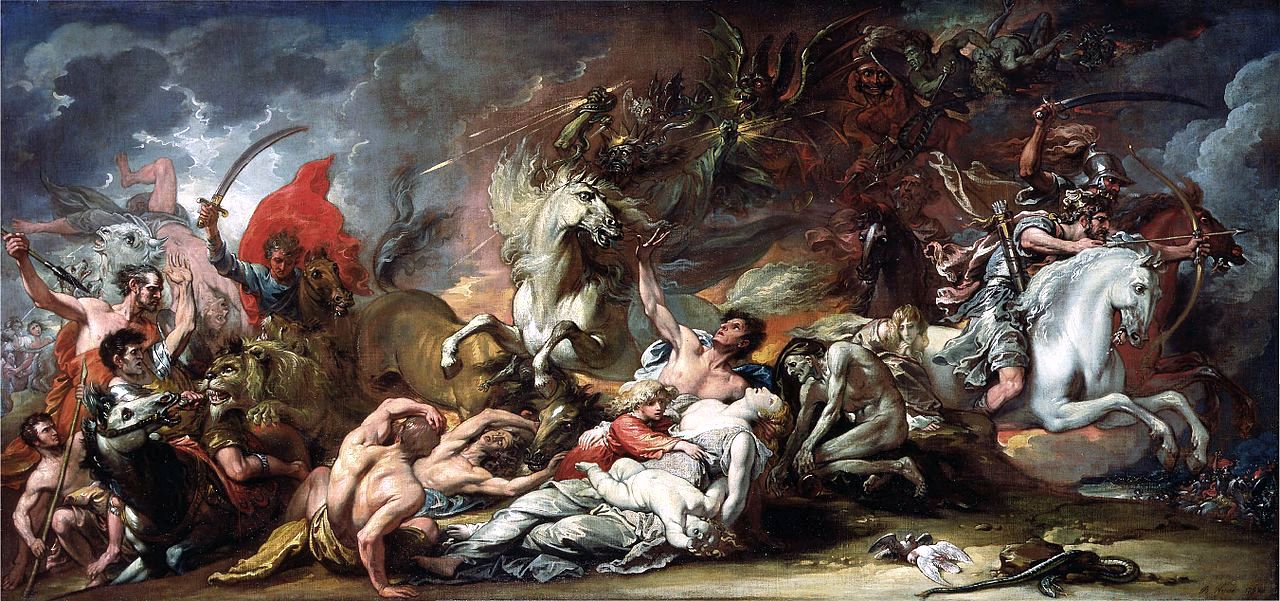
Four Horsemen of the Apocalype

Death on a Pale Horse is a version of the traditional subject, Four Horsemen of Revelation, 1796, Benjamin West (1738 – 1820), in the public domain in the US

Unless – a Conjunction

While doing research for a previous blog post, I noticed that John’s Gospel quotes the Lord Jesus several times using the word: unless.

Unless is interesting because it is a logic term.

Unless

/ənˈles/

conjunction

Except if (used to introduce a case in which a statement being made is not true or valid).

“Unless you have a photographic memory, repetition is vital”

Speaking English – How to Use “Unless,” July 10, 2013, Learn English with Rebecca [engVid RebeccaESL]

The Lord Jesus Christ used this conjunction to lead those who heard Him into God’s Kingdom.

Unless it is granted him by the Father, no one can come to me John 6:64-66 English Standard Version (ESV)

Unless the Father who sent me draws him, no one can come to me John 6:43-45 (ESV)

Unless one is born again he cannot see the kingdom of God John 3:2-3 (ESV)

Unless one is born of water and the Spirit, he cannot enter the kingdom of God John 3:4-6 (ESV)

Unless you believe that I am He you will die in your sins John 8:23-25 (ESV)

To sum up, unless God the Father grants it and draws us we cannot come to the Lord Jesus. Unless one is born again, of water and the Spirit, we can neither see nor enter God’s Kingdom. And unless we believe that the Lord Jesus Christ is the God who saves, we will die condemned to eternal punishment.

All Israel Shall Be Saved

Much has been said recently about the reestablishment of Israel in the Middle East. Even Kim Riddlebarger’s A Case for Amillennialism, which we mentioned a few weeks ago, touches on the issue of national Israel. Some of what’s been said is divisive and some is not.

So let’s step back from the contemporary rhetoric and see what the Bible says. The Apostle Paul discussed Israel in his letter to the church in Rome. He described that nation’s relationship to God now that the gospel had been revealed. Paul made the following statement:

And in this way all Israel will be saved, as it is written,

“The Deliverer will come from Zion,

He will banish ungodliness from Jacob”;

Romans 11:26 English Standard Version (ESV)

What did he mean by ‘in this way?’ It seems that a lot of controversy surrounds this clause.

The exegete John Calvin said of the verse:

Many understand this of the Jewish people, as though Paul had said, that religion would again be restored among them as before [e.g., the sacrificial system].

But I extend the word Israel to all the people of God, according to this meaning:

“When the Gentiles shall come in, the Jews also shall return from their defection to the obedience of faith; and thus shall be completed the salvation of the whole Israel of God, which must be gathered from both; and yet in such a way that the Jews shall obtain the first place, being as it were the first-born in God’s family.”

Calvin didn’t make this assertion and others because of personal preference or animus, but based on the context of Paul’s statements in the chapter. Paul went on to say:

As regards the gospel, they [i.e., Israel] are enemies for your [i.e., the hearers of his letter] sake. But as regards election, they are beloved for the sake of their forefathers. For the gifts and the calling of God are irrevocable.

For just as you were at one time disobedient to God but now have received mercy because of their disobedience, so they too have now been disobedient in order that by the mercy shown to you they also may now receive mercy. For God has consigned all to disobedience, that he may have mercy on all. Romans 11:28-32 (ESV)

To this, Calvin commented:

[Paul] shows that the worst thing in the Jews ought not to subject them to the contempt of the Gentiles. Their chief crime was unbelief: but Paul teaches us, that they were thus blinded for a time by God’s providence, that a way to the gospel might be made for the Gentiles;

Paul then intends here to teach two things — that there is nothing in any man why he should be preferred to others, apart from the mere favor of God; and that God in the dispensation of his grace, is under no restraint that he should not grant it to whom he pleases.

There is an emphasis in the word mercy; for it intimates that God is bound to none, and that he therefore saves all freely, for they are all equally lost.

…Paul simply means that both Jews and Gentiles do not otherwise obtain salvation than through the mercy of God, and thus he leaves to none any reason for complaint. It is indeed true that this mercy is without any difference offered to all, but everyone must seek it by faith.

And thus ‘in this way’: All Israel Shall Be Saved.

Valley of Jezreel

The view from Megiddo, northeast across the Jezreel Valley in Israel to Mount Tabor, 9 November 2005, by Joe Freeman, Creative Commons Attribution-Share Alike 2.5 Generic

Gift Economy — Review and Commentary by Bernhardt Writer

Michael Horton’s Ordinary: Sustainable Faith in a Radical, Restless World is summarized by the two section headings that divide the book: ‘radical and restless’ and ‘ordinary and content.’ The first section concerns evangelicalism and its contractual foundation. The second, reformed tradition and its covenantal grounding.

Two points stood out to me. First, how God gives gifts to His people who, in turn, give them to those inside and outside the faith through good works. Horton submits that our common labors such as: employee, employer, wife, mother, father, husband, etc. are part of the means by which to share with others God’s gifts to us. Horton calls this God’s covenantal ‘gift economy.’

He says that giving gifts back to God in ‘our service to Him’ is giving them in a direction He did not intend. These gifts are to be given to our neighbors for His glory.

The second point is that elders of the local church should, in their spiritual oversight responsibility, meet with members often to listen to, instruct, and, if necessary, correct them. The word that caught my attention was often. How much more attentive, representative, and corrective they could be if they did this in all the churches.

I also noted that Horton didn’t outline any specific program of evangelism. He emphasized the image of a garden where one plants, another waters, but God gives the growth. If we are giving God’s gifts to us to our neighbors then opportunities to share the gospel, in sincere friendship, will open for us.

Christmas Gifts

Christmas Gifts, 25 December 2003, Kelvin Kay, Creative Commons Attribution-Share Alike 3.0 Unported license

A New Prophet like Moses

“The end is near, the end is near!” We all associate this trope with crackpots and lunatics. Especially street corner prophets wearing sandwich boards. However, they are right in a sense. Around 150,000 people die every day, worldwide. Their ends are no longer near but already past.

We have to be wary of a prophet and his message. Thus Moses pointed us to the Prophet we should all listen to:

“The Lord your God will raise up for you a prophet like me from among you, from your brothers—it is to him you shall listen…and whoever will not listen to my words that he shall speak in my name, I myself will require it of him. Deuteronomy 18:15, 19 English Standard Version (ESV)

John Calvin has quite a bit to say about these verses:

The Lord thy God will raise up …But if He had referred them to Christ alone, the objection would naturally arise that it was hard for them to have neither Prophets nor revelations for two thousand years. Nor is there any strength in those two arguments on which some insist, that the Prophet, of whom Moses bears witness, must be more excellent than him who proclaimed him; and that the eulogium that he should be “like unto” Moses could not be applied to the ancient Prophets, since it is said elsewhere that “there arose not a Prophet since like unto” him. (Deuteronomy 34:10)…

…Yet Peter aptly and elegantly accommodates this testimony to Christ, (Acts 3:22) not to the exclusion of others of God’s servants, but in order to warn the Jews that in rejecting Christ they are at the same time refusing this inestimable benefit of God; for the gift of prophecy had so flourished among His ancient people, and teachers had so been constantly appointed to succeed each other, that nevertheless there should be some interruption before the coming of Christ.

Hence, in that sad dispersion which followed the return from the Babylonian captivity, the faithful complain in Psalm 74:9, “We see not our signs; there is no more any prophet.” On this account Malachi exhorts the people to remember the Law given in Horeb; and immediately after adds, “Behold I send you Elijah the prophet,” etc., (Malachi 4:4, 5) as much as to say, that the time was at hand in which a more perfect doctrine should be manifested, and a fuller light should shine. For the Apostle says truly, that:

“God, who at sundry times and in divers manners spoke unto the fathers by the prophets, hath in these last days spoken unto us by his Son,” (Hebrews 1:1, 2)

And, in fact, by the appearing of the doctrine of the Gospel, the course of the prophetic doctrine was completed; because God thus fully exhibited what was promised by the latter.

And this was so generally understood that even the Samaritan woman said that Messiah was coming, who would tell all things. (John 4:25) To this, then, what I have lately quoted as to the transition from the Law and the Prophets to the Gospel refers; and hence it is made out, that this passage was most appropriately expounded by Peter as relating to Christ; for unless the Jews chose to accuse God of falsehood, it was incumbent upon them to look to Christ, at whose hand was promised both the confirmation of doctrine and the restoration of all things.

They had been for a long time destitute of Prophets, of whom Moses had testified that they should never be wanting to them, and whom he had promised as the lawful ministers for retaining the people in allegiance, so that they should not turn aside to superstitions; they had, therefore, either no religion, or else that greatest of Teachers was to be expected, who in his own person would present the perfection of the prophetic office…

…But with regard to the comparison which Moses makes between himself and other prophets, its effect is to raise their teaching in men’s estimation. They had been long accustomed to this mode of instruction, viz., to hear God speaking to them by the mouth of a man; and the authority of Moses was so fully established, that they were firmly persuaded that they were under the divine government, and that all things necessary to salvation were revealed to them.

And, as recorded in John’s Gospel, chapter 5, verses: 39-40 and 46-47, the Lord Jesus Christ Himself says:

“You search the Scriptures because you think that in them you have eternal life; and it is they that bear witness about me, yet you refuse to come to me that you may have life…For if you believed Moses, you would believe me; for he wrote of me. But if you do not believe his writings, how will you believe my words?” John 5:39-40, 46-47 (ESV)

Please, believe Him.

Brazen Serpent

[The Brazen Serpent], Mount Nebo, Jordan (2001), Jerzy Strzelecki, Creative Commons Attribution-Share Alike 3.0 Unported

I’m Sorry, Please Forgive Me

How often do we say: “I’m sorry; please forgive me?” Rarely, is my guess, based on how often I hear it. I suspect that no longer seeking forgiveness is the result of permissiveness seeping into what used to be common practice almost everywhere. That’s not to say that these words aren’t still necessary for good relations with others.

Most of us know that my standard is the scriptures, and specifically, in this case, the Gospels. Here, we see how the Lord’s disciples tried to evade this very burden; but He didn’t let them do it:

Then Peter came up and said to him, “Lord, how often will my brother sin against me, and I forgive him? As many as seven times?” Jesus said to him, “I do not say to you seven times, but seventy-seven times.” Matthew 18:21-22 English Standard Version (ESV)

And

“Pay attention to yourselves! If your brother sins, rebuke him, and if he repents, forgive him, and if he sins against you seven times in the day, and turns to you seven times, saying, ‘I repent,’ you must forgive him.”

The apostles said to the Lord, “Increase our faith!” And the Lord said, “If you had faith like a grain of mustard seed, you could say to this mulberry tree, ‘Be uprooted and planted in the sea,’ and it would obey you.” Luke 17:3-6 (ESV)

We’re all prone to doubt others’ motives when they keep repeating the same offenses and “seeking forgiveness” time and again. We’re not to be punching bags, after all. However, the Gospel of Matthew lays out a clear process of reconciliation for us to follow:

“So if you are offering your gift at the altar and there remember that your brother has something against you, leave your gift there before the altar and go.

First be reconciled to your brother, and then come and offer your gift.” Matthew 5:23-24 (ESV)

And

“If your brother sins against you, go and tell him his fault, between you and him alone. If he listens to you, you have gained your brother.

But if he does not listen, take one or two others along with you, that every charge may be established by the evidence of two or three witnesses.

If he refuses to listen to them, tell it to the church. And if he refuses to listen even to the church, let him be to you as a Gentile and a tax collector.” Matthew 18:15-17 (ESV)

So, if they refuse to listen to the church and continue to persist in their sin then, as the Apostle Paul states, do not associate with them:

I wrote to you in my letter not to associate with sexually immoral people— not at all meaning the sexually immoral of this world, or the greedy and swindlers, or idolaters, since then you would need to go out of the world.

But now I am writing to you not to associate with anyone who bears the name of brother if he is guilty of sexual immorality or greed, or is an idolater, reviler, drunkard, or swindler—not even to eat with such a one.

For what have I to do with judging outsiders? Is it not those inside the church whom you are to judge? God judges those outside. “Purge the evil person from among you.” 1 Corinthians 5:9-13 (ESV)

Until, perhaps, the Lord may grant them repentance, or even salvation, if that’s what’s lacking.

Now such a reconciliation process should not be an occasion for gloating; rather, it should give us pause to reflect on our own behavior. We should be humble toward one another:

I therefore, a prisoner for the Lord, urge you to walk in a manner worthy of the calling to which you have been called, with all humility and gentleness, with patience, bearing with one another in love, eager to maintain the unity of the Spirit in the bond of peace. Ephesians 4:1-3 (ESV)

And this sacrificial love (i.e., agape) is, for the professing church, the mark by which we are to be known:

“A new commandment I give to you, that you love one another: just as I have loved you, you also are to love one another. By this all people will know that you are my disciples, if you have love for one another.” John 13:34-35 (ESV)

We have to remember right relationships require humility and not anger:

Know this, my beloved brothers: let every person be quick to hear, slow to speak, slow to anger; for the anger of man does not produce the righteousness of God. Therefore put away all filthiness and rampant wickedness and receive with meekness the implanted word, which is able to save your souls. James 1:19-21 (ESV)

To do this, we must exercise self-control:

For the grace of God has appeared, bringing salvation for all people, training us to renounce ungodliness and worldly passions, and to live self-controlled, upright, and godly lives in the present age, Titus 2:11-12 (ESV)

We must make our actions agree with the words we profess:

But someone will say, “You have faith and I have works.” Show me your faith apart from your works, and I will show you my faith by my works. James 2:18 (ESV)

So, then, let us press on toward the goal for the prize of the upward call in Christ Jesus.

Prodigal Son, Rembrandt

The Return of the Prodigal Son, circa 1668, Rembrandt (1606–1669), Public Domain in the US

Judgment and Condemnation

I was speaking with someone at church a few weeks back and we both wondered what 2 Corinthians 5:10 meant:

For we must all appear before the judgment seat of Christ, so that each one may receive what is due for what he has done in the body, whether good or evil. 2 Corinthians 5:10 English Standard Version (ESV)

Are believers judged? Rather than guess, I offered to look into it. Here’s what I found Calvin had to say:

We must be manifested. Though this is common to all, yet all without distinction do not raise their views in such a way as to consider every moment, that they must appear before the judgment-seat of Christ…For then the books, which are now shut, will be opened (Daniel 7:10).

That every one may give account. As the passage relates to the recompensing of deeds, we must notice briefly, that, as evil deeds are punished by God, so also good deeds are rewarded, but for a different reason; for evil deeds are requited with the punishment that they deserve, but God in rewarding good deeds does not look to merit or worthiness.

For no work is so full and complete in all its parts as to be deservedly well-pleasing to him, and farther, there is no one whose works are in themselves well-pleasing to God, unless he render satisfaction to the whole law. Now no one is found to be thus perfect. Hence the only resource is in his accepting us through unmerited goodness, and justifying us, by not imputing to us our sins.

After he has received us into favor, he receives our works also by a gracious acceptance. It is on this that the reward hinges. There is, therefore, no inconsistency in saying, that he rewards good works, provided we understand that mankind, nevertheless, obtain eternal life gratuitously…

So, here, I think we have half the explanation. All humankind is judged for the good and bad that they’ve done in this life. Any good we can do is only good insofar as God does not count our sins against us. This is only possible through faith in Christ’s saving work on the cross. And that, too, is freely given by Him alone to those who do not merit it.

But what of the condemnation due for the bad that we do? The scriptures say:

Truly, truly, I say to you, whoever hears my word and believes him who sent me has eternal life. He does not come into judgment, but has passed from death to life. John 5:24 (ESV)

Calvin says about this verse:

He that heareth my word. Here is described the way and manner of honoring God, that no one may think that it consists solely in any outward performance, or in frivolous ceremonies. …But here Christ demands from us no other honor than to obey his Gospel…

Hath eternal life. By these words he likewise commends the fruit of obedience, that we may be more willing to render it…

And shall not come into condemnation. There is here an implied contrast between the guilt to which we are all naturally liable, and the unconditional acquittal which we obtain through Christ; for if all were not liable to condemnation, what purpose would it serve to free from it those who believe in Christ?

The meaning therefore is, that we are beyond the danger of death, because we are acquitted through the grace of Christ; and, therefore, though Christ sanctifies and regenerates us, by his Spirit, to newness of life, yet here he specially mentions the unconditional forgiveness of sins, in which alone the happiness of men consists. For then does a man begin to live when he has God reconciled to him; and how would God love us, if he did not pardon our sins?

…Though life be only begun in us, Christ declares that believers are so certain of obtaining it, that they ought not to fear death; and we need not wonder at this, since they are united to him who is the inexhaustible fountain of life.

But what shall we do with such confidence? I suggest, with Calvin, that we cast off fear and live a life worthy of our gracious God’s gift.

The Last Judgment, Martin, 1853

The Last Judgment, 1853, John Martin (1789-1854), Tate Britain, Public Domain in US

Restore to Repentance?

Having been in the church a while, I’ve seen and heard things. This verse has always troubled me:

For it is impossible,

in the case of those:

who have once been enlightened,

who have tasted the heavenly gift,

and have shared in the Holy Spirit,

and have tasted the goodness of the word of God and the powers of the age to come,

and then have fallen away,

to restore them again to repentance,

since they are:

crucifying once again the Son of God to their own harm

and holding him up to contempt.

Hebrews 6:4-6 English Standard Version (ESV) emphasis mine

I had once presented the gospel to a fellow who said to me that he knew he was not redeemable because of these verses. Ignorant as I was at the time, I tried to convince him that there was always hope while he yet lived. He, a non-believer, quoted these verses to me, thanked me for my concern, and wandered away. I never saw him again.

John Calvin comments:

Let us then know, that the Gospel cannot be otherwise rightly known than by the illumination of the Spirit, and that being thus drawn away from the world, we are raised up to heaven, and that knowing the goodness of God we rely on his word.

But here arises a new question, how can it be that he who has once made such a progress should afterwards fall away? For God, it may be said, calls none effectually but the elect, and Paul testifies that they are really his sons who are led by his Spirit, (Romans 8:14) and he teaches us, that it is a sure pledge of adoption when Christ makes us partakers of his Spirit. The elect are also beyond the danger of finally falling away; for the Father who gave them to be preserved by Christ his Son is greater than all, and Christ promises to watch over them all so that none may perish.

To all this I answer, That God indeed favors none but the elect alone with the Spirit of regeneration, and that by this they are distinguished from the reprobate; for they are renewed after his image and receive the earnest of the Spirit in hope of the future inheritance, and by the same Spirit the Gospel is sealed in their hearts.

But I cannot admit that all this is any reason why he should not grant the reprobate also some taste of his grace, why he should not irradiate their minds with some sparks of his light, why he should not give them some perception of his goodness, and in some sort engrave his word on their hearts.

Otherwise, where would be the temporal faith mentioned by Mark 4:17? There is therefore some knowledge even in the reprobate, which afterwards vanishes away, either because it did not strike roots sufficiently deep, or because it withers, being choked up.

And by this bridle the Lord keeps us in fear and humility; and we certainly see how prone human nature is otherwise to security and foolish confidence. At the same time our solicitude ought to be such as not to disturb the peace of conscience. For the Lord strengthens faith in us, while he subdues our flesh: and hence he would have faith to remain and rest tranquilly as in a safe haven; but he exercises the flesh with various conflicts, that it may not grow wanton through idleness.

So the bitter admonition in these verses serves us well: to keep us striving for holiness, humility, and obedience to the Lord Jesus Christ in all we think, say, and do.

Fallen Angels in Hell

Fallen Angels in Hell, circa 1841, John Martin, 1789 – 1854, Public Domain in US