Sanctification

Paul writes to the church in Rome:

I am speaking in human terms, because of your natural limitations. For just as you once presented your members as slaves to impurity and to lawlessness leading to more lawlessness, so now present your members as slaves to righteousness leading to sanctification.

For when you were slaves of sin, you were free in regard to righteousness. But what fruit were you getting at that time from the things of which you are now ashamed? For the end of those things is death.

But now that you have been set free from sin and have become slaves of God, the fruit you get leads to sanctification and its end, eternal life. For the wages of sin is death, but the free gift of God is eternal life in Christ Jesus our Lord.

Romans 6:19-23 English Standard Version (ESV)

The Westminster Confession Shorter Catechism Question and Answer number 35 states:

What is sanctification? Sanctification is the work of God’s free grace, whereby we are renewed in the whole man after the image of God, and are enabled more and more to die unto sin, and live unto righteousness.

What does John Calvin say about these verses in Romans here and here?

I speak what is human, etc. He says that he speaks after the manner of men, not as to the substance but as to the manner. So Christ says, in John 3:12, that he announced earthly things, while yet he spoke of heavenly mysteries, though not so magnificently as the dignity of the things required, because he accommodated himself to the capacities of a people ignorant and simple.

…As though [the Apostle] had said, “I might, by comparing sin and righteousness, show how much more ardently you ought to be led to render obedience to the latter [righteousness], than to serve the former [sin]; but from regard to your infirmity I omit this comparison: nevertheless, though I treat you with great indulgence, I may yet surely make this just demand — that you should not at least obey righteousness more coldly or negligently than you served sin…”

As you have presented, etc.; that is, “As you were formerly ready with all your faculties to serve sin, it is hence sufficiently evident how wretchedly enslaved and bound did your depravity hold you to itself: now then you ought to be equally prompt and ready to execute the commands of God; let not your activity in doing good be now less than it was formerly in doing evil.” He does not indeed observe the same order in the antithesis, by adapting different parts to each other, as he does in 1 Thessalonians 4:7, where he sets uncleanness in opposition to holiness; but the meaning is still evident…

For when you were, etc. He still repeats the difference, which he had before mentioned, between the yoke of righteousness and that of sin; for these two things, sin and righteousness, are so contrary, that he who devotes himself to the one, necessarily departs from the other. And he thus represents both, that by viewing them apart we may see more clearly what is to be expected from each; for to set things thus apart enables us to understand better their distinctive character. He then sets sin on one side, and righteousness on the other; and having stated this distinction, he afterwards shows what results from each of them…

What fruit, then, etc. He could not more strikingly express what he intended than by appealing to their conscience, and by confessing shame as it were in their person. Indeed the godly, as soon as they begin to be illuminated by the Spirit of Christ and the preaching of the gospel, do freely acknowledge their past life, which they have lived without Christ, to have been worthy of condemnation; and so far are they from endeavoring to excuse it, that, on the contrary, they feel ashamed of themselves. Yea, further, they call to mind the remembrance of their own disgrace, that being thus ashamed, they may more truly and more readily be humbled before God…

Ye have your fruit unto holiness, etc. As he had before mentioned a twofold end of sin, so he does now as to righteousness. Sin in this life brings the torments of an accusing conscience, and in the next eternal death. We now gather the fruit of righteousness, even holiness; we hope in future to gain eternal life. These things, unless we are beyond measure stupid, ought to generate in our minds a hatred and horror of sin, and also a love and desire for righteousness…

For the wages of sin, etc. …This verse is a conclusion to the former, and as it were an epilogue to it. He does not, however, in vain repeat the same thing again; but by doubling the terror, he intended to render sin an object of still greater hatred.

But the gift of God. They are mistaken who thus render the sentence, “Eternal life is the gift of God,” as though eternal life were the subject, and the gift of God the predicate; for this does not preserve the contrast. But as he has already taught us, that sin produces nothing but death; so now he subjoins, that this gift of God, even our justification and sanctification, brings to us the happiness of eternal life. Or, if you prefer, it may be thus stated, — “As the cause of death is sin, so righteousness, which we obtain through Christ, restores to us eternal life…”

I Could Laugh (feat. Chris Taylor) performed at BD’s House, 2014, by Michael Roe
Assurance

After I was saved from the death penalty that hangs over us all, I memorized a different translation of this verse very early on:

For God is not unjust so as to overlook your work and the love that you have shown for his name in serving the saints, as you still do. And we desire each one of you to show the same earnestness to have the full assurance of hope until the end, so that you may not be sluggish, but imitators of those who through faith and patience inherit the promises. Hebrews 6:10-12 English Standard Version (ESV)

This is a key verse of assurance. Self-sacrifice in service to our brothers and sisters is both a marker and builder of our confidence in His promise of eternal life. And that service is not directed only to those professing faith, but those especially; while not forgetting our duty for service to all.

Every day shows us how futile this world is. Our faithful actions can show us to have a different destiny.

What does Calvin say about the passage here and here?

For God is not unrighteous, etc. These words signify as much as though he had said, that from good beginnings he hoped for a good end.

But here a difficulty arises, because he seems to say that God is bound by the services of men: “I am persuaded,” he says, “as to your salvation, because God cannot forget your works.” He seems thus to build salvation on works, and to make God a debtor to them…

…God does not pay us a debt, but performs what he has of himself freely promised, and thus performs it, inasmuch as he pardons us and our works; nay, he looks not so much on our works as on his own grace in our works. It is on this account that he forgets not our works, because he recognizes himself and the work of his Spirit in them…

…God is righteous in recompensing works, because he is true and faithful: and he has made himself a debtor to us, not by receiving anything from us; but as Augustine says, by freely promising all things.

And labor of love, etc. By this he intimates that we are not to spare labor, if we desire to perform duty towards our neighbors; for they are not only to be helped by money, but also by counsel, by labor, and in various other ways. Great [diligence], then, must be exercised, many troubles must be undergone, and sometimes many dangers must be encountered. Thus let him who would engage in the duties of love, prepare himself for a life of labor…

By saying that they had ministered and were still ministering, he commended their perseverance; which in this particular was very necessary; for there is nothing to which we are more prone than to weariness in well doing. Hence it is, that though many are found ready enough to help their brethren, yet the virtue of constancy is so rare, that a large portion soon relax as though their warmth had cooled.

But what ought constantly to stimulate us is even this one expression used by the apostle, that the love shown to the saints is shown towards the name of the Lord; for he intimates that God holds himself indebted to us for whatever good we do to our neighbors, according to that saying,

“What you have done to one of the least of these, you have done to me,” (Matthew 25:40)

and there is also another,

“He that gives to the poor lends to the Lord.” (Proverbs 19:17).

And we desire, etc…“You have made,” he says, “your love evident by many acts of kindness; it remains, however, that your faith should correspond with it; you have [diligently] labored not to be wanting in your duties to men; but with no less earnestness it behooves you to make progress in faith, so as to manifest before God its unwavering and full certainty.”

Now, by these words the Apostle shows that there are two parts in Christianity which correspond with the two tables of the Law…Let us then remember, that the life of a Christian is not complete in all its parts, unless we attend to faith as well as to love.

To the full assurance of hope, or, to the certainty of hope, etc. As they who professed the Christian faith were distracted by various opinions, or were as yet entangled in many superstitions, he bids them to be so fixed in firm faith, as no longer to vacillate nor be driven here and there, suspended between alternate winds of doubts. This injunction is, however, applicable to all; for, as the truth of God is unchangeably fixed, so faith, which relies on him, when it is true, ought to be certain, surmounting every doubt. It is a full assurance, πληροφορία, an undoubting persuasion, when the godly mind settles it with itself, [which] it is not right to call in question what God, who cannot deceive or lie, has spoken…

But followers, or imitators, etc. To sloth he opposes imitation; it is then the same thing as though he said, that there was need of constant alacrity of mind; but it had far more weight, when he reminded them, that the fathers were not made partakers of the promises except through the unconquerable firmness of faith; for examples convey to us a more impressive idea of things…

Faith and patience, etc. What is meant is, a firm faith, which has patience as its companion. For faith is what is, chiefly required; but as many who make at first a marvelous display of faith, soon fail, he shows that the true evidence of that faith which is not fleeting and evanescent, is endurance. By saying that the promises were obtained by faith, he takes away the notion of merits; and still more clearly by saying that they came by “inheritance”; for we are in no other way made heirs but by the right of adoption.

Beautiful Scandalous Night from Flap Your Wings by The Choir

Your Fiery Trial

No doubt you’ve suffered “the slings and arrows of outrageous fortune.” Perhaps you’ve been insulted, falsely accused, or unjustly condemned when you’ve tried to do good for others? All alive will at some time suffer one or more of these adversities. However, only those saved by God’s grace can grow as a result of them. The Apostle Peter says in his first letter:

Beloved, do not be surprised at the fiery trial when it comes upon you to test you, as though something strange were happening to you. But rejoice insofar as you share Christ’s sufferings, that you may also rejoice and be glad when his glory is revealed. 1 Peter 4:12-13 English Standard Version (ESV)

Although Peter elsewhere counsels that Paul’s writings are sometimes hard to understand, I find this passage of his difficult as well. Let’s see what John Calvin has to say:

Beloved, think it not strange, or, wonder not. There is a frequent mention made in this Epistle of afflictions; the cause of which we have elsewhere explained. But this difference is to be observed, that when he exhorts the faithful to patience, he sometimes speaks generally of troubles common to man’s life; but here he speaks of wrongs done to the faithful for the name of Christ.

And first, indeed, he reminded them that they ought not to have deemed it strange as for a thing sudden and unexpected; by which he intimates, that they ought by a long mediation to have been previously prepared to bear the cross. For whosoever has resolved to fight under Christ’s banner, will not be dismayed when persecution happens, but, as one accustomed to it, will patiently bear it. [In order] that we may then be in a prepared state of mind when the waves of persecutions roll over us, we ought in due time to habituate ourselves to such an event by meditating continually on the cross.

Moreover, he proves that the cross is useful to us by two arguments, — that God thus tries our faith, — and that we become thus partakers with Christ. Then, in the first place, let us remember that the trial of our faith is most necessary, and that we ought thus willingly to obey God who provides for our salvation. However, the chief consolation is to be derived from a fellowship with Christ.

Hence Peter not only forbids us to think it strange, when he sets this before us, but also bids us to rejoice. It is, indeed, a cause of joy, when God tries our faith by persecution; but the other joy far surpasses it, that is, when the Son of God allots to us the same course of life with himself, that he might lead us with himself to a blessed participation of heavenly glory.

For we must bear in mind this truth, that we have the dying of Christ in our flesh, that his life may be manifested in us. The wicked also do indeed bear many afflictions; but as they are separated from Christ, they apprehend nothing but God’s wrath and curse: thus it comes that sorrow and dread overwhelm them.

Hence, then, is the whole consolation of the godly, that they are associates with Christ, that hereafter they may be partakers of his glory; for we are always to bear in mind this transition from the cross to the resurrection. But as this world is like a labyrinth, in which no end of evils appears, Peter refers to the future revelation of Christ’s glory, as though he had said, that the day of its revelation is not to be overlooked, but ought to be expected.

But he mentions a twofold joy, one which we now enjoy in hope, and the other the full fruition of which the coming of Christ shall bring to us; for the first is mingled with grief and sorrow, the second is connected with exultation. For it is not suitable in the midst of afflictions to think of joy, which can free us from all trouble; but the consolations of God moderate evils, so that we can rejoice at the same time.

One might object that suffering for righteousness sake in the hope of future joy is nothing more than “pie in the sky when we die.” But it is so much more. This kind of suffering shows we are His possession, and if we are His, this world has no hold on us. This momentary light affliction is preparing us for an eternal weight of glory beyond all comparison.

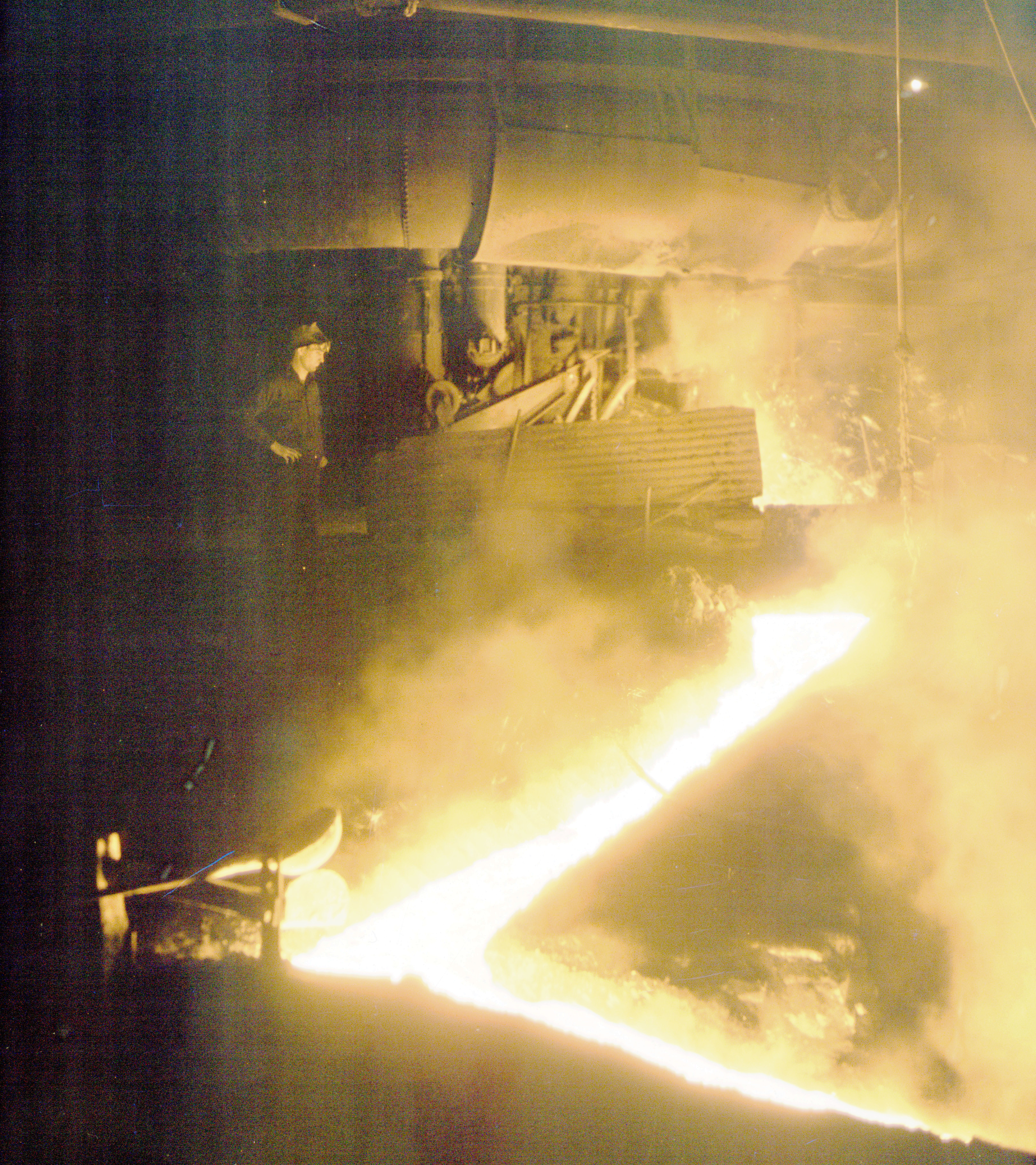
Steel Mill Run-off

Run-off from a Steel Mill Open Hearth Furnace, Republic Steel Corp., Youngstown, Ohio, November 1941, A work of the U.S. federal government, in the public domain

Resistance Isn’t Futile

The author of the book to the Hebrews, in chapter 12, verses 4-6 says:

In your struggle against sin you have not yet resisted to the point of shedding your blood. And have you forgotten the exhortation that addresses you as sons?

“My son, do not regard lightly the discipline of the Lord,

    nor be weary when reproved by him.

For the Lord disciplines the one he loves,

    and chastises every son whom he receives.”

Hebrews 12:4-6 English Standard Version (ESV)

Do you say, as I do sometimes: “Why should I struggle against doing my own will and instead do His will?” Or do we see ourselves as better than this One?

And he came out and went, as was his custom, to the Mount of Olives, and the disciples followed him. And when he came to the place, he said to them, “Pray that you may not enter into temptation.”

And he withdrew from them about a stone’s throw, and knelt down and prayed, saying, Father, if you are willing, remove this cup from me. Nevertheless, not my will, but yours, be done.”

And there appeared to him an angel from heaven, strengthening him. And being in an agony he prayed more earnestly; and his sweat became like great drops of blood falling down to the ground.

And when he rose from prayer, he came to the disciples and found them sleeping for sorrow, and he said to them, “Why are you sleeping? Rise and pray that you may not enter into temptation.”

Luke 22:39-46 (ESV)

Some manuscripts leave out the verses in the third paragraph.

So, with regard to the verse:

And being in an agony he prayed more earnestly; and his sweat became like great drops of blood falling down to the ground.

what does John Calvin comment?

Certainly those who imagine that the Son of God was exempt from human passions do not truly and sincerely acknowledge him to be a man…

…When Christ was distressed by grief and fear, he did not rise against God, but continued to be regulated by the true rule of moderation. We need not wonder that, since he was innocent and pure from every stain, the affections which flowed from him were pure and stainless… Christ, amidst fear and sadness, was weak without any taint of sin…

…He [Christ] had no horror at death…simply as a passage out of the world, but because he had before his eyes the dreadful tribunal of God, and the Judge himself armed with inconceivable vengeance; and because our sins, the load of which was laid upon him, pressed him down with their enormous weight. There is no reason to wonder, therefore, if the dreadful abyss of destruction tormented him grievously with fear and anguish.

…And, therefore, though he suffered death, yet since its pains were loosed—as Peter tells us, (Acts 2:24)—and he was victorious in the conflict, the Apostle justly says, that he was heard on account of his fear [Hebrews 5:7]. Here ignorant people rise up and exclaim, that it would have been unworthy of Christ to be afraid of being swallowed up by death.

But I should wish them to answer this question, What kind of fear do they suppose it to have been which drew from Christ drops of blood? (Luke 22:44). For that mortal sweat could only have proceeded from fearful and unusual horror. If any person, in the present day, were to sweat blood, and in such a quantity that the drops should fall to the ground, it would be reckoned an astonishing miracle…

If it be objected, that the fear which I am describing arises from unbelief, the answer is easy. When Christ was struck with horror at the divine curse, the feeling of the flesh affected him in such a manner, that faith still remained firm and unshaken. For such was the purity of his nature, that he felt, without being wounded by them, those temptations which pierce us with their stings.

And yet those persons, by representing him not to have felt temptations, foolishly imagine that he was victorious without fighting. And, indeed, we have no right to suppose that he used any hypocrisy, when he complained of a mortal sadness in his soul; nor do the Evangelists speak falsely, when they say that he was exceedingly sorrowful, and that he trembled.

In the face of deep fear and anguish, Christ prayed earnestly that His Father’s will be done and He opened the way of salvation to all who will be saved. No matter what anyone says, resistance is not futile.

Borg transmission from the movie Star Trek VIII First Contact – English version

Restore to Repentance?

Having been in the church a while, I’ve seen and heard things. This verse has always troubled me:

For it is impossible,

in the case of those:

who have once been enlightened,

who have tasted the heavenly gift,

and have shared in the Holy Spirit,

and have tasted the goodness of the word of God and the powers of the age to come,

and then have fallen away,

to restore them again to repentance,

since they are:

crucifying once again the Son of God to their own harm

and holding him up to contempt.

Hebrews 6:4-6 English Standard Version (ESV) emphasis mine

I had once presented the gospel to a fellow who said to me that he knew he was not redeemable because of these verses. Ignorant as I was at the time, I tried to convince him that there was always hope while he yet lived. He, a non-believer, quoted these verses to me, thanked me for my concern, and wandered away. I never saw him again.

John Calvin comments:

Let us then know, that the Gospel cannot be otherwise rightly known than by the illumination of the Spirit, and that being thus drawn away from the world, we are raised up to heaven, and that knowing the goodness of God we rely on his word.

But here arises a new question, how can it be that he who has once made such a progress should afterwards fall away? For God, it may be said, calls none effectually but the elect, and Paul testifies that they are really his sons who are led by his Spirit, (Romans 8:14) and he teaches us, that it is a sure pledge of adoption when Christ makes us partakers of his Spirit. The elect are also beyond the danger of finally falling away; for the Father who gave them to be preserved by Christ his Son is greater than all, and Christ promises to watch over them all so that none may perish.

To all this I answer, That God indeed favors none but the elect alone with the Spirit of regeneration, and that by this they are distinguished from the reprobate; for they are renewed after his image and receive the earnest of the Spirit in hope of the future inheritance, and by the same Spirit the Gospel is sealed in their hearts.

But I cannot admit that all this is any reason why he should not grant the reprobate also some taste of his grace, why he should not irradiate their minds with some sparks of his light, why he should not give them some perception of his goodness, and in some sort engrave his word on their hearts.

Otherwise, where would be the temporal faith mentioned by Mark 4:17? There is therefore some knowledge even in the reprobate, which afterwards vanishes away, either because it did not strike roots sufficiently deep, or because it withers, being choked up.

And by this bridle the Lord keeps us in fear and humility; and we certainly see how prone human nature is otherwise to security and foolish confidence. At the same time our solicitude ought to be such as not to disturb the peace of conscience. For the Lord strengthens faith in us, while he subdues our flesh: and hence he would have faith to remain and rest tranquilly as in a safe haven; but he exercises the flesh with various conflicts, that it may not grow wanton through idleness.

So the bitter admonition in these verses serves us well: to keep us striving for holiness, humility, and obedience to the Lord Jesus Christ in all we think, say, and do.

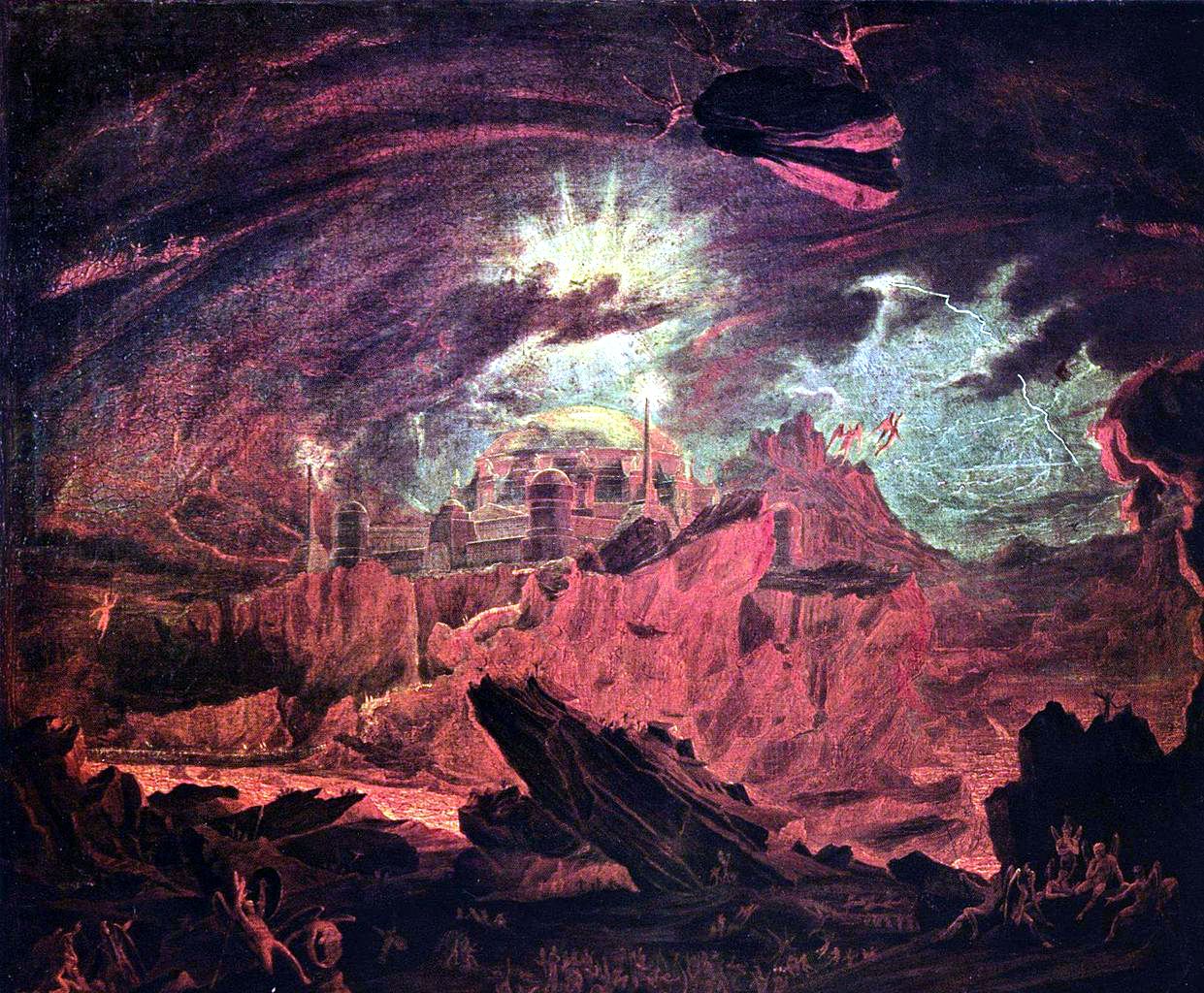
Fallen Angels in Hell

Fallen Angels in Hell, circa 1841, John Martin, 1789 – 1854, Public Domain in US

The Samaritan Leper

The story where Jesus cleanses ten lepers is a familiar one. It’s unusual that it comes right before one of Jesus’s declarations of the Kingdom. Or is it?

On the way to Jerusalem he was passing along between Samaria and Galilee. And as he entered a village, he was met by ten lepers, who stood at a distance and lifted up their voices, saying, “Jesus, Master, have mercy on us.” When he saw them he said to them, “Go and show yourselves to the priests.” And as they went they were cleansed.

Then one of them, when he saw that he was healed, turned back, praising God with a loud voice; and he fell on his face at Jesus’ feet, giving him thanks. Now he was a Samaritan. Then Jesus answered, “Were not ten cleansed? Where are the nine? Was no one found to return and give praise to God except this foreigner?” And he said to him, “Rise and go your way; your faith has made you well.”

Being asked by the Pharisees when the kingdom of God would come, he answered them, “The kingdom of God is not coming in ways that can be observed, nor will they say, ‘Look, here it is!’ or ‘There!’ for behold, the kingdom of God is in the midst of you.” Luke 17:11-21 English Standard Version (ESV)

John Calvin has some interesting comments about the passage:

Thy faith hath saved thee. The word save is restricted by some commentators to the cleanness of the flesh. But if this be the case, since Christ commends the lively faith of this Samaritan, it may be asked, how were the other nine saved? for all of them without exception obtained the same cure.

We must therefore arrive at the conclusion, that Christ has here pronounced a different estimate of the gift of God from that which is usually pronounced by ungodly men; namely, that it was a token or pledge of God’s fatherly love.

The nine lepers were cured; but as they wickedly efface the remembrance of the grace of God, the cure itself is debased and contaminated by their ingratitude, so that they do not derive from it the advantage which they ought. It is faith alone that sanctifies the gifts of God to us, so that they become pure, and, united to the lawful use of them, contribute to our salvation.

Lastly, by this word Christ has informed us in what manner we lawfully enjoy divine favors. Hence we infer that he included the eternal salvation of the soul along with the temporal gift. The Samaritan was saved by his faith How? Certainly not because he was cured of leprosy, (for this was likewise obtained by the rest,) but because he was admitted into the number of the children of God, and received from His hand a pledge of fatherly kindness.

We see the extent of God’s common grace through healings. But, without faith, those temporal miracles do not result in salvation.

Further, Calvin notes:

The kingdom of God will not come with observation. …The word observation is here employed by Christ to denote extraordinary splendor; and he declares, that the kingdom of God will not make its appearance at a distance, or attended by pompous display. He means, that they are greatly mistaken who seek with the eyes of the flesh the kingdom of God, which is in no respect carnal or earthly, for it is nothing else than the inward and spiritual renewal of the soul.

From the nature of the kingdom itself he shows that they are altogether in the wrong, who look around here or there, in order to observe visible marks. That restoration of the Church,” he tells us,which God has promised, must be looked for within; for, by quickening his elect into a heavenly newness of life, he establishes his kingdom within them.”

And thus he indirectly reproves the stupidity of the Pharisees, because they aimed at nothing but what was earthly and fading. It must be observed, however, that Christ speaks only of the beginnings of the kingdom of God; for we now begin to be formed anew by the Spirit after the image of God, in order that our entire renovation, and that of the whole world, may afterwards follow in due time.

I urge you, turn back, submit yourself to Him, and give Him thanks.

The Healing of the Ten Lepers, Tissot

The Healing of Ten Lepers, 1886 – 1894, James Tissot, Brooklyn Museum, PD-Art-US

Is He Fair?

I hope God’s not fair, and so should you. The scriptures say: by the works of the law, no one is justified.

For all have sinned and fall short of God’s glory.

But, He has not dealt with us as our sins deserve.

He saves us, not because of righteous works we have done, but according to His mercy.

But, as a result of His work in us, we must show our faith by our works.

God, through His apostles and prophets, is blunt:

Let no one deceive himself. If anyone among you thinks that he is wise in this age, let him become a fool that he may become wise. For the wisdom of this world is folly with God. For it is written, “He catches the wise in their craftiness,” and again, “The Lord knows the thoughts of the wise, that they are futile.” 1 Corinthians 3:18-20 English Standard Version (ESV)

Therefore, repent and trust Him for life.

Last Judgment, Michelangelo Buonarroti

Last Judgment, 1537–41, Michelangelo Buonarroti (1475–1564), public domain in US

You Thought I Was Like You

This IS a new blog post. We rehearse again the same opening statement from an Aeon article on the possibility and ethics of a human imposed artificial hell as we did in a previous post:

Even in my most religious moments, I have never been able to take the idea of hell seriously. Prevailing Christian theology asks us to believe that an all-powerful, all-knowing being would do what no human parent could ever do: create tens of billions of flawed and fragile creatures, pluck out a few favourites to shower in transcendent love, and send the rest to an eternity of unrelenting torment.

However, this time we explore a different facet of the Aeon article argument. Is God like us doing what no human parent would? Although we could spend time expounding on human parenting, both good and bad, I think all of us know those stories either through the media or through our experience. In our age, it’s God’s declarations we’ve forgotten.
The obvious place to start is Psalm 50:21:

These things you have done, and I have been silent; you thought that I was one like yourself. But now I rebuke you and lay the charge before you.

The psalmist describes God calling His people to hear Him speak. He rebukes His faithful, not for being delinquent in ritual sacrifice of bulls and goats which are His anyway, but for not offering sacrifices of thanksgiving, performing their vows to the Most High, and calling upon Him in the day of trouble. And He promises in response:

“I will deliver you, and you shall glorify me.”

To the wicked He says that they have no right to recite His statutes or covenant because they hate discipline and reject His words. He goes on to say that they are pleased with thieves, keep company with adulterers, speak evil and deceit, and condemn and slander even their own kin.

These are the charges over which He kept silent. But not for the reason they might have thought, that He didn’t notice or care, but for them to have time to repent.

Finally, He calls those thus condemned to repentance, even warning them of the penalty if they do not:

“Mark this, then, you who forget God, lest I tear you apart, and there be none to deliver! The one who offers thanksgiving as his sacrifice glorifies Me; to one who orders his way rightly I will show the salvation of God!”

Reiterating this theme, He says through His prophet, Isaiah:

Let the wicked forsake his way, and the unrighteous man his thoughts; let him return to the LORD, that He may have compassion on him, and to our God, for He will abundantly pardon.

For My thoughts are not your thoughts, neither are your ways My ways, declares the LORD. For as the heavens are higher than the earth, so are My ways higher than your ways and My thoughts than your thoughts.

He calls yet again, through His prophet Ezekiel:

“I have no pleasure in the death of the wicked, but that the wicked turn from his way and live.”

And through His prophet Paul, He states that He: desires all people to be saved and to come to the knowledge of the truth.

This God gave His own Son as a sacrifice for us, His enemies, that whoever believes in Him should not die but live, eternally. What human parent ever did that?

Ecce homo! (Behold the man!), by Antonio Ciseri, 1871

Pontius Pilate presenting a scourged Christ to the people Ecce homo! (Behold the man!), by Antonio Ciseri, 1871, in the public domain.

God – Mean Ogre or Transcendent Benefactor?

An Aeon article on the possibility and ethics of a human imposed artificial hell opens with the following statement:

Even in my most religious moments, I have never been able to take the idea of hell seriously. Prevailing Christian theology asks us to believe that an all-powerful, all-knowing being would do what no human parent could ever do: create tens of billions of flawed and fragile creatures, pluck out a few favourites to shower in transcendent love, and send the rest to an eternity of unrelenting torment.

I wouldn’t want to worship that god either.

Chat Botté and the Ogre by Gustave Doré

Illustration of Chat Botté and the Ogre by Gustave Doré (Creative Commons Attribution-Share Alike 3.0 Unported)

But God isn’t that. He created man sin free but with an ability to become otherwise through an act of disobedience.

We are responsible for evil in the world.

The fact that God saw fit to create man and communicate with him at all, even as a friend, is amazing. That He did all this knowing we’d disobey is a wonder. That He would sacrifice His Son on our behalf is a miracle beyond compare. That he would save any (rather than none) is a superlative I can’t express.

It’s characterizations like that in the Aeon article which lead others to make heartrending statements like this:

As I have explained previously, the problem of evil prevents me from believing in God, or at least an all-powerful God who gives a damn about us. But the problem of beauty keeps me from being an adamant atheist.

Beauty is an attribute of God and His habitations. He set beauty in our midst for our enjoyment and so that we’d look to him for salvation.

There, But for God’s Grace and Mercy Through His Providence, Go I

John Calvin

John Calvin (Photo credit: Wikipedia)

Why are we shocked when things like this, this, or this happen?

These sensational stories are tragic, no doubt. Scary, even. But we seem to think we’d never do or even be capable of such heinous acts. Then we bolt our door against our neighbor (rightly or wrongly, I can’t say; that’s up to you). Some believe we’re naturally moral. Still others say: red in tooth and claw.

The scriptures conclude we all fall short of God’s glory. But isn’t this an overstatement of our condition? Aren’t we really good, but just misguided, unmotivated, or low informational?

Paul, in the letter to the Romans, elaborates on what he concludes in case we were unsure:

11 no one understands;
no one seeks for God.
12  All have turned aside; together they have become worthless;
no one does good,
not even one.”
13 “Their throat is an open grave;
they use their tongues to deceive.”
“The venom of asps is under their lips.”
14 “Their mouth is full of curses and bitterness.”
15 “Their feet are swift to shed blood;
16   in their paths are ruin and misery,
17    and the way of peace they have not known.”
18   “There is no fear of God before their eyes.”

So, we have no excuse to be shocked at these sensational stories. This is the condition of man. However, if this is so, why then do we not claw and bite until we are no more?

John Calvin, a theologian not often cited now–a–days, suggests in the Institutes of the Christian Religion, book 1, chapter 17, and paragraph 11:

…How comes it, I ask, that their confidence never fails, but just that while the world apparently revolves at random, they know that God is everywhere at work, and feel assured that his work will be their safety? When assailed by the devil and wicked men, were they not confirmed by remembering and meditating on Providence, they should, of necessity, forthwith despond. But when they call to mind that the devil, and the whole train of the ungodly, are, in all directions, held in by the hand of God as with a bridle, so that they can neither conceive any mischief, nor plan what they have conceived, nor how much so ever they may have planned, move a single finger to perpetrate, unless in so far as he permits, nay, unless in so far as he commands; that they are not only bound by his fetters, but are even forced to do him service,—when the godly think of all these things they have ample sources of consolation. For, as it belongs to the lord to arm the fury of such foes and turn and destine it at pleasure, so it is his also to determine the measure and the end, so as to prevent them from breaking loose and wantoning as they list…

So God not only constrains the evildoer but commands him to do His bidding, yet without complicity or taint thrown back upon Him. But why, if we’re this way, are we guilty at all?

Calvin says in the Institutes of the Christian Religion, book 1, chapter 17, and paragraph 5:

… As all contingencies whatsoever depend on it, therefore, neither thefts nor adulteries, nor murders, are perpetrated without an interposition of the divine will. Why, then, they ask, should the thief be punished for robbing him whom the Lord chose to chastise with poverty? Why should the murderer be punished for slaying him whose life the Lord had terminated? If all such persons serve the will of God, why should they be punished?

I deny that they serve the will of God. For we cannot say that he who is carried away by a wicked mind performs service on the order of God, when he is only following his own malignant desires. He obeys God, who, being instructed in his will, hastens in the direction in which God calls him.

But how are we so instructed unless by his word? The will declared by his word is, therefore, that which we must keep in view in acting, God requires of us nothing but what he enjoins. If we design anything contrary to his precept, it is not obedience, but contumacy and transgression. But if he did not will it, we could not do it. I admit this.

But do we act wickedly for the purpose of yielding obedience to him? This, assuredly, he does not command. Nay, rather we rush on, not thinking of what he wishes, but so inflamed by our own passionate lust, that, with destined purpose, we strive against him. And in this way, while acting wickedly, we serve his righteous ordination, since in his boundless wisdom he well knows how to use bad instruments for good purposes.

And see how absurd this mode of arguing is. They will have it that crimes ought not to be punished in their authors, because they are not committed without the dispensation of God. I concede more—that thieves and murderers, and other evil-doers, are instruments of Divine Providence, being employed by the Lord himself to execute the Judgments which he has resolved to inflict.

But I deny that this forms any excuse for their misdeeds. For how? Will they implicate God in the same iniquity with themselves, or will they cloak their depravity by his righteousness? They cannot exculpate themselves, for their own conscience condemns them: they cannot charge God, since they perceive the whole wickedness in themselves, and nothing in Him save the legitimate use of their wickedness

So, it is apparent that Romans 3 is true and we are not only held back from what we could do but others are employed to execute God’s judgments and, yet, are solely guilty of their transgression.

I see the tendency to do wrong in myself all the time. Do you? The only remedy is falling at the feet of the Lord Jesus Christ in surrender because he says: Come to me, all who labor and are heavy laden, and I will give you rest.