Believe and Suffer

Some of us are bewildered when we face adversity, some expect it more often than it occurs, some chalk it up to mysterious forces, and some see it as highly probable at all times. What is certain in this life is that we will suffer at some time in our lives. For all of us, I wish it were as certain that we would all believe so as to be saved from the penalty that our sins deserve. The Apostle Paul wrote to the church in Philippi about believing and suffering:

Only let your manner of life be worthy of the gospel of Christ, so that whether I come and see you or am absent, I may hear of you that:

You are standing firm in one spirit

With one mind striving side by side for the faith of the gospel, and

Not frightened in anything by your opponents.

This is a clear sign to them of their destruction, but of your salvation, and that from God.

For it has been granted to you that for the sake of Christ you should not only believe in him but also suffer for his sake, engaged in the same conflict that you saw I had and now hear that I still have.

Philippians 1:27-30 English Standard Version (ESV)

Paul says God has granted them to believe in Him. But also, in an act of His Sovereign will, to suffer. Not any kind of suffering, but that according to His will, “for His sake.”

The reformer and preacher, John Calvin, makes at least three points about these verses. First, our common struggle against our sin, the world, and the devil unites us. Even if we’re divided by our sins against one another, the struggle is so great against us that we will reconcile and contend for the faith together.

Striving together for the faith…is the strongest bond of concord, …for this has often been the occasion of reconciling even the greatest enemies.

…The Apostle’s meaning is this: “Let the faith of the gospel unite you together, more especially as that is a common armory against one and the same enemy.”

The wicked, too, conspire together for evil, but their agreement is accursed: let us, therefore, contend with one mind under the banner of faith.

These struggles, and our patient suffering, are ordained and given by God as a sign of our salvation to us and to the enemies of the faith. These are both a benefit for our increased devotion and an honor to participate in His sufferings.

To you, says he, it is given, not only to believe in Christ, but also to suffer for him. Hence even the sufferings themselves are evidences of the grace of God; and, since it is so, you have from this source a token of salvation. Oh, if this persuasion were effectually [woven into] our minds — that persecutions are to be reckoned among God’s benefits, what progress would be made in the doctrine of piety!

…It is the highest honor…conferred upon us by Divine grace, that we suffer for his name either reproach, or imprisonment, or miseries, or tortures, or even death, for in that case he adorns us with his marks of distinction. But [many would] rather [that] God [refrain from giving] gifts of that nature, than embrace with [readiness] the cross when it is presented to them. Alas, then, for our stupidity!

Finally, Calvin stresses that our struggle and godly resistance is analogous, though far lesser, to Christ’s struggle and godly resistance on the cross. Yet, both faith and endurance remain His unmerited gifts to us, evident in our inability to resist in our own strength.

[Paul] wisely conjoins faith with the cross by an inseparable connection, [so] that the Philippians may know that they have been called to the faith of Christ on this condition — that they endure persecutions on His account, as though he had said that their adoption can no more be separated from the cross, than Christ can be torn asunder from himself.

Here Paul clearly testifies, that faith, as well as [faithfulness] in enduring persecutions, is an unmerited gift of God. And certainly the knowledge of God is a wisdom that is too high for our attaining it by our own acuteness, and our weakness shows itself in daily instances in our own experience, when God withdraws his hand for a little while…

May God grant you to believe and suffer for His sake.

Suffering and the Sovereignty of God: An Interview with R.C. Sproul Jr., Ligonier Ministries
Why We Use Scripture Extensively in Our Posts

It’s not because we’re lazy (but, if you knew me better, you might disagree.) Nor is it because we can’t write well; though you may disagree with this as well. It’s because His word is what He says He will use to save us from the penalty of death which our sins against Him alone so richly deserve. He says:

“For as the rain and the snow come down from heaven

   and do not return there but water the earth,

making it bring forth and sprout,

   giving seed to the sower and bread to the eater,

so shall my word be that goes out from my mouth;

   it shall not return to me empty,

but it shall accomplish that which I purpose,

   and shall succeed in the thing for which I sent it.

Isaiah 55:10-11 English Standard Version (ESV)

His purpose, His eternal purpose is realized in Christ and the Church. The Lord alone is the objective source of knowledge and action who has entered into what we consider our world. Of course, it is His and is His forever.

When He was drawing me to Himself, He made my reading from the scriptures irresistible. I remember dwelling in long passages from a large bible at the front of a main line church sanctuary so many years ago. Months later, when He was ready for me to submit to Him in repentance, He sent an evangelist who read from the scriptures in answer to my doubting questions. And I trusted in the Lord Jesus Christ that evening after that sent one left.

You might think: “What does this have to do with me; I’m doing okay. It’s you, Adolphus, who needs a crutch to face the inevitability of death.” Well, I thought the same back then; so did everyone who professes belief in the Lord Jesus Christ. It is His sovereign will that chooses and saves you. No one, by strength of will, can save themselves. Everyone, whether saved or not, will stand before God’s judgment seat and give an account of ourselves. It is only by the merit of His Son, the Lord Jesus Christ, conferred to us through faith that we can face that judgment and live. All others will be sent away from His presence.

I offer you, not only the links above, but this verse for your consideration:

“For God so loved the world, that he gave his only Son, that whoever believes in him should not perish but have eternal life. John 3:16 (ESV)

Please, we beg of you, repent and believe.

Albert Mohler: The Authority of Scripture, Ligonier Ministries

Why Are There Four Gospel Accounts?

From an historical perspective, theologian Louis Berkhof explains that:

…Matthew wrote for the Jews and characterized Christ as the great King of the house of David. Mark composed his Gospel for the Romans and pictured the Savior as the mighty Worker, triumphing over sin and evil. Luke in writing his Gospel had in mind the needs of the Greeks and portrayed Christ as the perfect man, the universal Savior. And John, composing his Gospel for those who already had a saving knowledge of the Lord and stood in need of a more profound understanding of the essential character of Jesus, emphasized the divinity of Christ, the glory that was manifested in his works…

Recently, I ran across an interesting conjecture about this question while researching my next book. However, while it was compelling, I thought it best to test this conjecture against what Calvin penned about the four gospels in his Commentaries.

The first thing to notice is that Calvin values the Gospel of John differently from the synoptic gospels of Matthew, Mark, and Luke.

Concerning John’s Gospel in relation to the other three, Calvin says:

Yet there is also this difference between them, which the other three are more copious in their narrative of the life and death of Christ, but John dwells more largely on the doctrine by which the office of Christ, together with the power of his death and resurrection, is unfolded.

…And as all of them had the same object in view, to point out Christ, the three former exhibit his body, if we may be permitted to use the expression, but John exhibits his soul.

On this account, I am accustomed to say that this Gospel [i.e., John’s] is a key to open the door for understanding the rest; for whoever shall understand the power of Christ, as it is here strikingly portrayed, will afterwards read with advantage what the others relate about the Redeemer who was manifested.

About Mark’s gospel, Calvin says:

Mark is generally supposed to have been the private friend and disciple of Peter. It is even believed that he wrote the Gospel, as it was dictated to him by Peter, and thus merely performed the office of an amanuensis or clerk. But on this subject we need not give ourselves much trouble, for it is of little importance to us, provided only we believe that he is a properly qualified and divinely appointed witness, who committed nothing to writing, but as the Holy Spirit directed him and guided his pen.

Of Luke:

Luke asserts plainly enough that he is the person who attended Paul.

And of Matthew, Calvin says:

Matthew is sufficiently known [from the Gospel accounts].

Summing up for all three:

…For we will not say that the diversity which we perceive in the three Evangelists was the object of express arrangement, but as they intended to give an honest narrative of what they knew to be certain and undoubted, each followed that method which he reckoned best. Now as this did not happen by chance, but by the direction of Divine Providence, so under this diversity in the manner of writing the Holy Spirit suggested to them an astonishing harmony, which would almost be sufficient of itself to secure credit to them, if there were no other and stronger evidences to support their authority.

Note that John had intimate access with God and man and later in life, much knowledge and love.

Matthew (called Levi) was a Hebrew civil official collecting Roman taxes, despised by his countrymen, and was grateful to leave all behind.

Peter (and perhaps Mark) worked with his hands, was bold, impulsive, and spoke well  extemporaneously.

Luke was a physician who set out to document both the life of Jesus and the Acts of the Apostles meticulously.

The conclusion of the preceding exposition brings us to the source of the conjecture.

David Keirsey’s book Please Understand Me is a useful reference for writers who want to fully flesh out their characters.

He says Hippocrates and Galen observed that there are four personality types. Later scientists refined their observations by identifying four distinctions within each type. We’ll review Keirsey’s take on the four personality types via several posts over the next few weeks (possibly interspersed among other postings on different topics).

In the book’s notes section, Keirsey relates the four main personality types to the gospel writers:

Artisan (SP) — Bold, Works with Hands, Extemporaneous, Present Oriented — Peter (with amanuensis Mark)

Guardian (SJ) — Administrative, Works with Resources, Desires Respect, Past Oriented — Matthew

Rational (NT) — Reasoning, Works in Sciences, Seeks Knowledge, Period Oriented — Luke

Idealist (NF) — Empathetic, Works with People, Sagacious, Future Oriented — John

These are the Gospel author’s predispositions. Their experiences molded them, as far as they were willing and able, so that they acquired attributes of the other personality types. These attributes in total could be said to be their overall dispositions.

Although God may choose to relate to our predispositions through the Gospel writers, once He gets hold of us, He conforms us to His Son’s likeness as His sons and daughters.

None of the four writers seemed more transformed than Peter who, in his second letter to the churches, documents instruction for and prophesy of the future as his provision for the saints:

I think it right, as long as I am in this body, to stir you up by way of reminder, since I know that the putting off of my body will be soon, as our Lord Jesus Christ made clear to me. And I will make every effort so that after my departure you may be able at any time to recall these things. 2 Peter 1:13-15 English Standard Version (ESV)

Of course, the number “four” is a common theme throughout the bible.

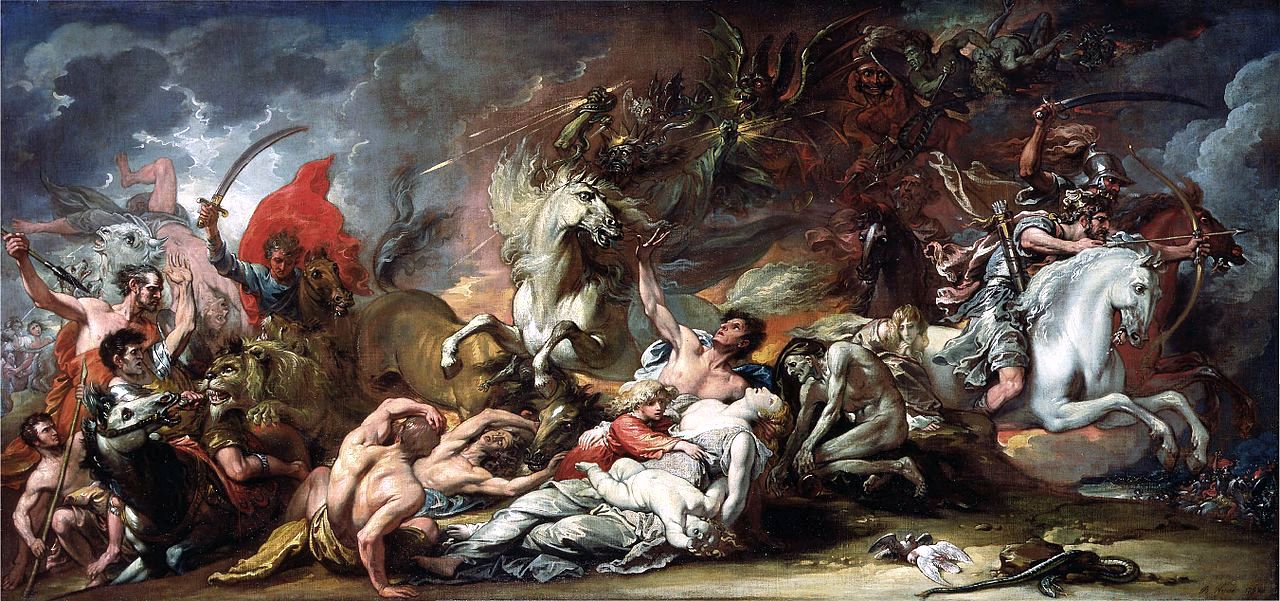
Four Horsemen of the Apocalype

Death on a Pale Horse is a version of the traditional subject, Four Horsemen of Revelation, 1796, Benjamin West (1738 – 1820), in the public domain in the US

The Shocking Concrete Abstract Universal

Flannery O’Connor meant to shock us by her storylines and imagery:

The novelist with Christian concerns will find in modern life distortions which are repugnant to him, and his problem will be to make these appear as distortions to an audience which is used to seeing them as natural; and he may well be forced to take ever more violent means to get his vision across to this hostile audience.

When you can assume that your audience holds the same beliefs you do, you can relax a little and use more normal ways of talking to it; when you have to assume that it does not, then you have to make your vision apparent by shock – to the hard of hearing you shout, and for the almost blind you draw large and startling figures.

Anyone who has read The Violent Bear It Away or Everything That Rises Must Converge would have to agree that O’Connor had the ability to shout and startle.

On a more philosophical note, she reflected on the imbalance between abstract and concrete knowledge of her day in her essay: ‘The Catholic Novelist in the Protestant South,’ p 858–9, Collected Works:

It takes a story of mythic dimensions; one which belongs to everybody; one in which everybody is able to recognize the hand of God and imagine its descent upon himself.

In the Protestant South the Scriptures fill this role. The ancient Hebrew genius for making the absolute concrete has conditioned the Southerner’s way of looking at things…

Our response to life is different if we have been taught only the definition of faith than if we have trembled with Abraham as he held the knife over Isaac.

I’d say it was God’s genius for making the absolute concrete; but who’s quibbling. To paraphrase O’Connor, the point is that the abstract is transformed into the concrete thereby making the universal accessible. That’s what God has done throughout the Scriptures. To illustrate, I cite two examples.

The intricate description of the ephod and breastpiece of judgement belonging to the High Priest’s garments culminates in Exodus, chapter 28, verses 29 and 30:

So Aaron shall bear the names of the sons of Israel in the breastpiece of judgment on his heart, when he goes into the Holy Place, to bring them to regular remembrance before the Lord. And in the breastpiece of judgment you shall put the Urim and the Thummim, and they shall be on Aaron’s heart, when he goes in before the Lord. Thus Aaron shall bear the judgment of the people of Israel on his heart before the Lord regularly. English Standard Version

If we have ears to hear it, all the concrete details of these garments portray the concern Aaron was to have for the people of Israel as he regularly bore their judgement on his heart while he brought them in remembrance before the Lord. We later learn, in the Letter to the Hebrews, that Aaron and his line are a shadow of the reality residing in the Lord Jesus Christ’s intercession for His own before the Father.

Another example of the abstract being made concrete is the bread and wine of communion. First, the Lord Jesus shocks the religious rulers of His day (and us, if we’re honest):

“I am the living bread that came down from heaven. If anyone eats of this bread, he will live forever. And the bread that I will give for the life of the world is my flesh.”

The Jews then disputed among themselves, saying, “How can this man give us his flesh to eat?”

So Jesus said to them, “Truly, truly, I say to you, unless you eat the flesh of the Son of Man and drink his blood, you have no life in you. Whoever feeds on my flesh and drinks my blood has eternal life, and I will raise him up on the last day.” John 6:51-54 (ESV)

Then in the Upper Room, the Lord inaugurates the commemoration of His death and resurrection:

And as they were eating, he took bread, and after blessing it broke it and gave it to them, and said, “Take; this is my body.” And he took a cup, and when he had given thanks he gave it to them, and they all drank of it. And he said to them, “This is my blood of the [new] covenant, which is poured out for many. Truly, I say to you, I will not drink again of the fruit of the vine until that day when I drink it new in the kingdom of God.” Mark 14:22-25 (ESV)

Finally, Paul explains its significance

For I received from the Lord what I also delivered to you, that the Lord Jesus on the night when he was betrayed took bread, and when he had given thanks, he broke it, and said, “This is my body which is for you. Do this in remembrance of me.” In the same way also he took the cup, after supper, saying, “This cup is the new covenant in my blood. Do this, as often as you drink it, in remembrance of me.” For as often as you eat this bread and drink the cup, you proclaim the Lord’s death until he comes. 1 Corinthians 11:23-26 (ESV)

Which brings us full circle back to John, chapter 6:

Jesus said to them, “I am the bread of life; whoever comes to me shall not hunger, and whoever believes in me shall never thirst.” John 6:35 (ESV)

Even the Prophet Isaiah said as much:

“Come, everyone who thirsts,

    come to the waters;

and he who has no money,

    come, buy and eat!

Come, buy wine and milk

    without money and without price.

Why do you spend your money for that which is not bread,

    and your labor for that which does not satisfy?

Listen diligently to me, and eat what is good,

    and delight yourselves in rich food.

Incline your ear, and come to me;

    hear, that your soul may live;

and I will make with you an everlasting covenant,

    my steadfast, sure love for David.

Isaiah 55:1-3 (ESV)

Indeed, come and eat.

High Priest's Garments

The High Priest Aaron, Illustration from Brockhaus and Efron Jewish Encyclopedia (1906—1913), Public Domain in the United States

Sanctification

Paul writes to the church in Rome:

I am speaking in human terms, because of your natural limitations. For just as you once presented your members as slaves to impurity and to lawlessness leading to more lawlessness, so now present your members as slaves to righteousness leading to sanctification.

For when you were slaves of sin, you were free in regard to righteousness. But what fruit were you getting at that time from the things of which you are now ashamed? For the end of those things is death.

But now that you have been set free from sin and have become slaves of God, the fruit you get leads to sanctification and its end, eternal life. For the wages of sin is death, but the free gift of God is eternal life in Christ Jesus our Lord.

Romans 6:19-23 English Standard Version (ESV)

The Westminster Confession Shorter Catechism Question and Answer number 35 states:

What is sanctification? Sanctification is the work of God’s free grace, whereby we are renewed in the whole man after the image of God, and are enabled more and more to die unto sin, and live unto righteousness.

What does John Calvin say about these verses in Romans here and here?

I speak what is human, etc. He says that he speaks after the manner of men, not as to the substance but as to the manner. So Christ says, in John 3:12, that he announced earthly things, while yet he spoke of heavenly mysteries, though not so magnificently as the dignity of the things required, because he accommodated himself to the capacities of a people ignorant and simple.

…As though [the Apostle] had said, “I might, by comparing sin and righteousness, show how much more ardently you ought to be led to render obedience to the latter [righteousness], than to serve the former [sin]; but from regard to your infirmity I omit this comparison: nevertheless, though I treat you with great indulgence, I may yet surely make this just demand — that you should not at least obey righteousness more coldly or negligently than you served sin…”

As you have presented, etc.; that is, “As you were formerly ready with all your faculties to serve sin, it is hence sufficiently evident how wretchedly enslaved and bound did your depravity hold you to itself: now then you ought to be equally prompt and ready to execute the commands of God; let not your activity in doing good be now less than it was formerly in doing evil.” He does not indeed observe the same order in the antithesis, by adapting different parts to each other, as he does in 1 Thessalonians 4:7, where he sets uncleanness in opposition to holiness; but the meaning is still evident…

For when you were, etc. He still repeats the difference, which he had before mentioned, between the yoke of righteousness and that of sin; for these two things, sin and righteousness, are so contrary, that he who devotes himself to the one, necessarily departs from the other. And he thus represents both, that by viewing them apart we may see more clearly what is to be expected from each; for to set things thus apart enables us to understand better their distinctive character. He then sets sin on one side, and righteousness on the other; and having stated this distinction, he afterwards shows what results from each of them…

What fruit, then, etc. He could not more strikingly express what he intended than by appealing to their conscience, and by confessing shame as it were in their person. Indeed the godly, as soon as they begin to be illuminated by the Spirit of Christ and the preaching of the gospel, do freely acknowledge their past life, which they have lived without Christ, to have been worthy of condemnation; and so far are they from endeavoring to excuse it, that, on the contrary, they feel ashamed of themselves. Yea, further, they call to mind the remembrance of their own disgrace, that being thus ashamed, they may more truly and more readily be humbled before God…

Ye have your fruit unto holiness, etc. As he had before mentioned a twofold end of sin, so he does now as to righteousness. Sin in this life brings the torments of an accusing conscience, and in the next eternal death. We now gather the fruit of righteousness, even holiness; we hope in future to gain eternal life. These things, unless we are beyond measure stupid, ought to generate in our minds a hatred and horror of sin, and also a love and desire for righteousness…

For the wages of sin, etc. …This verse is a conclusion to the former, and as it were an epilogue to it. He does not, however, in vain repeat the same thing again; but by doubling the terror, he intended to render sin an object of still greater hatred.

But the gift of God. They are mistaken who thus render the sentence, “Eternal life is the gift of God,” as though eternal life were the subject, and the gift of God the predicate; for this does not preserve the contrast. But as he has already taught us, that sin produces nothing but death; so now he subjoins, that this gift of God, even our justification and sanctification, brings to us the happiness of eternal life. Or, if you prefer, it may be thus stated, — “As the cause of death is sin, so righteousness, which we obtain through Christ, restores to us eternal life…”

I Could Laugh (feat. Chris Taylor) performed at BD’s House, 2014, by Michael Roe

Salvation

There is much confusion about this concept nowadays. There needn’t be. Scripture is clear:

“And there is salvation in no one else, for there is no other name under heaven given among men by which we must be saved.” Acts 4:12 English Standard Version (ESV)

Calvin says:

Neither is there salvation in any other. …And assuredly Christ had showed this one token of his grace, to the end [that] he might be known to be the only author of life. We must consider this in all the benefits of God, to wit, that he is the fountain of salvation. And he meant to prick and sting the priests with this sentence, when as he says that there is salvation in none other save only in Christ, whom they went about to put quite out of remembrance.

As if he should say, that they are twice damned who did not only refuse the salvation offered them by God, but endeavor to bring the same to naught, and did take from all the people the fruit and use thereof. Although he seems to speak unto deaf men, yet he preaches of the grace of Christ, if [perhaps] some can abide to hear; [and] if not, that they may at least be deprived of all excuse by this testimony.

Neither is there any other name…Salvation (says he) is in Christ alone, because God has decreed that it should be so. For by name he means the cause or means, as if he should have said, forasmuch as salvation is in God’s power only, he will not have the same to be common to us by any other means than if we ask it of Christ alone.

Whereas he says under heaven…I do rather think that this was added, because men cannot ascend into heaven, that they may come unto God. Therefore, seeing we are so far from the kingdom of God, it is needful that God does not only invite us unto himself, but that reaching out his hand he offer salvation unto us, that we may enjoy the same.

Peter teaches in this [passage], that he has done that in Christ, because he came down into the earth for this cause, that he might bring salvation with him. Neither is that contrary to this doctrine, that Christ is ascended above all heavens, (Ephesians 4:10). For he took upon him our flesh once for this cause, that he might be a continual pledge of our adoption. He has reconciled the Father to us forever by the sacrifice of his death: by his resurrection he has purchased for us eternal life.

And he is present with us now also, that he may make us partakers of the fruit of eternal redemption; but the revealing of salvation is handled in this [passage], and we know that the same was so revealed in Christ, that we need not any longer to say, “Who shall ascend into heaven?” (Romans 10:6).

And if this doctrine were deeply imprinted in the minds of all men, then should so many controversies concerning the causes of salvation be soon at an end, wherewith the Church is so much troubled…

The Visual Bible – Acts Chapter 4

Judgment and Condemnation

I was speaking with someone at church a few weeks back and we both wondered what 2 Corinthians 5:10 meant:

For we must all appear before the judgment seat of Christ, so that each one may receive what is due for what he has done in the body, whether good or evil. 2 Corinthians 5:10 English Standard Version (ESV)

Are believers judged? Rather than guess, I offered to look into it. Here’s what I found Calvin had to say:

We must be manifested. Though this is common to all, yet all without distinction do not raise their views in such a way as to consider every moment, that they must appear before the judgment-seat of Christ…For then the books, which are now shut, will be opened (Daniel 7:10).

That every one may give account. As the passage relates to the recompensing of deeds, we must notice briefly, that, as evil deeds are punished by God, so also good deeds are rewarded, but for a different reason; for evil deeds are requited with the punishment that they deserve, but God in rewarding good deeds does not look to merit or worthiness.

For no work is so full and complete in all its parts as to be deservedly well-pleasing to him, and farther, there is no one whose works are in themselves well-pleasing to God, unless he render satisfaction to the whole law. Now no one is found to be thus perfect. Hence the only resource is in his accepting us through unmerited goodness, and justifying us, by not imputing to us our sins.

After he has received us into favor, he receives our works also by a gracious acceptance. It is on this that the reward hinges. There is, therefore, no inconsistency in saying, that he rewards good works, provided we understand that mankind, nevertheless, obtain eternal life gratuitously…

So, here, I think we have half the explanation. All humankind is judged for the good and bad that they’ve done in this life. Any good we can do is only good insofar as God does not count our sins against us. This is only possible through faith in Christ’s saving work on the cross. And that, too, is freely given by Him alone to those who do not merit it.

But what of the condemnation due for the bad that we do? The scriptures say:

Truly, truly, I say to you, whoever hears my word and believes him who sent me has eternal life. He does not come into judgment, but has passed from death to life. John 5:24 (ESV)

Calvin says about this verse:

He that heareth my word. Here is described the way and manner of honoring God, that no one may think that it consists solely in any outward performance, or in frivolous ceremonies. …But here Christ demands from us no other honor than to obey his Gospel…

Hath eternal life. By these words he likewise commends the fruit of obedience, that we may be more willing to render it…

And shall not come into condemnation. There is here an implied contrast between the guilt to which we are all naturally liable, and the unconditional acquittal which we obtain through Christ; for if all were not liable to condemnation, what purpose would it serve to free from it those who believe in Christ?

The meaning therefore is, that we are beyond the danger of death, because we are acquitted through the grace of Christ; and, therefore, though Christ sanctifies and regenerates us, by his Spirit, to newness of life, yet here he specially mentions the unconditional forgiveness of sins, in which alone the happiness of men consists. For then does a man begin to live when he has God reconciled to him; and how would God love us, if he did not pardon our sins?

…Though life be only begun in us, Christ declares that believers are so certain of obtaining it, that they ought not to fear death; and we need not wonder at this, since they are united to him who is the inexhaustible fountain of life.

But what shall we do with such confidence? I suggest, with Calvin, that we cast off fear and live a life worthy of our gracious God’s gift.

The Last Judgment, Martin, 1853

The Last Judgment, 1853, John Martin (1789-1854), Tate Britain, Public Domain in US

Resistance Isn’t Futile

The author of the book to the Hebrews, in chapter 12, verses 4-6 says:

In your struggle against sin you have not yet resisted to the point of shedding your blood. And have you forgotten the exhortation that addresses you as sons?

“My son, do not regard lightly the discipline of the Lord,

    nor be weary when reproved by him.

For the Lord disciplines the one he loves,

    and chastises every son whom he receives.”

Hebrews 12:4-6 English Standard Version (ESV)

Do you say, as I do sometimes: “Why should I struggle against doing my own will and instead do His will?” Or do we see ourselves as better than this One?

And he came out and went, as was his custom, to the Mount of Olives, and the disciples followed him. And when he came to the place, he said to them, “Pray that you may not enter into temptation.”

And he withdrew from them about a stone’s throw, and knelt down and prayed, saying, Father, if you are willing, remove this cup from me. Nevertheless, not my will, but yours, be done.”

And there appeared to him an angel from heaven, strengthening him. And being in an agony he prayed more earnestly; and his sweat became like great drops of blood falling down to the ground.

And when he rose from prayer, he came to the disciples and found them sleeping for sorrow, and he said to them, “Why are you sleeping? Rise and pray that you may not enter into temptation.”

Luke 22:39-46 (ESV)

Some manuscripts leave out the verses in the third paragraph.

So, with regard to the verse:

And being in an agony he prayed more earnestly; and his sweat became like great drops of blood falling down to the ground.

what does John Calvin comment?

Certainly those who imagine that the Son of God was exempt from human passions do not truly and sincerely acknowledge him to be a man…

…When Christ was distressed by grief and fear, he did not rise against God, but continued to be regulated by the true rule of moderation. We need not wonder that, since he was innocent and pure from every stain, the affections which flowed from him were pure and stainless… Christ, amidst fear and sadness, was weak without any taint of sin…

…He [Christ] had no horror at death…simply as a passage out of the world, but because he had before his eyes the dreadful tribunal of God, and the Judge himself armed with inconceivable vengeance; and because our sins, the load of which was laid upon him, pressed him down with their enormous weight. There is no reason to wonder, therefore, if the dreadful abyss of destruction tormented him grievously with fear and anguish.

…And, therefore, though he suffered death, yet since its pains were loosed—as Peter tells us, (Acts 2:24)—and he was victorious in the conflict, the Apostle justly says, that he was heard on account of his fear [Hebrews 5:7]. Here ignorant people rise up and exclaim, that it would have been unworthy of Christ to be afraid of being swallowed up by death.

But I should wish them to answer this question, What kind of fear do they suppose it to have been which drew from Christ drops of blood? (Luke 22:44). For that mortal sweat could only have proceeded from fearful and unusual horror. If any person, in the present day, were to sweat blood, and in such a quantity that the drops should fall to the ground, it would be reckoned an astonishing miracle…

If it be objected, that the fear which I am describing arises from unbelief, the answer is easy. When Christ was struck with horror at the divine curse, the feeling of the flesh affected him in such a manner, that faith still remained firm and unshaken. For such was the purity of his nature, that he felt, without being wounded by them, those temptations which pierce us with their stings.

And yet those persons, by representing him not to have felt temptations, foolishly imagine that he was victorious without fighting. And, indeed, we have no right to suppose that he used any hypocrisy, when he complained of a mortal sadness in his soul; nor do the Evangelists speak falsely, when they say that he was exceedingly sorrowful, and that he trembled.

In the face of deep fear and anguish, Christ prayed earnestly that His Father’s will be done and He opened the way of salvation to all who will be saved. No matter what anyone says, resistance is not futile.

Borg transmission from the movie Star Trek VIII First Contact – English version

Is He Fair?

I hope God’s not fair, and so should you. The scriptures say: by the works of the law, no one is justified.

For all have sinned and fall short of God’s glory.

But, He has not dealt with us as our sins deserve.

He saves us, not because of righteous works we have done, but according to His mercy.

But, as a result of His work in us, we must show our faith by our works.

God, through His apostles and prophets, is blunt:

Let no one deceive himself. If anyone among you thinks that he is wise in this age, let him become a fool that he may become wise. For the wisdom of this world is folly with God. For it is written, “He catches the wise in their craftiness,” and again, “The Lord knows the thoughts of the wise, that they are futile.” 1 Corinthians 3:18-20 English Standard Version (ESV)

Therefore, repent and trust Him for life.

Last Judgment, Michelangelo Buonarroti

Last Judgment, 1537–41, Michelangelo Buonarroti (1475–1564), public domain in US

Every Good Story – Thysdor Ya’Rosel

Dorothy L. Sayers offered a very interesting hypothesis in an essay she wrote long ago. It goes something like this.

Description: Front side (obverse) of one of th...

Nobel Prize Medal (Wikipedia)

Every story has a beginning, middle, and end. If the author is a good one then the story fits within a self-consistent world. Each character and setting has a backstory that supports the plot. Characters are born, are shaped by childhood experiences, become educated or not, and venture out into the world where we meet them. The settings that the characters inhabit have histories and origins. Someone had to dig the foundations, build the walls and pave the roads. These beginnings are often untold but are clearly important and materially affect the story.

Although also untold, the characters have futures. Some could rise to great heights while others come to ignoble ends. The settings might tumble to ruin or rise to new grandeur. They might be swept up by titanic forces of destruction or innovation or remain just as the author portrayed them in the story. Ultimately, the backstory influences and carries the story as if it already happened or will happen in the future.

A good author desires that we enter into and identify with the story and characters. The author starts their story as late as possible in the action to enhance the story’s drama. They prevent unnecessary author intrusion by introducing materials through view-point characters. They craft clear transitions from scene to scene and chapter to chapter to enhance the story’s momentum. All these techniques aid our understanding and appreciation of the author’s story.

Classical analysis suggests the story must follow a narrative arc where the main character, or protagonist, comes to understand their goal and the penalty for not attaining it. The protagonist then struggles to attain the goal while overcoming obstacles. He or she makes a key decision or performs a heroic act to ultimately realize the goal or fail tragically, sometimes in opposition to a key adversary. Next, the protagonist uses the results of the decision or act to progress toward the goal while contending against adversaries or unfavorable circumstances. Finally, the protagonist confronts the adversary and either wins or loses bringing about resulting consequences.

***

With this background, what if a perfect Author existed with a completely consistent imagination? An Author, unlike human ones of limited capability, who was able to bring forth Their story with substance and overwhelming power. Suppose They decided to create an immense and ancient universe with a comprehensive history. Within that universe, they formed our Earth. And in, on and around it, They placed all that we have or will ever find: minerals, gems, fossils, fuels, animals, water, air and such. And They did all this so that everything created pointed to the Author’s eternal power and divine nature. No mere cosmos written on paper but in reality.

What if They decided to skip ahead for drama’s sake and populated the Earth with us — actually, just with our original parents — and gave them one rule to obey in a garden they would tend. Suppose They provided our parents with an adversary who hated their very existence and wanted them to disobey that rule?

Having planned the outcome, the Author provided means for our parents to be restored once they failed, yet outside their former relationship – separated from the Author – experiencing death even while they lived. Why would the Author have done all this to have it end in tragedy? Perhaps the Author had a greater plan in mind.

Our first parents offspring did amazing things, some good and some desperately evil. The adversary ruled through death and each generation died one by one when their time was up. After a cataclysmic flood wiped the Earth clean, eight souls repopulated it. Later, one man, although past his prime and as good as dead, believed the Author’s word that in his offspring all the nations of the earth would be blessed.

Later still, the Author established a people from that one man to represent Themselves to the world. These people received laws and ordinances which set them apart from all other nations. Failure to obey these laws meant certain death. The people failed to see that the laws were impossible to keep apart from the kind of trust in the Author that their ancestor had shown. They rejected call after call from the Author’s representatives to trust and obey the Author.

After the Author’s people rejected all the representatives who had come before, the Author sent the Son in the world as one of them. The Author always planned on entering directly into the story when the time was right. The Son perfectly obeyed the laws given to Their people and thereby deserved life and not death. However, the Son took the evil of those who were His upon Himself in a death perpetrated by that hateful adversary from the garden long ago.

Having overcome death through an indestructible life, the Author created a new people. At first, They drew from the original people. But soon, They called out new ones throughout the world. All of these followed the Author through the Author’s written words and the Author’s Spirit. The adversary, knowing his time was limited, raised up opposition to the new people and sought to lead them astray. Perhaps the adversary could still win?

However, the Author has given Their people aid against their adversaries. And They enter once more at the end of this story to rescue Their people, mete out justice to the opposition and vanquish the adversary. Finally, the Author promises sequels filled with peace and rest for those who trusted and obeyed and filled with never-ending torment to those who opposed.

***

The scientific among us would declare this position is unfalsifiable. Some call it the ‘Last Thursday’ hypothesis as if that terminology were derisive. However, one of their own declared a theory is only unfalsifiable to those without the imagination to figure out how to do so. I would claim you are undertaking the test at this very moment and its conclusion awaits only your demise. Then you will know the outcome. Then, of course, it will be too late to change your bet. The die would be cast and the case closed. No study grant or Nobel Prize for you.

***

Maybe, on the other hand, you realize that you are part of the Author’s story. It is happening all around and in you this very moment. Now that you know the Author’s ending, what will you decide to do? Every good story has a beginning, middle, and end. How will yours end?