Salvation

There is much confusion about this concept nowadays. There needn’t be. Scripture is clear:

“And there is salvation in no one else, for there is no other name under heaven given among men by which we must be saved.” Acts 4:12 English Standard Version (ESV)

Calvin says:

Neither is there salvation in any other. …And assuredly Christ had showed this one token of his grace, to the end [that] he might be known to be the only author of life. We must consider this in all the benefits of God, to wit, that he is the fountain of salvation. And he meant to prick and sting the priests with this sentence, when as he says that there is salvation in none other save only in Christ, whom they went about to put quite out of remembrance.

As if he should say, that they are twice damned who did not only refuse the salvation offered them by God, but endeavor to bring the same to naught, and did take from all the people the fruit and use thereof. Although he seems to speak unto deaf men, yet he preaches of the grace of Christ, if [perhaps] some can abide to hear; [and] if not, that they may at least be deprived of all excuse by this testimony.

Neither is there any other name…Salvation (says he) is in Christ alone, because God has decreed that it should be so. For by name he means the cause or means, as if he should have said, forasmuch as salvation is in God’s power only, he will not have the same to be common to us by any other means than if we ask it of Christ alone.

Whereas he says under heaven…I do rather think that this was added, because men cannot ascend into heaven, that they may come unto God. Therefore, seeing we are so far from the kingdom of God, it is needful that God does not only invite us unto himself, but that reaching out his hand he offer salvation unto us, that we may enjoy the same.

Peter teaches in this [passage], that he has done that in Christ, because he came down into the earth for this cause, that he might bring salvation with him. Neither is that contrary to this doctrine, that Christ is ascended above all heavens, (Ephesians 4:10). For he took upon him our flesh once for this cause, that he might be a continual pledge of our adoption. He has reconciled the Father to us forever by the sacrifice of his death: by his resurrection he has purchased for us eternal life.

And he is present with us now also, that he may make us partakers of the fruit of eternal redemption; but the revealing of salvation is handled in this [passage], and we know that the same was so revealed in Christ, that we need not any longer to say, “Who shall ascend into heaven?” (Romans 10:6).

And if this doctrine were deeply imprinted in the minds of all men, then should so many controversies concerning the causes of salvation be soon at an end, wherewith the Church is so much troubled…

The Visual Bible – Acts Chapter 4

Judgment and Condemnation

I was speaking with someone at church a few weeks back and we both wondered what 2 Corinthians 5:10 meant:

For we must all appear before the judgment seat of Christ, so that each one may receive what is due for what he has done in the body, whether good or evil. 2 Corinthians 5:10 English Standard Version (ESV)

Are believers judged? Rather than guess, I offered to look into it. Here’s what I found Calvin had to say:

We must be manifested. Though this is common to all, yet all without distinction do not raise their views in such a way as to consider every moment, that they must appear before the judgment-seat of Christ…For then the books, which are now shut, will be opened (Daniel 7:10).

That every one may give account. As the passage relates to the recompensing of deeds, we must notice briefly, that, as evil deeds are punished by God, so also good deeds are rewarded, but for a different reason; for evil deeds are requited with the punishment that they deserve, but God in rewarding good deeds does not look to merit or worthiness.

For no work is so full and complete in all its parts as to be deservedly well-pleasing to him, and farther, there is no one whose works are in themselves well-pleasing to God, unless he render satisfaction to the whole law. Now no one is found to be thus perfect. Hence the only resource is in his accepting us through unmerited goodness, and justifying us, by not imputing to us our sins.

After he has received us into favor, he receives our works also by a gracious acceptance. It is on this that the reward hinges. There is, therefore, no inconsistency in saying, that he rewards good works, provided we understand that mankind, nevertheless, obtain eternal life gratuitously…

So, here, I think we have half the explanation. All humankind is judged for the good and bad that they’ve done in this life. Any good we can do is only good insofar as God does not count our sins against us. This is only possible through faith in Christ’s saving work on the cross. And that, too, is freely given by Him alone to those who do not merit it.

But what of the condemnation due for the bad that we do? The scriptures say:

Truly, truly, I say to you, whoever hears my word and believes him who sent me has eternal life. He does not come into judgment, but has passed from death to life. John 5:24 (ESV)

Calvin says about this verse:

He that heareth my word. Here is described the way and manner of honoring God, that no one may think that it consists solely in any outward performance, or in frivolous ceremonies. …But here Christ demands from us no other honor than to obey his Gospel…

Hath eternal life. By these words he likewise commends the fruit of obedience, that we may be more willing to render it…

And shall not come into condemnation. There is here an implied contrast between the guilt to which we are all naturally liable, and the unconditional acquittal which we obtain through Christ; for if all were not liable to condemnation, what purpose would it serve to free from it those who believe in Christ?

The meaning therefore is, that we are beyond the danger of death, because we are acquitted through the grace of Christ; and, therefore, though Christ sanctifies and regenerates us, by his Spirit, to newness of life, yet here he specially mentions the unconditional forgiveness of sins, in which alone the happiness of men consists. For then does a man begin to live when he has God reconciled to him; and how would God love us, if he did not pardon our sins?

…Though life be only begun in us, Christ declares that believers are so certain of obtaining it, that they ought not to fear death; and we need not wonder at this, since they are united to him who is the inexhaustible fountain of life.

But what shall we do with such confidence? I suggest, with Calvin, that we cast off fear and live a life worthy of our gracious God’s gift.

The Last Judgment, Martin, 1853

The Last Judgment, 1853, John Martin (1789-1854), Tate Britain, Public Domain in US

How They Love One Another

Lately, I’ve been struck by the distance between my actions and my words. Maybe you have, too? It’s cliché to consider resolutions this time of year. However, resolutions that we set for ourselves are sure to fail. Ask God, with me, that our actions and words align this year. In that spirit, let us consider:

A new commandment I give to you, that you love one another: just as I have loved you, you also are to love one another. By this all people will know that you are my disciples, if you have love for one another.” John 13:34-35 English Standard Version (ESV)

So we do not go far astray, let’s see what Calvin has to say about the verse:

A new commandment I give you. …In order to impress more deeply, therefore, on the minds of his disciples the doctrine of brotherly love, Christ recommends it on the ground of novelty; as if he had said, “I wish you continually to remember this commandment, as if it had been a law but lately made.”

…And how necessary this admonition was, we learn by daily experience; for, since it is difficult to maintain brotherly love, men lay it aside, and contrive, for themselves, new methods of worshipping God, and Satan suggests many things for the purpose of occupying their attention. Thus, by idle employments, they in vain attempt to mock God, but they deceive themselves.

By not following Christ’s command, it’s as if we seek to worship Him in ways not commanded.

That you love one another. Brotherly love is, indeed, extended to strangers, for we are all of the same flesh, and are all created after the image of God; but because the image of God shines more brightly in those who have been regenerated, it is proper that the bond of love, among the disciples of Christ, should be far more close.

In God brotherly love seeks its cause, from him it has its root, and to him it is directed. Thus, in proportion as it perceives any man to be a child of God, it embraces him with the greater warmth and affection.

Besides, the mutual exercise of love cannot exist but in those who are guided by the same Spirit. It is the highest degree of brotherly love, therefore, that is here described by Christ; but we ought to believe, on the other hand, that, as the goodness of God extends to the whole world, so we ought to love all, even those who hate us.

The love we owe the brethren will spill over to even those who oppose our beliefs and conduct.

As I have loved you. He holds out his own example, not because we can reach it, for we are at a vast distance behind him, but that we may, at least, aim at the same end.

By this all men will know. Christ again confirms what he had formerly said, that they who mutually love one another have not been in vain taught in his school; as if he had said, “Not only will you know that you are my disciples, but your profession will also be acknowledged by others to be sincere.”

…Nor is it superfluous that Christ dwells so largely on this subject. There is no greater agreement between the love of ourselves, and the love of our neighbor, than there is between fire and water. Self love keeps all our senses bound in such a manner that brotherly love is altogether banished; and yet we think that we fully discharge our duty, because Satan has many enticements to deceive us, that we may not perceive our faults.

Whoever, then, desires to be truly a disciple of Christ, and to be acknowledged by God, let him form and direct his whole life to love the brethren, and let him pursue this object with diligence.

This is the essence of what I desire for myself, the fellowship I attend, and the Church in America and the world:

“Not only will you know that you are my disciples, but your profession will also be acknowledged by others to be sincere.”

Philadelphia [Brotherly Love] from Pennsylvania Building

Philadelphia [Brotherly Love] from Pennsylvania Building, No known copyright restrictions, OSU Special Collections & Archives : Commons @ Flickr Commons

Schadenfreude

Have you ever laughed when someone trips up, makes a mistake, or some other calamity befalls them? That’s an example of Schadenfreude.

Wikipedia defines it as:

Pleasure derived from the misfortunes of others. This word is taken from German and literally means ‘harm-joy.’ It is the feeling of joy or pleasure when one sees another fail or suffer misfortune. It is also borrowed by some other languages.

But it’s not something we should practice towards those we call brothers and sisters.

Rejoice with those who rejoice, weep with those who weep. Live in harmony with one another. Do not be haughty, but associate with the lowly. Never be wise in your own sight. Romans 12:15-16 English Standard Version (ESV)

We shouldn’t practice it toward those who do us wrong either.

Do not rejoice when your enemy falls,

and let not your heart be glad when he stumbles,

lest the Lord see it and be displeased,

and turn away his anger from him.

Proverbs 24:17-18 (ESV)

And not because we wish them harm, but because we’re commanded:

Beloved, never avenge yourselves, but leave it to the wrath of God, for it is written, “Vengeance is mine, I will repay, says the Lord.” Romans 12:19 (ESV)

and

Do not be overcome by evil, but overcome evil with good. Romans 12:21 (ESV)

But if we do persist, we’re on a slippery slope. Soon, we may find ourselves siding with the Pharisees and looking down on the Tax Collectors in our midst:

He also told this parable to some who trusted in themselves that they were righteous, and treated others with contempt:

“Two men went up into the temple to pray, one a Pharisee and the other a tax collector. The Pharisee, standing by himself, prayed thus: ‘God, I thank you that I am not like other men, extortioners, unjust, adulterers, or even like this tax collector. I fast twice a week; I give tithes of all that I get.’

“But the tax collector, standing far off, would not even lift up his eyes to heaven, but beat his breast, saying, ‘God, be merciful to me, a sinner!’

“I tell you, this man went down to his house justified, rather than the other. For everyone who exalts himself will be humbled, but the one who humbles himself will be exalted.” Luke 18:9-14 (ESV)

What does John Calvin think of the passage in Luke?

There are two faults at which Christ glances, and which he intended to condemn, — wicked confidence in ourselves, and the pride of despising brethren, the one of which springs out of the other. It is impossible that he who deceives himself with vain confidence should not lift himself up above his brethren. Nor is it wonderful that it should be so; for how should that man not despise his equals, who vaunts against God himself? Every man that is puffed up with self-confidence carries on open war with God, to whom we cannot be reconciled in any other way than by denial of ourselves; that is, by laying aside all confidence in our own virtue and righteousness, and relying on his mercy alone.

I urge you to read what else Calvin says about the passage.

It always seems to come down to: “Let him who is without sin among you be the first to throw a stone…” And it needs to start with me.

The Swallow's Nest Castle near Gaspra

The Swallow’s Nest Castle near Gaspra, Yalta municipality. Republic of Crimea, 4 April 2014, A. Savin, Creative Commons Attribution-Share Alike 3.0 Unported

Self-renunciation

When I first became a Christian many years ago, I heard words like the one in the title. And then I didn’t any longer. The plain meaning is:

Renunciation or formal rejection of one’s own will; self-sacrifice; unselfishness.

The scriptural basis for the concept is:

Then Jesus told his disciples, “If anyone would come after me, let him deny himself and take up his cross and follow me. Matthew 16:24 English Standard Version (ESV)

And calling the crowd to him with his disciples, he said to them, “If anyone would come after me, let him deny himself and take up his cross and follow me. Mark 8:34 (ESV)

And he said to all, “If anyone would come after me, let him deny himself and take up his cross daily and follow me. Luke 9:23 (ESV)

Of course, you might think of many other verses. What does Calvin comment on Matt 16:24:

If any man will come after me. …The words must be explained in this manner: “If any man would be my disciple, let him follow me by denying himself and taking up his cross, or, let him conform himself to my example.” The meaning is, that none can be reckoned to be the disciples of Christ unless they are true imitators of him, and are willing to pursue the same course.

He lays down a brief rule for our imitation, in order to make us acquainted with the chief points in which he wishes us to resemble him. It consists of two parts, self-denial and a voluntary bearing of the cross.

Let him deny himself. This self-denial is very extensive, and implies that we ought to give up our natural inclinations, and part with all the affections of the flesh, and thus give our consent to be reduced to nothing, provided that God lives and reigns in us.

We know with what blind love men naturally regard themselves, how much they are devoted to themselves, how highly they estimate themselves. But if we desire to enter into the school of Christ, we must begin with that folly to which Paul (1 Corinthians 3:18) exhorts us, becoming fools, that we may be wise; and next we must control and subdue all our affections.

And let him take up his cross. He lays down this injunction, because, though there are common miseries to which the life of men is indiscriminately subjected, yet as God trains his people in a peculiar manner, in order that they may be conformed to the image of his Son, we need not wonder that this rule is strictly addressed to them.

It may be added that, though God lays both on good and bad men the burden of the cross, yet unless they willingly bend their shoulders to it, they are not said to bear the cross; for a wild and refractory horse cannot be said to admit his rider, though he carries him.

The patience of the saints, therefore, consists in bearing willingly the cross which has been laid on them. Luke adds the word daily — let him take up his cross daily — which is very emphatic; for Christ’s meaning is, that there will be no end to our warfare till we leave the world. Let it be the uninterrupted exercise of the godly, that when many afflictions have run their course, they may be prepared to endure fresh afflictions.

John Calvin discusses the reality of self–renunciation in his devotional called An Introduction to the Christian Life, an appendix to his Institutes of the Christian Religion. It is a 44 page tract that begins with a realistic assessment of the difficulties in following Christ and concludes with the very real goals we must aim for if we hope to live the Christian life well. He discusses the middle ground of liberty between asceticism and license (both of which he considers inimical).

So let us:

“Enter by the narrow gate. For the gate is wide and the way is easy that leads to destruction, and those who enter by it are many. For the gate is narrow and the way is hard that leads to life, and those who find it are few. Matthew 7:13-14 (ESV)

Narrow path through pine trees

Meenikunno Landscape Reserve (the trees are Pinus sylvestris), Ruta Badina, Creative Commons Attribution-Share Alike 3.0 Unported

Legalistic?

I’ve heard it said that those who profess Christ shouldn’t try to put off the old self and put on the new self, to pursue sanctification, or intentionally obey the word of God.

Paul, in his letter to the Philippian church says:

Therefore, my beloved, as you have always obeyed, so now, not only as in my presence but much more in my absence, work out your own salvation with fear and trembling, for it is God who works in you, both to will and to work for his good pleasure. Philippians 2:12-13 English Standard Version (ESV)

Some would have you believe that Paul must have been mistaken. John Calvin comments on these verses:

It is God that worketh. This is the true engine for bringing down all haughtiness — this the sword for putting an end to all pride, when we are taught that we are utterly nothing, and can do nothing, except through the grace of God alone. I mean supernatural grace, which comes forth from the spirit of regeneration.

…There are, in any action, two principal departments — the inclination, and the power to carry it into effect. Both of these he ascribes wholly to God; what more remains to us as a ground of glorying?

Nor is there any reason to doubt that this division has the same force as if Paul had expressed the whole in a single word; for the inclination is the groundwork; the accomplishment of it is the summit of the building brought to a completion. …For he does not say that our hearts are simply turned or stirred up, or that the infirmity of a good will is helped, but that a good inclination is wholly the work of God.

…For we acknowledge that we have from nature an inclination, but as it is depraved through the corruption of sin, it begins to be good only when it has been renewed by God. Nor do we say that a man does anything good without willing it, but that it is only when his inclination is regulated by the Spirit of God.

Hence, in so far as concerns this department, we see that the entire praise is ascribed to God, and that what sophists teach us is frivolous — that grace is offered to us, and placed, as it were, in the midst of us, that we may embrace it if we choose; for if God did not work in us efficaciously, he could not be said to produce in us a good inclination.

As to the second department, we must entertain the same view. “God,” says he, “is ̔Ο ἐνεργῶν το ἐνεργεῖν he that worketh in us to do.” He brings, therefore, to perfection those pious dispositions which he has implanted in us, that they may not be unproductive, as he promises by Ezekiel, —

I will cause them to walk in my commandments.” (Ezekiel 11:20)

From this we infer that perseverance, also, is his free gift.

According to his good pleasure. …For Paul has it in view to ascribe everything to God, and to take everything from us. Accordingly, not satisfied with having assigned to God the production both of willing and of doing aright, he ascribes both to his unmerited mercy. By this means he shuts out the contrivance of the sophists as to subsequent grace, which they imagine to be the reward of merit. Hence he teaches, that the whole course of our life, if we live aright, is regulated by God, and that, too, from his unmerited goodness.

With fear and trembling. From this Paul deduces an exhortation — that they must with fear work out their own salvation. He conjoins, as he is accustomed, fear and trembling, for the sake of greater intensity, to denote — serious and anxious fear. He, accordingly, represses drowsiness as well as confidence…

The inference, also, is to be carefully observed: “You have,” says he, “all things from God; therefore be solicitous and humble.” For there is nothing that ought to train us more to modesty and fear, than our being taught, that it is by the grace of God alone that we stand, and will instantly fall down, if he even in the slightest degree withdraw his hand. Confidence in ourselves produces carelessness and arrogance.

…For distrust of ourselves leads us to lean more confidently upon the mercy of God. And this is what Paul’s words import, for he requires nothing from the Philippians, but that they submit themselves to God with true self-renunciation.

Work out your own salvation. …Salvation is taken to mean the entire course of our calling, and that this term includes all things, by which God accomplishes that perfection, to which he has predestinated us by his gracious choice. This no one will deny…

We are said to perfect it, when, under the regulation of the Spirit, we aspire after a life of blessedness. It is God that calls us, and offers to us salvation; it is our part to embrace by faith what he gives, and by obedience act suitably to his calling; but we have neither from ourselves. Hence we act only when he has prepared us for acting.

Addressing the whole issue, James wrote ironically:

But someone will say, “You have faith and I have works.” Show me your faith apart from your works, and I will show you my faith by my works. James 2:18 (ESV)

Know this then, that faith without works is dead.

Papyrus 54: James 2:16-18

Papyrus 54: James 2:16-18, 6th century, Public Domain in US

Resistance Isn’t Futile

The author of the book to the Hebrews, in chapter 12, verses 4-6 says:

In your struggle against sin you have not yet resisted to the point of shedding your blood. And have you forgotten the exhortation that addresses you as sons?

“My son, do not regard lightly the discipline of the Lord,

    nor be weary when reproved by him.

For the Lord disciplines the one he loves,

    and chastises every son whom he receives.”

Hebrews 12:4-6 English Standard Version (ESV)

Do you say, as I do sometimes: “Why should I struggle against doing my own will and instead do His will?” Or do we see ourselves as better than this One?

And he came out and went, as was his custom, to the Mount of Olives, and the disciples followed him. And when he came to the place, he said to them, “Pray that you may not enter into temptation.”

And he withdrew from them about a stone’s throw, and knelt down and prayed, saying, Father, if you are willing, remove this cup from me. Nevertheless, not my will, but yours, be done.”

And there appeared to him an angel from heaven, strengthening him. And being in an agony he prayed more earnestly; and his sweat became like great drops of blood falling down to the ground.

And when he rose from prayer, he came to the disciples and found them sleeping for sorrow, and he said to them, “Why are you sleeping? Rise and pray that you may not enter into temptation.”

Luke 22:39-46 (ESV)

Some manuscripts leave out the verses in the third paragraph.

So, with regard to the verse:

And being in an agony he prayed more earnestly; and his sweat became like great drops of blood falling down to the ground.

what does John Calvin comment?

Certainly those who imagine that the Son of God was exempt from human passions do not truly and sincerely acknowledge him to be a man…

…When Christ was distressed by grief and fear, he did not rise against God, but continued to be regulated by the true rule of moderation. We need not wonder that, since he was innocent and pure from every stain, the affections which flowed from him were pure and stainless… Christ, amidst fear and sadness, was weak without any taint of sin…

…He [Christ] had no horror at death…simply as a passage out of the world, but because he had before his eyes the dreadful tribunal of God, and the Judge himself armed with inconceivable vengeance; and because our sins, the load of which was laid upon him, pressed him down with their enormous weight. There is no reason to wonder, therefore, if the dreadful abyss of destruction tormented him grievously with fear and anguish.

…And, therefore, though he suffered death, yet since its pains were loosed—as Peter tells us, (Acts 2:24)—and he was victorious in the conflict, the Apostle justly says, that he was heard on account of his fear [Hebrews 5:7]. Here ignorant people rise up and exclaim, that it would have been unworthy of Christ to be afraid of being swallowed up by death.

But I should wish them to answer this question, What kind of fear do they suppose it to have been which drew from Christ drops of blood? (Luke 22:44). For that mortal sweat could only have proceeded from fearful and unusual horror. If any person, in the present day, were to sweat blood, and in such a quantity that the drops should fall to the ground, it would be reckoned an astonishing miracle…

If it be objected, that the fear which I am describing arises from unbelief, the answer is easy. When Christ was struck with horror at the divine curse, the feeling of the flesh affected him in such a manner, that faith still remained firm and unshaken. For such was the purity of his nature, that he felt, without being wounded by them, those temptations which pierce us with their stings.

And yet those persons, by representing him not to have felt temptations, foolishly imagine that he was victorious without fighting. And, indeed, we have no right to suppose that he used any hypocrisy, when he complained of a mortal sadness in his soul; nor do the Evangelists speak falsely, when they say that he was exceedingly sorrowful, and that he trembled.

In the face of deep fear and anguish, Christ prayed earnestly that His Father’s will be done and He opened the way of salvation to all who will be saved. No matter what anyone says, resistance is not futile.

Borg transmission from the movie Star Trek VIII First Contact – English version

The Sower

The first 23 verses of the Book of Matthew, chapter 13, record the Lord Jesus’s parable of the sower, His reasoning behind speaking in parables, and His explanation of the sower parable. This is His explanation:

“Hear then the parable of the sower:

When anyone hears the word of the kingdom and does not understand it, the evil one comes and snatches away what has been sown in his heart. This is what was sown along the path.

As for what was sown on rocky ground, this is the one who hears the word and immediately receives it with joy, yet he has no root in himself, but endures for a while, and when tribulation or persecution arises on account of the word, immediately he falls away.

As for what was sown among thorns, this is the one who hears the word, but the cares of the world and the deceitfulness of riches choke the word, and it proves unfruitful.

As for what was sown on good soil, this is the one who hears the word and understands it. He indeed bears fruit and yields, in one case a hundredfold, in another sixty, and in another thirty.”

Matthew 13:18-23 English Standard Version (ESV)

John Calvin comments on the parable as a whole:

…He only intended to warn us, that, in many persons, the seed of life is lost on account of various defects, in consequence of which it is either destroyed immediately, or it withers, or it gradually degenerates.

That we may derive the greater advantage from this warning, we ought to bear in mind, that he makes no mention of despisers who openly reject the word of God, but describes those only in whom there is some appearance of docility.

But if the greater part of such men perishes, what shall become of the rest of the world, by whom the doctrine of salvation is openly rejected?

And relative to the good soil:

But he that received the seed into a good soil… None are compared by Christ to a good and fertile soil, but those in whom the word of God not only strikes its roots deep and solid, but overcomes every obstacle that would prevent it from yielding fruit.

Is it objected that it is impossible to find anyone who is pure and free from thorns? It is easy to reply, that Christ does not now speak of the perfection of faith, but only points out those in whom the word of God yields fruit. Though the produce may not be great, yet everyone who does not fall off from the sincere worship of God is reckoned a good and fertile soil

Hence too we learn that we have no right to despise those who occupy a lower degree of excellence; for the master of the house himself, though he gives to one the preference above another on account of more abundant produce, yet bestows the general designation, good, even on inferior soils…

Therefore, please:

…Put away all filthiness and rampant wickedness and receive with meekness the implanted word, which is able to save your souls. James 1:21 (ESV)

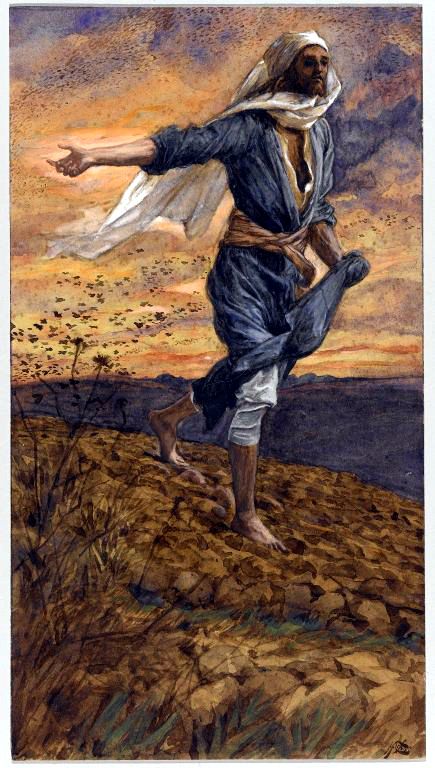
The Sower - Tissot

The Sower, 1886 – 1894, James Tissot, Brooklyn Museum, PD-Art-US

Holy as I Am Holy?

The Apostle Peter wrote in his first letter:

As obedient children, do not be conformed to the passions of your former ignorance, but as he who called you is holy, you also be holy in all your conduct, since it is written, “You shall be holy, for I am holy.” 1 Peter 1:14-16 English Standard Version (ESV)

John Calvin comments on these verses:

He who hath called you is holy – He reasons from the end for which we are called. God sets us apart as a peculiar people for himself; then we ought to be free from all pollutions

Calvin, stating the obvious, that we are not capable of being like God in holiness, nevertheless, points out:

…We ought daily to strive more and more. And we ought to remember that we are not only told what our duty is, but that God also adds, “I am he who sanctify you.”

The Calvin presses the point further:

It is added: in all manner of conversation, or, in your whole conduct. There is then no part of our life which is not to be redolent with this good odour of holiness…

You may currently stink at holy conduct. However, if you are in Christ and He is in you, then you must make great efforts to achieve or obtain it:

Strive for peace with everyone, and for the holiness without which no one will see the Lord. Hebrews 12:14 (ESV)

To this verse, Calvin comments with regard to those who profess Christ as Lord:

Follow peace, etc. – Men are so born that they all seem to shun peace; for all study their own interest, seek their own ways, and care not to accommodate themselves to the ways of others. Unless then we strenuously labor to follow peace, we shall never retain it; for many things will happen daily affording occasion for discords…

And, with regard to those outside of Christ, Calvin says:

As however peace cannot be maintained with the ungodly except on the condition of approving of their vices and wickedness, the Apostle immediately adds, that holiness is to be followed together with peace; as though he commended peace to us with this exception, that the friendship of the wicked is not to be allowed to defile or pollute us; for holiness has an especial regard to God…

Finally, Calvin adds:

He declares, that without holiness no man shall see the Lord; for with no other eyes shall we see God than those which have been renewed after his image.

As scripture teaches, we know everyone born from above practices right behavior.

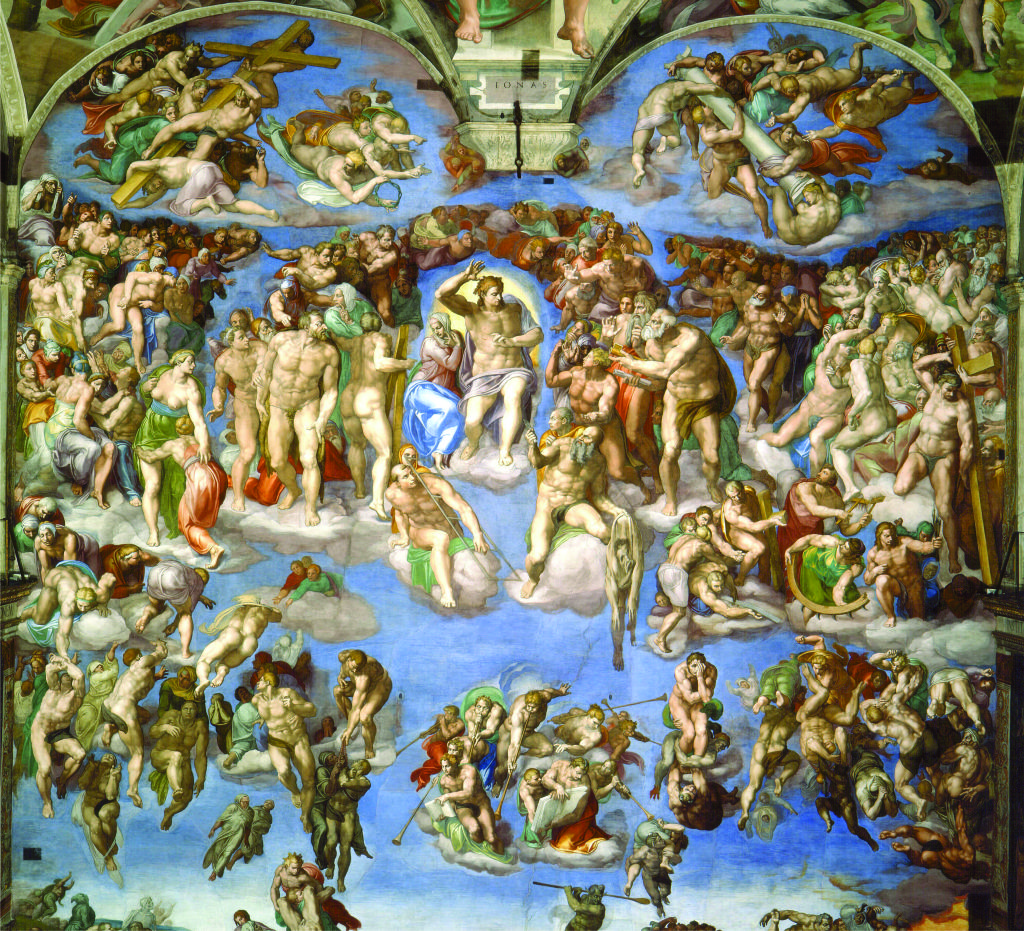
Last Judgment

Last Judgment, 1537 – 1541, Michelangelo and assistants, the Sistine Chapel in the Vatican, PD-Art-US

Can I be Certain of You?

In his comments on Philippians, chapter 1, verse 6:

And I am sure of this, that he who began a good work in you will bring it to completion at the day of Jesus Christ. Philippians 1:6 English Standard Version (ESV)

John Calvin says:

It is asked, however, whether anyone can be certain as to the salvation of others, for Paul here is not speaking of himself but of the Philippians. I answer, that the assurance which an individual has respecting his own salvation, is very different from what he has as to that of another. For the Spirit of God is a witness to me of my calling, as he is to each of the elect. As to others, we have no testimony, except from the outward efficacy of the Spirit; that is, in so far as the grace of God shews itself in them, so that we come to know it.

There is, therefore, a great difference, because the assurance of faith remains inwardly shut up, and does not extend itself to others. But wherever we see any such tokens of Divine election as can be perceived by us, we ought immediately to be stirred up to entertain good hope, both in order that we may not be envious towards our neighbors, and withhold from them an equitable and kind judgment of charity; and also, that we may be grateful to God. This, however, is a general rule both as to ourselves and as to others — that, distrusting our own strength, we depend entirely upon God alone [emphasis mine].

And what can we look for as tokens of Divine election? Scripture says we are to be clothed in His righteousness, in word and deed:

Put on then, as God’s chosen ones, holy and beloved, compassionate hearts, kindness, humility, meekness, and patience, bearing with one another and, if one has a complaint against another, forgiving each other; as the Lord has forgiven you, so you also must forgive. Colossians 3:12-13 (ESV)

Look for these things in yourselves first and then in others.

Tamme-Lauri oak. The oldest tree in Estonia

Tamme-Lauri oak. The oldest tree in Estonia, 3 September 2013, Abrget47j, Creative Commons Attribution-Share Alike 3.0 Unported