Thanksgiving – 2015

Last Year, we posted “The Real Meaning of Thanksgiving Day“.

This year we quote from President James Madison’s 1815 Thanksgiving proclamation:

No people ought to feel greater obligations to celebrate the goodness of the Great Disposer of Events and of the Destiny of Nations than the people of the United States.

His kind providence originally conducted them to one of the best portions of the dwelling place allotted for the great family of the human race. He protected and cherished them under all the difficulties and trials to which they were exposed in their early days.

Under His fostering care their habits, their sentiments, and their pursuits prepared them for a transition in due time to a state of independence and self-government. In the arduous struggle by which it was attained they were distinguished by multiplied tokens of His benign interposition…

And to the same Divine Author of Every Good and Perfect Gift we are indebted for all those privileges and advantages, religious as well as civil, which are so richly enjoyed in this favored land.

An early example of God’s kind providence for what has become the United States is the Patuxet native named Tisquantum, or Squanto. Eric Metaxas relates the miracle of Squanto’s life. The following is a Reader’s Digest version of Metaxas’s story:

Around 1608 an English crew captured a number of Patuxet warriors and sold them into slavery in Spain. One young man, Squanto, was bought by Catholic friars, who treated him well and freed him. Around 1612, Squanto stayed with John Slany in London and learned English customs and language. In 1618, Squanto returned home aboard a ship in return for his services as an interpreter.

After his 10 year journey, Squanto found that the Patuxets had perished from smallpox brought by European ships. Although he was spared from death through his kidnapping, he was not consoled. He tried living with an adjacent tribe but eventually lived alone in the woods.

In November of 1620, the Mayflower passengers, unable to reach Virginia, settled at Plymouth, the area where Squanto had grown up. They had come in search of religious freedom, hoping to found a colony based on Christian principles.

However, half of them died during the terrible winter. They must have wondered how the God they trusted and followed could lead them to these grim circumstances. They considered returning to Europe.

In the spring of 1621, Squanto walked out of the woods to greet them. He spoke perfect English, having lived in London more recently than did the settlers. He knew everything about how to survive in Plymouth; not only how to plant corn and squash, but how to find fish, lobsters, eels, and much else.

The Pilgrims adopted Squanto as their own and he lived with them. He helped broker a peace with the local tribes that lasted 50 years, a staggering accomplishment considering the troubles settlers would face later.

So the question is: Can all of this have been sheer happenstance, as most versions of the story would have us believe? The Pilgrims did not think so. To them, Squanto was a living answer to their tearful prayers, an outrageous miracle of God. Plymouth Colony Governor William Bradford declared in his journal that Squanto “became a special instrument sent of God” who didn’t leave them “till he died [in 1622].”

Perhaps our reflection on this historical truth can dispel our current distrust of the direction in which we see our country headed.

The Artisan Personality

More than forty percent of all men and women are artisan personalities. They are bold, empirical, do what works rather than what is socially acceptable, sensitive to what sounds good, always on the lookout for advantage and opportunity, perfecting their technique no matter the cost, and rolling with the punches.

Artisans are unplanned, undiplomatic, and cynical. They do not easily learn from errors and they impulsively abandon activities and relationships without regret. They are playmates as spouses, liberators as parents, and negotiators as leaders. Presidents Jackson, Reagan, and Clinton and Prime Minister Churchill possessed artisan personalities.

No doubt you know many that fit this description. The bully next door who works in a metal working plant, the smooth talking car sales rep who sold you your last car, or the audacious rescue coordinator being interviewed on national television who led a diverse team and saved thousands during a terrorist attack.

We mainly associate this personality with men. Bold and empirical rarely was applied to women. However, now-a-days, women like Ronda Rousey, Ashley Force Hood, or Carly Fiorina have stepped out into prominence in their fields.

This is one of the personalities that is especially important for writers to recognize and portray. David Keirsey’s book Please Understand Me is a useful reference for writers who want to fully flesh out their characters.

Keirsey says Hippocrates and Galen observed that there are four personality types. Later scientists refined their observations by identifying four distinctions within each type.

Keirsey defines the artisan personality as concrete in their word use and utilitarian in their tool use. Their language sounds good, it points to things seen or felt, it’s devoid of interpretation, and it incorporates slang and catchy turns of phrase.

Artisans fall into four subcategories, each containing approximately 10 percent of the population. Two are characterized as directive: the expressive promoter and the reserved crafter. The promoter is smooth, able to gain other’s confidence. The crafter is quiet, skillful at using equipment, and sometimes insubordinate.

The two other subtypes are informative: expressive performers and reserved composers. The performer is outgoing, skillful at handling an audience, and outwardly showing social concern while doing what they deem expedient. The composer skillfully blends what excites the five senses, whether music, art, or food.

Artisans are interested in anything requiring skillful practice. They will perfect their technique no matter the cost and employ whatever equipment necessary.

They live each day for maximum payoff. The past is water under the bridge. The future is far off so why plan. Wherever the action is that’s where they want to be. They seize the day but do not learn easily from errors.

They see themselves as artistic, taking pride in their performance; audacious, risking it all fearlessly; and adaptable, altering and shaping their behavior moment by moment according to circumstances in order to be effective.

They value excitement and are easily bored. Artisans are spontaneous, intense, and free; abandoning commitments without regret. They exert a strong presence in events for social impact, seek sensation to liven up dull times, and are impulsively extravagant gift givers. They are relentless in pursuit of artistic execution.

They are devoted to giving pleasure and excitement to mates. A friend but no more. They will leave if they feel trapped. Artisans encourage children to test the limits of their surroundings and do things on their own as early as possible. They easily spot the edge that gives them leverage over people and circumstances.

As we wrote in “Why Are There Four Gospel Accounts?,” an earlier blog posting, these traits describe some peoples’ predispositions. Their experiences can mold them, as far as they are willing and able, so that they acquire attributes of the other personality types. These attributes in sum could be said to be their overall dispositions.

If you are a writer, I heartily recommend reading Keirsey’s book for yourself. I created detailed outlines for my personal use. You may profit from the same effort. We’ll review Keirsey’s take on the Guardian, Idealist, and Rational personality types via several posts over the next few weeks.

Kardinal - Hybrid tea rose

Kardinal – Hybrid tea rose, Raised by R. Kordes, Germany. 1986 (reg.), 26 May 2013, Photo by Laitche, licensed under Creative Commons Attribution-Share Alike 4.0 International license.

Why Are There Four Gospel Accounts?

From an historical perspective, theologian Louis Berkhof explains that:

…Matthew wrote for the Jews and characterized Christ as the great King of the house of David. Mark composed his Gospel for the Romans and pictured the Savior as the mighty Worker, triumphing over sin and evil. Luke in writing his Gospel had in mind the needs of the Greeks and portrayed Christ as the perfect man, the universal Savior. And John, composing his Gospel for those who already had a saving knowledge of the Lord and stood in need of a more profound understanding of the essential character of Jesus, emphasized the divinity of Christ, the glory that was manifested in his works…

Recently, I ran across an interesting conjecture about this question while researching my next book. However, while it was compelling, I thought it best to test this conjecture against what Calvin penned about the four gospels in his Commentaries.

The first thing to notice is that Calvin values the Gospel of John differently from the synoptic gospels of Matthew, Mark, and Luke.

Concerning John’s Gospel in relation to the other three, Calvin says:

Yet there is also this difference between them, which the other three are more copious in their narrative of the life and death of Christ, but John dwells more largely on the doctrine by which the office of Christ, together with the power of his death and resurrection, is unfolded.

…And as all of them had the same object in view, to point out Christ, the three former exhibit his body, if we may be permitted to use the expression, but John exhibits his soul.

On this account, I am accustomed to say that this Gospel [i.e., John’s] is a key to open the door for understanding the rest; for whoever shall understand the power of Christ, as it is here strikingly portrayed, will afterwards read with advantage what the others relate about the Redeemer who was manifested.

About Mark’s gospel, Calvin says:

Mark is generally supposed to have been the private friend and disciple of Peter. It is even believed that he wrote the Gospel, as it was dictated to him by Peter, and thus merely performed the office of an amanuensis or clerk. But on this subject we need not give ourselves much trouble, for it is of little importance to us, provided only we believe that he is a properly qualified and divinely appointed witness, who committed nothing to writing, but as the Holy Spirit directed him and guided his pen.

Of Luke:

Luke asserts plainly enough that he is the person who attended Paul.

And of Matthew, Calvin says:

Matthew is sufficiently known [from the Gospel accounts].

Summing up for all three:

…For we will not say that the diversity which we perceive in the three Evangelists was the object of express arrangement, but as they intended to give an honest narrative of what they knew to be certain and undoubted, each followed that method which he reckoned best. Now as this did not happen by chance, but by the direction of Divine Providence, so under this diversity in the manner of writing the Holy Spirit suggested to them an astonishing harmony, which would almost be sufficient of itself to secure credit to them, if there were no other and stronger evidences to support their authority.

Note that John had intimate access with God and man and later in life, much knowledge and love.

Matthew (called Levi) was a Hebrew civil official collecting Roman taxes, despised by his countrymen, and was grateful to leave all behind.

Peter (and perhaps Mark) worked with his hands, was bold, impulsive, and spoke well  extemporaneously.

Luke was a physician who set out to document both the life of Jesus and the Acts of the Apostles meticulously.

The conclusion of the preceding exposition brings us to the source of the conjecture.

David Keirsey’s book Please Understand Me is a useful reference for writers who want to fully flesh out their characters.

He says Hippocrates and Galen observed that there are four personality types. Later scientists refined their observations by identifying four distinctions within each type. We’ll review Keirsey’s take on the four personality types via several posts over the next few weeks (possibly interspersed among other postings on different topics).

In the book’s notes section, Keirsey relates the four main personality types to the gospel writers:

Artisan (SP) — Bold, Works with Hands, Extemporaneous, Present Oriented — Peter (with amanuensis Mark)

Guardian (SJ) — Administrative, Works with Resources, Desires Respect, Past Oriented — Matthew

Rational (NT) — Reasoning, Works in Sciences, Seeks Knowledge, Period Oriented — Luke

Idealist (NF) — Empathetic, Works with People, Sagacious, Future Oriented — John

These are the Gospel author’s predispositions. Their experiences molded them, as far as they were willing and able, so that they acquired attributes of the other personality types. These attributes in total could be said to be their overall dispositions.

Although God may choose to relate to our predispositions through the Gospel writers, once He gets hold of us, He conforms us to His Son’s likeness as His sons and daughters.

None of the four writers seemed more transformed than Peter who, in his second letter to the churches, documents instruction for and prophesy of the future as his provision for the saints:

I think it right, as long as I am in this body, to stir you up by way of reminder, since I know that the putting off of my body will be soon, as our Lord Jesus Christ made clear to me. And I will make every effort so that after my departure you may be able at any time to recall these things. 2 Peter 1:13-15 English Standard Version (ESV)

Of course, the number “four” is a common theme throughout the bible.

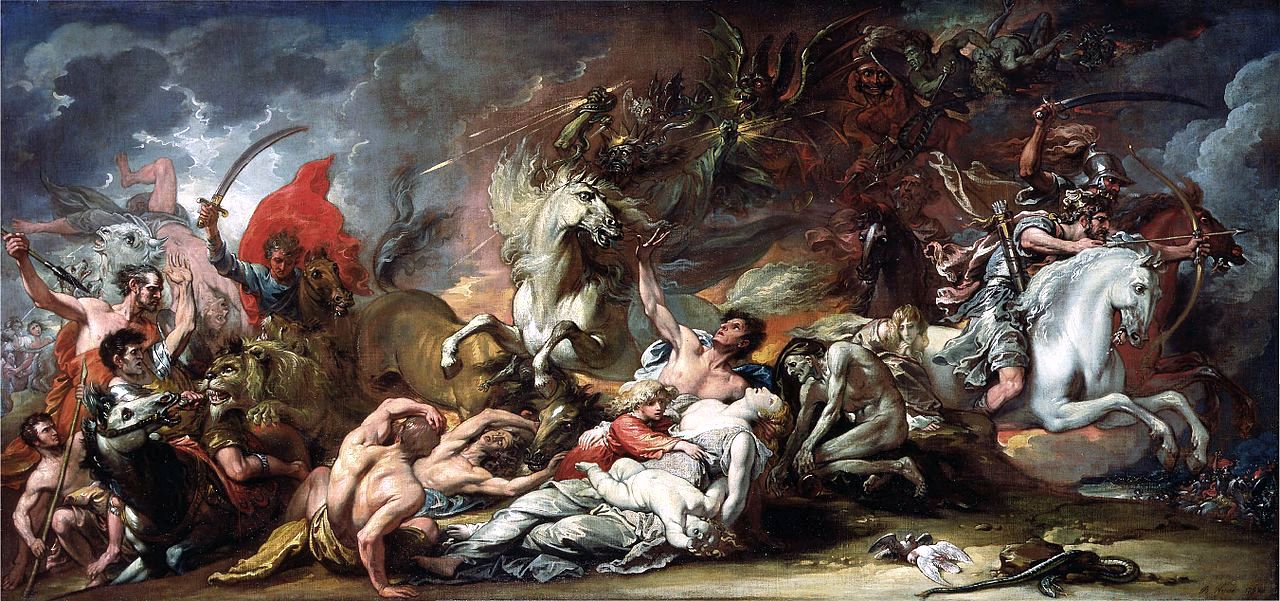
Four Horsemen of the Apocalype

Death on a Pale Horse is a version of the traditional subject, Four Horsemen of Revelation, 1796, Benjamin West (1738 – 1820), in the public domain in the US

Live Move Be

The words in the title of this week’s post are found in Oprah’s favorite bible verse:

She says these are words to live by. The verse in its entirety is:

For

   “‘In him we live and move and have our being’;[a]

as even some of your own poets have said,

   “‘For we are indeed his offspring.’”[b]

Footnotes: a. Probably from Epimenides of Crete; b. From Aratus’s poem “Phainomena”

Acts 17:28 English Standard Version (ESV)

Calvin comments:

For in him. …We have our being in him, inasmuch as by His Spirit he keeps us in life, and upholds us. For the power of the Spirit is spread abroad throughout all parts of the world, that it may preserve them in their state; that He may minister unto the heaven and earth that force and vigor which we see, and motion to all living creatures.

Then Calvin corrects a possible misinterpretation:

Not as brain-sick men do trifle, that all things are full of gods, yea, that stones are gods; but because God does, by the wonderful power and inspiration of His Spirit, preserve those things which He hath created of nothing…

He explains why the Apostle Paul would use such non-biblical sources:

Certain of your poets. [Paul] cites half a verse out of Aratus, not so much for authority’s sake, as that he may make the men of Athens ashamed; for such sayings of the poets came from no other fountain save only from nature and common reason.

Neither is it any marvel if Paul, who spoke unto men who were infidels and ignorant of true godliness, [did] use the testimony of a poet, wherein was [present] a confession of that knowledge which is naturally engraved in men’s minds…

Focusing on the meaning of the poetry itself, Calvin says:

…It may be that Aratus did imagine that there was some parcel of the divinity in men’s minds, as the [Manicheans] did say, that the souls of men are of the nature of God…

But this invention ought not to have hindered Paul from retaining a true maxim, though it were corrupt with men’s fables, that men are the generation of God, because by the excellency of nature they resemble some divine thing.

Finally, Calvin relates the poetical expressions to that which God explains throughout scripture:

This is that which the Scripture teaches, that we are created after the image and similitude of God, (Genesis 1:27.)

The same Scripture teaches also, in many places, that we be made the sons of God by faith and free adoption when we are engrafted into the body of Christ, and being regenerate by the Spirit, we begin to be new creatures, (Galatians 3:26.)

And certainly, God’s scriptures are words to live by.

The Shocking Concrete Abstract Universal

Flannery O’Connor meant to shock us by her storylines and imagery:

The novelist with Christian concerns will find in modern life distortions which are repugnant to him, and his problem will be to make these appear as distortions to an audience which is used to seeing them as natural; and he may well be forced to take ever more violent means to get his vision across to this hostile audience.

When you can assume that your audience holds the same beliefs you do, you can relax a little and use more normal ways of talking to it; when you have to assume that it does not, then you have to make your vision apparent by shock – to the hard of hearing you shout, and for the almost blind you draw large and startling figures.

Anyone who has read The Violent Bear It Away or Everything That Rises Must Converge would have to agree that O’Connor had the ability to shout and startle.

On a more philosophical note, she reflected on the imbalance between abstract and concrete knowledge of her day in her essay: ‘The Catholic Novelist in the Protestant South,’ p 858–9, Collected Works:

It takes a story of mythic dimensions; one which belongs to everybody; one in which everybody is able to recognize the hand of God and imagine its descent upon himself.

In the Protestant South the Scriptures fill this role. The ancient Hebrew genius for making the absolute concrete has conditioned the Southerner’s way of looking at things…

Our response to life is different if we have been taught only the definition of faith than if we have trembled with Abraham as he held the knife over Isaac.

I’d say it was God’s genius for making the absolute concrete; but who’s quibbling. To paraphrase O’Connor, the point is that the abstract is transformed into the concrete thereby making the universal accessible. That’s what God has done throughout the Scriptures. To illustrate, I cite two examples.

The intricate description of the ephod and breastpiece of judgement belonging to the High Priest’s garments culminates in Exodus, chapter 28, verses 29 and 30:

So Aaron shall bear the names of the sons of Israel in the breastpiece of judgment on his heart, when he goes into the Holy Place, to bring them to regular remembrance before the Lord. And in the breastpiece of judgment you shall put the Urim and the Thummim, and they shall be on Aaron’s heart, when he goes in before the Lord. Thus Aaron shall bear the judgment of the people of Israel on his heart before the Lord regularly. English Standard Version

If we have ears to hear it, all the concrete details of these garments portray the concern Aaron was to have for the people of Israel as he regularly bore their judgement on his heart while he brought them in remembrance before the Lord. We later learn, in the Letter to the Hebrews, that Aaron and his line are a shadow of the reality residing in the Lord Jesus Christ’s intercession for His own before the Father.

Another example of the abstract being made concrete is the bread and wine of communion. First, the Lord Jesus shocks the religious rulers of His day (and us, if we’re honest):

“I am the living bread that came down from heaven. If anyone eats of this bread, he will live forever. And the bread that I will give for the life of the world is my flesh.”

The Jews then disputed among themselves, saying, “How can this man give us his flesh to eat?”

So Jesus said to them, “Truly, truly, I say to you, unless you eat the flesh of the Son of Man and drink his blood, you have no life in you. Whoever feeds on my flesh and drinks my blood has eternal life, and I will raise him up on the last day.” John 6:51-54 (ESV)

Then in the Upper Room, the Lord inaugurates the commemoration of His death and resurrection:

And as they were eating, he took bread, and after blessing it broke it and gave it to them, and said, “Take; this is my body.” And he took a cup, and when he had given thanks he gave it to them, and they all drank of it. And he said to them, “This is my blood of the [new] covenant, which is poured out for many. Truly, I say to you, I will not drink again of the fruit of the vine until that day when I drink it new in the kingdom of God.” Mark 14:22-25 (ESV)

Finally, Paul explains its significance

For I received from the Lord what I also delivered to you, that the Lord Jesus on the night when he was betrayed took bread, and when he had given thanks, he broke it, and said, “This is my body which is for you. Do this in remembrance of me.” In the same way also he took the cup, after supper, saying, “This cup is the new covenant in my blood. Do this, as often as you drink it, in remembrance of me.” For as often as you eat this bread and drink the cup, you proclaim the Lord’s death until he comes. 1 Corinthians 11:23-26 (ESV)

Which brings us full circle back to John, chapter 6:

Jesus said to them, “I am the bread of life; whoever comes to me shall not hunger, and whoever believes in me shall never thirst.” John 6:35 (ESV)

Even the Prophet Isaiah said as much:

“Come, everyone who thirsts,

    come to the waters;

and he who has no money,

    come, buy and eat!

Come, buy wine and milk

    without money and without price.

Why do you spend your money for that which is not bread,

    and your labor for that which does not satisfy?

Listen diligently to me, and eat what is good,

    and delight yourselves in rich food.

Incline your ear, and come to me;

    hear, that your soul may live;

and I will make with you an everlasting covenant,

    my steadfast, sure love for David.

Isaiah 55:1-3 (ESV)

Indeed, come and eat.

High Priest's Garments

The High Priest Aaron, Illustration from Brockhaus and Efron Jewish Encyclopedia (1906—1913), Public Domain in the United States

Not Your Own

We often hear that faith must be personal. “My faith,” they say. People might tell us they’ve persevered through trials due to their faith. Were it to have failed, they would’ve been lost. But they had enough. At least that’s what they say. I don’t know about you, but I get the impression that they think this faith is their own, as if they produced it. As if it were due to strength of character or moral upbringing.

On the contrary, though we must hold faith individually:

And to the one who does not work but believes in him who justifies the ungodly, his faith is counted as righteousness. Romans 4:5 English Standard Version (ESV)

It is not our faith, it is a gift of God so that we might not boast about ourselves.

For by grace you have been saved through faith. And this is not your own doing; it is the gift of God, not a result of works, so that no one may boast. For we are his workmanship, created in Christ Jesus for good works, which God prepared beforehand, that we should walk in them. Ephesians 2:8-10 (ESV)

John Calvin comments on this verse:

For by grace are you saved. …God declares, that he owes us nothing; so that salvation is not a reward or recompense, but unmixed grace. The next question is, in what way do men receive that salvation which is offered to them by the hand of God? The answer is, by faith; and hence he concludes that nothing connected with it is our own…

Not of works. …Many persons restrict the word ‘gift’ to faith alone. But Paul is only repeating in other words the former sentiment. His meaning is, not that faith [only] is the gift of God, but that salvation [entirely] is given to us by God…

For we are his work. …The apostle affirms that we are God’s work, and that everything good in us is his creation; by which he means that the whole man is formed by his hand to be good. It is not the mere power of choosing aright, or some indescribable kind of preparation, or even assistance, but the right will itself, which is his workmanship; otherwise Paul’s argument would have no force.

Created to good works. …[Paul] says, that, before we were born, the good works were prepared by God; meaning, that in our own strength we are not able to lead a holy life, but only so far as we are formed and adapted by the hand of God. Now, if the grace of God came before our performances, all ground of boasting has been taken away…

To reiterate, faith is not a result of human will:

For he says to Moses, “I will have mercy on whom I have mercy, and I will have compassion on whom I have compassion.” So then it depends not on human will or exertion, but on God, who has mercy Romans 9:15-16 (ESV)

To this, Calvin comments:

It is not then of him who wills, etc. …That none of you may think that they who are elected are elected because they are deserving, or because they had in any way procured for themselves the favor of God, or, in short, because they had in them a particle of worthiness by which God might be moved, take simply this view of the matter, that it is neither by our will nor efforts…that we are counted among the elect, but that it wholly depends on the divine goodness, which of itself chooses those who neither will, nor strive, nor even think of such a thing… [Emphasis mine]

Therefore faith is not subjective. It is not of ourselves so that we may not boast. Just like the scriptures, faith is not a matter of one’s own opinion.

***

Now, if we accept that faith is not of ourselves, we who profess faith must also realize that we, ourselves, are not our own, either.

Or do you not know that your body is a temple of the Holy Spirit within you, whom you have from God? You are not your own, for you were bought with a price. So glorify God in your body. 1 Corinthians 6:19-20 (ESV)

77s – The 77’s – Bottom Line,   Uploaded to YouTube on Apr 6, 2008, posted by Neamberthal, Lyrics

Unless – a Conjunction

While doing research for a previous blog post, I noticed that John’s Gospel quotes the Lord Jesus several times using the word: unless.

Unless is interesting because it is a logic term.

Unless

/ənˈles/

conjunction

Except if (used to introduce a case in which a statement being made is not true or valid).

“Unless you have a photographic memory, repetition is vital”

Speaking English – How to Use “Unless,” July 10, 2013, Learn English with Rebecca [engVid RebeccaESL]

The Lord Jesus Christ used this conjunction to lead those who heard Him into God’s Kingdom.

Unless it is granted him by the Father, no one can come to me John 6:64-66 English Standard Version (ESV)

Unless the Father who sent me draws him, no one can come to me John 6:43-45 (ESV)

Unless one is born again he cannot see the kingdom of God John 3:2-3 (ESV)

Unless one is born of water and the Spirit, he cannot enter the kingdom of God John 3:4-6 (ESV)

Unless you believe that I am He you will die in your sins John 8:23-25 (ESV)

To sum up, unless God the Father grants it and draws us we cannot come to the Lord Jesus. Unless one is born again, of water and the Spirit, we can neither see nor enter God’s Kingdom. And unless we believe that the Lord Jesus Christ is the God who saves, we will die condemned to eternal punishment.

The Rebellion

Most of us would like to know beforehand when a disaster will occur. Many, to avoid the consequences, but some, to profit from them. If only those who boarded the planes knew that fateful September morning what was about to happen.

In the same way, we’d all like to know when the world will end. Many pretend that it will go on just as it has for millennia. Some think differently. A few believe the scriptures when they speak of the last day:

Let no one deceive you in any way. For that day will not come, unless the rebellion comes first, and the man of lawlessness is revealed, the son of destruction, who opposes and exalts himself against every so-called god or object of worship, so that he takes his seat in the temple of God, proclaiming himself to be God. 2 Thessalonians 2:3-4 English Standard Version (ESV)

So there are signs of the end. But, what would these things look like? John Calvin comments on this passage:

Paul, …foretells that, after [those in the visible church] have had foreign enemies for some time molesting them, they will have more evils to endure from enemies [within the church], inasmuch as many of those that have made a profession of attachment to Christ would be hurried away into base treachery, and inasmuch as the temple of God itself would be polluted by sacrilegious tyranny, so that Christ’s greatest enemy would exercise dominion there.

Relative to Antichrist’s pernicious arrogation of deity, Calvin says:

Scripture declares that God is the alone Lawgiver (James 4:12) who is able to save and to destroy; the alone King, whose office it is to govern souls by His word. [Scripture] represents Him as the author of all sacred rites; it teaches that righteousness and salvation are to be sought from Christ alone; and it assigns, at the same time, the manner and means.

And concerning the history of the visible church, Calvin says:

My readers now understand, that all the sects by which the Church has been lessened from the beginning, have been so many streams of revolt which began to draw away the water from the right course, but that the sect of Mahomet was like a violent bursting forth of water, that took away about the half of the Church by its violence. It remained, also, that Antichrist should infect the remaining part with his poison. Thus, we see with our own eyes, that this memorable prediction of Paul has been confirmed by the event.

So, are we able discern the fruition of these things in time to flee the consequences? The Lord Jesus Christ warned:

“But concerning that day and hour no one knows, not even the angels of heaven, nor the Son, but the Father only. For as were the days of Noah, so will be the coming of the Son of Man. For as in those days before the flood they were eating and drinking, marrying and giving in marriage, until the day when Noah entered the ark, and they were unaware until the flood came and swept them all away, so will be the coming of the Son of Man. Matthew 24:36-39 (ESV)

Calvin comments on this passage:

So now Christ declares that the last age of the world will be in a state of [senseless] indifference, so that men will think of nothing but the present life, and will extend their cares to a long period, pursuing their ordinary course of life, as if the world were always to remain in the same condition… [Emphasis mine]

Though the report of the last judgment is now widely circulated, and though there are a few persons who have been taught by God to perceive that Christ will come as a Judge in due time, yet it is proper that those persons should be aroused by this extraordinary kindness of God, and that their senses should be sharpened, lest they give themselves up to the indifference which so generally prevails.

Therefore, if you haven’t yet, we urge you to repent while there is still time.

***

Speaking of our collective indifference, The Federalist has summarized the recent Planned Parent video expose’. Item number 7 describes the Carly Fiorina video. No, I did NOT watch.

In the same vein, I don’t often agree with Mr. O’Reilly, but when I do, I offer you this video:

Is America Becoming Barbaric? Fox News, July 28, 2015

Gullible

Many think that those who follow Christ are hopelessly ignorant and gullible. They’ll believe anything.

I was reminded of how gullible I am by this video. It purports to show an F-35B Lightning II Marine Corps fighter takeoff, falter, and make a remarkable recovery to flight from a ship at sea.

F-35 Unintended loop right off the carrier deck during vertical take-off, December 15, 2009

Is it real? It sure looks real on the surface. But the answer is no; it’s a doctored frame sequence from a video game. Once you see how the F–35B actually takes off and lands, you’ll note many obvious discrepancies.

Are those who follow Christ gulled into believing? Are they rubes unworthy of being taken seriously? Are they insufferable? When you see what’s involved in true belief, you’ll note the impossibility of it.

We’ll take the Lord Jesus Christ’s testimony as evidence. Speaking in His own defense before the Council of Elders at Jerusalem, they ask if He is the Messiah and He responds to them:

“If you are the Christ, tell us.” But he said to them, “If I tell you, you will not believe” Luke 22:67 English Standard Version (ESV)

Their refusal to believe was ordained. John explains this clearly in his gospel account. After Christ’s triumphal entry into Jerusalem and His performance of many attesting signs, when the people still did not believe in Him, John tells us:

So that the word spoken by the prophet Isaiah might be fulfilled:

“Lord, who has believed what he heard from us,

   and to whom has the arm of the Lord been revealed?”

Therefore they could not believe. For again Isaiah said,

“He has blinded their eyes

   and hardened their heart,

lest they see with their eyes,

   and understand with their heart, and turn,

   and I would heal them.”

John 12:38-40 (ESV)

The Lord Jesus picked up on this theme when He told the parable of the Rich Man and Lazarus to His disciples, the Pharisees, scribes, tax collectors, and sinners [a derogatory term the religious elite used for commoners as if they were not the same].

And [the rich man] said, ‘No, father Abraham, but if someone goes to them from the dead, they will repent.’ He said to him, ‘If they do not hear Moses and the Prophets, neither will they be convinced if someone should rise from the dead.’” Luke 16:30-31 (ESV)

From elsewhere in scripture we know that Moses and the Prophets spoke of Him. I always imagine he delivered this punch line to the parable with dramatic irony.

While speaking with His disciples about the difficulty of entering the Kingdom of God, His disciples questioned Him:

And they were exceedingly astonished, and said to him, “Then who can be saved?” Jesus looked at them and said, “With man it is impossible, but not with God. For all things are possible with God.” Mark 10:26-27 (ESV)

So, by His own admission, entering into belief is impossible for humankind on their own. The Apostle Paul reiterates and expands on this truth:

For He says to Moses, “I will have mercy on whom I have mercy, and I will have compassion on whom I have compassion.” So then it depends not on human will or exertion, but on God, who has mercy. Romans 9:15-16 (ESV)

So belief is a gift of a merciful God to individuals, not something we can adopt like a political party affiliation or can attain like elected office.

But we may be assured that:

Whoever believes in the Son has eternal life; whoever does not obey the Son shall not see life, but the wrath of God remains on him. John 3:36 (ESV)

And we know that this gift is certain:

For the Scripture says, “Everyone who believes in him will not be put to shame.” Romans 10:11 (ESV)

Please, believe in Him.

The Sky Is Falling

No, really, it is. And the bottom is dropping out too. At least that’s what Margaret Atwood says.

In her article for Medium: “It’s Not Climate Change; It’s Everything Change,” Atwood describes three possible outcomes for mankind’s response to climate change. The following is an excerpt from picture 2, her most dismal:

…It will quickly become apparent that the present world population of six and a half billion people is not only dependent on oil, but was created by it: humanity has expanded to fill the space made possible to it by oil, and without that oil it would shrink with astounding rapidity. As for the costs to “the economy,” there won’t be any “economy.” Money will vanish: the only items of exchange will be food, water, and most likely — before everyone topples over — sex…

Contrary to Atwood’s views, we’ve urged responsible action to avert disaster:

…We should reconsider our approaches [toward climate change] for the sake of the next generation…

We’ve got to stop trying to oppress and coerce one another because we think we know what’s best for everyone else. Change over time is possible if we’re willing to cast off the hard sell, and adapt.

But climate change isn’t humanity’s most pressing problem. Nor is it our biggest problem, yours and mine, individually.

In John Calvin’s Institutes of the Christian Religion, chapter 17: “Use to be Made of the Doctrine of Providence,” he portrays the predicament of man living apart from God’s care under the dominion of chance:

Innumerable are the ills which beset human life, and present death in as many different forms. Not to go beyond ourselves, since the body is a receptacle, nay the nurse, of a thousand diseases, a man cannot move without carrying along with him many forms of destruction. His life is in a manner interwoven with death.

For what else can be said where heat and cold bring equal danger? Then, in what direction so ever you turn, all surrounding objects not only may do harm, but almost openly threaten and seem to present immediate death.

After giving many particulars through which we are exposed to harm, he says:

Amid these perils, must not man be very miserable, as one who, more dead than alive, with difficulty draws an anxious and feeble breath, just as if a drawn sword were constantly suspended over his neck?

It may be said that these things happen seldom, at least not always, or to all, certainly never all at once. I admit it; but since we are reminded by the example of others, that they may also happen to us, and that our life is not an exception any more than theirs, it is impossible not to fear and dread as if they were to befall us…

But, it is not so for the one who casts his lot with the Lord Jesus Christ, Calvin says:

…But when once the light of Divine Providence has illumined the believer’s soul, he is relieved and set free, not only from the extreme fear and anxiety which formerly oppressed him, but from all care. For as he justly shudders at the idea of chance, so he can confidently commit himself to God [Who actively protects him]…

The great American preacher, Jonathan Edwards, said that there is no security apart from Christ’s redeeming sacrifice. He said:

“There is nothing that keeps wicked men at any one moment out of hell, but the mere pleasure of God.”

Therefore, if you have not already, I urge you:

“Believe in the Lord Jesus, and you will be saved, you and your household.”

Sinners In The Hands Of An Angry God,” sermon reenacted by Ralph Green, October 30, 2012, Cloverhill4’s channel