Assurance

After I was saved from the death penalty that hangs over us all, I memorized a different translation of this verse very early on:

For God is not unjust so as to overlook your work and the love that you have shown for his name in serving the saints, as you still do. And we desire each one of you to show the same earnestness to have the full assurance of hope until the end, so that you may not be sluggish, but imitators of those who through faith and patience inherit the promises. Hebrews 6:10-12 English Standard Version (ESV)

This is a key verse of assurance. Self-sacrifice in service to our brothers and sisters is both a marker and builder of our confidence in His promise of eternal life. And that service is not directed only to those professing faith, but those especially; while not forgetting our duty for service to all.

Every day shows us how futile this world is. Our faithful actions can show us to have a different destiny.

What does Calvin say about the passage here and here?

For God is not unrighteous, etc. These words signify as much as though he had said, that from good beginnings he hoped for a good end.

But here a difficulty arises, because he seems to say that God is bound by the services of men: “I am persuaded,” he says, “as to your salvation, because God cannot forget your works.” He seems thus to build salvation on works, and to make God a debtor to them…

…God does not pay us a debt, but performs what he has of himself freely promised, and thus performs it, inasmuch as he pardons us and our works; nay, he looks not so much on our works as on his own grace in our works. It is on this account that he forgets not our works, because he recognizes himself and the work of his Spirit in them…

…God is righteous in recompensing works, because he is true and faithful: and he has made himself a debtor to us, not by receiving anything from us; but as Augustine says, by freely promising all things.

And labor of love, etc. By this he intimates that we are not to spare labor, if we desire to perform duty towards our neighbors; for they are not only to be helped by money, but also by counsel, by labor, and in various other ways. Great [diligence], then, must be exercised, many troubles must be undergone, and sometimes many dangers must be encountered. Thus let him who would engage in the duties of love, prepare himself for a life of labor…

By saying that they had ministered and were still ministering, he commended their perseverance; which in this particular was very necessary; for there is nothing to which we are more prone than to weariness in well doing. Hence it is, that though many are found ready enough to help their brethren, yet the virtue of constancy is so rare, that a large portion soon relax as though their warmth had cooled.

But what ought constantly to stimulate us is even this one expression used by the apostle, that the love shown to the saints is shown towards the name of the Lord; for he intimates that God holds himself indebted to us for whatever good we do to our neighbors, according to that saying,

“What you have done to one of the least of these, you have done to me,” (Matthew 25:40)

and there is also another,

“He that gives to the poor lends to the Lord.” (Proverbs 19:17).

And we desire, etc…“You have made,” he says, “your love evident by many acts of kindness; it remains, however, that your faith should correspond with it; you have [diligently] labored not to be wanting in your duties to men; but with no less earnestness it behooves you to make progress in faith, so as to manifest before God its unwavering and full certainty.”

Now, by these words the Apostle shows that there are two parts in Christianity which correspond with the two tables of the Law…Let us then remember, that the life of a Christian is not complete in all its parts, unless we attend to faith as well as to love.

To the full assurance of hope, or, to the certainty of hope, etc. As they who professed the Christian faith were distracted by various opinions, or were as yet entangled in many superstitions, he bids them to be so fixed in firm faith, as no longer to vacillate nor be driven here and there, suspended between alternate winds of doubts. This injunction is, however, applicable to all; for, as the truth of God is unchangeably fixed, so faith, which relies on him, when it is true, ought to be certain, surmounting every doubt. It is a full assurance, πληροφορία, an undoubting persuasion, when the godly mind settles it with itself, [which] it is not right to call in question what God, who cannot deceive or lie, has spoken…

But followers, or imitators, etc. To sloth he opposes imitation; it is then the same thing as though he said, that there was need of constant alacrity of mind; but it had far more weight, when he reminded them, that the fathers were not made partakers of the promises except through the unconquerable firmness of faith; for examples convey to us a more impressive idea of things…

Faith and patience, etc. What is meant is, a firm faith, which has patience as its companion. For faith is what is, chiefly required; but as many who make at first a marvelous display of faith, soon fail, he shows that the true evidence of that faith which is not fleeting and evanescent, is endurance. By saying that the promises were obtained by faith, he takes away the notion of merits; and still more clearly by saying that they came by “inheritance”; for we are in no other way made heirs but by the right of adoption.

Beautiful Scandalous Night from Flap Your Wings by The Choir

The Upper Hand – Bernhardt Writer

Some people always have to have the upper hand. My father was one of those people. He would do whatever it took to gain an advantage over those he met. He would be proper, humble, a terror, or a fool if it would give him power and control over others. Fundamentally, he both disrespected and feared them at the same time. He was an expert at what he did and I was a rebellious teen who rejected his ways (by God’s grace).

Such recollections remind me of the scripture:

And in his teaching he said, “Beware of the scribes, who like to walk around in long robes and like greetings in the marketplaces and have the best seats in the synagogues and the places of honor at feasts, who devour widows’ houses and for a pretense make long prayers. They will receive the greater condemnation.” Mark 12:38-40 English Standard Version (ESV)

These prominent men displayed unwarranted pride and feigned humility as a cover for their real motive: greed. Further, we have:

But understand this: that in the last days there will come times of difficulty. For people will be lovers of self, lovers of money, proud, arrogant, abusive, disobedient to their parents, ungrateful, unholy, heartless, unappeasable, slanderous, without self-control, brutal, not loving good, treacherous, reckless, swollen with conceit, lovers of pleasure rather than lovers of God, having the appearance of godliness, but denying its power. Avoid such people. 2 Timothy 3:1-5 (ESV)

My father was such a one. He said he took communion because he was merely hungry:

But they will not get very far, for their folly will be plain to all… 2 Timothy 3:9 (ESV)

It saddens me, even today, that he did not repent while he had the chance. But such things should not characterize our behavior:

But let none of you suffer as a murderer or a thief or an evildoer or as a meddler. 1 Peter 4:15 (ESV)

In a note to this verse, the New American Standard translation renders meddler literally as: one who oversees others’ affairs. NAS adds troublesome to modify the noun in case we would misinterpret it. It’s the attitude, so prevalent today, of: “I know better than you,” put into action.

This should not be our way. Instead:

Do not love the world or the things in the world. If anyone loves the world, the love of the Father is not in him. For all that is in the world—the desires of the flesh and the desires of the eyes and pride of life—is not from the Father but is from the world. And the world is passing away along with its desires, but whoever does the will of God abides forever. 1 John 2:15-17 (ESV)

Even further:

When he had washed their feet and put on his outer garments and resumed his place, he said to them, “Do you understand what I have done to you? You call me Teacher and Lord, and you are right, for so I am. If I then, your Lord and Teacher, have washed your feet, you also ought to wash one another’s feet. For I have given you an example, that you also should do just as I have done to you. Truly, truly, I say to you, a servant is not greater than his master, nor is a messenger greater than the one who sent him. If you know these things, blessed are you if you do them. John 13:12-17 (ESV) [emphasis added]

I’ve always heard the Lord Jesus’s statement in John 13:8:

“If I do not wash you, you have no share with me,”

as a rebuke to Peter’s:

“You shall never wash my feet.”

But what if it were a plea?

Listening to good doctrine (as important as we think that is) is not enough to soften our hard hearts toward others. Or as one of our poets wrote: “I need love…to melt the frozen sea inside me.”

‘I Need Love’ by Sam Phillips – performed by Sixpence None the Richer (with lyrics)

But, exhibiting genuine humility in all circumstances that proceeds from a changed, crushed, and submissive heart may just be our duty.

Salvation

There is much confusion about this concept nowadays. There needn’t be. Scripture is clear:

“And there is salvation in no one else, for there is no other name under heaven given among men by which we must be saved.” Acts 4:12 English Standard Version (ESV)

Calvin says:

Neither is there salvation in any other. …And assuredly Christ had showed this one token of his grace, to the end [that] he might be known to be the only author of life. We must consider this in all the benefits of God, to wit, that he is the fountain of salvation. And he meant to prick and sting the priests with this sentence, when as he says that there is salvation in none other save only in Christ, whom they went about to put quite out of remembrance.

As if he should say, that they are twice damned who did not only refuse the salvation offered them by God, but endeavor to bring the same to naught, and did take from all the people the fruit and use thereof. Although he seems to speak unto deaf men, yet he preaches of the grace of Christ, if [perhaps] some can abide to hear; [and] if not, that they may at least be deprived of all excuse by this testimony.

Neither is there any other name…Salvation (says he) is in Christ alone, because God has decreed that it should be so. For by name he means the cause or means, as if he should have said, forasmuch as salvation is in God’s power only, he will not have the same to be common to us by any other means than if we ask it of Christ alone.

Whereas he says under heaven…I do rather think that this was added, because men cannot ascend into heaven, that they may come unto God. Therefore, seeing we are so far from the kingdom of God, it is needful that God does not only invite us unto himself, but that reaching out his hand he offer salvation unto us, that we may enjoy the same.

Peter teaches in this [passage], that he has done that in Christ, because he came down into the earth for this cause, that he might bring salvation with him. Neither is that contrary to this doctrine, that Christ is ascended above all heavens, (Ephesians 4:10). For he took upon him our flesh once for this cause, that he might be a continual pledge of our adoption. He has reconciled the Father to us forever by the sacrifice of his death: by his resurrection he has purchased for us eternal life.

And he is present with us now also, that he may make us partakers of the fruit of eternal redemption; but the revealing of salvation is handled in this [passage], and we know that the same was so revealed in Christ, that we need not any longer to say, “Who shall ascend into heaven?” (Romans 10:6).

And if this doctrine were deeply imprinted in the minds of all men, then should so many controversies concerning the causes of salvation be soon at an end, wherewith the Church is so much troubled…

The Visual Bible – Acts Chapter 4

No Rest

We are now planning Mandated Memoranda Publishing’s next novel: Who Shall Be God. We have characters, certain scenes, and even a cover image in mind already. We’re investigating background materials for the theme of the novel. Since it deals with political conflict reflected through two families, we’re reading The Fourth Revolution by John Micklethwait and Adrian Wooldridge and Alien Powers by Kenneth Minogue. However, we always have a biblical theme in mind too.

The scripture: Isaiah 57 jumped out at us based on our reading of The Art of Dramatic Writing by L. Egri. Here are the pertinent parts:

The righteous man perishes,

    and no one lays it to heart;

devout men are taken away,

    while no one understands.

For the righteous man is taken away from calamity;

    he enters into peace;

they rest in their beds

    who walk in their uprightness.

Isaiah 57:1-2 English Standard Version (ESV)

But the wicked are like the tossing sea;

    for it cannot be quiet,

    and its waters toss up mire and dirt.

There is no peace,” says my God, “for the wicked.”

Isaiah 57:20-21 (ESV)

We commonly know the last verse (repeated elsewhere in Isaiah 48:22, 57:20, 57:21) as the phrase:

“No rest for the wicked [or weary]”.

As we always do, let’s consult Calvin to get his take on Isaiah’s verses:

The righteous man hath perished…And no man layeth it to heart. …The Lord holds out as a mirror this event of his providence, more remarkable than all others, that he takes away good and worthy men out of this life, when he determines to chastise his people severely. But no man considers it, or reflects that it is a token of approaching destruction, that God gathers them, and places them in safety from being distressed by prevailing afflictions.

…The general meaning is, that wicked men grievously deceive themselves by supposing that there is no greater happiness than to have life continued to a great age, and by thus pluming themselves on their superiority to the servants of God, who die early. Being attached to the world, they likewise harden themselves by this pretense that, by nothing else than a manifestation of God’s favor towards them, while others die, they continue to be safe and sound…

Men of mercy are gathered. …But, since God, in many passages of Scripture, represents gentleness and kindness as a distinguishing mark of his children, this may be, as I have said, a definition of true righteousness.

Hence we see that the Lord, at that time, gathered many good men, whose death portended some dreadful calamity, and yet that the Jews [the Prophet’s proximate audience] paid no regard to such forewarnings, and even proceeded to more daring lengths of wickedness; for they thought that all went well with them, when they were the survivors of many excellent men.

Peace shall come. The Prophet describes what shall be the condition of believers in death; for the wicked, who think that there is no life but the present, imagine that good men have perished; because in death they see nothing but ruin. For this reason he says that “Peace shall come,” which is more desirable than a thousand lives full of trouble; as if he compared them to discharged soldiers, who are and allowed to enjoy case and quietness.

They shall rest in their beds. He adds the metaphor of sleep, in order to show that they shall be absolutely free from all the uneasiness of cares, just as if they were safely pleasantly asleep “on their beds.”

Whosoever walketh before him. …as if he had said, “Whosoever walketh before God shall enjoy peace.” Thus, when righteous men die, and their various labors are finished, and their course is ended, they are called to peace and repose. They “rest in their beds,” because they do not yet enjoy perfect blessedness and glory; but they wail; for the last day of the resurrection, when everything shall be perfectly restored; and that, I think, is what Isaiah meant.

By these comments, Calvin seems to echo Revelation 18:4.

Then I heard another voice from heaven saying,

“Come out of her, my people,

lest you take part in her sins,

lest you share in her plagues;”

Revelation 18:4 (ESV)

As for Isaiah’s second couplet, Calvin says:

But the wicked. …But because the reprobate make false pretensions to the name of God, and vainly glory in it, the Prophet shows that there is no reason why they should flatter themselves, or advance any claim, on the ground of this promise, since they can have no share in this peace. Nor will it avail them anything, that God, having compassion upon his people, receives them into favor, and commands peace to be proclaimed to them.

As the troubled sea. That metaphor of “the sea” is elegant and very well fitted to describe the uneasiness of the wicked; for of itself “the sea is troubled.” …Most appropriately, therefore, has the Prophet compared them to a stormy and troubled sea. Whoever then wishes to avoid these alarms and this frightful agony of heart, let him not reject that peace which the Lord offers to him. There can be no middle course between them; for, if you do not lay aside sinful desires and accept of this peace, you must unavoidably be miserably distressed and tormented.

There is no peace to the wicked. He confirms the preceding statement, namely, that in vain shall the reprobate endeavor to seek peace, for everywhere they will meet with war. It is God who threatens war, and therefore there can be no hope of “peace.” Wicked men would indeed wish to enjoy peace, and ardently long for it; for there is nothing which they more eagerly desire than to be at ease, and to lull their consciences, that they may freely take their pleasures and indulge in their vices.

They drive away all thoughts about the judgment of God, and endeavor to stupefy themselves and to repose in indolence, and think that these are the best ways and methods of obtaining peace. But they never shall enjoy it; for, until men have been reconciled to God, conscience will never cease to annoy and carry on war with them.

Saith my God. Thus he represents God as the only author of peace, that he may, by this dreadful threatening, tear from the Jews their dearest pleasures; and calls him “his God,” in opposition to the vain boasting of those who falsely boasted of his name; for they cannot acknowledge God, so long as they reject his Prophet and his doctrine. For this reason the Prophet boldly declares that he has received a command from God to declare perpetual war against them.

There is no rest for the wicked; no rest now or in eternity. Turn away from evil ways and do good.

Triumph of Death, 1562, Pieter Breughel the Elder

Triumph of Death, 1562, Pieter Breughel the Elder (1526/1530–1569), Museo del Prado, Madrid, Public Domain

Judgment and Condemnation

I was speaking with someone at church a few weeks back and we both wondered what 2 Corinthians 5:10 meant:

For we must all appear before the judgment seat of Christ, so that each one may receive what is due for what he has done in the body, whether good or evil. 2 Corinthians 5:10 English Standard Version (ESV)

Are believers judged? Rather than guess, I offered to look into it. Here’s what I found Calvin had to say:

We must be manifested. Though this is common to all, yet all without distinction do not raise their views in such a way as to consider every moment, that they must appear before the judgment-seat of Christ…For then the books, which are now shut, will be opened (Daniel 7:10).

That every one may give account. As the passage relates to the recompensing of deeds, we must notice briefly, that, as evil deeds are punished by God, so also good deeds are rewarded, but for a different reason; for evil deeds are requited with the punishment that they deserve, but God in rewarding good deeds does not look to merit or worthiness.

For no work is so full and complete in all its parts as to be deservedly well-pleasing to him, and farther, there is no one whose works are in themselves well-pleasing to God, unless he render satisfaction to the whole law. Now no one is found to be thus perfect. Hence the only resource is in his accepting us through unmerited goodness, and justifying us, by not imputing to us our sins.

After he has received us into favor, he receives our works also by a gracious acceptance. It is on this that the reward hinges. There is, therefore, no inconsistency in saying, that he rewards good works, provided we understand that mankind, nevertheless, obtain eternal life gratuitously…

So, here, I think we have half the explanation. All humankind is judged for the good and bad that they’ve done in this life. Any good we can do is only good insofar as God does not count our sins against us. This is only possible through faith in Christ’s saving work on the cross. And that, too, is freely given by Him alone to those who do not merit it.

But what of the condemnation due for the bad that we do? The scriptures say:

Truly, truly, I say to you, whoever hears my word and believes him who sent me has eternal life. He does not come into judgment, but has passed from death to life. John 5:24 (ESV)

Calvin says about this verse:

He that heareth my word. Here is described the way and manner of honoring God, that no one may think that it consists solely in any outward performance, or in frivolous ceremonies. …But here Christ demands from us no other honor than to obey his Gospel…

Hath eternal life. By these words he likewise commends the fruit of obedience, that we may be more willing to render it…

And shall not come into condemnation. There is here an implied contrast between the guilt to which we are all naturally liable, and the unconditional acquittal which we obtain through Christ; for if all were not liable to condemnation, what purpose would it serve to free from it those who believe in Christ?

The meaning therefore is, that we are beyond the danger of death, because we are acquitted through the grace of Christ; and, therefore, though Christ sanctifies and regenerates us, by his Spirit, to newness of life, yet here he specially mentions the unconditional forgiveness of sins, in which alone the happiness of men consists. For then does a man begin to live when he has God reconciled to him; and how would God love us, if he did not pardon our sins?

…Though life be only begun in us, Christ declares that believers are so certain of obtaining it, that they ought not to fear death; and we need not wonder at this, since they are united to him who is the inexhaustible fountain of life.

But what shall we do with such confidence? I suggest, with Calvin, that we cast off fear and live a life worthy of our gracious God’s gift.

The Last Judgment, Martin, 1853

The Last Judgment, 1853, John Martin (1789-1854), Tate Britain, Public Domain in US

How They Love One Another

Lately, I’ve been struck by the distance between my actions and my words. Maybe you have, too? It’s cliché to consider resolutions this time of year. However, resolutions that we set for ourselves are sure to fail. Ask God, with me, that our actions and words align this year. In that spirit, let us consider:

A new commandment I give to you, that you love one another: just as I have loved you, you also are to love one another. By this all people will know that you are my disciples, if you have love for one another.” John 13:34-35 English Standard Version (ESV)

So we do not go far astray, let’s see what Calvin has to say about the verse:

A new commandment I give you. …In order to impress more deeply, therefore, on the minds of his disciples the doctrine of brotherly love, Christ recommends it on the ground of novelty; as if he had said, “I wish you continually to remember this commandment, as if it had been a law but lately made.”

…And how necessary this admonition was, we learn by daily experience; for, since it is difficult to maintain brotherly love, men lay it aside, and contrive, for themselves, new methods of worshipping God, and Satan suggests many things for the purpose of occupying their attention. Thus, by idle employments, they in vain attempt to mock God, but they deceive themselves.

By not following Christ’s command, it’s as if we seek to worship Him in ways not commanded.

That you love one another. Brotherly love is, indeed, extended to strangers, for we are all of the same flesh, and are all created after the image of God; but because the image of God shines more brightly in those who have been regenerated, it is proper that the bond of love, among the disciples of Christ, should be far more close.

In God brotherly love seeks its cause, from him it has its root, and to him it is directed. Thus, in proportion as it perceives any man to be a child of God, it embraces him with the greater warmth and affection.

Besides, the mutual exercise of love cannot exist but in those who are guided by the same Spirit. It is the highest degree of brotherly love, therefore, that is here described by Christ; but we ought to believe, on the other hand, that, as the goodness of God extends to the whole world, so we ought to love all, even those who hate us.

The love we owe the brethren will spill over to even those who oppose our beliefs and conduct.

As I have loved you. He holds out his own example, not because we can reach it, for we are at a vast distance behind him, but that we may, at least, aim at the same end.

By this all men will know. Christ again confirms what he had formerly said, that they who mutually love one another have not been in vain taught in his school; as if he had said, “Not only will you know that you are my disciples, but your profession will also be acknowledged by others to be sincere.”

…Nor is it superfluous that Christ dwells so largely on this subject. There is no greater agreement between the love of ourselves, and the love of our neighbor, than there is between fire and water. Self love keeps all our senses bound in such a manner that brotherly love is altogether banished; and yet we think that we fully discharge our duty, because Satan has many enticements to deceive us, that we may not perceive our faults.

Whoever, then, desires to be truly a disciple of Christ, and to be acknowledged by God, let him form and direct his whole life to love the brethren, and let him pursue this object with diligence.

This is the essence of what I desire for myself, the fellowship I attend, and the Church in America and the world:

“Not only will you know that you are my disciples, but your profession will also be acknowledged by others to be sincere.”

Philadelphia [Brotherly Love] from Pennsylvania Building

Philadelphia [Brotherly Love] from Pennsylvania Building, No known copyright restrictions, OSU Special Collections & Archives : Commons @ Flickr Commons

Schadenfreude

Have you ever laughed when someone trips up, makes a mistake, or some other calamity befalls them? That’s an example of Schadenfreude.

Wikipedia defines it as:

Pleasure derived from the misfortunes of others. This word is taken from German and literally means ‘harm-joy.’ It is the feeling of joy or pleasure when one sees another fail or suffer misfortune. It is also borrowed by some other languages.

But it’s not something we should practice towards those we call brothers and sisters.

Rejoice with those who rejoice, weep with those who weep. Live in harmony with one another. Do not be haughty, but associate with the lowly. Never be wise in your own sight. Romans 12:15-16 English Standard Version (ESV)

We shouldn’t practice it toward those who do us wrong either.

Do not rejoice when your enemy falls,

and let not your heart be glad when he stumbles,

lest the Lord see it and be displeased,

and turn away his anger from him.

Proverbs 24:17-18 (ESV)

And not because we wish them harm, but because we’re commanded:

Beloved, never avenge yourselves, but leave it to the wrath of God, for it is written, “Vengeance is mine, I will repay, says the Lord.” Romans 12:19 (ESV)

and

Do not be overcome by evil, but overcome evil with good. Romans 12:21 (ESV)

But if we do persist, we’re on a slippery slope. Soon, we may find ourselves siding with the Pharisees and looking down on the Tax Collectors in our midst:

He also told this parable to some who trusted in themselves that they were righteous, and treated others with contempt:

“Two men went up into the temple to pray, one a Pharisee and the other a tax collector. The Pharisee, standing by himself, prayed thus: ‘God, I thank you that I am not like other men, extortioners, unjust, adulterers, or even like this tax collector. I fast twice a week; I give tithes of all that I get.’

“But the tax collector, standing far off, would not even lift up his eyes to heaven, but beat his breast, saying, ‘God, be merciful to me, a sinner!’

“I tell you, this man went down to his house justified, rather than the other. For everyone who exalts himself will be humbled, but the one who humbles himself will be exalted.” Luke 18:9-14 (ESV)

What does John Calvin think of the passage in Luke?

There are two faults at which Christ glances, and which he intended to condemn, — wicked confidence in ourselves, and the pride of despising brethren, the one of which springs out of the other. It is impossible that he who deceives himself with vain confidence should not lift himself up above his brethren. Nor is it wonderful that it should be so; for how should that man not despise his equals, who vaunts against God himself? Every man that is puffed up with self-confidence carries on open war with God, to whom we cannot be reconciled in any other way than by denial of ourselves; that is, by laying aside all confidence in our own virtue and righteousness, and relying on his mercy alone.

I urge you to read what else Calvin says about the passage.

It always seems to come down to: “Let him who is without sin among you be the first to throw a stone…” And it needs to start with me.

The Swallow's Nest Castle near Gaspra

The Swallow’s Nest Castle near Gaspra, Yalta municipality. Republic of Crimea, 4 April 2014, A. Savin, Creative Commons Attribution-Share Alike 3.0 Unported

A Digital Carol – A Tale for Our Generation – Professionally Reviewed by Kirkus Indie

At Kirkus Reviews’s 35% fair use limit, here’s what Kirkus Indie thought of A Digital Carol – A Tale for Our Generation.

A Digital Carol – A Tale for Our Generation

by Adolphus Writer

KIRKUS REVIEW

A Digital Carol cover (quarter scale) - copyright, all rights reservedWriter’s (Tragic Wonders, 2013, etc.) novella reimagines Charles Dickens’ A Christmas Carol as a cautionary sci-fi tale.

In this 21st century recasting of the classic story, E. Ben Ezer fills the role of the iconic Ebenezer Scrooge. He’s a callous businessman in the not-too-distant future, who, in his quest for wealth, has replaced almost his entire staff with a sophisticated autonomous computer network. Ezer’s greed extends far beyond mere wealth, however; he’s looking to transcend his current position and become something of a godlike figure. While working late one night, Ezer confronts the image of his former business partner emanating from his computer screen. Unfazed, Ezer decides to try out his company’s experimental virtual reality suit, and the apparition soon leads him through his past, present and future.

Read the entire review

We expected a fair to middlin’ review and that’s what we’ve got. We’ll work on our prose next time around.

Based on Amazon’s editorial review policies and Kirkus Reviews excerpt guidelines, we’ll use:

“Writer’s (Tragic Wonders, 2013…) novella reimagines Charles Dickens’ A Christmas Carol as a cautionary sci-fi tale.” —Kirkus Reviews

and

“Writer’s interpretation is an intriguing retelling…it does much more than merely change the classic tale’s setting and style.” —Kirkus Reviews

Both excerpts fit Twitter and Goodreads self-serve ad character count limits.

If you are interested in reading the $0.99 story for yourself:

A Digital Carol – A Tale for Our Generation

By Adolphus Writer

amazon.com/dp/B00PVFS5AQ

Genre: science fiction, Christian futuristic

1st edition, released November 19, 2014

By Mandated Memoranda Publishing, LLC

Exclusively as an Amazon Kindle Edition

ASIN: B00PVFS5AQ

ISBN: 978-0-9855327-2-7

Simultaneous Device Usage: Unlimited

90 pages (estimated)

From the Civil Rights Act to Ferguson — Bernhardt Writer

Recently, our nation has had several high-profile cases where black men have been killed by law enforcement officers or neighborhood watch members. Any death is tragic. We should remember all those who were cut down by violence whether or not their deaths were televised or otherwise recognized in the media. Each of them has left behind mothers, father, brothers, and sisters.

Recently, I was privileged to watch a lone voice speak out on the things I feel but have no right to voice. Fredrick Wilson II gives us straight talk on Ferguson, Travon Martin, you and me. His video channel is named: I’m Just Saying. Please be aware, he expresses some things coarsely.

In the video, Mr. Wilson speaks about events that took place fifty years ago. So what happened back then?

President Lyndon Baines Johnson (LBJ) sums up the situation in his 1965 voting rights speech before Congress:

But voting rights were only part of the story. Here’s a history of events leading up to the Civil Rights Act of 1964. This is the text of President Kennedy’s Civil Rights speech. Unfortunately, he was assassinated before his legislation was enacted. It was intentionally stalled in Congress. It took a Southern Democrat and former Senate Majority Leader (Johnson) to ram it through the Congress.

In my essay: The Revolt Against the Masses – A Review (Part 1), I told the story of my origins. I was born in a Harlem hospital, raised in Inwood, moved up to the East Harlem public housing projects, and then, after moving again and through hardships my mother took on, had access to good schools outside my immediate neighborhood (Manhattan Valley on the Upper West Side just below Morningside Heights).

Seen as privileged because of the white shirts and ties my mother dressed me in, I was discriminated against in the ways preteen children often do. Ours was a multicultural intermediate school (Nee junior high) before that term was fashionable. It was fed by several schools serving low, middle, and upper income families.

My mother made sure I had friends from all economic classes. Now, I wish I did again. We’re all stratified by where we live, work, and shop. Even our churches are mainly homogeneous by economics and race. This is sadly true even in the black community. I see the situation as a particular failure of the churches in America. It shouldn’t be this way. That’s why I was drawn to Mr. Wilson’s video. He spoke from his head and heart. I imagine he spoke from an upbringing like the one I had. Actually, it seemed better, because my father was often absent.

Greta Van Susteren also speaks on our common predicament. Please watch her video:

VIDEO: A Reminder to Charlatans Who Like to Demonize All Police …

— Greta Van Susteren (@greta) December 6, 2014

I want the nation to be racially and economically reconciled. But that isn’t some abstract thing that happens. It happens one by one on the ground where we live. All I can say is let it start with me.

It’s Not Your Founding Fathers’ Republic Any More – Review and Commentary — Bernhardt Writer

This week, I’d like to recommend Myron Magnet’s book review: ‘It’s Not Your Founding Fathers’ Republic Any More.’ According to Magnet we abandoned the original intent of the U.S. Constitution long ago. The books he reviews suggest many remedies including automatic sunsetting of laws and regulations in the U.S. Code (USC) and Code of Federal Regulations (CFR), respectively.

Magnet says President Wilson established in the WWI era the doctrine of the “Living Constitution” administered by the Supreme Court thereby codifying judicial activism that undid civil liberty victories in the aftermath of the Civil War. Secondly, President Roosevelt established prior to and during the WWII era unelected extra-governmental commissions (aka agencies) that have independent legislative, administrative, and judicial powers within themselves. Agencies are created as a matter of course now by legislative action. FDR also strengthened the power of the judiciary to act as a permanent constitutional convention amending the document through their decisions.

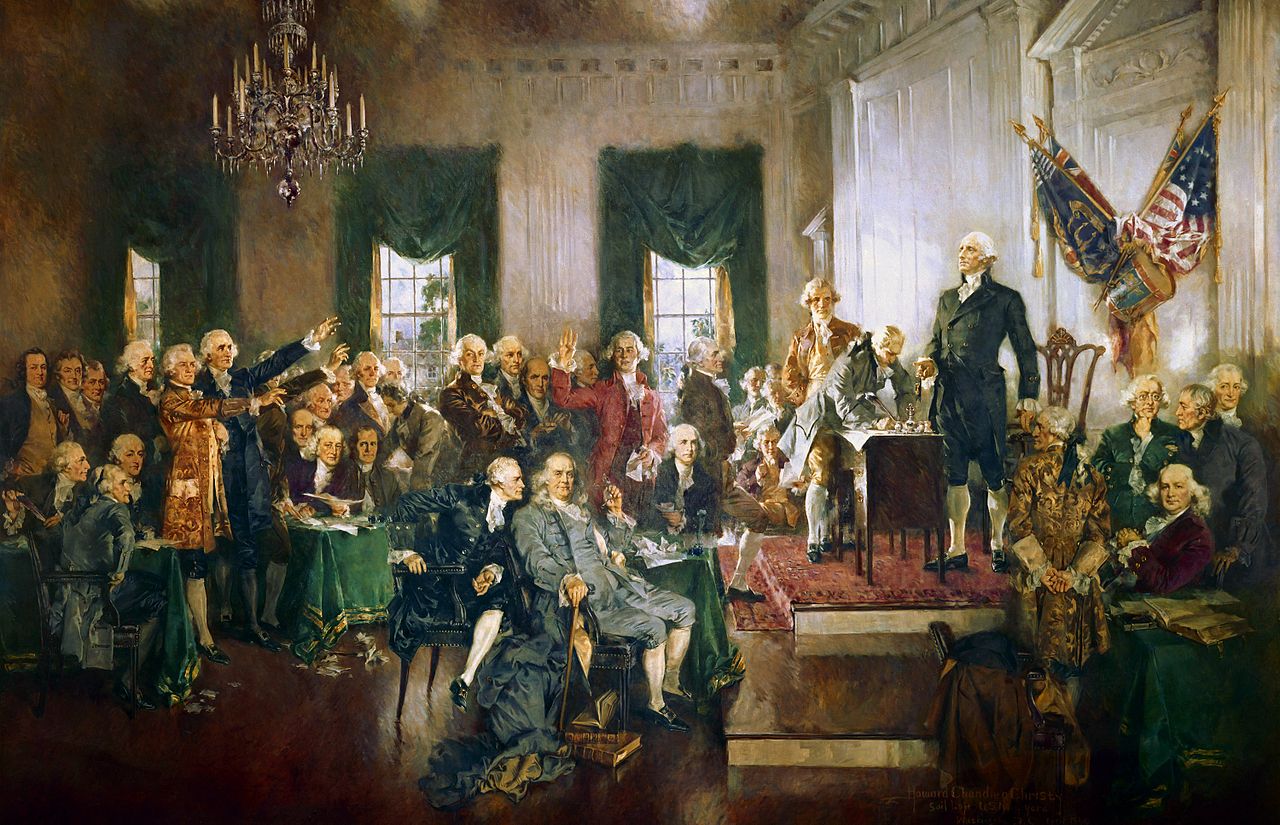
Signing the U.S. Constitution

Scene at the Signing of the Constitution of the United States, Howard Chandler Christy (January 10, 1873 – March 3, 1952), Public Domain in the US

Magnet states that the Founders original intent was to limit governmental authority through the division and limited enumeration of powers. Only nineteen federal government powers were enumerated. Principle among these were: raising taxes, coining money, keeping the country safe, building post offices and post roads, regulating the armed forces, and making laws for carrying out limited governmental responsibilities. All other powers devolved to the states or the people.

Flawed through compromise (in the bad sense), the Constitution was amended from 1865 and 1870 via the Thirteenth Amendment which freed the slaves, the Fourteenth assuring black Americans citizenship and civil rights, and the Fifteenth that prohibited states from denying black citizens the right to vote.

However, a series of Supreme Court decisions undid the power of those amendments won through Civil War bloodshed. In 1873, the Supreme Court subverted the Fourteenth Amendment through the Slaughter-House Cases, stating that the amendment did not include the rights: to own property; to court access; to equal taxation; to vote; to live, work, and travel where you want; and to have the protection of the Bill of Rights against state and federal violation. The Court held the amendment only granted the right to travel on interstate waterways and to petition the federal government for redress of grievances

In 1876, the Supreme Court, in their United States v. Cruikshank decision, threw out a federal indictment of Louisiana murderers for conspiracy to deprive more than 100 freedmen of their constitutional rights, on the grounds that the killers had violated no federal rights that extended to the states, citing the Slaughter-House Cases. This decision led Southern Democrats to enact Jim Crow laws. Cruikshank smoothed the way for Plessy v. Ferguson, in 1896, which enabled Southern states to segregate transportation and schools and outlaw interracial marriage.

In 1908, Wilson wrote:

No doubt a great deal of nonsense has been talked about the inalienable rights of the individual, and a great deal that was mere vague sentiment and pleasing speculation has been put forward as fundamental principle…Living political constitutions must be Darwinian in structure and practice…The chief instrumentality by which the law of the Constitution has been extended to cover the facts of national development has of course been judicial interpretations—the decisions of courts. The process of formal amendment of the Constitution was made so difficult by the…Constitution itself that it has seldom been feasible to use it; and the difficulty of formal amendment has undoubtedly made the courts more liberal, not to say more lax, in their interpretation than they would otherwise have been.

Wilson went on to advocate that the judicial system adapt the Constitution to the times through their decisions. In other words, the courts were to “make the law for their own day.”

Although the Supreme Court deflected attempts to control the national economy, executive pressure during the New Deal swayed the Court’s 1942 Wickard v. Filburn decision. Filburn, a dairy farmer, was fined for not limiting his wheat crop in accordance with the Agricultural Adjustment Act. The act was meant to curb a perceived deflationary overproduction crisis (held, at the time, to be a cause of the Depression). Congress established the act based on the Interstate Commerce Clause. The act established a crop quota system by state. These quotas were then allocated to individual farms by the states. Filburn used his wheat locally to feed his cows. But the Court decided that his wheat competed with wheat in commerce (he could have purchased it instead of growing it) so, therefore, it was subject to the Commerce clause and the act’s quotas.

In the same period, FDR noted, “The practice of creating independent regulatory commissions, who perform administrative work in addition to judicial work, threatens to develop a ‘fourth branch’ of Government for which there is no sanction in the Constitution.” He was responsible for numerous legislative Acts and their associated bureaucratic agencies.

So much for the intent of Lincoln’s Gettysburg Address:

FOUR SCORE AND SEVEN YEARS AGO OUR FATHERS BROUGHT FORTH ON THIS CONTINENT A NEW NATION CONCEIVED IN LIBERTY AND DEDICATED TO THE PROPOSITION THAT ALL MEN ARE CREATED EQUAL…

IT IS RATHER FOR US TO BE HERE DEDICATED TO THE GREAT TASK REMAINING BEFORE US

THAT FROM THESE HONORED DEAD WE TAKE INCREASED DEVOTION TO THAT CAUSE FOR WHICH THEY GAVE THE LAST FULL MEASURE OF DEVOTION

THAT WE HERE HIGHLY RESOLVE THAT THESE DEAD SHALL NOT HAVE DIED IN VAIN

THAT THIS NATION UNDER GOD SHALL HAVE A NEW BIRTH OF FREEDOM~AND

THAT GOVERNMENT OF THE PEOPLE BY THE PEOPLE FOR THE PEOPLE SHALL NOT PERISH FROM THE EARTH

I must admit, with everything going on lately, I became overwhelmed. I’m sure it’s happened to you too. Please forgive the hiatus. We’ll cover two special topics from Professor Siegel’s book Revolt Against the Masses in the future.