No Other Name

Jesus’ is one of the most recognized curse words the world over. Beyond this, there are many who profess that theirs is the right way to God. However, the Acts of the Apostles records Peter as saying:

This Jesus is the stone that was rejected by you, the builders, which has become the cornerstone. And there is salvation in no one else, for there is no other name under heaven given among men by which we must be saved.” Acts 4:11-12 English Standard Version (ESV)

Oops, we all must be mistaken. According to the scriptures, there’s no alternative for: “This Jesus.” How did John Calvin understand the passage?

Neither is there salvation in any other. […Peter] meant to prick and sting the priests…as if he should say, that they are twice damned who did not only refuse the salvation offered them by God, but endeavored to bring the same to naught, and did take from all the people the fruit and use thereof.

…And although he seems to speak unto deaf men, yet does he preach of the grace of Christ, if [perhaps] some can [bear] to hear; if not, that they may at least be deprived of all excuse by this testimony.

Neither is there any other name …Salvation (says Peter) is in Christ alone, because God hath decreed that it should be so. For by ‘name’ he means the cause or means, as if he should have said, forasmuch as salvation is in God’s power only, he will not have the same to be common to us by any other means than if we ask it of Christ alone.

…And if…this doctrine were deeply imprinted in the minds of all men, then…so many controversies concerning the causes of salvation [would] be soon at an end, with [which] the Church is so much troubled.

Calvin, in his exposition clearly states the import of ‘this Jesus’ for us who have believed:

…Christ took upon him our flesh once…that he might be a continual pledge of our adoption. He has reconciled the Father to us forever by the sacrifice of his death: by his resurrection he has purchased for us eternal life. And he is present with us now also, that he may make us partakers of the fruit of eternal redemption.

And, those of you who have no assurance of Christ’s pledge to you, I urge you to consider:

“The word is near you, in your mouth and in your heart” (that is, the word of faith that we proclaim); because, if you confess with your mouth that Jesus is Lord and believe in your heart that God raised him from the dead, you will be saved. For with the heart one believes and is justified, and with the mouth one confesses and is saved. Romans 10:8-10 (ESV)

Opponents: Objections and Judgment – Dr. Martyn Lloyd-Jones Sermon, posted by Christian Praise and Worship in Songs, Sermons, and Audio Books

Get Behind Me

No one likes a stern rebuke for something they’ve done wrong. Perhaps our father, a coworker, or our boss reprimanded us. Rejecting correction from the former could have led to punishment if we weren’t repentant (and sometimes even then.) Rejecting the same from the latter could lead to job termination. Often, however, chastisement brings with it wisdom.

But, what if the one you’ve offended has a world-changing responsibility to carry out? Performing that responsibility will affect untold millions upon millions of lives for all time and eternity and you’re opposing them. After Christ described to His Disciples the manner of His death and resurrection:

…Peter took him aside and began to rebuke him, saying, “Far be it from you, Lord! This shall never happen to you.” But he turned and said to Peter, “Get behind me, Satan! You are a hindrance to me. For you are not setting your mind on the things of God, but on the things of man.” Matthew 16:22-23 English Standard Version (ESV)

Clearly, what Christ earlier described and then later endured was in all of our interests and for our benefit. That Peter opposed it showed earthly sentiment. Christ used the opportunity to correct, not only Peter, but, the rest of the disciples and us:

But turning and seeing his disciples, he rebuked Peter and said, “Get behind me, Satan! For you are not setting your mind on the things of God, but on the things of man.” Mark 8:33 (ESV)

How should we understand what Peter did and the nature of Christ’s rebuke? John Calvin says:

And Peter, taking him aside, began to rebuke him. It is a proof of the excessive zeal of Peter, that he reproves his Master…It was highly presumptuous of Peter to advise our Lord to spare himself, as if he had been deficient in prudence or self-command. But so completely are men hurried on and driven headlong by inconsiderate zeal, that they do not hesitate to pass judgment on God himself, according to their own fancy.

…In the person of one man [Christ] intended to restrain all from gratifying their own passions. …It is on this account that Christ reproves it so sharply, and bruises it, as it were, with an iron hammer, to teach us that it is only from the word of God that we ought to be wise.

Get thee behind me, Satan. …Luke (4:8) informs us that our Lord used those very words in repelling the attacks of Satan, and the verb…signifies to withdraw. Christ therefore throws his disciple to a distance from him, because, in his inconsiderate zeal, he acted the part of Satan; for he does not simply call him adversary, but gives him the name of the devil, as an expression of the greatest abhorrence.

Thou art an offense to me; for you relish not those things which are of God, but those which are of men. Peter was an offense to Christ, so long as he opposed his calling; for, when Peter attempted to stop the course of his Master, [he would have] deprived himself and all mankind of eternal salvation.

This single word, therefore, shows with what care we ought to avoid everything that withdraws us from obedience to God…Lest we and our intentions should be sent away by our heavenly Judge to the devil, let us learn not to be too much attached to our own views, but submissively to embrace whatever the Lord approves.

…And with regard to ourselves, if we do not, of our own accord, resolve to shut ourselves out from the way of salvation by deadly obstacles, let us not desire to be wise in any other manner than from the mouth of God.

That day, Peter clearly learned the truth of Proverbs 3:5–8 the hard way.

Trust in the Lord with all your heart,

    and do not lean on your own understanding.

In all your ways acknowledge him,

    and he will make straight your paths.

Be not wise in your own eyes;

    fear the Lord, and turn away from evil.

It will be healing to your flesh

    and refreshment to your bones.

Proverbs 3:5-8 (ESV)

Let us take his lesson to heart and not repeat his mistake.

Get Thee Behind Me - Tissot

Get Thee Behind Me, Satan, (between 1886 and 1894), James Tissot (1836–1902), public domain in the United States

Believe and Suffer

Some of us are bewildered when we face adversity, some expect it more often than it occurs, some chalk it up to mysterious forces, and some see it as highly probable at all times. What is certain in this life is that we will suffer at some time in our lives. For all of us, I wish it were as certain that we would all believe so as to be saved from the penalty that our sins deserve. The Apostle Paul wrote to the church in Philippi about believing and suffering:

Only let your manner of life be worthy of the gospel of Christ, so that whether I come and see you or am absent, I may hear of you that:

You are standing firm in one spirit

With one mind striving side by side for the faith of the gospel, and

Not frightened in anything by your opponents.

This is a clear sign to them of their destruction, but of your salvation, and that from God.

For it has been granted to you that for the sake of Christ you should not only believe in him but also suffer for his sake, engaged in the same conflict that you saw I had and now hear that I still have.

Philippians 1:27-30 English Standard Version (ESV)

Paul says God has granted them to believe in Him. But also, in an act of His Sovereign will, to suffer. Not any kind of suffering, but that according to His will, “for His sake.”

The reformer and preacher, John Calvin, makes at least three points about these verses. First, our common struggle against our sin, the world, and the devil unites us. Even if we’re divided by our sins against one another, the struggle is so great against us that we will reconcile and contend for the faith together.

Striving together for the faith…is the strongest bond of concord, …for this has often been the occasion of reconciling even the greatest enemies.

…The Apostle’s meaning is this: “Let the faith of the gospel unite you together, more especially as that is a common armory against one and the same enemy.”

The wicked, too, conspire together for evil, but their agreement is accursed: let us, therefore, contend with one mind under the banner of faith.

These struggles, and our patient suffering, are ordained and given by God as a sign of our salvation to us and to the enemies of the faith. These are both a benefit for our increased devotion and an honor to participate in His sufferings.

To you, says he, it is given, not only to believe in Christ, but also to suffer for him. Hence even the sufferings themselves are evidences of the grace of God; and, since it is so, you have from this source a token of salvation. Oh, if this persuasion were effectually [woven into] our minds — that persecutions are to be reckoned among God’s benefits, what progress would be made in the doctrine of piety!

…It is the highest honor…conferred upon us by Divine grace, that we suffer for his name either reproach, or imprisonment, or miseries, or tortures, or even death, for in that case he adorns us with his marks of distinction. But [many would] rather [that] God [refrain from giving] gifts of that nature, than embrace with [readiness] the cross when it is presented to them. Alas, then, for our stupidity!

Finally, Calvin stresses that our struggle and godly resistance is analogous, though far lesser, to Christ’s struggle and godly resistance on the cross. Yet, both faith and endurance remain His unmerited gifts to us, evident in our inability to resist in our own strength.

[Paul] wisely conjoins faith with the cross by an inseparable connection, [so] that the Philippians may know that they have been called to the faith of Christ on this condition — that they endure persecutions on His account, as though he had said that their adoption can no more be separated from the cross, than Christ can be torn asunder from himself.

Here Paul clearly testifies, that faith, as well as [faithfulness] in enduring persecutions, is an unmerited gift of God. And certainly the knowledge of God is a wisdom that is too high for our attaining it by our own acuteness, and our weakness shows itself in daily instances in our own experience, when God withdraws his hand for a little while…

May God grant you to believe and suffer for His sake.

Suffering and the Sovereignty of God: An Interview with R.C. Sproul Jr., Ligonier Ministries

Not Your Own

We often hear that faith must be personal. “My faith,” they say. People might tell us they’ve persevered through trials due to their faith. Were it to have failed, they would’ve been lost. But they had enough. At least that’s what they say. I don’t know about you, but I get the impression that they think this faith is their own, as if they produced it. As if it were due to strength of character or moral upbringing.

On the contrary, though we must hold faith individually:

And to the one who does not work but believes in him who justifies the ungodly, his faith is counted as righteousness. Romans 4:5 English Standard Version (ESV)

It is not our faith, it is a gift of God so that we might not boast about ourselves.

For by grace you have been saved through faith. And this is not your own doing; it is the gift of God, not a result of works, so that no one may boast. For we are his workmanship, created in Christ Jesus for good works, which God prepared beforehand, that we should walk in them. Ephesians 2:8-10 (ESV)

John Calvin comments on this verse:

For by grace are you saved. …God declares, that he owes us nothing; so that salvation is not a reward or recompense, but unmixed grace. The next question is, in what way do men receive that salvation which is offered to them by the hand of God? The answer is, by faith; and hence he concludes that nothing connected with it is our own…

Not of works. …Many persons restrict the word ‘gift’ to faith alone. But Paul is only repeating in other words the former sentiment. His meaning is, not that faith [only] is the gift of God, but that salvation [entirely] is given to us by God…

For we are his work. …The apostle affirms that we are God’s work, and that everything good in us is his creation; by which he means that the whole man is formed by his hand to be good. It is not the mere power of choosing aright, or some indescribable kind of preparation, or even assistance, but the right will itself, which is his workmanship; otherwise Paul’s argument would have no force.

Created to good works. …[Paul] says, that, before we were born, the good works were prepared by God; meaning, that in our own strength we are not able to lead a holy life, but only so far as we are formed and adapted by the hand of God. Now, if the grace of God came before our performances, all ground of boasting has been taken away…

To reiterate, faith is not a result of human will:

For he says to Moses, “I will have mercy on whom I have mercy, and I will have compassion on whom I have compassion.” So then it depends not on human will or exertion, but on God, who has mercy Romans 9:15-16 (ESV)

To this, Calvin comments:

It is not then of him who wills, etc. …That none of you may think that they who are elected are elected because they are deserving, or because they had in any way procured for themselves the favor of God, or, in short, because they had in them a particle of worthiness by which God might be moved, take simply this view of the matter, that it is neither by our will nor efforts…that we are counted among the elect, but that it wholly depends on the divine goodness, which of itself chooses those who neither will, nor strive, nor even think of such a thing… [Emphasis mine]

Therefore faith is not subjective. It is not of ourselves so that we may not boast. Just like the scriptures, faith is not a matter of one’s own opinion.

***

Now, if we accept that faith is not of ourselves, we who profess faith must also realize that we, ourselves, are not our own, either.

Or do you not know that your body is a temple of the Holy Spirit within you, whom you have from God? You are not your own, for you were bought with a price. So glorify God in your body. 1 Corinthians 6:19-20 (ESV)

77s – The 77’s – Bottom Line,   Uploaded to YouTube on Apr 6, 2008, posted by Neamberthal, Lyrics

Unless – a Conjunction

While doing research for a previous blog post, I noticed that John’s Gospel quotes the Lord Jesus several times using the word: unless.

Unless is interesting because it is a logic term.

Unless

/ənˈles/

conjunction

Except if (used to introduce a case in which a statement being made is not true or valid).

“Unless you have a photographic memory, repetition is vital”

Speaking English – How to Use “Unless,” July 10, 2013, Learn English with Rebecca [engVid RebeccaESL]

The Lord Jesus Christ used this conjunction to lead those who heard Him into God’s Kingdom.

Unless it is granted him by the Father, no one can come to me John 6:64-66 English Standard Version (ESV)

Unless the Father who sent me draws him, no one can come to me John 6:43-45 (ESV)

Unless one is born again he cannot see the kingdom of God John 3:2-3 (ESV)

Unless one is born of water and the Spirit, he cannot enter the kingdom of God John 3:4-6 (ESV)

Unless you believe that I am He you will die in your sins John 8:23-25 (ESV)

To sum up, unless God the Father grants it and draws us we cannot come to the Lord Jesus. Unless one is born again, of water and the Spirit, we can neither see nor enter God’s Kingdom. And unless we believe that the Lord Jesus Christ is the God who saves, we will die condemned to eternal punishment.

The Rebellion

Most of us would like to know beforehand when a disaster will occur. Many, to avoid the consequences, but some, to profit from them. If only those who boarded the planes knew that fateful September morning what was about to happen.

In the same way, we’d all like to know when the world will end. Many pretend that it will go on just as it has for millennia. Some think differently. A few believe the scriptures when they speak of the last day:

Let no one deceive you in any way. For that day will not come, unless the rebellion comes first, and the man of lawlessness is revealed, the son of destruction, who opposes and exalts himself against every so-called god or object of worship, so that he takes his seat in the temple of God, proclaiming himself to be God. 2 Thessalonians 2:3-4 English Standard Version (ESV)

So there are signs of the end. But, what would these things look like? John Calvin comments on this passage:

Paul, …foretells that, after [those in the visible church] have had foreign enemies for some time molesting them, they will have more evils to endure from enemies [within the church], inasmuch as many of those that have made a profession of attachment to Christ would be hurried away into base treachery, and inasmuch as the temple of God itself would be polluted by sacrilegious tyranny, so that Christ’s greatest enemy would exercise dominion there.

Relative to Antichrist’s pernicious arrogation of deity, Calvin says:

Scripture declares that God is the alone Lawgiver (James 4:12) who is able to save and to destroy; the alone King, whose office it is to govern souls by His word. [Scripture] represents Him as the author of all sacred rites; it teaches that righteousness and salvation are to be sought from Christ alone; and it assigns, at the same time, the manner and means.

And concerning the history of the visible church, Calvin says:

My readers now understand, that all the sects by which the Church has been lessened from the beginning, have been so many streams of revolt which began to draw away the water from the right course, but that the sect of Mahomet was like a violent bursting forth of water, that took away about the half of the Church by its violence. It remained, also, that Antichrist should infect the remaining part with his poison. Thus, we see with our own eyes, that this memorable prediction of Paul has been confirmed by the event.

So, are we able discern the fruition of these things in time to flee the consequences? The Lord Jesus Christ warned:

“But concerning that day and hour no one knows, not even the angels of heaven, nor the Son, but the Father only. For as were the days of Noah, so will be the coming of the Son of Man. For as in those days before the flood they were eating and drinking, marrying and giving in marriage, until the day when Noah entered the ark, and they were unaware until the flood came and swept them all away, so will be the coming of the Son of Man. Matthew 24:36-39 (ESV)

Calvin comments on this passage:

So now Christ declares that the last age of the world will be in a state of [senseless] indifference, so that men will think of nothing but the present life, and will extend their cares to a long period, pursuing their ordinary course of life, as if the world were always to remain in the same condition… [Emphasis mine]

Though the report of the last judgment is now widely circulated, and though there are a few persons who have been taught by God to perceive that Christ will come as a Judge in due time, yet it is proper that those persons should be aroused by this extraordinary kindness of God, and that their senses should be sharpened, lest they give themselves up to the indifference which so generally prevails.

Therefore, if you haven’t yet, we urge you to repent while there is still time.

***

Speaking of our collective indifference, The Federalist has summarized the recent Planned Parent video expose’. Item number 7 describes the Carly Fiorina video. No, I did NOT watch.

In the same vein, I don’t often agree with Mr. O’Reilly, but when I do, I offer you this video:

Is America Becoming Barbaric? Fox News, July 28, 2015

Now and Not Yet

I recently read Kim Riddlebarger’s A Case for Amillennialism. In it, he surveys ways Christians understand (or misunderstand) end times prophesy. I recommend the book for those interested in working through what they believe about the end.

He treats the subject fairly, in my opinion, although he does have a vested interest in Amillennialism. Throughout the text, he explores the concept of multiple fulfillments over time of individual Bible prophesies termed: ‘the now and not yet.’

While reading, it occurred to me that everyone you meet has their own ‘now and not yet.’ Perhaps the following statement seems alien to you:

Though you have not seen Him, you love him. Though you do not now see Him, you believe in Him and rejoice with joy that is inexpressible and filled with glory, obtaining the outcome of your faith, the salvation of your souls. 1 Peter 1:8-9 English Standard Version (ESV)

Certainly, it’s true that those alive today have not seen the Lord Jesus Christ. This is ‘a now and not yet’ for those who trust Him for salvation.

However, what struck me is that many do not love or even believe in Him. Consider this: perhaps it is not yet your time to believe and be saved from God’s wrath. But it could be, soon; perhaps even today.

Of course, you will be saved not because of anything you have done, but according to His mercy and purpose for you:

Though they were not yet born and had done nothing either good or bad—in order that God’s purpose of election might continue, not because of works but because of him who calls— Romans 9:11 (ESV)

What am I trying to get at? Let’s approach it this way. The Apostle Paul writes in his letter to the church at Rome:

And we know that for those who love God all things work together for good, for those who are called according to his purpose.

For those whom He foreknew He also predestined to be conformed to the image of his Son, in order that he might be the firstborn among many brothers.

And those whom He predestined, He also called, and those whom He called He also justified [i.e., made righteous], and those whom He justified he also glorified.

Romans 8:28-30 (ESV)

Paul speaks of a progressive reveal of those who become His children: from time in eternity past, through our lives, and to eternity future. One commentator points out (see note 270) how Paul describes this process in the past tense to show the certainty of its accomplishment because, by God’s decree, it is as good as already done. There is an element of ‘the now and a not yet’ for each of us as we journey through our lives.

To embark on the next step of your journey, you must believe that God exists and He rewards those that seek Him.

Then, consider:

…He appoints a certain day, “Today,” saying through David so long afterward, in the words already quoted,

“Today, if you hear his voice,

Do not harden your hearts.”

Hebrews 4:7 (ESV)

And He calls to us from heaven:

Behold, I stand at the door and knock. If anyone hears my voice and opens the door, I will come in to him and eat with him, and he with me. Revelation 3:20 (ESV)

Please receive Him today and make your ‘not yet’ into ‘now.’ Come out of the darkness and into the light, for it has not yet appeared what we shall become.

The Now and the Not Yet, Amy Grant, YouTube

Salvation

There is much confusion about this concept nowadays. There needn’t be. Scripture is clear:

“And there is salvation in no one else, for there is no other name under heaven given among men by which we must be saved.” Acts 4:12 English Standard Version (ESV)

Calvin says:

Neither is there salvation in any other. …And assuredly Christ had showed this one token of his grace, to the end [that] he might be known to be the only author of life. We must consider this in all the benefits of God, to wit, that he is the fountain of salvation. And he meant to prick and sting the priests with this sentence, when as he says that there is salvation in none other save only in Christ, whom they went about to put quite out of remembrance.

As if he should say, that they are twice damned who did not only refuse the salvation offered them by God, but endeavor to bring the same to naught, and did take from all the people the fruit and use thereof. Although he seems to speak unto deaf men, yet he preaches of the grace of Christ, if [perhaps] some can abide to hear; [and] if not, that they may at least be deprived of all excuse by this testimony.

Neither is there any other name…Salvation (says he) is in Christ alone, because God has decreed that it should be so. For by name he means the cause or means, as if he should have said, forasmuch as salvation is in God’s power only, he will not have the same to be common to us by any other means than if we ask it of Christ alone.

Whereas he says under heaven…I do rather think that this was added, because men cannot ascend into heaven, that they may come unto God. Therefore, seeing we are so far from the kingdom of God, it is needful that God does not only invite us unto himself, but that reaching out his hand he offer salvation unto us, that we may enjoy the same.

Peter teaches in this [passage], that he has done that in Christ, because he came down into the earth for this cause, that he might bring salvation with him. Neither is that contrary to this doctrine, that Christ is ascended above all heavens, (Ephesians 4:10). For he took upon him our flesh once for this cause, that he might be a continual pledge of our adoption. He has reconciled the Father to us forever by the sacrifice of his death: by his resurrection he has purchased for us eternal life.

And he is present with us now also, that he may make us partakers of the fruit of eternal redemption; but the revealing of salvation is handled in this [passage], and we know that the same was so revealed in Christ, that we need not any longer to say, “Who shall ascend into heaven?” (Romans 10:6).

And if this doctrine were deeply imprinted in the minds of all men, then should so many controversies concerning the causes of salvation be soon at an end, wherewith the Church is so much troubled…

The Visual Bible – Acts Chapter 4

Legalistic?

I’ve heard it said that those who profess Christ shouldn’t try to put off the old self and put on the new self, to pursue sanctification, or intentionally obey the word of God.

Paul, in his letter to the Philippian church says:

Therefore, my beloved, as you have always obeyed, so now, not only as in my presence but much more in my absence, work out your own salvation with fear and trembling, for it is God who works in you, both to will and to work for his good pleasure. Philippians 2:12-13 English Standard Version (ESV)

Some would have you believe that Paul must have been mistaken. John Calvin comments on these verses:

It is God that worketh. This is the true engine for bringing down all haughtiness — this the sword for putting an end to all pride, when we are taught that we are utterly nothing, and can do nothing, except through the grace of God alone. I mean supernatural grace, which comes forth from the spirit of regeneration.

…There are, in any action, two principal departments — the inclination, and the power to carry it into effect. Both of these he ascribes wholly to God; what more remains to us as a ground of glorying?

Nor is there any reason to doubt that this division has the same force as if Paul had expressed the whole in a single word; for the inclination is the groundwork; the accomplishment of it is the summit of the building brought to a completion. …For he does not say that our hearts are simply turned or stirred up, or that the infirmity of a good will is helped, but that a good inclination is wholly the work of God.

…For we acknowledge that we have from nature an inclination, but as it is depraved through the corruption of sin, it begins to be good only when it has been renewed by God. Nor do we say that a man does anything good without willing it, but that it is only when his inclination is regulated by the Spirit of God.

Hence, in so far as concerns this department, we see that the entire praise is ascribed to God, and that what sophists teach us is frivolous — that grace is offered to us, and placed, as it were, in the midst of us, that we may embrace it if we choose; for if God did not work in us efficaciously, he could not be said to produce in us a good inclination.

As to the second department, we must entertain the same view. “God,” says he, “is ̔Ο ἐνεργῶν το ἐνεργεῖν he that worketh in us to do.” He brings, therefore, to perfection those pious dispositions which he has implanted in us, that they may not be unproductive, as he promises by Ezekiel, —

I will cause them to walk in my commandments.” (Ezekiel 11:20)

From this we infer that perseverance, also, is his free gift.

According to his good pleasure. …For Paul has it in view to ascribe everything to God, and to take everything from us. Accordingly, not satisfied with having assigned to God the production both of willing and of doing aright, he ascribes both to his unmerited mercy. By this means he shuts out the contrivance of the sophists as to subsequent grace, which they imagine to be the reward of merit. Hence he teaches, that the whole course of our life, if we live aright, is regulated by God, and that, too, from his unmerited goodness.

With fear and trembling. From this Paul deduces an exhortation — that they must with fear work out their own salvation. He conjoins, as he is accustomed, fear and trembling, for the sake of greater intensity, to denote — serious and anxious fear. He, accordingly, represses drowsiness as well as confidence…

The inference, also, is to be carefully observed: “You have,” says he, “all things from God; therefore be solicitous and humble.” For there is nothing that ought to train us more to modesty and fear, than our being taught, that it is by the grace of God alone that we stand, and will instantly fall down, if he even in the slightest degree withdraw his hand. Confidence in ourselves produces carelessness and arrogance.

…For distrust of ourselves leads us to lean more confidently upon the mercy of God. And this is what Paul’s words import, for he requires nothing from the Philippians, but that they submit themselves to God with true self-renunciation.

Work out your own salvation. …Salvation is taken to mean the entire course of our calling, and that this term includes all things, by which God accomplishes that perfection, to which he has predestinated us by his gracious choice. This no one will deny…

We are said to perfect it, when, under the regulation of the Spirit, we aspire after a life of blessedness. It is God that calls us, and offers to us salvation; it is our part to embrace by faith what he gives, and by obedience act suitably to his calling; but we have neither from ourselves. Hence we act only when he has prepared us for acting.

Addressing the whole issue, James wrote ironically:

But someone will say, “You have faith and I have works.” Show me your faith apart from your works, and I will show you my faith by my works. James 2:18 (ESV)

Know this then, that faith without works is dead.

Papyrus 54: James 2:16-18

Papyrus 54: James 2:16-18, 6th century, Public Domain in US

Restore to Repentance?

Having been in the church a while, I’ve seen and heard things. This verse has always troubled me:

For it is impossible,

in the case of those:

who have once been enlightened,

who have tasted the heavenly gift,

and have shared in the Holy Spirit,

and have tasted the goodness of the word of God and the powers of the age to come,

and then have fallen away,

to restore them again to repentance,

since they are:

crucifying once again the Son of God to their own harm

and holding him up to contempt.

Hebrews 6:4-6 English Standard Version (ESV) emphasis mine

I had once presented the gospel to a fellow who said to me that he knew he was not redeemable because of these verses. Ignorant as I was at the time, I tried to convince him that there was always hope while he yet lived. He, a non-believer, quoted these verses to me, thanked me for my concern, and wandered away. I never saw him again.

John Calvin comments:

Let us then know, that the Gospel cannot be otherwise rightly known than by the illumination of the Spirit, and that being thus drawn away from the world, we are raised up to heaven, and that knowing the goodness of God we rely on his word.

But here arises a new question, how can it be that he who has once made such a progress should afterwards fall away? For God, it may be said, calls none effectually but the elect, and Paul testifies that they are really his sons who are led by his Spirit, (Romans 8:14) and he teaches us, that it is a sure pledge of adoption when Christ makes us partakers of his Spirit. The elect are also beyond the danger of finally falling away; for the Father who gave them to be preserved by Christ his Son is greater than all, and Christ promises to watch over them all so that none may perish.

To all this I answer, That God indeed favors none but the elect alone with the Spirit of regeneration, and that by this they are distinguished from the reprobate; for they are renewed after his image and receive the earnest of the Spirit in hope of the future inheritance, and by the same Spirit the Gospel is sealed in their hearts.

But I cannot admit that all this is any reason why he should not grant the reprobate also some taste of his grace, why he should not irradiate their minds with some sparks of his light, why he should not give them some perception of his goodness, and in some sort engrave his word on their hearts.

Otherwise, where would be the temporal faith mentioned by Mark 4:17? There is therefore some knowledge even in the reprobate, which afterwards vanishes away, either because it did not strike roots sufficiently deep, or because it withers, being choked up.

And by this bridle the Lord keeps us in fear and humility; and we certainly see how prone human nature is otherwise to security and foolish confidence. At the same time our solicitude ought to be such as not to disturb the peace of conscience. For the Lord strengthens faith in us, while he subdues our flesh: and hence he would have faith to remain and rest tranquilly as in a safe haven; but he exercises the flesh with various conflicts, that it may not grow wanton through idleness.

So the bitter admonition in these verses serves us well: to keep us striving for holiness, humility, and obedience to the Lord Jesus Christ in all we think, say, and do.

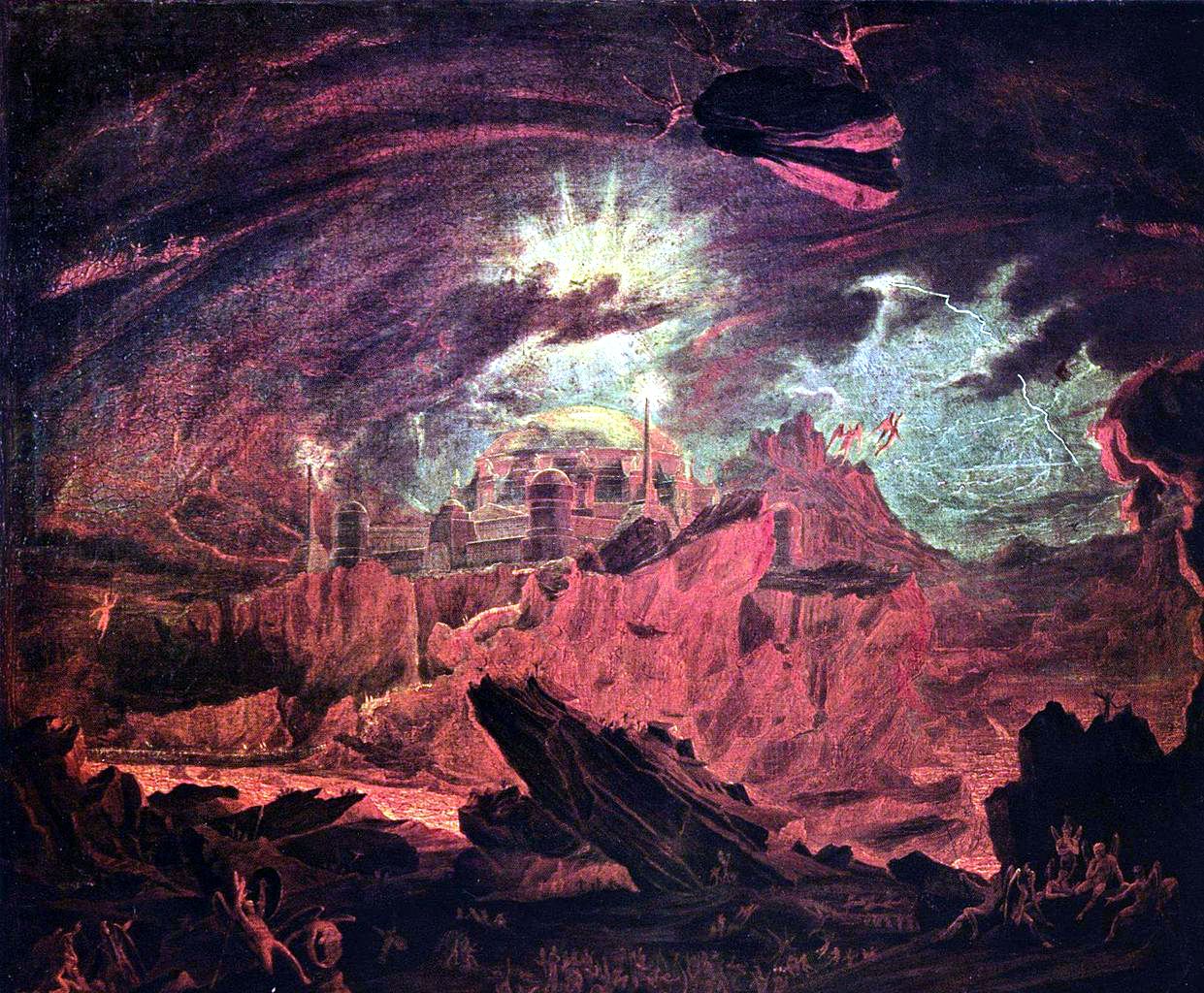
Fallen Angels in Hell

Fallen Angels in Hell, circa 1841, John Martin, 1789 – 1854, Public Domain in US