A New Prophet like Moses

“The end is near, the end is near!” We all associate this trope with crackpots and lunatics. Especially street corner prophets wearing sandwich boards. However, they are right in a sense. Around 150,000 people die every day, worldwide. Their ends are no longer near but already past.

We have to be wary of a prophet and his message. Thus Moses pointed us to the Prophet we should all listen to:

“The Lord your God will raise up for you a prophet like me from among you, from your brothers—it is to him you shall listen…and whoever will not listen to my words that he shall speak in my name, I myself will require it of him. Deuteronomy 18:15, 19 English Standard Version (ESV)

John Calvin has quite a bit to say about these verses:

The Lord thy God will raise up …But if He had referred them to Christ alone, the objection would naturally arise that it was hard for them to have neither Prophets nor revelations for two thousand years. Nor is there any strength in those two arguments on which some insist, that the Prophet, of whom Moses bears witness, must be more excellent than him who proclaimed him; and that the eulogium that he should be “like unto” Moses could not be applied to the ancient Prophets, since it is said elsewhere that “there arose not a Prophet since like unto” him. (Deuteronomy 34:10)…

…Yet Peter aptly and elegantly accommodates this testimony to Christ, (Acts 3:22) not to the exclusion of others of God’s servants, but in order to warn the Jews that in rejecting Christ they are at the same time refusing this inestimable benefit of God; for the gift of prophecy had so flourished among His ancient people, and teachers had so been constantly appointed to succeed each other, that nevertheless there should be some interruption before the coming of Christ.

Hence, in that sad dispersion which followed the return from the Babylonian captivity, the faithful complain in Psalm 74:9, “We see not our signs; there is no more any prophet.” On this account Malachi exhorts the people to remember the Law given in Horeb; and immediately after adds, “Behold I send you Elijah the prophet,” etc., (Malachi 4:4, 5) as much as to say, that the time was at hand in which a more perfect doctrine should be manifested, and a fuller light should shine. For the Apostle says truly, that:

“God, who at sundry times and in divers manners spoke unto the fathers by the prophets, hath in these last days spoken unto us by his Son,” (Hebrews 1:1, 2)

And, in fact, by the appearing of the doctrine of the Gospel, the course of the prophetic doctrine was completed; because God thus fully exhibited what was promised by the latter.

And this was so generally understood that even the Samaritan woman said that Messiah was coming, who would tell all things. (John 4:25) To this, then, what I have lately quoted as to the transition from the Law and the Prophets to the Gospel refers; and hence it is made out, that this passage was most appropriately expounded by Peter as relating to Christ; for unless the Jews chose to accuse God of falsehood, it was incumbent upon them to look to Christ, at whose hand was promised both the confirmation of doctrine and the restoration of all things.

They had been for a long time destitute of Prophets, of whom Moses had testified that they should never be wanting to them, and whom he had promised as the lawful ministers for retaining the people in allegiance, so that they should not turn aside to superstitions; they had, therefore, either no religion, or else that greatest of Teachers was to be expected, who in his own person would present the perfection of the prophetic office…

…But with regard to the comparison which Moses makes between himself and other prophets, its effect is to raise their teaching in men’s estimation. They had been long accustomed to this mode of instruction, viz., to hear God speaking to them by the mouth of a man; and the authority of Moses was so fully established, that they were firmly persuaded that they were under the divine government, and that all things necessary to salvation were revealed to them.

And, as recorded in John’s Gospel, chapter 5, verses: 39-40 and 46-47, the Lord Jesus Christ Himself says:

“You search the Scriptures because you think that in them you have eternal life; and it is they that bear witness about me, yet you refuse to come to me that you may have life…For if you believed Moses, you would believe me; for he wrote of me. But if you do not believe his writings, how will you believe my words?” John 5:39-40, 46-47 (ESV)

Please, believe Him.
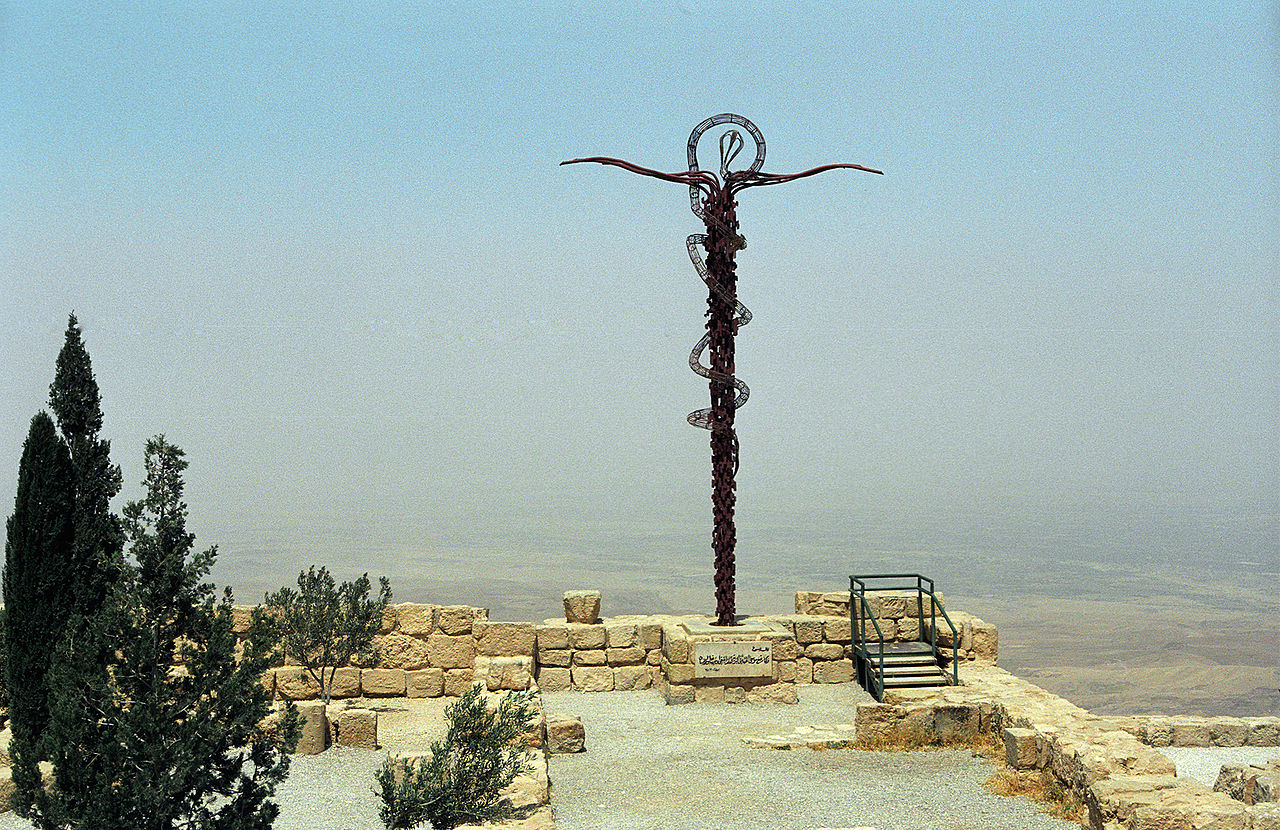
Brazen Serpent

[The Brazen Serpent], Mount Nebo, Jordan (2001), Jerzy Strzelecki, Creative Commons Attribution-Share Alike 3.0 Unported

God Is Testing Us

If you’ve attended some North American churches, you’ve experienced the winds of doctrine. If you’ve read, listened to, or watched the news, you know the alarm that current events bring. Some of the aforementioned offer other gods to serve. To these things, the word of God says:

“If a prophet or a dreamer of dreams arises among you and gives you a sign or a wonder, and the sign or wonder that he tells you comes to pass, and if he says, ‘Let us go after other gods,’ which you have not known, ‘and let us serve them,’ you shall not listen to the words of that prophet or that dreamer of dreams. For the Lord your God is testing you, to know whether you love the Lord your God with all your heart and with all your soul. You shall walk after the Lord your God and fear him and keep his commandments and obey his voice, and you shall serve him and hold fast to him. Deuteronomy 13:1-4 English Standard Version (ESV)

John Calvin has a lot to say about verse three:

For the Lord your God [tests] you. …He [God] designedly brings the truly pious to the test, in order to distinguish them from the hypocrites; and this takes place, when they constantly persevere in the true faith against the assaults of their temptations, and do not fall from their standing. The Apostle declares the same thing also with regard to heresies, which…must needs arise in the Church, “that they which are approved may be made manifest.” (1 Corinthians 11:19).

Wherefore we must not be impatient, nor murmur against God, if He chooses that the firmness of our faith, which is more precious than silver or gold, should be tried in the fiery furnace; but it behooves us humbly to acquiesce in His justice and wisdom.

If any should still object, that, since the weakness of mankind is only too notorious, God deals with them somewhat unkindly when He subjects them to these dangerous temptations, an answer may be readily given. I acknowledge indeed that, since our carnal sense is tender, this may seem hard, and inconsistent with the fatherly kindness of God; for, surely, when a miracle presents itself before our eyes, it is difficult not to submit to it.

But, since the temptation injures none but those whose impiety, which it lays bare, was already convicted and condemned, while the sincere worshippers of God are preserved free from injury, how unjust would it be to take away from God this liberty of plucking the mask from treachery and deceit?

Whosoever loves God with a pure heart is armed with the invincible power of the Divine Spirit, that he should not be ensnared by falsehoods; God thus rewards true and not fictitious piety, so that whosoever are of a true heart, should be protected by his faithful guardianship, and never feel the deadly wound.

Meanwhile, why should He not devote to just destruction those who willfully desire to perish? Nor need we be surprised at what He elsewhere declares, that it is He who deceives false prophets, that by them he may inflict just vengeance on the reprobate, who eagerly go in search of their destructive deceits.

Since, then, all the good are sure to overcome, so that the wiles of Satan are to them nothing but the exercises of their virtue; why should God be blamed, because the malice of Satan and of the wicked prepares for them [i.e., the good] the grounds of their victory and triumph?

Only let us cleave to this axiom, that all, who heartily love and reverence God, will always be sure and safe under the protection of God. It is true, I confess, that integrity of heart is a peculiar gift of God and the fruit of His secret election; but, since their own consciences reproach the reprobate with their contempt of God, their hypocrisy, pride, or depravity, the blame of the iniquity that dwells in them is unjustly laid upon God.

This, then, is sufficient to refute all carnal and perverse reasoning and blasphemies, viz., that whosoever are right in heart are guarded by the aid of the Spirit from the poisonous influence of Satan, and that no one perishes against his will.

And thus we come to the conclusion, that all who, having once seemed to embrace the doctrines of salvation, afterwards reject and deny them, had never possessed anything more than the disguise of a false profession, because, if they sincerely loved God, they would remain firm in heart in the midst of all things tending to disturb them.

It will indeed sometimes happen that the pious also will fall into errors, and will be seduced by the wicked; but it will only be in some respects and for a time; so that they never fall from the foundation, and presently recover themselves, [reformed].

And then, it must also be observed, they pay the penalty of their negligence, or instability, because they have not been sufficiently attentive to God’s Word, or have not sufficiently devoted themselves to religious pursuits.

Hence we further gather, that while many turn away professedly from the doctrines of religion, on the ground of their seeing so many contentions and disputes to distract them, it is a mere vain excuse to cover their profane neglect or hatred of God.

It is true that there are great discrepancies of opinion, and very warm contentions; but whosoever in a teachable and gentle spirit shall seek after truth, and shall give himself over and submit himself as the disciple of God, he will never be without the spirit of judgment and discretion.

But, since some listen disdainfully, some supremely despise it, some wish that God’s Word were altogether destroyed, others think lightly of it, the saying of the Prophet holds good, “that that die, let it die;” (Zechariah 11:9) and what Paul after him declares, “But if any man be ignorant, let him be ignorant.” (1 Corinthians 14:38).

Since it has always been the case that God’s truth was never hidden from anybody, except him whose mind the God of this world has blinded. (2 Corinthians 4:4). And this especially takes place when light has shone from heaven, which suffers none to go astray but those who shut their eyes.

The remedy, therefore, is immediately subjoined, “Ye shall walk after the Lord your God;” as if Moses had said, it was sufficient for their preservation, that they had God to guide them in the right way, who had already prevented them by His gratuitous bounty.

But, since numbers respond not to God’s call, and regard Him not when He points out the way to them, the words “and fear him” are added; because “the fear of God is the beginning of wisdom.” (Psalm 111:10).

Finally, Moses again inculcates that, if men are only resolved to obey God, they will be sufficiently taught by His voice what they ought to do. By the word “cleave,” perseverance is denoted, and he indirectly reproves the instability of those who forsake and forget God, and go astray after empty imaginations.

As Moses exhorts us in Deuteronomy 13:4:

“You shall walk after the Lord your God and fear him and keep his commandments and obey his voice, and you shall serve him and hold fast to him.”

So, along with Mary, speaking of her son, the Lord Jesus Christ, I say: “Do whatever he tells you.”

Marriage at Cana, (1561), Jacopo Tintoretto (1518–1594)

Marriage at Cana, (1561), Jacopo Tintoretto (1518–1594), public domain in the United States

Sanctification

Paul writes to the church in Rome:

I am speaking in human terms, because of your natural limitations. For just as you once presented your members as slaves to impurity and to lawlessness leading to more lawlessness, so now present your members as slaves to righteousness leading to sanctification.

For when you were slaves of sin, you were free in regard to righteousness. But what fruit were you getting at that time from the things of which you are now ashamed? For the end of those things is death.

But now that you have been set free from sin and have become slaves of God, the fruit you get leads to sanctification and its end, eternal life. For the wages of sin is death, but the free gift of God is eternal life in Christ Jesus our Lord.

Romans 6:19-23 English Standard Version (ESV)

The Westminster Confession Shorter Catechism Question and Answer number 35 states:

What is sanctification? Sanctification is the work of God’s free grace, whereby we are renewed in the whole man after the image of God, and are enabled more and more to die unto sin, and live unto righteousness.

What does John Calvin say about these verses in Romans here and here?

I speak what is human, etc. He says that he speaks after the manner of men, not as to the substance but as to the manner. So Christ says, in John 3:12, that he announced earthly things, while yet he spoke of heavenly mysteries, though not so magnificently as the dignity of the things required, because he accommodated himself to the capacities of a people ignorant and simple.

…As though [the Apostle] had said, “I might, by comparing sin and righteousness, show how much more ardently you ought to be led to render obedience to the latter [righteousness], than to serve the former [sin]; but from regard to your infirmity I omit this comparison: nevertheless, though I treat you with great indulgence, I may yet surely make this just demand — that you should not at least obey righteousness more coldly or negligently than you served sin…”

As you have presented, etc.; that is, “As you were formerly ready with all your faculties to serve sin, it is hence sufficiently evident how wretchedly enslaved and bound did your depravity hold you to itself: now then you ought to be equally prompt and ready to execute the commands of God; let not your activity in doing good be now less than it was formerly in doing evil.” He does not indeed observe the same order in the antithesis, by adapting different parts to each other, as he does in 1 Thessalonians 4:7, where he sets uncleanness in opposition to holiness; but the meaning is still evident…

For when you were, etc. He still repeats the difference, which he had before mentioned, between the yoke of righteousness and that of sin; for these two things, sin and righteousness, are so contrary, that he who devotes himself to the one, necessarily departs from the other. And he thus represents both, that by viewing them apart we may see more clearly what is to be expected from each; for to set things thus apart enables us to understand better their distinctive character. He then sets sin on one side, and righteousness on the other; and having stated this distinction, he afterwards shows what results from each of them…

What fruit, then, etc. He could not more strikingly express what he intended than by appealing to their conscience, and by confessing shame as it were in their person. Indeed the godly, as soon as they begin to be illuminated by the Spirit of Christ and the preaching of the gospel, do freely acknowledge their past life, which they have lived without Christ, to have been worthy of condemnation; and so far are they from endeavoring to excuse it, that, on the contrary, they feel ashamed of themselves. Yea, further, they call to mind the remembrance of their own disgrace, that being thus ashamed, they may more truly and more readily be humbled before God…

Ye have your fruit unto holiness, etc. As he had before mentioned a twofold end of sin, so he does now as to righteousness. Sin in this life brings the torments of an accusing conscience, and in the next eternal death. We now gather the fruit of righteousness, even holiness; we hope in future to gain eternal life. These things, unless we are beyond measure stupid, ought to generate in our minds a hatred and horror of sin, and also a love and desire for righteousness…

For the wages of sin, etc. …This verse is a conclusion to the former, and as it were an epilogue to it. He does not, however, in vain repeat the same thing again; but by doubling the terror, he intended to render sin an object of still greater hatred.

But the gift of God. They are mistaken who thus render the sentence, “Eternal life is the gift of God,” as though eternal life were the subject, and the gift of God the predicate; for this does not preserve the contrast. But as he has already taught us, that sin produces nothing but death; so now he subjoins, that this gift of God, even our justification and sanctification, brings to us the happiness of eternal life. Or, if you prefer, it may be thus stated, — “As the cause of death is sin, so righteousness, which we obtain through Christ, restores to us eternal life…”

I Could Laugh (feat. Chris Taylor) performed at BD’s House, 2014, by Michael Roe

Salvation

There is much confusion about this concept nowadays. There needn’t be. Scripture is clear:

“And there is salvation in no one else, for there is no other name under heaven given among men by which we must be saved.” Acts 4:12 English Standard Version (ESV)

Calvin says:

Neither is there salvation in any other. …And assuredly Christ had showed this one token of his grace, to the end [that] he might be known to be the only author of life. We must consider this in all the benefits of God, to wit, that he is the fountain of salvation. And he meant to prick and sting the priests with this sentence, when as he says that there is salvation in none other save only in Christ, whom they went about to put quite out of remembrance.

As if he should say, that they are twice damned who did not only refuse the salvation offered them by God, but endeavor to bring the same to naught, and did take from all the people the fruit and use thereof. Although he seems to speak unto deaf men, yet he preaches of the grace of Christ, if [perhaps] some can abide to hear; [and] if not, that they may at least be deprived of all excuse by this testimony.

Neither is there any other name…Salvation (says he) is in Christ alone, because God has decreed that it should be so. For by name he means the cause or means, as if he should have said, forasmuch as salvation is in God’s power only, he will not have the same to be common to us by any other means than if we ask it of Christ alone.

Whereas he says under heaven…I do rather think that this was added, because men cannot ascend into heaven, that they may come unto God. Therefore, seeing we are so far from the kingdom of God, it is needful that God does not only invite us unto himself, but that reaching out his hand he offer salvation unto us, that we may enjoy the same.

Peter teaches in this [passage], that he has done that in Christ, because he came down into the earth for this cause, that he might bring salvation with him. Neither is that contrary to this doctrine, that Christ is ascended above all heavens, (Ephesians 4:10). For he took upon him our flesh once for this cause, that he might be a continual pledge of our adoption. He has reconciled the Father to us forever by the sacrifice of his death: by his resurrection he has purchased for us eternal life.

And he is present with us now also, that he may make us partakers of the fruit of eternal redemption; but the revealing of salvation is handled in this [passage], and we know that the same was so revealed in Christ, that we need not any longer to say, “Who shall ascend into heaven?” (Romans 10:6).

And if this doctrine were deeply imprinted in the minds of all men, then should so many controversies concerning the causes of salvation be soon at an end, wherewith the Church is so much troubled…

The Visual Bible – Acts Chapter 4

Is He Fair?

I hope God’s not fair, and so should you. The scriptures say: by the works of the law, no one is justified.

For all have sinned and fall short of God’s glory.

But, He has not dealt with us as our sins deserve.

He saves us, not because of righteous works we have done, but according to His mercy.

But, as a result of His work in us, we must show our faith by our works.

God, through His apostles and prophets, is blunt:

Let no one deceive himself. If anyone among you thinks that he is wise in this age, let him become a fool that he may become wise. For the wisdom of this world is folly with God. For it is written, “He catches the wise in their craftiness,” and again, “The Lord knows the thoughts of the wise, that they are futile.” 1 Corinthians 3:18-20 English Standard Version (ESV)

Therefore, repent and trust Him for life.

Last Judgment, Michelangelo Buonarroti

Last Judgment, 1537–41, Michelangelo Buonarroti (1475–1564), public domain in US

I Desire Mercy, and Not Sacrifice

The Lord Jesus Christ referred to this scripture twice as recorded in the gospels.

On the first occasion, His message seems to be: associate with the sin sick to bring them healing and exhort those, who consider themselves well and in no need of a doctor, that they need healing, too.

And as Jesus reclined at table in the house, behold, many tax collectors and sinners came and were reclining with Jesus and his disciples. And when the Pharisees saw this, they said to his disciples, “Why does your teacher eat with tax collectors and sinners?”  But when he heard it, he said, “Those who are well have no need of a physician, but those who are sick. Go and learn what this means, ‘I desire mercy, and not sacrifice.’ For I came not to call the righteous, but sinners.” Matthew 9:10-13 English Standard Version (ESV)

On the second occasion, He urged those who considered themselves righteous to obey the substance and not just the form of God’s commandments.

Or have you not read in the Law how on the Sabbath the priests in the temple profane the Sabbath and are guiltless? I tell you, something greater than the temple is here. And if you had known what this means, ‘I desire mercy, and not sacrifice,’ you would not have condemned the guiltless. For the Son of Man is lord of the Sabbath.” Matthew 12:5-8 (ESV)

Clearly, these folks thought themselves better than those around them.

But to what scripture (because the New Testament was not yet written) was the Lord referring? He quoted Hosea 6:6, but verses six and seven complete a thought.

For I desire steadfast love and not sacrifice, the knowledge of God rather than burnt offerings.

But like Adam they transgressed the covenant; there they dealt faithlessly with me.

Hosea 6:6-7 (ESV)

Textual notes indicate the term steadfast love is rendered mercy in the Septuagint (Greek translation of the Old Testament).

John Calvin comments on verse six:

It is a remarkable passage; the Son of God has twice quoted it. The Pharisees reproached him for his intercourse with men of bad and abandoned life, and he said to them in Matthew 9, ‘Mercy I desire, and not sacrifice.’ He shows, by this defense, that God is not worshipped by external ceremonies, but when men forgive and bear with one another, and are not above measure rigid. [emphasis added]

Again, in the Matthew 12, when the Pharisees blamed the disciples for gathering ears of corn, he said ‘But rather go and learn what this is, Mercy I desire, and not sacrifice.’ Inasmuch as they were so severe against his disciples, Christ shows that those who make holiness to consist in ceremonies are foolish worshipers of God; and that they also blamed their brethren without a cause, and made a crime of what was not in itself sinful, and what could be easily defended by any wise and calm expounder.

Calvin adds concerning verse seven:

God then subjoins a complaint, — But they like men have transgressed the covenant; there have they dealt treacherously against me. Here God shows that the Israelites boasted in vain of their sacrifices and of all the pomps of their external worship, for God did not regard these external things, but only wished to exercise the faithful in spiritual worship.

Then the import of the whole is this, “My design was, when I appointed the sacrifices and the whole legal worship, to lead you so to myself, that there might be nothing carnal or earthly in your sacrificing; but ye have corrupted the whole law; you have been perverse interpreters; for sacrifices have been nothing else among you but mockery as if it were a satisfaction to me to have an ox or a ram killed. You have then transgressed my covenant; and it is nothing that the people say to me, that they have diligently performed the outward ceremonies, for such a worship is not in the least valued by me.”

We can (and must) replace Calvin’s reference to ‘Israelites who boast in vain’ with the ‘unbelieving church of that age,’ for such they were. And we have these same with us today. It’s not as if they are unaware of the substance of proper worship, it’s just less costly (in the here and now) to practice merely the form of it.

At least two of these folks asked the Lord, “Which commandment is the most important of all?” He answered:

“You shall love the Lord your God with all your heart and with all your soul and with all your strength and with all your mind, and your neighbor as yourself.”

On another occasion He asked one of these folks how they understood the scriptures in a nutshell and they gave the same answer. To this one, the Lord said, “You have answered correctly; do this, and you will live.”

But, as we are prone to do, let us not go beyond what the scriptures say. The best example that comes to mind of mercy correctly applied is that demonstrated by the Lord.

The Woman taken in Adultery.  1644, Rembrandt (1606 – 1669), Public Domain

The Woman taken in Adultery. 1644, Rembrandt (1606 – 1669), Public Domain

Here’s the entire story from the source:

Early in the morning he came again to the temple. All the people came to him, and he sat down and taught them.  The scribes and the Pharisees brought a woman who had been caught in adultery, and placing her in the midst they said to him, “Teacher, this woman has been caught in the act of adultery. Now in the Law Moses commanded us to stone such women. So what do you say?” This they said to test him, that they might have some charge to bring against him.

Jesus bent down and wrote with his finger on the ground.  And as they continued to ask him, he stood up and said to them, “Let him who is without sin among you be the first to throw a stone at her.”  And once more he bent down and wrote on the ground.  

But when they heard it, they went away one by one, beginning with the older ones, and Jesus was left alone with the woman standing before him.  Jesus stood up and said to her, “Woman, where are they? Has no one condemned you?”  She said, “No one, Lord.” And Jesus said, “Neither do I condemn you; go, and from now on sin no more.”

So there we have it. When someone is repentant from the heart (and surely she was), the Lord says:

“Neither do I condemn you; go, and from now on sin no more.”

Go and do likewise.