Fear and Trembling

The Christian life is often criticized. Sometimes for right reasons and sometimes not. When it’s maligned, the Christian life is mischaracterized as an exercise in self-effort leading to self-aggrandizement. Nothing could be further from the truth. In fact, we can’t live this life acceptably apart from total reliance on our Lord and Savior.

The Apostle Paul declared this doctrine in his letter to the Philippian church:

Therefore, my beloved, as you have always obeyed, so now, not only as in my presence but much more in my absence, work out your own salvation with fear and trembling, for it is God who works in you, both to will and to work for his good pleasure. Philippians 2:12-13 English Standard Version (ESV)

For months, we’ve consistently appealed to John Calvin’s scripture commentary. His unique idiom is sometimes difficult to render, and even harder to untangle, in the English language. We’ve tried to simplify his compressed and iterative text by rephrasing or reordering his words. We indicate these modifications with ellipses and square brackets. Let’s examine his exposition of this doctrine. First, Calvin contrasts those who apply this principle with those who do not:

…[One makes] progress in the knowledge of both the grace of God and [their] own weakness [when, awakened from negligence, they] diligently seek God’s help; while those that are puffed up with confidence in their own strength, must necessarily be at the same time in a state of intoxicated security.

He differentiates between two types of fear, only one of which leads to a good outcome:

…There are two kinds of fear; the one produces anxiety along with humility; the other hesitation. The former is opposed to fleshly confidence, negligence, [and] arrogance; the latter [is opposed] to assurance of faith.

…For distrust of ourselves leads us to lean more confidently upon the mercy [and grace] of God [alone]. And this is what Paul [implies], for he requires nothing from the Philippians, but that they submit themselves to God with true self-renunciation.

It’s somewhat startling to read this view from the namesake of Calvinism. Further, from the scriptures, Calvin shows us that starting and continuing in self-renunciation is supplied by God:

…For [Paul] does not say that our hearts are simply turned or stirred up, or that the infirmity of a good will is helped, but that a good inclination is wholly the work of God…as he promises by Ezekiel, —

“I will cause them to walk in my commandments.” (Ezekiel 36:26-27)

From this we infer that perseverance, also, is his free gift.

Summarizing the doctrine, Calvin writes:

Hence [Paul] teaches, that the whole course of our life, if we live aright, is regulated by God, and that, too, from his unmerited goodness.

Therefore, let us acknowledge that we are His workmanship by walking in the works He created for us to do.

R.C. Sproul – Fear and Trembling – Fear and Trembling Series, Uploaded to YouTube on Apr 1, 2011

Whose Strength?

Some days, we might wonder, “How can any of us continue this way?” The children, our spouses, the relatives or neighbors, our work schedules, these contentious elections, worries about terrorism here and war overseas; the list is endless. Perhaps your trials have dragged on over weeks, months, or even years. Can anyone bear up under such persistent pressure? Where is there strength to carry on one more day? The song writer, Asaph, penned these words:

My flesh and my heart may fail,

    but God is the strength of my heart and my portion forever.

Psalm 73:26 English Standard Version (ESV)

John Calvin summarizes the import of the entire song this way:

[The Psalmist]:

…Extolls the righteousness and goodness of God.

…Confesses that when he saw:

the wicked abounding in wealth, …scornfully mocking God, and cruelly harassing the righteous…

and the children of God […, who] practice uprightness, …weighed down by troubles and calamities, …were pining away…

while God, …did not interfere to remedy [this injustice.]

[This disparity] almost [caused] him to cast off all…religion and [his] fear of God.

[But, the Psalmist] reproves his own folly in rashly…pronouncing judgment, merely [based on] the present state of things…

…He concludes that, provided we leave the providence of God to take its own course, …in the end, …the righteous are not defrauded of their reward, and that, on the other, the wicked do not escape the hand of the Judge.

It is in this context that Asaph declares his own powerlessness to face what seems unjust: the wicked prosper, the godly suffer, and God doesn’t seem to care. Asaph also acknowledges his dependence on God for any ability to stand under this weight. As Calvin explains:

…There is here a contrast between the failing which [the Psalmist] felt in himself and the strength with which he was divinely supplied; as if he had said,

“Separated from God I am nothing, and all that I attempt to do ends in nothing; but when I come to Him, I find an abundant supply of strength.”

It is…necessary for us to consider what we are without God; …We will seek nothing from God but what we are conscious of [lacking] in ourselves. Indeed, all men confess this, [but the majority] think that all which is necessary is that God should aid our [weaknesses], or [give us assistance] when we have not the means…ourselves. [However, the Psalmist’s] confession…is far [stronger] than this when he lays, so to speak, his own nothingness before God.

He, therefore, …adds, that God is his portion…[denoting] the condition or lot with which every man is contented. …The reason why God is represented as a portion is, because He alone is abundantly sufficient for us, and because in Him the perfection of our happiness consists.

Whence it follows, that we are chargeable with ingratitude, if we turn away our minds from Him and fix them on any other object, as has been stated in Psalm 16:4, where David explains more clearly the import of the metaphor.

None of this means that we will escape from trouble in the here and now. We will go through it, and yet we have hope if we do well.

***

The Apostle Paul lived in the truth Asaph wrote about. When commending his service for God to the Church, he said:

Not that we are sufficient in ourselves to claim anything as coming from us, but our sufficiency is from God. 2 Corinthians 3:5 (ESV)

We can see that Paul’s witness stands to this day. Since our sufficiency comes from Him, will you give up your own methods? Will I? We must rely on the Lord Jesus Christ’s strength alone in these perilous times.

Michael Roe – I Could Laugh (feat. Chris Taylor) – bd’s house 2014, Lyrics

Fear No Man

Many of us have feared someone. Bullies, from school, work, next door, or the national stage, come to mind. In an effort to blend in or hide, we change what we say, what we think, and what we do. Perhaps, if you are a Christian, you betray your witness of Him. Not everyone who inspires fear is a mere bully, though. Some are sociopaths. These can turn your world upside down or worse.

The collected proverbs of scripture are not just fortune cookie prescriptions for our amusement, but hard truths leading to life. Concerning bullies and sociopaths, it says:

The fear of man lays a snare,

    but whoever trusts in the Lord is safe.

Proverbs 29:25 English Standard Version (ESV)

That seems unlikely. How does belief in a Deity provide safety from what may become for us trials that lead to certain death? For that answer, let us look to the source of wisdom, the Lord Jesus Christ:

And do not fear those who kill the body but cannot kill the soul. Rather fear him who can destroy both soul and body in hell. Matthew 10:28 (ESV)

And again:

“I tell you, my friends, do not fear those who kill the body, and after that have nothing more that they can do. But I will warn you whom to fear: fear him who, after he has killed, has authority to cast into hell. Yes, I tell you, fear him! Luke 12:4-5 (ESV)

Calvin’s analysis of these passages and their contexts is enlightening:

…Our Lord’s discourse consists of two parts. First, in order to instruct us to bear with composure the loss of the bodily life, he bids us contemplate both eternal life and eternal death, and then arrives gradually at this [second] point, that the protection of our life is in the hand of God.

…Now the proud imaginations of wicked men, as if the life of the godly were placed at their disposal, is utterly unfounded: for God keeps them within limits, and restrains, whenever it pleases him, the cruelty and violence of their attacks. And yet they are said to have power to kill by his permission, for he often permits them to indulge their cruel rage.

…These words of Christ ought therefore to be explained in this manner: “Acknowledge that you have received immortal souls, which are subject to the disposal of God alone, and do not come into the power of men.” The consequence will be, that no terrors or alarms which men may employ will shake your faith. “For how comes it that the dread of men prevails in the struggle, but because the body is preferred to the soul, and immortality is less valued than a perishing life?”

The calculus we fear to face is that this life is not meant for pleasures but for testing. When all is said and done, death overtakes us all. Bullies and sociopaths can take no more from us than this earthly existence. If our lives are hidden with Christ, then we will appear with Him. Even now He walks with us. Fear Him.

The Seventy SevensYou Don’t Scare MeAll Fall Down (1984), Lyrics

Live Blues Version (1990)

Envy

Parrott and Smith (1993) say, in the Journal of Personality and Social Psychology, that envy is an emotion which “occurs when a person lacks another’s superior quality, achievement, or possession and either desires it or wishes that the other lacked it.” The dictionary defines envy as:

Envy. [ˈenvē]

NOUN – A feeling of discontented or resentful longing aroused by someone else’s possessions, qualities, or luck: “She felt a twinge of envy for the people on board.” Synonyms: jealousy · covetousness · resentment · bitterness · discontent

VERB – Desire to have a quality, possession, or other desirable attribute belonging to (someone else): “He envied people who did not have to work on weekends.” Synonyms: be envious of · be jealous of · begrudge · be resentful of

And Wikipedia has a remarkably comprehensive list of biblical references on envy.

At the end of 2015, we covered the topic of envy, as presented by the Apostle Paul, in our post Honor Our Feet.

Here, let us consider the Apostle James warning against bitter jealousy and selfish ambition:

What causes quarrels and what causes fights among you? Is it not this, that your passions are at war within you? You desire and do not have, so you murder. You covet and cannot obtain, so you fight and quarrel. You do not have, because you do not ask. You ask and do not receive, because you ask wrongly, to spend it on your passions. James 4:1-3 English Standard Version (ESV)

The theologian, John Calvin, makes three main points about the passage. First, Calvin states that their strife arises from acting on unchecked desires:

From whence come wars. …They created confusion among themselves [by their contentions]; and…these arose from their invidious desires and lusts, rather than from a zeal for what was just and right; for if everyone observed moderation, they would not have [injured] one another. They had their hot conflicts, because their lusts were allowed to prevail unchecked…

But their contentious actions brought no satisfaction as they had hoped; only punishment:

You lust, or covet, and have not. …They derived no benefit from [violent] contentions [which prevailed among them] for…they received the punishment of their own wickedness. God, indeed, whom they owned not as the author of blessings, justly disappointed them.

…For when they contended in ways so unlawful, they sought to be enriched through the favor of Satan rather than through the favor of God…It was therefore no wonder that they were frustrated in their efforts [to be happy], since no success can be expected except through the blessings of God alone.

And finally, Calvin says in summation, subjecting our desires to God brings about peace and His blessings:

You seek and receive not. In short…James meant briefly this, — that our desires ought to be bridled: and the way of bridling them is to subject them to the will of God [i.e., His will as revealed in the scriptures]. And he also teaches us, that what we in moderation wish, we ought to seek from God himself; which if it be done, we shall be preserved from wicked contentions, from fraud and violence, and from doing any injury to others.

Do you envy someone? Do you want to stop envying that person? You can through Christ. Please trust Him.

Cain Kills Abel, circa 1610, Bartolomeo Manfredi (1582–1622)

Cain kills Abel, circa 1610, Bartolomeo Manfredi (1582–1622), public domain in the United States

Faith Fail?

This was a critical time in the Lord Jesus Christ’s service to humankind. The ruling leadership was plotting his murder with one of His inner circle of disciples, Judas. Jesus had sent Peter and John ahead to prepare for a significant religious dinner celebration.

Then, at that dinner, while instructing His disciples of His impending death and resurrection, a controversy over who was the greatest disciple broke out. After Jesus taught them the meaning of humility and about their future roles as his disciples, He tells Peter how he will betray Him:

“Simon, Simon, behold, Satan demanded to have you, that he might sift you like wheat, but I have prayed for you that your faith may not fail. And when you have turned again, strengthen your brothers.” Peter said to him, “Lord, I am ready to go with you both to prison and to death.” Jesus said, “I tell you, Peter, the rooster will not crow this day, until you deny three times that you know me.” Luke 22:31–34 English Standard Version (ESV)

Calvin explains:

…When Christ formerly promised to his disciples the spirit of unshaken fortitude, he referred to a new state of things which followed the resurrection; and, therefore, as they were not yet [endowed] with heavenly power, Peter, forming confident expectations from himself, goes beyond the limits of faith.

…This claims our attention, that every man, remembering his own weakness, may earnestly resort to the assistance of the Holy Spirit [through prayer]; and next, that no man may venture to take more upon himself than what the Lord promises. [Thus,] Paul…enjoins us to:

…Work out our salvation with fear and trembling, because it is God that works in us to will and perform, (Philippians 2:12 – 13.)

…Therefore, whenever any temptation is presented to us, let us first remember our weakness, that, being entirely thrown down, we may learn to seek elsewhere [i.e., from God] what we need [i.e., His mercy and grace]; and, next, let us remember the grace which is promised, that it may free us from doubt.

So, we must rely on Christ and not on our own strength. However, this is not the end of the matter. Christ, through His servant Paul, challenges us:

Examine yourselves, to see whether you are in the faith. Test yourselves. Or do you not realize this about yourselves, that Jesus Christ is in you? — unless indeed you fail to meet the test! 2 Corinthians 13:5 (ESV)

And Calvin says:

…But what does Paul say here? He declares, that all are reprobates, who doubt whether they profess Christ and are a part of His body. Let us, therefore, reckon…right faith [is that] which leads us to [rest] in safety in the favor of God, with no wavering opinion, but with a firm and steadfast assurance.

They admonish us because God supplies saving faith; it is not our own doing:

For by grace you have been saved through faith. And this is not your own doing; it is the gift of God, not a result of works, so that no one may boast. For we are his workmanship, created in Christ Jesus for good works, which God prepared beforehand, that we should walk in them. Ephesians 2:8-10 (ESV)

Yet, facing ourselves more deeply, let us not forget the parable of the soils. As Christ explains:

Now the parable is this: The seed is the word of God. The ones along the path are those who have heard; then the devil comes and takes away the word from their hearts, so that they may not believe and be saved.

And the ones on the rock are those who, when they hear the word, receive it with joy. But these have no root; they believe for a while, and in time of testing fall away.

And as for what fell among the thorns, they are those who hear, but as they go on their way they are choked by the cares and riches and pleasures of life, and their fruit does not mature.

As for that in the good soil, they are those who, hearing the word, hold it fast in an honest and good heart, and bear fruit with patience.

Luke 8:11-15 (ESV)

Let us therefore exercise patience in our calling because He cannot fail; though we may:

My flesh and my heart may fail,

   but God is the strength of my heart and my portion forever.

Psalm 73:26 (ESV)

To this, Calvin reveals:

…There is here a contrast between the failing which David felt in himself and the strength with which he was divinely supplied; as if he had said, “Separated from God I am nothing, and all that I attempt to do ends in nothing; but when I come to him, I find an abundant supply of strength.”

It is highly necessary for us to consider what we are without God; for no man will cast himself wholly upon God, but he…who despairs of the sufficiency of his own powers. We will seek nothing from God but what we are conscious of [lacking] in ourselves.

Then, let us cast ourselves wholly upon Him that our faith may not fail.

The Denial of Saint Peter - Carravagio (1610)

The Denial of Saint Peter, circa 1610, by Michelangelo Merisi da Caravaggio (1571 – 1610), public domain in the United States

Where Are You?

On at least two recorded occasions, God has called out, “Where are you?” or words to that effect. The first call was in the garden of Eden at the beginning of creation:

And they heard the sound of the Lord God walking in the garden in the cool of the day, and the man and his wife hid themselves from the presence of the Lord God among the trees of the garden.

But the Lord God called to the man and said to him, “Where are you?” And he said, “I heard the sound of you in the garden, and I was afraid, because I was naked, and I hid myself.” He said, “Who told you that you were naked? Have you eaten of the tree of which I commanded you not to eat?”

Genesis 3:8-11 English Standard Version (ESV)

God created Man: Adam and Eve, gave them dominion over the earth, commanded them to obey one constraint, and placed them in the garden He created to tend it. Within a short time, by the will of God, their obedience to His one command was tested. They failed that test, and hid themselves because of their shame.

John Calvin comments on this crucial drama. First, he explains the nature of Adam’s and Eve’s fall:

Eve erred in not regulating the measure of her knowledge by the will of God…whereas the principal point of wisdom is a well-regulated sobriety in obedience to God.

…For the sake of complying with the wishes of his wife [and] being drawn by her into fatal ambition…[Adam] gave greater credit to the flatteries of the devil than to the sacred word of God.

God…manifest[s] himself to men…through the word, so…his majesty [is] maintained [and he is properly worshipped by us only] while we obey his word. Therefore, unbelief was the root of defection.

…They had been made in the likeness of God; but [they unlawfully aspired to] equality [with God by knowing good and evil].

As to the consequences of our ancestors’ fall, Calvin says:

…We are despoiled of the excellent gifts of the Holy Spirit, of the light of reason, of justice, and of rectitude, and are prone to every evil; that we are also lost and condemned, and subjected to death, is both our hereditary condition, and, at the same time, a just punishment which God, in the person of Adam, has indicted on the human race…From the time in which we were corrupted in Adam, we do not bear the punishment of another’s offense, but are guilty by our own fault.

Expounding on God’s confrontation of Adam and Eve in the garden, Genesis 3:8-11, Calvin says:

They had been already smitten by the voice of God, but they lay confounded under the trees…God now approaches nearer, and from the tangled thicket of trees draws him, however unwilling and resisting, forth into the midst…

Although this seems to be the confession of a dejected and humbled man, it will nevertheless soon appear that he was not yet properly subdued, nor led to repentance. He imputes his fear to the voice of God, and to his own nakedness…he fails to recognize the cause of shame in his sin; he, therefore, shows that he does not yet so feel his punishment, as to confess his fault.

…God [states] that Adam was admonished [prior to his disobedience]; and that he fell from no other cause than this, that he knowingly and voluntarily brought destruction upon himself.

Again, the atrocious nature of sin is marked in this transgression and rebellion; for, as nothing is more acceptable to God than obedience, so nothing is more intolerable than when men, having spurned his commandments, obey Satan and their own lust.

The second cry of “Where are you?” comes through other words from Christ on the Cross:

And about the ninth hour Jesus cried out with a loud voice, saying, “Eli, Eli, lema sabachthani?” that is, “My God, my God, why have you forsaken me?” Matthew 27:46 (ESV)

Calvin dissects this passage with help of old testament witnesses to Christ’s sufferings:

…Not only did he [i.e., Christ] offer his body as the price of our reconciliation with God, but in his soul also he endured the punishments due to us; and thus he became, as Isaiah speaks, a man of sorrows, (Is. 53:3.)

…When this temptation [i.e., being forsaken of God] was presented to Christ, as if, having God opposed to him, he were already devoted to destruction, he was seized with horror…but by the amazing power of the Spirit he achieved the victory.

In short, during this fearful torture his faith remained uninjured, so that, while he complained of being forsaken, he still relied on the aid of God as at hand.

Thus we see two diametrically opposite outcomes to similar events. God called to the first Adam, “Where are you?” The last Adam called to God “Why have you forsaken me?” The first Adam forsook his obedience to God’s word in exchange for his own self-exaltation. The last Adam overcame the temptation to reject God’s plan through faith in His Father’s promises. The Apostle Paul summarizes it nicely:

Therefore, as one trespass led to condemnation for all men, so one act of righteousness leads to justification and life for all men. For as by the one man’s disobedience the many were made sinners, so by the one man’s obedience the many will be made righteous. Romans 5:18-19 (ESV)

So, I must ask, where are you?

Ecce homo! (Behold the man!), by Antonio Ciseri, 1871

Pontius Pilate presenting a scourged Christ to the people, Ecce homo! (Behold the man!), (circa 1860–1880), by Antonio Ciseri (1821–1891), in the public domain in the United States

God and Country

From the title, you might think this post is entirely about politics. It could have been, but instead, we examine human responsibility in light of God’s sovereign providence. Though, by the end of this post, you might concede that the principles we will discover are applicable to today’s political process and the restoration of our Republic.

The scripture that starkly portrays this seeming dichotomy between God and Man is found in the second book of Samuel the prophet (sometimes referred to as Two Samuel.) Preparing to battle the Ammonites and Syrians, Joab, commander of David’s armies, exhorts Abishai, his brother, to:

Be of good courage, and let us be courageous for our people, and for the cities of our God, and may the Lord do what seems good to him.” 2 Samuel 10:12 English Standard Version (ESV)

John Calvin discussed this verse in The Institutes of the Christian Religion. As prelude, he sets out the following principles for one who would know and do God’s will. First God’s provision for us often comes through human hands:

…He [or she] will revere and extol God as the principal author [of the blessings which he receives], but will also honor men as his ministers, and perceive…that by the will of God he is under obligation to those, by whose hand God has been pleased to show him kindness.

The one who fears God will:

Believe that [any loss sustained through negligence or imprudence] was the Lord’s will it should so be, but, at the same time, he will impute it to himself.

Furthermore:

…In the case of theft or murder, fraud and preconceived malice, […he] will distinctly recognize the justice of God, and the iniquity of man, as each is separately manifested.

Therefore, this one:

…Will not…be remiss in taking measures, or slow in employing the help of those whom he sees possessed of the means of assisting him. …As hands offered him by the Lord, he will avail himself of [all the aids which the creatures can lend him] as the legitimate instruments of Divine Providence.

Yet, undeterred by uncertainty or overconfidence:

And as he is uncertain what the result of any business in which he engages is to be (save that he knows, that in all things the Lord will provide for his good), he will zealously aim at what he deems for the best, so far as his abilities enable him.

However, his confidence in external aid will not be such that the presence of it will make him feel secure, the absence of it fill him with dismay, as if he were destitute.

Calvin, having laid out these principles, says:

Thus Joab, while he acknowledges that the issue of the battle is entirely in the hand of God, does not therefore become inactive, but strenuously proceeds with what belongs to his proper calling, “Be of good courage,” says he, “and let us play the men for our people, and for the cities of our God; and the Lord do that which seems him good,” (2 Sam. 10:12).

The same conviction keeping us free from rashness and false confidence, will stimulate us to constant prayer, while at the same time filling our minds with good hope, it will enable us to feel secure, and bid defiance to all the dangers by which we are surrounded.

***

Some voters this election season have been thinking:

“…[I have] nothing to lose,” but most of us have something to lose.”

I feel we’re in danger of throwing our Republic to the wind. Another commentator has said:

Now we are at the start of an electoral season that Americans say is of the utmost importance even as they make the most flippant choice of front-runners…

Sober up, America. We’re a republic only for as long as we can keep it.

You might say, “we trust in God; He will bring about a good result.” But, I urge us to trust “the Lord to do what seems good to Him” and be courageous for our people: pray, vote, donate, and campaign.

Speaker Ryan at National Prayer Breakfast: ‘Prayer Should Always Come First,’ Speaker Paul Ryan, Published Feb 4, 2016

Meant Evil?

Perhaps you’ve read it? A story of treachery and redemption that unfolds at the end of the Book of Genesis (chapters 37, 39 – 50.) Jacob’s son Joseph is sold to traders by his brothers and winds up in Egypt as a slave. Through God’s providence, Joseph is promoted to ruler second only to Pharaoh. During a devastating Near East famine, Joseph is instrumental in feeding the civilizations in and around Egypt at the time. Providentially, one of those civilizations, in embryonic form, consisted of his brothers. Joseph, humbled by his God and Savior, offers mercy to them:

But Joseph said to them, “Do not fear, for am I in the place of God? As for you, you meant evil against me, but God meant it for good, to bring it about that many people should be kept alive, as they are today. So do not fear; I will provide for you and your little ones.” Thus he comforted them and spoke kindly to them. Genesis 50:19-21 English Standard Version (ESV)

The reformation preacher and teacher, John Calvin draws out three points from the passage. First, Calvin cautions us to follow Joseph’s example by restraining our passions in light of God’s providence in and through our circumstances:

Am I in the place of God? …Joseph considers the design of divine providence [and] restrains his feelings as with a bridle, lest they should carry him to excess…When, therefore, the desire of revenge urges us, let all our feelings be subjected to the same authority. […If we let] this thought take full possession of our minds, there is no ardor, however furious, which it will not suffice to mitigate.

It is to our advantage to deal with men of moderation, who set God before them as their leader, and who not only submit to His will, but also cheerfully obey Him. For if anyone is impotently carried away by the lust of the flesh, we must fear a thousand deaths from him, unless God should forcibly break his fury.

Calvin explains that, under God’s sovereignty, the brothers were fully guilty of their evil deeds and Joseph owed all honor to God for his good deeds.

You thought evil against me. …The selling of Joseph was a crime detestable for its cruelty and [faithlessness]; yet he was not sold except by the decree of heaven.

…Nothing is done without [God’s] will; because He both governs the counsels of men ([swaying] their wills and [turning] their efforts at his pleasure) and regulates all events: but if men undertake anything right and just, He so actuates and moves them inwardly by his Spirit, that whatever is good in them, may justly be said to be received from Him.

But if Satan and ungodly men rage, He acts by their hands in such an inexpressible manner, that the wickedness of the deed belongs to them, and the blame of it is imputed to them. For they are not induced to sin, as the faithful are to act aright, by the impulse of the Spirit, but they are the authors of their own evil, and follow Satan as their leader.

And finally, true repentance and reconciliation are evidenced by kind acts toward the one or ones forgiven:

I will nourish you. It was a [mark] of a solid and unfeigned reconciliation, not only to abstain from malice and injury, but also to “overcome evil with good,” as Paul teaches (Romans 12:21.)

He who fails in his duty, when he possesses the power of giving help, and when the occasion demands his assistance, shows, by this [failure], that he is not forgetful of injury.

Therefore, we shall prove our minds to be free from malevolence, when we [do] kindness [to] those enemies by whom we have been ill-treated.

In light of God’s providence, let us then practice forgiveness and reconciliation by doing good to those who have trespassed against us that we’ve forgiven.

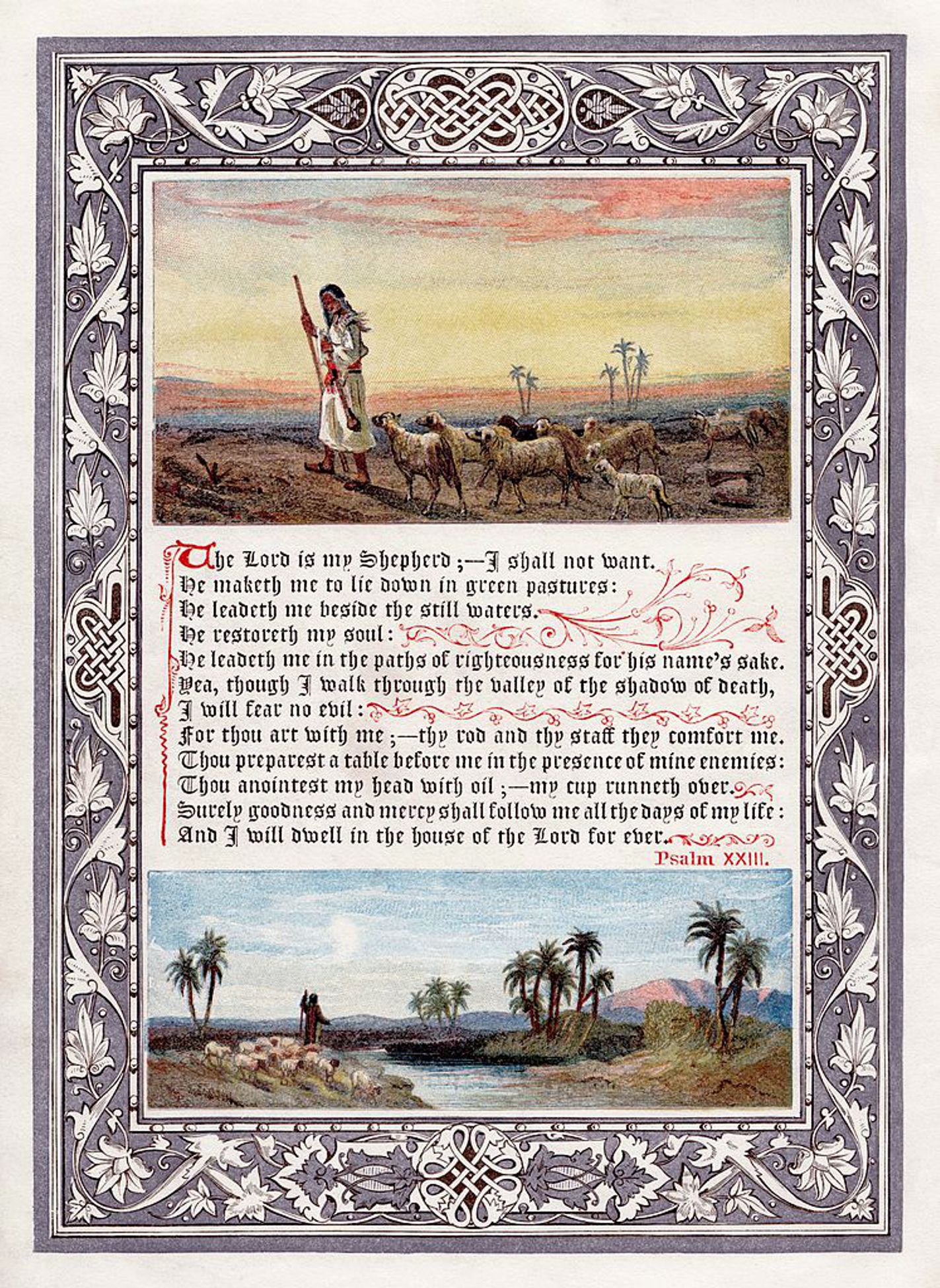
An image of Psalm 23 (KJV), frontispiece to the 1880 omnibus printing of The Sunday at Home

An image of Psalm 23 (KJV), frontispiece to the 1880 omnibus printing of The Sunday at Home: A Family Magazine for Sabbath Reading, [collected volume], London, Religious Tract Society, Public Domain in the United States

Believe and Suffer

Some of us are bewildered when we face adversity, some expect it more often than it occurs, some chalk it up to mysterious forces, and some see it as highly probable at all times. What is certain in this life is that we will suffer at some time in our lives. For all of us, I wish it were as certain that we would all believe so as to be saved from the penalty that our sins deserve. The Apostle Paul wrote to the church in Philippi about believing and suffering:

Only let your manner of life be worthy of the gospel of Christ, so that whether I come and see you or am absent, I may hear of you that:

You are standing firm in one spirit

With one mind striving side by side for the faith of the gospel, and

Not frightened in anything by your opponents.

This is a clear sign to them of their destruction, but of your salvation, and that from God.

For it has been granted to you that for the sake of Christ you should not only believe in him but also suffer for his sake, engaged in the same conflict that you saw I had and now hear that I still have.

Philippians 1:27-30 English Standard Version (ESV)

Paul says God has granted them to believe in Him. But also, in an act of His Sovereign will, to suffer. Not any kind of suffering, but that according to His will, “for His sake.”

The reformer and preacher, John Calvin, makes at least three points about these verses. First, our common struggle against our sin, the world, and the devil unites us. Even if we’re divided by our sins against one another, the struggle is so great against us that we will reconcile and contend for the faith together.

Striving together for the faith…is the strongest bond of concord, …for this has often been the occasion of reconciling even the greatest enemies.

…The Apostle’s meaning is this: “Let the faith of the gospel unite you together, more especially as that is a common armory against one and the same enemy.”

The wicked, too, conspire together for evil, but their agreement is accursed: let us, therefore, contend with one mind under the banner of faith.

These struggles, and our patient suffering, are ordained and given by God as a sign of our salvation to us and to the enemies of the faith. These are both a benefit for our increased devotion and an honor to participate in His sufferings.

To you, says he, it is given, not only to believe in Christ, but also to suffer for him. Hence even the sufferings themselves are evidences of the grace of God; and, since it is so, you have from this source a token of salvation. Oh, if this persuasion were effectually [woven into] our minds — that persecutions are to be reckoned among God’s benefits, what progress would be made in the doctrine of piety!

…It is the highest honor…conferred upon us by Divine grace, that we suffer for his name either reproach, or imprisonment, or miseries, or tortures, or even death, for in that case he adorns us with his marks of distinction. But [many would] rather [that] God [refrain from giving] gifts of that nature, than embrace with [readiness] the cross when it is presented to them. Alas, then, for our stupidity!

Finally, Calvin stresses that our struggle and godly resistance is analogous, though far lesser, to Christ’s struggle and godly resistance on the cross. Yet, both faith and endurance remain His unmerited gifts to us, evident in our inability to resist in our own strength.

[Paul] wisely conjoins faith with the cross by an inseparable connection, [so] that the Philippians may know that they have been called to the faith of Christ on this condition — that they endure persecutions on His account, as though he had said that their adoption can no more be separated from the cross, than Christ can be torn asunder from himself.

Here Paul clearly testifies, that faith, as well as [faithfulness] in enduring persecutions, is an unmerited gift of God. And certainly the knowledge of God is a wisdom that is too high for our attaining it by our own acuteness, and our weakness shows itself in daily instances in our own experience, when God withdraws his hand for a little while…

May God grant you to believe and suffer for His sake.

Suffering and the Sovereignty of God: An Interview with R.C. Sproul Jr., Ligonier Ministries

Why We Use Scripture Extensively in Our Posts

It’s not because we’re lazy (but, if you knew me better, you might disagree.) Nor is it because we can’t write well; though you may disagree with this as well. It’s because His word is what He says He will use to save us from the penalty of death which our sins against Him alone so richly deserve. He says:

“For as the rain and the snow come down from heaven

   and do not return there but water the earth,

making it bring forth and sprout,

   giving seed to the sower and bread to the eater,

so shall my word be that goes out from my mouth;

   it shall not return to me empty,

but it shall accomplish that which I purpose,

   and shall succeed in the thing for which I sent it.

Isaiah 55:10-11 English Standard Version (ESV)

His purpose, His eternal purpose is realized in Christ and the Church. The Lord alone is the objective source of knowledge and action who has entered into what we consider our world. Of course, it is His and is His forever.

When He was drawing me to Himself, He made my reading from the scriptures irresistible. I remember dwelling in long passages from a large bible at the front of a main line church sanctuary so many years ago. Months later, when He was ready for me to submit to Him in repentance, He sent an evangelist who read from the scriptures in answer to my doubting questions. And I trusted in the Lord Jesus Christ that evening after that sent one left.

You might think: “What does this have to do with me; I’m doing okay. It’s you, Adolphus, who needs a crutch to face the inevitability of death.” Well, I thought the same back then; so did everyone who professes belief in the Lord Jesus Christ. It is His sovereign will that chooses and saves you. No one, by strength of will, can save themselves. Everyone, whether saved or not, will stand before God’s judgment seat and give an account of ourselves. It is only by the merit of His Son, the Lord Jesus Christ, conferred to us through faith that we can face that judgment and live. All others will be sent away from His presence.

I offer you, not only the links above, but this verse for your consideration:

“For God so loved the world, that he gave his only Son, that whoever believes in him should not perish but have eternal life. John 3:16 (ESV)

Please, we beg of you, repent and believe.

Albert Mohler: The Authority of Scripture, Ligonier Ministries