Idols

Scripture is clear: Idols are nothing. However, the scriptures point out that it is not the physical manifestation of the idol nor the demonic forces it represents but the disaffection of peoples’ hearts from their Lord and Creator that is deadly.

In one of the more amusing Old Testament passages, the Prophet Isaiah shows the futility of idols by describing a man using half of a wooden log to warm himself and cook a meal and then worshipping the other half:

He cuts down cedars, or he chooses a cypress tree or an oak and lets it grow strong among the trees of the forest. He plants a cedar and the rain nourishes it. Then it becomes fuel for a man. He takes a part of it and warms himself; he kindles a fire and bakes bread. Also he makes a god and worships it; he makes it an idol and falls down before it. Half of it he burns in the fire. Over the half he eats meat; he roasts it and is satisfied. Also he warms himself and says, “Aha, I am warm, I have seen the fire!” And the rest of it he makes into a god, his idol, and falls down to it and worships it. He prays to it and says, “Deliver me, for you are my god! Isaiah 44:14-17 English Standard Version (ESV)

The Prophet Jeremiah says physical idols are mere inanimate articles of superstition:

Their idols are like scarecrows in a cucumber field,

   and they cannot speak;

they have to be carried,

   for they cannot walk.

Do not be afraid of them,

   for they cannot do evil,

   neither is it in them to do good.”

Jeremiah 10:5 (ESV)

The Prophet Ezekiel emphasizes what was true all along; idol worship is a question of a person’s heart disaffection from the Lord:

For any one of the house of Israel, or of the strangers who sojourn in Israel, who separates himself from me, taking his idols into his heart and putting the stumbling block of his iniquity before his face, and yet comes to a prophet to consult me through him, I the Lord will answer him myself. Ezekiel 14:7 (ESV)

John Calvin comments on this passage:

He who caused his idols to ascend unto his heart, he who placed the stumbling block of his iniquity before his face, that is, was drowned in his own superstitions, so that his idols bore sway in his heart.

Lastly, he who is so forward in audacity that he did not conceal his wish to oppose the Almighty: if anyone, says he, came to a prophet to inquire of him in me, or my name, I will answer him. He [the Lord speaking through the prophet]…could no longer bear the hypocrites who deluded themselves so proudly. And certainly when they openly worshipped idols, and were [filled] with many superstitions, what audacity and pride it was to consult true prophets?

It is much the same as if a person should want only insult and rail at a physician, and not only load him with reproaches, but even spit in his face: and should afterwards go and ask his advice, saying, “What do you advise me to do? How must I be cured of this disease?” Such pride could not be borne between man and man…How then will God permit such reproaches to go unpunished?

The Apostle Paul addresses the question of idols directly:

Therefore, as to the eating of food offered to idols, we know that “an idol has no real existence,” and that “there is no God but one.” For although there may be so-called gods in heaven or on earth—as indeed there are many “gods” and many “lords”— yet for us there is one God, the Father, from whom are all things and for whom we exist, and one Lord, Jesus Christ, through whom are all things and through whom we exist. 1 Corinthians 8:4-6 (ESV)

Calvin disagrees with the translation no…existence:

…As to the words, Erasmus reads thus — “An idol has no existence.” I prefer the rendering of the old translation — an idol is nothing. For the argument is this — that an idol is nothing, inasmuch as there is but one God; for it follows admirably — “If there is no other God besides our God, then an idol is an empty dream, and mere vanity.” When he says — and there is none other God but one, I understand the conjunction [as giving this explanation].

For the reason why an idol is nothing is, that it must be estimated according to the thing that it represents. Now it is appointed for the purpose of representing God: nay more, for the purpose of representing false gods, inasmuch as there is but one God, who is invisible and incomprehensible.

The reason, too, must be carefully observed — An idol is nothing because there is no God but one; for he is the invisible God, and cannot be represented by a visible sign, so as to be worshipped through means of it. Whether, therefore, idols are erected to represent the true God, or false gods, it is in all cases a perverse contrivance.

Hence Habakkuk calls idols teachers of lies, (Habakkuk 2:18) because they deal falsely in pretending to give a figure or image of God, and deceive men under a false title. Hence οὐδεν (nothing) refers not to essence, but to quality — for an idol is made of some substance — either silver, or wood, or stone; but as God does not choose to be represented in this way, it is vanity and nothing as to meaning and use.

Paul takes it further and calls covetousness, which is a specific heart attitude, idolatry:

For you may be sure of this, that everyone who is sexually immoral or impure, or who is covetous (that is, an idolater), has no inheritance in the kingdom of Christ and God. Ephesians 5:5 (ESV)

Calvin points out this identification is representative of a greater issue:

Nor covetous man, who is an idolater. “Covetousness,” as he says in another place, “is idolatry,” (Colossians 3:5) — not the idolatry which is so frequently condemned in Scripture, but one of a different description. All covetous men must deny God, and put wealth in his place; such is their blind greediness of wretched gain.

But why does Paul attribute to covetousness alone what belongs equally to other carnal passions? In what respect is covetousness better entitled to this disgraceful name than ambition, or than a vain confidence in ourselves?

I answer, that this disease is widely spread, and not a few minds have caught the infection. Nay, it is not reckoned a disease, but receives, on the contrary, very general commendation. This accounts for the harshness of Paul’s language, which arose from a desire to tear from our hearts the false view.

Calvin says that all heart passions that disobey God deserve being labelled idolatry. But, he says, Paul is emphasizing covetousness because of its effect in man. As his Lord had said:

“No one can serve two masters, for either he will hate the one and love the other, or he will be devoted to the one and despise the other. You cannot serve God and money [or possessions].” Matthew 6:24 (ESV)

The same also recorded in Luke 16:13. Calvin draws an important distinction concerning this passage in Matthew:

…Christ affirms that it is impossible for any man to obey God, and, at the same time, to obey his own flesh…where riches hold the dominion of the heart, God has lost his authority. True, it is not impossible that those who are rich shall serve God; but whoever gives himself up as a slave to riches must abandon the service of God: for covetousness makes us the slaves of the devil.

…What is here said with a special reference to riches, may be properly extended to every other description of vice. As God pronounces everywhere such commendations of sincerity, and hates a double heart, (1 Chronicles 12:33; Psalm 12:2) all are deceived, who imagine that he will be satisfied with the half of their heart.

All, indeed, confess in words, that, where the affection is not entire, there is no true worship of God: but they deny it in fact, when they attempt to reconcile contradictions. “I shall not cease,” says an ambitious man, “to serve God, though I devote a great part of my mind to hunting after honors.”

It is, no doubt, true, that believers themselves are never so perfectly devoted to obedience to God, as not to be withdrawn from it by the sinful desires of the flesh. But as they groan under this wretched bondage, and are dissatisfied with themselves, and give nothing more than an unwilling and reluctant service to the flesh, they are not said to serve two masters.

For their desires and exertions are approved by the Lord, as if they rendered to him a perfect obedience. But this passage reproves the hypocrisy of those who flatter themselves in their vices, as if they could reconcile light and darkness.

Scarecrows out standing in a field

Scarecrow, Japan Paddy Field, By FG2, released into the Public Domain by its author

Legalistic?

I’ve heard it said that those who profess Christ shouldn’t try to put off the old self and put on the new self, to pursue sanctification, or intentionally obey the word of God.

Paul, in his letter to the Philippian church says:

Therefore, my beloved, as you have always obeyed, so now, not only as in my presence but much more in my absence, work out your own salvation with fear and trembling, for it is God who works in you, both to will and to work for his good pleasure. Philippians 2:12-13 English Standard Version (ESV)

Some would have you believe that Paul must have been mistaken. John Calvin comments on these verses:

It is God that worketh. This is the true engine for bringing down all haughtiness — this the sword for putting an end to all pride, when we are taught that we are utterly nothing, and can do nothing, except through the grace of God alone. I mean supernatural grace, which comes forth from the spirit of regeneration.

…There are, in any action, two principal departments — the inclination, and the power to carry it into effect. Both of these he ascribes wholly to God; what more remains to us as a ground of glorying?

Nor is there any reason to doubt that this division has the same force as if Paul had expressed the whole in a single word; for the inclination is the groundwork; the accomplishment of it is the summit of the building brought to a completion. …For he does not say that our hearts are simply turned or stirred up, or that the infirmity of a good will is helped, but that a good inclination is wholly the work of God.

…For we acknowledge that we have from nature an inclination, but as it is depraved through the corruption of sin, it begins to be good only when it has been renewed by God. Nor do we say that a man does anything good without willing it, but that it is only when his inclination is regulated by the Spirit of God.

Hence, in so far as concerns this department, we see that the entire praise is ascribed to God, and that what sophists teach us is frivolous — that grace is offered to us, and placed, as it were, in the midst of us, that we may embrace it if we choose; for if God did not work in us efficaciously, he could not be said to produce in us a good inclination.

As to the second department, we must entertain the same view. “God,” says he, “is ̔Ο ἐνεργῶν το ἐνεργεῖν he that worketh in us to do.” He brings, therefore, to perfection those pious dispositions which he has implanted in us, that they may not be unproductive, as he promises by Ezekiel, —

I will cause them to walk in my commandments.” (Ezekiel 11:20)

From this we infer that perseverance, also, is his free gift.

According to his good pleasure. …For Paul has it in view to ascribe everything to God, and to take everything from us. Accordingly, not satisfied with having assigned to God the production both of willing and of doing aright, he ascribes both to his unmerited mercy. By this means he shuts out the contrivance of the sophists as to subsequent grace, which they imagine to be the reward of merit. Hence he teaches, that the whole course of our life, if we live aright, is regulated by God, and that, too, from his unmerited goodness.

With fear and trembling. From this Paul deduces an exhortation — that they must with fear work out their own salvation. He conjoins, as he is accustomed, fear and trembling, for the sake of greater intensity, to denote — serious and anxious fear. He, accordingly, represses drowsiness as well as confidence…

The inference, also, is to be carefully observed: “You have,” says he, “all things from God; therefore be solicitous and humble.” For there is nothing that ought to train us more to modesty and fear, than our being taught, that it is by the grace of God alone that we stand, and will instantly fall down, if he even in the slightest degree withdraw his hand. Confidence in ourselves produces carelessness and arrogance.

…For distrust of ourselves leads us to lean more confidently upon the mercy of God. And this is what Paul’s words import, for he requires nothing from the Philippians, but that they submit themselves to God with true self-renunciation.

Work out your own salvation. …Salvation is taken to mean the entire course of our calling, and that this term includes all things, by which God accomplishes that perfection, to which he has predestinated us by his gracious choice. This no one will deny…

We are said to perfect it, when, under the regulation of the Spirit, we aspire after a life of blessedness. It is God that calls us, and offers to us salvation; it is our part to embrace by faith what he gives, and by obedience act suitably to his calling; but we have neither from ourselves. Hence we act only when he has prepared us for acting.

Addressing the whole issue, James wrote ironically:

But someone will say, “You have faith and I have works.” Show me your faith apart from your works, and I will show you my faith by my works. James 2:18 (ESV)

Know this then, that faith without works is dead.

Papyrus 54: James 2:16-18

Papyrus 54: James 2:16-18, 6th century, Public Domain in US

Restore to Repentance?

Having been in the church a while, I’ve seen and heard things. This verse has always troubled me:

For it is impossible,

in the case of those:

who have once been enlightened,

who have tasted the heavenly gift,

and have shared in the Holy Spirit,

and have tasted the goodness of the word of God and the powers of the age to come,

and then have fallen away,

to restore them again to repentance,

since they are:

crucifying once again the Son of God to their own harm

and holding him up to contempt.

Hebrews 6:4-6 English Standard Version (ESV) emphasis mine

I had once presented the gospel to a fellow who said to me that he knew he was not redeemable because of these verses. Ignorant as I was at the time, I tried to convince him that there was always hope while he yet lived. He, a non-believer, quoted these verses to me, thanked me for my concern, and wandered away. I never saw him again.

John Calvin comments:

Let us then know, that the Gospel cannot be otherwise rightly known than by the illumination of the Spirit, and that being thus drawn away from the world, we are raised up to heaven, and that knowing the goodness of God we rely on his word.

But here arises a new question, how can it be that he who has once made such a progress should afterwards fall away? For God, it may be said, calls none effectually but the elect, and Paul testifies that they are really his sons who are led by his Spirit, (Romans 8:14) and he teaches us, that it is a sure pledge of adoption when Christ makes us partakers of his Spirit. The elect are also beyond the danger of finally falling away; for the Father who gave them to be preserved by Christ his Son is greater than all, and Christ promises to watch over them all so that none may perish.

To all this I answer, That God indeed favors none but the elect alone with the Spirit of regeneration, and that by this they are distinguished from the reprobate; for they are renewed after his image and receive the earnest of the Spirit in hope of the future inheritance, and by the same Spirit the Gospel is sealed in their hearts.

But I cannot admit that all this is any reason why he should not grant the reprobate also some taste of his grace, why he should not irradiate their minds with some sparks of his light, why he should not give them some perception of his goodness, and in some sort engrave his word on their hearts.

Otherwise, where would be the temporal faith mentioned by Mark 4:17? There is therefore some knowledge even in the reprobate, which afterwards vanishes away, either because it did not strike roots sufficiently deep, or because it withers, being choked up.

And by this bridle the Lord keeps us in fear and humility; and we certainly see how prone human nature is otherwise to security and foolish confidence. At the same time our solicitude ought to be such as not to disturb the peace of conscience. For the Lord strengthens faith in us, while he subdues our flesh: and hence he would have faith to remain and rest tranquilly as in a safe haven; but he exercises the flesh with various conflicts, that it may not grow wanton through idleness.

So the bitter admonition in these verses serves us well: to keep us striving for holiness, humility, and obedience to the Lord Jesus Christ in all we think, say, and do.

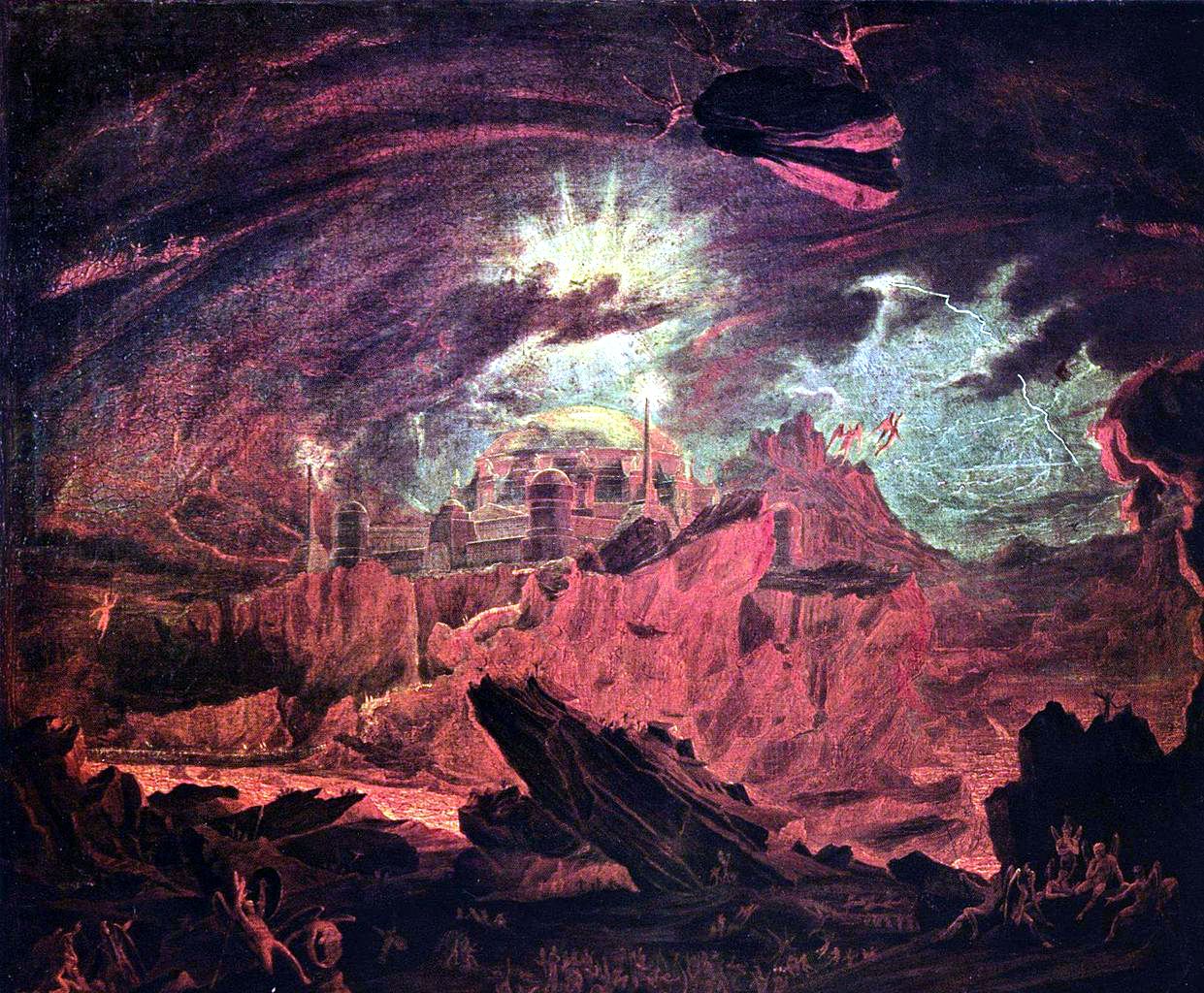
Fallen Angels in Hell

Fallen Angels in Hell, circa 1841, John Martin, 1789 – 1854, Public Domain in US

I Desire Mercy, and Not Sacrifice

The Lord Jesus Christ referred to this scripture twice as recorded in the gospels.

On the first occasion, His message seems to be: associate with the sin sick to bring them healing and exhort those, who consider themselves well and in no need of a doctor, that they need healing, too.

And as Jesus reclined at table in the house, behold, many tax collectors and sinners came and were reclining with Jesus and his disciples. And when the Pharisees saw this, they said to his disciples, “Why does your teacher eat with tax collectors and sinners?”  But when he heard it, he said, “Those who are well have no need of a physician, but those who are sick. Go and learn what this means, ‘I desire mercy, and not sacrifice.’ For I came not to call the righteous, but sinners.” Matthew 9:10-13 English Standard Version (ESV)

On the second occasion, He urged those who considered themselves righteous to obey the substance and not just the form of God’s commandments.

Or have you not read in the Law how on the Sabbath the priests in the temple profane the Sabbath and are guiltless? I tell you, something greater than the temple is here. And if you had known what this means, ‘I desire mercy, and not sacrifice,’ you would not have condemned the guiltless. For the Son of Man is lord of the Sabbath.” Matthew 12:5-8 (ESV)

Clearly, these folks thought themselves better than those around them.

But to what scripture (because the New Testament was not yet written) was the Lord referring? He quoted Hosea 6:6, but verses six and seven complete a thought.

For I desire steadfast love and not sacrifice, the knowledge of God rather than burnt offerings.

But like Adam they transgressed the covenant; there they dealt faithlessly with me.

Hosea 6:6-7 (ESV)

Textual notes indicate the term steadfast love is rendered mercy in the Septuagint (Greek translation of the Old Testament).

John Calvin comments on verse six:

It is a remarkable passage; the Son of God has twice quoted it. The Pharisees reproached him for his intercourse with men of bad and abandoned life, and he said to them in Matthew 9, ‘Mercy I desire, and not sacrifice.’ He shows, by this defense, that God is not worshipped by external ceremonies, but when men forgive and bear with one another, and are not above measure rigid. [emphasis added]

Again, in the Matthew 12, when the Pharisees blamed the disciples for gathering ears of corn, he said ‘But rather go and learn what this is, Mercy I desire, and not sacrifice.’ Inasmuch as they were so severe against his disciples, Christ shows that those who make holiness to consist in ceremonies are foolish worshipers of God; and that they also blamed their brethren without a cause, and made a crime of what was not in itself sinful, and what could be easily defended by any wise and calm expounder.

Calvin adds concerning verse seven:

God then subjoins a complaint, — But they like men have transgressed the covenant; there have they dealt treacherously against me. Here God shows that the Israelites boasted in vain of their sacrifices and of all the pomps of their external worship, for God did not regard these external things, but only wished to exercise the faithful in spiritual worship.

Then the import of the whole is this, “My design was, when I appointed the sacrifices and the whole legal worship, to lead you so to myself, that there might be nothing carnal or earthly in your sacrificing; but ye have corrupted the whole law; you have been perverse interpreters; for sacrifices have been nothing else among you but mockery as if it were a satisfaction to me to have an ox or a ram killed. You have then transgressed my covenant; and it is nothing that the people say to me, that they have diligently performed the outward ceremonies, for such a worship is not in the least valued by me.”

We can (and must) replace Calvin’s reference to ‘Israelites who boast in vain’ with the ‘unbelieving church of that age,’ for such they were. And we have these same with us today. It’s not as if they are unaware of the substance of proper worship, it’s just less costly (in the here and now) to practice merely the form of it.

At least two of these folks asked the Lord, “Which commandment is the most important of all?” He answered:

“You shall love the Lord your God with all your heart and with all your soul and with all your strength and with all your mind, and your neighbor as yourself.”

On another occasion He asked one of these folks how they understood the scriptures in a nutshell and they gave the same answer. To this one, the Lord said, “You have answered correctly; do this, and you will live.”

But, as we are prone to do, let us not go beyond what the scriptures say. The best example that comes to mind of mercy correctly applied is that demonstrated by the Lord.

The Woman taken in Adultery.  1644, Rembrandt (1606 – 1669), Public Domain

The Woman taken in Adultery. 1644, Rembrandt (1606 – 1669), Public Domain

Here’s the entire story from the source:

Early in the morning he came again to the temple. All the people came to him, and he sat down and taught them.  The scribes and the Pharisees brought a woman who had been caught in adultery, and placing her in the midst they said to him, “Teacher, this woman has been caught in the act of adultery. Now in the Law Moses commanded us to stone such women. So what do you say?” This they said to test him, that they might have some charge to bring against him.

Jesus bent down and wrote with his finger on the ground.  And as they continued to ask him, he stood up and said to them, “Let him who is without sin among you be the first to throw a stone at her.”  And once more he bent down and wrote on the ground.  

But when they heard it, they went away one by one, beginning with the older ones, and Jesus was left alone with the woman standing before him.  Jesus stood up and said to her, “Woman, where are they? Has no one condemned you?”  She said, “No one, Lord.” And Jesus said, “Neither do I condemn you; go, and from now on sin no more.”

So there we have it. When someone is repentant from the heart (and surely she was), the Lord says:

“Neither do I condemn you; go, and from now on sin no more.”

Go and do likewise.