Legalistic?

I’ve heard it said that those who profess Christ shouldn’t try to put off the old self and put on the new self, to pursue sanctification, or intentionally obey the word of God.

Paul, in his letter to the Philippian church says:

Therefore, my beloved, as you have always obeyed, so now, not only as in my presence but much more in my absence, work out your own salvation with fear and trembling, for it is God who works in you, both to will and to work for his good pleasure. Philippians 2:12-13 English Standard Version (ESV)

Some would have you believe that Paul must have been mistaken. John Calvin comments on these verses:

It is God that worketh. This is the true engine for bringing down all haughtiness — this the sword for putting an end to all pride, when we are taught that we are utterly nothing, and can do nothing, except through the grace of God alone. I mean supernatural grace, which comes forth from the spirit of regeneration.

…There are, in any action, two principal departments — the inclination, and the power to carry it into effect. Both of these he ascribes wholly to God; what more remains to us as a ground of glorying?

Nor is there any reason to doubt that this division has the same force as if Paul had expressed the whole in a single word; for the inclination is the groundwork; the accomplishment of it is the summit of the building brought to a completion. …For he does not say that our hearts are simply turned or stirred up, or that the infirmity of a good will is helped, but that a good inclination is wholly the work of God.

…For we acknowledge that we have from nature an inclination, but as it is depraved through the corruption of sin, it begins to be good only when it has been renewed by God. Nor do we say that a man does anything good without willing it, but that it is only when his inclination is regulated by the Spirit of God.

Hence, in so far as concerns this department, we see that the entire praise is ascribed to God, and that what sophists teach us is frivolous — that grace is offered to us, and placed, as it were, in the midst of us, that we may embrace it if we choose; for if God did not work in us efficaciously, he could not be said to produce in us a good inclination.

As to the second department, we must entertain the same view. “God,” says he, “is ̔Ο ἐνεργῶν το ἐνεργεῖν he that worketh in us to do.” He brings, therefore, to perfection those pious dispositions which he has implanted in us, that they may not be unproductive, as he promises by Ezekiel, —

I will cause them to walk in my commandments.” (Ezekiel 11:20)

From this we infer that perseverance, also, is his free gift.

According to his good pleasure. …For Paul has it in view to ascribe everything to God, and to take everything from us. Accordingly, not satisfied with having assigned to God the production both of willing and of doing aright, he ascribes both to his unmerited mercy. By this means he shuts out the contrivance of the sophists as to subsequent grace, which they imagine to be the reward of merit. Hence he teaches, that the whole course of our life, if we live aright, is regulated by God, and that, too, from his unmerited goodness.

With fear and trembling. From this Paul deduces an exhortation — that they must with fear work out their own salvation. He conjoins, as he is accustomed, fear and trembling, for the sake of greater intensity, to denote — serious and anxious fear. He, accordingly, represses drowsiness as well as confidence…

The inference, also, is to be carefully observed: “You have,” says he, “all things from God; therefore be solicitous and humble.” For there is nothing that ought to train us more to modesty and fear, than our being taught, that it is by the grace of God alone that we stand, and will instantly fall down, if he even in the slightest degree withdraw his hand. Confidence in ourselves produces carelessness and arrogance.

…For distrust of ourselves leads us to lean more confidently upon the mercy of God. And this is what Paul’s words import, for he requires nothing from the Philippians, but that they submit themselves to God with true self-renunciation.

Work out your own salvation. …Salvation is taken to mean the entire course of our calling, and that this term includes all things, by which God accomplishes that perfection, to which he has predestinated us by his gracious choice. This no one will deny…

We are said to perfect it, when, under the regulation of the Spirit, we aspire after a life of blessedness. It is God that calls us, and offers to us salvation; it is our part to embrace by faith what he gives, and by obedience act suitably to his calling; but we have neither from ourselves. Hence we act only when he has prepared us for acting.

Addressing the whole issue, James wrote ironically:

But someone will say, “You have faith and I have works.” Show me your faith apart from your works, and I will show you my faith by my works. James 2:18 (ESV)

Know this then, that faith without works is dead.

Papyrus 54: James 2:16-18

Papyrus 54: James 2:16-18, 6th century, Public Domain in US
Restore to Repentance?

Having been in the church a while, I’ve seen and heard things. This verse has always troubled me:

For it is impossible,

in the case of those:

who have once been enlightened,

who have tasted the heavenly gift,

and have shared in the Holy Spirit,

and have tasted the goodness of the word of God and the powers of the age to come,

and then have fallen away,

to restore them again to repentance,

since they are:

crucifying once again the Son of God to their own harm

and holding him up to contempt.

Hebrews 6:4-6 English Standard Version (ESV) emphasis mine

I had once presented the gospel to a fellow who said to me that he knew he was not redeemable because of these verses. Ignorant as I was at the time, I tried to convince him that there was always hope while he yet lived. He, a non-believer, quoted these verses to me, thanked me for my concern, and wandered away. I never saw him again.

John Calvin comments:

Let us then know, that the Gospel cannot be otherwise rightly known than by the illumination of the Spirit, and that being thus drawn away from the world, we are raised up to heaven, and that knowing the goodness of God we rely on his word.

But here arises a new question, how can it be that he who has once made such a progress should afterwards fall away? For God, it may be said, calls none effectually but the elect, and Paul testifies that they are really his sons who are led by his Spirit, (Romans 8:14) and he teaches us, that it is a sure pledge of adoption when Christ makes us partakers of his Spirit. The elect are also beyond the danger of finally falling away; for the Father who gave them to be preserved by Christ his Son is greater than all, and Christ promises to watch over them all so that none may perish.

To all this I answer, That God indeed favors none but the elect alone with the Spirit of regeneration, and that by this they are distinguished from the reprobate; for they are renewed after his image and receive the earnest of the Spirit in hope of the future inheritance, and by the same Spirit the Gospel is sealed in their hearts.

But I cannot admit that all this is any reason why he should not grant the reprobate also some taste of his grace, why he should not irradiate their minds with some sparks of his light, why he should not give them some perception of his goodness, and in some sort engrave his word on their hearts.

Otherwise, where would be the temporal faith mentioned by Mark 4:17? There is therefore some knowledge even in the reprobate, which afterwards vanishes away, either because it did not strike roots sufficiently deep, or because it withers, being choked up.

And by this bridle the Lord keeps us in fear and humility; and we certainly see how prone human nature is otherwise to security and foolish confidence. At the same time our solicitude ought to be such as not to disturb the peace of conscience. For the Lord strengthens faith in us, while he subdues our flesh: and hence he would have faith to remain and rest tranquilly as in a safe haven; but he exercises the flesh with various conflicts, that it may not grow wanton through idleness.

So the bitter admonition in these verses serves us well: to keep us striving for holiness, humility, and obedience to the Lord Jesus Christ in all we think, say, and do.

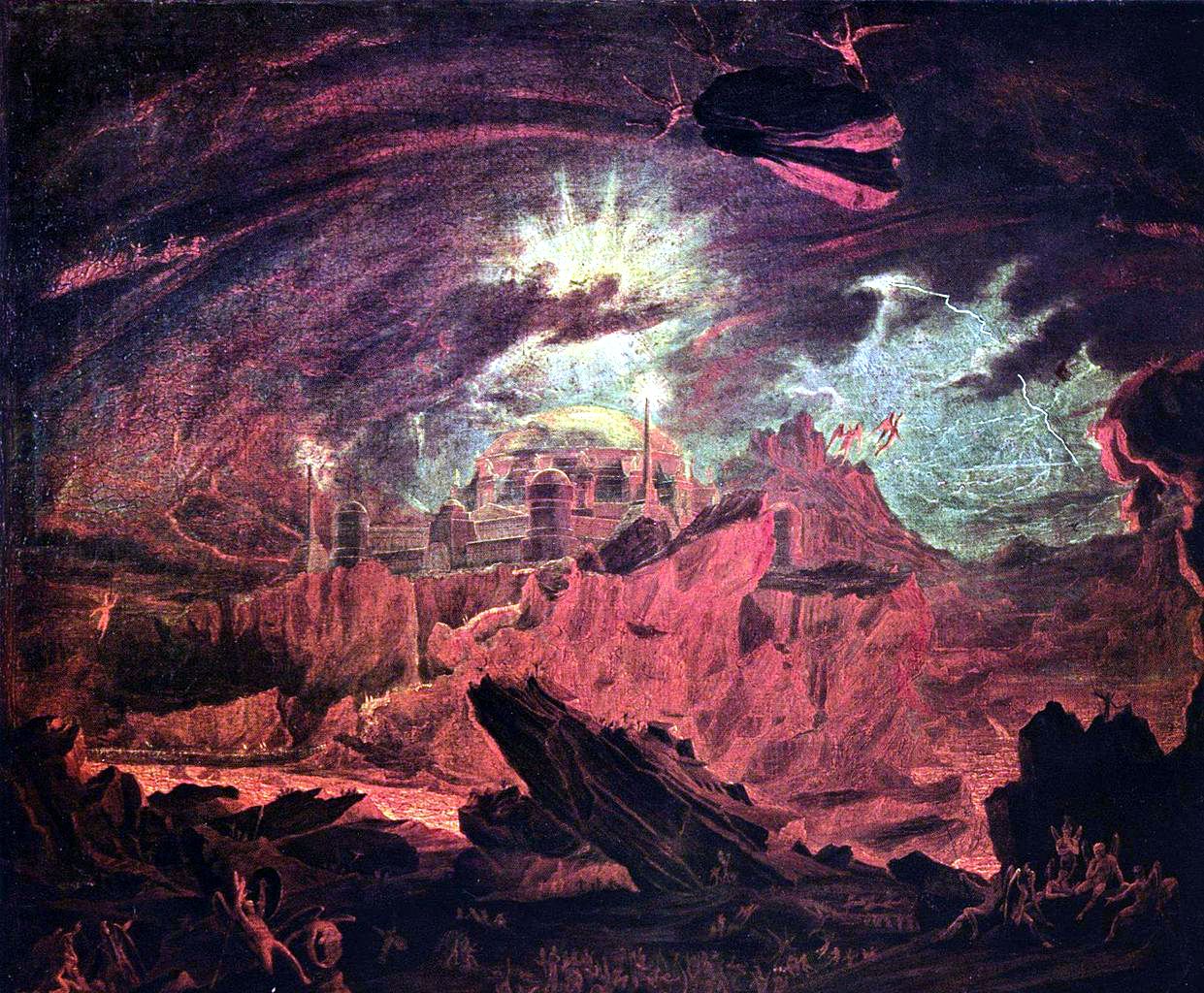
Fallen Angels in Hell

Fallen Angels in Hell, circa 1841, John Martin, 1789 – 1854, Public Domain in US

Can I be Certain of You?

In his comments on Philippians, chapter 1, verse 6:

And I am sure of this, that he who began a good work in you will bring it to completion at the day of Jesus Christ. Philippians 1:6 English Standard Version (ESV)

John Calvin says:

It is asked, however, whether anyone can be certain as to the salvation of others, for Paul here is not speaking of himself but of the Philippians. I answer, that the assurance which an individual has respecting his own salvation, is very different from what he has as to that of another. For the Spirit of God is a witness to me of my calling, as he is to each of the elect. As to others, we have no testimony, except from the outward efficacy of the Spirit; that is, in so far as the grace of God shews itself in them, so that we come to know it.

There is, therefore, a great difference, because the assurance of faith remains inwardly shut up, and does not extend itself to others. But wherever we see any such tokens of Divine election as can be perceived by us, we ought immediately to be stirred up to entertain good hope, both in order that we may not be envious towards our neighbors, and withhold from them an equitable and kind judgment of charity; and also, that we may be grateful to God. This, however, is a general rule both as to ourselves and as to others — that, distrusting our own strength, we depend entirely upon God alone [emphasis mine].

And what can we look for as tokens of Divine election? Scripture says we are to be clothed in His righteousness, in word and deed:

Put on then, as God’s chosen ones, holy and beloved, compassionate hearts, kindness, humility, meekness, and patience, bearing with one another and, if one has a complaint against another, forgiving each other; as the Lord has forgiven you, so you also must forgive. Colossians 3:12-13 (ESV)

Look for these things in yourselves first and then in others.

Tamme-Lauri oak. The oldest tree in Estonia

Tamme-Lauri oak. The oldest tree in Estonia, 3 September 2013, Abrget47j, Creative Commons Attribution-Share Alike 3.0 Unported

Earn Your Place In Heaven?

Recently, two prominent personalities implied one could earn one’s way to heaven. I’ll let them say it in their own words. Former New York City Mayor Michael Bloomberg is quoted as saying:

“I am telling you if there is a God, when I get to Heaven I’m not stopping to be interviewed,” he told the New York Times, citing his work on gun control, obesity, and anti-smoking laws. “I am heading straight in. I have earned my place in Heaven. It’s not even close.”

On April 15, 2014, in a Back of Book Segment: Life After Death with guest Pastor Robert Jeffers, Bill O’Reilly opined:

“I’ve always felt there is a battle between good and evil and if there is a heaven you have to earn your way in through your actions on Earth.”

Pastor Jeffers corrected the statement by quoting from the book of James.

And, of course, for those who are old enough to remember or are well–schooled in the classics, there’s Led Zeppelin’s Stairway to Heaven:

There’s a lady who’s sure all that glitters is gold And she’s buying a stairway to heaven.

These things they say make me wonder…

But then I remember that He saved us, not because of good works we have done, but according to His own mercy.

I recall that entrance to heaven depends not on human will or exertion, but on God, who has mercy.

Finally, I know that we were ransomed from our futile ways, not with perishable silver or gold, but with Christ’s precious blood.

And, lest we think these assurances are merely cherry picked scriptures, He states, through His prophet, in a single passage excerpted here:

And you were dead in the trespasses and sins…

But God, being rich in mercy, because of the great love with which he loved us, even when we were dead in our trespasses, made us alive together with Christ—by grace you have been saved—

For by grace you have been saved through faith. And this is not your own doing; it is the gift of God, not a result of works, so that no one may boast.

The dead are incapable of earning anything. Only by His mercy does He raise us to life that we might repent of our pride and circumspectly follow Him. And only His way leads to life eternal.

Heaven’s Peak by Greg Willis

Heaven’s Peak by Greg Willis (Creative Commons Attribution-Share Alike 2.0 Generic)

Neil deGrasse Tyson Mistakes God for Who He Is Not

Of course all humans fail and err. However, does Tyson mean to impugn God?

According to Mother Jones’ biblical and cosmological authority, Chris Mooney:

To be a Young Earth creationist is to hold a truly unique place in the history of wrongness. These religious ideologues don’t just deny human evolution; their belief in a universe that is only a few thousand years old commits them to an enormity of other errors, including many beliefs that fly in the face of modern physics.

But maybe he’s just host of MJ’s Climate Desk.

According to Mooney, Tyson explains:

To believe in a universe as young as 6 or 7,000 years old is to extinguish the light from most of the galaxy. Not to mention the light from all the hundred billion other galaxies in the observable universe.

But, by this statement, Tyson fallaciously misrepresents his opponent.

Crab Nebula (NASA)

Crab Nebula by Hubble Space Telescope (Public Domain)

Someone of no import nowadays, John Calvin, had this to say of God’s prerogatives with respect to His universe:

With regard to inanimate objects again we must hold that though each is possessed of its peculiar properties, yet all of them exert their force only in so far as directed by the immediate hand of God. Hence they are merely instruments, into which God constantly infuses what energy he sees meet, and turns and converts to any purpose at his pleasure. No created object makes a more wonderful or glorious display than the sun. …No pious man, therefore, will make the sun either the necessary or principal cause of those things which existed before the creation of the sun, but only the instrument which God employs, because he so pleases; though he can lay it aside, and act equally well by himself: Again, when we read, that at the prayer of Joshua the sun was stayed in its course; that as a favor to Hezekiah, its shadow receded ten degrees; by these miracles God declared that the sun does not daily rise and set by a blind instinct of nature, but is governed by Him in its course, that he may renew the remembrance of his paternal favor toward us…

We addressed this previously with our blog post Superstition. Another expert, Aldous Huxley, said:

Most ignorance is vincible ignorance. We don’t know because we don’t want to know. It is our will that decides how and upon what subjects we shall use our intelligence… No philosophy is completely disinterested. The pure love of truth is always mingled to some extent with the need, consciously or unconsciously felt by even the noblest and the most intelligent philosophers.

However, I think we’d all do well to heed John Horgan when he says:

Of course we feel validated when others see the world as we do. But we should resist the need to insist or even imply that our views—or anti-views—are better than all others. In fact, we should all be more modest in how we talk about our faith or lack thereof.

By way of disclosure, we do not hold to typical creation hypotheses, we believe Genesis chapters 1 and 2 are in harmony, and John Horgan does not endorse the content or views expressed on this blog.

There, But for God’s Grace and Mercy Through His Providence, Go I

John Calvin

John Calvin (Photo credit: Wikipedia)

Why are we shocked when things like this, this, or this happen?

These sensational stories are tragic, no doubt. Scary, even. But we seem to think we’d never do or even be capable of such heinous acts. Then we bolt our door against our neighbor (rightly or wrongly, I can’t say; that’s up to you). Some believe we’re naturally moral. Still others say: red in tooth and claw.

The scriptures conclude we all fall short of God’s glory. But isn’t this an overstatement of our condition? Aren’t we really good, but just misguided, unmotivated, or low informational?

Paul, in the letter to the Romans, elaborates on what he concludes in case we were unsure:

11 no one understands;
no one seeks for God.
12  All have turned aside; together they have become worthless;
no one does good,
not even one.”
13 “Their throat is an open grave;
they use their tongues to deceive.”
“The venom of asps is under their lips.”
14 “Their mouth is full of curses and bitterness.”
15 “Their feet are swift to shed blood;
16   in their paths are ruin and misery,
17    and the way of peace they have not known.”
18   “There is no fear of God before their eyes.”

So, we have no excuse to be shocked at these sensational stories. This is the condition of man. However, if this is so, why then do we not claw and bite until we are no more?

John Calvin, a theologian not often cited now–a–days, suggests in the Institutes of the Christian Religion, book 1, chapter 17, and paragraph 11:

…How comes it, I ask, that their confidence never fails, but just that while the world apparently revolves at random, they know that God is everywhere at work, and feel assured that his work will be their safety? When assailed by the devil and wicked men, were they not confirmed by remembering and meditating on Providence, they should, of necessity, forthwith despond. But when they call to mind that the devil, and the whole train of the ungodly, are, in all directions, held in by the hand of God as with a bridle, so that they can neither conceive any mischief, nor plan what they have conceived, nor how much so ever they may have planned, move a single finger to perpetrate, unless in so far as he permits, nay, unless in so far as he commands; that they are not only bound by his fetters, but are even forced to do him service,—when the godly think of all these things they have ample sources of consolation. For, as it belongs to the lord to arm the fury of such foes and turn and destine it at pleasure, so it is his also to determine the measure and the end, so as to prevent them from breaking loose and wantoning as they list…

So God not only constrains the evildoer but commands him to do His bidding, yet without complicity or taint thrown back upon Him. But why, if we’re this way, are we guilty at all?

Calvin says in the Institutes of the Christian Religion, book 1, chapter 17, and paragraph 5:

… As all contingencies whatsoever depend on it, therefore, neither thefts nor adulteries, nor murders, are perpetrated without an interposition of the divine will. Why, then, they ask, should the thief be punished for robbing him whom the Lord chose to chastise with poverty? Why should the murderer be punished for slaying him whose life the Lord had terminated? If all such persons serve the will of God, why should they be punished?

I deny that they serve the will of God. For we cannot say that he who is carried away by a wicked mind performs service on the order of God, when he is only following his own malignant desires. He obeys God, who, being instructed in his will, hastens in the direction in which God calls him.

But how are we so instructed unless by his word? The will declared by his word is, therefore, that which we must keep in view in acting, God requires of us nothing but what he enjoins. If we design anything contrary to his precept, it is not obedience, but contumacy and transgression. But if he did not will it, we could not do it. I admit this.

But do we act wickedly for the purpose of yielding obedience to him? This, assuredly, he does not command. Nay, rather we rush on, not thinking of what he wishes, but so inflamed by our own passionate lust, that, with destined purpose, we strive against him. And in this way, while acting wickedly, we serve his righteous ordination, since in his boundless wisdom he well knows how to use bad instruments for good purposes.

And see how absurd this mode of arguing is. They will have it that crimes ought not to be punished in their authors, because they are not committed without the dispensation of God. I concede more—that thieves and murderers, and other evil-doers, are instruments of Divine Providence, being employed by the Lord himself to execute the Judgments which he has resolved to inflict.

But I deny that this forms any excuse for their misdeeds. For how? Will they implicate God in the same iniquity with themselves, or will they cloak their depravity by his righteousness? They cannot exculpate themselves, for their own conscience condemns them: they cannot charge God, since they perceive the whole wickedness in themselves, and nothing in Him save the legitimate use of their wickedness

So, it is apparent that Romans 3 is true and we are not only held back from what we could do but others are employed to execute God’s judgments and, yet, are solely guilty of their transgression.

I see the tendency to do wrong in myself all the time. Do you? The only remedy is falling at the feet of the Lord Jesus Christ in surrender because he says: Come to me, all who labor and are heavy laden, and I will give you rest.

Redeemed Regret – Macon Georgia

Ecclesia and the Three Sons of Noah - medieval...

Ecclesia and the Three Sons of Noah – medieval stained glass detail, Canterbury Cathedral (Photo credit: chrisjohnbeckett)

It was a cold night, and I was running through a neighborhood I feared to walk in during the day. The sun was coming up as I reached the main drag. I was almost home. Just a few more miles to go.

When I reached my toasty–warm one–room apartment, I found it as I had left it so many weeks before. The boarder she asked me to house had left it in pretty good shape. Better than I deserved. She, though, did not leave me in very good shape. I collapsed on my bed.

I was bought and sold as you would a loaf of bread, maybe half a loaf, when all was said and done. We met by arrangement of our mutual friends at the time. They had thoughts of what each of us wanted and saw a match worth making. It took a few strikes of that match to ignite a spark.

I thought one thing and she thought another. I was headed toward the idea of marriage and she was headed toward her former lover. However, her way lay through me. I was trapped by an unrealizable idea that she had no intention of bringing to fruition. She got what she wanted. I should have known better. I was so infatuated with the romance of Hollywood that I ignored the warning signs of disaffection and entrapment.

The prophets say, “More bitter than death: the woman whose heart is snares and nets, and whose hands are fetters. He who pleases God escapes her…” Well, that escape wasn’t my doing. Not long afterward, I was captured by the Sovereign One, who, alone, was deserving of my utmost allegiance. He drew me as surely as a parent draws their child to what is good. I was now free indeed.

There, in new surroundings with much to learn and unlearn, I was barely coping with all the changes I needed to make. I was juggling responsibilities that I had so long neglected. Folks were having their doubts about whether I was having doubts. Things were taken away as well as given. I was experiencing the Ecclesia firsthand. Having searched for a new place to lay my head, I found myself in the company of a diverse and chastening crowd.

My time was up so soon. I had gained my employment from one and ceded my bedroom to another. I needed to find a new residence quickly. That’s when I fell into a trap again. Not of the same kind, thankfully, but entrapped nevertheless. I should have seen the warning signs. I should have fled my obligations (but I wouldn’t on principle). Only Mercy rescued me once more.

In the midst of the turmoil and strife, I did not notice a rare opportunity escape overseas. I was too bound by my unsophistication and numbed by the rapid–fire changes in my life. I was dislocated from a proper response. In a parking lot, on another cold night, I bid farewell to someone I should have known better.

I imagine her happily married and blessed with children, prosperous and satisfied with her life. A better path than I could have given. I must tread alone toward our mutual upward goal. For I have no doubts about her.