The Fourth Revolution – Review and Commentary

The book by former Economist Editor in Chief John Micklethwait and Management Editor Adrian Wooldridge: The Fourth Revolution: The Global Race to Reinvent the State contends that states in the West must complete the revolution started by Reagan and Thatcher and become smaller, more efficient systems that provide greater individual liberty.

In 1814, during the first revolutionary period, John Adams said: “Democracy never lasts long. It soon wastes, exhausts, and murders itself. There never was a democracy yet that did not commit suicide.” He also said: “It is vain to say that democracy is less vain, less proud, less selfish, less ambitious, or less avaricious than autocracy or monarchy…” The authors of The Fourth Revolution contend that the secret of good governance lies in checking human desires, not letting them run free.

America’s founding fathers also worried that democracy would crush individual liberty. The majority would use pressure and regulation to press the minority into conformity. The authors say few examine these issues now. In the vacuum, voters regard the practice of democracy as corrupt and inefficient. And yet they won’t question the theory. Their contempt delegitimizes government and turns setbacks into crises.

Democracy is overloaded with obligations, overburdened with unfulfillable expectations, and distorted by special interests. The population’s dependency forces government to continuously expand. During the second revolution, nineteenth century liberals in Great Britain reformed both the state’s machinery and its form of representation. The authors suggest today’s politicians should trim the state and renew democracy.

The rise of the Beijing consensus’s top down modernization and meritocratic governmental institutions makes the west’s democratic alternative seem regressive. America demonstrates too many of democracy’s vices and Europe too few of its virtues.

America’s checks and balances, though successful in the past in preventing the tyranny of the majority, has been subverted to become a political tool that decreases efficiency, compromise, and justice. America’s gerrymandering voting districts entrench special interests, extremism, and mediocre representation for a lifetime. America’s lobbying by special interests awash in money begs the question of graft and favoritism.

Europe, in an effort to stifle popular passions that caused two world wars, has sacrificed national sovereignty to technocratic governmental, financial, and trade bodies and, in the process, are vivifying national populist movements.

Economic inequality is putting western democracy to the test. Quoting Louis Brandeis, “we can have a democratic society or we can have great concentrated wealth in the hands of a few. We cannot have both.” In the era of financial crisis with less to go around and a bloated but inefficient welfare state, the West must stop democracy’s decay or risk their people’s ire.

The authors call for limited government that constrains itself through self-denying ordinances. In the process, three government dangers must be overcome: liberty encroaching expansion, surrender to special interests, and making unfulfillable promises.

As remedies, the authors propose balanced budgets over the economic cycle, fully funded and means tested entitlements tied to life expectancy, and sunset clauses for laws and regulations. Handing some economic power to technocrats and independent commissions and pushing decisions to the states and cities are ways to limit centralized power.

Micklethwait and Wooldridge say that the cost of inaction is high—unreformed, the welfare state will collapse under oppressive debt. The opportunity is great—the rewards to states that revive democracy and reduce the burden of the state will sprint ahead of its peers economically and in life satisfaction. History will be on the side of the nations that promote individual liberty.

We in the West are polarized politically. Our leaders pander to special interests instead of providing for the common good. How much longer can we mortgage our children’s future to pay for our pensions and health care? We are getting less benefit from and paying more for our educational system. We’re transferring tax revenues to the middle classes and crony capitalists in agriculture, defense, finance, etc. at the expense of caring for the truly poor.

The world is looking to the East as the model for economic advances and a better life at the expense of individual liberties. We in the West must become serious about reforming our systems or be left behind in the rubbish heap of history. Some western states, provinces, and cities are becoming more efficient through experimentation. There are lots of ideas to try, if only we were willing to start.

In the coming weeks we’ll cover how Beatrice and Sidney Webb laid the foundations for the welfare state in the third revolution, how Lee Kuan Yew created the Asian Consensus, and how the Nordic states point the way to the future.

The Fourth Revolution: The Global Race to Reinvent the State

Idols

Scripture is clear: Idols are nothing. However, the scriptures point out that it is not the physical manifestation of the idol nor the demonic forces it represents but the disaffection of peoples’ hearts from their Lord and Creator that is deadly.

In one of the more amusing Old Testament passages, the Prophet Isaiah shows the futility of idols by describing a man using half of a wooden log to warm himself and cook a meal and then worshipping the other half:

He cuts down cedars, or he chooses a cypress tree or an oak and lets it grow strong among the trees of the forest. He plants a cedar and the rain nourishes it. Then it becomes fuel for a man. He takes a part of it and warms himself; he kindles a fire and bakes bread. Also he makes a god and worships it; he makes it an idol and falls down before it. Half of it he burns in the fire. Over the half he eats meat; he roasts it and is satisfied. Also he warms himself and says, “Aha, I am warm, I have seen the fire!” And the rest of it he makes into a god, his idol, and falls down to it and worships it. He prays to it and says, “Deliver me, for you are my god! Isaiah 44:14-17 English Standard Version (ESV)

The Prophet Jeremiah says physical idols are mere inanimate articles of superstition:

Their idols are like scarecrows in a cucumber field,

   and they cannot speak;

they have to be carried,

   for they cannot walk.

Do not be afraid of them,

   for they cannot do evil,

   neither is it in them to do good.”

Jeremiah 10:5 (ESV)

The Prophet Ezekiel emphasizes what was true all along; idol worship is a question of a person’s heart disaffection from the Lord:

For any one of the house of Israel, or of the strangers who sojourn in Israel, who separates himself from me, taking his idols into his heart and putting the stumbling block of his iniquity before his face, and yet comes to a prophet to consult me through him, I the Lord will answer him myself. Ezekiel 14:7 (ESV)

John Calvin comments on this passage:

He who caused his idols to ascend unto his heart, he who placed the stumbling block of his iniquity before his face, that is, was drowned in his own superstitions, so that his idols bore sway in his heart.

Lastly, he who is so forward in audacity that he did not conceal his wish to oppose the Almighty: if anyone, says he, came to a prophet to inquire of him in me, or my name, I will answer him. He [the Lord speaking through the prophet]…could no longer bear the hypocrites who deluded themselves so proudly. And certainly when they openly worshipped idols, and were [filled] with many superstitions, what audacity and pride it was to consult true prophets?

It is much the same as if a person should want only insult and rail at a physician, and not only load him with reproaches, but even spit in his face: and should afterwards go and ask his advice, saying, “What do you advise me to do? How must I be cured of this disease?” Such pride could not be borne between man and man…How then will God permit such reproaches to go unpunished?

The Apostle Paul addresses the question of idols directly:

Therefore, as to the eating of food offered to idols, we know that “an idol has no real existence,” and that “there is no God but one.” For although there may be so-called gods in heaven or on earth—as indeed there are many “gods” and many “lords”— yet for us there is one God, the Father, from whom are all things and for whom we exist, and one Lord, Jesus Christ, through whom are all things and through whom we exist. 1 Corinthians 8:4-6 (ESV)

Calvin disagrees with the translation no…existence:

…As to the words, Erasmus reads thus — “An idol has no existence.” I prefer the rendering of the old translation — an idol is nothing. For the argument is this — that an idol is nothing, inasmuch as there is but one God; for it follows admirably — “If there is no other God besides our God, then an idol is an empty dream, and mere vanity.” When he says — and there is none other God but one, I understand the conjunction [as giving this explanation].

For the reason why an idol is nothing is, that it must be estimated according to the thing that it represents. Now it is appointed for the purpose of representing God: nay more, for the purpose of representing false gods, inasmuch as there is but one God, who is invisible and incomprehensible.

The reason, too, must be carefully observed — An idol is nothing because there is no God but one; for he is the invisible God, and cannot be represented by a visible sign, so as to be worshipped through means of it. Whether, therefore, idols are erected to represent the true God, or false gods, it is in all cases a perverse contrivance.

Hence Habakkuk calls idols teachers of lies, (Habakkuk 2:18) because they deal falsely in pretending to give a figure or image of God, and deceive men under a false title. Hence οὐδεν (nothing) refers not to essence, but to quality — for an idol is made of some substance — either silver, or wood, or stone; but as God does not choose to be represented in this way, it is vanity and nothing as to meaning and use.

Paul takes it further and calls covetousness, which is a specific heart attitude, idolatry:

For you may be sure of this, that everyone who is sexually immoral or impure, or who is covetous (that is, an idolater), has no inheritance in the kingdom of Christ and God. Ephesians 5:5 (ESV)

Calvin points out this identification is representative of a greater issue:

Nor covetous man, who is an idolater. “Covetousness,” as he says in another place, “is idolatry,” (Colossians 3:5) — not the idolatry which is so frequently condemned in Scripture, but one of a different description. All covetous men must deny God, and put wealth in his place; such is their blind greediness of wretched gain.

But why does Paul attribute to covetousness alone what belongs equally to other carnal passions? In what respect is covetousness better entitled to this disgraceful name than ambition, or than a vain confidence in ourselves?

I answer, that this disease is widely spread, and not a few minds have caught the infection. Nay, it is not reckoned a disease, but receives, on the contrary, very general commendation. This accounts for the harshness of Paul’s language, which arose from a desire to tear from our hearts the false view.

Calvin says that all heart passions that disobey God deserve being labelled idolatry. But, he says, Paul is emphasizing covetousness because of its effect in man. As his Lord had said:

“No one can serve two masters, for either he will hate the one and love the other, or he will be devoted to the one and despise the other. You cannot serve God and money [or possessions].” Matthew 6:24 (ESV)

The same also recorded in Luke 16:13. Calvin draws an important distinction concerning this passage in Matthew:

…Christ affirms that it is impossible for any man to obey God, and, at the same time, to obey his own flesh…where riches hold the dominion of the heart, God has lost his authority. True, it is not impossible that those who are rich shall serve God; but whoever gives himself up as a slave to riches must abandon the service of God: for covetousness makes us the slaves of the devil.

…What is here said with a special reference to riches, may be properly extended to every other description of vice. As God pronounces everywhere such commendations of sincerity, and hates a double heart, (1 Chronicles 12:33; Psalm 12:2) all are deceived, who imagine that he will be satisfied with the half of their heart.

All, indeed, confess in words, that, where the affection is not entire, there is no true worship of God: but they deny it in fact, when they attempt to reconcile contradictions. “I shall not cease,” says an ambitious man, “to serve God, though I devote a great part of my mind to hunting after honors.”

It is, no doubt, true, that believers themselves are never so perfectly devoted to obedience to God, as not to be withdrawn from it by the sinful desires of the flesh. But as they groan under this wretched bondage, and are dissatisfied with themselves, and give nothing more than an unwilling and reluctant service to the flesh, they are not said to serve two masters.

For their desires and exertions are approved by the Lord, as if they rendered to him a perfect obedience. But this passage reproves the hypocrisy of those who flatter themselves in their vices, as if they could reconcile light and darkness.

Scarecrows out standing in a field

Scarecrow, Japan Paddy Field, By FG2, released into the Public Domain by its author

The State and End State by Bernhardt Writer

A while back we reviewed Kenneth Minogue’s book: Alien Powers – The Pure Theory of Ideology. In it, he contends that Western civilization is in the throes of a conflict over a right understanding of the human condition. So, how does it all turn out in the end were ideology to win?

Politics and Democracy

Ideology masquerades as a political movement, but it is determined to destroy the circumstances underpinning politics. It draws out our moral instincts while it denies the possibility of morality. It affirms freedom while striving for a community in which only one right act will be possible for each circumstance. Ideology attacks inequality but seeks to destroy the individual human capable of achieving equality in a meaningful sense. It champions real democracy but advocates unanimity that makes democracy superfluous. Ideology’s practitioners use criticism to attack opponents while claiming their own truths are incontrovertible.

Ideology portrays deficiencies of the human condition (i.e., personal sin) as structural flaws of an oppressive system. It must methodically destroy the political ideas and values that the system represents. These ideas and values merely hide the system’s ulterior interests. Ideology can only be satisfied by a perfect democracy which is, by definition, unattainable. It is ideologically absurd to let those deluded by the system’s structural faults to select leaders when the people (i.e., the vanguard) leading the way to the perfect community, alone, have the necessary knowledge.

Ideology and the State

States provide liberty by instituting legal rights. Individuals within the state exercise these rights as responsible agents of choice. The result is a world both unpredictable and uncontrollable because what people will do with their rights is unknowable until they decide and act.

Karl Marx, however, said that rights separated person from person (i.e., alienated them one from another). His ideal society would possess liberty without rights. Those in his transformed society would no longer mistrust or have disagreements of right and wrong. There would be complete harmony in which no one would need to exercise rights. In fact, there would no longer be individuals capable of exercising rights in such a perfect harmonious community.

Ideology says states foster citizens’ independent actions, the soil in which oppression thrives. Oppression can only be prevented by destroying the state itself. Ideologies use “one party states” to destroy any remaining independence in a society enthralled to the ideology.

A capitalistic society provides laws under which the citizenry orders their life choices and actions. Under an ideology’s social order, everyone is occupied with transforming society. Nothing prevents citizens in a modern state from creating communes, collective farms, or cooperatives. However, it is both criminal and regressive for those in an ideological state to set up a business or practice unsanctioned religion.

States provide rules according to which citizens choose how to satisfy their interests. The mistake ideological governments make is to decide between interests. By determining interests, ideologies show that their social criticism is aimed, not at the centralized state, but the private interests of citizens and associations that compose the state.

Impediment to Revolution

What stands in the way of ideology’s revolutionary conquest is transcendent religion. Minogue says that someone is not fit for revolution who, like Adam Smith, believes:

“A wise man never complains of the destiny of Providence, nor thinks the universe in confusion when he is out-of-order.”

Marx observed that engaging the wretched to carry out insurrection will never happen if they are lost in religious fantasies.

Perfect Community and the Individual

In an integrated community of individuals, each one is the proprietor of their own desires and the adjudicator of their own thoughts. Ideology sees this as the cause for aggression, greed, selfishness, and violence because some desire more than they have or want what others possess. Ideology rejects the possibility of personal responsibility and self-control as the foundation of relationships within a functioning society.

Should humans live as free agents making individual choices or as a collective species with no individuation in so-called perfection? Ideology says perfect community is not only desirable, but the only form possible (all other forms being ones of oppression).

Would these humans in perfect community have self-awareness and the ability to choose to cooperate? Ideology says that as long as they have real choice then their actions no longer depend on correct human consciousness but on contingent human will. In short: no. A community that freely chooses to cooperate could choose not to do so at some point in the future. If that were to happen, then the ideological terminus (perfect community) could itself be overthrown.

To give a sense of the import of such a transformation, Marx says:

When the laborer co-operates systematically with others, he strips off the fetters of his individuality, and develops the capabilities of his species…The present generation resembles the Jews whom Moses led through the wilderness. It must not only conquer a new world, it must also perish in order to make room for people who will be equal to a new world.

Further, Minogue says that in true community:

Each of us will be drops of water in a clear pond. We shall live at the level of the universal, sloughing off that involvement in particular passions and particular points of view which is the very definition of our present entrapment. There will be no self to be denied or subjected. Particular character and situation would have no reality in themselves.

Ideology’s Results

Ideology’s direct contribution to society is to set worker against capitalist, Black against White, men against women, etc. No one can doubt ideology has gotten results by calling out grave instances of oppression; but, in the process, it has multiplied pointless, diffuse antagonisms that have weakened the fabric of Western society and culture.

True community may be a thing of wonder. However, the resolution of strife between essences and existence leaves no one to contemplate that beauty since they both must be “resolved.” The so-called alienated human being is abolished.

This means that ideology, carried to its terminus (and there is no other purpose), poses an existential threat to the West. Declaring Western civilization rotten to the core, ideology does away with the possibility of the individual human life in exchange for a myth of pure species. This is the equivalent of a suicide pact.

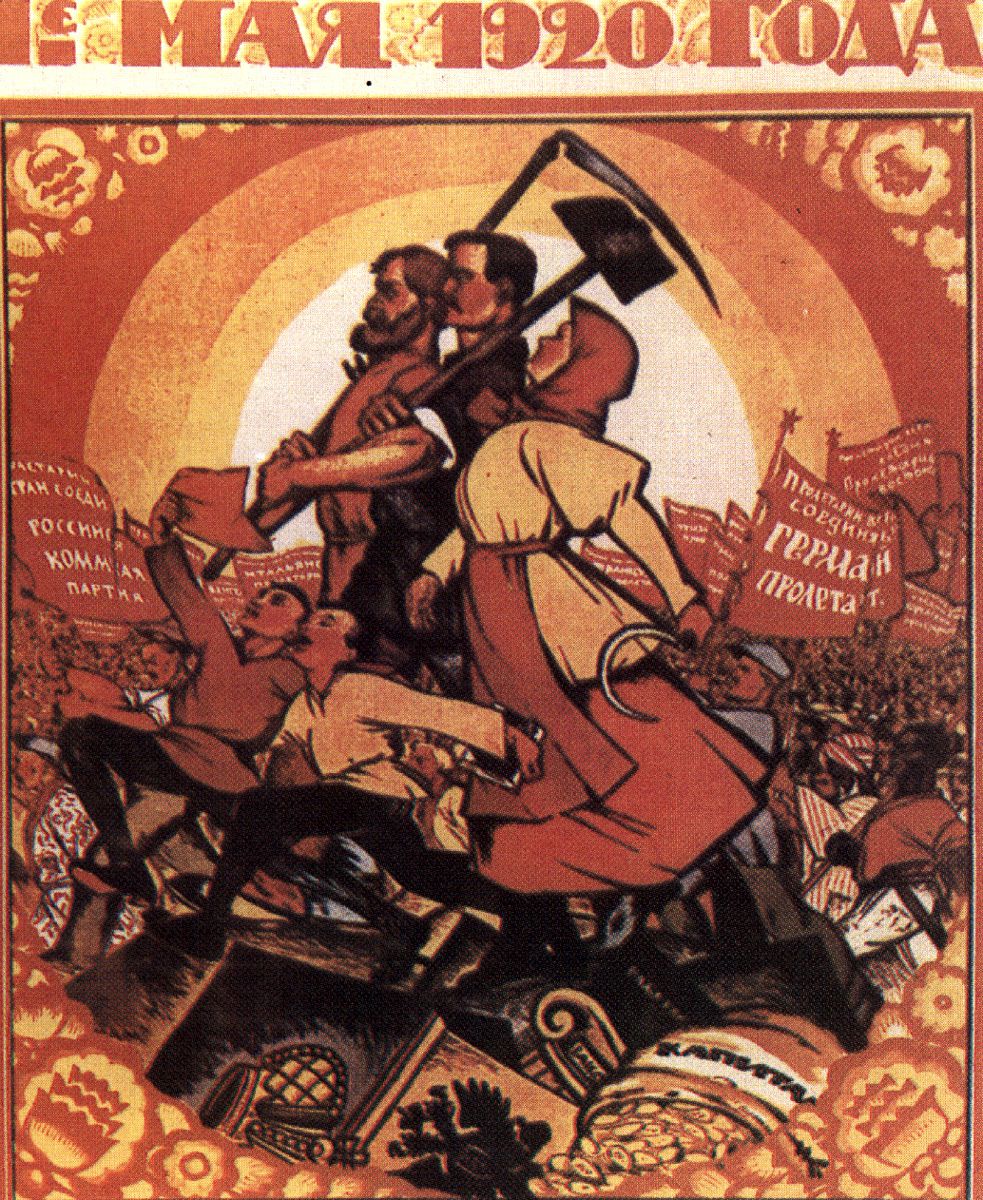
May Day Poster

Russian 1st of May poster, Soviet, Public Domain in the US

Minogue’s book is available (in part) on Google Books. As an example of the pervasive influence of ideology, the National Association of Scholars has recently addressed the sustainability movement as an ideology encroaching on academic freedom.

“Sustainability” is a key idea on college campuses in the United States and the rest of the Western world. To the unsuspecting, sustainability is just a new name for environmentalism. But the word really marks out a new and larger ideological territory in which curtailing economic, political, and intellectual liberty is the price that must be paid now to ensure the welfare of future generations. [Emphasis mine]

The movement is just another example of special interests seeking to “throw off oppression” using coercion and, if that fails, barbarity in a quest for supremacy.

As I’ve said before, I agree with Orwell’s assessment of his novel Nineteen Eighty Four: “The moral to be drawn from this dangerous nightmare situation is a simple one: Don’t let it happen. It depends on you.

Ideology’s Characteristics by Bernhardt Writer

A few weeks ago, we reviewed Kenneth Minogue’s book: Alien Powers – The Pure Theory of Ideology. He writes that Western civilization is in the throes of a conflict over a right understanding of the human condition. Minogue suggests that the ideological approach is ascendant in our society while the transcendent is declining. He claims that there is a generally applicable pure theory of ideology best realized to date in Marxist ideology and its offspring. Let us touch on some of the general points from his book.

***

The common person on the street condemns the results of bad human actions. They attempt to rectify those results when possible through small corrective steps. These citizens view politics as the method to work together toward agreed-to ends within the context of the rule of law.

The ideologist takes bad actions as evidence of systemic structural oppression that can be remedied only through complete overhaul of the entire system (i.e., revolution). The ideologist sees incremental moral reform as the mystification (i.e., obscuration or concealment) by which an oppressive system strings its victims along. Politics is a question of power. Only the power of a unified oppressed group can wring concessions from the oppressors who have more power.

Ideologies disclose truths that the prevailing system has an interest in hiding. Ideologies claim all interactions within the system are power relationships. This truth is masked by societal constraints (i.e., moral and civil rules of conduct) and nefarious concealments perpetrated by the oppressive system. Denial of unmasked truths is proof of the system’s betrayal and oppression at work.

Societal constraints serve the oppressors’ interests. That these rules promote goodness and justice masks their real import which is the exercise of power over the oppressed. If the oppressed demand their right to overthrow these constraints they are rebuffed for not obeying a law, moral principle, or divine ordinance. But the real reason they are denied is because it conflicts with the oppressors interests in a zero-sum transaction.

Ideology reveals masked favoritism and domination throughout the corrupt system. The oppressed have rightful grievances (e.g., ones of class, gender, race, or ethnicity) against the system. Each oppressed person is imprisoned by the system’s conditioning which divides the oppressed from each other and from their real source of being in the species. Their struggle for liberation will result in true community.

Science, philosophy, law, and the state are instruments of special interests according to ideology. Although the intellectual elite might root out interests in favor of inclusiveness, those ideologically driven look to those deprived by the system for remedy. These persons, excluded by the system, unqualified to represent themselves, are appointed to lead humankind to liberation. This oppressed group is qualified because it is least tainted by the system’s corrupting influences. Of course, ideologists are ready and willing to indoctrinate the oppressed group in the ways of liberation and speak for them.

Ideology unveils for us the hidden truth otherwise mystified by the system’s apologists. Cleansed of the system’s mystifications we will see the truth of our essence and our consciences will rise to state of things as they actually exist. We will realize that the human species is defined by social (e.g., production) and material (e.g., eating) processes. We will arrive at this non-western reality through the struggle for liberation rather than through fruitless and pernicious contemplation.

Ideology is to revolution the way politics is to reform. Ideology does not debate whether theft, for instance, should be treated severely or mercifully but rather abolishes private property altogether making theft fictitious. Each resolution of this type typifies the true community. Any particular problem is solved only by solving all problems via revolution.

Ideology pledges a comprehensive and ultimate explanation of this material world (since it claims that the transcendent world to come does not exist). The explanation (i.e., ideological revelation) is not merely knowledge but leads to societal transformation which improves the earthly human condition. The difficulty of overcoming opposition and bringing about the transformation is evidence for the truth of the explanation.

The ideological model of human history is triadic: the primitive community in harmony gives way to a succession of societies characterized by domination. By overthrowing this progression man arrives at a higher form of his initial communal harmony.

***

Minogue credits Karl Marx as the sole individual responsible, not only for clear insights into capitalism, but for the creation of pure ideology. He claims Marx developed the theory further and more deeply than all others. It is this pure theory that Minogue describes in his book. We will cover the end result of the ideological project in a later post.

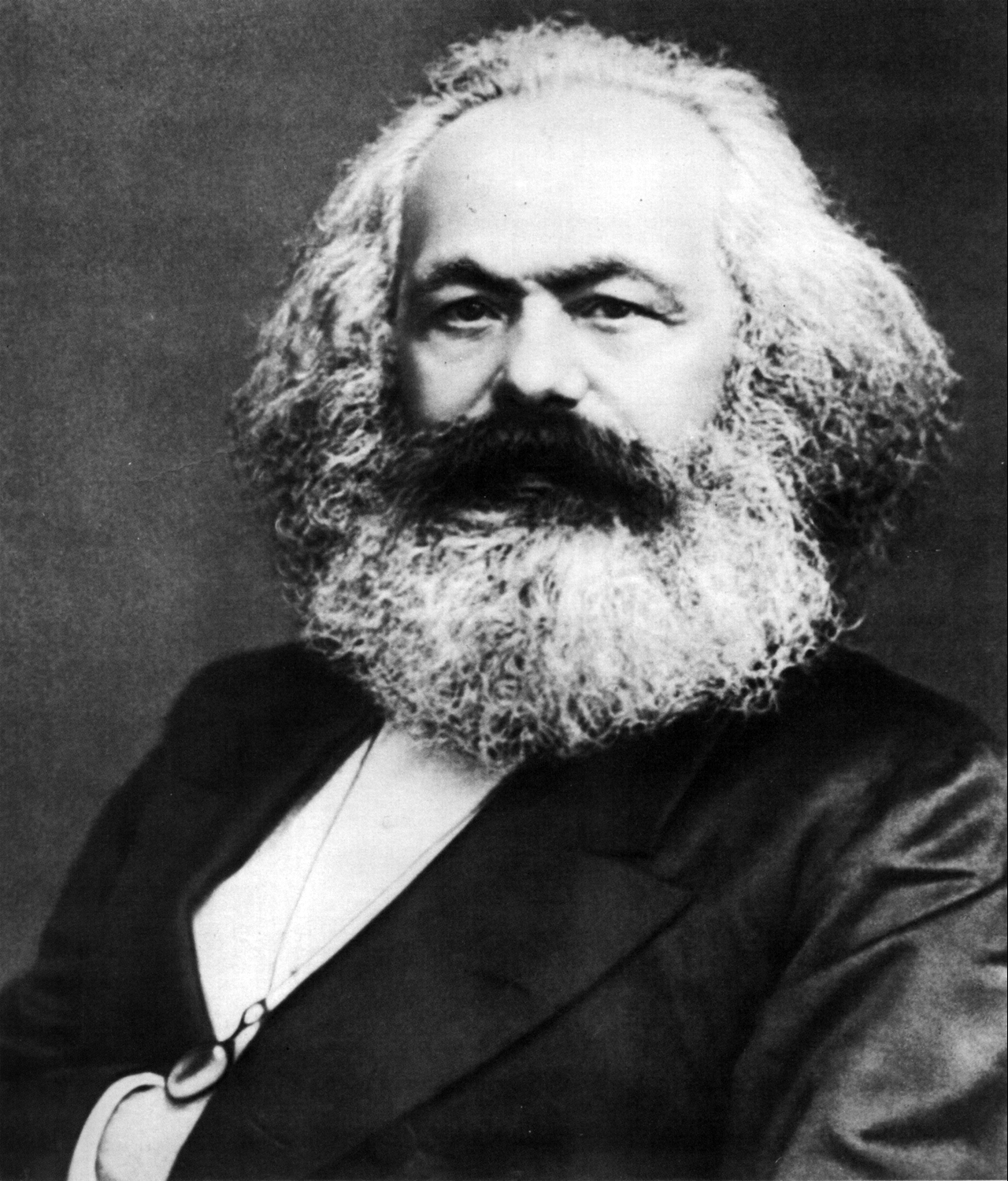
Karl Marx

A Portrait of Karl Marx, John Jabez Edwin Mayall (1813–1901), Public Domain in the US

I’m Sorry, Please Forgive Me

How often do we say: “I’m sorry; please forgive me?” Rarely, is my guess, based on how often I hear it. I suspect that no longer seeking forgiveness is the result of permissiveness seeping into what used to be common practice almost everywhere. That’s not to say that these words aren’t still necessary for good relations with others.

Most of us know that my standard is the scriptures, and specifically, in this case, the Gospels. Here, we see how the Lord’s disciples tried to evade this very burden; but He didn’t let them do it:

Then Peter came up and said to him, “Lord, how often will my brother sin against me, and I forgive him? As many as seven times?” Jesus said to him, “I do not say to you seven times, but seventy-seven times.” Matthew 18:21-22 English Standard Version (ESV)

And

“Pay attention to yourselves! If your brother sins, rebuke him, and if he repents, forgive him, and if he sins against you seven times in the day, and turns to you seven times, saying, ‘I repent,’ you must forgive him.”

The apostles said to the Lord, “Increase our faith!” And the Lord said, “If you had faith like a grain of mustard seed, you could say to this mulberry tree, ‘Be uprooted and planted in the sea,’ and it would obey you.” Luke 17:3-6 (ESV)

We’re all prone to doubt others’ motives when they keep repeating the same offenses and “seeking forgiveness” time and again. We’re not to be punching bags, after all. However, the Gospel of Matthew lays out a clear process of reconciliation for us to follow:

“So if you are offering your gift at the altar and there remember that your brother has something against you, leave your gift there before the altar and go.

First be reconciled to your brother, and then come and offer your gift.” Matthew 5:23-24 (ESV)

And

“If your brother sins against you, go and tell him his fault, between you and him alone. If he listens to you, you have gained your brother.

But if he does not listen, take one or two others along with you, that every charge may be established by the evidence of two or three witnesses.

If he refuses to listen to them, tell it to the church. And if he refuses to listen even to the church, let him be to you as a Gentile and a tax collector.” Matthew 18:15-17 (ESV)

So, if they refuse to listen to the church and continue to persist in their sin then, as the Apostle Paul states, do not associate with them:

I wrote to you in my letter not to associate with sexually immoral people— not at all meaning the sexually immoral of this world, or the greedy and swindlers, or idolaters, since then you would need to go out of the world.

But now I am writing to you not to associate with anyone who bears the name of brother if he is guilty of sexual immorality or greed, or is an idolater, reviler, drunkard, or swindler—not even to eat with such a one.

For what have I to do with judging outsiders? Is it not those inside the church whom you are to judge? God judges those outside. “Purge the evil person from among you.” 1 Corinthians 5:9-13 (ESV)

Until, perhaps, the Lord may grant them repentance, or even salvation, if that’s what’s lacking.

Now such a reconciliation process should not be an occasion for gloating; rather, it should give us pause to reflect on our own behavior. We should be humble toward one another:

I therefore, a prisoner for the Lord, urge you to walk in a manner worthy of the calling to which you have been called, with all humility and gentleness, with patience, bearing with one another in love, eager to maintain the unity of the Spirit in the bond of peace. Ephesians 4:1-3 (ESV)

And this sacrificial love (i.e., agape) is, for the professing church, the mark by which we are to be known:

“A new commandment I give to you, that you love one another: just as I have loved you, you also are to love one another. By this all people will know that you are my disciples, if you have love for one another.” John 13:34-35 (ESV)

We have to remember right relationships require humility and not anger:

Know this, my beloved brothers: let every person be quick to hear, slow to speak, slow to anger; for the anger of man does not produce the righteousness of God. Therefore put away all filthiness and rampant wickedness and receive with meekness the implanted word, which is able to save your souls. James 1:19-21 (ESV)

To do this, we must exercise self-control:

For the grace of God has appeared, bringing salvation for all people, training us to renounce ungodliness and worldly passions, and to live self-controlled, upright, and godly lives in the present age, Titus 2:11-12 (ESV)

We must make our actions agree with the words we profess:

But someone will say, “You have faith and I have works.” Show me your faith apart from your works, and I will show you my faith by my works. James 2:18 (ESV)

So, then, let us press on toward the goal for the prize of the upward call in Christ Jesus.

Prodigal Son, Rembrandt

The Return of the Prodigal Son, circa 1668, Rembrandt (1606–1669), Public Domain in the US

Portrait of an Ideologist — by Bernhardt Writer

One of our reasons for reviewing Kenneth Minogue’s book: Alien Powers – The Pure Theory of Ideology is that in it he promised a recipe book for constructing an ideology. The book didn’t provide a step by step method but it did provide a portrait of an ideologist. It is this portrait we sketch next.

General Characteristics

An ideologist believes that the modern world is evil and oppressive and that it must be overthrown. She sees particular incidences of evil as proof of ubiquitous, structural imperfection which can be remedied only by far-reaching and thorough change of the whole system. The difference between appearances and reality implies that the real truth is hidden by the system. Denial of this difference by the system’s apologists demonstrates the deception.

The ideologist believes that incremental social and moral reform is a mystification of (i.e., a means to obscure or conceal) the oppressive system’s real interests (i.e., the revealed secret) and a means to take its victims for a ride. Politics is a question of power and only a unified oppressed group can wrest their demands from more powerful oppressors.

The lead ideologist(s) owns the revealed secret, intimidating attackers and insubordinate followers via verbal abuse or direct action to maintain superiority. The full revelation is limited to only those who are attune to the shifting policies of the leader or leaders. This coterie is the vanguard of the movement.

Journalism is a conspiracy to suppress oppressor truths by defining facts and shaping how events are perceived:

“Communicative power is about the right to define and demarcate situations…In short, one must see the news as reflecting not the events of the world ‘out there,’ but as the manifestation of the collective cultural codes of those employed to do this selective and judgmental work for society.”

Ideologists deny that news viewers have the ability to exercise discernment. All viewers are helpless victims of journalistic bias.

Methodology

Social criticism is the tool ideologists use to reveal and undermine the system’s structure of domination. While social criticism purports to discover truth, it finds fault with everyday modern society for the purpose of confirming the ideologist’s theories of oppression. This oppression is imposed upon the masses via societal constraints (i.e., moral and civil rules of conduct).

By attacking so-called apologists for the status quo (i.e., structural oppression) the ideologists believe they perform the work of liberation. The ideologist as social critic is infallible because she’s either right or, because of the corrupting influences of society’s structural flaws, is wrong (and therefore right again having demonstrated those flaws in herself).

Ideologists’ claims to superiority arise from their heroically escaping societal constraints by embracing universal and comprehensive knowledge; from having arrived at their special knowledge of how the oppressors operate even in the face of societal conditioning to the opposite; and from their practical work of change on behalf of the oppressed masses. The ideologist demonstrates courage, discipline, and unwavering constancy in her mission when confronted with opposition and peril.

The ideologist sees the world divided into those who know the central secret and those who don’t. Those who don’t must be tutored. The ideologist determines the conditions under which all will live and disseminates these dogmas via indoctrination rather than open inquiry and discussion because their truths are incontrovertible and settled.

Politics and Argument

Ordinary politics relies on the evenhanded assumption that other parties share similar values and goals. Debate centers on what means should be employed to achieve common ends. This is not the case for the ideologist who is always fighting to liberate the oppressed masses from their oppressors’ central secret (and smaller subsidiary secrets).

When arguing, the skilled ideologist will establish that she recognizes reality, she is sensible, and that her approach is reasonable. She might make concessions to the opponent which may be sincere or merely a façade. All these remarks are made to set up a reversal signified by the words: ‘but’ or ‘yet.’ Then she reveals the hidden character of the domination she fights against. The ideologist derives power and force from using melodrama when unmasking her adversary’s secrets.

The ideologist is slippery. They pretend to confront particular problems but their intent is to gain an upper hand over their opponent and the issues. No practical issue can be isolated from the system’s universal imperfection. The only solution for the particular problem being discussed is comprehensive and total revolution to abolish the root causes (i.e., if coveting property is at issue then doing away with individual ownership is the fix).

The ideologist knows that arguments always reflect interests and do not objectively decide the truth or falsity of statements about reality. The ideologist must deny her opponent a position of neutrality on the issue under discussion. Arguments are a contest for power and dominance. Because the ideologist is struggling on behalf of the oppressed, she gains the moral high ground since truth always supports justice.

Ultimately, no real discussion is possible. The ideologist’s role in arguments is to raise the opponent’s consciousness via a tutorial since she possesses the truth whereas the opponent advocates for oppression. By demonstrating courage and intellectual insight against the conformist pressure of the domination structure, having rejected its mystifications, the ideologists portray themselves as heroic and superior.

Achieving the End State

In order to achieve the overthrow of the existing system and establishment of their goals, the ideologist must make a direct assault on freedom. The ideologist replaces freedom through deception (and violence, if necessary) with an enlightened dictatorship promising distant perfection. In this perfection (i.e., the ideological terminus) there is no freedom because there is no need for it. Only the one right option will be what everyone wants to do.

Once the end state is achieved there will be no possibility for a reversal. The historical (i.e., temporary) progress from capitalism and individuality to socialism and community is inevitable. The ideologists are the beneficiaries of this shift in power. They alone speak for the oppressed masses since they (the masses) are not capable of speaking for themselves. The ideologists have selected (and cultivated) the masses based on the principle that those who are most excluded from a corrupt society are least corrupted by that society.

Dogmatic in rhetoric and ruthless in practice, the ideologist fights to transcend the evils of the world. The inevitable twisting and turning of political upheavals indicate that humanity is waking up from the nightmare of history. “Every event is providential and every slaughter is the price paid” to bring about the end of history in perfection (i.e., the ideological terminus).

***

As we’ve said before, all political persuasions and any grievance focus can be made into an ideology. That’s Minogue’s thesis. Once you decide there is only one universal way for all to proceed, you are on your way to becoming either a god or his (or her) slave.

After the fiascos of the Twentieth century most ideologists see that their role is to slow walk the inevitable revolution. You’ll recognize the tactics and techniques described above on our televisions, in our books, and from many claiming authority (especially on college campuses). Ideologists cultivate their oppressed masses even going so far as to prevent their rise from oppression. This, to me, is the most despicable aspect of the ideological project.

Again, I concur with Orwell’s assessment of his novel Nineteen Eighty Four: “The moral to be drawn from this dangerous nightmare situation is a simple one: Don’t let it happen. It depends on you.”

William F. Buckley and Kenneth Minogue – part 1

Pure Ideology – Kenneth Minogue’s Alien Powers — Review and Commentary by Bernhardt Writer

Kenneth Minogue contends in his book: Alien Powers – The Pure Theory of Ideology that Western civilization is in the throes of a conflict over a right understanding of the human condition. In Western societies, individuals follow customs or conduct projects of which others may dislike or disapprove and the result may be conflict.

However, Western society is predominantly peaceful in spite of potential (or actual) conflict because individuals master internalized rules of law and morality. Poverty, inequality, and disappointment are inevitable consequences of open participation in a risk based society even when it is free from iniquitous societal distortions (e.g., American slavery).

Ideologists say these consequences result from hidden structural flaws that can only be remedied through the destruction of the prevailing system. One must attain the perfection of social harmony. If material possessions cause envy, then all possessions must be jointly owned. Rather than insisting on moral decency to curb envy, ideologists will abolish ownership altogether.

This same approach, rooted in externals, is applied to all inequality and disappointment. Transcendent principles (e.g., morality) are not applicable to unruly minds. Once harmony is achieved there will be no need for the transcendent; all humanity will become one in thinking and affections.

Minogue suggests the ideological approach is ascendant in our society while the transcendent is declining. But how is ideology commonly defined?

Ideology /ˌīdēˈäləjē,ˌidēˈäləjē/ noun: ideology; plural noun: ideologies

1. A system of ideas and ideals, especially one that forms the basis of economic or political theory and policy.

“The ideology of republicanism.”

Synonyms: beliefs, ideas, ideals, principles, ethics, morals; doctrine, creed, credo, faith, teaching, theory, philosophy; tenets, canon(s); conviction(s), persuasion; informal: -ism

1b. The ideas and manner of thinking characteristic of a group, social class, or individual.

“A critique of bourgeois ideology.”

“The party has to jettison outdated ideology and give up its stranglehold on power”

1c. Archaic: Visionary speculation, especially of an unrealistic or idealistic nature.

2. Archaic: The science of ideas; the study of their origin and nature.

Origin: late 18th century (sense 2): from French idéologie, from Greek idea ‘form, pattern’ + -logos (denoting discourse or compilation).

Not the most illuminating definitions. But this is one of Minogue’s points. We use the word too generally. Minogue’s contention is that there is a generally applicable pure theory of ideology best realized to date in Marxist ideology and its offspring.

The ideological end state (or terminus), typified by its Marxist form, harkens back to rule under the Egyptian Pharaohs or Chinese Emperors. Those rulers were worshipped as God (which they were not) and the populace, generally denied individuality, performed service to the ruler and his coterie (or vanguard). These dynasties persisted substantially unchanged for millennia. Ideology is anti-western in this sense: individualism is the problem and the vanguard in power is the solution.

If you think it through, all political persuasions and any grievance focus can be made into an ideology. That’s Minogue’s thesis. Once you decide there is only one universal way for all to proceed, you are on your way to becoming either a god or his (or her) slave.

Eric Arthur Blair (pen name: George Orwell, 1902 – 1950) parodied the outcome of what is described above in his novel Nineteen Eighty Four (1949). The following video is from a 1984 movie version of the book; it summarizes the main theme:

Orwell 1984 – O’Brien about Power

Over the past year or so, my other posts have dealt with politics in an effort to understand what America is experiencing. The articles are titled:

‘It’s Not Your Founding Fathers’ Republic Any More,’ Review and Commentary

The Revolt Against the Masses, A Review, Part 1

The Revolt Against the Masses, A Review, Part 2

The Three Languages of Politics, A Review

And

Inflammation.’

Also, over the next few weeks, I plan to post: “Portrait of an Ideologist,” “Ideology’s Characteristics,” and “The State and End State.”

Finally, I concur with Orwell’s assessment of his novel Nineteen Eighty Four: “The moral to be drawn from this dangerous nightmare situation is a simple one: Don’t let it happen. It depends on you.”

WSBG Cover Reveal

Who Shall Be God is a fictional account of the struggles between two families, the Stadists and the Libertas, who live in an east coast US city, north and south of the 38th parallel, respectively. Mandated Memoranda Publishing will release it on Amazon in late 2015 or early 2016.

Cincinnata Stadist is a central figure whom we experience as a rough and tumble seven-year old growing up through her teen years into a young adult. She witnesses much more than she can appreciate at the time. What will become of her?

Her father and mother arrive in town under clouded circumstances, already on a downward slide they cannot reverse. The Libertas arrive soon after, they’re risk-takers who create unique opportunities. Both families get embroiled in the town’s politics. Who wins, who loses?

Always in the background, making things happen. Feared by those who do his bidding. Respected by those who serve the town and despised by those who serve themselves. Everyone wonders what this mysterious man, Joshua, is up to. Is he responsible for what goes on in the town?

One of the novel’s thematic undercurrents follows from the Book of Isaiah, chapter 57, verses 1-2 and 20-21:

The righteous man perishes, and no one lays it to heart;

Devout men are taken away, while no one understands.

For the righteous man is taken away from calamity; he enters into peace;

They rest in their beds who walk in their uprightness…

“…But the wicked are like the tossing sea;

For it cannot be quiet, and its waters toss up mire and dirt.

There is no peace,” says my God, “for the wicked.”

The cover is not finished, this is only a mock-up. The foreground characters and scenery need a lot of work. We thank all those who commented on the cover concept. Look for Mandated Memoranda Publishing’s logo in the book’s back matter.

At the moment, we’re studying how to be better story tellers. We’re also doing the research required to define our story’s milieu. Plotting work starts soon. We want this to be our best effort yet.

In the face of ten-cent per page books, Mandated Memoranda Publishing intends to sell this book at one or two cents per page. We hope Who Shall Be God accomplishes the goals for which it is offered to you, our dear readers.

WSBG cover

Who Shall Be God Cover – Quarter Scale Mock-up
Copyright 2015-2016 – All Rights Reserved

God Is Testing Us

If you’ve attended some North American churches, you’ve experienced the winds of doctrine. If you’ve read, listened to, or watched the news, you know the alarm that current events bring. Some of the aforementioned offer other gods to serve. To these things, the word of God says:

“If a prophet or a dreamer of dreams arises among you and gives you a sign or a wonder, and the sign or wonder that he tells you comes to pass, and if he says, ‘Let us go after other gods,’ which you have not known, ‘and let us serve them,’ you shall not listen to the words of that prophet or that dreamer of dreams. For the Lord your God is testing you, to know whether you love the Lord your God with all your heart and with all your soul. You shall walk after the Lord your God and fear him and keep his commandments and obey his voice, and you shall serve him and hold fast to him. Deuteronomy 13:1-4 English Standard Version (ESV)

John Calvin has a lot to say about verse three:

For the Lord your God [tests] you. …He [God] designedly brings the truly pious to the test, in order to distinguish them from the hypocrites; and this takes place, when they constantly persevere in the true faith against the assaults of their temptations, and do not fall from their standing. The Apostle declares the same thing also with regard to heresies, which…must needs arise in the Church, “that they which are approved may be made manifest.” (1 Corinthians 11:19).

Wherefore we must not be impatient, nor murmur against God, if He chooses that the firmness of our faith, which is more precious than silver or gold, should be tried in the fiery furnace; but it behooves us humbly to acquiesce in His justice and wisdom.

If any should still object, that, since the weakness of mankind is only too notorious, God deals with them somewhat unkindly when He subjects them to these dangerous temptations, an answer may be readily given. I acknowledge indeed that, since our carnal sense is tender, this may seem hard, and inconsistent with the fatherly kindness of God; for, surely, when a miracle presents itself before our eyes, it is difficult not to submit to it.

But, since the temptation injures none but those whose impiety, which it lays bare, was already convicted and condemned, while the sincere worshippers of God are preserved free from injury, how unjust would it be to take away from God this liberty of plucking the mask from treachery and deceit?

Whosoever loves God with a pure heart is armed with the invincible power of the Divine Spirit, that he should not be ensnared by falsehoods; God thus rewards true and not fictitious piety, so that whosoever are of a true heart, should be protected by his faithful guardianship, and never feel the deadly wound.

Meanwhile, why should He not devote to just destruction those who willfully desire to perish? Nor need we be surprised at what He elsewhere declares, that it is He who deceives false prophets, that by them he may inflict just vengeance on the reprobate, who eagerly go in search of their destructive deceits.

Since, then, all the good are sure to overcome, so that the wiles of Satan are to them nothing but the exercises of their virtue; why should God be blamed, because the malice of Satan and of the wicked prepares for them [i.e., the good] the grounds of their victory and triumph?

Only let us cleave to this axiom, that all, who heartily love and reverence God, will always be sure and safe under the protection of God. It is true, I confess, that integrity of heart is a peculiar gift of God and the fruit of His secret election; but, since their own consciences reproach the reprobate with their contempt of God, their hypocrisy, pride, or depravity, the blame of the iniquity that dwells in them is unjustly laid upon God.

This, then, is sufficient to refute all carnal and perverse reasoning and blasphemies, viz., that whosoever are right in heart are guarded by the aid of the Spirit from the poisonous influence of Satan, and that no one perishes against his will.

And thus we come to the conclusion, that all who, having once seemed to embrace the doctrines of salvation, afterwards reject and deny them, had never possessed anything more than the disguise of a false profession, because, if they sincerely loved God, they would remain firm in heart in the midst of all things tending to disturb them.

It will indeed sometimes happen that the pious also will fall into errors, and will be seduced by the wicked; but it will only be in some respects and for a time; so that they never fall from the foundation, and presently recover themselves, [reformed].

And then, it must also be observed, they pay the penalty of their negligence, or instability, because they have not been sufficiently attentive to God’s Word, or have not sufficiently devoted themselves to religious pursuits.

Hence we further gather, that while many turn away professedly from the doctrines of religion, on the ground of their seeing so many contentions and disputes to distract them, it is a mere vain excuse to cover their profane neglect or hatred of God.

It is true that there are great discrepancies of opinion, and very warm contentions; but whosoever in a teachable and gentle spirit shall seek after truth, and shall give himself over and submit himself as the disciple of God, he will never be without the spirit of judgment and discretion.

But, since some listen disdainfully, some supremely despise it, some wish that God’s Word were altogether destroyed, others think lightly of it, the saying of the Prophet holds good, “that that die, let it die;” (Zechariah 11:9) and what Paul after him declares, “But if any man be ignorant, let him be ignorant.” (1 Corinthians 14:38).

Since it has always been the case that God’s truth was never hidden from anybody, except him whose mind the God of this world has blinded. (2 Corinthians 4:4). And this especially takes place when light has shone from heaven, which suffers none to go astray but those who shut their eyes.

The remedy, therefore, is immediately subjoined, “Ye shall walk after the Lord your God;” as if Moses had said, it was sufficient for their preservation, that they had God to guide them in the right way, who had already prevented them by His gratuitous bounty.

But, since numbers respond not to God’s call, and regard Him not when He points out the way to them, the words “and fear him” are added; because “the fear of God is the beginning of wisdom.” (Psalm 111:10).

Finally, Moses again inculcates that, if men are only resolved to obey God, they will be sufficiently taught by His voice what they ought to do. By the word “cleave,” perseverance is denoted, and he indirectly reproves the instability of those who forsake and forget God, and go astray after empty imaginations.

As Moses exhorts us in Deuteronomy 13:4:

“You shall walk after the Lord your God and fear him and keep his commandments and obey his voice, and you shall serve him and hold fast to him.”

So, along with Mary, speaking of her son, the Lord Jesus Christ, I say: “Do whatever he tells you.”

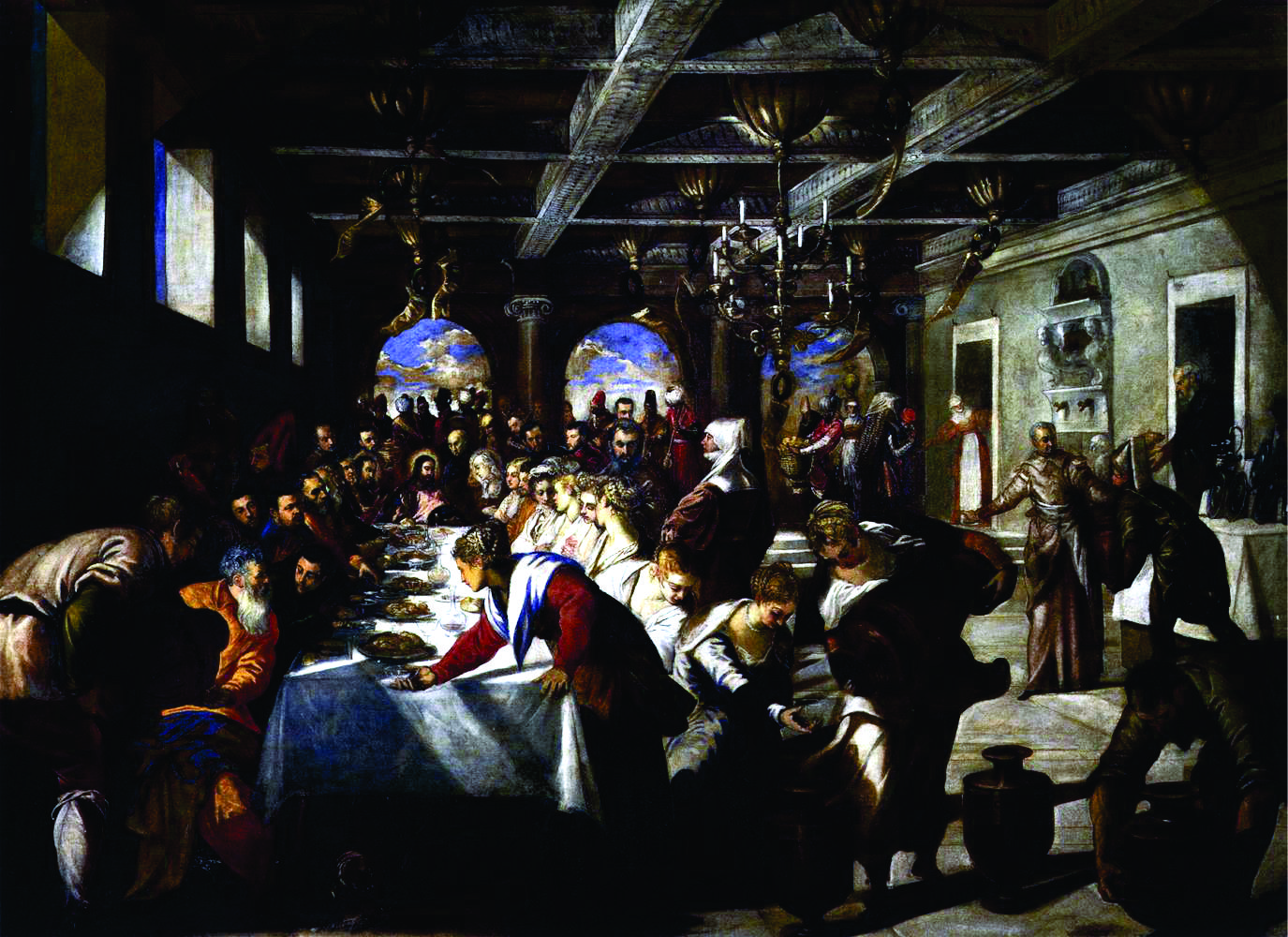
Marriage at Cana, (1561), Jacopo Tintoretto (1518–1594)

Marriage at Cana, (1561), Jacopo Tintoretto (1518–1594), public domain in the United States

Deluding Influence

Delusion is defined as:

De·lu·sion /dəˈlo͞oZHən/ noun: delusion; plural noun: delusions

An idiosyncratic belief or impression that is firmly maintained despite being contradicted by what is generally accepted as reality or rational argument, typically a symptom of mental disorder.

“The delusion of being watched.”

“Was her belief in his fidelity just a delusion?”

The action of deluding someone or the state of being deluded.

“What a capacity television has for delusion.”

And, perhaps more directly:

De·lude /dəˈlo͞od/ verb: delude; 3rd person present: deludes; past tense and past participle: deluded; gerund or present participle: deluding

Impose a misleading belief upon (someone); deceive; fool.

“Too many theorists have deluded the public.”

In the second letter to the Thessalonians, the Apostle Paul speaks of deluding influences and the man of lawlessness:

Now concerning the coming of our Lord Jesus Christ and our being gathered together to him, we ask you, brothers, not to be quickly shaken in mind or alarmed, either by a spirit or a spoken word, or a letter seeming to be from us, to the effect that the day of the Lord has come.

Let no one deceive you in any way. For that day will not come, unless the rebellion comes first, and the man of lawlessness is revealed, the son of destruction, who opposes and exalts himself against every so-called god or object of worship, so that he takes his seat in the temple of God, proclaiming himself to be God.

Do you not remember that when I was still with you I told you these things? And you know what is restraining him now so that he may be revealed in his time. For the mystery of lawlessness is already at work. Only he who now restrains it will do so until he is out of the way. And then the lawless one will be revealed, whom the Lord Jesus will kill with the breath of his mouth and bring to nothing by the appearance of his coming.

The coming of the lawless one is by the activity of Satan with all power and false signs and wonders, and with all wicked deception for those who are perishing, because they refused to love the truth and so be saved. Therefore God sends them a strong delusion, so that they may believe what is false, in order that all may be condemned who did not believe the truth but had pleasure in unrighteousness [emphasis added].

2 Thessalonians 2:1-12 English Standard Version (ESV)

Calvin has much to say about these verses: 1–2, 3–4, 5–8, and 9–12. We’ll concentrate on what he said about verses 11 and 12:

Verse 11 – The working of delusion. He means that errors will not merely have a place, but [that] the wicked will be blinded, so…they will rush forward to ruin without consideration.

For as God enlightens us inwardly by his Spirit, that his doctrine may be efficacious in us, and opens our eyes and hearts, that it may make its way thither, so by a righteous judgment he delivers over to a reprobate mind (Romans 1:28) those whom he has appointed to destruction, that with closed eyes and a senseless mind, they may, as if bewitched, deliver themselves over to Satan and his ministers to be deceived…

Verse 12 – That all may be condemned. That is, that they may receive the punishment due to their impiety. Thus, those that perish have no just ground to expostulate with God, inasmuch as they have obtained what they sought.

For we must keep in view what is stated in Deuteronomy 13:3, that the hearts of men are subjected to trial, when false doctrines come abroad, inasmuch as they [the false doctrines] have no power except among those who do not love God with a sincere heart. Let those, then, who take pleasure in unrighteousness, reap the fruit of it.

When he says all, he means that contempt of God finds no excuse in the great crowd and multitude of those who refuse to obey the gospel, for God is the Judge of the whole world, so that he will inflict punishment upon a hundred thousand, no less than upon one individual.

The participle εὐδοκήσαντες (taking pleasure) means (so to speak) a voluntary inclination to evil, for in this way every excuse is cut off from the ungrateful, when they take so much pleasure in unrighteousness, as to prefer it to the righteousness of God.

For by what violence will they say that they have been impelled to alienate themselves by a mad revolt from God, towards whom they were led by the guidance of nature? It is at least manifest that they willingly and knowingly lent an ear to falsehoods.

But none of this is new. Throughout history and in all lands, God has given over the disobedient.

Roughly seven hundred years before Christ and more than a century and a half before their decreed release by Cyrus the Great, the prophet Isaiah encouraged the future Babylonian exiles to flee from there and, by faith, return to the Promised Land. Speaking of their spiritual blindness, he says to them:

They know not, nor do they discern, for he has shut their eyes, so that they cannot see, and their hearts, so that they cannot understand. Isaiah 44:18 (ESV)

Speaking to His disciples about the crowds gathered by the Sea of Galilee to hear Him, the Lord Jesus Christ cites Isaiah (Is. 6:9–10):

And he said to them, “To you has been given the secret of the kingdom of God, but for those outside everything is in parables, so that

“they may indeed see but not perceive,

    and may indeed hear but not understand,

lest they should turn and be forgiven.”

Mark 4:11-12 (ESV)

Later, during Lord’s entry into Jerusalem prior to the Passover, John recounts what Isaiah said about God’s hardening of hearts as a commentary on those who did not believe in the Lord:

“He has blinded their eyes

    and hardened their heart,

lest they see with their eyes,

    and understand with their heart, and turn,

    and I would heal them.”

John 12:40 (ESV)

Later still, Paul, in his letter to the church in Rome says:

So then he has mercy on whomever he wills, and he hardens whomever he wills. Romans 9:18 (ESV)

This is a clear expression of God’s sovereign kindness and severity.

And yet, He sets Eternity in the heart:

He has made everything beautiful in its time. Also, he has put eternity into man’s heart, yet so that he cannot find out what God has done from the beginning to the end. Ecclesiastes 3:11 (ESV)

Truly, His ways are past finding out:

Oh, the depth of the riches and wisdom and knowledge of God! How unsearchable are his judgments and how inscrutable his ways! Romans 11:33 (ESV)

Even though we deserve ruthlessness, He Himself seeks to persuade us with rational arguments:

“Come now, let us reason together, says the Lord:

Though your sins are like scarlet, they shall be as white as snow;

Though they are red like crimson, they shall become like wool.

If you are willing and obedient, you shall eat the good of the land;

But if you refuse and rebel,you shall be eaten by the sword;

For the mouth of the Lord has spoken.”

Isaiah 1:18–20 (ESV)

Then, of course, He speaks to us of an unmerited gift:

Come to me, all who labor and are heavy laden, and I will give you rest. Take my yoke upon you, and learn from me, for I am gentle and lowly in heart, and you will find rest for your souls. Matthew 11:28-29 (ESV)

With Paul (and Isaiah), I say to you: sleeper, awake!

Fall of Rebel Angels - Brueghel

The Fall of the Rebel Angels (1562), Pieter Brueghel the Elder (1526/1530–1569), PD in US