The Fourth Revolution – The Nordic Future

In the fourth and last installment of our review and commentary on The Fourth Revolution: The Global Race to Reinvent the State by Micklethwait and Wooldridge, we examine the authors’ contention that Sweden and the other Nordic nations represent the future for the West’s reinvigoration.

Before and After

For most of the twentieth century, Sweden embraced the Fabian ideal for their society. Marquis Childs called their social experiment the “middle way,” one between capitalism and communism. In the nineteen sixties, Sweden moved left as they broadened the meaning of equality in their society. They applied more government and higher taxes to every problem.

Then it ended. Their politicians did what most world leaders know they ought to do but fail because they lack courage. Sweden reduced their public spending in proportion to their GDP. The government required itself to produce a fiscal surplus over the economic cycle. Swedish politicians reinvented the state while reducing its size. They gave their nation’s pension system a sound foundation, they adopted education vouchers, and revamped their health care system.

Sweden focused on reducing waiting times for hospital procedures and on speeding patients through their stays, which also reduced the frequency of hospital communicated diseases. They published data such as operation success rates in health registries for patients and taxpayers to evaluate. And they charged minor fees similar to those that Lee Kuan Yew initiated in Singapore to discourage healthcare system abuse through elective services overconsumption. Swedish health care is now one of the most efficient in the world. Swedes live longer than most in the Western hemisphere and their health costs have decreased too.

Other Nordic countries have improved to a more limited extent. Yet, all four have triple A credit ratings and debt loads below the Eurozone mean. Their economic experiments seem successful. Indices show that they have superior social inclusion, competitiveness, and well-being.

And they’ve done this by serving the individual, employing fiscal responsibility, promoting choice, and encouraging competition. They’ve eschewed state expansion, pump priming, paternalism, and centralized planning. The Nordic countries have extended the market into the state instead of the opposite.

From There to Here

The Nordic countries show what is possible. They had to change because they ran out of money and continued to change because they found they could provide a better state for their citizens.

In 1991, Sweden plunged into their “black of night crisis.” The banking system seized up, foreign investors abandoned their confidence in the third way, and mortgage rates peaked briefly at 500 percent.

In the early 1980s, the people of Denmark faced a “potato crisis.” It was called this because they felt that potatoes might be all they’d be able to afford for their subsistence. Not only was there a cash shortage but the industries which financially supported government programs were strapped.

Now, countries in the West find themselves at or near the same crises. Western states have promised their peoples benefits beyond their ability to provide. The Nordics prove that the state can be brought under control and can be improved for the betterment of their peoples’ future.

But Big Government

History over the last two centuries seems to show that governments grow larger as they accumulate power and control. The Nordic countries provide a counterfactual: government can be contained while its performance and efficiency increases.

The authors pose the question: “How far can you take [the Nordic experiment]?” They argue that neither diminishing productivity returns in the service and government sectors [Baumol’s disease] nor society’s accelerated aging can prevent success. They claim technology is a solution to both problems.

Baumol stated that systems which boost manufacturing productivity are not applicable to the service sector (of which government is a part). The authors suggest that his disease is simply technological lag. As an example, educational efficiency once depended on increasing class sizes.

Now, with the internet, students with drive and grit can access materials from world-class educators. This sort of teaching is even extending into formal classrooms. Accredited degrees are increasingly available online. As a result, universities are having to reconsider the wisdom of administrative bloat and building monuments.

Technology is delayering management and making workers more productive, disseminating health care and school performance data so citizens can make informed choices, and, increasingly, bypassing government by putting power in citizens’ hands.

Law and order, a very labor intensive government function, is also an example. Instead of harsh sentences, increased warehousing, or even a decreasing cohort of young men, the authors maintain that crime prevention is what led to a decrease in crime worldwide starting in the mid 1990s (but varying across the globe). And this decrease has most to do with technology (e.g., CompStat, increased video surveillance, monitored alarms, etc.). Although community policing (directed by CompStat), a hands on solution, is also necessary.

Technology is even reducing costs in the military. By replacing soldiers, sailors, marines, coast guard and air men with automated hardware and software systems, lifecycle costs such as salaries, healthcare, and pensions are decreased. Operations, maintenance, and personnel costs are an overwhelming proportion of total cost of military systems when compared with initial development and procurement costs.

Technology, in the authors’ view, is taking out costs while increasing efficiency in many, if not all, public sector activities.

But Greying Demography

The authors’ ask: “won’t any gains from treating Baumol’s disease be wiped out by demography?” They note that the Nordics have changed the basis for their retirement systems from totally defined benefits to partially defined contributions. Swedes put some of their pension money into private plans. The government indexes the retirement age to life expectancy and decreases pensions during economic declines.

Delaying retirement increases worker payments into the system, reduces outlays, and enhances economic productivity of older workers through entrepreneurial activity and skills transfer. And Sweden made these improvements with cross party consensus: the “people’s home” survives only if finances are handled competently.

A Call to Action

There are many ways to improve the state that increase benefits to citizens while decreasing the cost of (and frustration with) government. While the Left argues cutting government will hurt the poor and the Right cries that expanded welfare will collapse the economy, the authors assert that it’s not a zero sum proposition.

Nineteenth century Victorian liberals went after “Old Corruption” in its various forms. Subsidies for the wealthy and middle classes at the expense of the poor are easy to correct via means testing, flat taxes, and repealing funds for government agencies that provide unfair aid where it is not needed (e.g., if I own suitable land that I have no intention of cultivating, should I be paid for not growing tomatoes or some other crop?). It only takes the will to do it.

Rather than take away from the poor, remedying this one situation actually helps the poor. Entitlement programs on which they depend will not run out if we fix who pays in, for how long, up to how much, and who gets to collect and when. There are many other substantive instances of waste, fraud, and abuse that we’re spending trillions on (i.e., not just shrimp on treadmill studies). Fixing these will make the country run more efficiently, benefit those who really need benefits, and increase citizens confidence in government.

Just as Sweden updated their “middle way,” using capitalist competition to efficiently provide socialist services successfully, the United States, Great Britain, and other Western states can shrink government, improve their economies, and restore confidence in Democracy (or the Republic, in our case) while providing the safety nets they’ve promised to those who need them for as long as they need them.

Halfhearted efforts rooted in selective interests just won’t do. We have serious problems to solve, and we need serious people to solve them.
RSA Replay: The Fourth Revolution

The Fourth Revolution – Lee Kuan Yew and the Asian Consensus

Lee Kuan Yew (16 September 1923 – 23 March 2015) was founder and Prime Minister of the Republic of Singapore. He started out as an advocate for Beatrice Webb’s societal view.

Lee shifted right to counteract communism and tighten control over Singapore. He ended closer to Hayek‘s views while developing a unique blend of authoritarianism, self-sufficiency, and meritocracy. In the process of his transformation, Lee Kuan Yew molded Singapore according to his principles.

As a result, Singapore has become the economic success it is today. Micklethwait and Wooldridge, the authors of The Fourth Revolution: The Global Race to Reinvent the State portray Lee and his Singapore as the model for the economic rise of China and the rest of Asia. They also pose the possibility that Singapore is the model for success of authoritarianism over democracy.

Asian Ascent

Singapore is a night-watchman state that provides its citizens with economic opportunities and control over how they fund their healthcare and pensions. In return, citizens must not challenge the social order.

Rather than Western democratic governance and generous benefits, Lee’s model is elitist, authoritarian, and parsimonious. This approach follows from Lee’s fundamental axiom: “human beings, regrettable though it may be, are inherently vicious and have to be restrained from their viciousness.”

Like Lee, other Asian nations sense that Western political dead lock and economic sluggishness point to the failure of liberal democracy. Additionally, their own economic growth puts them in competition with each other and good government seems to be the way to succeed. Asian nations are therefore looking at Lee’s model.

Although self-sufficiency is a core Eastern value, the entire experiment might derail as their populations prosper and age. Almost everyone eventually wants bread and circuses if they can get it.

The Singaporean State

“We decide what is right,” Lee once said. “Never mind what the people think.” “I do not believe that democracy necessarily leads to development,” Lee remarked to Philippine hosts in 1992. “The exuberance of democracy leads to undisciplined and disorderly conditions.” He also said, “what a country needs to develop is discipline more than democracy.”

To Westerners, Singaporean government looks like Plato’s Republic, composed of chosen guardians of society. Actually, it is modelled on China’s mandarin tradition of merit selected elites who rule administratively.

Singapore identifies individuals with potential early. It gives them scholarships and trains them afterward for service. Those that make it can receive pay packages upward of two million dollars per year. Those who don’t are thrown overboard.

This elite acquires over time both private and public administration experience. They apply best practice management techniques to both state dominated enterprises and government. They rotate between the two for the benefit of the citizens and shareholders that they serve.

With regard to social benefits, Lee had said: “westerners have abandoned an ethical basis for society…In the East, we start with self-reliance. In the West today, it is the opposite.” Western leaders made charity an entitlement: “and the stigma of living on charity disappeared.”

Lee also said: “When you have popular democracy, to win votes you have to give more. And to beat your opponent in the next election, you have to promise to give more away. So it is a never-ending process of auctions—and the cost, the debt being paid for by the next generation.”

Self-reliant Singaporeans pay a fifth [although the rate has varied] into the Central Provident Fund. Employers pay about fifteen percent more to the fund. Most of what a citizen receives from the fund (about 90%) is tied to what they pay in. Hard work is thereby rewarded.

Other countries are trying to duplicate Singapore’s success. Dubai has a modern financial district, exclusive shopping malls, state-run companies, a Government Excellence Program, and they use Harvard Business School professor Robert Kaplan  ‘s key performance indicators (KPI) as metrics of their progress.

China’s Rise

China shares Lee’s concerns about the west: democracy isn’t efficient, society and the economy need direction, and right governance means success and survival. It has the world’s second largest economy. It is the largest energy consumer, merchandise exporter, smartphone market, and foreign holder of US debt. China is home to the most of the world’s millionaires and billionaires and has accomplished the largest poverty reduction in history. Lee had said that China will reach its former prominence in thirty to fifty years but warned, if it pursued liberal democracy, “It would collapse.”

However, China’s leadership is not so credulous to ignore the fact that most cities use land grabs as a means to balance their budgets. While Shanghai is ranked at the top of OECD’s Program for International Student Assessment (PISA), primary and secondary education receives short shrift when compared with bribing local officials. Old corruption, similar to early nineteenth century Britain, is pervasive.

According to the authors, China has tried to follow Singapore most closely in state capitalism and in meritocratically selected administrators (rather than democratically elected officials). China’s implementation of these two aspects of state control are good in part, say the authors.

State Capitalism

China’s state directed capitalism follows a long tradition from the East India Company to Korea’s Chaebol. However, they’ve taken control further. The authors quote the Party Committee of the China Civil Engineering Construction Corporation (CCECC): “Where there are people, there are Party organizations and Party activities.” The state directs many state-owned enterprises (SOE)

The State-Owned Assets Supervision and Administration Commission (SASAC) oversees the SOEs by appointing top executives, approving mergers, approving stock or asset sales, and drafting SOE related laws.

The Organization Department of the Communist Party of China controls more than 70 million personnel assignments throughout government and industry. In that role it compiles detailed and confidential reports on future Party leaders. It is a highly trusted and secretive agency at the institutional heart of the Party system.

According to the authors, the SOEs are still expected to compete abroad and use modern management techniques internally. They have to meet common industry wide strategic goals while exercising relative freedom in daily operational decisions. Company management informs government management and vice versa in what the authors call “joined-up capitalism.”

State capitalism is an instrument of foreign policy and initiative. SOEs fund eighty percent of foreign direct investment. Through loans from state banks, China has woven a web of foreign economic and policy advances. China is fostering Lee’s ideas through the China Executive Leadership Academy in Pudong (CELAP) which trains their best and brightest leaders. They also counterbalance Davos with the Boao Forum for Asia. This is how China exercises soft power.

However, SOEs are viewed by investors as favoring government interests over their own. Corruption is a disincentive for investment. SOEs can be forced to implement state policy. Further, SOEs attract capital that more independent Chinese companies might otherwise put toward more innovative use leading to faster growth.

The authors point out that intellectual and cultural freedom lead to breakthrough ideas and vibrant competition. Although some think that SOEs will wither away as the economy grows, others are not so sanguine. For state capitalism to work well, you need a strong and competent state. We’ve see how that’s worked in the past.

State Meritocracy

China originated the concept we in the West refer to as mandarin administration. They instituted formal civil service examinations in 605 AD. The authors quote a common saying, popular for a thousand years, that Chinese parents tell their children: “those who work with strength are ruled. Those who work with their minds manage others. Those who excel in scholarship become officials.”

China’s elite agrees with Lee Kuan Yew’s opinion that meritocracy offers more benefits than democracy such as long term planning and leadership succession without pressure to win votes at the expense of societal breakdown.

Recruitment starts at university rather than the factory. Candidates need to excel at the Central Party School and CELAP. Then they prove themselves as competent administrators by running a province (maybe as large as several European countries combined). More recently, these leaders are called to prove their business skills running an SOE.

Young leaders of the future, selected and promoted up the ranks based on merit, tackle big problems. They’ve had both government and industry experience. Increasingly, they have had graduate level training or work experiences in countries around the world. They conduct civil service in a business-like manner using best practices culled from successful examples proven globally.

The authors are quick to point out that elitism comes with problems. They cite the example of a deputy who was denied office space to meet with locals to conduct his part in an anticorruption drive. Ordinary citizens with legitimate grievances are hard-pressed to get a hearing with officials, let alone a satisfactory resolution. They vent their anger on one of many Weibo, a Twitter equivalent, complaining of inefficient government, failing schools, unsanitary hospitals, and inept officials.

President Xi Jinping sends leaders from Beijing into the provinces to instill order. But, citing a Chinese proverb, the authors point out: “the mountains are high and the emperor is far away.” And the leaders are not as meritorious as they would have everyone believe. Many in the upper echelons are “red princelings:” offspring of the Communist Party elite.

Inside or outside the party, leaders systematically accumulate wealth and privilege using their power. The authors cite an internet posting:

They drive top-brand cars. They go to exclusive night bars. They sleep on the softest beds in the best hotels. Their furniture is all of the best red wood. Their houses overlook the best landscapes, in the quietest locations. They play golf, travel at public expense, and enjoy a life of luxury.

But, the authors say, it is the same the world over. And it is, unfortunately.

A Reckoning

China’s economic and world power rise validates its authoritarianism to its people and many in the world at-large. It poses a challenge and viable alternative to the Western liberal democratic, capitalistic model. Singapore has managed its success on the strength of its now deceased leader. However, Asians, like the rest of the world, increasingly want a generous social safety net.

China’s economic growth is slipping as its population is aging. Corruption at the local level and vast unpaid (and unpayable?) debts threaten stability. Western impulses for bread and circuses already surge through its citizenry. Although there is hope that representative democracy might develop, the populace is so diverse that the center is sure not to hold. Censorship can prevent unrest only so long.

However, Asia as a whole is still trying to improve government. They have a fresh start and innovative technologies and techniques may yet provide efficient social services and governance (even if not democratic) that are responsive to their citizens. Singapore and the Nordic countries provide a way forward. If only the West would follow suit to revamp their now illiberal democracies.

Here is yet another presentation by the authors of: The Fourth Revolution: the global race to reinvent the state.

The Fourth Revolution: the global race to reinvent the state

A memorial tribute to Mr. Lee Kuan Yew.

Passing of Mr Lee Kuan Yew

The Fourth Revolution – Beatrice and Sidney Webb Laid Foundations for the Welfare State

Last week, we reviewed the book: The Fourth Revolution: The Global Race to Reinvent the State, by former Economist Editor in Chief John Micklethwait and Management Editor Adrian Wooldridge. This week, we summarize how two individuals: Beatrice and Sidney Webb, laid sure foundations for the third revolution: the welfare state.

***

Prelude

The world lurched leftward in second half of the nineteenth century. The British elite recognized their poor needed support to escape crushing poverty. More insidiously, they realized hands off politics had left them unable to, as Lloyd George would later phrase it in the early twentieth century, “…maintain an A1 Empire with a C3 population.” They were falling behind Germany with its successful government intervention in business and social welfare. In response, Britain embraced state activism.

Around the same time period, Abraham Lincoln said: “The legitimate object of government is to do for a community of people whatever they need to have done, but cannot do, at all, or cannot, so well do, for themselves, in their separate and individual capacities.” Some would claim him as progressive, others as aspirational .

Marx formulated his communist ideology over the same half century. He theorized that government was merely the way one class controlled another. Once classes were abolished, the government would wither, reduced to the administration of things. The form of government did not much matter to Marx.

By ignoring Thomas Hobbes’s statement [not original to him, of course] that a state is necessary for the peaceful conduct of human affairs, Marx prepared the way for dictatorships that treated people as nothing more than things to be administered. The next century would put Marx’s theories into practice.

The Webbs

Living on her Victorian father’s fortune, Beatrice Potter (b. 1858 – d. 1943) was characterized as: “the cleverest member of one of the cleverest families in the cleverest class of the cleverest nation in the world.”

Beatrice met the tireless, brilliant, and homely Sidney Webb in 1890. She was swept off her feet by his vision for expanding government: “collective ownership wherever practicable; collective regulation everywhere else; collective provision according to need for all the impotent and sufferers; and collective taxation in proportion to wealth, especially surplus wealth.”

Beatrice Webb’s vision—the state as the epitome of reason and truth—enabled her to develop the ideology adopted by pro-statists worldwide. The state stood for: planning versus confusion, merit versus privilege, and science versus prejudice.

Her modus operandi to spread this ideology was one of progressive suffusion. Why cause revolution when the same change could be brought about more lastingly through subversion of society using propaganda and recognized committees of experts.

The Webbs founded the Fabian Society as guardians of this socialist transformation. They established the London School of Economics to train a global cohort of social engineers. The Webbs also founded the New Statesman, a weekly review of politics and literature, as the clarion of their revolution.

Since people are the constituents of the socialist state they wished to build, it made sense, the Webbs said, for Leviathan to regulate society’s reproductive practice. They embraced eugenics as eagerly as they did town planning. The Webbs trusted the judgment of professional experts over the “average sensual man” when it came to bettering the life of commoners.

They ingeniously formed the inchoate anxieties and idealism of their age into political action of all three major British parties. The Webbs pushed collectivism using Labour’s penchant for social justice, Liberal’s national efficiency, and Conservatism’s desire to preserve the Empire. Within a generation, they converted educated opinion to the view that the state must provide “a national minimum” of education and social welfare.

In the period 1905-1915, sympathetic British governments passed legislation that provided: free meals for needy school children (1906), old-age pensions (1908), anti-poverty budget provisions (1909), national sickness and unemployment insurance (1911), and sterilization for the unfit (1913).The Webbs helped enact redistributive taxation to pay for these programs and lessened the stigma of “Poor Laws.” The poor became “victims,” not layabouts.

The Webbs, through their vast influence, helped redefine classical liberal principles. Freedom, which used to mean freedom from external control, became “freedom from want” and equality before the law became “equality of opportunity” and, to a lesser extent, equality of respect. This shift required activist government intervention. The government now provided social services and primary and, to the talented poor, secondary education.

Propagation

The Webbs were not alone in this socialist revolution. A prominent liberal ally, John Maynard Keynes, advocated for government intervention to aid Adam Smith’s hidden hand of the market. Although he spelled out caveats to his philosophy, these were conveniently forgotten over the years. His philosophy, Keynesianism, still powers big government.

The British Statist model was adopted by Hitler, Stalin, Mussolini, Franco, and Peron. They all blended Hegelian state worship into their dictatorships and used the state to control their economies. America, however, took a different turn under the Roosevelts.

Theodore Roosevelt (US president 1901-1909) acknowledged that the Webbs were right when they said that laissez-faire capitalism was over. He established regulatory bodies to constrain the power of corporations over the American people: “The Corporation is the creature of the people, and must not be allowed to become the ruler of the people.”

He was not a socialist. He saw capitalism for the wealth creator it was. However, he used state power to make it work better by suppressing “crony capitalism” which arose from the collusion of “corrupt politics” with “corrupt business.”

TR’s goal was to use the state to provide a “square deal,” a safety net in rough times, and to improve the quality of America’s workforce. By not embracing European style statism, with its comprehensive welfare state, he squared-the-circle through his progressive republicanism and saved the US from Europe’s excesses.

Franklin Delano Roosevelt, for his part, imposed tighter regulation instead of nationalizing broad sectors of the economy in the face of economic collapse and world war.

Establishment

World War II demonstrated big government’s ability to marshal all of industry to the service of war through detailed planning, financial incentives, and coercion. The same occurred on both sides of the Atlantic and the Pacific.

In post-war Britain, the Education Act, the National Insurance Act, and the National Health Service Act were formulated by a Conservative (Butler), a Liberal (Beveridge), and a socialist (Bevan), respectively. The Webb’s cross-politics approach was further validated when the Conservative Party, under Winston Churchill, returned to power in October 1951 and did nothing to roll back the welfare state.

On the continent, the state ran companies, universities, research institutes, libraries, and broadcasting corporations. In the closing days of World War II, international supervisory organizations like the International Monetary Fund and the World Bank were created under Keynes influence as a result of the Bretton Woods international agreements.

***

As counterpoint, Philip Hamburger writes in his book about US executive branch agencies that administer regulations, Is Administrative Law Unlawful:

“There is a jarring disconnect between what is taught and celebrated in constitutional law and what is accepted in administrative law…” and “…[Only] the shell of [the American] republican experiment remains. Within it, however, another government has arisen, in which new masters once again assert themselves, issuing commands as if they were members of a ruling class, and as if the people were merely their servants. Self-government has given way to a system of submission.” [Emphasis mine]

Hamburger reasons that judicial pushback at the Appellate and Supreme Court levels is necessary to head off a more Lockean approach. Read more about Hamburger’s book in Myron Magnet’s City Journal book review.

Finally, here is another lecture and Q&A by Micklethwait and Wooldridge:

John Micklethwait & Adrian Wooldridge, “The Fourth Revolution

The Fourth Revolution – Review and Commentary

The book by former Economist Editor in Chief John Micklethwait and Management Editor Adrian Wooldridge: The Fourth Revolution: The Global Race to Reinvent the State contends that states in the West must complete the revolution started by Reagan and Thatcher and become smaller, more efficient systems that provide greater individual liberty.

In 1814, during the first revolutionary period, John Adams said: “Democracy never lasts long. It soon wastes, exhausts, and murders itself. There never was a democracy yet that did not commit suicide.” He also said: “It is vain to say that democracy is less vain, less proud, less selfish, less ambitious, or less avaricious than autocracy or monarchy…” The authors of The Fourth Revolution contend that the secret of good governance lies in checking human desires, not letting them run free.

America’s founding fathers also worried that democracy would crush individual liberty. The majority would use pressure and regulation to press the minority into conformity. The authors say few examine these issues now. In the vacuum, voters regard the practice of democracy as corrupt and inefficient. And yet they won’t question the theory. Their contempt delegitimizes government and turns setbacks into crises.

Democracy is overloaded with obligations, overburdened with unfulfillable expectations, and distorted by special interests. The population’s dependency forces government to continuously expand. During the second revolution, nineteenth century liberals in Great Britain reformed both the state’s machinery and its form of representation. The authors suggest today’s politicians should trim the state and renew democracy.

The rise of the Beijing consensus’s top down modernization and meritocratic governmental institutions makes the west’s democratic alternative seem regressive. America demonstrates too many of democracy’s vices and Europe too few of its virtues.

America’s checks and balances, though successful in the past in preventing the tyranny of the majority, has been subverted to become a political tool that decreases efficiency, compromise, and justice. America’s gerrymandering voting districts entrench special interests, extremism, and mediocre representation for a lifetime. America’s lobbying by special interests awash in money begs the question of graft and favoritism.

Europe, in an effort to stifle popular passions that caused two world wars, has sacrificed national sovereignty to technocratic governmental, financial, and trade bodies and, in the process, are vivifying national populist movements.

Economic inequality is putting western democracy to the test. Quoting Louis Brandeis, “we can have a democratic society or we can have great concentrated wealth in the hands of a few. We cannot have both.” In the era of financial crisis with less to go around and a bloated but inefficient welfare state, the West must stop democracy’s decay or risk their people’s ire.

The authors call for limited government that constrains itself through self-denying ordinances. In the process, three government dangers must be overcome: liberty encroaching expansion, surrender to special interests, and making unfulfillable promises.

As remedies, the authors propose balanced budgets over the economic cycle, fully funded and means tested entitlements tied to life expectancy, and sunset clauses for laws and regulations. Handing some economic power to technocrats and independent commissions and pushing decisions to the states and cities are ways to limit centralized power.

Micklethwait and Wooldridge say that the cost of inaction is high—unreformed, the welfare state will collapse under oppressive debt. The opportunity is great—the rewards to states that revive democracy and reduce the burden of the state will sprint ahead of its peers economically and in life satisfaction. History will be on the side of the nations that promote individual liberty.

We in the West are polarized politically. Our leaders pander to special interests instead of providing for the common good. How much longer can we mortgage our children’s future to pay for our pensions and health care? We are getting less benefit from and paying more for our educational system. We’re transferring tax revenues to the middle classes and crony capitalists in agriculture, defense, finance, etc. at the expense of caring for the truly poor.

The world is looking to the East as the model for economic advances and a better life at the expense of individual liberties. We in the West must become serious about reforming our systems or be left behind in the rubbish heap of history. Some western states, provinces, and cities are becoming more efficient through experimentation. There are lots of ideas to try, if only we were willing to start.

In the coming weeks we’ll cover how Beatrice and Sidney Webb laid the foundations for the welfare state in the third revolution, how Lee Kuan Yew created the Asian Consensus, and how the Nordic states point the way to the future.

The Fourth Revolution: The Global Race to Reinvent the State

The State and End State by Bernhardt Writer

A while back we reviewed Kenneth Minogue’s book: Alien Powers – The Pure Theory of Ideology. In it, he contends that Western civilization is in the throes of a conflict over a right understanding of the human condition. So, how does it all turn out in the end were ideology to win?

Politics and Democracy

Ideology masquerades as a political movement, but it is determined to destroy the circumstances underpinning politics. It draws out our moral instincts while it denies the possibility of morality. It affirms freedom while striving for a community in which only one right act will be possible for each circumstance. Ideology attacks inequality but seeks to destroy the individual human capable of achieving equality in a meaningful sense. It champions real democracy but advocates unanimity that makes democracy superfluous. Ideology’s practitioners use criticism to attack opponents while claiming their own truths are incontrovertible.

Ideology portrays deficiencies of the human condition (i.e., personal sin) as structural flaws of an oppressive system. It must methodically destroy the political ideas and values that the system represents. These ideas and values merely hide the system’s ulterior interests. Ideology can only be satisfied by a perfect democracy which is, by definition, unattainable. It is ideologically absurd to let those deluded by the system’s structural faults to select leaders when the people (i.e., the vanguard) leading the way to the perfect community, alone, have the necessary knowledge.

Ideology and the State

States provide liberty by instituting legal rights. Individuals within the state exercise these rights as responsible agents of choice. The result is a world both unpredictable and uncontrollable because what people will do with their rights is unknowable until they decide and act.

Karl Marx, however, said that rights separated person from person (i.e., alienated them one from another). His ideal society would possess liberty without rights. Those in his transformed society would no longer mistrust or have disagreements of right and wrong. There would be complete harmony in which no one would need to exercise rights. In fact, there would no longer be individuals capable of exercising rights in such a perfect harmonious community.

Ideology says states foster citizens’ independent actions, the soil in which oppression thrives. Oppression can only be prevented by destroying the state itself. Ideologies use “one party states” to destroy any remaining independence in a society enthralled to the ideology.

A capitalistic society provides laws under which the citizenry orders their life choices and actions. Under an ideology’s social order, everyone is occupied with transforming society. Nothing prevents citizens in a modern state from creating communes, collective farms, or cooperatives. However, it is both criminal and regressive for those in an ideological state to set up a business or practice unsanctioned religion.

States provide rules according to which citizens choose how to satisfy their interests. The mistake ideological governments make is to decide between interests. By determining interests, ideologies show that their social criticism is aimed, not at the centralized state, but the private interests of citizens and associations that compose the state.

Impediment to Revolution

What stands in the way of ideology’s revolutionary conquest is transcendent religion. Minogue says that someone is not fit for revolution who, like Adam Smith, believes:

“A wise man never complains of the destiny of Providence, nor thinks the universe in confusion when he is out-of-order.”

Marx observed that engaging the wretched to carry out insurrection will never happen if they are lost in religious fantasies.

Perfect Community and the Individual

In an integrated community of individuals, each one is the proprietor of their own desires and the adjudicator of their own thoughts. Ideology sees this as the cause for aggression, greed, selfishness, and violence because some desire more than they have or want what others possess. Ideology rejects the possibility of personal responsibility and self-control as the foundation of relationships within a functioning society.

Should humans live as free agents making individual choices or as a collective species with no individuation in so-called perfection? Ideology says perfect community is not only desirable, but the only form possible (all other forms being ones of oppression).

Would these humans in perfect community have self-awareness and the ability to choose to cooperate? Ideology says that as long as they have real choice then their actions no longer depend on correct human consciousness but on contingent human will. In short: no. A community that freely chooses to cooperate could choose not to do so at some point in the future. If that were to happen, then the ideological terminus (perfect community) could itself be overthrown.

To give a sense of the import of such a transformation, Marx says:

When the laborer co-operates systematically with others, he strips off the fetters of his individuality, and develops the capabilities of his species…The present generation resembles the Jews whom Moses led through the wilderness. It must not only conquer a new world, it must also perish in order to make room for people who will be equal to a new world.

Further, Minogue says that in true community:

Each of us will be drops of water in a clear pond. We shall live at the level of the universal, sloughing off that involvement in particular passions and particular points of view which is the very definition of our present entrapment. There will be no self to be denied or subjected. Particular character and situation would have no reality in themselves.

Ideology’s Results

Ideology’s direct contribution to society is to set worker against capitalist, Black against White, men against women, etc. No one can doubt ideology has gotten results by calling out grave instances of oppression; but, in the process, it has multiplied pointless, diffuse antagonisms that have weakened the fabric of Western society and culture.

True community may be a thing of wonder. However, the resolution of strife between essences and existence leaves no one to contemplate that beauty since they both must be “resolved.” The so-called alienated human being is abolished.

This means that ideology, carried to its terminus (and there is no other purpose), poses an existential threat to the West. Declaring Western civilization rotten to the core, ideology does away with the possibility of the individual human life in exchange for a myth of pure species. This is the equivalent of a suicide pact.

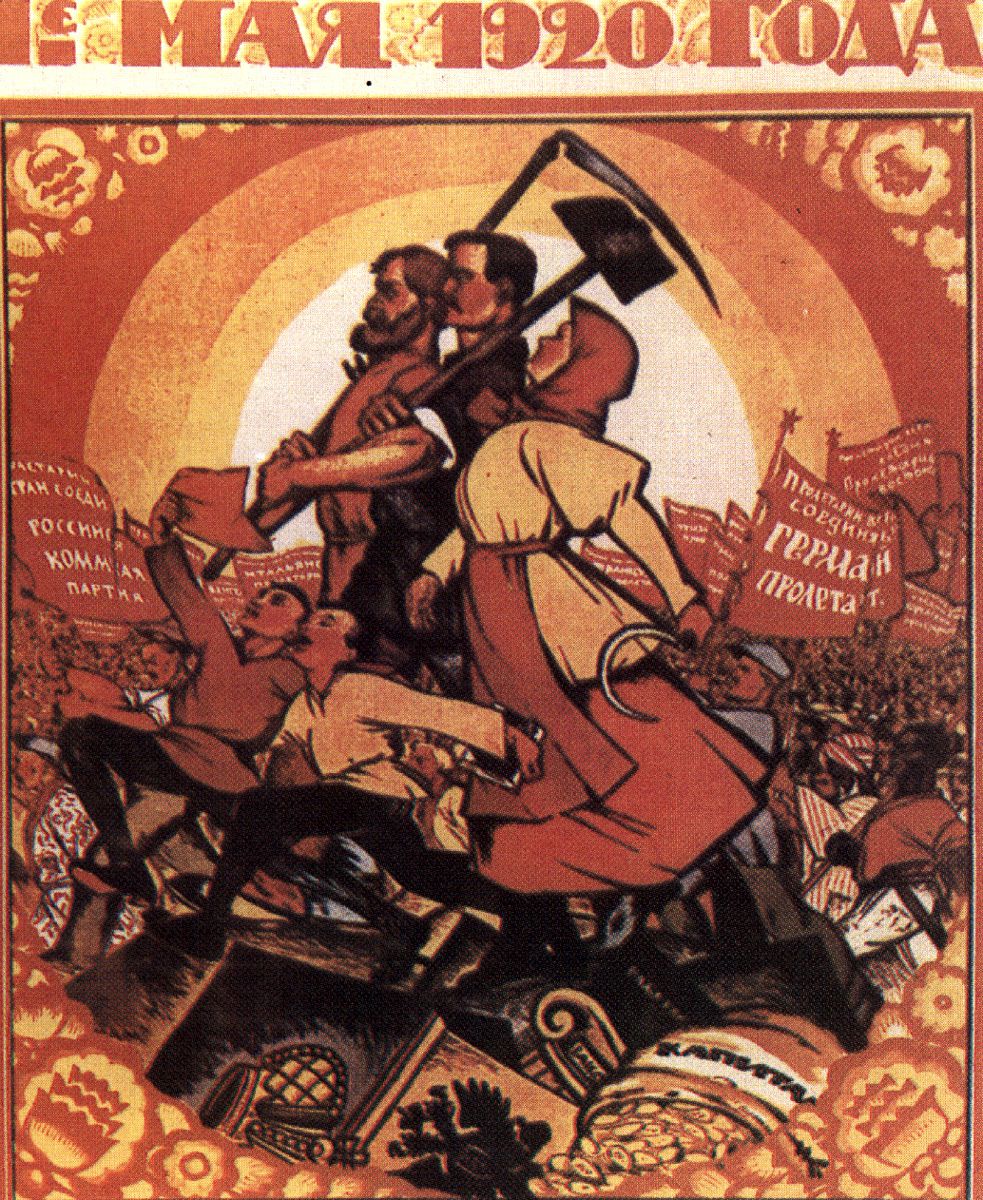
May Day Poster

Russian 1st of May poster, Soviet, Public Domain in the US

Minogue’s book is available (in part) on Google Books. As an example of the pervasive influence of ideology, the National Association of Scholars has recently addressed the sustainability movement as an ideology encroaching on academic freedom.

“Sustainability” is a key idea on college campuses in the United States and the rest of the Western world. To the unsuspecting, sustainability is just a new name for environmentalism. But the word really marks out a new and larger ideological territory in which curtailing economic, political, and intellectual liberty is the price that must be paid now to ensure the welfare of future generations. [Emphasis mine]

The movement is just another example of special interests seeking to “throw off oppression” using coercion and, if that fails, barbarity in a quest for supremacy.

As I’ve said before, I agree with Orwell’s assessment of his novel Nineteen Eighty Four: “The moral to be drawn from this dangerous nightmare situation is a simple one: Don’t let it happen. It depends on you.

Ideology’s Characteristics by Bernhardt Writer

A few weeks ago, we reviewed Kenneth Minogue’s book: Alien Powers – The Pure Theory of Ideology. He writes that Western civilization is in the throes of a conflict over a right understanding of the human condition. Minogue suggests that the ideological approach is ascendant in our society while the transcendent is declining. He claims that there is a generally applicable pure theory of ideology best realized to date in Marxist ideology and its offspring. Let us touch on some of the general points from his book.

***

The common person on the street condemns the results of bad human actions. They attempt to rectify those results when possible through small corrective steps. These citizens view politics as the method to work together toward agreed-to ends within the context of the rule of law.

The ideologist takes bad actions as evidence of systemic structural oppression that can be remedied only through complete overhaul of the entire system (i.e., revolution). The ideologist sees incremental moral reform as the mystification (i.e., obscuration or concealment) by which an oppressive system strings its victims along. Politics is a question of power. Only the power of a unified oppressed group can wring concessions from the oppressors who have more power.

Ideologies disclose truths that the prevailing system has an interest in hiding. Ideologies claim all interactions within the system are power relationships. This truth is masked by societal constraints (i.e., moral and civil rules of conduct) and nefarious concealments perpetrated by the oppressive system. Denial of unmasked truths is proof of the system’s betrayal and oppression at work.

Societal constraints serve the oppressors’ interests. That these rules promote goodness and justice masks their real import which is the exercise of power over the oppressed. If the oppressed demand their right to overthrow these constraints they are rebuffed for not obeying a law, moral principle, or divine ordinance. But the real reason they are denied is because it conflicts with the oppressors interests in a zero-sum transaction.

Ideology reveals masked favoritism and domination throughout the corrupt system. The oppressed have rightful grievances (e.g., ones of class, gender, race, or ethnicity) against the system. Each oppressed person is imprisoned by the system’s conditioning which divides the oppressed from each other and from their real source of being in the species. Their struggle for liberation will result in true community.

Science, philosophy, law, and the state are instruments of special interests according to ideology. Although the intellectual elite might root out interests in favor of inclusiveness, those ideologically driven look to those deprived by the system for remedy. These persons, excluded by the system, unqualified to represent themselves, are appointed to lead humankind to liberation. This oppressed group is qualified because it is least tainted by the system’s corrupting influences. Of course, ideologists are ready and willing to indoctrinate the oppressed group in the ways of liberation and speak for them.

Ideology unveils for us the hidden truth otherwise mystified by the system’s apologists. Cleansed of the system’s mystifications we will see the truth of our essence and our consciences will rise to state of things as they actually exist. We will realize that the human species is defined by social (e.g., production) and material (e.g., eating) processes. We will arrive at this non-western reality through the struggle for liberation rather than through fruitless and pernicious contemplation.

Ideology is to revolution the way politics is to reform. Ideology does not debate whether theft, for instance, should be treated severely or mercifully but rather abolishes private property altogether making theft fictitious. Each resolution of this type typifies the true community. Any particular problem is solved only by solving all problems via revolution.

Ideology pledges a comprehensive and ultimate explanation of this material world (since it claims that the transcendent world to come does not exist). The explanation (i.e., ideological revelation) is not merely knowledge but leads to societal transformation which improves the earthly human condition. The difficulty of overcoming opposition and bringing about the transformation is evidence for the truth of the explanation.

The ideological model of human history is triadic: the primitive community in harmony gives way to a succession of societies characterized by domination. By overthrowing this progression man arrives at a higher form of his initial communal harmony.

***

Minogue credits Karl Marx as the sole individual responsible, not only for clear insights into capitalism, but for the creation of pure ideology. He claims Marx developed the theory further and more deeply than all others. It is this pure theory that Minogue describes in his book. We will cover the end result of the ideological project in a later post.

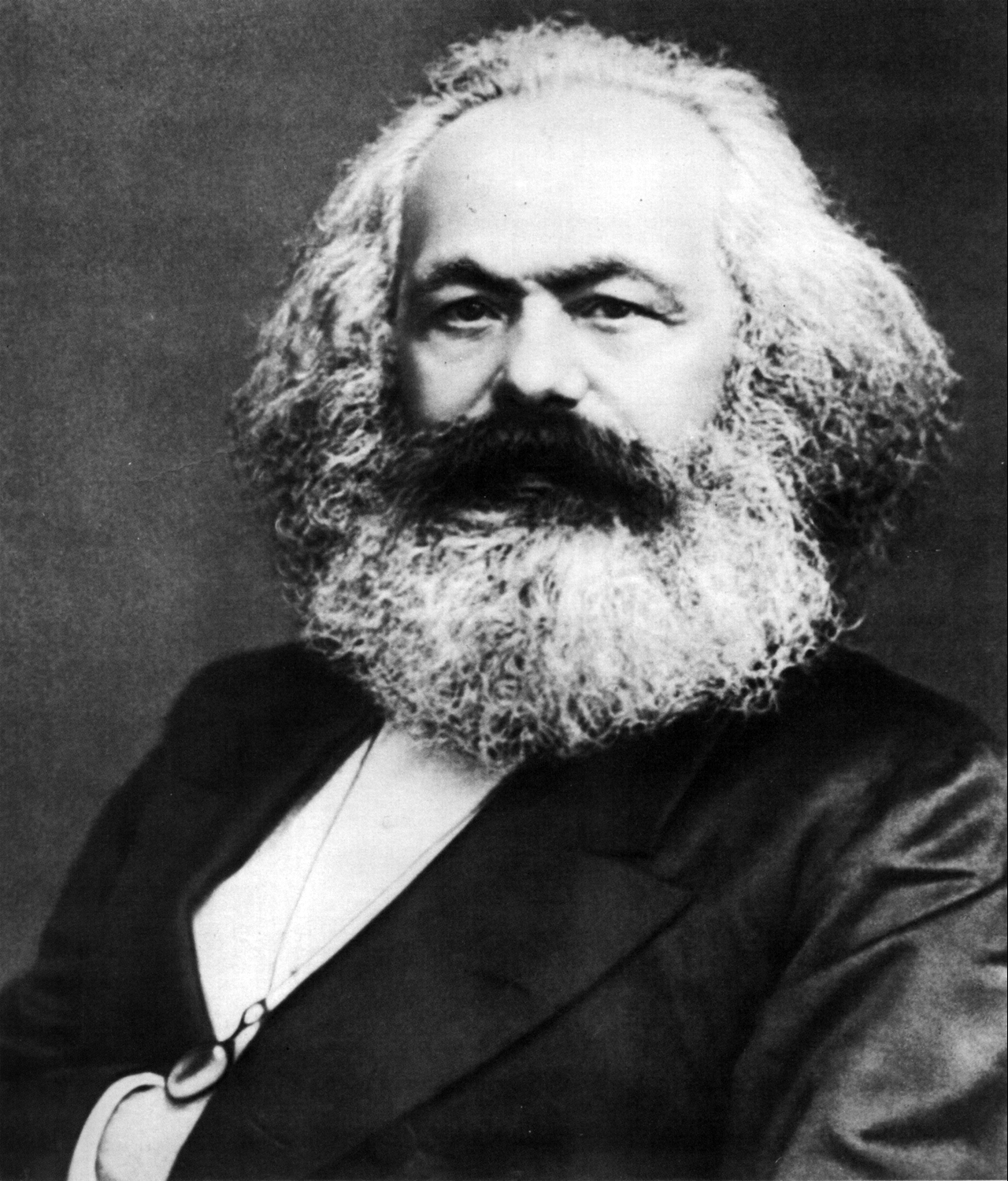
Karl Marx

A Portrait of Karl Marx, John Jabez Edwin Mayall (1813–1901), Public Domain in the US

Portrait of an Ideologist — by Bernhardt Writer

One of our reasons for reviewing Kenneth Minogue’s book: Alien Powers – The Pure Theory of Ideology is that in it he promised a recipe book for constructing an ideology. The book didn’t provide a step by step method but it did provide a portrait of an ideologist. It is this portrait we sketch next.

General Characteristics

An ideologist believes that the modern world is evil and oppressive and that it must be overthrown. She sees particular incidences of evil as proof of ubiquitous, structural imperfection which can be remedied only by far-reaching and thorough change of the whole system. The difference between appearances and reality implies that the real truth is hidden by the system. Denial of this difference by the system’s apologists demonstrates the deception.

The ideologist believes that incremental social and moral reform is a mystification of (i.e., a means to obscure or conceal) the oppressive system’s real interests (i.e., the revealed secret) and a means to take its victims for a ride. Politics is a question of power and only a unified oppressed group can wrest their demands from more powerful oppressors.

The lead ideologist(s) owns the revealed secret, intimidating attackers and insubordinate followers via verbal abuse or direct action to maintain superiority. The full revelation is limited to only those who are attune to the shifting policies of the leader or leaders. This coterie is the vanguard of the movement.

Journalism is a conspiracy to suppress oppressor truths by defining facts and shaping how events are perceived:

“Communicative power is about the right to define and demarcate situations…In short, one must see the news as reflecting not the events of the world ‘out there,’ but as the manifestation of the collective cultural codes of those employed to do this selective and judgmental work for society.”

Ideologists deny that news viewers have the ability to exercise discernment. All viewers are helpless victims of journalistic bias.

Methodology

Social criticism is the tool ideologists use to reveal and undermine the system’s structure of domination. While social criticism purports to discover truth, it finds fault with everyday modern society for the purpose of confirming the ideologist’s theories of oppression. This oppression is imposed upon the masses via societal constraints (i.e., moral and civil rules of conduct).

By attacking so-called apologists for the status quo (i.e., structural oppression) the ideologists believe they perform the work of liberation. The ideologist as social critic is infallible because she’s either right or, because of the corrupting influences of society’s structural flaws, is wrong (and therefore right again having demonstrated those flaws in herself).

Ideologists’ claims to superiority arise from their heroically escaping societal constraints by embracing universal and comprehensive knowledge; from having arrived at their special knowledge of how the oppressors operate even in the face of societal conditioning to the opposite; and from their practical work of change on behalf of the oppressed masses. The ideologist demonstrates courage, discipline, and unwavering constancy in her mission when confronted with opposition and peril.

The ideologist sees the world divided into those who know the central secret and those who don’t. Those who don’t must be tutored. The ideologist determines the conditions under which all will live and disseminates these dogmas via indoctrination rather than open inquiry and discussion because their truths are incontrovertible and settled.

Politics and Argument

Ordinary politics relies on the evenhanded assumption that other parties share similar values and goals. Debate centers on what means should be employed to achieve common ends. This is not the case for the ideologist who is always fighting to liberate the oppressed masses from their oppressors’ central secret (and smaller subsidiary secrets).

When arguing, the skilled ideologist will establish that she recognizes reality, she is sensible, and that her approach is reasonable. She might make concessions to the opponent which may be sincere or merely a façade. All these remarks are made to set up a reversal signified by the words: ‘but’ or ‘yet.’ Then she reveals the hidden character of the domination she fights against. The ideologist derives power and force from using melodrama when unmasking her adversary’s secrets.

The ideologist is slippery. They pretend to confront particular problems but their intent is to gain an upper hand over their opponent and the issues. No practical issue can be isolated from the system’s universal imperfection. The only solution for the particular problem being discussed is comprehensive and total revolution to abolish the root causes (i.e., if coveting property is at issue then doing away with individual ownership is the fix).

The ideologist knows that arguments always reflect interests and do not objectively decide the truth or falsity of statements about reality. The ideologist must deny her opponent a position of neutrality on the issue under discussion. Arguments are a contest for power and dominance. Because the ideologist is struggling on behalf of the oppressed, she gains the moral high ground since truth always supports justice.

Ultimately, no real discussion is possible. The ideologist’s role in arguments is to raise the opponent’s consciousness via a tutorial since she possesses the truth whereas the opponent advocates for oppression. By demonstrating courage and intellectual insight against the conformist pressure of the domination structure, having rejected its mystifications, the ideologists portray themselves as heroic and superior.

Achieving the End State

In order to achieve the overthrow of the existing system and establishment of their goals, the ideologist must make a direct assault on freedom. The ideologist replaces freedom through deception (and violence, if necessary) with an enlightened dictatorship promising distant perfection. In this perfection (i.e., the ideological terminus) there is no freedom because there is no need for it. Only the one right option will be what everyone wants to do.

Once the end state is achieved there will be no possibility for a reversal. The historical (i.e., temporary) progress from capitalism and individuality to socialism and community is inevitable. The ideologists are the beneficiaries of this shift in power. They alone speak for the oppressed masses since they (the masses) are not capable of speaking for themselves. The ideologists have selected (and cultivated) the masses based on the principle that those who are most excluded from a corrupt society are least corrupted by that society.

Dogmatic in rhetoric and ruthless in practice, the ideologist fights to transcend the evils of the world. The inevitable twisting and turning of political upheavals indicate that humanity is waking up from the nightmare of history. “Every event is providential and every slaughter is the price paid” to bring about the end of history in perfection (i.e., the ideological terminus).

***

As we’ve said before, all political persuasions and any grievance focus can be made into an ideology. That’s Minogue’s thesis. Once you decide there is only one universal way for all to proceed, you are on your way to becoming either a god or his (or her) slave.

After the fiascos of the Twentieth century most ideologists see that their role is to slow walk the inevitable revolution. You’ll recognize the tactics and techniques described above on our televisions, in our books, and from many claiming authority (especially on college campuses). Ideologists cultivate their oppressed masses even going so far as to prevent their rise from oppression. This, to me, is the most despicable aspect of the ideological project.

Again, I concur with Orwell’s assessment of his novel Nineteen Eighty Four: “The moral to be drawn from this dangerous nightmare situation is a simple one: Don’t let it happen. It depends on you.”

William F. Buckley and Kenneth Minogue – part 1

Pure Ideology – Kenneth Minogue’s Alien Powers — Review and Commentary by Bernhardt Writer

Kenneth Minogue contends in his book: Alien Powers – The Pure Theory of Ideology that Western civilization is in the throes of a conflict over a right understanding of the human condition. In Western societies, individuals follow customs or conduct projects of which others may dislike or disapprove and the result may be conflict.

However, Western society is predominantly peaceful in spite of potential (or actual) conflict because individuals master internalized rules of law and morality. Poverty, inequality, and disappointment are inevitable consequences of open participation in a risk based society even when it is free from iniquitous societal distortions (e.g., American slavery).

Ideologists say these consequences result from hidden structural flaws that can only be remedied through the destruction of the prevailing system. One must attain the perfection of social harmony. If material possessions cause envy, then all possessions must be jointly owned. Rather than insisting on moral decency to curb envy, ideologists will abolish ownership altogether.

This same approach, rooted in externals, is applied to all inequality and disappointment. Transcendent principles (e.g., morality) are not applicable to unruly minds. Once harmony is achieved there will be no need for the transcendent; all humanity will become one in thinking and affections.

Minogue suggests the ideological approach is ascendant in our society while the transcendent is declining. But how is ideology commonly defined?

Ideology /ˌīdēˈäləjē,ˌidēˈäləjē/ noun: ideology; plural noun: ideologies

1. A system of ideas and ideals, especially one that forms the basis of economic or political theory and policy.

“The ideology of republicanism.”

Synonyms: beliefs, ideas, ideals, principles, ethics, morals; doctrine, creed, credo, faith, teaching, theory, philosophy; tenets, canon(s); conviction(s), persuasion; informal: -ism

1b. The ideas and manner of thinking characteristic of a group, social class, or individual.

“A critique of bourgeois ideology.”

“The party has to jettison outdated ideology and give up its stranglehold on power”

1c. Archaic: Visionary speculation, especially of an unrealistic or idealistic nature.

2. Archaic: The science of ideas; the study of their origin and nature.

Origin: late 18th century (sense 2): from French idéologie, from Greek idea ‘form, pattern’ + -logos (denoting discourse or compilation).

Not the most illuminating definitions. But this is one of Minogue’s points. We use the word too generally. Minogue’s contention is that there is a generally applicable pure theory of ideology best realized to date in Marxist ideology and its offspring.

The ideological end state (or terminus), typified by its Marxist form, harkens back to rule under the Egyptian Pharaohs or Chinese Emperors. Those rulers were worshipped as God (which they were not) and the populace, generally denied individuality, performed service to the ruler and his coterie (or vanguard). These dynasties persisted substantially unchanged for millennia. Ideology is anti-western in this sense: individualism is the problem and the vanguard in power is the solution.

If you think it through, all political persuasions and any grievance focus can be made into an ideology. That’s Minogue’s thesis. Once you decide there is only one universal way for all to proceed, you are on your way to becoming either a god or his (or her) slave.

Eric Arthur Blair (pen name: George Orwell, 1902 – 1950) parodied the outcome of what is described above in his novel Nineteen Eighty Four (1949). The following video is from a 1984 movie version of the book; it summarizes the main theme:

Orwell 1984 – O’Brien about Power

Over the past year or so, my other posts have dealt with politics in an effort to understand what America is experiencing. The articles are titled:

‘It’s Not Your Founding Fathers’ Republic Any More,’ Review and Commentary

The Revolt Against the Masses, A Review, Part 1

The Revolt Against the Masses, A Review, Part 2

The Three Languages of Politics, A Review

And

Inflammation.’

Also, over the next few weeks, I plan to post: “Portrait of an Ideologist,” “Ideology’s Characteristics,” and “The State and End State.”

Finally, I concur with Orwell’s assessment of his novel Nineteen Eighty Four: “The moral to be drawn from this dangerous nightmare situation is a simple one: Don’t let it happen. It depends on you.”

Deluding Influence

Delusion is defined as:

De·lu·sion /dəˈlo͞oZHən/ noun: delusion; plural noun: delusions

An idiosyncratic belief or impression that is firmly maintained despite being contradicted by what is generally accepted as reality or rational argument, typically a symptom of mental disorder.

“The delusion of being watched.”

“Was her belief in his fidelity just a delusion?”

The action of deluding someone or the state of being deluded.

“What a capacity television has for delusion.”

And, perhaps more directly:

De·lude /dəˈlo͞od/ verb: delude; 3rd person present: deludes; past tense and past participle: deluded; gerund or present participle: deluding

Impose a misleading belief upon (someone); deceive; fool.

“Too many theorists have deluded the public.”

In the second letter to the Thessalonians, the Apostle Paul speaks of deluding influences and the man of lawlessness:

Now concerning the coming of our Lord Jesus Christ and our being gathered together to him, we ask you, brothers, not to be quickly shaken in mind or alarmed, either by a spirit or a spoken word, or a letter seeming to be from us, to the effect that the day of the Lord has come.

Let no one deceive you in any way. For that day will not come, unless the rebellion comes first, and the man of lawlessness is revealed, the son of destruction, who opposes and exalts himself against every so-called god or object of worship, so that he takes his seat in the temple of God, proclaiming himself to be God.

Do you not remember that when I was still with you I told you these things? And you know what is restraining him now so that he may be revealed in his time. For the mystery of lawlessness is already at work. Only he who now restrains it will do so until he is out of the way. And then the lawless one will be revealed, whom the Lord Jesus will kill with the breath of his mouth and bring to nothing by the appearance of his coming.

The coming of the lawless one is by the activity of Satan with all power and false signs and wonders, and with all wicked deception for those who are perishing, because they refused to love the truth and so be saved. Therefore God sends them a strong delusion, so that they may believe what is false, in order that all may be condemned who did not believe the truth but had pleasure in unrighteousness [emphasis added].

2 Thessalonians 2:1-12 English Standard Version (ESV)

Calvin has much to say about these verses: 1–2, 3–4, 5–8, and 9–12. We’ll concentrate on what he said about verses 11 and 12:

Verse 11 – The working of delusion. He means that errors will not merely have a place, but [that] the wicked will be blinded, so…they will rush forward to ruin without consideration.

For as God enlightens us inwardly by his Spirit, that his doctrine may be efficacious in us, and opens our eyes and hearts, that it may make its way thither, so by a righteous judgment he delivers over to a reprobate mind (Romans 1:28) those whom he has appointed to destruction, that with closed eyes and a senseless mind, they may, as if bewitched, deliver themselves over to Satan and his ministers to be deceived…

Verse 12 – That all may be condemned. That is, that they may receive the punishment due to their impiety. Thus, those that perish have no just ground to expostulate with God, inasmuch as they have obtained what they sought.

For we must keep in view what is stated in Deuteronomy 13:3, that the hearts of men are subjected to trial, when false doctrines come abroad, inasmuch as they [the false doctrines] have no power except among those who do not love God with a sincere heart. Let those, then, who take pleasure in unrighteousness, reap the fruit of it.

When he says all, he means that contempt of God finds no excuse in the great crowd and multitude of those who refuse to obey the gospel, for God is the Judge of the whole world, so that he will inflict punishment upon a hundred thousand, no less than upon one individual.

The participle εὐδοκήσαντες (taking pleasure) means (so to speak) a voluntary inclination to evil, for in this way every excuse is cut off from the ungrateful, when they take so much pleasure in unrighteousness, as to prefer it to the righteousness of God.

For by what violence will they say that they have been impelled to alienate themselves by a mad revolt from God, towards whom they were led by the guidance of nature? It is at least manifest that they willingly and knowingly lent an ear to falsehoods.

But none of this is new. Throughout history and in all lands, God has given over the disobedient.

Roughly seven hundred years before Christ and more than a century and a half before their decreed release by Cyrus the Great, the prophet Isaiah encouraged the future Babylonian exiles to flee from there and, by faith, return to the Promised Land. Speaking of their spiritual blindness, he says to them:

They know not, nor do they discern, for he has shut their eyes, so that they cannot see, and their hearts, so that they cannot understand. Isaiah 44:18 (ESV)

Speaking to His disciples about the crowds gathered by the Sea of Galilee to hear Him, the Lord Jesus Christ cites Isaiah (Is. 6:9–10):

And he said to them, “To you has been given the secret of the kingdom of God, but for those outside everything is in parables, so that

“they may indeed see but not perceive,

    and may indeed hear but not understand,

lest they should turn and be forgiven.”

Mark 4:11-12 (ESV)

Later, during Lord’s entry into Jerusalem prior to the Passover, John recounts what Isaiah said about God’s hardening of hearts as a commentary on those who did not believe in the Lord:

“He has blinded their eyes

    and hardened their heart,

lest they see with their eyes,

    and understand with their heart, and turn,

    and I would heal them.”

John 12:40 (ESV)

Later still, Paul, in his letter to the church in Rome says:

So then he has mercy on whomever he wills, and he hardens whomever he wills. Romans 9:18 (ESV)

This is a clear expression of God’s sovereign kindness and severity.

And yet, He sets Eternity in the heart:

He has made everything beautiful in its time. Also, he has put eternity into man’s heart, yet so that he cannot find out what God has done from the beginning to the end. Ecclesiastes 3:11 (ESV)

Truly, His ways are past finding out:

Oh, the depth of the riches and wisdom and knowledge of God! How unsearchable are his judgments and how inscrutable his ways! Romans 11:33 (ESV)

Even though we deserve ruthlessness, He Himself seeks to persuade us with rational arguments:

“Come now, let us reason together, says the Lord:

Though your sins are like scarlet, they shall be as white as snow;

Though they are red like crimson, they shall become like wool.

If you are willing and obedient, you shall eat the good of the land;

But if you refuse and rebel,you shall be eaten by the sword;

For the mouth of the Lord has spoken.”

Isaiah 1:18–20 (ESV)

Then, of course, He speaks to us of an unmerited gift:

Come to me, all who labor and are heavy laden, and I will give you rest. Take my yoke upon you, and learn from me, for I am gentle and lowly in heart, and you will find rest for your souls. Matthew 11:28-29 (ESV)

With Paul (and Isaiah), I say to you: sleeper, awake!

Fall of Rebel Angels - Brueghel

The Fall of the Rebel Angels (1562), Pieter Brueghel the Elder (1526/1530–1569), PD in US

Sanctification

Paul writes to the church in Rome:

I am speaking in human terms, because of your natural limitations. For just as you once presented your members as slaves to impurity and to lawlessness leading to more lawlessness, so now present your members as slaves to righteousness leading to sanctification.

For when you were slaves of sin, you were free in regard to righteousness. But what fruit were you getting at that time from the things of which you are now ashamed? For the end of those things is death.

But now that you have been set free from sin and have become slaves of God, the fruit you get leads to sanctification and its end, eternal life. For the wages of sin is death, but the free gift of God is eternal life in Christ Jesus our Lord.

Romans 6:19-23 English Standard Version (ESV)

The Westminster Confession Shorter Catechism Question and Answer number 35 states:

What is sanctification? Sanctification is the work of God’s free grace, whereby we are renewed in the whole man after the image of God, and are enabled more and more to die unto sin, and live unto righteousness.

What does John Calvin say about these verses in Romans here and here?

I speak what is human, etc. He says that he speaks after the manner of men, not as to the substance but as to the manner. So Christ says, in John 3:12, that he announced earthly things, while yet he spoke of heavenly mysteries, though not so magnificently as the dignity of the things required, because he accommodated himself to the capacities of a people ignorant and simple.

…As though [the Apostle] had said, “I might, by comparing sin and righteousness, show how much more ardently you ought to be led to render obedience to the latter [righteousness], than to serve the former [sin]; but from regard to your infirmity I omit this comparison: nevertheless, though I treat you with great indulgence, I may yet surely make this just demand — that you should not at least obey righteousness more coldly or negligently than you served sin…”

As you have presented, etc.; that is, “As you were formerly ready with all your faculties to serve sin, it is hence sufficiently evident how wretchedly enslaved and bound did your depravity hold you to itself: now then you ought to be equally prompt and ready to execute the commands of God; let not your activity in doing good be now less than it was formerly in doing evil.” He does not indeed observe the same order in the antithesis, by adapting different parts to each other, as he does in 1 Thessalonians 4:7, where he sets uncleanness in opposition to holiness; but the meaning is still evident…

For when you were, etc. He still repeats the difference, which he had before mentioned, between the yoke of righteousness and that of sin; for these two things, sin and righteousness, are so contrary, that he who devotes himself to the one, necessarily departs from the other. And he thus represents both, that by viewing them apart we may see more clearly what is to be expected from each; for to set things thus apart enables us to understand better their distinctive character. He then sets sin on one side, and righteousness on the other; and having stated this distinction, he afterwards shows what results from each of them…

What fruit, then, etc. He could not more strikingly express what he intended than by appealing to their conscience, and by confessing shame as it were in their person. Indeed the godly, as soon as they begin to be illuminated by the Spirit of Christ and the preaching of the gospel, do freely acknowledge their past life, which they have lived without Christ, to have been worthy of condemnation; and so far are they from endeavoring to excuse it, that, on the contrary, they feel ashamed of themselves. Yea, further, they call to mind the remembrance of their own disgrace, that being thus ashamed, they may more truly and more readily be humbled before God…

Ye have your fruit unto holiness, etc. As he had before mentioned a twofold end of sin, so he does now as to righteousness. Sin in this life brings the torments of an accusing conscience, and in the next eternal death. We now gather the fruit of righteousness, even holiness; we hope in future to gain eternal life. These things, unless we are beyond measure stupid, ought to generate in our minds a hatred and horror of sin, and also a love and desire for righteousness…

For the wages of sin, etc. …This verse is a conclusion to the former, and as it were an epilogue to it. He does not, however, in vain repeat the same thing again; but by doubling the terror, he intended to render sin an object of still greater hatred.

But the gift of God. They are mistaken who thus render the sentence, “Eternal life is the gift of God,” as though eternal life were the subject, and the gift of God the predicate; for this does not preserve the contrast. But as he has already taught us, that sin produces nothing but death; so now he subjoins, that this gift of God, even our justification and sanctification, brings to us the happiness of eternal life. Or, if you prefer, it may be thus stated, — “As the cause of death is sin, so righteousness, which we obtain through Christ, restores to us eternal life…”

I Could Laugh (feat. Chris Taylor) performed at BD’s House, 2014, by Michael Roe