
If you’ve attended some North American churches, you’ve experienced the winds of doctrine. If you’ve read, listened to, or watched the news, you know the alarm that current events bring. Some of the aforementioned offer other gods to serve. To these things, the word of God says:
“If a prophet or a dreamer of dreams arises among you and gives you a sign or a wonder, and the sign or wonder that he tells you comes to pass, and if he says, ‘Let us go after other gods,’ which you have not known, ‘and let us serve them,’ you shall not listen to the words of that prophet or that dreamer of dreams. For the Lord your God is testing you, to know whether you love the Lord your God with all your heart and with all your soul. You shall walk after the Lord your God and fear him and keep his commandments and obey his voice, and you shall serve him and hold fast to him. Deuteronomy 13:1-4 English Standard Version (ESV)
John Calvin has a lot to say about verse three:
For the Lord your God [tests] you. …He [God] designedly brings the truly pious to the test, in order to distinguish them from the hypocrites; and this takes place, when they constantly persevere in the true faith against the assaults of their temptations, and do not fall from their standing. The Apostle declares the same thing also with regard to heresies, which…must needs arise in the Church, “that they which are approved may be made manifest.” (1 Corinthians 11:19).
Wherefore we must not be impatient, nor murmur against God, if He chooses that the firmness of our faith, which is more precious than silver or gold, should be tried in the fiery furnace; but it behooves us humbly to acquiesce in His justice and wisdom.
If any should still object, that, since the weakness of mankind is only too notorious, God deals with them somewhat unkindly when He subjects them to these dangerous temptations, an answer may be readily given. I acknowledge indeed that, since our carnal sense is tender, this may seem hard, and inconsistent with the fatherly kindness of God; for, surely, when a miracle presents itself before our eyes, it is difficult not to submit to it.
But, since the temptation injures none but those whose impiety, which it lays bare, was already convicted and condemned, while the sincere worshippers of God are preserved free from injury, how unjust would it be to take away from God this liberty of plucking the mask from treachery and deceit?
Whosoever loves God with a pure heart is armed with the invincible power of the Divine Spirit, that he should not be ensnared by falsehoods; God thus rewards true and not fictitious piety, so that whosoever are of a true heart, should be protected by his faithful guardianship, and never feel the deadly wound.
Meanwhile, why should He not devote to just destruction those who willfully desire to perish? Nor need we be surprised at what He elsewhere declares, that it is He who deceives false prophets, that by them he may inflict just vengeance on the reprobate, who eagerly go in search of their destructive deceits.
Since, then, all the good are sure to overcome, so that the wiles of Satan are to them nothing but the exercises of their virtue; why should God be blamed, because the malice of Satan and of the wicked prepares for them [i.e., the good] the grounds of their victory and triumph?
Only let us cleave to this axiom, that all, who heartily love and reverence God, will always be sure and safe under the protection of God. It is true, I confess, that integrity of heart is a peculiar gift of God and the fruit of His secret election; but, since their own consciences reproach the reprobate with their contempt of God, their hypocrisy, pride, or depravity, the blame of the iniquity that dwells in them is unjustly laid upon God.
This, then, is sufficient to refute all carnal and perverse reasoning and blasphemies, viz., that whosoever are right in heart are guarded by the aid of the Spirit from the poisonous influence of Satan, and that no one perishes against his will.
And thus we come to the conclusion, that all who, having once seemed to embrace the doctrines of salvation, afterwards reject and deny them, had never possessed anything more than the disguise of a false profession, because, if they sincerely loved God, they would remain firm in heart in the midst of all things tending to disturb them.
It will indeed sometimes happen that the pious also will fall into errors, and will be seduced by the wicked; but it will only be in some respects and for a time; so that they never fall from the foundation, and presently recover themselves, [reformed].
And then, it must also be observed, they pay the penalty of their negligence, or instability, because they have not been sufficiently attentive to God’s Word, or have not sufficiently devoted themselves to religious pursuits.
Hence we further gather, that while many turn away professedly from the doctrines of religion, on the ground of their seeing so many contentions and disputes to distract them, it is a mere vain excuse to cover their profane neglect or hatred of God.
It is true that there are great discrepancies of opinion, and very warm contentions; but whosoever in a teachable and gentle spirit shall seek after truth, and shall give himself over and submit himself as the disciple of God, he will never be without the spirit of judgment and discretion.
But, since some listen disdainfully, some supremely despise it, some wish that God’s Word were altogether destroyed, others think lightly of it, the saying of the Prophet holds good, “that that die, let it die;” (Zechariah 11:9) and what Paul after him declares, “But if any man be ignorant, let him be ignorant.” (1 Corinthians 14:38).
Since it has always been the case that God’s truth was never hidden from anybody, except him whose mind the God of this world has blinded. (2 Corinthians 4:4). And this especially takes place when light has shone from heaven, which suffers none to go astray but those who shut their eyes.
The remedy, therefore, is immediately subjoined, “Ye shall walk after the Lord your God;” as if Moses had said, it was sufficient for their preservation, that they had God to guide them in the right way, who had already prevented them by His gratuitous bounty.
But, since numbers respond not to God’s call, and regard Him not when He points out the way to them, the words “and fear him” are added; because “the fear of God is the beginning of wisdom.” (Psalm 111:10).
Finally, Moses again inculcates that, if men are only resolved to obey God, they will be sufficiently taught by His voice what they ought to do. By the word “cleave,” perseverance is denoted, and he indirectly reproves the instability of those who forsake and forget God, and go astray after empty imaginations.
As Moses exhorts us in Deuteronomy 13:4:
“You shall walk after the Lord your God and fear him and keep his commandments and obey his voice, and you shall serve him and hold fast to him.”
So, along with Mary, speaking of her son, the Lord Jesus Christ, I say: “Do whatever he tells you.”
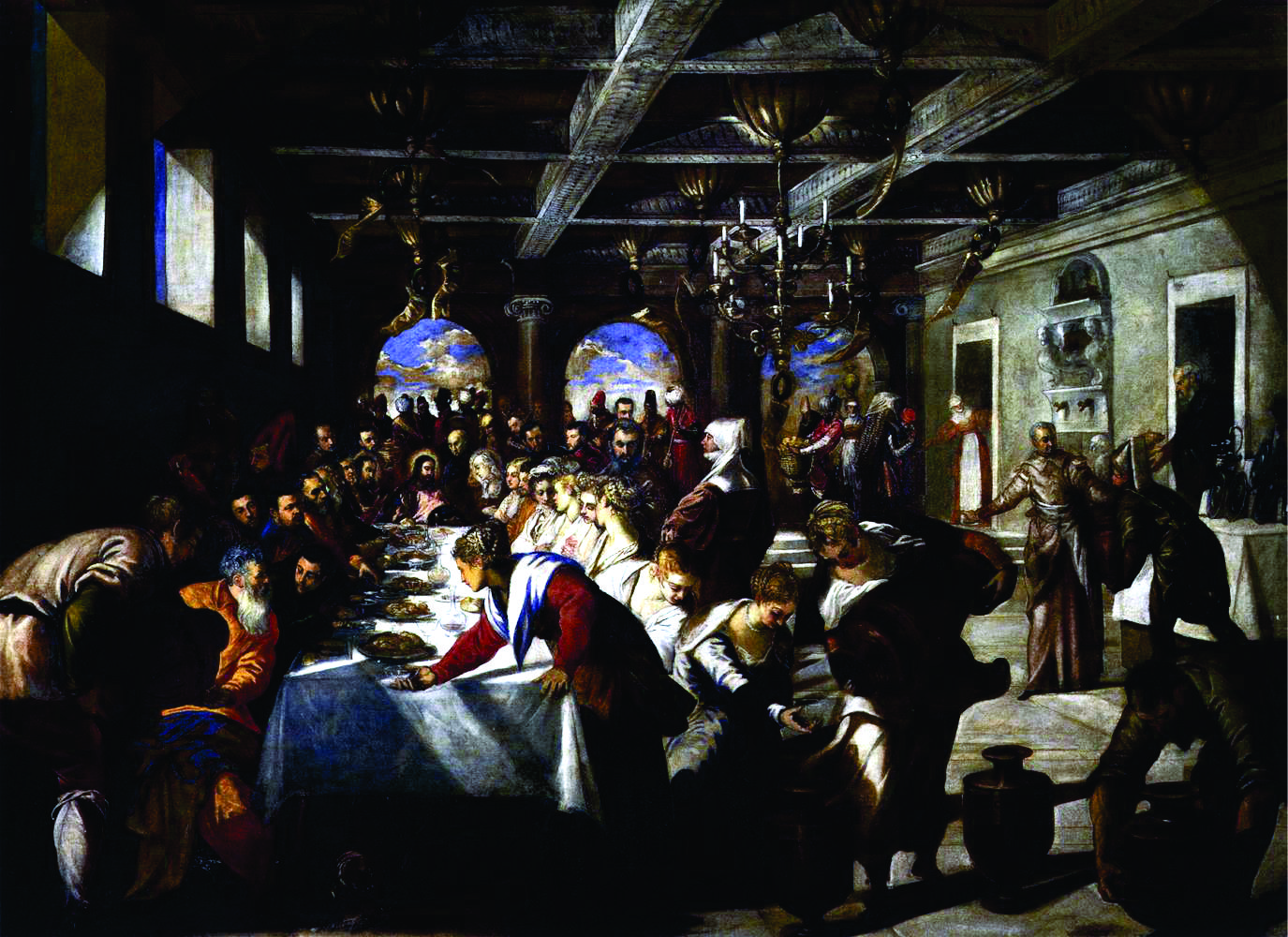
Marriage at Cana, (1561), Jacopo Tintoretto (1518–1594), public domain in the United States
 Mandated Memoranda